



Abstract
Artemisia L. is a genus of small herbs and shrubs found in northern temperate regions. It belongs to the important family Asteraceae, one of the most numerous plant groupings, which comprises about 1000 genera and over 20000 species. Artemisia has a broad spectrum of bioactivity, owing to the presence of several active ingredients or secondary metabolites, which work through various modes of action. It has widespread pharmacological activities and has been used as traditional medicine since ancient times as an anthelmintic, antispasmodic, antirheumatic, and antibacterial agent and for the treatment of malaria, hepatitis, cancer, inflammation, and menstrual-related disorders. This review comprises the updated information about the ethnomedical uses and health benefits of various Artemisia spp. and general information about bioactive compounds and free radicals.
Artemisia L. is included in the tribe Anthemideae and comprises over 500 species, which are mainly found in Asia, Europe, and North America. 1 -3 A large number of members of the Anthemideae tribe are important as flowers and ornamental crops, as well as medicinal and aromatic plants, many of which produce essential oils used in folk and modern medicine, and in the cosmetics and pharmaceutical industry. 2,4 The genus Artemisia comprises a variable number of species found throughout the northern half of the world. The genus may be divided into sections Artemisia and Dracunculus. 5 -7 Artemisia comprises over 400 species, many of which have an aromatic, bitter taste. Some say that it is named after the Greek Artemis, who was the goddess of the hunt, of forests, and of childbirth. 5,8,9
The large genus Artemisia from the tribe Anthemideae comprises important medicinal plants, which are currently the subject of phytochemical attention because of their biological and chemical diversity and essential oil production. 2 Artemisia generally has a broad spectrum of bioactivity, owing to the presence of several active ingredients or secondary metabolites, which work through various modes of action. Secondary metabolism in a plant not only plays a role in its survival by producing attractants for pollinators, but also acts as a chemical defense against herbivory and disease. 10,11 Artemisia essential oils, mostly distilled from the aromatic plants, contain a variety of volatile components such as terpenoids, phenylpropanoids, and aliphatic compounds. 12
The 500 species of Artemisia are mostly perennial herbs dominating the vast steppe communities of Asia. Asia has the greatest concentration of species, with 150 accessions for China, 174 in the former Soviet Union, about 50 reported for Japan, 35 species of the genus found in Iran, and about 30 in Italy. Artemisia species are frequently utilized for the treatment of different diseases such as malaria, hepatitis, cancer, inflammation, and infections by fungi, bacteria, and viruses. 2,5
Traditional and Current Uses
One of the most known plants of the genus Artemisia is A. absinthium L., commonly known as “wormwood,” a yellow-flowering perennial plant distributed throughout various parts of Europe, the Middle East, North Africa, and Asia, and several chemotypes have been recognized. 13 The plant is used for its antiparasitic effects and to treat gastrointestinal problems, anorexia, and indigestion. 14 The aerial parts are present in many gastric herbal preparations, in dietary supplements, and in alcoholic beverages, for example, absinthe products, which enjoy a resurgence of popularity all over the world. 2,15 Moreover A. absinthium and other plants of this genus were used to control pain in childbirth and to induce abortions. 5 -17
In North African and Middle Eastern countries, A. abyssinica Sch. Bip. ex A. Rich. is used in folk medicine as an anthelmintic, antispasmodic, antirheumatic, and antibacterial agent. 18 This plant grows abundantly in various parts of the Arabian peninsula and is locally known as “ather” (Saudi Arabia) and “boitheran” (Yemen). 2,19,20
Preparations of A. abrotanum L. (“southernwood”) have been used in traditional medicine for treating a variety of disorders, including upper airway diseases. Moreover it has been found to possess spasmolytic activity on the carbacholine-induced contraction of guinea pig trachea. 6,21 Nowadays, this perennial plant is used mainly for culinary or cosmetic purposes. 2
Artemisia afra Jacq. ex Willd. is a well-known medicinal plant of South Africa, where it is known as “wilde als.” It is widely used for numerous ailments including colds, coughs, diabetes, heartburn, bronchitis, and asthma. 2,22
Artemisia annua L. (“sweet wormwood,” “qinghao”) has traditionally been used in China for the treatment of fever and chills. Though originally growing in Asia and Europe, the plant is cultivated in Africa and used as a tea for the treatment of malaria. Artemisinin has been identified as the antimalarial principal of the plant, and artemisinin derivatives are currently established as antimalarial drugs with activity toward otherwise drug-resistant Plasmodium infections. 2,23 Most importantly, however, A. annua is now known worldwide for its antimalarial properties. Other Artemisia species have also been used for the treatment of fevers and malaria. Artemisia absinthium and A. abrotanum were used to treat malaria in Europe, while A. afra in Africa. 5,16,24,25 The species A. annua and A. apiacea Hance are native to China. There has been some confusion about their ancient Chinese names. In older texts, qing hao (blue-green herb) and cao hao (herbaceous herb) were used interchangeably. The polymath Shen Gua (1031–1095) of the Song dynasty described two different varieties of qing hao, one with blue-green leaves, the other with yellowish-green leaves in autumn. Based partly on his description, the famous physician and natural historian Li Shizhen (1518—1593), whose cyclopedic Classified Materia Medica (Ben cao gang mu) was published posthumously in 1596, differentiated between qing hao (blue-green herb) and huang hua hao (yellow blossom herb). 5,26 Artemisia annua has been recognized as an important ethnomedicinal herb for 2 millennia. It has been included in ancient pharmacopeias of various Asian and European countries. The World Health Organization has recommended A. annua as an antimalarial drug. 27 Its most common ethnobotanical practice involves the use of whole plant decoction for the treatment of malaria, cough, and cold. Its dry leaf powder has been reported in the treatment of diarrhea. 28 The whole flowering plant is known to be anthelminthic, antipyretic, antiseptic, antispasmodic, carminative, stimulant, tonic, and stomachic. The tincture was formally used to treat nervous diseases and crushed plants in liniments. 28 Artemisia annua tea infusion has been used for the treatment of malaria in African countries. As mentioned above, A. annua contains artemisinin, which provides a structural chemical base for combinatorial treatment therapy for worldwide antimalarial programs. Research studies also report that artemisinin is effective for killing human breast cancer cells. 28 Therefore, isolation and characterization of artemisinin has increased the interest in A. annua worldwide. Several ethnobotanical uses in Africa claim that the A. annua tea is also effective against human immunodeficiency virus (HIV). Recently, research investigations are more focused to evaluate its antiviral potential against HIV, as it is a highly emerging disease throughout the world. 29
Artemisia arborescens L. (“great mugwort,” “arborescent mugwort”) is a morphologically variable species (or mixture of species) with grey-green to silver leaves. It is native to the various habitats of the Mediterranean region, where it occurs as a shrub growing up to 1 m in height. According to popular folklore, it is used as an anti-inflammatory remedy. 2,30
Artemisia argyi H. Lév. & Vaniot is an herbaceous perennial plant with a creeping rhizome. It is native to China, Japan, and the far eastern parts of the former Soviet Union. In Japan, it is known as “gaiyou” and in China as “ai ye.” It is used in herbal medicine for pathologic conditions of the liver, spleen, and kidney. 2
The powdered leaves of Artemisia biennis Willd. are used as spices and in folk remedies as antiseptics. They have been applied externally in salves and washes by the native inhabitants of North America for treating sores and wounds, and internally to treat chest infections. 2,31
Artemisia campestris L. is a perennial faintly aromatic herb, widespread in the south of Tunisia, commonly known as “tgouft.” The leaves of this plant are widely used in traditional medicine as a decoction for their antivenin, anti-inflammatory, anti-rheumatic, and antimicrobial properties. 32 Artemisia cana Pursh is used as a spice and in folk remedies as an antiseptic. 2
Artemisia douglasiana Besser (“California mugwort”) is a perennial herb that is native to the western United States, especially northern California, Oregon, and Washington. Artemisia douglasiana is used to promote menstruation, as a stimulant, tonic, to treat nervous disorders, and as a diuretic. The essential oil has been used for aromatherapy, inhaled for mental clarity and ease of mental distress; used as a massage for aching muscles and pain on the surface of the body; and as a bath or tonic. 33 In Argentina, A. douglasiana, which is adventitious and cultivated in the Cuyo region, is used in folk medicine and known under the common name of “matico.”. The popular use of the infusion of leaves of “matico” is to treat peptic ulcers and gastrointestinal disorders. 34
Artemisia dracunculus L. (“tarragon”) is a perennial herb, which has a long history of use in culinary traditions. It also possesses a wide range of health benefits and has therefore been widely used as an herbal medicine. For example, in the Himalayas, extracts of A. dracunculus are used to relieve toothache, reduce fever, and as a treatment for gastrointestinal problems. 35 Two well-described cultivars (Russian and French) are used widely and differ in ploidy level, morphology, and chemistry. The botanical and chemical constituents are closely detailed in the literature, the latter mainly focusing on its essential oil composition, which give its distinctive flavor. 2,36
Artemisia dubia Wall. ex Besser is native to Bhutan, China, India, Japan, Nepal, and Thailand. 37 In Nepal, the leaf juice of A. dubia is used to treat cuts and wounds while the plant paste is used against fever. 38
Artemisia echegaray Hieron is commonly known in Argentina as “ajenjo” and is used as a natural food additive. 2 Decoctions of leaves and stems of A. frigida Willd. are used for coughs and diabetes 2 ; several native American tribes have used decoctions of A. frigida for menstrual irregularities. 39
Artemisia fukudo Makino is distributed along the shorelines of South Korea’s Jeju Island and in the south of the Korean Peninsula, Japan, and Taiwan. This plant is used as a flavoring agent and in a variety of cosmetics in Korea. It also has various biological effects, including anti-inflammatory, antitumor, and antibacterial properties. 40
Artemisia gmelinii Weber ex Stechm. is a plant of the high-altitude regions of Asia. In Nepal, the fresh plant is ground into a paste and applied externally for headaches, boils, and pimples. 35 Artemisia haussknechtii Boiss. is used in dyspepsia and other gastrointestinal disorders by local people in the Western part of Iran (province of Kermanshah). 41 In Nepal, A. indica Willd. is used to treat ringworm, cuts, and wounds, and as an anti-leech treatment. 35,38 Artemisia iwayomogi Kitamura is a perennial herb easily found around Korea. It is called “hanin-jin” or “dowijigi” in Korean and is traditionally used for the treatment of various liver diseases, including hepatitis. 2
Artemisia japonica Thunb. is distributed throughout continental Asia and Japan. 37 In northern Pakistan, the leaf extract is used to treat malaria and a paste of leaves is used externally on skin diseases. 35 Artemisia judaica L. is a perennial fragrant shrub that grows widely in the deserts and on the Sinai Peninsula in Egypt, and is a very common anthelmintic drug in most North African and Middle-Eastern countries where it is known by the Arabic name of “shih.” 2,22
The genus Artemisia is known to contain many bioactive compounds; artemisinin exerts not only antimalarial activity but also profound cytotoxicity against tumor cells 6,42 and arglabin is employed for treating certain types of cancer in the former Soviet Union. 43 Over the past decade Artemisia species have been used traditionally in various populations; thus, A. keiskeana Miq. has been used as a traditional Chinese drug for the treatment of gynecopathy, amenorrhea, bruise, and rheumatic disease. 6,44
The inhabitants of northeastern Mexico use an infusion of leaves from A. ludoviciana Nutt. as an antidiarrheal remedy, 2 while several Native American tribes of North America have used infusions for coughs, sore throats, and colds. 39 Artemisia nilagirica (C.B. Clarke) Pamp., commonly called “Indian wormwood,” is widely found in the hilly areas of India, where it is used as insecticide. 45 A paste from the leaves of A. nilagirica is used externally to treat cuts and wounds and the leaves chewed to treat oral ulcers. 35
Artemisia princeps Willd. (“Japanese mugwort” or “yomogi”) is the best-known Artemisia in Japan, where it is a fundamental ingredient of the Japanese confection “kusa-mochi.” This plant has also been used in traditional Asian medicine for the treatment of inflammation, diarrhea, and many circulatory disorders. 2
Artemisia rubripes Nakai has been used as a traditional Korean medicine for stomach ache, vomiting, diarrhea, and as a hemostatic agent. 46 Artemisia rutifolia Stephan ex Spreng. is distributed in Afghanistan, China, India, Kazakhstan, Kyrgyzstan, Mongolia, Nepal, Pakistan, Russian Federation, and Tajikistan. A tea from the herb is taken to treat asthma, as an anti-inflammatory and diuretic; the fresh herb is used as an analgesic for toothache; a decoction of the herb is gargled for treatment of angina, stomach problems, and heart problems. 14,47
Artemisia scoparia Waldst. & Kit. (“red stem worm wood”) is a faintly scented annual herb which is widespread and common throughout the world, particularly in southwest Asia and central Europe. The success of A. scoparia may be attributed to the presence of phytotoxins, the volatile essential oils, in addition to other nonvolatile secondary products. It has been established that aerial parts of A. scoparia yield a volatile essential oil that has medicinal value. It possesses insecticidal, antibacterial, anticholesterolemic, antipyretic, antiseptic, cholagogue, diuretic, purgative, and vasodilatory activities and is also used for the treatment of gall bladder inflammation, hepatitis, jaundice, malaria, and diabetes. 2,35,48
Artemisia spicigera K. Koch, named locally as “yavs¸an,” is widespread in Central and Eastern Anatolia in Turkey, at an altitude between 1000 and 2500 m. 49
Artemisia tridentata Nutt. “big sagebrush” is one of the most widely distributed and ecologically important shrub species in Western North America. This species serves as a critical habitat and food resource for many animals and invertebrates. 32 Several North American native tribes have used infusions of A. tridentata to treat bronchitis and pneumonia. 39
Artemisia vestita Wall ex Besser has been utilized for the treatment of fungal infections such as tinea, tympanitis, and thrush. 2,6,23
Artemisia vulgaris L., commonly known as “mugwort,” is a perennial weed growing wild native in temperate and cold-temperature zones of the world such as in Asia, Europe, and North America. 50,51 The plant is widely used in the Philippines, where it is locally known as “herbaka,” for its antihypertensive actions. It has also been suggested to have other medicinal activities such as anti-inflammatory, antispasmodic, carminative, and anthelmintic properties, and has been used in the treatment of painful menstruation (dysmenorrhea) and in the induction of labor or miscarriage. 50 Artemisia vulgaris has been known not only as an edible plant but also as a folk medicine resource. Mugwort is used to flavor tea and rice dishes in Asia and as a culinary herb for poultry and pork in Western cultures. 51 In Oriental medicine, mugwort has been employed as an analgesic agent and in conjunction with acupuncture therapy. 51,52 Considered an emmenagogue, an inducing agent of menstrual flow, mugwort has been traditionally employed to bring about regular menses in cases of amenorrhea or menorrhagia. 51
Artemisia mongolica (Fisch. ex Besser) Nakai has been used as a folk medicine for generations to cure inflammations and colds in Northwest China. 53
Artemisia pontica L. is well known in Bulgarian folk medicine as a sedative and an appetizer. 54
In the western Himalayas of northern Pakistan, A. roxburghiana Besser extract is used to treat fever, malaria, and intestinal worms. In Uttarakhand, India, A. roxburghiana is used in ethnoveterinary medicine to treat eye diseases, wounds, cuts, and external parasites. 35
Artemisia herba-alba Asso (syn. Artemisia maritima L., Artemisia brevifolia Wall.) is used in the traditional medicine of the Northern Badia region of Jordan, in the form of a decoction, against fever and menstrual and nervous problems. 55 Artemisia herba-alba, known also as desert wormwood (known in Arabic as “shih,” and French as “armoiseblanche”), 56 has been used in folk medicine by many cultures since ancient times and in Moroccan folk medicine to treat arterial hypertension and/or diabetes. 57 -59 Artemisia herba-alba is widely distributed in North Africa and used traditionally by the Egyptians as a vermifuge in addition to its other medical and veterinary uses. 60 Herbal tea from this species has been used as analgesic, antibacterial, antispasmodic, and hemostatic agents. 61 During an ethnopharmacological survey carried out among the Bedouins of the Negev Desert, it was found that A. herba-alba relieved stomach disorders. 60 This plant is also suggested to be important as a fodder for sheep and for livestock in the plateau regions of Algeria where it grows abundantly. 62
Artemisia sieberi Besser is a famous medicinal plant in Middle East traditional medicine as an anthelmintic. In external use, the flowering shoots and leaves were boiled in normal saline and the extracted solution was used for treatment of gangrenous ulcers, infectious ulcers, and inflammations. Artemisia sieberi is used as fodder for sheep and it is believed that it can increase weight and fleece of sheep. It was used as carminative, to relieve inflammation and abscesses and to prevent leprosy.
Bioactive Compounds From Artemisia
Bioactive compounds are experiencing a growing interest in wide range of applications: geo-medicine, plant science, modern pharmacology, agrochemicals, cosmetics, food industry, nano-bio-science, and so on. 63 -65
Bioactive compounds in plants are classified according to different criteria. A presentation based on clinical function–their pharmacological or toxicological effects–is relevant for the clinician, pharmacist, or toxicologist. An approach based on biological effects is complicated by the fact that the clinical outcome is not exclusively connected to biochemically closely related compounds; even biochemically different molecules might produce similar clinical effects. A botanical categorization based on families and genera of the plants producing the bioactive compounds might also be relevant, as closely related plant species most often produce the same or chemically similar bioactive compounds. However, there are also ranges of examples that species even genetically less related produce similar secondary compounds. The main focus are the bioactive chemical compounds; therefore, it is useful to categorize them according to biochemical pathways and chemical classes. 66 -68
Artemisia species represent rich sources of various types of biologically active compounds accountable for numerous pharmacological activities. Differences in qualitative and quantitative composition of bioactive compounds might be correlated with environmental conditions, species variation, geographic, climatic, and genetic conditions, plant age, soil, phase of vegetation, anatomical part of plant, harvesting season, and method of harvesting. 69 -72
Tables 1 and 2 present detailed list of the chemical constituents and essential oil components of various Artemisia sp., respectively (Figures 1 and 2).
List of the Chemical Constituents of Various Artemisia Spp.

List of the Constituents of Essential Oils in Various Artemisia Spp.

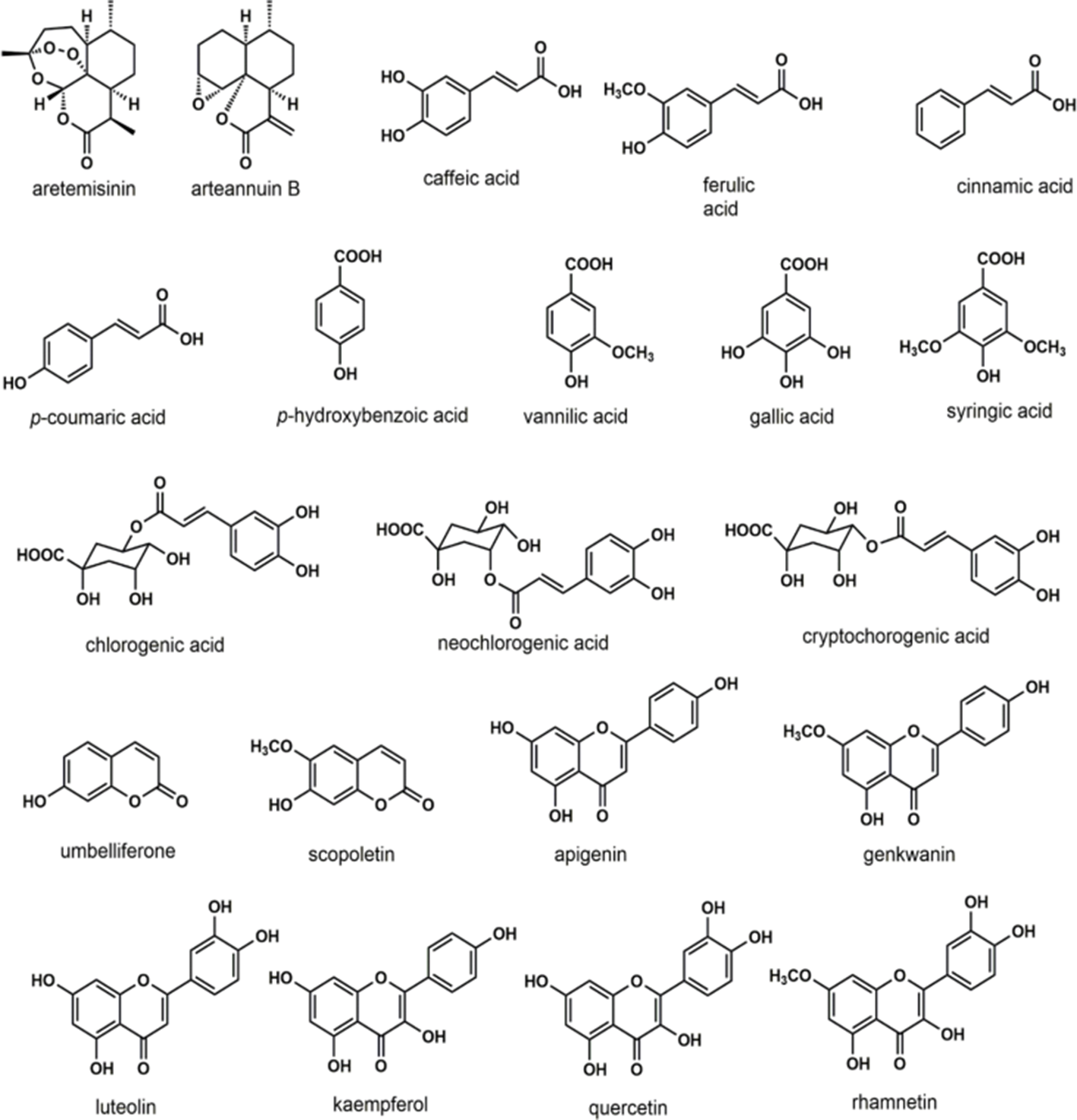
Some nonvolatile constituents of Artemisia spp.

Structure of some volatile constituents of Artemisia spp.
Conclusion
Artemisia species are widely used in traditional medicine all over the world with different and well-known therapeutic applications. They exhibit anti-inflammatory, antitumor, antioxidant, antispasmodic, antimicrobial, insecticidal, antimalarial, antifungal, and antioxidant activities. These diverse biological activities are manifested by different compounds whose main components are essential oils and polyphenols. Artemisia holds a great potential for human health and its therapeutic effects should be more strictly and intensively analyzed. Preclinical and clinical research needs to be done on the use of these plants and further indepth investigations are urgently necessary to study all bioactive compounds and their biomolecular mechanisms at the cellular and tissue levels.
Footnotes
Acknowledgments
The authors are very thankful to all the authors whose work has been cited in this paper.
Declaration of Conflicting Interests
The author(s) declared no potential conflicts of interest with respect to the research, authorship, and/or publication of this article.
Authors’ Note
Sergey Plygun is now affiliated with Laboratory of Biocontrol and Antimicrobial Resistance, Orel State University named after I.S. Turgenev, Orel, Russia and European Society of Clinical Microbiology and Infectious Diseases, Basel, Switzerland. Javad Sharifi-Rad is now affiliated with Zabol Medicinal Plants Research Center, Zabol University of Medical Sciences, Zabol, Iran.
Funding
The author(s) received no financial support for the research, authorship, and/or publication of this article.