Carbazole derivatives have a tricyclic skeleton, consisting of a central pyrrole ring fused with two benzene rings. Carbazole derivatives are an important class of nitrogen-containing heterocyclic compounds that are widely found in nature and in synthetic source. These heterocycles possess a wide range of bioactivities and some of them have been marketed as drugs for the treatment of various diseases. Although some review articles on carbazole alkaloids have appreared in the literature, they are quite outdated. The current study offers a comprehensive review on the isolation and bioactivities of carbazole alkaloids within a decade. The article might be useful for chemists who work in alkaloid chemistry as well as pharmaceutical area.
Methods
‘Carbazole alkaloids’ was the most useful keyword to search for literature data. References have been collected from various resources such as Google Scholar, SciFinder, and PubMed. More than 70 electronic publications were obtained from these resources.
Results
More than 230 carbazole alkaloids have been isolated and structurally elucidated from different sources. Carbazole alkaloids possess a wide range of bioactivities, such as antimicrobial, antiimflamatory, anticancer, neuroprotective properties activities.
Conclusion
In this review article, we have summarized 66 studies on isolation and bioactivities of carbazole alkaloids in the literature. More than 230 carbazole alkaloid compounds have been isolated and identified. In addition, the article also gives an overview on bioactivities of carbazole alkaloids.
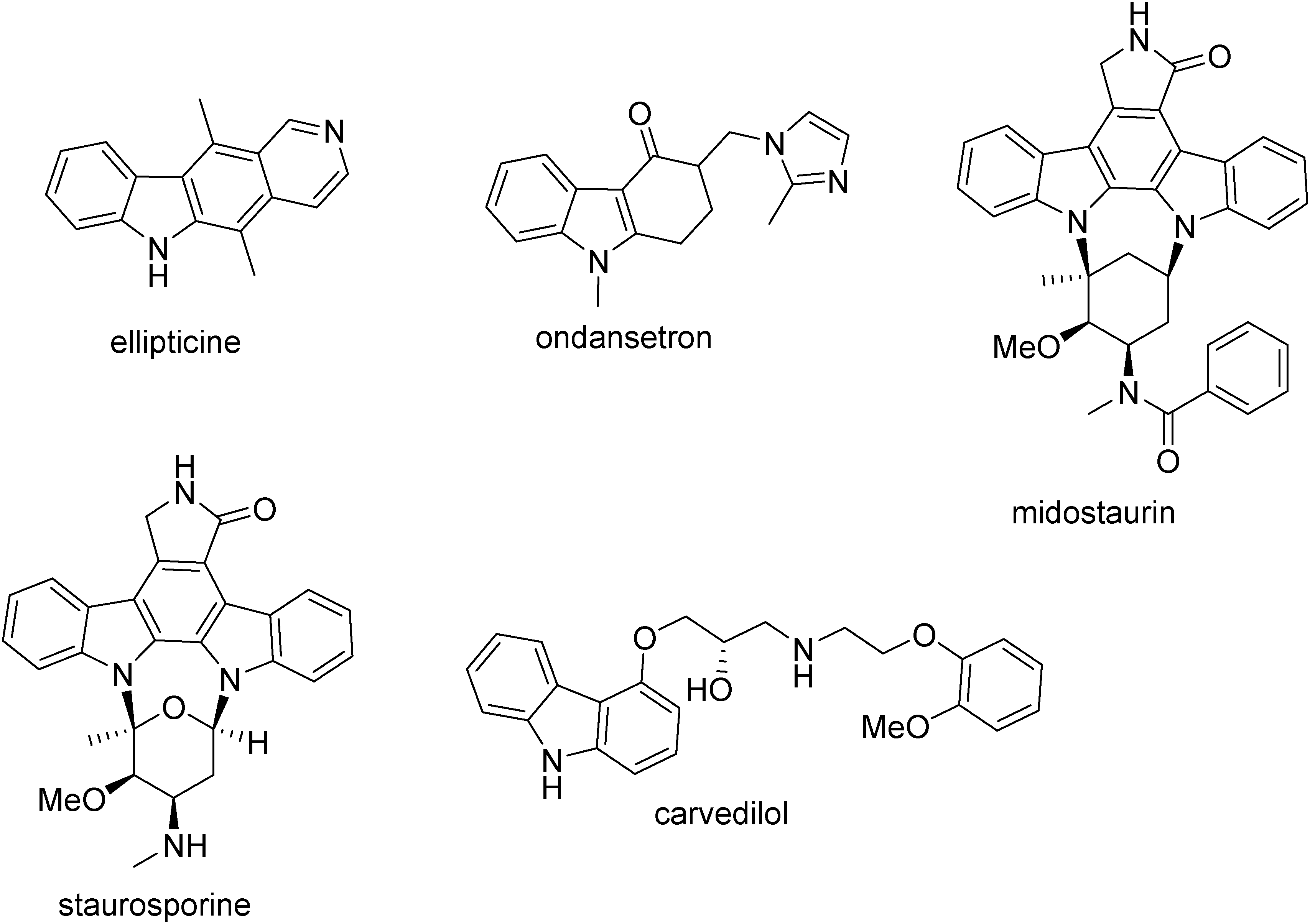
Carbazole is an aromatic heterocyclic organic compound. It has a tricyclic structure, consisting of a central pyrrole ring fused with two benzene rings. Carbazole was originally isolated from coal tar.1 Carbazole derivatives (carbazole compounds with substituents) are an important class of nitrogen-containing heterocyclic compounds that are widely found in nature2 and in synthetic source.3 These heterocycles possess a wide range of bioactivities3,4 and some of them have been marketed as drugs for the treatment of various diseases (Figure 1). For examples, ondansetron is a medication used to prevent nausea and vomiting, midostaurin is a multi-targeted protein kinase inhibitor, and cardevilol is a β-blocker. The diverse bioactivities of carbazoles such as antimicrobial, anti-inflammatory, anticancer, neuroprotective, and antidiabetic activities have been well documented in the literature.5,6
Some drugs with carbazole skeleton.
Although some review articles on phytochemistry of carbazole alkaloids were found in the literature, they are quite out dated and do not cover recent studies or all aspects of phytochemistry.4–6 This article summarized studies on isolation of newly discovered naturally occurring carbazole alkaloids as well as their bioactivities which dates backs in 2012. More than 230 carbazoles have been isolated and diverse bioactivities have been discovered. The articles might be useful for scientists who work in natural products chemistry and pharmacy.
Isolation of Naturally Occuring Carbazole Alkaloids
Isolation of Simple Carbazole Alkaloids
Liu et al isolated three novel carbazole alkaloids, claulansines H-J (1-3) from the stems of Clausena lansium. Their structures were elucidated by analyses of extensive spectroscopic.7 claulansines H and I are prenylated carbazole alkaloids (Figure 2). The isolation and structure determination of clausenawalline D (4) from the roots of C. wallichii was accomplished by Maneerat et al (Figure 2).8 Yang et al obtained 4-(7-hydroxy-3-methoxy-6-methyl-9H-carbazol-4-yl)but-3-en-2- one (5) from the stems of Glycosmis pentaphylla (Figure 2).9 Harmandianamine C (6) with two hydroxy group at the side chain was isolated by Maneerat et al from the twigs of C. harmandiana (Figure 2).10 However, the absolute configuration of this compound was not assigned. Nakamura et al discovered karapinchamine A (7) from the leaves of Murraya koenigii collected in Sri Lanka (Figure 2). Its structure was elucidated by analysis of spectroscopic data.11 Excavatine A (8), a new carbazole alkaloid, was yielded from the stems and leaves of C. excavata Burm.f. (Rutaceae) (Figure 2).12 Maneerat et al achieved two new prenylated carbazole alkaloids, clausenawallines G (9) and H (10) from the twigs of C. Wallichii (Figure 2). Their structures were elucidated by mean of spectroscopic methods.13 In 2014, Shen et al obtained two new carbazole alkaloids including clausenalines E (11) and F (12) from the roots of C. lansium (Figure 2). These compounds are rare natural carbazole carboxylic acids. Their structures were elucidated by mean of spectroscopic analysis.14
Simple isolated carbazole alkaloids.
In a report described by Jiang et al, 6-methoxy-9H-carbazole-3-carboxylic acid (13) was isolated from the stems of C. lansium (Figure 2).15 Tan et al afforded murrastanine A (14) from the bark and leaves of Murraya koenigii (Linn.) (Figure 2).16 From the aerial parts of this species, Naz et al isolated and identified two novel carbazole alkaloids, mukoenigatin (15) and murrayadinal (16) (Figure 2).17 Mukoenigatin is an ester of fatty acid. Unfortunately, detail about absolute configuration and optical rotation was not included. Du et al reported the isolation and structure determination of four new carbazole alkaloids, namely claulansines N, O, Q, and R (17-20), from the stems of C. lansium (Figure 2).18 Du et al also obtained two new carbazole alkaloids, namely claulansine S (21) and T (22), from the stems of C. lansium (Figure 2).19 Xia et al achieved five novel carbazole alkaloids named clauemarazoles A, B, and E-G (23, 24, 25-27) from the stems of C. emarginata (Figure 2). Compounds 23, 24, 26, and 27 were resolved from the two corresponding racemic mixtures using a chiral semipreparative column and their absolute configurations were confirmed by their electronic circular dichroism (ECD) spectroscopy.20 Tatsimo et al obtained one new carbazole alkaloid named clausamine H (28) from leaves and stem bark extracts of C. anisata monitored by liquid chromatography High-Resolution Mass Spectrometry (HRMS) (Figure 2).21 A new carbazole–indole hybrid dimeric alkaloid, glycosmisine B (29), were isolated from the stems of G. pentaphylla by Chen et al and their structures were established by mean of spectroscopic methods (Figure 2).22
In 2016, Chakthong et al achieved a carbazole-pyranocoumarin hybrid, carbazomarin B (30), and two carbazole alkaloids, 6-methoxymukonidine (31) and 2-hydroxy-3-methoxycarbazole (32) from the stems of C. excavata. Structure determination of these compounds was established based on spectroscopic analysis (Figure 2).23 The absolute configuration of carbazomarin B remained unclear although its optical rotation was provided. Shen et al reported the isolation and structure determination of clausenaline G [33] from the leaves of C. lansium (Figure 2).24 In 2018, Wei et al isolated 1,9-dimethoxy-3-methyl-9H-carbazol-2-ol (34) from the whole plant of C. sanki (Figure 2).25 Ma et al achieved five new carbazole alkaloids named clausehainanines A-E (35-39) from the stems and leaves of C. hainanensis (Figure 2). Compounds 35 and 36, 38 and 39 are two pairs of E and Z isomers. Their structures were determined based on extensive spectroscopic analysis. These compounds have diverse unusual isopentenyl derivatives as substituents at C-2.26 In 2019, five new carbazole alkaloids, namely clausenalansines B-F (40-44), were isolated by the Liu group from the fruits of C. Lansium (Figure 2).27 Compound 44 is methyl ether of compound 44. The group also afforded a novel and rare prenylated dicarboxylic carbazole alkaloid, named as clausevestine (45), from the stems and leaves of C. vestita (Figure 2).28 Unluckily, the configuration of this compound was not determined. Aminah et al reported the isolation and structure determination of carbazomarin C (46), a new carbazolepyranocoumarin conjugate, from the roots of C. excavata (Figure 2).29 There was no information about optical rotation and configuration of this compound.
Fu et al isolated a previously undescribed carbazole alkaloid, clausemargine A (47), the stems and leaves of C. emarginata (Figure 2).30 Ly et al afforded two novel carbazole alkaloids 1-ethoxy-2-hydroxy-3-methylcarbazole (48) and 1,7-dimethoxy-8-formyl- 2-hydroxy-3-methylcarbazole (49) from the leaves and stems of M. tetramera C. C. Huang (Figure 2).31 Cao et al isolated integerrines A (50) and G (51) from the dried leaves and stems of Micromelum integerrimum (Figure 2).32 Integerrine A is a racemic heterodimer of carbazole and indole. The racemic compound was then further resolved using chiral-phase high-performance liquid chromatography (HPLC) and configurations of enantiomerically pure compounds, (-)-50 and (+)-50, were established by comparison of experimental and calculated ECD data. The absolute configuration of (-)-50 was defined as aR and (+)-50 was defined as aS. Two novel carbazole alkaloids, zanthoaustrones A (52) and B (53) were isolated and identified by Fu et al from the roots of Zanthoxylum austrosinense Huang (Rutaceae) (Figure 2). Their structures were determined by mean of extensive and comprehensive spectroscopic methods.33 Yang et al achieved two new carbazole alkaloids, named clauolenzoles A [54] and B [55], from the ethanolic extract of the aerial parts of C. anisum-olens (Figure 2).34 Zhang et al demonstrated the isolation of two new carbazole alkaloids with amide side chain, namely antiostatin A5 (56) and antiostatin A6 (57), from a new soil-derived Streptomyces sp (Figure 2). Antiostatin A6 possesses a new cyclohexene side chain.35 Claulansine W (58) was afforded from the stems of C. lansium (Figure 2).36 In 2020, Liu et al demonstrated the isolation and structure elucidation of one novel carbazole alkaloids clausenanisine C (59), and three new naturally occurring carbazole alkaloids, clausenanisines D-F (60-62) from the fresh ripe fruits of C. anisum-olens (Figure 2).37
Sun et al isolated claulansine X (63) from the stems of C. lansium (Figure 2).38 A previously undescribed carbazole alkaloid, clausenalenine A (64), was obtained from the stems and leaves of C. lenis (Figure 2).39 Claulansine X and clausenalenine A are prenylated carbazole alkaloids. Four new chlorinated carbazole alkaloids, chlocarbazomycins A-D (65-68), were isolated by Cheng et al from sponge associated bacterium S. diacarni LHW51701 (Figure 2). Their structures were determined by analysis of spectroscopic data and the structures of 64 and 67 were confirmed by x-ray crystallographic analysis.40 Kim et al achieved three new carbazole glycosides, namely jejucarbazoles A-C (69-71), from Streptomyces sp. KCB15JA151 (Figure 2). Their absolute configurations were elucidated by ECD calculation.41
In 2023, 1-methoxy-3-formyl-8-isopentenyl carbazole (72) and N-methyl-1-hydroxyl carbazole (73) were achieved from C. lansium branch-leaves (Figure 2).42 In the same year, antiostatin A7 (74), a carbazole alkaloid with long side chain, was obtained from a fermentation broth of the soil-derived Streptomyces sp. HS-NF-1322 strain (Figure 2).43 The configuration of the OH group at the side chain remained unclear. Recently, four new 9H-carbazole derivatives (75-78) and four new natural carbazole alkaloids (79-82) were isolated from a fermented solid medium of the Thailand mangrove-derived Streptomyces strain, OUCMDZ-5511, under fluoride stress (Figure 2).44 Carbazomycins I (83) and J (84), two novel carbazole alkaloids were isolated from the fermentation broth of S. phattalungensis DSM 45584 (Figure 2). Their structures were elucidated by analysis of HRESIMS and NMR spectroscopic data.45 From the 95% ethanol aqueous extract of the roots of C. lansium, claulamine I (85) was isolated and identified based on spectroscopic data (Figure 2).46
Isolation of Furanocarbazole Alkaloids
Liu et al isolated claulansine D (86) from the stems of C. lansium (Figure 3). Its structure was elucidated by analyses of extensive spectroscopic and its absolute configuration was determined by ECD using the time-dependent density functional theory (TD-DFT) method.7 Harmandianamine A (87) was isolated by Maneerat et al from the twigs of C. harmandiana (Figure 3).10 Mafaicheenamine E (88) was afforded from the roots of C. lansium (Figure 3). Spectroscopic methods, including nuclear magnetic resonance (NMR), ultraviolet (UV), infared (IR), and mass spectrometry (MS) spectral data were used for structural characterization.47 In 2014, Shen et al obtained clausenaline D (89) from the roots of C. lansium (Figure 3). Its structure was elucidated by mean of 2D-NMR spectroscopic analysis.14 Du et al reported the isolation and structure determination of claulansine L from the stems of Clausena lansium (Figure 3). This compound was isolated as a racemic mixture which then was separated by semipreparative column to give two enantiomers, (+) claulansine L (90) and (-)-claulansine L (91). Configurations of these isomers were established based on CD spectrum.18 Compound 90 also obtained by Deng et al and named as claulansine K (Figure 3).48 Khan et al afforded two novel furocarbazole alkaloids including 3-formyl-6,7-dimethoxy-furo[1, 2]carbazole (92) and methyl-6,7-dimethoxy-furo[1, 2]carbazole-3-carboxylate (93) from the whole plant of Lonicera quinquelocularis (Figure 3).49 (+)-(1’R,2′R)-claulansine D (94) was discovered from the stems of C. lansium (Figure 3).50 Mycrophyline K (95) was isolated from the leaves and stems of M. microphylla as a racemic mixture and further separated by semipreparative HPLC using a Chiralpak AD-H column (Figure 3).51 In 2020, Liu et al obtained clausenanisine A (96) from the fresh ripe fruits of C. anisum-olens.37 Ma et al discovered a pair of new carbazole alkaloid enantiomers, namely microphylines R (97) from the leaves and stems of M. microphylla (Figure 3). The chirally pure isomers were isolated by chiral HPLC separation and their absolute configurations were established by analysis of the CD spectra and calculated ECD data.52
Simple isolated furanocarbazole alkaloids.
Isolation of Pyranocarbazole Alkaloids
Liu et al isolated two novel pyranocarbazole alkaloids, claulansine C (98) and F (99), from the stems of C. lansium (Figure 4). Their structures were determined by means of extensive spectroscopic. Furthermore, the absolute configuration of 98 was determined by ECD using the time-dependent-DFT method.7 The isolation and structure determination of clausenawalline C (100) from the roots of C. wallichii was accomplished by Maneerat et al (Figure 4).8 Shen et al obtained claulamine A (101) from the stems of C. lansium (Figure 4). Its structure and configuration were determined by analyses of spectroscopic data and CD analysis.53 Harmandianamine B (102) was isolated by Maneerat et al from the twigs of C. harmandiana (Figure 4).10 Nakamura et al discovered karapinchamine B (103) from the leaves of M. koenigii collected in Sri Lanka (Figure 4).11 Ma et al described the isolation and structure determination of four new carbazole alkaloids including N-benzyl carbazole-A (104), N-benzyl carbazole-B (105), iso-koenidine (106), and iso-koenigine (107) from M. koenigii (Figure 4). All of them belong to pyrano-carbazole alkaloids.54 Sriphana et al obtained one novel carbazole alkaloid, clauraila E (108), from the methanol extract of the roots of C. harmandiana (Figure 4).55 Maneerat et al isolated three new carbazole alkaloids, clausenawallines I-K (109-111) from the twigs of C. wallichii (Figure 4). Their structures were elucidated by mean of spectroscopic methods.13
Isolated pyranocarbazole alkaloids.
In 2014, Shen et al obtained three new carbazole alkaloids including claulamines C-E (112-114) from the roots of C. lansium (Figure 4). Their structures were elucidated by mean of 2D-NMR spectroscopic analysis and their absolute configurations were established from their ECD spectra.14 Two novel carbazole alkaloids, guillauminines A (115) and B (116), were afforded and identified from the acetone extract of C. guillauminii roots (Figure 4). Their structures were elucidated by spectroscopic methods.56 Tan et al achieved four new pyranocarbazole alkaloids including murrastinines A-C (117-119) and murrayatanine A (120) from the bark and leaves of M. koenigii (Linn.) (Figure 4).16 Unfortunately, configurations of 117 and 120 were not elucidated. Du et al reported the isolation and structure determination of claulansine M (121) from the stems of C. lansium (Figure 4).18 Glycosmisine A (122), a new carbazole–indole hybrid dimeric alkaloid, was isolated from the stems of G. pentaphylla by Chen et al (Figure 4) and its structure was elucidated by mean of spectroscopic methods.22 Nalli et al demonstrated the isolation and structure elucidation of three new carbazole alkaloids including murrayakonines B-D (123-125) from the stem and the leaves of M. koenigii (Figure 4).57 The configuration of murrayakonine B was not provided.
Cao et al isolated dunnine D (126) from the stems of C. dunniana as a racemic mixture which then was separated by chiral HPLC to obtain the optically pure enantiomers (Figure 4). The absolute configurations of these isomers were established based on ECD data.58 Two new polyprenylated pyranocarbazole alkaloid derivatives, namely mycrophylines L (127) and M (128) were isolated from the leaves and stems of M. microphylla (Figure 4). Structures of isolated compounds were determined by analysis of spectroscopic data but configurations at chiral carbons were not characterized.51 In their phytochemical investigation of M. microphylla, 12 novel pyranocarbazole alkaloid including microphylines A-J (129, 131, 133-140) and epimicrophylines A (130) and B (132) were discovered by Ma et al from the leaves and stems (Figure 4). Microphylines D-F were obtained as pairs of enantiomers and then were further separated by chiral-phase HPLC resolution to give pure enantiomers. Their structures were elucidated based on spectroscopic analysis. The absolute configuration of microphyline A was confirmed by x-ray crystallographic data analysis and other compounds by calculated ECD data.59 Compounds 136–140 are new thujane-carbazole alkaloids while the other are new menthene-carbazole alkaloids. Clausenalansine A (141) was isolated by Liu et al from the fruits of C. lansium (Figure 4).27 From the stems and leaves of C. lansium, Lin et al achieved two new geranylated pyranocarbazole alkaloids, clauselansiumines A (142) and B (143) (Figure 4).60 The complete absolute configuration of 143 was not assigned. Zanthoaustrone C (144) was isolated and identified by Fu et al from the roots of Z. austrosinense Huang (Rutaceae) (Figure 4).33 In 2020, Liu et al demonstrated the isolation and structure elucidation of clausenanisine B (145) from the fresh ripe fruits of C. anisum-olens (Figure 4).37
(-)-(2′R)-claulamine A (146) was isolated from the stems of C. lansium by Sun et al (Figure 4).36 In their phytochemical investigation on M. microphylla, Ma et al discovered four pairs of new carbazole alkaloid enantiomers, namely microphylines N-Q (147-150), from the leaves and stems (Figure 4). The chirally pure isomers were isolated by chiral HPLC separation and their absolute configurations were established by analysis of the CD spectra and calculated ECD data.52 Sakunpak et al afforded 8-hydroxymahanimbine (151), a new naturally occurring pyranocarbazole alkaloid from C. cambodiana Guill leaves (Figure 4).61 Optical rotation and absolute configuration of this alkaloid were not provided. Recently, from the 95% ethanol aqueous extract of the roots of C. lansium, a pair of enantiomeric alkaloids, (+) (2′R, 6′S)-claulamine H and (-) (2′S, 6′R)-claulamine H (152), was obtained and separated by chiral-phase separation (Figure 4).46
Isolation of Other Fused Carbazole Alkaloids
Mafaicheenamine D (153) was isolated from the roots of C. lansium (Figure 5).47 Liu et al isolated four novel carbazole alkaloids, claulansines A (154), B (155), E (156), and G from the stems of C. lansium (Figure 5). Claulansine G has the same structure as mafaicheenamine D. Their structures were elucidated by analyses of extensive spectroscopic. Furthermore, absolute configurations of compounds 154–156 were determined by ECD using the TD-DFT method.7 Shen et al isolated two new carbazole alkaloids, clausenaline A and claulamine B, from the stems of C. lansium (Figure 5). Again, clausenaline A has the same structure as mafaicheenamine D and claulamine B has the same structure as claulansine B.53 Zhou et al achieved three novel indolocarbazoles alkaloids, namely streptocarbazoles C (157), 3′-epi-K252d (158), and 2′,4′-epi-K252d (159), from the rice solid fermentation of the marine-derived Streptomyces sp. A65 (Figure 5). Structures of these alkaloids were elucidated by mean of spectroscopic and spectrometric methods. The absolute configurations of compounds 157 and 158 were confirmed by single-crystal x-ray crystallographic analysis, while the absolute configuration of 159 was deduced based on calculated ECD spectra.62 Shen et al obtained clausenalines B (160) and C (161) from the roots of C. lansium (Figure 5).14
Isolated other fussed carbazole alkaloids.
Du et al reported the isolation and structure determination of claulansine P (162), from the stems of C. lansium (Figure 5).18 This compound is ethyl ether of 155. Xia et al achieved two novel carbazole alkaloids named clauemarazoles C (163) and D(164) from the stems of C. emarginata (Figure 5).20 Shaaban et al demonstrated the isolation and structure elucidation of the four new indolocarbazole alkaloids, AT2433-A3, A4, A5, and B3 (165-168), from actinomadura melliaura ATCC 39691, a strain isolated from a soil sample collected in Bristol Cove, California (Figure 5).63 (+)-(1′R,2′R,6′R)- claulansine B (169) was discovered from the stems of C. lansium (Figure 5). Its structure was elucidated based on spectroscopic and chemical methods and its configurations was established based on ECD calculation spectra.50 Ndongo et al obtained janetinine (170) from the stem bark of Pleiocarpa pycnantha (Figure 5). The absolute configuration of this compound was confirmed by comparison of its experimental and computed ECD curves.64 Three new racemic pyridocarbazole alkaloids, namely (±)-stritidas A-C (171-173), were afforded by Li et al from the twigs of S. nitida and their structures were elucidated by mean of spectroscopic methods (Figure 5).65
Two new carbazole alkaloids, claulansiums A (174) and B (175) were yielded from the methanol extract of the branches and leaves of C. lansium (Figure 5).66 Ariantari et al obtained shearilicine (176), a novel carbazole alkaloid from the EtOAc extract of Penicillium sp (Figure 5). This compound features a new type of indole diterpenoid scaffold with a rare 6/5/6/6/6/6/5 heterocyclic system. The absolute configuration of this alkaloid was established based on the TDDFT-ECD approach and single-crystal x-ray determination.67 Two unreported carbazole alkaloids, namely claulansines U and V (177), were obtained from the stems of C. lansium. Their structures were demonstrated by spectroscopic experiments (Figure 5).36 Claulansine U has the same structure as claulansiums A. Zhang et al demonstrated the isolation and structure elucidation of (±)-morindolestatin (178) with a novel [1, 4]oxazino[2,3- c]carbazole skeleton from a new soil-derived Streptomyces sp (Figure 5).35 (±)- Morindolestatin B (179) and morindolestatin C (180) were obtained from a fermentation broth of the soil-derived Streptomyces sp. HS-NF-1322 strain (Figure 5).43 Two new alkaloids, 1,7-dimethoxy-2′-prenyl-1′,9-dihydropyrrolo-carbazole (181) and 1,7-dimethoxy-4′,5′-dimethylcyclopenta-carbazole-1′,3′-dione (182), were isolated from the CHCl3 extraction of Corydalis decumbens (Figure 5).68 Two new 9H-carbazole derivatives (183, 184) were isolated from a fermented solid medium of the Thailand mangrove-derived Streptomyces strain, OUCMDZ-5511, under fluoride stress (Figure 5).44
Isolation of di- and Trimeric Carbazole Alkaloids
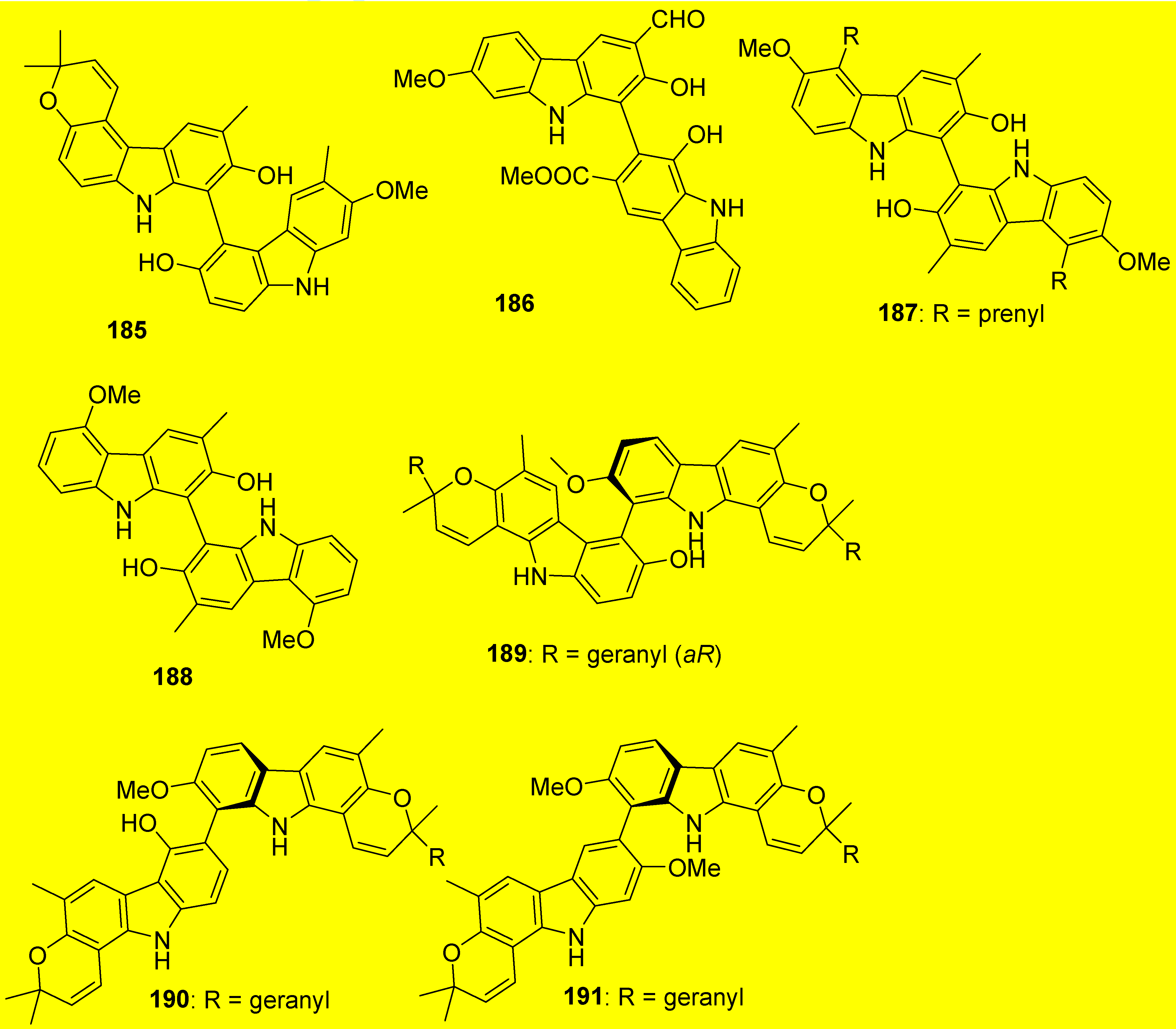
The isolation and structure determination of two dimeric carbazole alkaloids named clausenawallines E (185) and F (186) from the roots of C. wallichii was accomplished by Maneerat et al (Figure 6).8 Yang et al obtained two previously undescribed dimeric carbazole derivatives, bisglybomine B (187) and biscarbalexine A (188), from the stems of G. pentaphylla (Figure 6).9 In these two articles, no information about resolution of these compounds to pure enantiomers and configurations of enantiomers were given. Uvarani et al reported the isolation and structure determination of bisgerayafolines A-C (189-191), three new dimeric carbazole alkaloids, from the blue-violet-colored M. koenigii ripened fruits collected in India (Figure 6). Configurations of these compounds were defined as aR. These alkaloids have geranyl side chain at the pyran ring.69 These are geranylated carbazole alkaloids. Uvarani et al discovered two new dimeric carbazole alkaloids, bisgerayafoline D (192) and bismahanimbinol (193) from the fruit pulp of M. koenigii (Figure 6). The structures of these chiral bispyranocarbazoles were established by analysis of spectroscopic data and the absolute configurations of bisgerayafoline D (192) and bismahanimbinol (193) were assigned as (aS) and (aR), respectively using a combination of computational CD and experimental ECD spectroscopic data.70 Lv et al isolated two unique trimeric carbazole alkaloids, murratrines A (194) and B (195), and eleven new dimeric carbazole alkaloids, murradines A-K (196-206), from the leaves and stems of M. tetramera (Figure 6). Their structures and absolute configurations were determined based on NMR spectroscopy methods and ECD data analysis.71 The absolute configurations of murradines I (204) and J (205) were defined as (aR) and (aS), respectively.
Isolated dimeric carbazole alkaloids.
Tan et al afforded bismahanimboline (207) from the bark and leaves of M. koenigii (Linn.) (Figure 6).16 The absolute configuration of this compound was not determined. From the aerial parts of this species, Naz et al isolated and identified bikoeniquinonine (208) (Figure 6).17 Nalli et al demonstrated the isolation and structure elucidation of murrayakonine A (209) from the stem and the leaves of M. koenigii (Figure 6).57 In 2018, Wei et al obtained 6,7′-dimethoxy-3,3′,13,13′,14,14′-hexamethyl-9,9′-dihydro-[5,5′-bipyrano-carbazole]-6′,7-diol (210) from the whole plant of C. sanki (Figure 6).25 Unfortunately, there was no information about resolution of enantiomers and absolute configuration from the study. Through their phytochemical investigation of C. dunniana, Cao et al isolated three undescribed dimeric carbazole alkaloids, namely dunnines A-C (211-213), from the stems (Figure 6). All of them were obtained as racemic mixture which then were separated by chiral HPLC to obtain the optically pure enantiomers, 211 (aS), 211 (aR), 212 (aS), 212 (aR), 213 (aS), 213 (aR). Structures of isolated compounds were determined by mean of spectroscopic methods, and the absolute configurations were established based on ECD data.58 In their phytochemical investigation on the traditional Chinese medicine M. kwangsiensis, Chen et al achieved 14 undescribed biscarbazole alkaloids including kwangsines A-M (215-227) and (±)-bispyrayafoline C (214) from the leaves and stems (Figure 6). Compounds 214–217 were obtained as racemic mixtures which then separated by chiral HPLC separation to obtain 214 (aS), 214 (aR), 215 (aS), 215 (aR), 216 (aS), 216 (aR), 217 (aS), and 217 (aR). Their structures were determined by analysis of spectroscopic data. Their absolute configurations were established by ECD exciton coupling method, as well as comparison of experimental and calculated ECD data.72 Cao et al isolated five dimeric carbazole alkaloids including integerrines B-F (228-232) from the dried leaves and stems of Micromelum integerrimum (Figure 6). Integerrines B-E are racemic biscarbazoles. The racemic compounds were then further resolved using chiral-phase HPLC and configurations of enantiomerically pure compounds, 228 (aS), 228 (aR), 229 (aS), 229 (aR), 230 (aS), 230 (aR), 231 (aS), and 231 (aR) were established by comparison of experimental and calculated ECD data.32 Compound 232 was isolated as an enantiomerically pure compound and the (aR) configuration was deduced from ECD spectrum. Recently, a new dimeric carbazole alkaloid, 3,3′,5,5′,8-pentamethyl-3,3′-bis(4-methylpent-3-en-1-yl)-3,3′,11,11′-tetrahydro-10,10′-bipyrano[3,2-a]carbazole (233), was isolated from the hexane extract of leaves of M. koenigii (L.) Sprengel (Figure 6).73 The structure was elucidated based on 13C and 1H NMR, HRMS, and 2D NMR data.
Bioactivities of Isolated Carbazole Alkaloids
Antimicrobial Activity
Compounds 6, 87, 102 showed weak antibacterial activity against E. coli TISTR 780, S. typhimurium TISTR 292, S. aureus TISTR 1466 and S. aureus (MRSA) SK1.10 Similarly, compound 28 isolated from the leaves and stem bark extracts of C. anisata exhibited weak antibacterial activity against various bacterial strains.21 Murrayakonines A-D (209, 123-125) obtained from the stem and the leaves of M. koenigii also displayed weak antimicrobial activities when tested with various bacterial strains.57 Clausenawalline E obtained from the roots of C. wallichii displayed remarkable antibacterial activity against methicillin-resistant S. aureus SK1 (MRSA SK1) and S. aureus TISTR 1466 with MIC values of 8 μg/mL.8 Clauraila E (108), claulansine A (154), and mafaicheenamine E (88) displayed different degrees of antifungal activity against Botryosphaeria dothidea with EC50 values ranging from 54.18 to 129.83 μg/mL.55 Chlocarbazomycin C (67) displayed moderate antimicrobial activities (MIC, 32 μg/mL) against M. smegmatis, B. mycoides and C. albicans.
Anti-Inflammatory Activity
Some carbazole alkaloids exhibited considerable anti-inflammatory activity by different method. Two carbazole alkaloid dimer, murradines B (197) and H (203), isolated from the leaves and stems of M. tetramera exhibited inhibition of NO production stimulated by lipopolysaccharide in BV-2 microglial cells with IC50 values of 11.4 and 19.3 μM, respectively.71 The prenylated carbazole alkaloid clausevestine (45) displayed remarkable inhibitory effects on NO (nitric oxide) production with IC50 value of 19.3 μM.28 Dimeric carbazole murrayakonine A (209) showed good anti-inflammatory activities, using both in vitro and in vivo experiments, against the key inflammatory mediators TNF-α and IL-6.57 Zanthoaustrones A-C (52, 53, 144, respectively) isolated from the roots of Z. austrosinense Huang (Rutaceae) displayed significant inhibitory activities on NO production with IC50 values in range of 0.89 to 1.59 µM, which is better than the positive control (hydrocortisone) with an IC50 value of 4.06 µM.33 1-ethoxy-2-hydroxy-3-methylcarbazole (48) and 1,7-dimethoxy-8-formyl-2-hydroxy-3-methylcarbazole (49) exhibited moderate inhibitory effects on NO production in LPS-stimulated BV-2 microglial cells with IC50 values of 7.7 and 15.1 μM, respectively.31
Anticancer Activity
Many natural carbazole alkaloids displayed strong anticancer activity. Mafaicheenamine E (88) exhibited cytotoxicity against MCF-7 cell line with IC50 value of 3.1 µg /mL.47 Murrastinine C (119) and murrayatanine A (120) obtained from the bark and leaves of M. koenigii (Linn.) showed moderate cytotoxic activity against HL-60 and HeLa cell lines (CD50 < 20 µg/mL) via 3-(4,5-dimethylthiazol-2-yl)-2,5-diphenyltetrazolium bromide (MTT) assay.16 Two carbazole–indole-type dimeric alkaloids, glycosmisines A (122) and B (29), displayed good cytotoxicity against three human cancer cell lines including A549, HepG-2 and Huh-7.22 Clausevestine (45) displayed excellent antiproliferative activities against five human cancer cell lines, including HL-60, SMMC-7721, A-549, MCF-7 and SW480 by means of the MTT method, with the IC50 values ranging from 0.32 ± 0.04 to 3.86 ± 0.12 µM.28 Clausemargine A (47) exhibited significant neuroprotective activities against five human cancer cell lines, HL-60, SMMC-7721, A-549, MCF-7 and SW480 using the MTT method with IC50 values ranging from 0.28 to 1.08 μM, better than doxorubicin, the reference drug.30 Five new carbazole alkaloids named clausehainanines A-E (35-39) displayed remarkable anticancer activity against various human cancer cell lines including HL-60, SMMC-7721, A-549, MCF-7 and SW480 with IC50 values ranging from 0.36 to 1.36 μM.26 6-Methoxymukonidine (31) exhibited moderate cytotoxicity to HuCCA-1, MOLT-3 and HepG2 cancer cell lines with IC50 values ranging from 15.09 to 28.50 μg/mL, but none to A549 cell line.23 Zanthoaustrones A-C (52, 53, 144, respectively) showed significant antiproliferative activities against diverse human cancer cell lines including HL-60, SMMC-7721, A-549, MCF-7, and SW480, with IC50 values in range of 0.85 to 29.56 µM, which is equivalent to the positive control (cisplatin) (IC50 values ranging from 1.58 to 28.69 µM).33 3′-epi-K252d (158) and 2′,4′-epi-K252d (159) displayed moderate cytotoxic activity against the PC3 cells with IC50 values of 9.67 and 6.79 µM, respectively.62 Janetinine (170) showed cancer chemopreventive properties through either quinone reductase induction (CD = 30.7 μM).64 Shearilicine (176) was shown to be possess strong cytotoxic activity toward L5178Y cells, with an IC50 value of 3.6 μM, and an IC50 against A2780 cells of 8.7 μM.67 Excavatine A (8) displayed good cytotoxicity against A549 and HeLa cell lines with the IC50 values of 5.25 and 1.91 mg/ml via SRB assay, respectively.12 Clausenawalline F (18) displayed potent cytotoxicity against oral cavity cancer (KB) and small-cell lung cancer (NCI-H187) with IC50 values of 10.2 and 4.5 μM, respectively.8 6-methoxy-9H-carbazole-3-carboxylic acid (13) exhibited moderate cytotoxicity against MCF-7, H1299 and SMMC-7721 tumor cell lines.15 Claulansine W (58) displayed remarkable cytotoxicities against four human cancer cell lines including MCF-7, HCT-116, HepG2, and Capan-2 cell lines in vitro by the MTT method, with IC50 values ranging from 2.16 to 4.94 μM.36
Neuroprotective Activity
Neuroprotective activity is a valuable biological activity of carbazole alkaloids. Clausenalansines A-F (141 and 40-44) isolated from the fruits of C. lansium exhibited excellent neuroprotective effects with the EC50 values ranging from 0.86 to 2.58 μM indicating that the fruits of this species may help people prevent the occurrence of Parkinson's disease.27 Claulansine X (63) was shown to be moderate inhibition effect on PC12 cells induced by serum withdrawal at the concentration of 10 μM.38 Clausenalenine A (64) obtained from the stems and leaves of C. lenis displayed remarkable neuroprotective effect with EC50 value of 0.68 μM compared to the standard drug curcumine (EC50 value of 5.98 μM).39 Clauselansiumines A (142) and B (143) exhibited excellent neuroprotective effects against 6-hydroxydopamine induced cell death in human neuroblastoma SH-SY5Y cells in vitro with the EC50 values of 0.48 and 0.98 μM, respectively.60 Dunnines A-D (211-213 and 126) showed good inhibition of the apoptosis of PC12 cell induced by 6-hydroxydopamine with IC50 values in the range of 14.7–47.2 μM.58 (+)-(1′R,2′R)-claulansine D (94) inhibited PC12 cell damage induced by okadaic acid, and increased cell viability from 70.5 ± 5.4% to 89.7 ± 4.8% at 10 mM.50 Claulansines U (174) and V (177) protected PC12 cells against serum deprivation injury at 10μM - an increase of cell survival rates from 47.4 ± 4.3% (model) to 67.8 ± 6.6% and 63.3 ± 8.2%, respectively.36 Antiostatin A7 (74), (±)-morindolestatin B (179), and morindolestatin C (180) possessed neuroprotective effects on PC12 and HT-22 neuronal cells by inhibiting ferroptosis, especially, antiostatin A7, which significantly increased cell viability greater than the positive drug deferoxamine at a concentration of 10 μM.43
Antidiabetic Activity
Ma et al reported that microphylines A-J (129, 131, 133-140) and epimicrophylines A (130) and B (132) promoted insulin secretion in the HIT-T15 cell line, 1.9–3.1-fold higher than the gliclazide control at 100 μM.46 Claulansine K exhibited in vitro α-glucosidase inhibitory activity (IC50 value of 10 μM) with the IC50 value of 0.11 μM.48 Dunnines A-D (211-213 and 126) could remarkably promote insulin secretion in HIT-T15 cell line (1.9-3.1-fold of the control, phorbol 12-myristate 13-acetate) at 40 μM.58 Liu et al reported that clausenanisines A-C (96, 145, and 59, respectively) and clausenanisines D-F (60-62) isolated from the fresh ripe fruits of C. anisum-olens exhibited remarkable α-glucosidase inhibitory activities with IC50 values ranging from 0.58 to 38.48 μM.37 Carbazomarin C (46) showed strong inhibition on yeast α-glucosidase in a dose-dependent manner with IC50 value of 0.22 μM.29 Bisgerayafolines A-C (189-191) exhibited anti-α-glucosidase activity with IC50 values ranging from 41.2–69.0 μM using acarbose as the reference.69 Compound 233 showed excellent α-amylase inhibitory activity (IC50 = 30.32 ± 0.34 μM) and α-glucosidase inhibitory activity (IC50 = 30.91 ± 0.36 μM).73
Other Bioactivities
Bisgerayafolines A-C were moderately active via in vitro antioxidant bioassays including FRAP, metal chelating, ABTS+•, DPPH•, OH•, and NO•.69 Clausenanisines A-F (96, 145, and 59-62) displayed significant PTP1B inhibitory activities with IC50 values ranging from 0.58 ± 0.05 to 38.48 ± 0.32 μM.37 Dunnines A-D (211-213 and 126) could inhibit the apoptosis of PC12 cell induced by 6-hydroxydopamine with IC50 values in the range of 14.2–47.2 μM.58 Claulansines N, P, and Q (17, 162, 19) exhibited good hepatoprotective activities against APAP-induced toxicity in HepG2 cells, which are comparable to bicyclol, the positive control.18 Jejucarbazoles B (70) and C (71) displayed strong inhibition of indoleamine 2,3-dioxygenase 1 with IC50 values of 9.17 and 8.81 μM, respectively, while jejucarbazole A (69) exhibited a moderate activity with IC50 value of 18.38 μM.41 8-hydroxymahanimbine (151) showed potent inhibitory activity against pancreatic cholesterol esterase, with IC50 value of 48.56 μM.61 Clauolenzole A (54) exhibited anti-HIV activity with an EC50 value of 2.4 µg/mL and SI of 7.1.34 Compound 73 significantly reduced the level of violacein production and biofilm formation in C. violaceum, highlighting its potential as a novel quorum sensing inhibitor.44 In antidepressant assay, 1,7-dimethoxy-2′-prenyl-1′,9-dihydropyrrolo-carbazole (181) and 1,7-dimethoxy-4′,5′-dimethylcyclopenta-carbazole-1′,3′-dione (182) could significantly inhibit the reuptake of 5-HT and NE, which was equivalent to fluoxetine hydrochloride and desipramine, respectively.68
Conclusion
In conclusion, in this review article, we have described the isolation and bioactivity of carbazole alkaloids. We have summarized more than 60 studies on isolation and bioactivity of carbazole alkaloids in the literature. More than 230 carbazole alkaloids with different skeletons have been isolated and identified. Majority of isolated carbazole alkaloids are from Clausena and Murraya plants. These carbazole alkaloids possess a wide range of bioactivities such as antimicrobial, anti-inflammatory, anticancer, neuroprotective, and antidiabetic activities. Due to time constrain, details about structure elucidation and bioactivities were not described. In the future, construction of carbazole skeleton and total syntheses of carbazole alkaloids will be discussed and reported.
Footnotes
Author Contributions
Chung Nguyen-Thi collected materials. Dung Vo-Cong prepared figures. Duc Dau-Xuan wrote the manuscript.
Declaration of Conflicting Interests
The authors declared no potential conflicts of interest with respect to the research, authorship, and/or publication of this article.
Funding
The authors received no financial support for the research, authorship, and/or publication of this article.
Ethical Approval
Ethical approval is not applicable to the article.
Statement of Human and Animal Rights
This article does not contain any studies with human or animal subjects.
Statement of Informed Consent
There are no human subjects in this article and informed consent is not applicable.
SchmidtAWReddyKRKnölkerH-J. Occurrence, biogenesis, and synthesis of biologically active carbazole alkaloids. Chem Rev. 2012;112(6):3193‐3328. Doi: https://doi.org/10.1021/cr200447s
4.
GregerH. Phytocarbazoles: alkaloids with great structural diversity and pronounced biological activities. Phytochem Rev. 2017;16:1095‐1153. Doi: https://doi.org/10.1007/s11101-017-9521-5
5.
BashirMBanoAIjazASChaudharyRBA. Recent developments and biological activities of N-substituted carbazole derivatives. A Review. Molecules. 2015;20(8):13496‐13517. Doi: https://doi.org/10.3390/molecules200813496
ManeeratWPhakhodeeWRitthiwigromT, et al.Antibacterial carbazole alkaloids from Clausena harmandiana twigs. Fitoterapia. 2012;83(6):1110‐1114. Doi: https://doi.org/10.1016/j.fitote.2012.04.026
11.
NakamuraSNakashimaSOdaY, et al.Alkaloids from Sri Lankan curry-leaf (Murraya koenigii) display melanogenesis inhibitory activity: structures of karapinchamines A and B. Bioorg Med Chem. 2013;21(5):1043‐1049. Doi: https://doi.org/10.1016/j.bmc.2013.01.012
12.
PengaWWZengGZSongaWWTanNH. A new cytotoxic carbazole alkaloid and two new other alkaloids from Clausena excavata. Chem Biodivers. 2013;10(7):1317‐1321. Doi: https://doi.org/10.1002/cbdv.201200395
ShenDEChanYYHwangTL, et al.Constituents of the roots of Clausena lansium and their potential anti-inflammatory activity. J Nat Prod. 2014;77(5):1215‐1223. Doi: https://doi.org/10.1021/np500088u
15.
JiangHIZhangWJYouCX, et al.Two new cytotoxic constituents from the Clausena lansium (Lour.) Skeels. Phytochem Lett. 2014;9:92‐95. Doi: https://doi.org/10.1016/j.phytol.2014.04.016
16.
TanSPAliAMNafiahMAAwangKAhmadK. Isolation and cytotoxic investigation of new carbazole alkaloids from Murraya koenigii (Linn.) Spreng. Tetrahedron. 2015;71(23):3946‐3953. Doi: https://doi.org/10.1016/j.tet.2015.04.037
17.
NazaSSaiedaSAhmedaAShahidSM. Three new carbazole alkaloids and biological activities of Murraya koenigii. J Asian Nat Prod Res. 2015;17(1):7‐13. Doi:https://doi.org/10.1080/10286020.2014.959940
DuYQLiuHLiCJ, et al.Carbazole and amide alkaloids from the stems of Clausena lansium. J Asian Nat Prod Res. 2015;17(11):1048‐1053. Doi: https://doi.org/10.1080/10286020.2015.1052414
20.
XiaHMYangGQOLiCJ, et al.Clauemarazoles A-G, seven carbazole alkaloids from the stems of Clausena emarginata. Fitoterapia. 2015;103:83‐89. Doi: https://doi.org/10.1016/j.fitote.2015.03.016
21.
TatsimoSJNTamokouJDDLamshoftM, et al.LC-MS guided isolation of antibacterial and cytotoxic constituents from Clausena anisata. Med Chem Res. 2015;24:1468‐1479. Doi: https://doi.org/10.1007/s00044-014-1233-4
22.
ChenYTangCWuY, et al.Glycosmisines A and B: isolation of two new carbazole–indole-type dimeric alkaloids from Glycosmis pentaphylla and an evaluation of their antiproliferative activities. Org Biomol Chem. 2015;13:6773‐6781. Doi: https://doi.org/10.1039/C5OB00695C
23.
ChakthongSBindulemNRaknaiaSYodwareeaSKaewsaneeaSKanjana-OpasA. Carbazole-pyranocoumarin conjugate and two carbazole alkaloids from the stems of Clausena excavata. Nat Prod Res. 2016;30(15):1690‐1697. Doi: https://doi.org/10.1080/14786419.2015.1135143
24.
ShenDYKuoPCHuangSC, et al.Constituents from the leaves of Clausena lansium and their anti-inflammatory activity. J Nat Med. 2017;71:96‐104. Doi: https://doi.org/10.1007/s11418-016-1033-x
MaYLLiuYPZhangC, et al.Carbazole alkaloids from Clausena hainanensis with their potential antiproliferative activities. Bioorg Chem. 2018;76:359‐364. Doi: https://doi.org/10.1016/j.bioorg.2017.12.016
27.
LiuYPGuoJMLiuYY, et al.Carbazole alkaloids with potential neuroprotective activities from the fruits of Clausena lansium. J Agric Food Chem. 2019;67(20):5764‐5771. Doi: https://doi.org/10.1021/acs.jafc.9b00961
28.
LiuYPHuSLiuYY, et al.Anti-inflammatory and antiproliferative prenylated carbazole alkaloids from Clausena vestita. Bioorg Chem. 2019;91:103107. Doi: https://doi.org/10.1016/j.bioorg.2019.103107
29.
AminahNSThantTMKristantiANRamadhanRAungHTTakayaY. Carbazomarin: a new potential of α-glucosidase inhibitor from Clausena excavata roots. Nat Prod Commun. 2019;14(2):1‐5. Doi: https://doi.org/10.1177/1934578X198940
30.
FuYHMaYLYanG, et al.Carbazole alkaloids from Clausena emarginata with their potential antiproliferative activities. Nat Prod Res. 2019;33(23):3337‐3342. Doi: https://doi.org/10.1080/14786419.2018.1475386
31.
LyHNZhouYWenRTuPFJiangY. NO Inhibitory carbazole alkaloids from the folk medicine Murraya tetramera C. C. Huang. Chem Biodivers. 2020;17(11):e2000490. Doi: https://doi.org/10.1002/cbdv.202000490
32.
CaoNKChenYMZhuSS, et al.Isolation and structure characterization of cytotoxic alkaloids from Micromelum integerrimum. Phytochemistry. 2020;178:112463. Doi: https://doi.org/10.1016/j.phytochem.2020.112463
33.
FuYHGuoJMXieYT, et al.Structural characterization, antiproliferative and anti-inflammatory activities of alkaloids from the roots of Zanthoxylum austrosinense. Bioorg Chem. 2020;102:104101. Doi: https://doi.org/10.1016/j.bioorg.2020.104101
34.
YangJHWangXYZhouYP, et al.Carbazole alkaloids from Clausena anisum-olens: isolation, characterization, and anti-HIV evaluation. Molecules. 2020;25(1):99. doi:https://doi.org/10.3390/molecules25010099
35.
ZhangSYZhanZJZhangH, et al.Morindolestatin, naturally occurring dehydromorpholinocarbazole alkaloid from soil-derived bacterium of the genus Streptomyces. Org Lett. 2020;22(3):1113‐1116. Doi: https://doi.org/10.1021/acs.orglett.9b04609
LiuYPLiYJZhaoYY, et al.Carbazole alkaloids from the fruits of Clausena anisum-olens with potential PTP1B and α-glucosidase inhibitory activities. Bioorg Chem. 2021;110:104775. Doi: https://doi.org/10.1016/j.bioorg.2021.104775
38.
SunXLiCMaJ, et al.New amide alkaloids and carbazole alkaloid from the stems of Clausena lansium. Fitoterapia. 2021;154:104999. Doi: https://doi.org/10.1016/j.fitote.2021.104999
39.
YanGLiYJZhaoYY, et al.Neuroprotective carbazole alkaloids from the stems and leaves of Clausena lenis. Nat Prod Res. 2021;35(12):2002‐2009. Doi: https://doi.org/10.1080/14786419.2019.1652285
40.
ChengYChenNLiJ, et al.Antimicrobial chlorinated carbazole alkaloids from the sponge-associated actinomycete Streptomyces diacarni LHW51701. Chin J Chem. 2021;39(5):1188‐1192. Doi: https://doi.org/10.1002/cjoc.202000736
41.
KimGSJangJPKwonM, et al.Jejucarbazoles A-C, carbazole glycosides with indoleamine 2,3-dioxygenase 1 inhibitory activity from Streptomyces sp. KCB15JA151. RSC Adv. 2021;11:19805‐19812. Doi: https://doi.org/10.1039/D1RA02895B
42.
ZhangYWFuXXChenJG, et al.Antifungal alkaloids from the branch-leaves of Clausena lansium Lour. Skeels (Rutaceae). Pest Manag Sci. 2023;79(8):2675‐2685. Doi: https://doi.org/10.1002/ps.7441
43.
PengYLuoYTLiuQQ, et al.Neuroprotective carbazole alkaloids from Streptomyces sp. HS-NF-1322 by inhibition of ferroptosis. Phytochem Lett. 2023;55:112‐116. Doi: https://doi.org/10.1016/j.phytol.2023.04.006
44.
LiuYLiuJYanP, et al.Carbazole and quinazolinone derivatives from a fluoride-tolerant Streptomyces strain OUCMDZ-5511. J Agric Food Chem. 2024;72(12):6424‐6431. Doi: https://doi.org/10.1021/acs.jafc.4c00780
45.
WangWZhaoEJPengTYanZYGuoZKJiaoRH. Carbazomycins I and J, two novel carbazole alkaloids isolated from Saccharopolyspora phattalungensis. Phytochem Lett. 2024;60:1‐5. Doi: https://doi.org/10.1016/j.phytol.2024.01.009
46.
WangYChenGZhouD, et al.Chemical profile of the roots of Clausena lansium and their inhibitory effects of the over-activation in BV-2 microglial cells. Phytochemistry. 2024;220:114008. Doi: https://doi.org/10.1016/j.phytochem.2024.114008
47.
ManeeratWRitthiwigromTCheenprachaSLaphookhieoS. Carbazole alkaloids and coumarins from Clausena lansium roots. Phytochem Lett. 2012;5:26‐28. Doi: https://doi.org/10.1016/j.phytol.2011.08.013
LiuJDuYQLiCJ, et al.Alkaloids from the stems of Clausena lansium and their neuroprotective activity. RSC Adv. 2017;7:35417‐35425. Doi: https://doi.org/10.1039/C7RA06753D
51.
MaXCaoNZhangC, et al.Cytotoxic carbazole alkaloid derivatives from the leaves and stems of Murraya microphylla. Fitoterapia. 2018;127:334‐340. Doi: https://doi.org/10.1016/j.fitote.2018.03.010
52.
MaXLZhuSSLiuY, et al.Carbazole alkaloids with potential cytotoxic activities targeted on PCK2 protein from Murraya microphylla. Bioorg Chem. 2021;114:105113. Doi: https://doi.org/10.1016/j.bioorg.2021.105113
53.
ShenDYChaoCHChanHH, et al.Bioactive constituents of Clausena lansium and a method for discrimination of aldose enantiomers. Phytochemystry. 2012;82:110‐117. Doi: https://doi.org/10.1016/j.phytochem.2012.06.019
SriphanaUThongsriYPrariyachatigulCPakawatchaiCYenjaiC. Clauraila E from the roots of Clausena harmandiana and antifungal activity against Pythium insidiosum. Arch Pharm Res. 2013;36:1078‐1083. Doi:https://doi.org/10.1007/s12272-013-0115-5
56.
AuranwiwatCLaphookhieoSTrisuwanKPyneSGRitthiwigromT. Carbazole alkaloids and coumarins from the roots of Clausena guillauminii. Phytochem Lett. 2014;9:113‐116. Doi: https://doi.org/10.1016/j.phytol.2014.05.003
57.
NalliYKhajuriaVGuptaS, et al.Four new carbazole alkaloids from Murraya koenigii that display anti-inflammatory and anti-microbial activities. Org Biomol Chem. 2016;14:3322‐3332. Doi: https://doi.org/10.1039/C6OB00267F
MaXLLiJZhengJ, et al.LC-MS-guided isolation of insulin-secretion-promoting monoterpenoid carbazole alkaloids from Murraya microphylla. J Nat Prod. 2018;81(11):2371‐2380. Doi: https://doi.org/10.1021/acs.jnatprod.8b00338
60.
LiuYPGuoJMWangXP, et al.Geranylated carbazole alkaloids with potential neuroprotective activities from the stems and leaves of Clausena lansium. Bioorg Chem. 2019;92:103278. Doi: https://doi.org/10.1016/j.bioorg.2019.103278
61.
SakunpakASaingamWJaisamutSIssuriyaARuangrungsiN. Pyranocarbazole alkaloids, isolated from Clausena cambodiana leaves, as a pancreatic cholesterol esterase inhibitor, and their HPLC–DAD quantitative determination method. Chem Paper. 2021;75:2451‐2458. Doi: https://doi.org/10.1007/s11696-020-01471-0
ShaabanKAElshahawiSIWangX, et al.Cytotoxic indolocarbazoles from Actinomadura melliaura ATCC. J Nat Prod. 2015;78(7):1723‐1729. Doi: https://doi.org/10.1021/acs.jnatprod.5b00429
64.
NdongoJTMbingJNMonteillierA, et al.Alkaloids from Pleiocarpa pycnantha: pleiocarinine, a bisindoline alkaloid formed by connecting two aspidofractinine moieties via a methylene unit. J Nat Prod. 2018;81(5):1193‐1202. Doi: https://doi.org/10.1021/acs.jnatprod.7b00958
PengWWZhengLXJiCJShiXGXiongZHShangguanXC. Carbazole alkaloids isolated from the branch and leaf extracts of Clausena lansium. Chinese J Nat Med. 2018;16(7):0509‐0512. Doi: https://doi.org/10.1016/S1875-5364(18)30087-6
MaQGTangYHeMHWeiRR. Antidepressant alkaloids from the rhizomes of Corydalis decumbens. Z Naturforsch C. 2022;77(11–12):501‐507. Doi: https://doi.org/10.1515/znc-2021-0108
UvaraniCJaivelNSankaranMChandraprakashKAtaAMohanPS. Axially chiral biscarbazoles and biological evaluation of the constituents from Murraya koenigii. Fitoterapia. 2014;94:10‐20. Doi: https://doi.org/10.1016/j.fitote.2014.01.004
71.
LvHNWenRZhouY, et al.Nitrogen oxide inhibitory trimeric and dimeric carbazole alkaloids from Murraya tetramera. J Nat Prod. 2015;78(10):2432‐2439. Doi: https://doi.org/10.1021/acs.jnatprod.5b00527
SampathSNTIJayasingheSAttanayakeAPKarunaratneVYaddehigeMLWatkinsDL. A new dimeric carbazole alkaloid from Murraya koenigii (L.) leaves with α-amylase and α-glucosidase inhibitory activities. Phytochem Lett. 2022;52:87‐91. Doi: https://doi.org/10.1016/j.phytol.2022.09.013