



Abstract
Objectives
The genus Glochidion (the family Phyllanthaceae) is used for various medicinal purposes, such as dysentery, diarrhea, cough, and skin protection. A review of phytochemical and pharmacological aspects for this remains unavailable. The current study tends to sum up a detailed list of phytochemicals, and their role in biological examinations.
Methods
References in English were obtained by an extensive search across various electronic data sources, encompassing Web of Science, PubMed, Google Scholar, and Science Direct. The “Sci-Finder” was also utilized to find references and revise chemical structures. Referenced documents have been gathered from the 1960s to date. It also noted that Glochidion, phytochemistry, and pharmacology are likely the keywords to seek for references.
Results
Over 240 naturally occurring phytochemicals were isolated and identified from various Glochidion tissues, including terpenoids, sterols, saponins, lignans, flavonoids, mono-phenols, megastigmanes, butenolides, glycosides, alkaloids, cyanogens, tocopherols, fatty acids, and others. Three naturally occurring triterpenoids glochidonol, glochidiol, and glochidone are the likely characteristic metabolites, being isolated frequently. Glochidion crude extracts and their isolated compounds have been demonstrated as potential agents in various pharmacological targets, such as cytotoxicity, antioxidant, antiinflammation, and neuron and liver protection.
Conclusion
Several isolates acted as promising agents in pharmacological assays. The anticancer mechanisms of various triterpenoids and saponins, especially new and potential compounds, are expected. Pharmacological advancements to enhance the efficacies of Glochidion constituents, such as synergistic combinations and nano-drug formulations, are encouraged.
Introduction
The genus Glochidion contains flowering plants that belong to the family Phyllanthaceae, which was referred to as Cheese trees or Buttonwood in Australia, and Leafflower trees in various scientific documents. About 300 species were recorded, which were widely distributed in the Pacific area, and tropical Asia. 1 Traditionally, Glochidion plants have been used for both food and local medicinal purposes, in which they were appropriate for the treatments of various ailments, eg, eczema, rheumatoid, arthritis, influenza, dysentery, impaludism, dyspepsia, cold, and fever.1–3 The Nicobarese people attested to the therapeutic qualities of G. calocarpum, stating that the best treatments for amoebiasis-related, abdominal illnesses are its barks and seeds. 4 G. multiloculare fruits were used to cure dysentery, diarrhea, and cough. 5 In Thailand, the shoots and young leaves of G. hypoleucum were consumed raw or cooked. 6
Accumulative evidence indicated that species of the genus Glochidion were renowned for the presence of diverse phytochemical classes, consisting of the main compounds type terpenoids, sterols, saponins, lignans, flavonoids, mono-phenols, and others.1,7–15 Aliphatic compounds, monoterpenoids, sesquiterpenoids, and their derivatives appeared as the principal compounds in Glochidion essential oils.16,17 Crude extracts and natural compounds of Glochidion species have also received much attention in pharmacological studies.12–17 Triterpenoids and saponins from some Vietnamese Glochidion plants with significant cytotoxic results established the potential for anticancer drugs.11–15 The alcoholic extract of G. thomsonii barks showed in vivo anti-inflammatory activity against carrageenan-mediated paw edema and xylene-mediated ear edema in mice. 18 Both the aqueous extracts of G. zylanicum roots and G. velutinum leaves play a great role in in vivo antidiabetic activity since they reduce blood glucose levels in mice.19,20
To date, there is no in-depth review document on the phytochemical and pharmacological investigations regarding Glochidion species. Hence, the ultimate aim of this communication is to highlight the previous results in several aspects, such as natural occurrence, chemical classification, chromatographic isolation, and structural features, especially in terms of pharmacological experimental applications. It is expected that the research will provide a useful scientific foundation for future studies.
Methodology
An extensive survey of the keywords “Glochidion’’, “Euphorbiaceae”, “phytochemistry”, and “pharmacology” was conducted in scientific databases, including Pubmed, Scopus, Reaxys, and Google Scholar. The search terms “Bentham Science”, “Science Direct”, and “Springer”, etc were used for data collection. The “Sci-Finder” was also utilized to find references and revise chemical structures. In total, 96 publications were included from the 1960s to March 2024. From these references, 44 publications were used for phytochemistry, and 47 studies for pharmacological activities. Articles focused on morphology were excluded.
Phytochemistry
This is the first time that phytochemical studies of Glochidion have been reviewed. A detailed list of Glochidion phytochemicals has been alphabetically ordered in Table 1 and Figures 1–6, including terpenoids
Chemical Constituents from the Genus Glochidion.

Terpenoids, Sterols, and Saponins
Terpenoids derived from Glochidion plants can be divided into sesquiterpenoids

Terpenoids and sterols from Glochidion.
As shown in Table 1, triterpenoids can be seen as the main chemical class of Glochidion. G. assamicum, G. daltonii, G. dasyphyllum, G. eriocarpum, G. heyneanum, G. hohenackeri, G. hongkongense, G. macrophyllum, G. moonii, G. multiloculare, G. obliquum, G. puberum, G. sphaerogynum, G. venulatum, G. wrightii, and G. zeylanicum were the main plants contained triterpenoids. It is also possible to conclude that glochidonol (
G. heyneanum aerial parts have been documented to contain two known compounds β-amyrin (
Besides the known triterpenoids, two new analogs 5α,6α-epoxy D:C-friedoolean-8-en-3β-ol (
The known compounds
In general, Glochidion saponins

Saponins from Glochidion.
Lignans, Flavonoids, and Mono-Phenols
About forty lignans have been isolated and structurally identified, and they can be categorized as aryltetralins
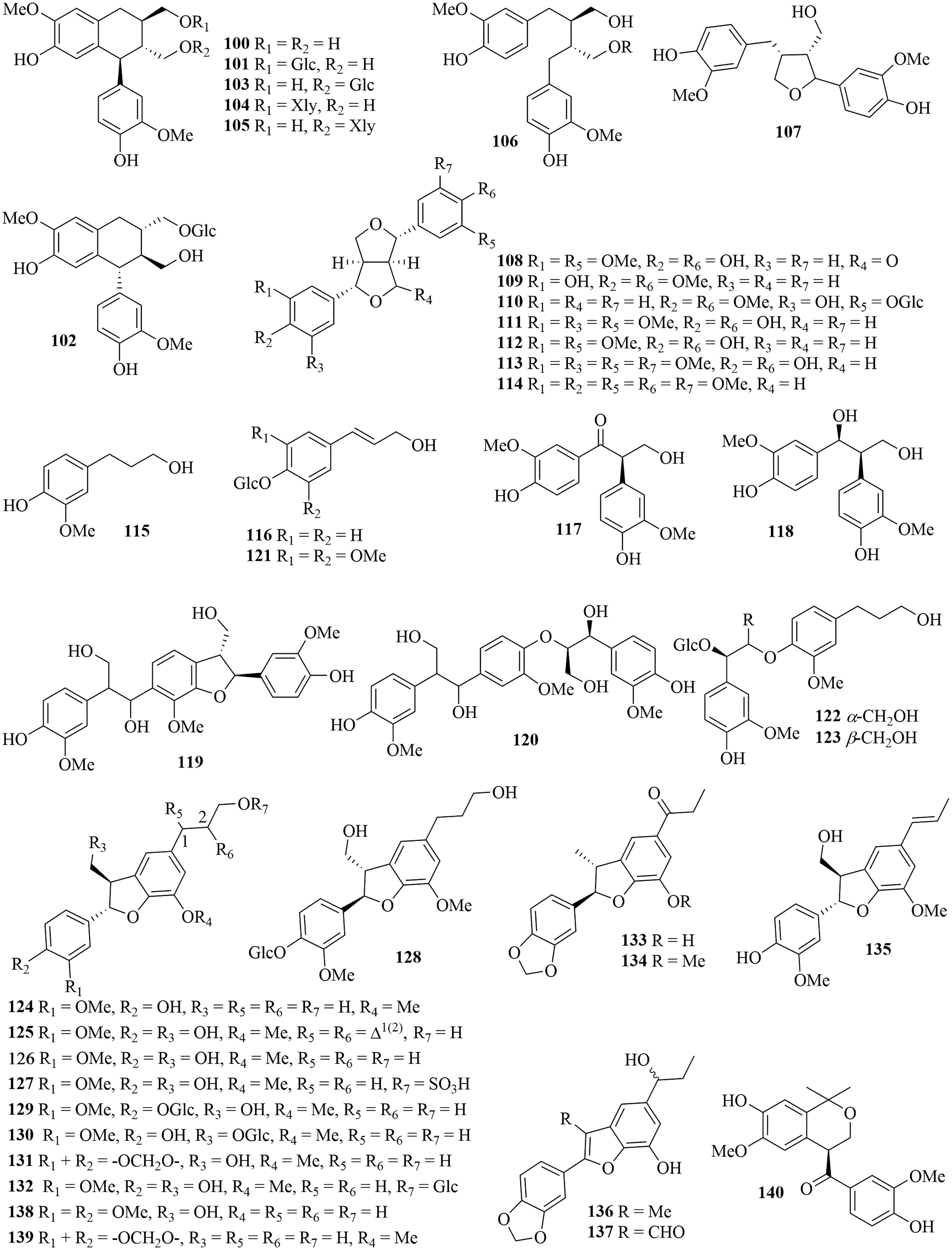
Lignans from Glochidion.
Taking aryltetralins type lignan
A total of seven furofuran-type lignans
A report published by Gao and partners indicated that G. wilsonii plant is thought to be a reservoir of lignans. Its roots contained six phenylpropanoids type lignan dihydroconiferyl alcohol (
Benzofurans type lignan were also characteristics of G. wilsonii, in which alcoholic extract of its roots consisted of five new derivatives glochiwilsonises A-E (
As shown in Table 1 and Figure 4, Glochidion flavonoids were found to contain the subclasses of flavones

Flavonoids and mono-phenols from Glochidion.
Among the isolated flavans
Mono-phenols are widely found in higher plants, as well as they appear in the form of mono-phenol or their precursors. Mono-phenols exhibited a great number of pharmacological activities such as antioxidant, antimicrobial, antiviral, and antiinflammatory activities.63–65 It turns out that the genus Glochidion is also rich in this type with more than twenty compounds
Megastigmanes, Butenolides, and Glycosides
Phytochemical studies of Glochidion species further reported the presence of megastigmanes
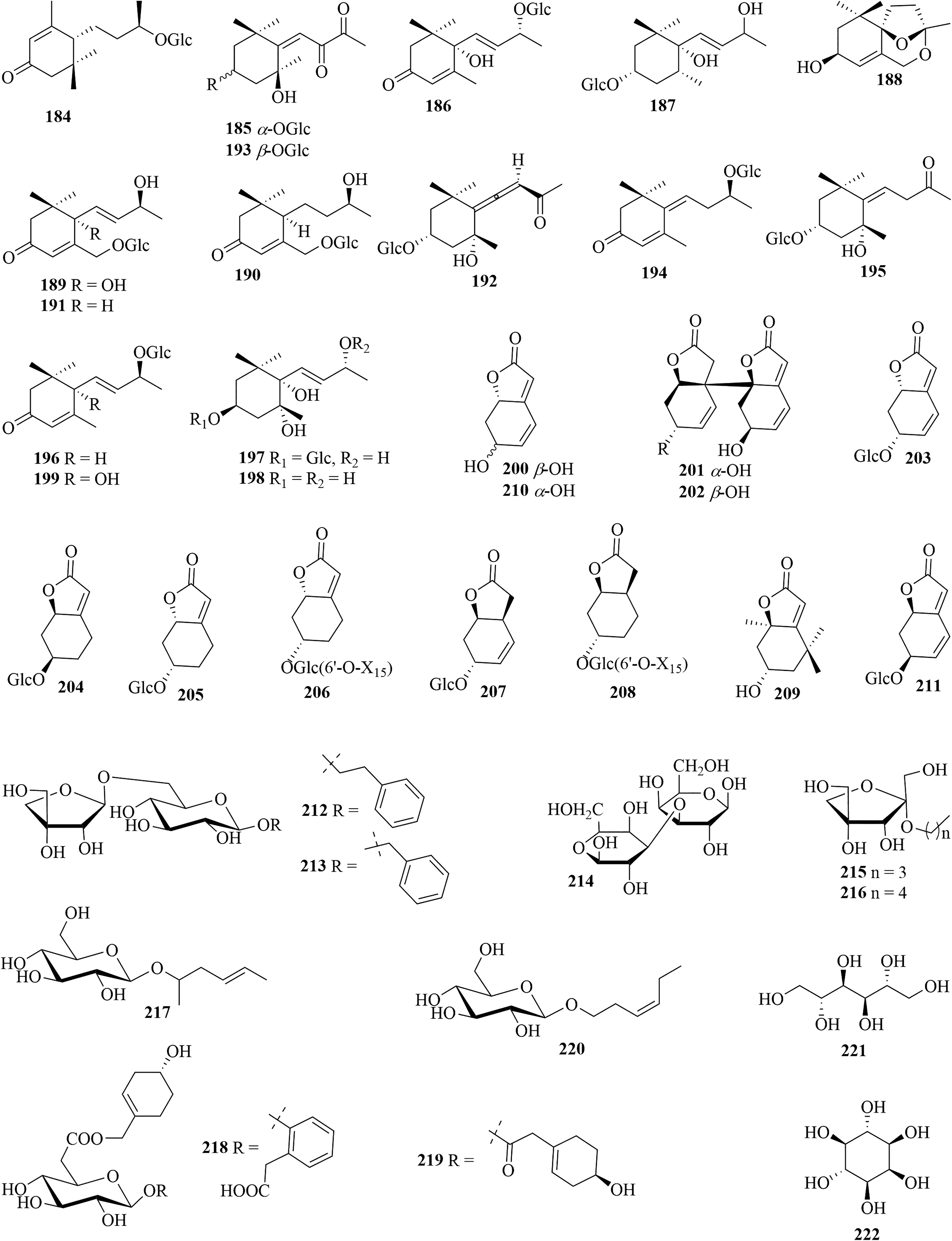
Megastigmanes, butenolides, and glycosides from Glochidion.
It matches well with previous evidence since butenolides were also characteristic compounds of Euphorbiaceae plants. Regarding the genus Glochidion, more than ten isolates
Glochidion glycosides
Alkaloids, Cyanogens, Tocopherols, Fatty Acids, and Others
Alkaloids are the next phytochemical class found in the genus Glochidion (Table 1 and Figure 6). Acuminaminoside (

Alkaloids, cyanogens, tocopherols, fatty acids, and others from Glochidion.
Natural compounds bearing the CN functional group were also present in Glochidion plants (Table 1 and Figure 6). Significantly, all the isolated cyanogen glycosides, consisting of 2-(2,4-dihydroxyphenyl) acetonitrile 2-O-β-D-glucopyranoside 6'-O-p-hydroxybenzoate (
The chromatographic procedure of the alcoholic extract of G. wrightii stems and leaves resulted in the isolation of two known tocopherols α-tocospiro A (
Phytochemical studies aided by the NMR spectral data also revealed the presence of three other phytochemicals (S)-methyl 2-[4-sulfooxycyclohex-1-en-1-yl] acetate (
the GC/LC-MS, and Other Phytochemical Analyses
Plants in the genus Glochidion are also the main object of essential oil studies. Following the GC-MS analysis, linalool (59.76%) and (E)-2-hexen-1-ol (7.76%) can be seen as the main agents of G. sphaerogynum male flowers. 17 (E)-2-Nonenal (36.6%) and (E)-2-nonen-1-ol (14.14%) accounted for 36.6 and 14.14% of G. hirsutum male flowers, respectively. 17 G. zeylanicum male flowers were dominated by (E)-2-nonenal (23.5%) and (E)-2-nonen-1-ol (11.17%), whereas (E)-β-ocinene (42.6%) was predominant in G. eriocarpum female flowers. 17 In another study, (E)-β-ocinene reached up to 25.66 and 94.34% in the flowers of G. rubrum and G. acuminatum, respectively. 16 (E)-Linalool oxide (furanoid) fluctuated from 45.88 to 73.19% in the flowers of G. lanceolatum, G. obovatum, and G. rubrum. 16 The GC-MS analysis identified the main compounds of G. sphaerogynum bark methanol extract as aliphatic compounds, whereas the atomic absorption spectrometry (ASS) analysis affirmed the concentration of metals Na and Ca at 8–10 ppm. 66 The phytochemical profile of G. velutinum leaf extracts using LC-MS/MS-based molecular networking was associated with the presence of mono-phenols and flavonoids. 67 For instance, its n-butanol fraction contained quinic acid, trehalose, isovitexin, hyperoside, and luteolin 4'-O-glucoside. 67
Total phenolic content (TPC) and total flavonoid content (TFC) in the methanol extract of G. ellipticum leaves were found to be 252.67 mg gallic acid equivalent (GAE)/100 g dried weight (DW) and 179.58 mg catechin equivalent (CE)/100 DW, and were better than those in the chloroform extract (136.34 mg GAE/100 g DW and 78.79 mg CE/100 g DW) and petroleum extract (25.86 mg GAE/100 g DW and 14.71 mg CE/100 g DW). 68 The TPC and TFC values of G. hirsutum leaf ethanol extract were 11.57 mg GAE/g DW and 3.02 mg CE/g DW, respectively, whereas those of G. sphaerogynum leaf ethanol extract were 4.83 mg GAE/g DW and 1.93 mg CE/g DW. 69 In another report, the TPC and TFC values of G. zeylanicum leaf methanol extract were 320.14 mg GAE/g DW, and 52.54 mg quercetin equivalent (QE)/g DW, respectively. 70 Cyanidin and anthocyanidin amounts in G. perakense young leaves were about 13.29 mg/100 g fresh weight (FW), whereas their TPC value was about 4762.76 mg GAE/100 g FW. 71 G. perakense young leaves were also rich in β-carotene, lutein, and vitamins C and E. 71
Pharmacological Activities
Cytotoxicity
New sesquiterpenoid glochiwilsonoside A (
Triterpenoids
A publication in 2023 revealed that new triterpenoid
Glochidion saponins are the next chemical class used for cytotoxic examinations. Triterpene saponins
Serial new triterpene saponins glomerulosides A-H (
In another report, four new triterpenoid saponins hirsutosides A-B and D-E (
Both the methanol extract of G. velutinum leaves and its n-hexane, chloroform, ethyl acetate, n-butanol, and aqueous fractions were reported to show cytotoxicity towards two cancer cell lines MCF-7 and PC-3 (Table 2). 67 At the same dose of 20 mg/kg, i.p., the methanol extract and its petroleum ether, carbon tetrachloride, and chloroform fractions of G. multiloculare stem barks increased the survival time of mice bearing EAC (Ehrlich's ascites carcinoma) from 21 to 27 days, compared to the control group (20 days). 73 The effect was also associated with a restoration of heamoglobin, a remarkable decrease in red blood cells, and an increase in white blood cells. 73
Pharmacological Activities of Constituents from Glochidion species.

Antioxidative Activity
It was noted that flavones
The methanol extract of G. sphaerogynum barks scavenged DPPH radicals with the IC50 value of 37.4479 µg/mL, in comparison with that of the methanol extract of G. hypoleucum leaves (IC50 40 µg/mL.6,66 The DPPH radical quenching activity of the 95% ethanol extracts of G. hirsutum leaves and G. sphaerogynum leaves corresponds to 181.74 and 42.19 µg AAE (ascorbic acid equivalent)/g DW. 69 G. zeylanicum leaf methanol extract strongly quenched DPPH and 2,2'-azino-bis(3-ethylbenzothiazoline-6-sulfonic acid) (ABTS) radicals with the IC50 values of 6.56 and 3.76 µg/mL, respectively. 70 The 80% ethanol extract of G. wallichianum leaves caused antioxidative activity against DPPH, and ABTS radicals and ferric reducing antioxidant power (FRAP) activity with 2.3, 1.9, and 1.1 mmole trolox equivalent (TE)/g DW, respectively. 74 In addition, this extract at the concentration of 0.01% could significantly maintain oxidative stability and physicochemical quality of the cooked sausage model system, which were comparable to or better than those of the standard butylated hydroxyl toluene (BHT). 74 The methanol extract of G. multiloculare barks containing about 100 mg GAE/mg DW caused the IC50 value of 16.46 µg/mL, which was stronger than the positive control BHT (IC50 20.45 µg/mL) against DPPH radicals. 75
Antimicrobial Activity
Glochidol (
Glochidiol (
New flavanones
Natural metabolite
In general, the use of halogenated solvents should be appropriate since the chloform extract of G. multiloculare barks with the IZ values of 9–12 mm was better than other typical extracts in antimicrobial experiments against B. cerus, B. megaterium, B. subtilis, Sarcina lutea, E. coli, P. aeruginosa, S. typhi, Shigella dysenteriae, Sh. boydii, Vibrio mimicus, V. parahemolyticus, Candida albicans, Aspergillus niger, and Sacharomyces cerevaceae. 77
The silver nanoparticles synthesized from G. candolleanum leaves inhibited the growth of bacteria Salmonella enterica and P. aeruginosa with the IZ values of 12.2 and 11.8 mm, respectively. 78 The ethanol extract of G. puberum roots monitored the proliferation of B. subtitis and P. aeruginosa with the corresponding MIC values of 100 and 200 µg/mL, but was inactive to bacteria E. coli and S. aureus (MIC > 200 µg/mL). 79
Antiinflammatory Activity
Sesquiterpenoid
The ethanol extract of G. thomsonii barks
An inflammatory bowel disease called ulcerative colitis makes your digestive system inflamed and produces ulcers, or sores.92,93 The rectum and the innermost lining of your large intestine, commonly referred to as the colon, are affected by ulcerative colitis. For the majority of persons, symptoms typically appear gradually as opposed to abruptly. It turns out that the treatment of G. ellipticum leaf extracts (n-hexane, dichloromethane, and n-butanol), at the same dose of 200 mg/kg, p.o., could ameliorate DSS (dextran sulfate sodium)-stimulated colitis in mice via the nuclear factor-kappa B (NF-κB) signaling inhibition. 80 The expressions included reductions in NO, ROS, pro-inflammatory cytokines, iNOS, and cyclooxygenase-2 (COX-2). 80
Antidiabetic Activity
The 95% ethanol extract of G. hirsutum leaves suppressed α-amylase and α-glucosidase enzymes with the IC50 values of 0.59–1.01 mg/mL, as compared with those of the 95% ethanol extract of G. sphaerogynum leaves (IC50 2.21-2.84 mg/mL). 69
The ethanol extract from a combination of G. arborescens leaves and Cynometra ramiflora leaves showed in vitro α-glucosidase inhibition with an IC50 value of 374.47 ppm, when acarbose was used as a positive control (IC50 14.17 ppm). 81 The oral administration of G. velutinum leaf ethanol extract at the two doses of 200 and 400 mg/kg inhibited streptozotocin-nicotinamide stimulated type 2 diabetic mice by reducing glucose levels, and altering lipid, glutamic-oxaloacetic transaminase, and alanine aminotransferase levels. 82 At the same two doses, the aqueous extract of G. zylanicum roots possessed hypoglycemic activity by lowering blood glucose levels in mice, which was comparable to that of the standard glibenclamide at 10 mg/kg. 19 In the same manner, the aqueous extract of G. velutinum leaves significantly reduced blood glucose levels at the dose of 400 mg/kg, p.o. for 15-day treatment. 20
Antiurolithiatic, and Antidiarrheal Activities
The methanol extract of G. velutinium leaves (500 mg/kg, p.o.) established antiurolithiatic action via suppression of the CAOX crystal formation in calculogenic mice. 83 The obtained results involved decreases in the levels of calcium, phosphorus, and oxalate in both the urine and kidney, and the levels of BUN, creatinine, and uric acid in the serum, especially a reduction of stone-forming constituents in the kidney. 83
The ethanol extract of G. thomsonii barks at two doses of 250 and 500 mg/kg, p.o., has a marked antidiarrheal effect again the episode number of defecation and diarrheal feces. 84 This extract at a higher dose protected against castor oil-induced diarrhea in mice by up to 54.47%, as well as reduced intestinal fluid accumulation by 51.6%. 84
Analgesic, and Sedative Activities
From Table 2, at the same dose of 100 mg/kg, i.p., the methanol extract and its petroleum ether, carbon tetrachloride, and chloroform fractions of G. multiloculare stem barks demonstrated inhibitions to acetic acid induced writhing in mice from 66.36 to 84.09%, when diclofenac-Na was used as a positive control (86.36% inhibition). 73
Besides antiinflammatory effect, at the same doses of 250 and 500 mg/kg, the ethanol extract of G. thomsonii barks suppressed formalin-mediated paw licking and acetic acid-mediated writhing in mice, and two phases of formalin-induced paw-licking models of pain. 18 Sedative activity of the methanol extract of G. multiloculare leaves (200 mg/kg, p.o.) was accompanied by decreasing the locomotor activity of mice in hole cross, opening field, and prolonging the sleeping time. 5
Neuroprotective Activity
The ethanol extract of G. zeylanicum leaves may be a viable therapy option for oxidative stress-induced Alzheimer's and other neurodegenerative diseases due to its intriguing neuritogenesis and neuroprotective properties. Herein, it protected against glutamate/H2O2-induced toxicity in HT-22 and neuro-2a neuronal cells by suppressing the intracellular ROS generation and enhancing the expression of endogenous antioxidative enzymes SODs, GPx, and GSTs at the concentration of 10 µg/mL. 85 This extract also triggered SIRT1/Nrf2 protein expression and mRNA transcription of antioxidative genes NQO1, GCLM, and EAAT3. In addition, at the concentration of 5 µg/mL, it showed protective activity against Aβ (amyloid-β)-induced toxicity in Caenorhabditis elegans and enhanced neuritogenesis in neuro-2a cells. 85
The neuroprotective effect of G. zelanicum leaf extract was explained by extending lifespan and oxidative stress suppression in C. elegans via DAF-16/FoxO and SKN-1/Nrf-2 signaling pathways.2,3 The aqueous extract of G. littorale leaves at the concentration of 100–200 µg/mL ameliorated H2O2 induced oxidative stress by ROS accumulation, and 1-methyl-4-phenylpyridinium ion (MMP+) induced neurodegeneration in C. elegans by DAF-16 transcription activation. 86
Liver, and Skin Protective Activities
Chronic ethanol consumption can lead to a drastic growth of liver ailments. 87 It was noted that the ethanol extract of G. wallichianum leaves at two doses of 300 and 600 mg/kg, p.o., suppressed ethanol-stimulated liver damage in mice for 28 days via antioxidative activity. 87 Herein, the mechanism of action involved decreases in alanine aminotransferase (ALT), hepatic malondialdehyde (MDA) levels, an increase in catalase (CAT) activity, and an improvement in histopathological alterations. 87 In a clinical setting, the dogs treated with G. ferdinandi roots for 30 days revealed a health status with serum biochemical and coagulation profile within reference intervals. 94
The methanol extract of G. zeylanicum leaves possessed the IC50 values of 47.94 and 76.00 µg/mL in elastase and tyrosine inhibitory assays, respectively. 70 Microemulsions containing G. wallichianum extract and surfactants (labrasol/HCO-40 (1:1) with transcutol (1:1, 2:1, 3:1), and tween 80/span 80 (3:2) with transcutol or propylene glycol/ethanol (1:1)) have potential for transdermal and topical skin delivery of gallic acid. 95
Other Activities
As we know, the 5α-reductase suppressor plays a great role in the management of male pattern hair loss. It turns out that the 50% ethanol extract of G. eriocarpum roots at 200 µg/mL inhibited 25.5% growth of the 5α-reductase enzyme. 88 The ethanol leaf extract of G. zeylanicum at the concentration of 75 µg/mL induced 60.52% inhibition of red blood cell destruction, as compared with that of the standard diclofenac (75.78%). 89 At a concentration of 50 ppm, the ethyl acetate extract of G. laneolarium leaves showed mosquito larvicidal activity against Culex vishnui third larval instars with mortality rates of 80, 85.33, and 100% for 24, 48, and 72 h treatments, respectively. 90
Toxicology
The methanol extract of G. multiloculare leaves and the standard vincristine sulfate showed the corresponding LC50 values of 37.19 and 10.50 µg/mL in a brine shrimp lethal assay against Artemia salina. 5 In the same model, the n-hexane, ethyl acetate, and methanol extracts of G. velutinum leaves exerted the LC50 values of 598.54, 651.92, and 428.47 µg/mL, respectively. 91 The extracts of G. multiloculare barks induced resistance to A. salina with the LC50 values of 3.11–16.32 µg/mL. 77
Conclusions and Perspectives
The current study first reviews full information about the phytochemistry and pharmacology aspects of Glochidion species. About 25 species have been the main objects of phytochemical research. Through chromatographic separation and NMR elucidation, more than 240 sary metabolites have been isolated and identified. They included terpenoids, sterols, saponins, lignans, flavonoids, mono-phenols, megastigmanes, butenolides, glycosides, alkaloids, cyanogens, tocopherols, fatty acids, and others. Three triterpenoids glochidonol, glochidiol, and glochidone can be seen as characteristic compounds present in this genus since they were found in frequency. The GC-MS studies reported the presence of aliphatic and terpenic compounds in Glochidion essential oils, whereas total phenolic and flavonoid contents were found to be different in each Glochidion species. Plants from this genus were documented to exhibit a wide range of in vitro pharmacological values, consisting of cytotoxic, antioxidative, antimicrobial, antiinflammatory, antidiabetic, antiurolithiatic, antidiarrheal, analgesic, and sedative activities, as well as living organ protection.
Although there have been plenty of phytochemical investigations, the isolated compounds were present in trace amounts. It is necessary to propose an advanced method to obtain huge amounts. Most pharmacological results were obtained at in vivo levels, and biomedical examinations of various compounds, especially in terms of new compounds are still unknown. Besides this, pharmacokinetics, clinical applications, nano-encapsulations, and synergistic combinations are expected.
Footnotes
List of abbreviations
Acknowledgments
The authors would like to express their sincere gratitude to supporters for their revisions.
Authors Contributions
Conceptualization: N. N. L.; Formal analysis: P. T. T. N.; Validation: P. T. B. D.; Data collection: V. Q. M., and T. V. P.; writing-original draft preparations and supervision: N. T. S. All authors have read and agreed to the published version of the manuscript
Declaration of Conflicting Interests
The authors declared no potential conflicts of interest with respect to the research, authorship, and/or publication of this article.
Funding
The authors received no financial support for the research, authorship, and/or publication of this article.

Statement of Institutional Review Board
Not applicable.
Statement of Informed Consent
Not applicable.