



Abstract
Pinus mugo Turra is a coniferous species of shrub or small tree typical of central and south-eastern Europe. It is commonly called mugo pine, mountain pine, or dwarf mountain pine referring to its habit and small size. Indeed, this plant lives at higher altitude above 1400 m above the see level where it deals with harsh conditions typical of high mountain. From an ethnotraditional point of view, P. mugo is mainly used for respiratory disorders and wound healing. In particular, its essential oils have been shown to possess interesting antimicrobial and antioxidant activities, which can substantiate its potential therapeutic effect in pulmonary and urinary tract diseases, as well as antinflammatory and antitumor effects. This review also offers a summary on the chemical constituents of P. mugo that contribute to its therapeutic potential.
Introduction
Pinus mugo Turra (P. mugo sensu stricto or P. mugo subsp. mugo) (family Pinaceae) is one of the best-known species belonging to the P. mugo complex (16 species, 91 varieties, and 19 other forms), an important fragment of the European dendroflora that is taxonomically very complicated due to its high polymorphism.1–4
P. mugo is known by many common names such as mugo pine, mountain pine, and dwarf mountain pine. The scientific name dates back to the middle of the eighteenth century and is partially derived from the Italian word mugo, which means “small mountain pine.”5,6 It is a small- to medium-sized shrub native to the mountains of central-southern Europe and the Balkan peninsula (Figure 1).7,8 It grows slowly, reaching heights of 3-15 m and developing thick, decumbent, ascending, or erect branches up to 3-5 m long. As the tree matures, its bark turns gray or brown and forms ridges and furrows. Its needles are short, dark green, slightly twisted, arranged in pairs, with a length between 3 and 7 cm. The cones are small and ovoid, usually 2-5 cm long and reddish-brown when fully developed.9,10 P. mugo evolved to thrive in challenging alpine environments, including as rocky and nutrient-poor soils.9,10 The current distribution range is highly fragmented, probably the remnant of a wider coverage of this species during the interglacial periods of the late Tertiary and Quaternary. 11 In Italy, P. mugo is naturally present in the Alps and Apennines, up to the Maiella area (Abruzzo Region) where it is protected by a regional law (L.R. 45/79) as in Molise (L.R. 22/82) and in Veneto (L.R. 33/95).6,12 It is also found in other areas of central and south-eastern Europe between 1500 and 2700 meters above sea level.6,13 P. mugo is naturalized in Canada, USA, and Russia.5,14

Natural range map of P. mugo [published by the European Commission. Ballian D, Ravazzi C, de Rigo D, Caudullo G, 2016. Pinus mugo in Europe: distribution, habitat, usage and threats. In: European Atlas of Forest Tree Species, San-Miguel-Ayanz, J., de Rigo, D., Caudullo, G., Houston Durrant, T., Mauri, A. (Eds.) and released under Creative Commons Attribution 4.0 International (CC-BY 4.0)]. https://forest.jrc.ec.europa.eu/en/european-atlas/.
P. mugo is a pioneer plant capable of colonizing both alkaline and acidic soils in conditions not suitable for other species and its normal habitat is calcareous and dolomite ground.12,15,16 Its growth is very slow and the maximum age reaches up to 300 years. 17 P. mugo is a significant species of European mountain ecosystems. It has been recognized as having a beneficial role in protecting against water and soil erosion. 17 Furthermore, it has also been reported as a tool for biomonitoring environmental pollution and predicting potential risks in high mountain habitats. 18
In folk medicine, P. mugo enjoys a consolidated tradition, linked above all to the treatment of respiratory problems. 19 Its essential oil (EO) is listed by the Western Pharmacopoeias among the aetheroleum drugs (eg, in the European Pharmacopoeia as Pini pumilionis aetheroleum) with pharmaceutical applications.20,21 Several works have been published on the chemical content of P. mugo through the analysis of extracts and EOs obtained from different plant parts (mainly needles, twigs, and cones) as well as on its bioactivity.12,19,22,23 The present review, for the first time, summarizes data relating to its ethnotraditional uses, phytochemistry, and therapeutic potential. Data was collected by searching several scientific databases such as Embase/Elsevier, Google Scholar, Ovid, PubMed/MedLine, Science Direct, Scopus, Web of Science, and using the MeSH terms and their combinations: “Pinus,” “pine,” “mugo,” “Pinus mugo,” “mountain pine,” “dwarf pine,” “bioactivity,” “pharmacology,” “ethnopharmacology,” “ethnotraditional use,” “phytochemical,” “antioxidant,” and “essential oil.” Only English-language publications from any country were considered.
Phytochemical Composition
Phytochemicals are naturally occurring compounds found in plants that are known to have potential health benefits. 24 P. mugo is rich in active molecules such as flavonoids, phenolic acids, proanthocyanidins, terpenes, tannins, lignans, higher alcohols, vitamins, and minerals responsible for many of its biological activities including antioxidant, anti-inflammatory, anticancer, and cardioprotective ones.19,25 Among the different chemically characterized parts (eg, bark, cones, young shoots, twigs, resin, and wood), needles have certainly been the object of the vast majority of analyses performed on P. mugo.12,19,22,26–29 Likewise, EOs from different organs of P. mugo have been more investigated than other extracts identifying more than 130 compounds, mainly monoterpenes.25,30–32 In particular, several authors reported that the composition of steam- or hydro-distilled EOs from fresh needles or air-dried needles, twigs, and cones of wild populations of P. mugo in Kosovo and Republic of Macedonia was dominated (up to 79.5%) by monoterpene hydrocarbons, with 3-δ-carene, α-, and β-pinene, limonene+β-phellandrene as major compounds, followed by sesquiterpene hydrocarbons (up to 47.8%) including (E)-caryophyllene and germacrene D.22,29,33,34 The same monoterpene and sesquiterpene hydrocarbons were also among the main components of the EO obtained from frozen twigs with needles of different populations of P. mugo from the Julian Alps (Slovenia and Italy). 35 The prevalence of 3-carene and α-pinene, together with myrcene, α-terpinolene, β-caryophyllene, and bornyl acetate was further confirmed by the characterization of EOs from different parts (twigs/branches with or without needles, needles only, bark, wood, cones, and young shoots) of Polish and Kosovar P. mugo.23,25 They were the two most abundant monoterpene hydrocarbons also in the 80% methanolic extract of P. mugo needles, followed in decreasing order by germacrene D, camphene, and D-limonene. 19 Otherwise, δ-3-carene was not detected in some Italian (Trentino Alto Adige Region) EOs, where the main compounds were β-pinene or limonene both in liquid and vapor phase, followed by α-pinene, β-myrcene, and γ-terpinene.31,32 Moreover, when young needles from P. mugo collected in the southernmost Italian station (Parco della Majella, Abruzzo) were hydrodistilled, the EO composition changed. Oxygenated monoterpenes (32.7%) were the predominant compounds and bornyl acetate the main one. 12
In addition to monoterpenes and sesquiterpenes (Figure 2), a diterpene fraction was identified in some P. mugo EOs, where oxygenated diterpenes (often derivatives of abietane and manool oxide) (Figure 2) prevailed (up to 12:1) over diterpene hydrocarbons.12,22,25,33,34

Main terpenes detected in P. mugo essential oils and extracts.
Not only lipid-derived molecules have been found in P. mugo needles. Other studies showed the presence of several polyphenolic compounds (Figure 3). Specifically, Karapandzova and co-authors identified 14 compounds in the methanolic extracts including 10 flavonoids (kaempferol glycosides, myricetin, quercetin, laricitrin, and isorhamnetin), two phenolic acids (quinic acid and p-coumaric acid), and two procyanidins (catechin and methylated catechin).22,36 Flavonoids and procyanidins were also detected in P. mugo branch wood methanolic extracts together with lignans and diterpenes. 37

Polyphenolic compounds found in P. mugo extracts.
In general, it is important to highlight that the concentrations and variety of chemical compounds as well as the EO yield vary depending on several factors including the geographical origin, the environmental conditions, the plant part, and the phenological stage of the plant.8,12,19,22,25,34–39 Said that, it is of note that most of the works analyzing the chemical compositions need to be carefully evaluated because any underrepresented parameter (biogeography, temperature, humidity, etc) could severely impact on the phytocomplex of the plant. In this regard, for example, a previous work on P. mugo complex tried to reset any possible influence by comparing three closely related species, namely P. uncinata Ramond ex DC., P. uliginosa G.E.Neumann ex Wimm., and P. mugo under selected and specified conditions managing to identify some volatile compounds as species-specific markers which allowed their successful identification overcoming the above limitations. 3
Pharmacological Properties
Ethnotraditional Uses
P. mugo belongs to a diverse and widely distributed group of plants that have been collected and used in folk medicine for centuries. In particular, it finds application in the ethnomedicinal practice of central and western Europe, mainly in the area of the Alps, Carpathians and Pyrenees, but also in the Balkan region and in some areas of the Apennines (Table 1).19,40–56
Applications of P. mugo in the Ethnomedicinal Practice Documented in European Countries.
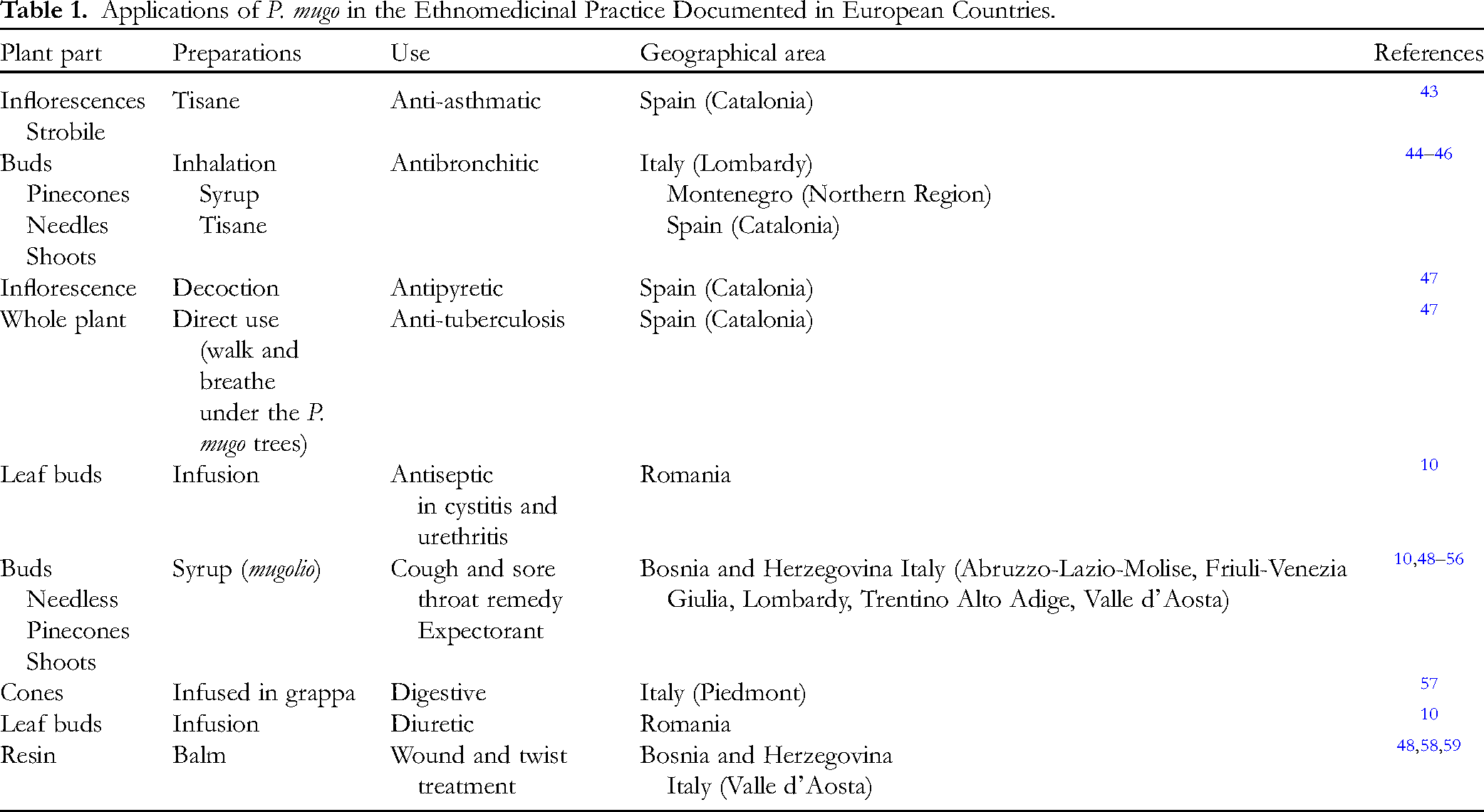
P. mugo preparations based on needles, buds, or young pinecones, administered in the form of syrup, called mugolio, and herbal teas or by inhalation, are commonly used as expectorants and decongestants due to their beneficial effects on sore throats, coughs, cold, and bronchitis.19,41–43,45–50 Furthermore, in the Iberian Peninsula, pinecone herbal tea is administered as an anti-asthmatic while the decoction as an antipyretic.40,44 In Romania, however, a 3-10% infusion of leaf buds harvested in February is recognized as having diuretic and antiseptic properties useful in the treatment of cystitis and urethritis. 19 Direct application of P. mugo resin in cases of wounds and muscle twists has also been reported.19,40,55,56 Finally, cones infused in grappa as a digestive or sprouts as ingredients for traditional Italian alcoholic beverages have also been documented.46,49,54,57
Preclinical Studies
Several preclinical studies have been conducted to investigate the therapeutic potential of P. mugo proving its biological effects (Table 2). The most relevant findings have been summarized below.
Preclinical Studies Carried out on Essential Oils and Extracts from P. mugo

Anti-infl, anti-inflammatory activity; Antimicrob, antimicrobial activity; Antiox, antioxidant activity; Cytotox, cytotoxic activity; Larv, Insect larvicidal activity; LCL, luminol chemiluminescence, MIC, minimum inhibitory concentration, MBC, minimum bactericidal concentration; MTT, Thiazolyl Blue Tetrazolium Bromide assay; N.A., Not available; POCL, peroxy-oxalate chemiluminescence; VP, vapor phase; LDL, low-density lipoprotein.
Antioxidant and Antibacterial Activity
In the early 2000s, Grassman and collaborators investigated the antioxidative property of P. mugo EO using different tests such as the Fenton system, the xanthine oxidase assay and the copper-induced oxidation of low-density lipoprotein (LDL). EO showed a good activity in lipophilic environments (ie, the ACC-cleavage by activated neutrophils in whole blood and the copper-induced oxidation of LDL), attributed to the presence of terpinolene and γ-terpinene.58,59 More recently, Kurti et al tested the antioxidant activity of EOs from five Pinus species including P. mugo by performing the DPPH (2,2-diphenyl-1-picrylhydrazyl) scavenging assay. 23 Among the analyzed samples, P. mugo EO showed the greatest effectiveness in terms of stable radical removal. A similar study was also conducted by Garzoli and co-authors confirming previous findings that P. mugo EO possessed the highest antioxidant potential. 31 It was among the most active even when evaluated together with 45 other pine species using the peroxy-oxalate (POCL) and luminol chemiluminescence assays. 24 However, its antiradical activity was weaker when compared to that of EOs obtained from species belonging to different families including Lamiaceae, Poaceae, and Rutaceae. 60 Lastly, methanolic extracts (70% or 80% MeOH) of P. mugo were found to possess remarkable antioxidant qualities with both the DPPH and TBARS methods, although lower than those of the EOs.19,22 In contrast, organic (CH2Cl2/EtOH) and hydroethanolic (EtOH/H2O) extracts showed higher activity. 24
In some works, in parallel with the antioxidant activity, the antimicrobial activity of P. mugo has been investigated, with different results depending on the microbial pathogens used as targets. For example, Kurti et al observed weak activity of P. mugo EO against Candida albicans and no activity against the tested Escherichia coli and Enterococcus faecalis strains. 23 Subsequently, these data were partially confirmed. In fact, the ineffectiveness of the vapor phase and the weak ability of the liquid phase of P. mugo EO to inhibit E. coli were reported by Garzoli and co-authors. 31 Conversely, the same vapor phase was able to counteract the growth of Acinetobacter bohemicus, Kocuria marina and Bacillus cereus better than the liquid phase. 31 Differently, other studies documented significant activity of P. mugo EO against E. coli and Morganella morganii, both isolated from nasal or throat swabs and sputum.30,34 Antifungal activity of bud and needle extracts obtained from P. mugo on yeasts and molds was also recorded. C. albicans and Aspergillus flavus showed sensitivity to both extracts, while only the needle extract induced growth inhibition of Penicillium chrysogenum and Cryptococcus neoformans. 19
In general, the documented variations in activity appear to be regulated by mutual interactions between the different subclasses of chemical compounds present in EOs, and, in particular, those of antimicrobial activity clearly associated with the concentration of oxygenated monoterpenes. 23
Anti-Inflammatory and Cytotoxic Activity
In 2017, Basholli-Salihu et al studied for the first time other aspects of the biological activity of P. mugo EO (needles, twigs, and cones), together with that of two other pine species. 29 To evaluate the anti-inflammatory effect of the samples, murine macrophage RAW 264.7 cells were incubated with the three EOs and treated with lipopolysaccharide to stimulate inflammation. Then, the supernatants were collected to measure the levels of the proinflammatory cytokine IL-6 by enzyme-linked immunosorbent assay. When used at a concentration of 0.001%, P. mugo needle EO was able to reduce IL-6 cytokine production by at least 35%, while at concentrations of 0.01% (twig EO) and 0.05% (cone EO), obtained an almost double effect with a decrease in IL-6 of at least 60%. 29 It is believed that α-pinene, one of the main components of all tested P. mugo EOs, may play an important role in the recorded anti-inflammatory activity with a significant impact on the cytokine secretion profile. 29 It is believed that α-pinene, one of the main components in all tested P. mugo EOs, may play an important role in the recorded anti-inflammatory activity with a significant impact on the cytokine secretion profile. 29 In the same study, the cytotoxicity of EOs was also assessed using three different cancer cell lines such as HeLa, CaCo-2, and MCF-7 analyzed by MTT assay. Strong activity was found for EOs obtained from P. mugo needles and twigs. In particular, at 0.1% concentration, they decreased the cell viability of HeLa by at least 90% and caused a reduction in the metabolic activity of CaCo-2 by 80-90%. The cell viability of the MCF-7 line was reduced by at least 85% due to the EO of the needles and by 45-60% by the EO of the twigs. EO from P. mugo cones was less effective as it negatively affected the viability of MCF-7 by only 15%. 29 Also in this case, α-pinene was taken into consideration as one of the compounds responsible for the cytotoxicity of P. mugo, especially in the EO of the needles, where it was more abundant, remembering that this activity, however, is not always linked only to the main components of an EO, but may be related to the synergism or cumulative effect of different constituents, including those present in trace amounts.29,61
Antitumor Activity
The potential antitumor activity of P. mugo was observed in a recent study by Thalappil et al, in which the DU145 prostate cancer cell line expressing active STAT3 (STAT3 phosphorylated with Tyr705), known to contribute to the initiation and cancer progression, was used.62,63 DU145 cells were treated with different EOs including P. mugo for 1 h, and then the levels of pTyr705STAT3 were analyzed by Western blot. The results showed strong inhibition of pTyr705STAT3 due to the action of P. mugo. 63 Furthermore, it was not cytotoxic in human fibroblasts, suggesting some specificity on tumor cells. Since P. mugo was the most promising among the analyzed EOs, the authors studied its effect on STAT phosphorylation in a time-dependent manner using the same cell line. Western blot analysis showed a decrease in STAT3 Tyr705 phosphorylation after only 2 h of treatment. It was also seen that 24-h treatment led to a reduced mRNA level of proliferative genes such as Cyclin D1, Bcl-2, Survivin, and IL-6. The antitumor effect was confirmed by flow cytometry showing that P. mugo EO induced apoptotic cell death in DU145 cells after 24 h of treatment. Finally, P. mugo EO has been found to act synergistically with cisplatin, a known chemotherapy drug. 63 These activities have been attributed to the presence of the bicyclic sesquiterpene β-caryophyllene, the oxygenated monoterpene bornyl acetate, the monoterpenes limonene, α-pinene, and δ-3-carene. 63
Conclusions and Future Perspectives
P. mugo is a conifer with a characteristic prostatic habit that grows in difficult environments. It has a distinctive chemical profile and notable medicinal properties that could lend itself to a wide range of versatile applications. In particular, EOs from P. mugo can be considered as promising agents for anti-inflammatory and anticancer drugs. However, the lack of clinical studies leads to an underutilization of its therapeutic potential. This gap could be filled and the present review aims to provide the basis for new work in this field. Furthermore, it would be desirable for future research to more thoroughly explore the phytochemicals peculiar to P. mugo, with particular attention to the possible synergy between this plant and other herbal remedies or conventional drugs. Combining the strengths of P. mugo with other treatments could lead to more effective and comprehensive treatment options.
Footnotes
Declaration of Conflicting Interests
The authors declared no potential conflicts of interest with respect to the research, authorship, and/or publication of this article.
Funding
The authors received no financial support for the research, authorship, and/or publication of this article.
