Objective/Background: In Chinese, Vietnamese, and Thai traditional medicine of Southeast Asian countries, Stemonaceae plants have long been employed. Various studies have proved that these herbal plants contain Stemona alkaloids with valuable medicinal value. Although some review articles on Stemona alkaloids have appeared in the literature, they are quite outdated. The current study offers a comprehensive review of the isolation and bioactivities of Stemona alkaloids. The article might be useful for chemists who work in alkaloid chemistry as well as pharmaceutical areas. Methods: “Stemona alkaloids” was the most useful keyword to search for literature data. References have been collected from various resources such as Google Scholar, SciFinder, and PubMed. More than 120 electronic publications were obtained from these resources. Results: More than 250 Stemona alkaloids from 8 groups have been isolated and structurally elucidated from Stemonaceae plants. Extracts from these plants as well as isolated compounds possess a wide range of bioactivities, such as antituberculosis, antibacterial, antifungal, and antihelmintic properties activities. Conclusion: In this review article, we have summarized 116 studies on the isolation and bioactivities of Stemona alkaloids in the literature. More than 250 Stemona alkaloid compounds have been isolated and identified. In addition, the article also gives an overview of the bioactivities of Stemona alkaloids.
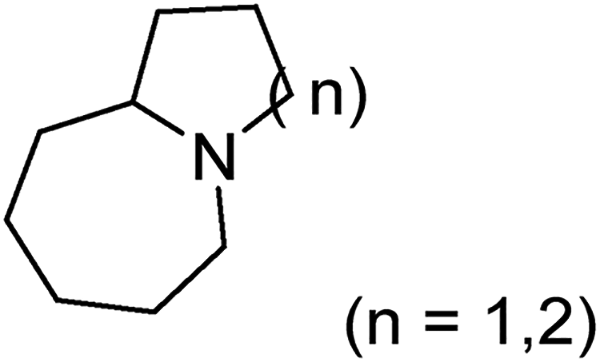
The Stemona alkaloids are a unique class of naturally occurring alkaloids exclusively isolated from the Stemonaceae family, mainly distributed in Southeast Asia.1 This class of alkaloids is structurally characterized by the presence of a pyrrolo[1,2-a]azepine skeleton (Figure 1, n = 1), or a pyrido[1,2-a]azepine core structure, the less common type (Figure 1, n = 2).2
The core structure of the Stemona alkaloids.
There are 30 species in 3 genera, Stemona, Croomia, and Stichoneuron of the Stemonaceae family. These herbal plants are widely distributed in Southeast Asia, Northern Australia, China, Japan, and Northern America. Extracts from these plants have long been employed in traditional medicine in East Asia, especially 3 species: S tuberosa, S japonica, and S sessilifolia, which were listed in the 2000 edition of the Chinese Pharmacopeia as antitussive medicinal herbs.3 In Vietnam (“Bach Bo”), China (“Bai Bu”), and Thailand (“Non Tai Yak” or “Pong Mot Ngam”), the dried roots from these 3 species have long been utilized to treat coughing and claimed to exhibit antitubercular, antibacterial, antifungal, and antihelmintic properties.4
In 2010, the Stemona alkaloids were classified into 8 different structural groups by Pilli et al2 (Figure 2) including stenine (I); stemoamide (II); tuberostemospironine (III); stemoamine (IV); parvistemoline (V); stemofoline (VI); stemocurtisine (VII); and a miscellaneous group (VIII), formed from those alkaloids which do not possess skeleton mentioned above. The core structures of groups I to VII are shown in Figure 2.
Pilli's classification of the Stemona alkaloids.
Phytochemistry
Until now, more than 250 Stemona alkaloids have been isolated and structurally elucidated. A large number of Stemona alkaloids isolated belong to groups I, II, and VIII. Some Stemona alkaloids possess complicated structures and need a long time or even revision to determine the correct configuration. In this section, we discuss the isolation of Stemona alkaloids belonging to each group which were isolated by 2023. Although some review articles on the isolation of Stemona alkaloids have been found in the literature,1,2,5,6 they did not cover recent studies. The article might be useful for chemists who work with the chemistry of natural products as well as pharmacology.
Isolation of Stemona Alkaloids Belonging to Stenine Group (Group 1)
The alkaloids in the stenine group possess furo[2,3-h]pyrrolo[32,1-j,k[1]benzazepin-10(2H)-one skeleton. Until now, 52 stenine group alkaloids have been isolated and structurally elucidated. Many of these alkaloids contain a γ-lactone ring at C3. Tuberostemonine 1 was the first Stenine Stemona alkaloid isolated from S tuberosa by Suzuki7 in 1934, but only until 1967 its structure was fully determined (Figure 3).8 In 1967, Uyeo et al9 reported the isolation and structural elucidation of stenine 2 from Stemona tuberosa (Figure 3). Tuberostemonine A 3 was discovered by Edwards et al10 from the rhizomes of Stentona sessilifolia. Especially, tuberostemonine A (3) displays an (R)-absolute configuration at the C-3 position where the γ-butyrolactone moiety is bonded to this stereogenic center (Figure 3). Lin et al11 isolated tuberosternonol 4, in which the A-ring has been oxidized to dihydropyrrole, from the roots of Stenuma tuberosa (Figure 3). Tuberostemonol (4) is the only stenine group alkaloid that possesses a hydroxy group at C-9. Neotuberostemonine 5 and bisdehydroneotuberostemonine 6 were obtained from the roots of Stemona tuberosa, collected in Yunnan Province (Figure 3).12 The A-ring in bisdehydroneotuberostemonine 6 is a pyrrole. Four new Stemona alkaloids, namely tuberostemonines B 7 and C 8, and bisdehydrotuberostemonines B 9 and C 10 were separated by Zou et al13 from the roots of Stemona japonica (Figure 3). In these alkaloids, the ethyl side chain is at the α-position. Isobisdehydrotuberostemonine 11 also known as isodidehydrotuberostemonine and N-oxytuberostemonine 12 was achieved by Lin and Fu14 (Figure 3). Compound 11 possesses a pyrrole ring. Neotuberostemonol (13) was isolated by Jiang et al15 in 2002. Neotuberostemonol differs from tuberostemonol by the β-oriented relative configuration of H-11 and H-12 (tuberostemonol has α-oriented) (Figure 3). 2-Oxostenine (14) with a ketone group at C2 was obtained from the roots of S sessilifolia and S mairei, although full physical data for structure elucidation has not been provided (Figure 3).16,17 Isostenine (15) was co-discovered by Pham et al17 from the root of Stemona collinsae. and by Lin et al from the dried root of Stemona tuberosa. Lin et al named it neostigmine (Figure 3).18 This compound does not contain a γ-lactone ring at C3. In this work, Lin et al also achieved 3 other Stemona alkaloids named tuberostemonines H (16) and J (17), and epi-bisdehydrotuberostemonine J (18) (Figure 3).18 Tuberostemonines H and J are distinguished with tuberostemonine in the configurations at C-1, C-9a, C-11, and C-12. H-9 is α-position in tuberostemonine J while the configuration of this hydrogen atom in tuberostemonine and tuberostemonine H is β-oriented. The configuration of epi-bisdehydrotuberostemonine J resembles that of tuberostemonine J except for α-oriented H-18 in epi-bisdehydroneotuberostemonine J. A pyrrole ring appeared in bisdehydrotuberostemonine J.
Stenine group alkaloids.
In 2006, tuberostemonine K (19) was separated from the root tubers of Stemona tuberosa.19 In the same year, tuberostemonine L (20) and tuberostemonine M (21) were obtained from a root extract of an unidentified Stemona species (Figure 3).20 Two of these alkaloids differ from each other by the configuration of the methyl group at the C3-lactone ring. Later, Hu et al reported the isolation and structure elucidation of 2 new alkaloids, didehydrotuberostemonine A (22) and tuberostemonine L (23) from the roots of Stemona tuberosa (Figure 3).21 These 2 tuberostemonine L (20) and tuberostemonine L (23) have different configurations, mainly at the 2 lactone rings. Sessilifolines A (24) and B (25) were isolated from the stems of Stemona sessilifolia (Figure 3).22 Sessilifoline A (24) contains an ether linkage, while sessilifoline B has the same configurations as stenine except for the methyl group at C-13. Schinnerl et al23 obtained tuberostemonine N (26) from a mixture of Stemona species (Figure 3). In 2008, Lin et al24 discovered tridehydrotuberostemonine, 9α-bisdehydrotuberostemonine (27), and 9α-bisdehydrotuberostemonine A (28), from the roots of Stemona tuberosa collected from Yunnan Province (Figure 3). 9α-Bisdehydrotuberostemonine A was the first sample of tuberostemonine-type alkaloid with an opened ring E, while 9α-bisdehydrotuberostemonine possesses a pyrrole ring. The structure of tridehydrotuberostemonine is the same as didehydrotuberostemonine A (22).
Three novel alkaloids, stemoxazolidinones D-F (29-31), were achieved from the roots of Stemona sessilifolia (Figure 3). The structures of stemoxazolidinones D and F were confirmed by X-ray crystallography.25 These alkaloids possess an oxazolidin-2-one ring and the core skeleton fused together. Hitotsuyanagi et al26 isolated 2 new alkaloids, stemona-amine B (32) and stemona-lactam P (33) from the roots of Stemona tuberosa (Figure 3). These compounds have a hydroxy group at C9a and stemona-amine B possesses an ether linkage. Tuberostemonoxirine (34) containing an epoxy ring was obtained from the roots of Stemona tuberosa.27 Lai et al28 reported the isolation and structure determination of stenines A (35) and stenine B (36) from the roots of Stemona sessilifolia (Figure 3). Both compounds do not have a lactone ring at C3 and stenine A (35) contains an N-oxide structure. Stemona-amine E (37) was yielded from the roots of Stemona tuberosa Lour (Figure 3).29 This alkaloid contains an additional γ-lactone ring fused to C1 and C9a.
In 2014, Gao et al30 achieved 3 new alkaloids, named 1,9-epoxy-9a-hydroxystenine (38), bisdehydrotuberostemonine D (39), and bisdehydrotuberostemonine E (40), from the roots of Stemona tuberosa (Figure 3). Compound 38 has an O-bridge instead of a lactone ring at C3, while the 2 other compounds possess a pyrrole ring. Later, by synthesis, Deng et al31 revised the structure of bisdehydrotuberostemonine E as 41. Epoxy-tuberostemonol (42) with an oxirane ring at C9 and C9a was obtained from the roots of S tuberosa.32 Kil et al33 separated tuberostemonine O (43) from the roots of Stemona tuberosa (Figure 3). Recently, Jiang et al34 revised structure of tuberostemonine O as 44, which differs in stereochemistry at C9. Zhang et al35 isolated tuberostemonine D (45) from the roots of Stemona tuberosa (Figure 3). Dong et al36 discovered 2 new alkaloids, dehydrostenines A (46) and B (47) from the roots of Stemona sessilifolia (Figure 3). Later, Olivier et al37 revised the structures of dehydrostenines A and B as 48 and 49, respectively (Figure 3). The compounds have a pyrrole ring but lack a lactone ring at C3. In 2020, Hu et al38 achieved stemtuberolines D-G (50-53) from the roots of Stemona tuberosa (Figure 3). The N-oxide structure appeared in compounds 52 and 53, while 51 has a pyrrole ring. 9a-epi-Stemona-lactam P (54) with a double bond at C1, C2, and a hydroxy group at C9a was yielded from the roots of Stemona tuberosa (Figure 3).39 Recently, neotuberostemonols B (55) and C (56) were isolated from the roots of Stemona tuberosa (Figure 3).40 The alkaloids do not possess a lactone ring at C3.
Isolation of Stemona Alkaloids Belonging to Stemoamide Group (Group 2)
The alkaloids in the stemoamide group are characterized by the presence of the 2H-furo[3,2-c]pyrrolo[1,2-a]azepine nucleus. To date, 65 Stemona alkaloids belonging to this group have been isolated. Stemonine (57) was the first Stemona alkaloid isolated which belongs to stemoamide group 2 and its structure was confirmed by X-ray (Figure 4).41 Protostemonine (58) was isolated by Kondo et al42 in 1947 and its structure was elucidated by Irie et al43 in 1970 (Figure 4). Stemoninine (59) with a spiro lactone at C11 was obtained by Chu and Kuo44 for the first time in 1978 and its structure and relative configuration were reported in 1988 (Figure 4).45 Lin et al isolated stemoamide, the simplest member of this group alkaloid without any lactone ring, (60) in 1992 (Figure 4).9 In 1994, Ye et al46 achieved 4 Stemona alkaloids, namely neostemonine (61), bisdehydroneostemonine (62), bisdehydroprotostemonine (63), and isoprotostemonine (64), from the roots of Stemona japonica, collected from Zhejiang Province, southern China (Figure 4). All these alkaloids have an unsaturated spironolactone ring connecting at C-11. In compounds 62 and 63, the A-ring has been oxidized to a pyrrole ring (Figure 4). Compounds 61 and 63 lack a lactone ring at C3. Stemoninoamide (65) was separated from the roots of Stemona tuberosa (Figure 4).47 This compound displays an unsaturated spironolactone ring fused at C-11. In 2003, oxyprotostemonine (66) and dehydroprotostemonine (67) were isolated from 4 Stemona species (Figure 4).48 An ether linkage has appeared in oxyprotostemonine (66) and other stereogenic centers are the same as protostemonine. Sessilifoliamide A (68) was obtained from the roots of Stemona sessilifolia (Figure 4).49 This compound has a spiro lactone at C11. In 2005, the Ye group discovered 5 Stemona alkaloids, bisdehydrostemoninine (69), isobisdehydrostemoninine (70), bisdehydroneostemoninine (71), and bisdehydrostemoninines A (72) and B (73), from the roots of Stemona tuberosa (Figure 4). Bisdehydrostemoninines A (72) and B (73) have a side chain at the C-3 position, which is reminiscent of the α-methyl-γ-butyrolactone ring. The relative configuration of 72 was determined by X-ray diffraction.50 In these alkaloids, the A-ring has been transformed into a pyrrole ring. In 2007, the Ye group isolated bisdehydrostemocochinine (74), isobisdehydrostemocochinine (75), neostemocochinine (76), and isoneostemocochinine (77) from the roots of Stemona cochinchinensis (Figure 4).51 In compounds 74 and 75, the A ring is oxidized to a pyrrole ring. Neostemocochinine and isoneostemocochinine differ in configuration at C12. Dihydrostemoninine (78) was isolated from the roots of Stemona sessilifolia and its structure was confirmed by X-ray single-crystal diffraction.52 It is a 12, 13-dihydro derivative of stemoninine. Wang et al53 achieved saxorumamide (79) and isosaxorumamide (80) from the roots of Stemona saxorum collected in Vietnam (Figure 4). These compounds differ from each other only in relative configuration at the C-11–C-12 bond: (11S*, 12S*) for saxorumamide and (11S*, 12R*) for isosaxorumamide. Saxorumamide could be considered as the oxidation product of stemocochinin. Stemoenonine (81), oxystemoenonine (82), oxystemoninine (83), and 9a-O-methylstemoenonine (84) were isolated from the roots of Stemona tuberosa (Figure 4).54 A double bond between C2 and C3 appears in 81, 82, and 84.
Stemoamide group alkaloids.
Wang et al55 reported the isolation and structure determination of stemoninines A (85) and B (86) from the roots of Stemona sessilifolia (Figure 4). These compounds display a saturated α-methyl butyrolactone at the spiro position and their configuration differs only at spiro carbon. 13-dimethoxy-11 (S*),12(R*)-dihydroprotostemonine (87), and neostemofoline (88) were isolated from stems and leaves of Stemona japonica (Figure 4).56 Neostemofoline displays the characteristic n-butyl side chain at C-3 and an oxygen bridge between C-2 and C-6. Yang et al57 obtained protostemonamide (89) from the roots of Stemona sessilifolia (Figure 4). Stemoninone (90) with a ketone group at C7 was isolated from the roots of Stemona tuberosa (Figure 4).19 1-Hydroxyprotostemonine (91) was yielded from the root extracts of Stemona curtisii.58 Ramli et al59 discovered stichoneurines C (92), D (93), and E (94) from extracts of the root and leaf of Stichoneuron halabalensis Inthachub collected from Peninsular Malaysia (Figure 4). These compounds have an N-oxide group. Stemona-lactam O (95) was isolated from the roots of Stemona tuberosa.24 This compound has a double bond at C2 and C3. Isoneostemocochinine-N-oxide (96) and neostemocochinine-N-oxide (97), 2 alkaloids with an N-oxide group, were achieved from the roots of Stemona cochinchinensis (Figure 4).60 Ramli et al61 separated and identified javastemonines A (98) and B (99) from the root extracts of Stemona javanica (Figure 4). These compounds have a lactone ring attached to C11.
A mixture of novel Stemona alkaloids stereo-isomers, stemocochinin (100) and isostemocochinin (101), was isolated from the roots of Stemona japonica Miq (Figure 4).62 Previously, stemocochinin was reported by Kaltenegger et al,48 however, its configuration was not determined. Huang et al63 isolated protostemonine N4-oxide (102), 3-n-butylneostemonine (103), 10-epi-3-n-butylneostemonine (104), and parvistemonine A (105), from the roots of Stemona parviflora (Figure 4). The alkaloids possess a butyl side chain at C3. Hu et al38 discovered stemtuberolines B (106) and C (107) from the roots of Stemona tuberosa (Figure 4). Xu et al40 described the isolation and structure elucidation of stemonines C (108) and D (109) from the roots of Stemona tuberosa (Figure 4). Recently, 15 novel Stemona alkaloids, including stemarine A (110) and stemarine C-M (111-121) were isolated from the roots of Stemona mairei (H.Ĺev.) K.Krause (Stemonaceae). Their structures were elucidated on the basis of NMR spectra, mass data, and computational study.64
Isolation of Stemona Alkaloids Belonging to Tuberostemospironine Group (Group 3)
In the tuberostemospironine group, the spiro-γ-butyrolactone moiety is attached to C-9 of its pyrrolo[1,2-a]azepine nucleus. Twenty-five tuberostemospironine group alkaloids have been isolated. Stemospironine (122) was the first isolated Stemona alkaloid belonging to tuberostemospironine group (Figure 5).65 Croomine (123) was yielded from the roots and rhizomes of Croomia Heterosepala in 1979 by Noro et al66 (Figure 5). Xu et al67 discovered stemotinine (124) and isostemotinine (125), 2 alkaloids with an ether bridge, from the roots of Stemona tuberosa (Figure 5). Bisdehydrocroomine (126) with a hydroxy group at C10 also known as didehydrocroomine was obtained by Lin et al68 (Figure 5). Tuberosternospironine (127) was yielded from the roots of Stenuma tuberosa by Lin et al11 The A ring 6α-hydroxycroomine (128) was separated from Stemona tuberosa (Figure 5).69 Tuberospironine (129) with a hydroxy group at C14 was isolated from Stemona tuberosa.18 Lin et al achieved 10-hydroxycroomine (130) and dehydrocroomine (131) from the roots of Stemona tuberosa collected from Yunnan Province (Figure 5).24 Recently, the structure of dehydrocroomine was revised as 132.34 Sessilifoliamine A (133) also known as stemona-amine A was obtained from the roots of Stemona sessilifolia.70 This compound possesses a lactone ring attached to C5 and C6. Hu et al21 separated tuberostemospiroline (134), from the roots of Stemona tuberosa (Figure 5). This is the simplest alkaloid belonging to this group.
Tuberostemospironine group alkaloids.
Dehydroisostemotinine (135) with an O-bridge was yielded from the roots of Stemona tuberosa collected from Yunnan Province (Figure 5).71 Tuberospironine A (136) (3-epi-tuberospironine) with a hydroxy group at C14 was discovered from the root extracts of Stemona tuberosa Lour. collected from Seram Island, Moluccas Province, Indonesia (Figure 5).72 Stemona-lactams R (137) with a hydroxy group at C10 was obtained from the roots of Stemona tuberosa (Figure 5).26 Yuea et al27 found 9a-epi-tuberospironine (138) from the roots of Stemona tuberosa (Figure 5). Hu et al73 achieved 3 novel croomine group alkaloids, stemtuberlines C-E (139-141), from the roots of Stemona tuberosa (Figure 5). Compound 139 has a hydroxy group at C8, while compound 140 possesses an N-oxide group. Dehydrocroomines A (142) and B (143) and tuberostemospironine B (144) were discovered and identified from the roots of Stemona tuberosa (Figure 5).40 Compounds 142 and 143 contain a double bond at C10 and C11. Compound 144 differs from compound 134 in the configuration of the methyl group. Later, structures of dehydrocroomines A and B were revised as 145 and 146, respectively.34
Isolation of Stemona Alkaloids Belonging to Stemonamine Group (Group 4)
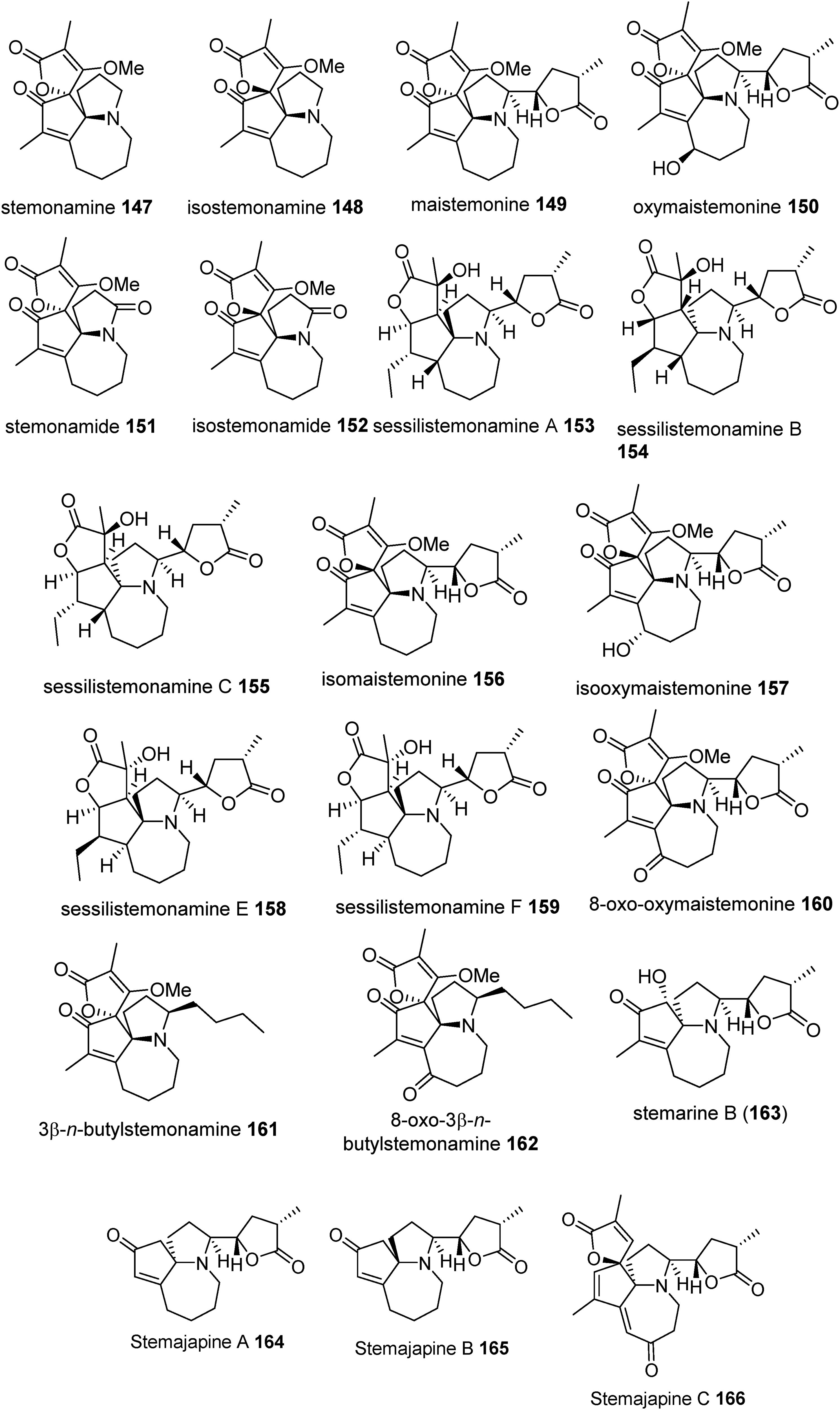
The stemonamine-type Stemona alkaloids are characterized by the presence of the cyclopenta[1,2-b]pyrrolo[1,2-a]azepine skeleton. Twenty stemonamine-type Stemona alkaloids have been isolated and identified until now. Iizuka isolated stemonamine (147) and isostenionamine (148) isolated from Stemona japonica Miq (Figure 6). The structure of 147 was confirmed by X-ray crystal-structure analysis of its hydrochloride form (Figure 6).74 These compounds do not have a lactone ring at C3. Lin et al75 reported the isolation and structure elucidation of maistemonine (149) and oxymaistemonine (150) from Stemona mairei collected from Yunnan Province, southwest China (Figure 6). Oxymaistemonine has a hydroxy group at C8. Stemonamide (151) and isostemonamide (152) were obtained from the roots extract of Stemona japonica, collected from Zhejiang Province, China (Figure 6).76 A ketone group appears at C3 of these compounds. In 2007, 3 new Stemona alkaloids, sessilistemonamines A-C (153-155) with a hydroxy group at C13, were isolated from the roots of Stemona sessilifolia (Figure 6).48 From the roots of Stemona sessilifolia, 2 alkaloids, namely isooxymaistemonine (156) and isomaistemonine (157) were discovered (Figure 6).77 Compound 157 has a hydroxy group at C8. Ramli et al78 obtained 2 new stichoneurine-type alkaloids sessilistemonamines E (158) and F (159), from the root extracts of Stichoneuron caudatum (Figure 6). These compounds differ from each other by the configuration of the ethyl group. In 2016, 8-oxo-oxymaistemonine (160), 3β-n-butylstemonamine (161), and 8-oxo-3β-n-butylstemonamine (160) were isolated from the roots of Stemona parviflora (Figure 6).63 Stemarines B (163) was isolated and identified from the roots of Stemona mairei (H.Ĺev.) K.Krause (Stemonaceae).64 Three hitherto undescribed Stemona alkaloids, namely stemajapines A-C (164-166) were achieved from the roots of Stemona japonica (Blume) Miq. (Stemonaceae). Their structures were elucidated by the analysis of the mass data, NMR spectra, and computational study. Stemjapines A and B differed from maistemonines by the absence of a spiro-lactone ring and skeletal methyl.79
Stemoamine group alkaloids.
Isolation of Stemona Alkaloids Belonging to Parvistemoline Group (Group 5)
The parvistemoline-type alkaloids are characterized by the presence of a substituent at C-9 of the pyrrolo[1,2-a]azepine nucleus and by the lack of the fused B-C ring system in comparison with the other groups of Stemona alkaloids. Thirteen Stemona alkaloids belonging to this group have been isolated and structurally elucidated. Parvistemonine (167) was the first parvistemoline group alkaloid which was isolated from the roots of Stemona parviflora collected in Hainan island, China (Figure 7).80 Lin et al81 isolated didehydroparvistemonine (168) and parvistemoline (169) from Stemona parviforia (Figure 7). Compound 168 has a pyrrole ring. Neostemodiol (170) was discovered by Ye and Xu82 (Figure 7). Kakuta et al49 achieved 3 new Stemona alkaloids, sessilifoliamides B-D (171-173), also known as stemona-lactams B-D, from the roots of Stemona sessilifolia (Figure 7). Compound 173 possesses a long side chain. Stichoneurine A (174) and B (175) were obtained from the lipophilic root extracts of Stichoneuron caudatum and Stemona tuberosa collected in Thailand (Figure 7).83 These compounds differ from each other by the configuration of the ethyl group.
Parvistemoline group alkaloids.
Protostemodiol (176) was yielded from stems and leaves of Stemona japonica (Figure 7).56 Two new alkaloids, stemaphylline (177) and stemaphylline-N-oxide (178) were produced from a root extract of Stemona aphylla (Figure 7).84 These compounds differ from each other by the N-oxide group. Recently, Hu et al38 isolated stemtuberoline A (179) from the roots of Stemona tuberosa (Figure 7).
Isolation of Stemona Alkaloids Belonging to Stemofoline Group (Group 6)
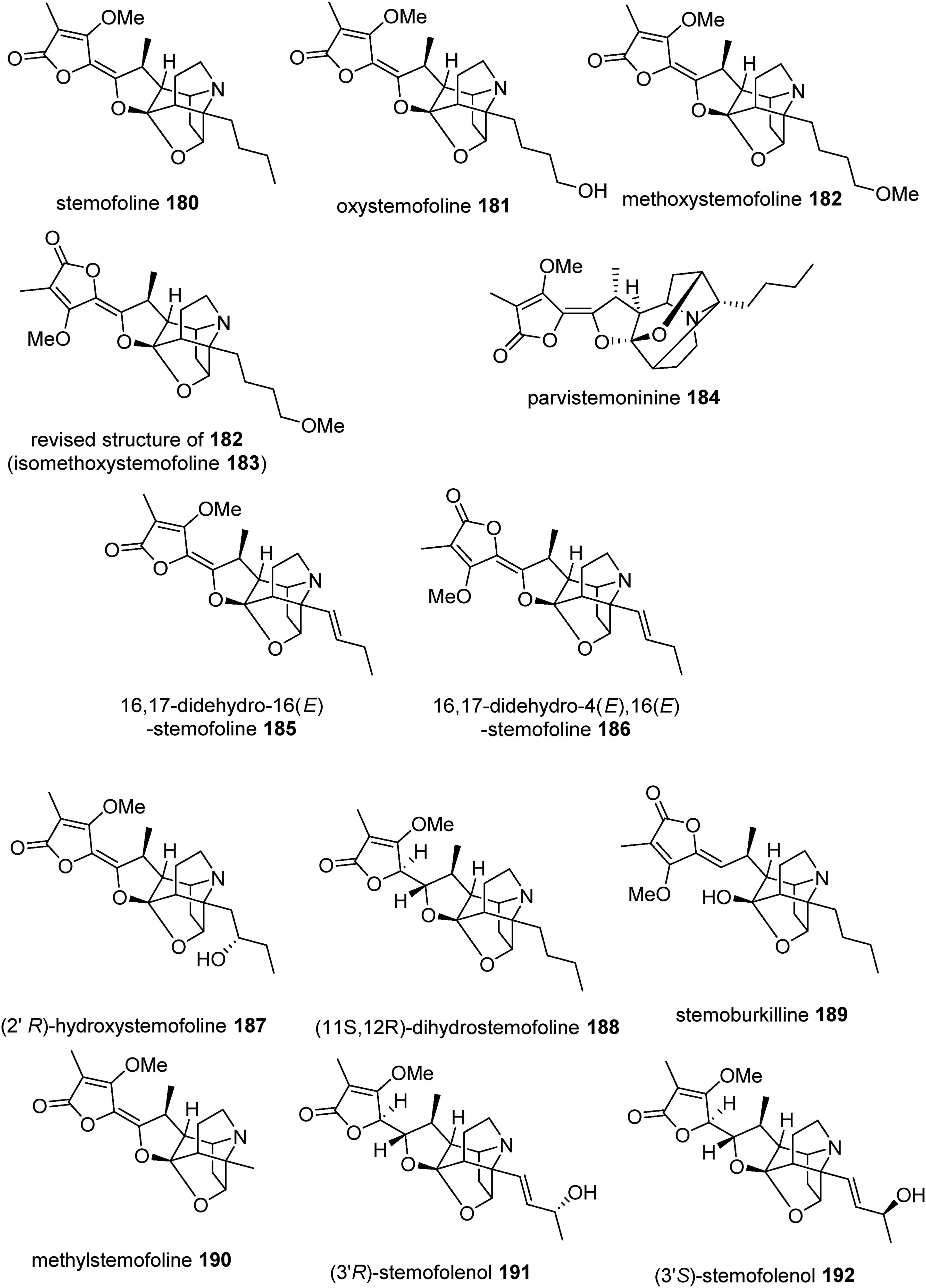
The alkaloids of this group possess a complex caged skeleton that has an ether bridge between C2 and C8 and a carbon-carbon bond between C3 and C7. Twenty Stemofoline group alkaloids have been isolated and identified until now. The first isolated Stemona alkaloid of this group was stemofoline (180) and the structure of this compound was confirmed by X-ray crystallographic analysis (Figure 8).85 Oxystemofoline (181) with a hydroxy group at the end of the butyl side chain and methoxystemofoline (182) were obtained from Stemona parvifloria (Figure 8).86 The structure of 182 was later revised as isomethoxystemofoline (183).87 Parvistemoninine (184) with an ether linkage was identified from Stemona parvifloria by Xu et al88 (Figure 8). 16,17-didehydro-16(E)-stemofoline (185) also known as didehydroisostemofoline) and 16,17-didehydro-4(E),16(E)-stemofoline (186) also known as isodidehydroisostemofoline) were achieved from the root extract of Stemona collinsae (Figure 8).89 These compounds have a double bond at the butyl side chain. 2-Hydroxystemofoline (187) was obtained from Stemona collinsae and its absolute configuration was confirmed by X-ray crystallography (Figure 8).90 Two novel dihydrostemofoline alkaloids, 11(S),12(R)-dihydrostemofoline (188) and stemoburkilline (189), were isolated from a root extract of Stemona burkillii Prain (Figure 8).91 In 2005, Sastraruji et al demonstrated the isolation and structure elucidation of 6 new stemofoline alkaloids including the first C19 stemofoline alkaloid, methylstemofoline (190), (3′R)-stemofolenol (191), (3′S)-stemofolenol (192), the first glycosidated Stemona alkaloid, stemofolinoside (193), 1′,2′-didehydrostemofoline-N-oxide (194), and (2′R)-hydroxystemofoline (195), from a root extract of an unidentified Stemona species (Figure 8).92 Compounds 191 and 192 differ from each other by the configuration of the hydroxy group at the side chain. Hydroxystemofoline (196) and 16-hydroxystemofoline (197) were obtained by Tang et al57 from stems and leaves of Stemona japonica (Figure 8). In 197, the methyl group at the lactone ring is oxidized to primary alcohol. By semisynthesis, Sastraruji et al93 proved that (1′R)-hydroxystemofoline (198), which they isolated and incorrectly reported as (2′S)-hydroxystemofoline, is a natural product (Figure 8). (2′S)-hydroxy-(11S,12R)-dihydrostemofoline (199) was isolated from the root extracts of Stemona aphylla (Figure 8).94 Huang et al63 isolated (19S)-hydroxy-21-methoxystemofoline (200) from the roots of Stemona parviflora (Figure 8).
Stemofoline group alkaloids.
Isolation of Stemona Alkaloids Belonging to Stemocurtisine Group (Group 7)
The stemocurtisine group alkaloids display a tetracyclic skeleton with an ether bridge between C-2 and C-8 and a carbon–carbon bond involving C-3 and C-7 of the pyrrolo[1,2-a]azepine nucleus. Thirteen alkaloids belonging to this group have been isolated and structurally determined. A new pentacyclic Stemona alkaloid, stemocurtisine (201) was isolated from a root extract of Stemona curtisii (Figure 9).95 This compound was also discovered by Kaltenegger et al48 at the same time and named pyridostemin. Along with pyridostemin, stemokerrin (202), oxystemokerrin (203), oxystemokerrin-N-oxide (204), and methoxystemokerrin-N-oxide (205) were isolated from 4 Stemona species (Figure 9).48 Stemokerrin has a double bond at C8 and C9, while oxystemokerrin and oxystemokerrin-N-oxide possess an ether bridge. Stemocurtisinol (206) with an ether linkage between C1 and C9 was obtained from a root extract of S curtisii (Figure 9).96 Wang et al53 achieved oxystemokerrilactone (207), stemokerrin-N-oxide (208), and cochinchistemoninone (209), from the roots of Vietnamese Stemona (Figure 9). Cochinchistemoninone contains a spiro lactone ring. Stemocochinamine (210) was yielded from the roots of Stemona cochinchinensis (Figure 9).51 Cochinchistemonine (211) was separated from the roots of Stemona cochinchinensis collected from northern Vietnam (Figure 9).97 Guo et al77 separated and identified stemosessifoine (212) from the roots of Stemona sessilifolia (Figure 9). Stemocurtisine N-oxide (213) was isolated from the root extracts of Stemona curtisii (Figure 9).58
Stemocurtisine group alkaloids.
Isolation of Stemona Alkaloids Belonging to Mislacenous Group (Group 7)
Fifty-six Stemona alkaloids belonging to this group have been isolated and characterized. Oxotuberostemonine (214) was separated by Kondo98 in 1954 and it was confirmed by crystallographic analysis in 1968 (Figure 10).99 Parvistemoamide (215) was obtained by Xu et al88 from Stemona parviflora (Figure 10). Recently, Olivier et al100 revised the structure of parvistemoamide as stemoamide 60. Lin et al11 separated tuberosternonone (216) from the roots of Stenuma tuberosa (Figure 10). Tuberostemoninol (217) was yielded from the roots of Stemona tuberosa (Figure 10).47 The isolation of tuberostemoenone (218) was reported by Cui and Lin101 (Figure 10). Jiang et al15 discovered neotuberostemoninol (219) from Stemona tuberosa Lour and its structure was characterized by X-ray crystallography (Figure 10). Parvineostemonine (220) was isolated from the stems and leaves of Stemona parviflora (Figure 10).102 Cai and Luo16 achieved maireistemoninol (221), neotuberostemonone (222), and epoxytuberostemonone (223) from the roots of Stemona mairei (Figure 10). Compound 223 contains an oxirane ring. Four new alkaloids, sessilifoliamides E-H (224-227) (also known as stemona-lactams E-H) were isolated from the roots of Stemona tuberosa (Miq.) Miq, and their configurations were confirmed by X-ray crystallography (Figure 10).103 Sessilifoliamides E and F differ from each other by a tertiary alcohol, while sessilifoliamide G has an ether bridge.
Mislaceneous Stemona alkaloids.
Sessilifoliamide I (228) was produced from the root extracts of Stemona sessilifolia (Miq.) and its structure was elucidated by analysis of spectral data and X-ray crystallography (Figure 10).104 Wang et al105 obtained sessilistemonamine D (229) from the roots of Stemona sessilifolia (Figure 10). Lin et al24 isolated tuberocrooline (230) and tuberostemoline (231) from the roots of Stemona tuberosa collected from Yunnan Province (Figure 10). Sessilifoliamide J (232) (also known as stemona-lactam J) having novel alkaloid skeletons was isolated from the roots of Stemona sessilifolia and its configuration was confirmed by X-ray crystallography (Figure 10).49 1,9a-seco-stemoenonine (233) with a carboxyl group was yielded from the roots of Stemona tuberosa by Lin et al.54 Two new alkaloids, named tuberostemoninol A (234) and tuberostemoninol B (235) were isolated from Stemona tuberosa (Figure 10).106 These compounds are diastereomers. Two novel Stemona alkaloids, sessilifoliamides K (236) and L (237), with a new pyrido[1,2-a]azonine skeleton were obtained from the roots of Stemona sessilifolia (Figure 10).107 Stemoxazolidinones A-C (238-240) were isolated from the roots of Stemona sessilifolia (Figure 10).25 The only difference between 238 and 239 is the configuration of the ethyl group, while 240 differs from 238 by the stereochemistry of the spiro lactone ring. Hitotsuyanagi et al26 discovered stemona-lactams M, N, and Q (241-243) from the roots of Stemona tuberosa (Figure 10). The configuration of stemona-lactam M was confirmed by X-ray crystallography (Figure 10). Stemona-amines C (244) and D (245) were isolated from the roots of Stemona tuberosa Lour (Figure 10).29 The only difference between 244 and 245 is the configuration of the hydroxy group.
A new Stemona alkaloid, 6-hydroxy-5,6-seco-stemocurtisine (246) was produced from the aerial parts of Stemona curtisii collected from Trang Province in Thailand and its configuration was determined by single-crystal X-ray crystallographic analysis (Figure 10).108 Fukaya et al109 obtained stemona-lactam S (247) from the roots of Stemona tuberosa and its absolute stereochemistry was elucidated by analysis of X-ray crystallography and vibrational circular dichroism (Figure 10). Stichoneurines F (248) and G (249) were achieved from the root extracts of Stichoneuron caudatum (Figure 10).78 Sessilifoliamides E and F differ from each other by a tertiary alcohol. Yue et al110 discovered stemonatuberone A-C (250-252), stemonatuberonol A (253), and stemonatuberosine A (254) from the ethanolic extract of dried root of Stemona tuberosa (Figure 10). Compounds 250 and 252 are epimers. Neotuberostemoenone (255) was produced from the roots of Stemona tuberosa (Figure 10).31 Tuberostemoline A (256), tuberostemoline B (257), oxotuberostemonine A (258), and tuberostemoninol C (259) were yielded from the roots of Stemona tuberosa (Figure 10).30 Two new alkaloids, stemona-amines F (260) and G (261) were obtained from the roots of Stemona tuberosa Lour. (Stemonaceae). The relative configuration of stemona-amine F was established by X-ray crystallography (Figure 10).111 Hu et al73 discovered stemtuberlines A (262) and B (263), 2 new alkaloids with a special pyrrolo[32,1-jk]benzazepine-12-one skeleton, from the roots of Stemona tuberosa (Figure 10).
Chalom et al112 separated a new Stemona alkaloid glycoside derivative, 6-hydroxy-5,6-secostemocurtisinoside (264) from the ethanolic extract of the aerial parts of Stemona curtisii (Figure 10). Tuberostemoline F (265) was produced from the roots of Stemona tuberosa and its structure was elucidated by spectroscopic data, X-ray single-crystal diffraction, and modified Mosher method (Figure 10).40 It is the first Stemona alkaloid to attach to a sugar molecule. Shi et al39 achieved atrop-tuberostemonone (266) and 9-deoxo-stemona-lactam F (267) from the roots of Stemona tuberosa (Figure 10). In this report, the structure of stemonatuberone B was revised to 268. Recently, stemarines N (269) and O (270) were isolated from the roots of Stemona mairei (H.Ĺev.) K.Krause (Stemonaceae).64 The only difference between 269 and 270 is the configuration of the hydroxy group.
Bioactivities of Stemona Alkaloids
Insecticidal Activity
Tang et al56 tested in vitro the insecticidal activity of 6β-hydroxystemofoline 196, 16-hydroxystemofoline 197, neostemofoline 88, protostemodiol 176, and 13-demethoxy (11S*,12R*)-dihydroprotostemonine 87, and stemofoline 180 against pest insect Heliothis virescens. All compounds showed potential activities. Compounds 196, 197, 88, and 180 acted as agonists, whereas 176 and 87 acted as antagonists of the insect nicotinic acetylcholine receptors (nAChRs). The remarkable potential of these stemofolines might be related to the defense system of the Stemona plants. Kaltenegger et al48 reported that lipophilic crude extracts of the roots of Stemona curtisii and Stemona cochinchinensis exhibited significant insecticidal activity against Spodoptera littoralis, whereas moderate activity for S kerrii was observed. Among isolated alkaloids, stemofoline 180 was the most active, followed by oxystemokerrin 203 with IC50 values of 2.0 and 5.9 ppm, respectively. The accumulation of stemofoline, oxystemokerrin, and dehydroprotostemonine 67 might be responsible for the insecticidal activity of these plants via 2 different modes of action.
The insecticidal properties of the crude extract of Stemona aphylla roots and stemaphylline 177, using a topical application, were screened by Mungkornasawakul et al.84 Results showed this compound had an equal activity to the positive control, methomyl, while the crude extract showed much lower activity. Sakata et al65 examined the biological activities of stemospironine and stemofoline against fourth-instar silkworm larvae. Stemofoline was much more active than stemospironine against silkworm larvae (Bombyx mori L.) by oral administration. Brem et al113 indicated that extracts from the leaves and roots of Stemona collinsae exhibited strong insecticidal activity compared to those of 2 Aglaia species, a commercial Pyrethrum extract, and azadirachtin. Stemofoline and didehydrostemofoline isolated from extracts exhibited stronger activities than those of Pyrethrum extract. Tuberostemonine showed excellent repellency but no toxic effects.
Jiwajinda et al89 demonstrated that 16,17-didehydro-16(E)-stemofoline (185) exhibited better insecticidal activity than stemofoline against diamondback moth larvae. Kongkiatpaiboon et al114 investigated insecticidal activities against neonate larvae of Spodoptera littoralis of 10 Stemona curtisii roots and found that stemofoline possessed the highest insecticidal activity with an LC50 value at 2.4 ppm and EC50 at 0.98 ppm. Sakulpanich et al115 demonstrated that S collinsiae root extract displayed insecticidal activity and killed P ruficornis in the larval stage via topical administrations and killed adult P ruficornis by ingestion administration. The finding suggested that the root extract could be used as a natural insecticide to terminate the life cycle of P ruficornis.
Antitussive Activity
In a study described by Lin’s group, bisdehydrostemoninine 69 showed remarkable antitussive activity in the citric acid-induced guinea pig cough model (ID50 = 188 ± 13 μM).50 In another report, tuberocrooline 230 and 10-hydroxycroomine 130, along with croomine 123 and tuberospironine were examined for antitussive activity in the citric acid-induced guinea pig cough model. Croomine 123 was the most potent compound showing a dose-dependent inhibition of coughing with an ID50 value of 0.18 mmol/kg.24 The group also evaluated stemoenonine 81, 9a-O-methylstemoenonine 84, stemoninoamide 65, and stemoninine 59 for their antitussive activities. Among them, compounds 65 and 59 displayed good antitussive activity after oral and intraperitoneal administrations with ID50 values of 0.33 and 0.26 mmol/kg, respectively.54
Stemokerrin was evaluated for antitussive activity using a citric acid-induced guinea pig cough model. It displayed significant antitussive activity, and about 62% cough inhibition was observed at a single intraperitoneal dose of 70 mg/kg.60 Four alkaloids, neotuberostemonine, tuberostemonine, and tuberostemonine were tested for antitussive activity in the citric acid-induced guinea pig cough model. All of them displayed dose-dependent inhibitory activity after intraperitoneal administration. Tuberostemonine had the same potency via both oral and intraperitoneal dosing, while neotuberostemonine showed significantly lower oral activity than intraperitoneal application. In contrast, tuberostemonine did not show oral activity.116 Yang et al57 proved that protostemonine, stemospironine, and maistemonine showed remarkable antitussive activity in a citric acid-induced guinea pig cough model via peripheral administration, while stemonamine had antitussive activity via intracerebroventricular administration.
Five Stemona alkaloids including neotuberostemonine (5), tuberostemonine H (16), tuberostemonine J (17), epi-bisdehydrotuberostemonine (18), and neostenine (15) isolated from Stemona tuberosa were tested for antitussive activity in the guinea pig after cough induction by citric acid aerosol stimulation. Compounds 5 and 15 showed excellent antitussive activity.18 Xu et al117 examined the antitussive potency of croomine, neotuberostemonine, stemonine, and tuberostemonine in guinea pigs with citric acid aerosol to induce cough. Neotuberostemonine, tuberostemonine, and stemoninine acted on the peripheral cough reflex pathway, while croomine acted on the central part.
Acetylcholinesterase (AChE) Inhibitory
AChE inhibition is also an important bioactivity of the Stemona alkaloids. Sessilistemonamines A-C 153 to 155 and dihydrostemoninine 78 isolated from the roots of Stemona sessilifolia were examined for AChE inhibitory properties by Wang et al.52 Compounds 153 and 154 displayed moderate activity with IC50 values of 68.8 ± 9.5 and 17.1 ± 2.5 µM, respectively but much less than huperzine A (IC50 = 0.021 ± 0.016 µM), the reference compound. Stichoneurine E 94, bisdehydostemoninine A 72, stemoninine 59, sessilistemonamine C 155, and sessilistemonamine A 131 were yielded from Stichoneuron halabalensis and evaluated as inhibitors of electric eel and human AChE. Compounds 72 and 59 exhibited moderate inhibitory activity against human AChE with IC50 values of 5.52 ± 0.13 and 3.74 ± 0.09, respectively, but less potent than galantamine (IC50 = 0.54 ± 1.25 μM), the standard drug.59
Kongkiatpaiboon et al118 evaluated the AChE inhibitory activity of hexane, dichloromethane, and methanol extracts of Stemona collinsiae roots as well as isolated Stemona alkaloids including didehydrostemofoline and stemofoline. IC50 values on AChE inhibitory activities of hexane, dichloromethane, and methanol extracts were 126.72, 73.78, and > 1000 mg/mL, respectively. IC50 values of didehydrostemofoline, stemofoline, and standard galanthamine were 131.3, 102.1, and 1.30 mM, respectively. In a study demonstrated by Qian et al,22 neotuberostemonine, sessilifoline B, and a mixture of bisdehydrotuberostemonine D and bisdehydrotuberostemonine E displayed potential AChE inhibitory activities in a dosage of 10 mg using huperzine A as a reference drug. Dong et al36 tested the AChE inhibitory activity of dehydrostenines A and B and concluded that these compounds did not show significant activity.
Mungkornasawakul et al84 screened the AChE inhibitory activity of crude dichloromethane root extract of Stemona aphylla and stemaphylline. The results revealed that the crude extract had higher activity than that of stemaphylline. In a report described by Lai et al,28 stenine A (35) and stenine (2) exhibited remarkable anti-AChE activities, with IC50 values of 2.1 ± 0.2 μM and 19.8 ± 2.5 μM, respectively. Stichoneurines F (248) and G (249), sessilistemonamines E (158) and F (157) were isolated from the root extracts of Stichoneuron caudatum and screened for AChE inhibitory activities. Among them, sessilistemonamines E displayed remarkable inhibitory activity with an IC50 value of 9.1 ± 0.15 μM.78 Sastraruji et al93 demonstrated that (1′R)-hydroxystemofoline showed the best AChE inhibition although its activity was weaker than galanthamine, the reference drug. Eight alkaloids including atrop-tuberostemonone, 9-deoxo-stemona-lactam F, 9a-epi-stemona-lactam P, tuberostemonone, tuberostemonine, 2-oxostenine, stemona-amine B, and stemona-lactam Q were examined for their AChE inhibitory activities following Ellman's method using huperzine A as the reference compound (IC50 48.8 nM). Among them, tuberostemonine and 2-oxostenine showed strong activities with IC50 values of 66.4 and 81.4 mM, respectively.39
Other Bioactivities
Umsumarng et al119 investigated the MDR modulation effects of alkaloids isolated from Stemonaceae plants from the family Stemona and Stichoneuron. Stemona alkaloids including isostmofoline, 11Z-didehydrostemofoline, and 11E-didehydrostemofoline with core caged ring structure displayed good activity to inhibit P-gp function and increase anti-neoplastic drug sensitivity. In addition, these alkaloids exhibited less toxicity toward normal cells (fibroblast, PBMCs, and RBCs) in in vitro studies. Chanmahasathien et al120 evaluated stemocurtisine, oxystemokerrine, and stemofoline for synergistic growth inhibitory activity with some anticancer agents including vinblastine, paclitaxel, and doxorubicin of KB-V1 cells. Results revealed that stemofoline exhibited the most inhibitory activity in vitro in the reversal of P-gp-mediated MDR. In addition, the sensitivity of these drugs in a dose- and time-dependent manner in KB-V1 cells was remarkably increased by treatment with stemofoline at different concentrations up to 72 h.
Hu et al38 described the evaluation for anti-tobacco mosaic virus (TMV) activity of the Stemona alkaloids and dehydroisostemoninine was found to exhibit excellent anti-TMV activity with the curative inhibition rate of 84.6% at a concentration of 50 µg/mL. Stemtuberoline also C displayed significant anti-TMV activity with an inhibition rate of 60.48% at the concentration of 50 μg/mL in comparison with ningnamycin, the reference drug (52.89%.).
The anthelminthic activity of tuberostemonine 1 was evaluated against A cantonensis, D canium, and F hepatica. This compound affected the mobility of these helminthic worms.121 Tuberostemonine was suggested as the major ingredient that is responsible for the insectidal activity of Stemona tuberosa against the larvae of Spodoptera littoralis.122 Stemarines C-F, Stemona alkaloids possessing a five-carbon carboxylic side chain at C-3, displayed excellent nematocidal activity against Caenorhabditis elegans.64 Pyne et al96 isolated a new pyrido[1,2-a]azepine Stemona alkaloids, stemocurtisinol, and known compound oxyprotostemonine from the roots of S curtisii and examined for larvicidal activity on malarial carrying mosquito larvae. These alkaloids displayed more significant activity than the crude extract. Among them, oxyprotostemonine was the most active component. Chalom et al112 examined larvicidal activities against the dengue vector, Aedes aegypti of the extract of aerial parts of Stemona curtisii and the pure isolated compounds including 6-hydroxy-5,6-secostemocurtisinoside, stemocurtisine, (11Z)-1′,2′ didehydrostemofoline, and 6-hydroxy-5,6-seco-stemocurtisine. (11Z)-1′,2′ didehydrostemofoline displayed the strongest larvicidal activity with a LC50 value of 2.44 mM. In a study reported by Ramli et al,61 3 alkaloids including 13-demethoxy-11(S*), 12(R*)-dihydroprotostemonine, isoprotostemonine, and protostemonine exhibited moderate antiplasmodial activities against the Plasmodium falciparum strains, TM4 (IC50 values of 17.7 3.7, 16.8 5.4, and 16.0 4.2 mg/mL, respectively) and K1 (IC50 values of 16.8 3.1, 14.1 3.7, and 11.9 3.3 mg/mL, respectively).
Twelve Stemona alkaloids including stemokerrin, methoxystemokerrin-N-oxide, oxystemokerrin, oxystemokerrin-N-oxide, pyridostemin (stemocurtisine), dehydroprotostemonine, oxyprotostemonine and stemocochinine, stemofoline, 2′-hydroxystemofoline, protostemonine, and parvistemonine were obtained from 4 Stemona species. All of them were evaluated for toxicity and growth inhibition against neonate larvae of Spodostera littoralis using 1′,2′-didehydrostemofoline as the reference compound. Stemofoline was found to be the most active, followed by oxystemokerrin (IC50 values of 2.0 and 5.9 ppm, respectively).96
Xu et al40 investigated NO production inhibitory effects in LPS-induced RAW 264.7 cells of 29 Stemona alkaloids and found that compound dehydrostenine B exhibited equivalent activity to that of the positive drug dexamethasone, while compounds dehydrostenine A, tuberostemonine D, tuberostemonine O, tuberostemoline F, tuberostemoline, and dehydrocroomine displayed a medium inhibitory effect. Stemjapines A and C exhibited strong NO production inhibitory activity with IC50 values of 19.7 and 13.8 µM.79
Lee et al123 investigated the inhibitory effect on lipopolysaccharide-induced nitric oxide production of methanol extract of the roots of Stemona tuberosa and isolated Stemona alkaloids. The results indicated that methanol extract significantly inhibited lipopolysaccharide-induced nitric oxide production in murine BV2 microglial cells. Among tested compounds, bisdehydroneotuberostemonine, epi-bisdehydrotuberostemonine J, and bisdehydrotuberostemonine exhibited remarkable inhibitory effects on lipopolysaccharide-induced nitric oxide production in BV2 microglia at 100 μM. In research reported by Huang et al, protostemonine and stemofoline showed strong nematicidal activity against Panagrellus redivevus, with IC50 values of 0.10 and 0.46 μM, respectively.59 The bioactivity of Stemona alkaloids is also well summarized by Pyne et al.124,125
Conclusion
In conclusion, in this review article, we have described the isolation and bioactivity of Stemona alkaloids from the Stemonacea family. We have summarized more than 110 studies on the isolation and bioactivity of Stemona alkaloids in the literature. More than 250 Stemona alkaloids have been isolated and identified. Furthermore, the article also focuses on the bioactivities of Stemona alkaloids. Revision on the structure of several Stemona alkaloids was also presented. Presumably, these activities can help to explain the traditional medicinal application of these plants although further pharmacological studies are needed. In the future, the total syntheses of Stemona alkaloids will be discussed and reported.
Footnotes
Declaration of Conflicting Interests
The author(s) declared no potential conflicts of interest with respect to the research, authorship, and/or publication of this article.
Ethical Approval
Ethical approval is not applicable to the article.
Funding
The author(s) received no financial support for the research, authorship, and/or publication of this article.
Informed Consent
There are no human subjects in this article and informed consent is not applicable.
ORCID iDs
Le Duc Giang
Duc Dau-Xuan
Statement of Human and Animal Rights
This article does not contain any studies with human or animal subjects.
References
1.
GregerH. Structural relationship, distribution and biological activities of Stemona alkaloids. Planta Med. 2006;72(2):99-113. DOI: https://doi.org/10.1055/s-2005-916258
2.
(a) PilliRARossoGBFerreira de OliveraM. Recent progress in the chemistry of the Stemona alkaloids. Nat Prod Rep. 2000(17):117-127. DOI: https://doi.org/10.1039/A902437I; (b) Pilli RA, Rosso GB, Ferreira de Olivera MdC. The chemistry of Stemona alkaloids: An update. Nat Prod Rep. 2010(27):1908-1937. DOI: 10.1039/C005018K
3.
ChungHSHonPMLinGButPPHDongH. Antitussive activity of Stemona alkaloids from Stemona tuberosa. Planta Med. 2003;69(10):914-920. DOI: https://doi.org/10.1021/np070651+
4.
SekineTIkegamiFFukasawaN, et al.Structure and relative stereochemistry of a new polycyclic alkaloid, asparagamine A, showing anti-oxytocin activity, isolated from Asparagus racernosus. J Chem Soc, Perkin Trans. 1995;1:391-393. DOI: https://doi.org/10.1039/P19950000391
5.
LiuYShenYTengL, et al.The traditional uses, photochemistry, and pharmacology of Stemona species: a review. J Ethnopharmacol. 2021;265:113112. Doi: https://doi.org/10.1016/j.jep.2020.113112
UyeoSIrieHHaradaH. The structure of stenine, a new alkaloid occurring in Stemona tuberosa. Chem Pharm Bull. 1967;15(6):768-770. DOI: https://doi.org/10.1248/cpb.15.768
10.
EdwardsOEFeniakGHandaKA. The alkaloid of Stemona sessilifolia. Canadian J Chem. 1961;40(3):455-462. DOI: https://doi.org/10.1139/v62-07
11.
LinWHYeYXuRS. Chemical studies on new Stemona alkaloids, IV. Studies on new Stemona alkaloids from Stemona tuberosa. J Nat Prod. 1992;55(5):571-576. DOI: https://doi.org/10.1021/np50083a003
ZouCYFuHZLeiHMLiJLinWH. New alkaloids from the roots of Stemona japonica Miq. J Chin Pharm Sci. 1999;8:185-189.
14.
LinWHFuHZ. Three new alkaloids from the roots of Stemona tuberosa. J Chin Pharm Sci. 1999;8:1-7.
15.
JiangRWHonPMButPPH, et al.Isolation and stereochemistry of two new alkaloids from Stemona tuberosa. Tetrahedron. 2002;58(33):6705-6712. DOI: https://doi.org/10.1016/S0040-4020(02)00678-6
ChungHSHonPMLinGButPPHDongH. Antitusive activity of Stemona alkaloids from Stemona tuberosa. Planta Med. 2003;69(10):914-920. DOI: https://doi.org/10.1055/s-2003-45100
19.
JiangRWHonPMZhouY, et al.Alkaloids and chemical diversity of Stemona tuberosa. J Nat Prod. 2006;69(5):749-754. DOI: https://doi.org/10.1021/np050539g
20.
SastrarujiTJatisatienrAIssakulK, et al.Phytochemical studies on Stemona plants: isolation of new tuberostemonine and stemofoline alkaloids. Nat Prod Commun. 2006;1(10):813-818. https://doi.org/10.1177/1934578X0600101
21.
HuJPYangaDHLinaWHCaiSQ. Alkaloids from the roots of Stemona tuberosa. Helv Chim Acta. 2009;92(10):2125-2133. DOI: https://doi.org/10.1002/hlca.200900124
SchinnerlJBremBButPPHVajrodayaSHoferOGregerH. Pyrrolo- and pyridoazepine alkaloids as chemical markers. Phytochemistry. 2007;68(10):1417-1427. DOI: https://doi.org/10.1016/j.phytochem.2007.03.002
24.
LinLGLeungHPHZhuJY, et al.Croomine- and tuberostemonine-type alkaloids from roots of Stemona tuberosa and their antitussive activity. Tetrahedron. 2008;64(4):10155-10161. DOI: https://doi.org/10.1016/j.tet.2008.08.046
25.
HitotsuyanagiYHikitaMUemuraGFukayaHTakeyaK. Structures of stemoxazolidinones A-F, alkaloids from Stemona sessilifolia. Tetrahedron. 2011;67(2):455-461. DOI: https://doi.org/10.1016/j.tet.2010.11.013
26.
HitotsuyanagiYFukayaHTakedaE, et al.Structures of stemona-amine B and stemona-lactams M-R. Tetrahedron. 2013;69(30):6297-6304. DOI: https://doi.org/10.1016/j.tet.2013.04.136
LaiDHYangZDXueWWShengJShiYYaoXJ. Isolation, characterization and acetylcholinesterase inhibitory activity of alkaloids from roots of Stemona sessilifolia. Fitoterapia. 2013;89:257-264. DOI: https://doi.org/10.1016/j.fitote.2013.06.010
29.
HitotsuyanagiYShigemoriGFukayaH, et al.Stemona-amines C–E, new alkaloids from Stemona tuberosa. Tetrahedron Lett. 2013;54(51):6995-6998. DOI: https://doi.org/10.1016/j.tetlet.2013.10.014
30.
GaoYWangJZhangCFXuXHZhangMKongLY. Seven new alkaloids from the roots of Stemona tuberosa. Tetrahedron. 2015;70(4):967-974. DOI: https://doi.org/10.1016/j.tet.2013.12.003
31.
DengYLiangXWeiKYangYR. Ir-catalyzed asymmetric total syntheses of bisdehydrotuberostemonine D, putative bisdehydrotuberostemonine E and structural revision of the latter. J Am Chem Soc. 2021;143(49):20622-20627. DOI: https://doi.org/10.1021/jacs.1c11265
32.
LinLKeCWangYYeY. Two new alkaloids from roots of Stemona tuberosa. Rec Nat Prod. 2014;8(4):317-322.
JiangJMShiZHYangXW, et al.Structural revision of the Stemona alkaloids tuberostemonine O, dehydrocroomines A and B, and dehydrocroomine. J Nat Prod. 2022;85(8):2110-2115. DOI: https://doi.org/10.1021/acs.jnatprod.2c00332
35.
ZhangRRTianHYWuY, et al.Isolation and chemotaxonomic significance of stenine- and stemoninine-type alkaloids from the roots of Stemona tuberosa. Chin Chem Lett. 2014;25(9):1252-1255. DOI: https://doi.org/10.1016/j.cclet.2014.03.051
OlivierWJLucasNTBissemberACSmithJA. Revised structures of dehydrostenines A and B: total syntheses of (±)-dehydrostenine A and structure assigned to dehydrostenine B. Chem Eur J. 2021;27(62):16382–15386. DOI: https://doi.org/10.1002/chem.202102651
38.
HuZXAnQTangHY, et al.Stemtuberolines A-G, new alkaloids from Stemona tuberosa and their anti-TMV activity. Fitoterapia. 2020;143:104572. DOI: https://doi.org/10.1016/j.fitote.2020.104572
39.
ShiZHZhouZBQinWN, et al.New Stemona alkaloids from the roots of Stemona tuberosa and structural revision of stemonatuberone B. Tetrahedron Lett. 2020;61(22):151925. DOI: https://doi.org/10.1016/j.tetlet.2020.151925
40.
XuYXiongLYanY, et al.Alkaloids from Stemona tuberosa and their anti-inflammatory activity. Frontier Chem. 2022;10:847595. DOI: https://doi.org/10.3389/fchem.2022.847595
41.
KoyamaHOdaK. Crystal and molecular structure of stemonine hydrobromide hemihydrate. J Chem Soc B. 1970:1330-1333. DOI: https://doi.org/10.1039/J29700001330
IrieHHaradaHOhnoKMizutaniTUyeoS. The structure of the alkaloid protosternonine. J Chem Soc D. 1970:268-269. DOI: https://doi.org/10.1039/C29700000268
44.
KuoCChuTT. A study of Stemona alkaloids I. Acta Chim Sin.1978;36(4):291-296.
45.
ChengDGuoJChuTT. A study of Stemona alkaloids III. Application of 2D-NMR spectroscopy in the structure determination of stemoninine. J Nat Prod.1988;51(2):202-211. DOI: https://doi.org/10.1021/np50056a002
KalteneggerEBremBMereiterK, et al.Insecticidal pyrido[1,2-a]azepine alkaloids and related derivatives from Stemona species. Phytochemistry. 2003;63(7):803-816. DOI: https://doi.org/10.1016/S0031-9422(03)00332-7
49.
KakutaDHitotsuyanagiYMatsuuraNFukayaHTakeyaK. Structures of new alkaloids sessilifoliamides A–D from Stemona sessilifolia. Tetrahedron. 2003;59(39):7779-7786. DOI: https://doi.org/10.1016/S0040-4020(03)01235-3
50.
LinLGZhongQXChengTY, et al.Stemoninines from the roots of Stemona tuberosa. J Nat Prod. 2006;69(7):1051-1054. DOI: https://doi.org/10.1021/np0505317
51.
LinLGDienPHTangCPKeCQYangXZYeY. Alkaloids from the roots of Stemona cochinchinensis. Helv Chim Acta. 2007;90(11):2167-2175. DOI: https://doi.org/10.1002/hlca.200790224
52.
WangPLiuALAnZLiZHDuGHQinHL. Novel alkaloids from the roots of Stemona sessilifolia. Chem Biodiver. 2007;4(3):523-530. DOI: https://doi.org/10.1002/cbdv.200790045
53.
WangYZTangCPDienPHYeY. Alkaloids from the roots of Stemona saxorum. J Nat Prod. 2007;70(8):1356-1359. DOI: https://doi.org/10.1021/np070099o
54.
LinLGLiKMTangCP, et al.Antitussive stemoninine alkaloids from the roots of Stemona tuberosa. J Nat Prod. 2008;71(6):1107-1110. DOI: https://doi.org/10.1021/np070651+
55.
WangPLiuALLiZHDuGHQinHL. Stemoninine-type alkaloids from the roots of Stemona sessilifolia. J Asian Nat Prod Res. 2008;10(4):311-314. DOI: https://doi.org/10.1080/10286020701833511
56.
TangCPChenTVeltenR, et al.Alkaloids from stems and leaves of Stemona japonica and their insecticidal activities. J Nat Prod. 2008;71(6):112-116. DOI: https://doi.org/10.1021/np070427k
57.
YangXZZhuJYTangCP, et al.Alkaloids from roots of Stemona sessilifolia and their antitussive activities. Planta Med. 2009;75(2):174-177. DOI: https://doi.org/10.1055/s-0028-1088345
58.
ChaiyongSJatisatienrAMungkornasawakulP, et al.Phytochemical investigations of Stemona curtisii and synthetic studies on stemocurtisine alkaloids. J Nat Prod. 2010;73(11):1833-1838. DOI: https://doi.org/10.1021/np100474y.9
59.
RamliRALieWPyneSG. Alkaloids from the roots and leaves of Stichoneuron halabalensis and their acetylcholinesterase inhibitory activities. Nat Prod Commun. 2013;8(6):695-698. DOI: https://doi.org/10.1177/1934578X1300800
RamliRAPudjiastutiPTjahjandaricTS, et al.Alkaloids from the roots of Stemona javanica (Kunth) Engl. (Stemonaceae) and their anti-malarial, acetylcholinesterase inhibitory and cytotoxic activities. Phytochem Lett. 2015;11:157-162. DOI: https://doi.org/10.1016/j.phytol.2014.12.009
62.
YiMXiaXWuHY, et al.Structures and chemotaxonomic significance of Stemona alkaloids from Stemona japonica. Nat Prod Commun. 2015;10(12):2097-2099. DOI: https://doi.org/10.1177/1934578X150100
ShiBBKongkiatpaiboonSChenG, et al.Nematocidal alkaloids from the roots of Stemona mairei (H.Ĺev.)K.Krause and identification of their pharmacophoric moiety. Bioorg Chem. 2023;130:106239. Doi: https://doi.org/10.1016/j.bioorg.2022.106239
65.
SakataKAokiKChangCFSakuraiATamuraSMurakoshiS. Stemospironine, a new insecticidal alkaloid of Stemona japonica Miq. isolation, structural determination and activity. Agric BioI Chem. 1978;42(2):457-463. DOI: https://doi.org/10.1080/00021369.1978.10862996
66.
NoroTFukushimaSUenoAMiyaseTIikataYSaikiY. A new alkaloid, croomine, from Croomia heterosepala Okuyama. Chem Pharm. Bull. 1979;27(6):1495-1497. DOI: https://doi.org/10.1248/cpb.27.1495
67.
XuRSLuYJChuZH. Study on some Stemona alkaloids: a diagnostically useful 1H NMR line-broadening effect. Tetrahedron. 1982;38(17):2667-2670. DOI: https://doi.org/10.1016/0040-4020(82)80020-3
JiangRWHonPMXuYT, et al.Isolation and chemotaxonomic significance of tuberostemospironine-type alkaloids from Stemona tuberosa. Phytochemistry. 2006;67(1):52-57. https://doi.org/10.1016/j.phytochem.2005.10.004
70.
HitotsuyanagiYTakedaEFukayaHTakeyaK. Sessilifoliamine A and sessilifoliamide J: new alkaloids from Stemona sessilifolia. Tetrahedron Lett. 2008;49(52):7376-7379. DOI: https://doi.org/10.1016/j.tetlet.2008.10.042
71.
GuoJHeHPLiSLHuaHMHaoXJ. A new alkaloid from the roots of Stemona tuberosa (Stemonaceae). Acta Bot Yunnanica.2010;32(5):463-465. DOI: https://doi.org/10.3724/SP.J.1143.2010.10084
72.
PudjiastutiPPyneSGSugiyantoLieW. Isolation of tuberospironine A, a novel croomine derivative from Stemona tuberosa Lour. Phytochem Lett. 2012;5(2):358-360. DOI: https://doi.org/10.1016/j.phytol.2012.03.001
73.
HuZXTangHYGuoJAisaHAZhangYHaoXJ. Alkaloids from the roots of Stemona tuberosa and their anti-tobacco mosaic virus activities. Tetrahedron. 2019;75(12):1711-1716. DOI: https://doi.org/10.1016/j.tet.2018.11.064
74.
IizukaHIrieHMasakiNOsakiKUyeoS. X-ray crystallographic determination of the structure of stemonamine, a new alkaloid from Stemona japonica Miq.:isolation of isostemonamine. J Chem Soc, Chem Commun. 1973:125-126. DOI: https://doi.org/10.1039/C39730000125
75.
LinWHYeYXuRS. Studies on new alkaloids of Stemona mairei. Chin Chem Lett. 1991;2(5):369-370.
GuoAJinLDengZCaiSGuoSLinW. New Stemona alkaloids from the roots of Stemona sessilifolia. Chem Biodiver. 2008;5(4):598-605. DOI: https://doi.org/10.1002/cbdv.200890056
78.
RamliRALeWPyneSG. Alkaloids from the roots of Stichoneuron caudatum and their acetylcholinesterase inhibitory activities. J Nat Prod. 2014;77(4):894-901. DOI: https://doi.org/10.1021/np400978x
79.
TanCYShiBBBaoMF, et al.Anti-inflammatory maistemonine-class alkaloids of Stemona japonica. Nat Prod Bioprospect. 2023;13(8):894-901. DOI: https://doi.org/10.1007/s13659-023-00372-5
80.
LinWHYingBPTangZJXuRSZhongQX. The structure of parvistemonine. Acta Chim Sin. 1990;48(8):814-818.
81.
LinWHXuRSZhongQX. Chemical studies on Stemona alkaloids I. Studies on new alkaloids of Stemona parviforia Wright C.H.[J]. Acta Chim Sin. 1991;49(9):927-931.
82.
YeYXuRS. Studies on new alkaloids of Stemona japonica. Chin Chem Lett. 1992;3(7):511-514.
83.
SchinnerlJKalteneggerEPacherTVajrodayaSHoferOGregerH. New pyrrolo[1,2-a]azepine type alkaloids from Stemona and Stichoneuron (Stemonaceae). Monatshefte für Chemie. 2005;136:1671-1680. DOI: https://doi.org/10.1007/s00706-005-0348-1
84.
MungkornasawakulPChaiyongSSastrarujiT, et al.Alkaloids from the roots of Stemona aphylla. J Nat Prod. 2009;72(5):848-851. DOI: https://doi.org/10.1021/np900030y
85.
IrieHMasakiNOhnoKOsakiKTagaTUyeoS. The crystal structure of a new alkaloid, stemofoline, from Stemona japonica. J Chem Soc D. 1970:1066-1066. DOI: https://doi.org/10.1039/C29700001066
86.
LinWHXuRSZhongQX. Chemical studies on Stemona alkaloids II. Studies on the minor alkaloids of Stemona parvifloria Wright C.H.[J]. Acta Chim Sin. 1991;49(10):1034-1037.
87.
HuangSYGaoLHHuangXZ, et al.Enantioselective total syntheses of the proposed and revised structures of methoxystemofoline: a stereochemical revision. J Org Chem. 2021;86(16):11053-11071. Doi: https://doi.org/10.1021/acs.joc.0c02667
88.
XuRSTangZJFengSCYangYPLinWH. Studies on bioactive components from Chinese medicinal plants. Mem Inst Oswaldo Cruz, Rio de Janeiro. 1991;86(2):55-59. DOI: https://doi.org/10.1590/S0074-02761991000600015
89.
JiwajindaSHiraiNWatanabeK, et al.Occurrence of the insecticidal 16,17-didehydro-16(E)-stemofoline in Stemona collinsae. Phytochemistry. 2001;56(7):693-695. DOI: https://doi.org/10.1016/S0031-9422(00)00443-X
90.
SegerCMereiterKKalteneggerEPacherTGregerHHoferO. Two pyrrolo[1,2 a]azepine type alkaloids from Stemona collinsae Craib: structure Elucidations, relationship to asparagamine A, and a new biogenetic concept of their formation. Chem Biodiver. 2004;1(2):265-279. DOI: https://doi.org/10.1002/cbdv.200490023
91.
MungkornasawakulPPyneSGJatisatienrA, et al.Phytochemical studies on Stemona burkillii Prain: two new dihydrostemofoline alkaloids. J Nat Prod. 2004;67(10):1740-1743. DOI: https://doi.org/10.1021/np049791z
92.
MungkornasawakulPJatisatienrAPyneSGUngATLieWWilliamsMC. Phytochemical studies on Stemona plants: isolation of stemofoline alkaloids. J Nat Prod. 2005;68(12):1763-1767. DOI: https://doi.org/10.1021/np050361y
93.
SastrarujiWSastrarujiTPyneSGUngATJatisatienrALieW. Semisynthesis and acetylcholinesterase inhibitory activity of stemofoline alkaloids and analogues. J Nat Prod. 2010;73(10):935-941. DOI: https://doi.org/10.1021/np100137h
94.
SastrarujiTChaiyongSJatisatienrAPyneSGUngATLieW. Phytochemical studies on Stemona aphylla: isolation of a new stemofoline alkaloid and six new stemofurans. J Nat Prod. 2011;74(1):60-64. DOI: https://doi.org/10.1021/np100668s
95.
MungkornasawakulPPyneSGJatisatienrA, et al.Stemocurtisine, the first pyrido[1,2-a]azapine Stemona alkaloid. J Nat Prod. 2003;66(7):980-982. DOI: https://doi.org/10.1021/np020612s
96.
MungkornasawakulPPyneSGJatisatienrA, et al.Phytochemical and larvicidal studies on Stemona curtisii: structure of a new pyrido[1,2-a]azepine Stemona alkaloid. J Nat Prod. 2004;67(4):675-677. DOI: https://doi.org/10.1021/np034066u
97.
LiLGTangCPDienPHXuRSYeY. Cochinchistemonine, a novel skeleton alkaloid from Stemona cochinchinensis. Tetrahedron. 2007;48(9):559-1561. DOI: https://doi.org/10.1016/j.tetlet.2007.01.013
98.
KondoHSatomiMOderaT. Ann. Rep. ITSUU Lab. (Tokyo). 1954:99-102.
OlivierWJSmithJABissemberAC. Structural revision of parvistemoamide: informing biosynthetic proposals of Stemona alkaloids. Org Lett. 2022;24(31):5772-5776. Doi: https://doi.org/10.1021/acs.orglett.2c02254
101.
CuiYXLinWH. 2D NMR studies on tuberostemoenone and tuberostemonone. Chin J Magn Res. 1998;15:515-520.
102.
OelrichsPBHillMWVallelyPJ, et al.A novel alkaloid from Stemona parviflora. Chin Chem Lett. 2003;14(2):173-175.
103.
HitotsuyanagiYHikitaMOdaTKakutaDFukayaHTakeyaK. Structures of four new alkaloids from Stemona sessilifolia. Tetrahedron. 2007;63(4):1008-1013. DOI: https://doi.org/10.1016/j.tet.2006.11.020
104.
HitotsuyanagiYHikitaMNakadaKFukayaHTakeyaK. Sessilifoliamide I, a new alkaloid from Stemona sessilifolia. Heterocycles. 2007;71(1):2035-2040. DOI: https://doi.org/10.3987/COM-07-11051
HitotsuyanagiYUemuraCTakeyaK. Sessilifoliamides K and L: new alkaloids from Stemona sessilifolia. Tetrahedron. 2010;51(43):5694-5696. DOI: https://doi.org/10.1016/j.tetlet.2010.08.059
108.
MungkornasawakulPPyneSGWillisACJatisatienrAPhuthsukDLieW. 6-Hydroxy-5,6-seco-stemocurtisine: a novel seco-stemocurtisinetype alkaloid. Phytochem Lett. 2013;6(4):602-605. DOI: https://doi.org/10.1016/j.phytol.2013.07.016
109.
FukayaHHitotsuyanagiYAoyagiYShuZKomatsuKTakeyaK. Absolute structures of stemona-lactam S and tuberostemospiroline, alkaloids from Stemona tuberosa. Chem Pharm Bull. 2013;61(10):1085-1089. DOI: https://doi.org/10.1248/cpb.c13-00454
110.
YueYDengAJLiZH, et al.New Stemona alkaloids from the roots of Stemona tuberosa. Magn Reson Chem. 2014;52(11):719-728. DOI https://doi.org/10.1002/mrc.4099
111.
HitotsuyanagiYSekiyaKFukayaHParkHSZhuSKomatsuK. Stemona-amines F and G, new alkaloids from Stemona tuberosa. Tetrahedron Lett. 2016;57(51):5746-5749. DOI: https://doi.org/10.1016/j.tetlet.2016.10.096
112.
ChalomSPanyakaewJPhayaMPyneSGMungkornasawakulP. Cytotoxic and larvicidal activities of Stemona alkaloids from the aerial parts and roots of Stemona curtisii Hook.f. Nat Prod Res. 2021;35(22):4311-4316. DOI: https://doi.org/10.1080/14786419.2019.1709188
113.
BremBSegerCPacherTHoferOVajrodayaSGregerH. Feeding deterrence and contact toxicity of Stemona alkaloids – a source of potent natural insecticides. J Agric Food Chem. 2002;50(22):6383-6388. DOI: https://doi.org/10.1021/jf0205615
114.
KongkiatpaiboonSMikulicicSKeeratinijakalVGregerHGritsanapanW. HPLC simultaneous analysis for quality assessment of Stemona curtisii roots and determination of their insecticidal activities. Ind Crops Prod. 2013;43:648-653. DOI: https://doi.org/10.1016/j.indcrop.2012.08.014
115.
SakulpanichAAttrapadungSGritsanapanW. Insecticidal activity of Stemona collinsiae root extract against Parasarcophaga ruficornis (Diptera: Sarcophagidae). Acta Trop.2017;173:62-68. Doi: https://doi.org/10.1016/j.actatropica.2017.05.027
116.
ZhouXLeungPHHLiN, et al.Oral absorption and antitussive activity of tuberostemonine alkaloids from the roots of Stemona tuberosa. Planta Med. 2009;75(6):575-580. DOI: https://doi.org/10.1055/s-0029-1185363
117.
XuYTShawPCJiangRWHonPMChanYMButPPH. Antitussive and central respiratory depressant effects of Stemona tuberosa. J Ethnopharmacol. 2010;128(3):679-684. DOI: https://doi.org/10.1016/j.jep.2010.02.018
118.
KongkiatpaiboonSRojsangaPPattarajindaVGritsanapanW. Acetylcholinesterase inhibitory activity of didehydrostemofoline, stemofoline alkaloids and extracts from Stemona collinsiae Craib roots. Pharmacogn J. 2013;5(2):56-59. DOI: https://doi.org/10.1016/j.phcgj.2013.02.004
119.
UmsumarngSPitchakarnPYodkeereeS, et al.Modulation of P-glycoprotein by Stemona alkaloids in human multidrug resistance leukemic cells and structural relationships. Phytomedidcine. 2017;34(15):182-190. DOI: https://doi.org/10.1016/j.phymed.2017.08.004
120.
ChanmahasathienWAmpasavateCGregerHLimtrakulP. Stemona alkaloids, from traditional Thai medicine, increase chemosensitivity via P-glycoprotein-mediated multidrug resistance. Phytomedicine. 2011;18(2-3):199-204. DOI: https://doi.org/10.1016/j.phymed.2010.07.014
121.
ShinozakiHIshidaM. Inhibitory actions of tuberostemonine on the excitatory transmission at the crayfish neuromuscular junction. Brain Res. 1985;334(1):33-40.
122.
BremBSegerCPacherTHoferOVaijrodayaSGregerH. Feeding deterrence and contact toxicity of Stemona alkaloids – a source of potent natural insecticides. J Agric Food Chem. 2002;50(22):6383-6388.
123.
LeeKYJeongEJSungSHKimYC. Stemona alkaloids isolated from Stemona tuberosa roots and their inhibitory activity on lipopolysaccharide-induced nitric oxide production. Rec Nat Prod. 2016;10(1):109-112.
124.
PyneSGJatisatienrAMungkornasawakulP. Phytochemical, synthetic and biological studies on Stemona and Stichoneuron plants and alkaloids: a personal perspective. Nat Prod Commun. 2017;12(8):1365-1369.
125.
DauXDWillisACPyneSG. Diastereoselective synthesis of the A-B-C tricyclic ring structure of stemocurtisine. Eur J Org Chem. 2015:7682-7694.