



Abstract
Objective
Bile-processed Coptidis Rhizoma (CR) exhibits stronger cold properties and central effect. However, the commonly used bile includes pig/cattle/sheep bile. It is currently unclear which kind of bile performs the best synergistic effect, and the enhanced efficacy is mainly contributed by what components. In this work, a comparative study on pig/cattle/sheep bile processed CR (pCR/cCR/sCR) was carried out.
Materials and Methods
Firstly, the anxiety model of sthenic heat type was established. Then, pharmacological research involving general state observation, biochemical examination (succinate dehydrogenase, glucokinase, corticosterone, adrenocor ticotropic hormore), pathological evaluation (liver and hippocampus tissue), and behavioral tests (elevated plus maze, open field test) was implemented. Finally, chemical assessment involving high-performance liquid chromatography (HPLC) fingerprints of pCR/cCR/sCR extracts and mass spectrograms of pig/cattle/sheep bile were performed in combination.
Results
cCR performed the most prominent enhancement in improving hyperactive energy metabolism in liver and abnormal hyperactivity of hypothalamic–pituitary–adrenal axis axis. As for chemical assessment, HPLC fingerprints of pCR/cCR/sCR extracts indicated that alkaloid components detected in cCR extracts were relatively low, mass spectrograms of pig/cattle/sheep bile suggested that bile acids in cattle bile were relatively abundant, and the contents of taurocholic acid, glycocholic acid, and glycodeoxycholic acid were particularly high.
Conclusion
Cattle bile could be specified as the processing excipient for bile-processed CR, and the high levels of taurocholic acid, glycocholic acid, and glycodeoxycholic acid mainly contributed to the enhanced efficacy of cCR.
Introduction
Anxiety is a common psychological disorder related to mental health, and up to 33.7% of people worldwide experience anxiety throughout their lives. 1 Currently, the clinical medication for anxiety disorder includes benzodiazepine anxiolytics, 5-hydroxytryptamine 1A receptor partial agonists, and antidepressants with anxiolytic effects. Among them, benzodiazepines have become the main clinical drugs due to their advantages of rapid onset and high efficacy. However, long-term use would lead to side effects such as excessive sedation, cognitive impairment,2,3 and withdrawal symptoms. 4 Therefore, it's crucial to find a safe and effective anti-anxiety medication. In recent years, traditional Chinese medicine has received increasing attention due to its characteristics of multiple components, multiple targets, multiple pathways of action, and high safety.
In Chinese medicine, sthenic heat is considered another major factor in the onset of anxiety disorder, except for chronic stress. Consequently, herbs for clearing heat and detoxifying are often the first choice. Coptidis Rhizoma (CR), the dry rhizome of Coptis chinensis Franch., is cold in nature, and attributes to the heart, spleen, stomach, liver, gallbladder, and large intestine meridians. It is a widely used herb for clearing heat, detoxifying, and calming the nerves.5,6 Berberine, the main ingredient of CR, exhibits a prominent central inhibitory effect, which could prolong the sleep time in pentobarbital test and improve the neurochemical reactions related to anxiety. 7 Due to the excessively strong properties of most raw herb, the processing is an essential procedure for clinical use in traditional Chinese medicine, which could enhance the efficacy and weaken the toxicity. 8 The situation for CR is that the bile-processed CR exhibits stronger cold property and central effect, and is mainly used for the anxiety model of sthenic heat type. However, the commonly used bile includes pig bile, cattle bile, and sheep bile. 9 Although bile from different sources belongs to the nature of bitter and cold, there are differences in chemical composition and acting features. 10 Therefore, it is currently unclear whether the synergistic effect between different kinds of bile and CR is consistent. And if inconsistent, which kind of bile performs best? What are the relevant material basis and mechanisms? Specifying the source of processing excipients is vitally important for standardizing the processing operations and ensuring the quality of processed products, thus these are all urgent issues that need to be revealed.
Referring to the above, a comparative study on pig/cattle/sheep bile processed CR (pCR/cCR/sCR) was carried out. Firstly, the composite modeling method of drinking water stimulation combined with Codonopsis radix & Astragali radix gavage was adopted to establish the anxiety model of sthenic heat type. Secondly, the general state observation, biochemical and pathological examination, as well as behavioral tests were implemented to compare the therapeutic effects of CR/pCR/cCR/sCR. Thirdly, the chemical analysis of CR/pCR/cCR/sCR extracts and the 3 kinds of bile was performed to explore the possible components that mainly contribute to the enhanced efficacy of bile-processed CR. The research could provide a reliable scientific basis for the selection of bile in processing CR, as well as the clinical application of bile-processed CR in treating anxiety disorders.
Results and Discussion
To specify the source of processing excipient for bile-processed CR, the research was carried out from the perspective of pharmacological efficacy and chemical analysis. The design idea is shown in Figure 1.

The design idea of the research.
General State Observation
In terms of general state observation, the model rats had fluffy fur, higher anal temperature and occasional bleeding from the mouth and nose, which was consistent with the clinical feature of sthenic heat syndrome. Besides, the model rats were more restless and inappropriate for grasping during the modelling period compared with the rats in the control group. After drug intervention, the above symptoms showed different degrees of improvement in CR/pCR/cCR/sCR group. As shown in Figure 2a, the anal temperature of model rats increased significantly on Day 13 of modeling (P < .05 or P < .01). After administration of CR/pCR/cCR/sCR extracts, the anal temperature of rats showed varying degrees of decrease (P < .05). Among them, the cCR group showed the most significant reduction (P < .01).
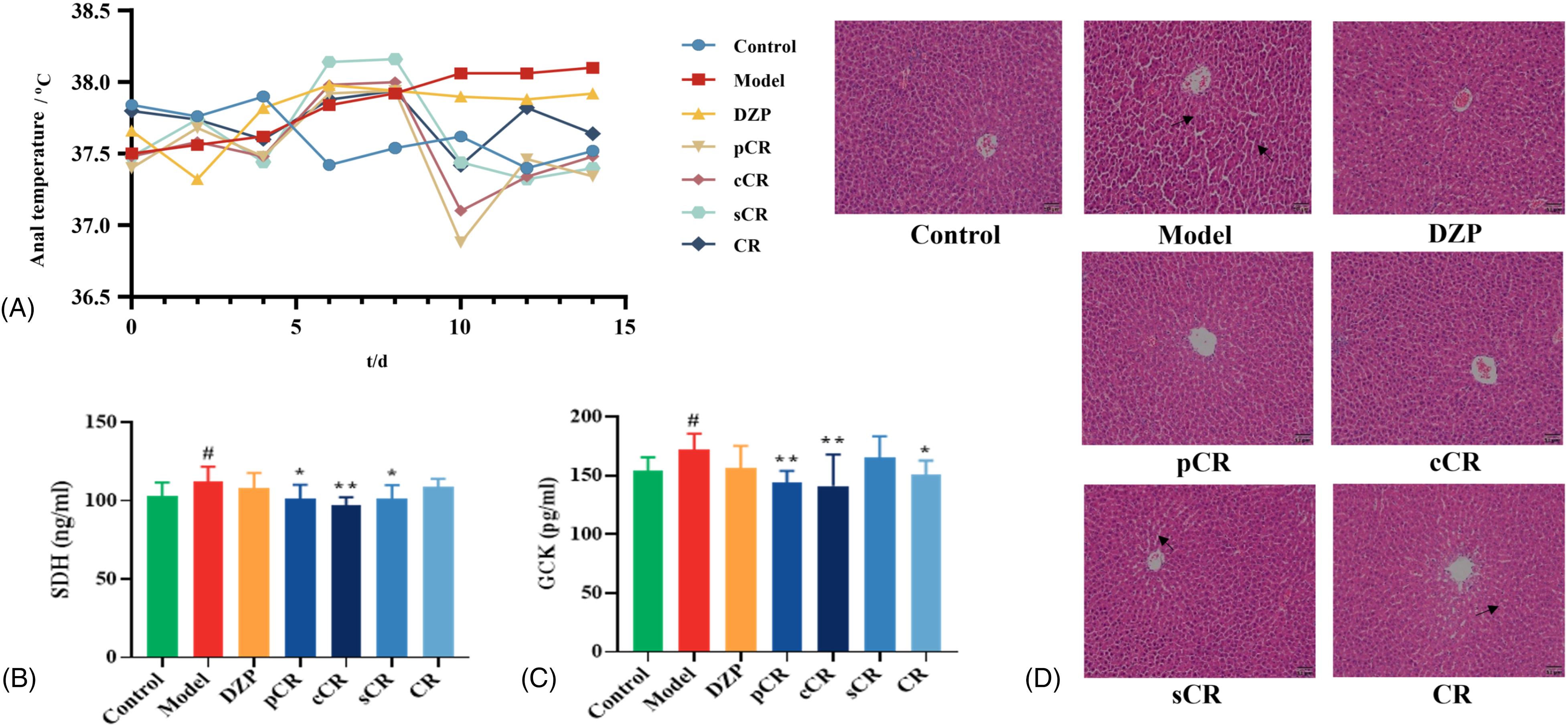
Influence of CR/pCR/cCR/sCR on anal temperature (A), expression of key enzymes in glucose metabolism SDH (B), GCK (C), and liver histomorphology (D). Black arrows indicate hepatocytes with altered morphology and structure. ##P < .01, #P < .05, versus control group; **P < .01, *P < .05, versus model group. Abbreviations: SDH, succinate dehydrogenase; GCK, glucokinase; CR, Coptidis Rhizoma.
Expression of Key Enzymes in Glucose Metabolism
As for material and energy metabolism, the succinate dehydrogenase (SDH) and glucokinase (GCK) levels in the liver were detected using enzyme-linked immunosorbent assay (ELISA) kits. SDH, as a hub linking oxidative phosphorylation and electron transfer, is one of the marker enzymes reflecting mitochondrial function and energy metabolism status. 11 GCK is the principal hexokinase in the liver, operating as a glucose sensor to regulate glucose metabolism, 12 which is also closely related to energy metabolism. In the clinic, the sthenic heat syndrome is characterized by active energy metabolism and elevated organism temperature. When the metabolic homeostasis changes, the expression of these 2 key enzymes also changes accordingly. As shown in Figure 2b-c, the liver levels of SDH and GCK were significantly increased in model rats compared with those in control group (P < .05). Both pCR and cCR could significantly inhibit the expression of these 2 enzymes, whereas sCR and CR could only interfere with a certain enzyme. Among them, cCR showed the strongest inhibitory ability (P < .01).
Morphological Evaluation of Liver Tissue
As liver is the core organ of material and energy metabolism, 13 and the hematoxylin and eosin staining (HE) sections of the liver were observed under the microscope (Figure 2d). In the normal group, the hepatocytes had clear outlines, the nuclei were located in the center of the hepatocytes, the cell size was normal, the cytoplasm was uniform, the structure was tight and neat, the hepatic sinusoids and the central vein did not show obvious changes. In the model group, the hepatocytes were disordered and loosely arranged, and a small amount of inflammatory cell infiltration can be seen around the central vein and the hepatocytes showed vacuolar degeneration and edema. After drug intervention, the arrangement of hepatocytes in diazepam (DZP), pCR, cCR and sCR groups were restored to the normal state. Also, the hepatic cell edema and inflammation were improved, and the hepatic sinusoids were clearly visible. As for CR group, the inflammation was improved, but the arrangement of hepatocytes was still disordered and loose.
Behavioral Examination
The elevated plus maze (EPM) and open field test (OFT) are experimental methods for evaluating exploratory activity and anxiety response. The anxiety behavior of rats could be evaluated by comparing the values of the percentage of the number of entries into the open arms (OE%) and the percentage of time spent in open arms (OT%) in EPM test, as well as the values of the percentage of distance from the center (DCF%) and the percentage of time at the center (TCF%) in OFT test. As shown in Figure 3, the OE%, OT%, DCF%, and TCF% values of the model group significantly decreased compared with that of the control group (P < .01), indicating that the model rats exhibited anxiety behavior.14,15 After drug intervention, cCR could significantly increase the OE% (P < .05) and OT% (P < .05) values in EPM test, as well as the DCF% (P < .05) and TCF% (P < .01) values in OFT test. However, pCR could only significantly increase the OT% (P < .05) and TCF% (P < .05) values. sCR and CR were basically ineffective in improving anxiety behavior.

Influence of CR/pCR/cCR/sCR on anxiety-like behavior. OE% value in EPM test (A). OT% value in EPM test (B). DCF% value in OFT test (C). TCF% value in OFT test (D). The trajectory of OFT in each group (E). ##P < .01, #P < .05, versus control group; **P < .01, *P < .05, versus model group. Abbreviations: EPM, elevated plus maze; OFT, open field test.
Detection of Adrenocor Ticotropic Hormore and Corticosterone Levels in Serum
The hypothalamic–pituitary–adrenal axis (HPA) is an important part of the neuroendocrine system, which is closely associated with mental activity and behavior. Usually, the dysfunction of HPA axis would induce the fluctuation of adrenocor ticotropic hormore (ACTH) and corticosterone (CORT). 16 As shown in Figure 4a-b, the serum levels of CORT and ACTH in model rats were significantly increased compared with that in the control group (P < .01). After drug intervention, all the treatment groups showed reverse changes.
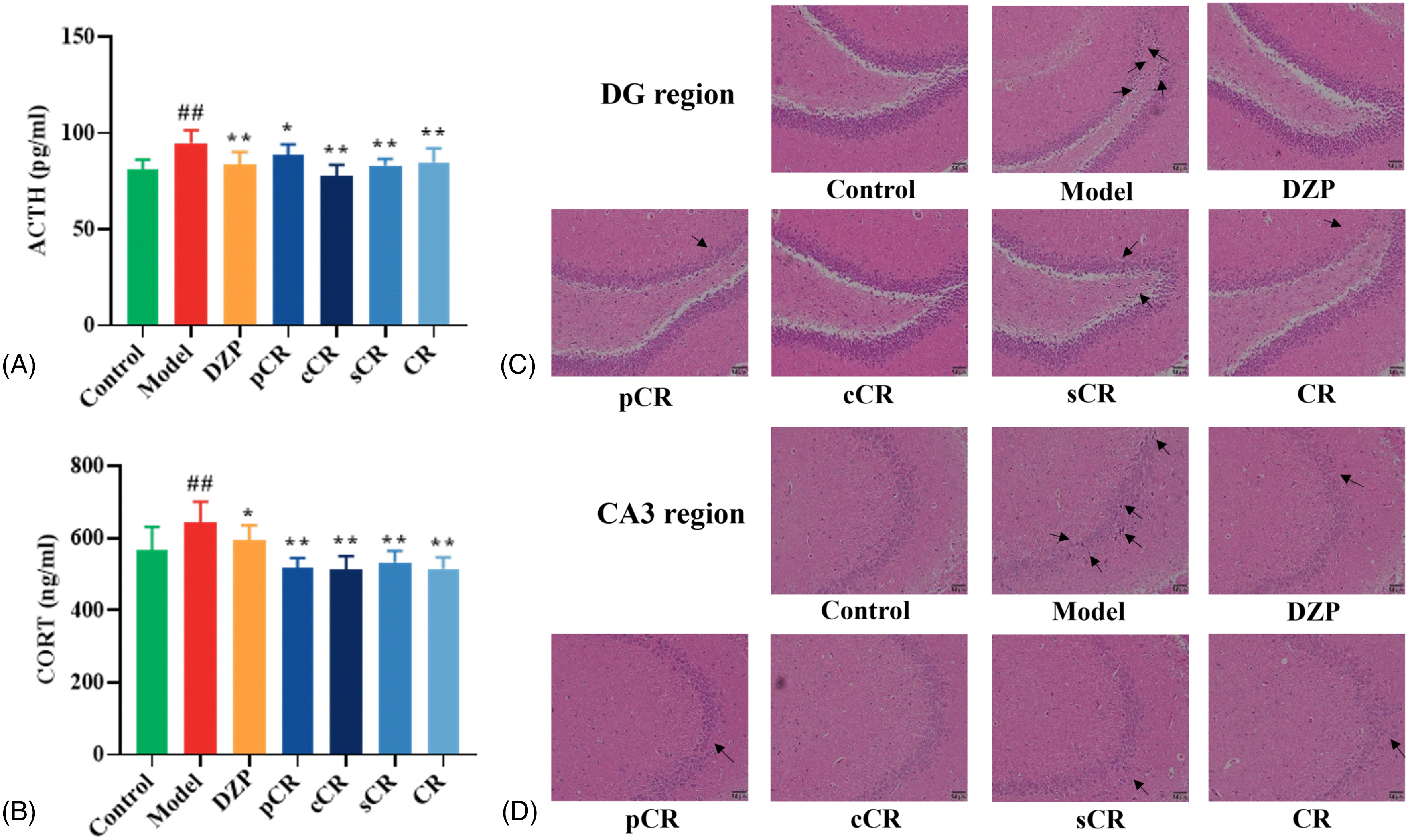
Influence of CR/pCR/cCR/sCR on ACTH (A), CORT (B) and brain histomorphology (C and D). Black arrows indicate shrunken and deformed neuronal cells. ##P < .01, #P < .05, versus control group; **P < .01, *P < .05, versus model group. Abbreviations: CORT, corticosterone; ACTH, adrenocor ticotropic hormore.
Morphological Evaluation of Hippocampus Tissue
As an important part of the limbic system, the hippocampus tissue plays an important role in regulating emotional function. 17 The HE-stained sections of the hippocampus were observed under a microscope. As shown in Figure 4c-d, the neurons in dentate gyrus (DG) and CA3 regions were abundant, and the connections between cells were tight and arranged neatly in the control group. While in the model group, the number of hippocampal cells was reduced, the cell gaps were enlarged, the number of layers was reduced, the arrangement was disordered, the nuclei appeared to be deep-stained and wrinkled, and the morphology was changed. After 7 days of drug intervention, all groups showed different degrees of improvement in status, eg, the number of hippocampal neuronal cells was increased, the number of damaged hippocampal neuronal cells was decreased, the number of layers was increased and the connections are tighter. Among them, DZP and cCR had the most prominent effects.
Chemical Analysis of CR/pCR/cCR/sCR Extracts and the 3 Kinds of Bile
High-performance liquid chromatography (HPLC) fingerprints of CR/pCR/cCR/sCR extracts suggested that the alkaloid components detected by HPLC method in cCR extracts were relatively low (Figure 5a).

The HPLC fingerprint of CR/pCR/cCR/sCR extracts (A) and the base peak chromatograms of the pig bile (B), cattle bile (C) and sheep bile (D). Abbreviations: HPLC, high-performance liquid chromatography; CR, Coptidis Rhizoma.
As for the chemical analysis of the 3 kinds of bile, the UHPLC-Q/TOF-MS/MS method was adopted, and there were significant differences in the types and contents of compounds (Figure 5b-d). 18 Compared to pig bile, the composition of cattle and sheep bile was more similar. However, there was a significant difference in the relative content of common components between them 2, and the cattle bile contained more abundant bile acids. Based on information in HMDB database (https://hmdb.ca/), literature review and MS/MS fragments, 9 bile acids were identified and the detail information was listed in Table 1. 19 The relative content of 9 identified bile acids and their respective proportions were shown in Figure 6.

The relative content and respective proportions of 9 identified bile acids.
Identification of the Major Components in Pig, Cattle, and Sheep Bile.

Discussion
Chronic stress is one of the important factors in the pathogenesis of mood disorders such as anxiety and depression. As a common modeling method for anxiety models, uncertain drinking water stimulation is milder and simple to operate. The anxious behavior of rats could be induced within 3 weeks. 20 However, sthenic heat is another major factor in the onset of anxiety disorder. Consequently, a composite modeling method of drinking water stimulation combined with Codonopsis radix & Astragali radix gavage was adopted in this study.
During the modeling stage, the state of the rats was evaluated from 2 aspects: Sthenic heat syndrome and anxiety status. In terms of sthenic heat syndrome, the model rats exhibited clinical feature of sthenic heat syndrome, the hepatic SDH and GCK levels were significantly increased, and cell edema and inflammation appeared in the HE staining section of the liver.21,22 We all know that the liver is an important organ for energy metabolism, and ATP is mainly produced by mitochondrial oxidative phosphorylation in the liver. Therefore, the above results suggested hyperactive energy metabolism and increased heat production in model rats. In terms of anxiety status, the model rats showed anxiety like behavior in OFT and EPM test, the CORT and ACTH levels in serum were significantly elevated, and neuronal injury appeared in the HE staining section of hippocampus tissue. All of these indicated the abnormal hyperactivity of HPA axis in model rats, as well as the successful modeling of anxiety disorder.16,23
Bile-processed CR is mainly used for the anxiety model of sthenic heat type. Throughout history, pig/cattle/sheep bile are 3 excipients that have appeared in the development of bile-processed CR. Pig bile is the most commonly used excipient nowadays, while in ancient times, people preferred to use cattle bile. It is still uncertain which kind of bile could perform the best synergistic effect with CR. In the present study, the therapeutic effects of CR/pCR/cCR/sCR were compared from the perspectives of general state observation, biochemical examination, pathological evaluation, and behavioral tests. It indicated that the processed products (pCR/cCR/sCR) exhibited varying degrees of enhancing ability in improving the hyperactive energy metabolism and increased heat production in the liver, as well as the abnormal hyperactivity of the HPA axis. Among them, cCR performed the most prominent enhancement. However, why did pCR/cCR/sCR exhibit varying degrees of anxiolytic effects? Can this be attributed to the composition of excipients? Thereupon, the chemical analysis of CR/pCR/cCR/sCR extracts and the 3 kinds of bile was performed as follows.
Studies have shown that alkaloids are the main active excipients of CR. 24 After being processed with bile, the bile acids could react with alkaloids in CR to form complexes, thereby promoting the absorption of alkaloids.25–27 Therefore, the relatively low levels of alkaloid components that were detected by HPLC method in cCR extract confirmed the formation of more complexes when processing CR with cattle bile. As for the chemical composition of the 3 kinds of bile, the bile acids in cattle bile were relatively abundant, and the contents of taurocholic acid, glycocholic acid and glycodeoxycholic acid were particularly high. Consequently, we speculate that the synergistic effect between cattle bile and CR may occur during the extraction and absorption process, and the high levels of taurocholic acid, glycocholic acid, and glycodeoxycholic acid in cattle bile may be the material basis for the strongest effect of cCR. To verify the speculation, we then conducted correlation analysis between the 3 bile acids and phenotypic indicators (SDH, GCK, ACTH, and CORT) by OmicStudio (Figure 7). 28 Interestingly, there was a strong negative correlation between the levels of the 3 bile acids and the phenotypic indicators, which coincidently confirmsed our speculation.

The correlation analysis between the phenotypic indicators and core bile acids.
However, there are still some limitations in this study. In the next phase of research, we will employ other modeling methods and more pharmacodynamic indicators. Additionally, the structural identification of complexes formed by alkaloids and bile acids, as well as relevant pharmacokinetic studies will be conducted to further validate our hypothesis.
Conclusion
Specifying the source of processing excipients is vitally important for standardizing the processing operations and ensuring the quality of processed products. Therefore, a comparative study on pCR/cCR/sCR was carried out in the present study to specify the source of bile and explore the relevant components that mainly contributed to the enhanced efficacy of bile processed CR. On the basis of general state observation, biochemical examination, pathological evaluation, and behavioral tests, the cattle bile could be specified as the processing excipient for bile-processed CR. The synergistic effect between cattle bile and CR may occur during the extraction and absorption process, and the high levels of taurocholic acid, glycocholic acid, and glycodeoxycholic acid in cattle bile may be the material basis for the enhanced efficacy of cCR. Furthermore, the research provided a reliable scientific basis for the clinical application of cCR in treating anxiety disorders.
Materials and Methods
Chemicals and Reagents
CR was purchased from Anhui Xusong Chinese Medicine Co., Ltd (batch number 220312). Codonopsis radix was purchased from Anhui Tuoyuantang Medicine Co., Ltd (batch number 230502). Astragali radix was purchased from Shanxi Taihang Chinese medicine Co., Ltd (batch number 230302). All the herbs were identified by Professor SuiQing Chen and Chengming Dong (Henan University of Chinese Medicine). Bile of pigs, cattle, and sheep was obtained from the local farmers’ market. DZP Tablets were purchased from Shandong Xinyi Pharmaceutical Co., Ltd (batch number 220902). All voucher specimens were maintained at Henan University of Chinese Medicine. HPLC-grade methanol (batch number 207911, purity 99.9%), acetonitrile (batch number F22MA7201, purity 99.95%) and MS-grade formic acid (batch number 220622) were all purchased from Fisher Chemical Company of the United States. The ELISA kits for relevant indicators, including GCK (LOT NO: 202308), SDH (LOT NO: 202308), ACTH (LOT NO: 202308) and CORT (LOT NO: 202308), were purchased from Jiangsu Meimian Industrial Co., Ltd The chemical reference standards of CR (Coptisine, Berberine, Jatrorrhizine, Epiberberine, Palmatine) (purity ≥ 98%) were purchased from Shanghai yuanye Bio-Technology Co., Ltd
Extraction of Herbs
CR was moistened with the bile of pigs/cattle/sheep for 1 h and parched at 100 oC for 17 min to prepare pig/cattle/sheep bile processed CR (pCR/cCR/sCR). Then CR/pCR/cCR/sCR were soaked in distilled water for 30 min and decocted 3 times (10/8/8 fold water and 1 h per time). The obtained extracting solution was merged and concentrated to 0.2 g/mL (convert into crude herb) as CR/pCR/cCR/sCR extracts. Equivalent amounts of Codonopsis radix and Astragali radix were soaked in distilled water for 30 min decocted 2 times (8/6 fold water and 1 h per time). The obtained extracting solution was merged and concentrated to 1.0 g/mL (converted into crude herb).
HPLC Analysis
The CR/pCR/cCR/sCR extracts were dissolved and diluted to the same concentration, then filtered using 0.22 μm microporous filter membrane and centrifuged at 12000 r/min for 15 min to obtain supernatants for HPLC analysis. The chemical reference standards were dissolved with methanol for HPLC analysis. The separation was performed on a Waters XBridge C18 column (4.6 mm × 250 mm, 5 μm) at 35 oC. The mobile phase consisted of acetonitrile (A) and 0.1% phosphate acid aqueous solution (B), and the gradient elution was performed at a flow rate of 1 mL/min. The elution program was set as follows: 0 to 8 min, 10 to 22.5% A; 8 to 38 min, 22.5% to 22.8% A; 38 to 48 min, 22.8% to 100% A.
UHPLC-Qtof-MS Analysis
The 3 kinds of bile were freeze-dried and dissolved with ultrapure water, then filtered using 0.22 μm microporous filter membrane and centrifuged at 12000 r/min for 15 min to obtain supernatants for UHPLC-MS analysis. A Dionex Ultimate 3000 UHPLC (Thermo Scientific) tandem to a maXis HD QTOF MS (Bruker) was used for the analysis. The separation was performed on a Thermo Scientific Acclaim™ RSLC 120 C18 column (100 mm × 2.1 mm, 2.2 μm) at 40 oC. The mobile phase consisted of 0.1% formic acid aqueous solution (A) and acetonitrile (C), and the gradient elution was performed at a flow rate of 0.3 mL/min. The elution program for bile samples was set as follows: 0 to 2 min, 10% to 16% C; 2–7 min, 16% to 24% C; 7 to 8 min, 24% to 33% C; 8 to 15 min, 33% to 47% C; 15 to 16 min, 47% to 53% C; 16 to 24 min, 53% to 75% C; 24 to 25 min, 75% to 90% C. The main parameters for QTOF MS were set as follows: The detection range of molecular was 50 to 1500 Da and the scan time was 0.2 s; the capillary voltage was 3.2 kV (ESI-); the nitrogen drying gas flow rate was 8 L/min and drying gas temperature was 230 oC.
Animals and Treatments
SPF grade Sprague Dawley rats (180 ± 20 g, male, licence No. SCXK-(jing) 2019-0008) were purchased from Beijing Huafukang Biotechnology Co., Ltd The rats were feed in standard laboratory (temperature 25 ± 2 oC, relative humidity 50%–55%, light/dark cycle for 12/12 h) with free access to food and water. After 5 days of adaptation, the rats were randomly divided into 7 groups (n = 10): control group, model group, DZP treating group (DZP, 2.5 mg/kg), pCR extract treating group (pCR), cCR extract treating group (cCR), sCR extract treating group (sCR) and CR extract treating group (CR) The dosage for CR/pCR/cCR/sCR group was 2.0 g/kg/d according to clinical dose conversion. The anxiety model of sthenic heat type was established using a combination of sthenic heat modeling and empty bottle stimulation experiments. Except for control group, each rat was raised in a single cage and trained to drink water at 9:00 to 9:10 and 21:00 to 21:10 from Day 1 to Day 7. 29 From Day 8 to Day 21, rats were stimulated with uncertain empty bottles and administrated with Codonopsis radix & Astragali radix extracts by gavage (4 mL/d). The drug intervention for DZP and CR/pCR/cCR/sCR groups was carried out on Day 15. The control group and model group were given equal amounts of physiological saline. The experimental process is shown in Figure 8 and all animal research has been approved by the Experimental Animal Ethics Committee of Henan University of Chinese Medicine (DWLL201903052).

Experimental process for modeling and administration.
General State Observation
The behavioral state and appearance of rats were observed and recorded. The anal temperature was measured every day at a fixed time during the modeling and drug administration procedure.
Biochemical and Pathological Examination
The blood samples were collected and centrifuged at 3000 r/min for 20 min to prepare serum samples, and the expression of CORT and ACTH in serum were detected using ELISA kits in accordance with the respective manufacturer's instructions. The liver tissue was ground with 0.01 mol/L PBS and centrifuged at 5000 r/min for 15 min to prepare liver samples, and the expression of SDH and GCK in liver was also detected using ELISA kits. The fresh liver and brain tissue were collected and fixed in 10% formalin solution overnight, then paraffin-embedded, sliced and stained with HE. The observation of sections was performed using ECLIPSE CI microscope (Nikon).
Behavioral Test
EPM: Anxiety-like behavior was measured using the EPM (PM-200, Chengdu Techman Software Co., Ltd). Each rat was placed in the central area of the maze facing one of the open arms after 5 minutes of acclimatization, and the OE% and OT% were recorded for 5 min. OFT: Exploratory activity and anxiety-like behavior were measured using an open-field apparatus (OFT-100, Chengdu Techman Software Co., Ltd). Each rat was placed in the central area after 5 min of acclimatization, and the DCF% and TCF% were recorded for 5 min.
Statistical Analysis
Statistical analysis was assessed by SPSS 25.0 software (IBM). All data were given as mean ± SD, and a comparison of mean values was evaluated using One-way-ANOVA. In all experiments, p value < .05 was considered a significant difference. Finally, Advanced Cor link of phenotypic indicators and core bile acids was performed using the OmicStudio tools at https://www.omicstudio.cn/tool.
Footnotes
Declaration of Conflicting Interests
The authors declared no potential conflicts of interest with respect to the research, authorship, and/or publication of this article.
Ethical Approval and Animal Rights
The experimental process is shown in Figure 6 and all animal research has been approved by the Experimental Animal Ethics Committee of Henan University of Chinese Medicine (DWLL201903052).
Funding
The authors disclosed receipt of the following financial support for the research, authorship, and/or publication of this article: This work was supported by the Youth Science Foundation Project in the National Natural Science Foundation of China (81903805), the Program for Science & Technology Innovation Talents in Universities of Henan Province (24HASTIT071), the National Key Research and Development Program of China (2019YFC1708802), the Training plan for young backbone teachers in colleges and universities of Henan province (2021GGJS082), and Doctoral Research Fund of Henan University of Chinese Medicine (BSJJ2022-03).
Statement of Informed Consent
There are no human subjects in this article and informed consent is not applicable.
