



Abstract
Keywords
Introduction
The cassane skeleton arises from the geranylgeranyl diphosphate pathway, transiting by the copalyl and pimarenyl cyclization pathways, and further molecular rearrangement to provide a tricyclic diterpene possessing an ethyl group at the C-13 and a methyl group at the C-14 positions.1,2 Biosynthetic oxidation of the cassane skeleton can yield furan diterpene derivatives, which are known as vouacapanes. 3 These compounds are peculiar secondary metabolites found in the Fabaceae family. 4 However, the analysis of the absolute configuration of this biologically relevant class of compounds has been scarcely undertaken. The Coulteria genus belongs to the subfamily Caesalpinideae and emerged from Caesalpinia sensu lato as a generic segregate. 5 There are currently 10 accepted species in the Coulteria genus: C cubensis, C glabra, C mollis, C platyloba, C pringlei, C pumila, C velutina, 6 C rosalindamedinae, 7 C delgadoana, 8 and C sousae. 9 Consequently, the presence of cassane-type diterpenes as the predominant class of compounds can be hypothesized according to the described phytochemical studies of the restructured genus Caesalpinia. 10 Only one previous study of a Coulteria species is described and involved the leaves of Coulteria platyloba, a tree previously known as Caesalpinia platyloba. 11 In this work, a new vouacapane was isolated from the leaves of C velutina (Britton & Rose) Sotuyo & G.P.Lewis (Fabaceae). The absolute configuration of this natural product was determined using vibrational circular dichroism (VCD), 12 involving a comparison of the experimental and calculated spectra of a rigid derivative, thus contributing to the stereochemical knowledge of these furan diterpenoids. It is worth mentioning that this is the first study about the chemical composition and biological activity of C velutina.
Results and Discussion
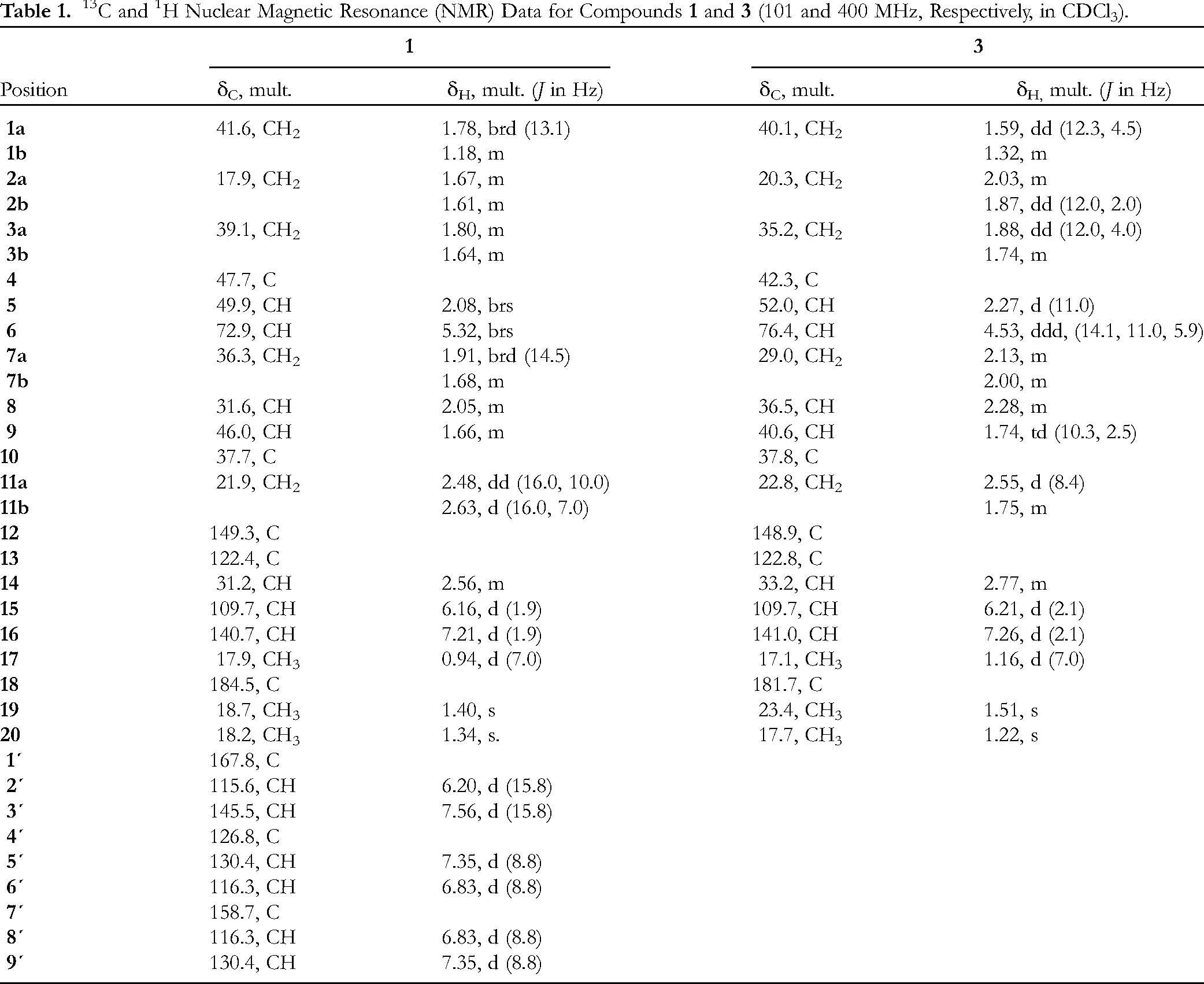
The dichloromethane extract of the leaves of C velutina provided, after purification by column chromatography, the new vouacapane

Skeletal (shorthand) structures of cassane diterpenoids
13C and 1H Nuclear Magnetic Resonance (NMR) Data for Compounds
Alkaline hydrolysis of
A lactonization reaction
18
of compound

Low-energy conformer of (+)-(4R,5R,6R,8S,9S,10R,14R)-vouacapan-6,18-olide (
The experimental VCD and infrared (IR) spectra of

Comparison of the experimental and DFT B3LYP/DGDZVP calculated IR and VCD spectra of (+)-(4R,5R,6R,8S,9S,10R,14R)-vouacapan-6,18-olide (
Several cassane diterpenoids have shown cytotoxic activities against cancer cell lines.2–4,10,23–25 Therefore, exploring the preliminary in vitro cytotoxicity of the natural compound

Effect of compound
Conclusions
The first phytochemical investigation of C velutina yielded a new weakly cytotoxic vouacapane from its leaves. Its structure was determined as (
Material and Methods
General
Melting points were measured on a Fisher-Johns apparatus. Optical rotations were determined on a Perkin-Elmer 341 polarimeter. IR spectra were measured on a Thermo-Scientific Nicolet IS10 spectrophotometer using the ATR technique. Low-resolution mass spectra were obtained by electron impact on a Varian Saturn 2000 spectrometer, and high-resolution accurate mass data were measured by electrospray ionization on a Thermo Fisher Scientific Orbitrap Exploris 120 mass spectrometer at Laboratorios Centrales, Cinvestav, Mexico City. The NMR spectra were acquired on a Varian Mercury 400 spectrometer from CDCl3 solutions using TMS as the internal standard. Column chromatography was carried out using Merck silica gel 60 (230-400).
Plant Material
The leaves of C velutina (Britton & Rose) Sotuyo & G.P.Lewis were collected from Panzacola village (18° 53´ 15.4´´ N, 100° 59´ 18.3´´W) near Paso de Núñez town in the municipality of Carácuaro, Michoacán, Mexico at 629 m above sea level in October 2021. The plant material was dried at room temperature for 3 days under the shade and identified by Professor Rosa Isabel Fuentes Chávez and Professor Norma Patricia Reyes Martínez. A specimen, consisting of a branch of the tree with leaves, flowers, and fruit with seeds, was deposited at Herbario de la Facultad de Biología (EBUM), Universidad Michoacana de San Nicolás de Hidalgo, with the voucher number 30779.
Extraction and Isolation
The crushed air-dried leaves (∼0.5 cm on average) of C velutina (1.2 kg) were extracted with CH2Cl2 (3.5 L) under reflux for 4 h. Filtration and evaporation of the extract afforded a green viscous material (85 g). A portion of the extract (35 g) was subjected to column chromatography on silica gel (250 g) using mixtures of hexanes–EtOAc (1:0, 9:1, 4:1, 3:2, and 1:1, 200 mL each). Fractions of 10 mL were collected, monitored by TLC, and analyzed by 1H NMR spectroscopy. The fractions eluted with hexanes–EtOAc 3:2 yielded compound
(−)-(4R,5R,6R,8S,9S,10R,14R)-6-[(E)-p-Coumaroyloxy]vouacapan-18-oic acid (
Hydrolysis of Compound 1
A solution of
Lactonization of Compound 2
A solution of
(+)-(4R,5R,6R,8S,9S,10R,14R)-Vouacapan-6,18-olide (
Vibrational Circular Dichroism
The VCD and IR spectra of compound
Cell Cultures
The human cancer cell lines HeLa, MDA-MB-231, Caco-2, and NIH/3T3 were acquired from the American Type Culture Collection (ATCC). The cell cultures were incubated at 37 °C in an atmosphere of 5% CO2% and 80% humidity in Dulbecco's modified Eagle's medium supplemented with 10% (v/v) fetal bovine serum and 1% antibiotic (10 000 units of penicillin, 10 mg streptomycin, and 25 μg of amphotericin B per mL) solution.
Antiproliferative Assay
The in vitro antiproliferative activity of compound
Supplemental Material
sj-docx-1-npx-10.1177_1934578X241252505 - Supplemental material for Absolute Configuration and Cytotoxicity of a New Vouacapane Diterpenoid from Coulteria velutina
Supplemental material, sj-docx-1-npx-10.1177_1934578X241252505 for Absolute Configuration and Cytotoxicity of a New Vouacapane Diterpenoid from Coulteria velutina by Odessa Magallón-Chávez, Laura Hernández-Padilla, Gabriela Rodríguez-García, Armando Talavera-Alemán, Concepción Armenta-Salinas, Ernestina Gutiérrez-Vázquez, Jesús Campos-García, Rosa E. del Río, Carlos M. Cerda-García-Rojas and Mario A. Gómez-Hurtado in Natural Product Communications
Footnotes
Acknowledgments
We acknowledge CIC-UMSNH for financial support. O.M.C. is grateful to CONACYT-Mexico for scholarship number 775693. L.H.P. and A.T.A. thank CONACYT-Mexico for their postdoctoral scholarships. We are grateful to M. en C. Ma Alvina Bucio Vásquez and Q. F. B. Verónica Reyes Olivares for VCD and optical rotation measurements, respectively. We also acknowledge I.BT. Lorena Ramírez-Reyes from Unidad de Genómica, Proteómica y Metabolómica, Laboratorio Nacional de Servicios Experimentales, Cinvestav-IPN for the high-resolution mass spectrometry analyses. We are also grateful to Dra. Rosa Elvira Nuñez Anita from Facultad de Medicina Veterinaria y Zootecnia de la Universidad Michoacana de San Nicolás de Hidalgo for the valuable support in the in vitro antiproliferative assays.
Declaration of Conflicting Interests
The authors declared no potential conflicts of interest with respect to the research, authorship, and/or publication of this article.
Funding
The authors disclosed receipt of the following financial support for the research, authorship, and/or publication of this article: This work was supported by CIC-UMSNH and CONACYT-Mexico. Coordinación de la Investigación Científica, Consejo Nacional de Ciencia y Tecnología.
ORCID iDs

Supplemental Material
Supplemental material for this article is available online.
References
Supplementary Material
Please find the following supplemental material available below.
For Open Access articles published under a Creative Commons License, all supplemental material carries the same license as the article it is associated with.
For non-Open Access articles published, all supplemental material carries a non-exclusive license, and permission requests for re-use of supplemental material or any part of supplemental material shall be sent directly to the copyright owner as specified in the copyright notice associated with the article.
