



Abstract
Objectives
This study focused on the isolation, structural elucidation, and antimicrobial activities of compounds from the culture broth of the strain Penicillium sp. OM01 (isolated from the marine mollusk sample Spondylus squamosus (Schreibers, 1793)).
Methods
Various chromatographic methods were used to isolate compounds from the ethyl acetate and MeOH extracts of the strain Penicillium sp. OM01. Their structures were elucidated using HR-ESI-MS and NMR data. The compounds were evaluated for antimicrobial effects using the dilution turbidimetric broth method.
Results
One new alkaloid, penicritin (
Conclusions
This is the first report of the strain Penicillium sp. OM01 from the marine mollusk sample S. squamosus (Schreibers, 1793). One new and seven known compounds were isolated from the strain Penicillium sp. OM01 (isolated from the marine mollusk sample S. squamosus (Schreibers, 1793). Compound
Introduction
In recent years, marine-derived fungi have attracted considerable attention as a new drug discovery and development source due to their ability to produce bioactive and unique structures.1,2 Many new natural products have been characterized from marine fungi and possess pharmaceutically relevant bioactivities. Among them, Penicillium genus is a large fungal genus comprising more than 354 described species, 3 many of which produce a diversified array of active secondary metabolites. So far, approximately 600 compounds have been isolated from the marine-derived Penicillium fungi, mainly including polyketides, alkaloids, terpenoids, sterols, and macrolides. 4 These compounds displayed antimicrobial, anti-inflammatory, cytotoxic, and immunosuppressant activities with potential applications in new drug development.5,6
As part of an ongoing project to investigate natural products from marine-derived fungi, the ethyl acetate extract of Penicillium sp. OM01 fermentation from the marine mollusk Spondylus squamosus (Schreibers, 1793) exhibited antimicrobial activity against all tested Gram (+) bacteria: (Enterococcus faecalis ATCC29212, Staphylococcus aureus ATCC25923, and Bacillus cereus ATCC 14579), and one yeast strain, Candida albicans ATCC10231 with MIC values of 16, 32, 32, 16 µg/mL, respectively, while the methanol extract of Penicillium sp. OM01 exhibited antimicrobial activity against E. faecalis ATCC29212 with MIC value of 256 µg/mL. Herein, we report the isolation, structural elucidation, and biological evaluation of one new alkaloid and seven known compounds (Figure 1) from the fermentation of the strain Penicillium sp. OM01.

Chemical structures of compounds
Results and Discussion
Compound
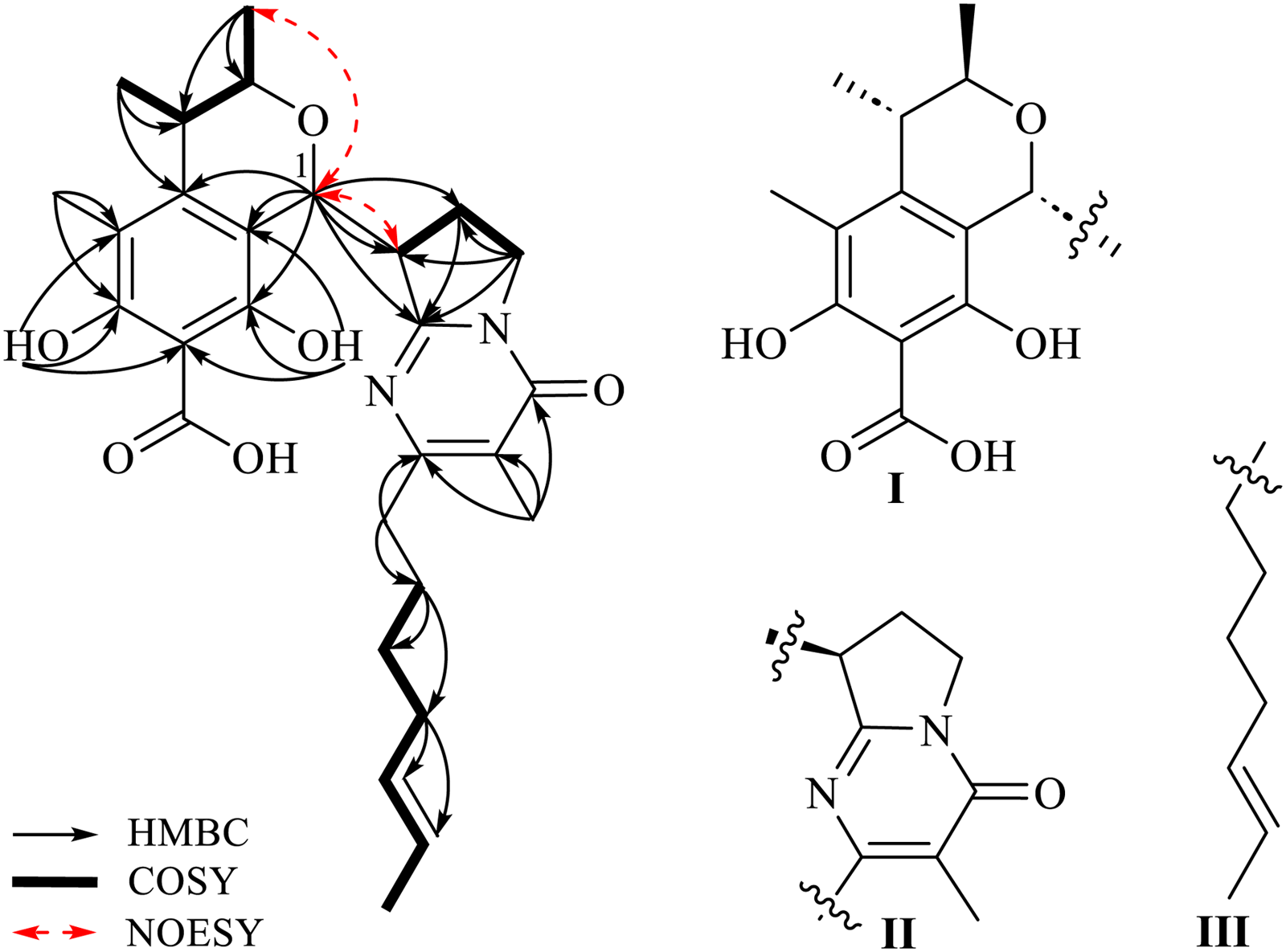
Key HMBC and COSY correlations of

Experimental CD spectrum of compound
1H- and 13C-NMR Data for Compound

The known compounds were elucidated as phenol A acid (
All isolated compounds were evaluated for their antibacterial activity against Escherichia coli, Pseudomonas aeruginosa, Salmonella enterica, E. faecalis, S. aureus, and B. cereus, and anti-yeast activity against C. albicans (Table 2). Streptomycin and cyclohexamide were used as positive controls. In previous studies, compound
Antimicrobial Activities of Compounds
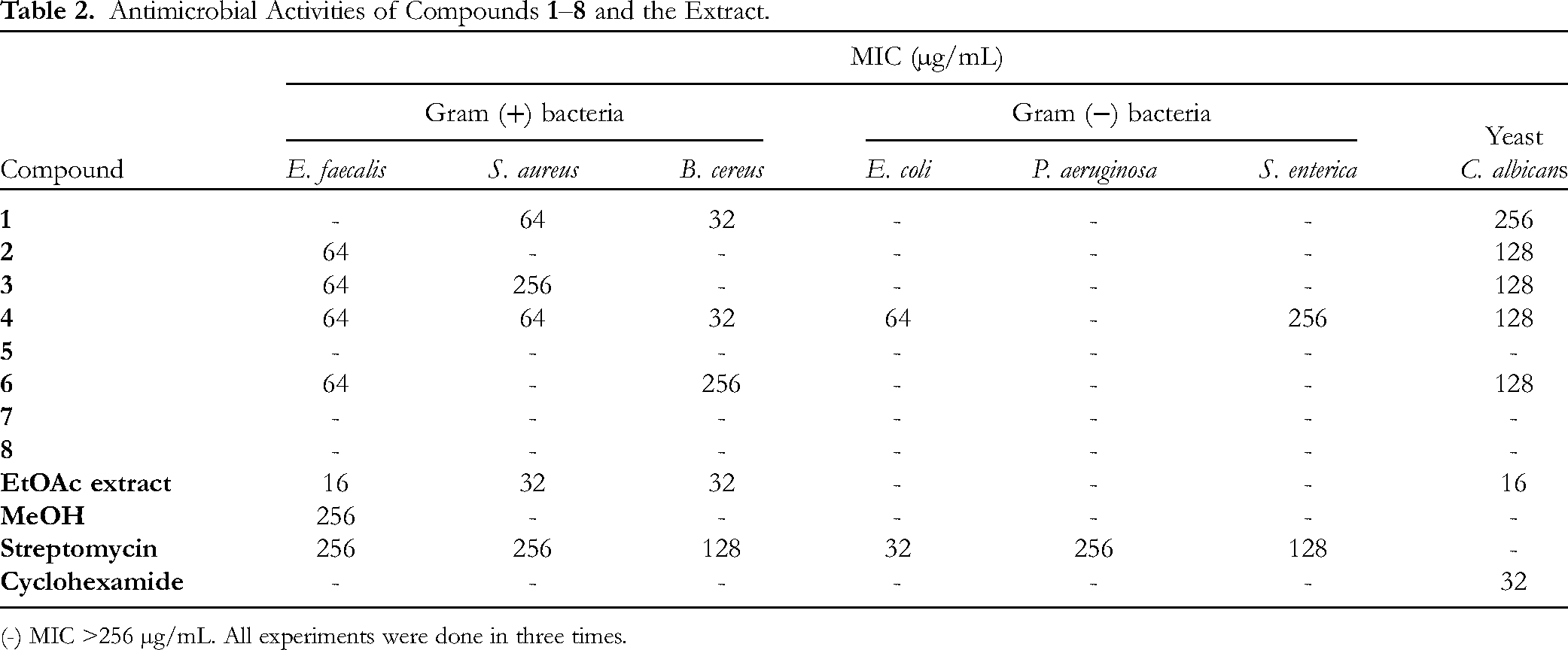
(-) MIC >256 µg/mL. All experiments were done in three times.
Material and Methods
General
See Supplemental Material.
Isolation and Taxonomic Identification
The fungus strain OM01 was isolated from the marine mollusk sample S. squamosus (Schreibers, 1793) collected at a depth of 6 m, from the sea area of Quangninh, Vietnam, in May 2021. A voucher specimen was deposited at the Institute of Marine Environment and Resources, VAST.
The taxonomy of the strain OM01 was identified by using 18S rRNA gene sequence analysis and compared with fungal 18S rRNA sequences in GenBank database by NCBI Blast program. The results showed that strain OM01 belonged to the genus Penicillium. Its 18S rRNA gene sequence was registered on GenBank database with the accession number of OR758795.
Fermentation
The strain OM01was activated and inoculated into 1 L of PDB broth medium pH 7, comprising potato extract (30 g/L), dextrose (20 g/L), soluble starch (5 g/L), and instant ocean (30 g/L). After 7 days of incubation at 28 °C, while shaking at 100 rpm, the culture broth was used to spread on the agar surface of 50 flasks containing 1L of PDA solid medium, including potato extract (30 g), dextrose (20 g), soluble starch (5 g), instant ocean (30 g), and agar (15 g). The fermentation was incubated in an incubator at 28°C and harvested on the twenty-five day.
Extraction and Isolation of Compounds
The agar culture (50 L) of the strain Penicillium sp. OM01 was minced and extracted with ethyl acetate (EtOAc) (10 L × 5 times) and methanol (10 L × 5 times), using a sonicator to afford corresponding extracts. These extracts were concentrated in vacuo to give the EtOAc extract (58 g) and the MeOH extract (240 g). The EtOAc extract (58 g) was subjected to column chromatography (CC) on silica gel eluting with CH2Cl2/MeOH (from 100/1, 50/1, 25/1, 10/1, 5/1, v/v) to yield 7 fractions, FE1-FE7. The fraction FE3 (0.4 g) was chromatographed on silica gel CC, eluted with n-hexane/EtOAc (from 0% to 100% EtOAc in n-hexane) to give 10 fractions, FE3.1-FE3.10. The fraction FE3.8 (65 mg) was further purified by CC on a Sephadex LH-20 CC eluting with MeOH to give compounds
The MeOH extract (90 g) was subjected to a silica gel CC eluting with CH2Cl2/MeOH (100/1, 50/1, 20/1, 10/1) to yield 4 fractions, FM1-FM4. The fraction FM1 (2.5 g) was chromatographed on a silica gel CC eluting with CH2Cl2/acetone (2/1) to give 4 fractions, FM2.1-FM2.4. The fraction FM2.3 (0.41 g) was separated on a Sephadex LH-20 CC, eluting with MeOH to yield compound
Penicritin (1 )
White solid; Rf: 0.5 (CH2Cl2/MeOH 6/1, v/v);
Antimicrobial Assays
Antimicrobial assays were carried out using E. coli (ATCC25922), P. aeruginosa (ATCC27853), S. enterica (ATCC13076), E. faecalis (ATCC299212), S. aureus (ATCC25923), B. cereus (ATCC14579), and C. albicans (ATCC10231). Stock solutions of samples were prepared in DMSO, and the antimicrobial assays were carried out in 96-well microtiter plates against the microbial strains (5 × 10⁵ CFU/mL) using a modification of the published method.21,22 After incubation for 24 h at 37°C, the absorbance at 650 nm was measured using a microplate reader. The minimal inhibitory concentration (MIC) is defined as the lowest concentration of an antimicrobial that inhibits visible growth of a microbial culture. This is accomplished by spreading cultures out on an agar plate. Streptomycin and cycloheximide were used as positive controls.
Statistical Analysis
All the experiments were conducted in triplicate and statistical analysis of the data was performed by ANOVA using STARGRAPHICS plus 5.1. Differences of P values < .05 were considered statistically significant.
Conclusions
One new alkaloid, penicritin (
Supplemental Material
sj-docx-1-npx-10.1177_1934578X241250204 - Supplemental material for Antimicrobial Activities of a New Alkaloid from Marine-Derived Fungus, Penicillium sp. OM01
Supplemental material, sj-docx-1-npx-10.1177_1934578X241250204 for Antimicrobial Activities of a New Alkaloid from Marine-Derived Fungus, Penicillium sp. OM01 by Van Cuong Pham, Thi Hue Nguyen, Thuy Linh Nguyen, Mai Anh Nguyen, Thi Quyen Vu, Thi Thu Huyen Vu, Thi Hong Minh Le and Thi Mai Huong Doan in Natural Product Communications
Footnotes
Acknowledgments
The authors would like to thank Mr Dang Vu Luong, Institute of Chemistry, VAST for recording NMR and Korea Basic Science Institute (KBSI, Chuncheon Center) for recording HR-ESI-MS spectra.
Declaration of Conflicting Interests
The authors declared no potential conflicts of interest with respect to the research, authorship, and/or publication of this article.
Funding
The authors disclosed receipt of the following financial support for the research, authorship, and/or publication of this article: This research is funded by Vietnam Academy of Science and Technology (Grant No: QTRU02.10/21-22 and NVCC38.03/22-23).
Ethical Approval
Ethical approval is not applicable to this article.
Statement of Human and Animal Rights
This article does not contain any studies with human or animal subjects.
Informed Consent
There are no human subjects in this article and informed consent is not applicable.

Supplemental Material
Supplemental material for this article is available online.
References
Supplementary Material
Please find the following supplemental material available below.
For Open Access articles published under a Creative Commons License, all supplemental material carries the same license as the article it is associated with.
For non-Open Access articles published, all supplemental material carries a non-exclusive license, and permission requests for re-use of supplemental material or any part of supplemental material shall be sent directly to the copyright owner as specified in the copyright notice associated with the article.
