



Abstract
Background
The ethnic drug Melastoma dodecandrum Lour. (MDL) is an important medicinal plant with potential antitumor properties, which have been proposed as promising anticancer agents, but the material basis for its therapeutic effect is still unclear and lacks in-depth research.
Methods
In this study, the in vitro antitumor effects of different MDL extracts in different gynecological tumor cells were investigated by CCK-8 assay. The active components of 21 batches of MDL samples collected from different product areas and markets were determined and compared by the UPLC method. On this basis, the data was processed with the fingerprint similarity software, and the correlation between MDL fingerprint and antihuman cervical cancer activity was further analyzed by a multivariate statistical method.
Results
Five kinds of MDL extracts, including the aqueous extract, the crude polysaccharide, the total polyphenol, the ethyl acetate fraction of the aqueous extract and 50% ethanol extract, had inhibitory effects on human cervical cancer HeLa and SiHa cells, among which total polyphenols of MDL showed stronger inhibition effect on human cervical cancer cells. In addition, the fingerprint of the total polyphenols of MDL had sixteen common peaks, and six common peaks were checked by using diode array and UV spectra, among which peak 1 (gallic acid), peak 4 (protocatechuic acid), peak 12 (unknown), and peak 15 (ellagic acid) were negatively correlated with the IC50 value of the SiHa cells, and all variable importance values were greater than 1.
Conclusion
Our data demonstrated that the main active components of MDL inhibiting human cervical cancer SiHa cells may be the synergistic effect of gallic acid, protocatechuic acid and ellagic acid, and the further spectrum-effect relationship analysis provides an important reference and basis for the quality control and the development of new anticervical cancer drug of MDL.
Keywords
Introduction
Malignant tumor is one of the most destructive diseases that seriously threaten human health and life at present, and its morbidity and mortality rate is showing a trend of increasing year by year, 13 million cancer deaths and 21.7 million new cancer cases are expected in the world by 2030. 1 Cervical cancer is the third most important cause of cancer deaths in women worldwide. According to statistics, there are about 570 000 new cases of cervical cancer and 310 000 deaths worldwide each year. 2 Chemotherapy is currently the main treatment choice for cervical cancer, but the final effect is not very ideal, and the toxicity and tolerance of chemotherapeutic drugs are still the main challenges and affect the quality of life of cancer patients. Therefore, it is crucial to find new antitumor drugs with high efficacy and low toxicity.
Traditional Chinese medicine (TCM) is one of the most important parts of the healthcare system in China, which is characterized by multiple pathways, multiple targets, multifunctions, and less side effects, and is currently considered a complementary or alternative medical system in most Western countries. Accumulating studies have shown that TCM and its active components have good antitumor activity.3,4 As an alternative to chemotherapeutic drugs, is receiving increasing attention worldwide. 5 Because TCM plays an important role in the whole course of cancer treatment, and can avoid the rapidly developing resistance of chemotherapy agents and the severe cytotoxicity of such agents to normal cells.6–8 Melastoma dodecandrum Lour. (MDL) is one of the representative TCM and ethnic medicine, which is widely distributed throughout South China.9,10 MDL has very extensive pharmacological activities, such as hypoglycemic, antiinflammatory, hemostasis, antihypertension, etc. It mainly contains polyphenols, polysaccharides, alkaloids, volatile oils, lactones, and so on, and the content of gallic acid is higher among these components. Studies have shown that gallic acid has good antitumor effects, while no relevant studies have been reported on MDL, and the material basis of its antitumor effects is still unclear and lacks in-depth research.11–13
High-performance liquid chromatography (HPLC) has become a powerful and versatile analytical method, and has been used for the routine analysis of complex chemical components, which is an effective tool for evaluating the quality of TCM, and identifying the authenticity of TCM and its components.14–17 However, HPLC chromatograms can only reflect the components present but do not provide any direct information related to the biological activity of the samples or their component compounds. Therefore, it is very important to combine the fingerprinting information of TCM with pharmacodynamic indicators, correlate and analyze them using chemometrics, thus revealing the correlation between chemical components and biological activity, elucidating the material basis of pharmacodynamics, and establishing a quality evaluation model in accordance with the theory of TCM and the basis of TCM practice, which has been recognized by the World Health Organization as a strategy for quality evaluation of medicinal plants.18–20
In this article, the in vitro cellular assay was used to evaluate the in vitro inhibitory effects of different extracted parts of MDL on different gynecological tumor cells, and to screen out the antitumor active parts of MDL. The chromatographic fingerprints and antitumor activity of 21 different batches of MDL extracts were obtained by UPLC-DAD and CCK-8 assays. The spectral-active relationship between the UPLC fingerprints and the anticervical cancer SiHa cell activity of the extracts showed that the anticervical cancer SiHa cell activity of the extracts was determined by the synergistic effect of several compounds. The anticancer activity of MDL has been reported, but there is no literature on which compounds play a decisive role. 21 The aim of this study was to screen the main active substances with anticervical cancer SiHa cell activity and to reveal the synergistic effects among the components in the total polyphenol extract of MDL. To clarify the pharmacodynamic material basis of the anticervical cancer SiHa cells of MDL, and to lay the foundation for its further development and utilization and quality evaluation and control.
Results
In Vitro Antitumor Activity of Different MDL Extracts
Figure 1 showed the cytotoxic effects of the total polyphenols, the ethyl acetate fraction of the aqueous extract, the aqueous extract, 50% ethanol extract and the crude polysaccharide of MDL on different tumor cells. Among them, the half-maximal inhibitory concentrations (IC50) of the total polyphenols extract of MDL showed the lowest IC50 value (0.057 mg/mL) in cervical cancer SiHa cells and certain inhibitory effects on other different gynecological tumor cells. The results indicated that the total polyphenol extract of MDL has the most potent inhibitory effect on SiHa cells. Therefore, the total polyphenol extract of MDL was selected for further study on human cervical cancer SiHa cells.

Antitumor activity studies of different extracts of MDL. (A) the total polyphenols; (B) the ethyl acetate fraction of the aqueous extract; (C) the aqueous extract; (D) 50% ethanol extract; (E) the crude polysaccharide.
UPLC Fingerprint Methodological Validation of the Total Polyphenols Extract of MDL
UPLC fingerprint methodological validation results showed that the relative standard deviation (RSD) of method precision, reproducibility, relative retention time (RRT) of sample solutions within 24 h and average peak area (PA) of common peaks were less than 3.0%. Meanwhile, the chromatographic peaks and the UV absorption curve of the mixed reference solution and the sample solution were consistent (Figure 2), which indicated that this method has good sensitivity and specificity.

UV absorption spectra of sample solution (blue lines) and control solution (black lines). (A) gallic acid, (B) protocatechuic acid, (C) vitexin, (D) isovitexin, (E) rutin, (F) ellagic acid.
HPLC Fingerprints
The UPLC fingerprints of the reference substance and total polyphenols extract of 21 batches of MDL are shown in Figures 3 and 4. Sixteen peaks (A1-A16) with good separation and resolution were selected as the common peaks for the identification of six standard compounds including gallic acid, protocatechuic acid, vitexin, isovitexin, rutin, and ellagic acid. The chromatogram of standard compound gallic acid (at an average retention time of 6.29 min), with suitable peak area and good stability, was selected as the reference peak to calculate the RRT of the other 16 common peaks. The RRT of 16 peaks among different production regions was in the range of 0.01% to 2.57%. The PA and RSD% values of those common peaks are shown in Supplemental Table 1. From the data collected, the RSD% of PA in different production regions was 20.96% to 64.00%, which revealed that the content of each compound of MDL total polyphenols has a significant difference in different production regions.

HPLC fingerprints. (A) The chromatogram of standards solution; (B) The reference fingerprint of total polyphenols extracts of MDL.
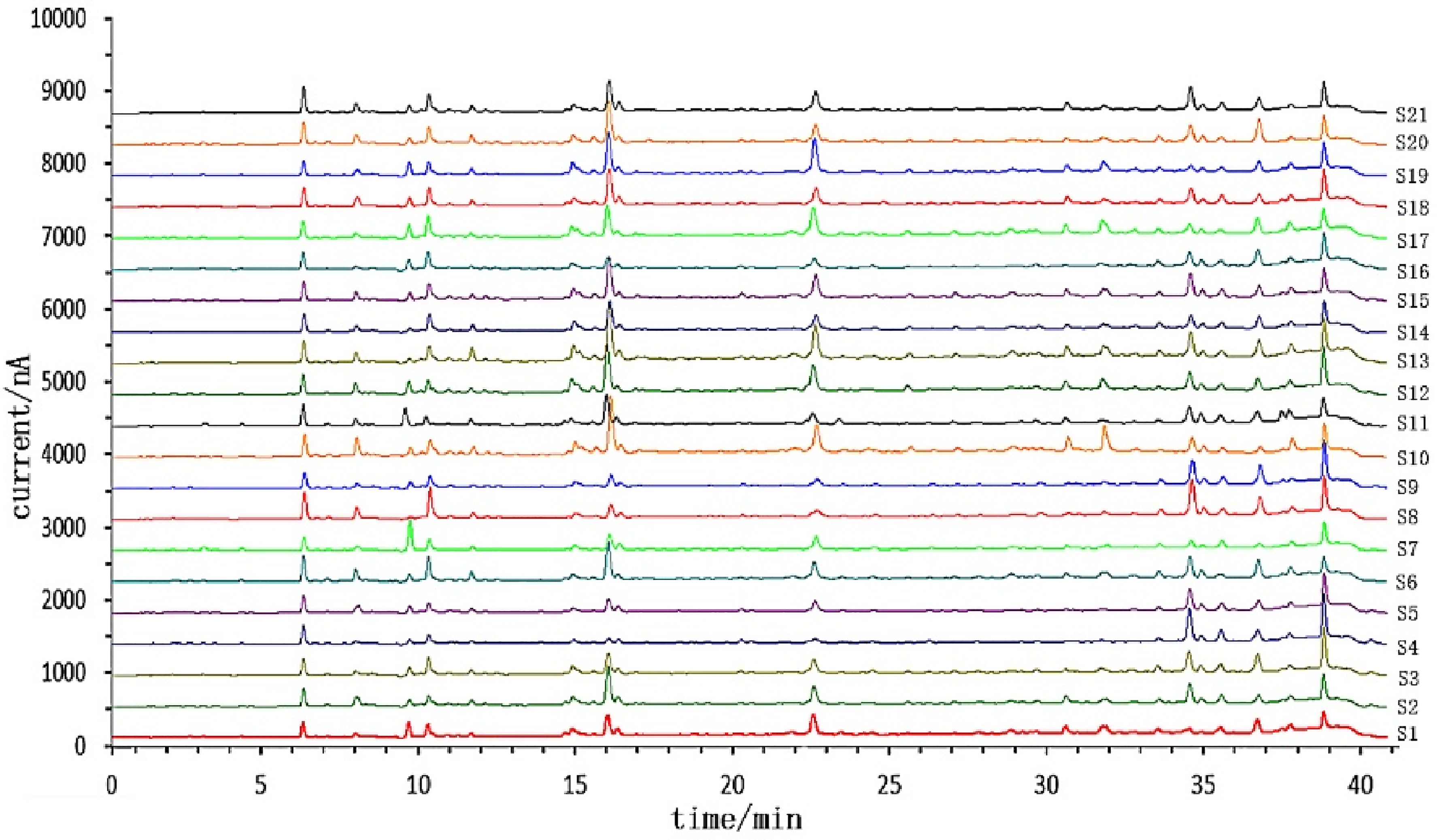
UPLC fingerprints of the total polyphenols extracts of 11 batches among Melastoma dodecandrum samples.
Similarity Analysis of Chromatographic Fingerprints
The similarity analysis and reference fingerprints of chromatographic fingerprints were evaluated in total polyphenol extracts of 21 batches of MDL. The results showed that the similarity values between each sample fingerprint of different samples and the reference fingerprint were in the range of 0.830 to 0.987, as shown in Table 2.
The Origin of Medicinal Materials MDL.

Abbreviations: MDL, Melastoma dodecandrum Lour.
Similarities of among 21 Batches MDL Samples From Various Sources.

Abbreviations: MDL, Melastoma dodecandrum Lour.
Anticervical Cancer SiHa Cell Activity Evaluation of MDL Total Polyphenol Extracts
CCK8 assay was used to evaluate the anti-SiHa cells activity in total polyphenol extracts of 21 batches of MDL, as shown in Table 3 and Figure 5. There was an obvious difference in IC50 values of MDL total polyphenols from different production origins on human cervical cancer SiHa cells. Among them, S12 (Doujiang Town, Sandou County, Guizhou Province) exhibited the best inhibitory activity on SiHa cells, and S2 (Guiding County, Qiannan County, Guizhou Province) had the worst inhibitory activity, which could be attributed to the external growth environment, growth years, and so on.

IC50 diagram of the inhibitory effects of different MDL total polyphenol extracts on SiHa cells.
Anti-SiHa Cells Activity of MDL Total Polyphenol Extracts.

Abbreviations: MDL, Melastoma dodecandrum Lour.
Spectrum–Effect Relationship
The common chromatographic peaks were analyzed by principal component analysis (PCA) (Table 4, Figures 6 and 7A). The principal component 1 showed the maximum contribution (32.872%). Then the contribution rates of principal components 2 to 4 were 25.645%, 14.270%, and 8.176%, respectively. The contribution rates of other components were less than principal components 1 to 4. The previous four principal components were automatically screened by software. The result showed that the cumulative variance contribution rate of the four principal components with characteristic root greater than 1 was 80.963%, it indicated that these four new variables could be used to replace the original 16 variables.

Principal component analysis and partial least squares regression chart of MDL total polyphenol extracts.

A. Principal component analysis chart of MDL total polyphenol extracts; B. VIP values.
Principal Component Analysis and Cumulative Contribution Rates.

The correlation coefficient between the principal component and the corresponding peak position was calculated by dividing the data of each group in Table 5 by the square root of the corresponding eigenvalue in the principal component, and further obtained the coefficient corresponding to each peak in the principal component equation. The principal component models were obtained by the following calculation procedures:
Initial Factor Loading Matrix.

F1 = 0.160A1 + 0.345A2-0.065A3-0.001A4 + 0.341A5 + 0.406A6 + 0.326A7 + 0.358A8 + 0.403A9-0.112A10-0.105A11-0.029A12-0.259A13-0.123A14 + 0.208A15-0.152A16,
F2 = 0.403A1 + 0.198A2-0.373A3 + 0.120A4 + 0.149A5 + 0.002A6-0.092A7-0.098A8-0.071A9 + 0.111A10 + 0.423A11 + 0.384A12 + 0.011A13 + 0.288A14 + 0.221A15 + 0.359A16,
F3 = -0.009A1-0.170A2 + 0.055A3 + 0.516A4 + 0.134A5 + 0.032A6-0.155A7 + 0.191A8-0.032A9 + 0.529A10-0.176A11-0.157A12-0.319A13 + 0.405A14-0.072A15-0.120A16,
F4 = -0.134A1 + 0.005A2-0.672A3-0.665A4 + 0.527A5 + 0.293A6 + 0.570A7 + 0.200A8-0.130A9 + 0.616A10 + 0.339A11-0.416A12 + 0.798A13 + 0.412A14-1.028A15-0.238A16.
Among them, F1, F2, F3, and F4 denote four principal components, A1, A2 … A16 denote the relative peak areas of each characteristic peak (peak 1, 2, … 16). Through the comparison of equation coefficients, the results showed that peak 6 and peak 9 could affect principal component 1. Peak 1 and peak 11 could affect principal component 2, peak 4, peak 10, and peak 14 could affect principal component 3, peak 13 and peak 15 could affect principal component 4, which suggested that multiple components comprehensively affected the quality of MDL.
The spectrum–effect relationship between chromatographic peaks and antitumor ability was established by bivariate correlations analysis (BCA) and PLSR models. The Pearson correlations and the standardized regression coefficients are shown in Table 6. The lateral shift of the numerical magnitude of these data represents the magnitude of the correlation and the positive and negative correlation between the independent and dependent variables, respectively. The variable importance (VIP) values of Figure 7B are an important indicator to reflect the independent variable's ability to explain the dependent variable. The greater the value, the greater the contribution rate of the independent variable to the dependent variable. The following regression equation was obtained by PLS model: Y = −0.1528A1 + 0.0114A2 + 0.0040A3 − 0.2502A4 + 0.0211A5 − 0.0622A6 + 0.2165A7 − 0.1256A8 − 0.0749A9 + 0.0119A10 + 0.0089A11 − 0.1661A12 + 0.2514A13 − 0.1497A14 − 0.1433A15 − 0.1081A16.
Correlations and Grade of BCA and PLSR Models.

*: p < .05, **: p < .01.
According to the analysis of the spectral efficiency relationship, BCA results showed that peaks 1, 4, and 15 were significantly and negatively correlated with the IC50 values of SiHa cells, and peak 13 was positively correlated with it. The results of VIP values showed that the VIP values of peak 1, 2, 4, 5, 7, 12, 13, and 15 were greater than 1, and The order was peak 13 > peak 4 > peak 1 > peak 7 > peak 15 > peak 12 > peak 5 > peak 2. Peaks 2, 5, 7, and 13 were positively correlated with the IC50 values of in vitro anticervical cancer SiHa cells according to the standardized regression coefficients, of which the standardized regression coefficients of peaks 7 and 13 were greater than 0.1, namely these peaks were negatively correlated with in vitro anticervical cancer SiHa cell activity. In addition, peaks 1, 4, 12, and 15 were negatively correlated with the IC50 values of SiHa cells, and the absolute values of standardized regression coefficients were also greater than 0.1, which indicated that these peaks were positively correlated with the anti-SiHa cells activity in vitro. Peaks A1, A4, A10, A13, A14, and A15 were identified as gallic acid, protocatechuic acid, vitexin, isovitexin, rutin, and ellagic acid by HPLC fingerprints. Pearson correlation coefficient, correlation coefficient, and VIP values finalized the spectrum–effect relationship of MDL total polyphenol extracts. Namely, peaks 1, 4, 12, and 15 were positively correlated with in vitro anticervical cancer SiHa cell activity and VIP value was greater than 1 (Figure 7B). This indicated that their contribution to in vitro antitumor activity was greater, and the inhibition activity of total polyphenols of MDL in cervical cancer SiHa cells was enhanced when the content of its corresponding components increased. It means that these compounds were the main antitumor-active components of MDL, and its antitumor activity was not determined by a single component, but the result of the combined action of multiple components. It has been reported that gallic acid (A1), protocatechuic acid (A4), and ellagic acid were the potential anticancer agents in herbal medicines.20,22
Discussion
In this study, the CCK-8 assay was used to investigate the activities of different extracts of MDL on different tumor cells. The results showed that five extracts (the aqueous, the crude polysaccharide, the total polyphenol, the ethyl acetate fraction of the aqueous extract and 50% ethanol) of MDL had certain inhibitory effects on human cervical cancer HeLa cells, human breast cancer MCF-7 cells, human cervical cancer SiHa cells and human ovarian cancer SKOV3 cells, but had no significant inhibitory effect on human endometrial cancer HEC-1-B cells. Five extracts had significant inhibitory effect on human cervical cancer HeLa and SiHa cells at low concentrations, among which the total polyphenols of MDL had the best inhibitory activity on the proliferation of human cervical cancer SiHa cells (IC50 = 0.057 mg/mL). Therefore, total polyphenols from MDL and SiHa cells of human cervical cancer were selected for further study. The IC50 value of total polyphenols in SiHa cells was used as an index to evaluate the relationship between the fingerprint of total polyphenols and its results. PCA, BCA, and PLS models were used to evaluate and reveal the correlation between the speculated chromatographic peaks and antitumor activity. The results showed that gallic acid, protocatechuic acid, and ellagic acid were the main antitumor components of total polyphenols of MDL. However, the PCA results showed that A6, A9, etc affected principal component 1. A1, A11, etc affected principal component 2. A4, A10, A14, etc affected principal component 3. A13, A15, etc affected principal component 4, suggesting that multiple components synthetically affected the quality of MDL. What's more, this result is different from the spectral effect result, because principal component analysis was a kind of fuzzy estimation in pattern recognition, which could not accurately estimate the variables. Secondly, although the fingerprinting of traditional Chinese medicine can label multiple chemical components in traditional Chinese medicine, only the combination of reflected chemical information and stoichiometry does not accurately reflect the actual active ingredients of traditional Chinese medicine while the biological activities of Chinese medicine components are isolated. 23 These results revealed that the antitumor effect of MDL is the result of the synergistic effect of various active components. In addition, the spectrum–activity relationship of anticervical cancer activity of MDL could better show the relationship between various chemical components and efficacy of traditional Chinese medicine, so as to more effectively control the quality and clinical efficacy of traditional Chinese medicine.
In this article, 21 batches of samples (S1-S21) collected were derived from the natural environment with karst geomorphological features. The UPLC fingerprints of samples from different origins were compared and found that the similarity among the fingerprints was significant, and the similarity range was 0.830∼0.987, among they the similarity values of four origins were lower than 0.9, which indicates that the chemical compositions of samples from different origins were similar, but the contents were significantly different. The reasons for this difference were mainly related to the origin, generation years and growth environment. At the same time, this distinction could better analyze and explain the contribution to the antitumor activity per peak. 24
In conclusion, the experimental variables related to the separation method, solvent and procedure of total polyphenols were optimized in order to improve the purity and detection accuracy of total polyphenols of MDL. The macroporous adsorbent resin was selected for the separation process study of total polyphenols of MDL and the optimal process parameters were determined to achieve higher target analytes. A detection wavelength of 260 nm was finally determined according to the result of full-wavelength scanning. In addition, methanol and water were selected as mobile phases and the chromatographic conditions were optimized to obtain good resolution. Six standard substances could be separated and eluted within 40 min.
Material and Method
Materials
HPLC-grade methanol and formic acid were purchased from Merk KGaA (Germany). Phosphate buffered saline (PBS), MEM (NEAA) culture medium, Hela (Procell CL-0101), SiHa (Procell CL-0201), HEC-1-B (Procell CL-0100), and SKOV3 (Procell CL-0215) were purchased from Procell Life Science & Technology Co., Ltd. MCF-7 was kindly provided by Institute of Pharmaceutical Preparations, Zhejiang University (Hangzhou, China). Biological Industries (BIOIND) fetal bovine serum was purchased from BIOLOGICAL INDUSTRIES ISRAEL BEIT HAEMEK LTD (Australia). Cell Counting Kit-8 (CCK-8) was purchased from Shanghai Topscience Co., Ltd (Shanghai, China). Gallic acid, protocatechuic acid, vitexin, and ellagic acid were purchased from the National Institutes for Food and Drug Control (Beijing, China). Rutin and isovitexin were purchased from Guizhou Di technology limited liability company (Guizhou, China). All other solvents were of analytical or chromatographic grade.
Twenty-one batches of MDL were collected from different areas of Guizhou and Guangxi of China from 2018 to 2021. Sample origins are shown in Table 1. All the samples were identified as the whole herbs of Melastomataceae MDL by Prof. Qingwen Sun of College of Pharmaceutical Sciences, Guizhou University of Traditional Chinese Medicine. Voucher specimens were deposited in the specimen room of the Key Laboratory of Pharmacy Sciences, Guizhou University of Traditional Chinese Medicine.
Preparation of Standard and Sample Solutions
We declare that we get permission to collect MDL from Guizhou University of Traditional Chinese Medicine according to the “Wild Plants Protection Regulation” of the People's Republic of China, and all methods including the collection of plant material were performed in accordance with the relevant guidelines and regulations of China.
Appropriate amounts of six reference substances, gallic acid, vitexin, rutin, protocatechuic acid, isovitexin, and ellagic acid were accurately weighed and dissolved in 10 mL methanol respectively to prepare individual stock standard solutions. A mixed standard solution was prepared by adding 1 mL of each of the standard stock solution to a 10 mL volumetric flask, diluted with methanol solution to volume, and mixed.
The sample solutions were prepared using the following method. Briefly, 3.0 kg of MDL was weighed and immersed in 12-fold water in weight for 30 min and decocted for 1 h. After that, the water decoction of MDL was filtered and collected, and then the drained MDL was immersed in 10-fold water in weight and decocted for 1 h. The final crude water extracts of MDL were prepared by merging decoction, filtering, concentrating and mixing steps. In addition, the crude polysaccharide extract, the total polyphenol extract, the ethyl acetate fraction of the aqueous extract and 50% ethanol extract of MDL were prepared by using different solvents and similar methods, respectively.
Cell Culture
HEC-1-B (human endometrial adenocarcinoma), Hela (human cervical carcinoma), MCF-7 (human mammary carcinoma), SiHa (human cervical carcinoma), and SKOV3 (human ovarian carcinoma) cells were cultured in Dulbecco's minimal essential medium (DMEM) containing 10% fetal bovine serum at 37 °C in a humidified atmosphere containing 5% CO2.
The In Vitro Antitumor Activity Studies of Different Extracts of MDL
The antitumor activity was determined according to the procedure described by Wang et al
25
with slight modification. Different gynecological tumor cells (see 2.3) were seeded 5000 cells per well in a 96-well plate and allowed to grow for 1 day. Then, the cells were exposed to different MDL extracts with various concentrations for 24 h (six replicates/sample). Meanwhile, negative and positive controls were set up in the experimental design, and normal cells were used as reference. The 96-well plate was removed from the incubator, and the CCK-8 assay kit was used to measure the antitumor activity of MDL according to the manufacturer's suggested procedures. The absorbance of the samples was measured by a Thermo Scientific Multiskan FC enzyme-linked immunoassay analyzer under the wavelength of 450 nm, and the cell-growth inhibitory activity was calculated by the following equation:
UPLC Conditions
Chromatography was performed on a 1290 Infinity II UPLC (Agilent Technologies) equipment with a diode array detector and Waters ACQUITY UPLC® HSS T3 (2.1mm × 100 mm, 1.8μm) at 30 °C. HPLC gradient elution method was used with methanol (A)-0.1% formic acid in water (B) as the mobile phase. UV detection was performed at 260 nm. HPLC was performed with gradient elution as follows 0-2 min,3% A:97% B;2-9 min,15% A:85% B;9-11 min,15% A:85% B;11-24 min,26% A:74% B;24-31 min,36% A:64% B;31-35 min,42% A:58% B;35-38 min,55% A: 45% B;38-40 min,3% A:97% B. The flow rate was 0.2 mL·min−1 with a sample injection volume of 0.8 μL.
Validation of Methodology
The mixed control and test solutions were sampled and determined separately, and the peak purity was checked by a diode array. Method precision of the total polyphenol samples was evaluated by 6 successive injections of one sample solution, while repeatability was estimated by 6 replicates of a sample from the same origin. For the storage stability test, replicate injections of one sample solution, which was stored in a volumetric flask at room temperature, and were analyzed in a day (0, 4, 8, 12, 16, and 24 h).
Peak Identification
The pure reference standard solutions were injected into the UPLC system for qualitative analysis and the retention time of the reference standard was recorded. By comparing the retention time, gallic acid, protocatechuic acid, vitexin, isovitexin, rutin, and ellagic acid, standards were identified.
Establishment and Evaluation of Fingerprints
Each sample solution was analyzed in triplicate to get the fingerprints with the optimized UPLC condition, respectively. The UPLC fingerprint data was saved as CDF format. With the aid of a similarity evaluation system for chromatographic fingerprint of TCM (Version 2012), the UPLC fingerprints were matched automatically, then the reference atlas was formed by this system using the Median method from the general comparison of the chromatograms of different batches of Melastoma dodecandrum. The similarities between the reference atlas and the chromatogram of 21 batches were calculated by using the software.
In Vitro Anticervical Cancer Activity Studies of the Total Polyphenol Extracts of MDL
The total polyphenol samples of 21 batches of MDL from different origins were precisely weighed and dissolved in serum-free DMEM to prepare the test solutions. Prior to use, the test solutions were then sterile-filtered using a 0.22 μm syringe filter. Then, the SiHa cells prepared according to the method of 2.4 were exposed to the final test solutions with various concentrations for 24 h, and the in vitro anticervical cancer activity of the total polyphenol extracts of MDL was evaluated by CCK-8 assay. The 50% concentration of inhibition (IC50) was performed using the SPSS statistics software (SPSS for Windows 25.0 SPSS Inc., USA).
Spectrum–Effect Relationship Analysis of the Total Polyphenol of MDL
PCA are common pattern recognition methods in fingerprint analysis of TCM. Taking the common peak area of 21 batches of total polyphenols from different origins as variables, the principal components of peak area were analyzed, and the contribution rate of principal component analysis, gravel map and initial factor load matrix were obtained. The PCA was performed using the OriginPro 2021b statistics software.
For BCA, the independent variables (X) were obtained by the natural logarithm of peak area, and the antitumor activity levels by different assays were regarded as dependent variables (Y). Then BCA between X and Y was analyzed with the Pearson model. 26 The BCA was performed using the SPSS statistics software (SPSS for Windows 25.0 SPSS Inc., USA).
The IC50 value of anti-cervical cancer SiHa cells from different origins was used as the dependent variable (Y) and the common peak area (X) as the independent variable, and the standardized regression coefficient and variable importance projection (VIP) value were calculated. The greater the standardized regression coefficient, the greater the influence of the independent variable on the efficacy of the drug, and a positive value of the coefficient indicates a positive correlation with the efficacy of the drug, while a negative value indicates a negative correlation with the efficacy of the drug. 27 The VIP value is an important indicator of the explanatory power of the independent variable on the dependent variable, and a greater value indicates a greater contribution of the independent variable to the dependent variable.28,29
Conclusions
This article proved that cervical cancer cells could be inhibited by the extracts of MDL. The abundant total polyphenols in MDL were likely responsible for their beneficial effects by spectrum–effect relationship. The interaction of these compounds was complicated including additive, synergetic, and antagonistic. In conclusion, we explored the relationship between the fingerprints of MDL and in vitro antitumor cellular pharmacodynamics, and the material basis of the antitumor activity of the antitumor was elaborated by using the research idea of the spectral effect relationship, which provided a scientific basis for the study of the material basis of the MDL and the quality control of the MDL.
Supplemental Material
sj-doc-1-npx-10.1177_1934578X231222096 - Supplemental material for Study on the Active Components and Inhibiting Effect of Melastoma dodecandrum Lour. on Human Cervical Cancer Cells Based on Spectrum–Effect Relationship Analysis
Supplemental material, sj-doc-1-npx-10.1177_1934578X231222096 for Study on the Active Components and Inhibiting Effect of Melastoma dodecandrum Lour. on Human Cervical Cancer Cells Based on Spectrum–Effect Relationship Analysis by Song Qian, Zuhua Wang, Xiuping Ma, Huiyi Ming, Jing Liu, Jing Yang, Teng Chen, Linli Liu, Jibian Ban and Jiangtao Guo in Natural Product Communications
Footnotes
Acknowledgements
This work was supported by the National Natural Science Foundation of China (No. 81860695).
Authors’ Notes
Song Qian and Zuhua Wang contributed equally to this work.
Author Contributions
Conceptualization: S.Q., Z.H.W., X.PM, and T.C.; methodology: S.Q., H.M., Z.H.W., X.PM, and J.Y.; formal Analysis: L.L.L., J.B.B., J.T.G., and T.C.; funding acquisition: X.PM; project administration: Z.H.W. and X.PM; resources: Z.H.W., X.PM; software: H.Y.M., J.L., and J.Y.; validation: S.Q., X.PM, and Z.H.W.; writing—review and editing: S.Q., Z.H.W., and X.PM. All authors have read and agreed to the published version of the manuscript.
Data Availability
The original contributions presented in the study are included in the article/supplemental material, further inquiries can be directed to the corresponding author.
Conflicts of Interest
The authors declared that there is no conflict of interest.
Ethical Approval
Ethical approval is not applicable to this article.
Funding
The author(s) disclosed receipt of the following financial support for the research, authorship, and/or publication of this article: This work was supported by the National Natural Science Foundation of China, (grant number 81860695).

Supplemental Material
Supplemental material for this article is available online.
References
Supplementary Material
Please find the following supplemental material available below.
For Open Access articles published under a Creative Commons License, all supplemental material carries the same license as the article it is associated with.
For non-Open Access articles published, all supplemental material carries a non-exclusive license, and permission requests for re-use of supplemental material or any part of supplemental material shall be sent directly to the copyright owner as specified in the copyright notice associated with the article.
