



Abstract
Pinostrobin (5-hydroxy-7-methoxyflavanone) is an active flavonoid substance. It is widely present in many traditional Chinese herbs, including Carya cathayensis leaves, Boesenbergia rotunda and propolis. Pinostrobin possesses many pharmacological activities without significant toxicity. In addition to anti-inflammatory and antioxidant effects, pinostrobin also exerts antitumor effects. Pinostrobin is able to protect against infection by several viruses, bacteria, fungi, and parasites. Pinostrobin reduces the expression of proprotein convertase subtilisin/kexin type 9 (PCSK9), which is a promising target of lipid-lowering drugs. It also reduces high uric acid levels while not affecting the normal uric acid levels. Furthermore, it has protective effects on the liver, kidney, bone, skin, reproductive system, stomach and nerves. Due to its multifunctional effects and safety, pinostrobin has advantages for development as a novel drug for clinical application. Based on this, this current article summarized the research progress on the pharmacological effects and mechanisms of pinostrobin, to provide a reference for further development.
Introduction
Pinostrobin (C16H14O4) is a small flavonoid compound with a molecular weight of 270.28 daltons. It is widely present in traditional Chinese herbs such as Carya cathayensis leaves, Boesenbergia rotunda and propolis,1‐3 and these natural products are widely used as anti-inflammatory and anti-infection agent.4‐7 Pinostrobin is mainly metabolized by glucuronidation via nonrenal routes, and there are higher concentrations in the liver and gastrointestinal tract than in other tissues. Pinostrobin generally has short half-lives and low bioavailability. Chiral differences in the chemical structure of pinostrobin result in significant pharmacodynamic differences.8,9 This compound has anti-inflammatory, 10 antitumor, 11 neuroprotective, 12 and lipid-lowering effects, 13 inhibits infections, 14 reduces uric acid, 15 and protects multiple organs16,17 (Figure 1). Due to its multifunctional effects and safety, pinostrobin has the potential to be a promising drug for treating many diseases.18,19 Thus, this paper summarized the progress on the pharmacological effects and mechanisms of pinostrobin and provides references for its further rational medicinal development.
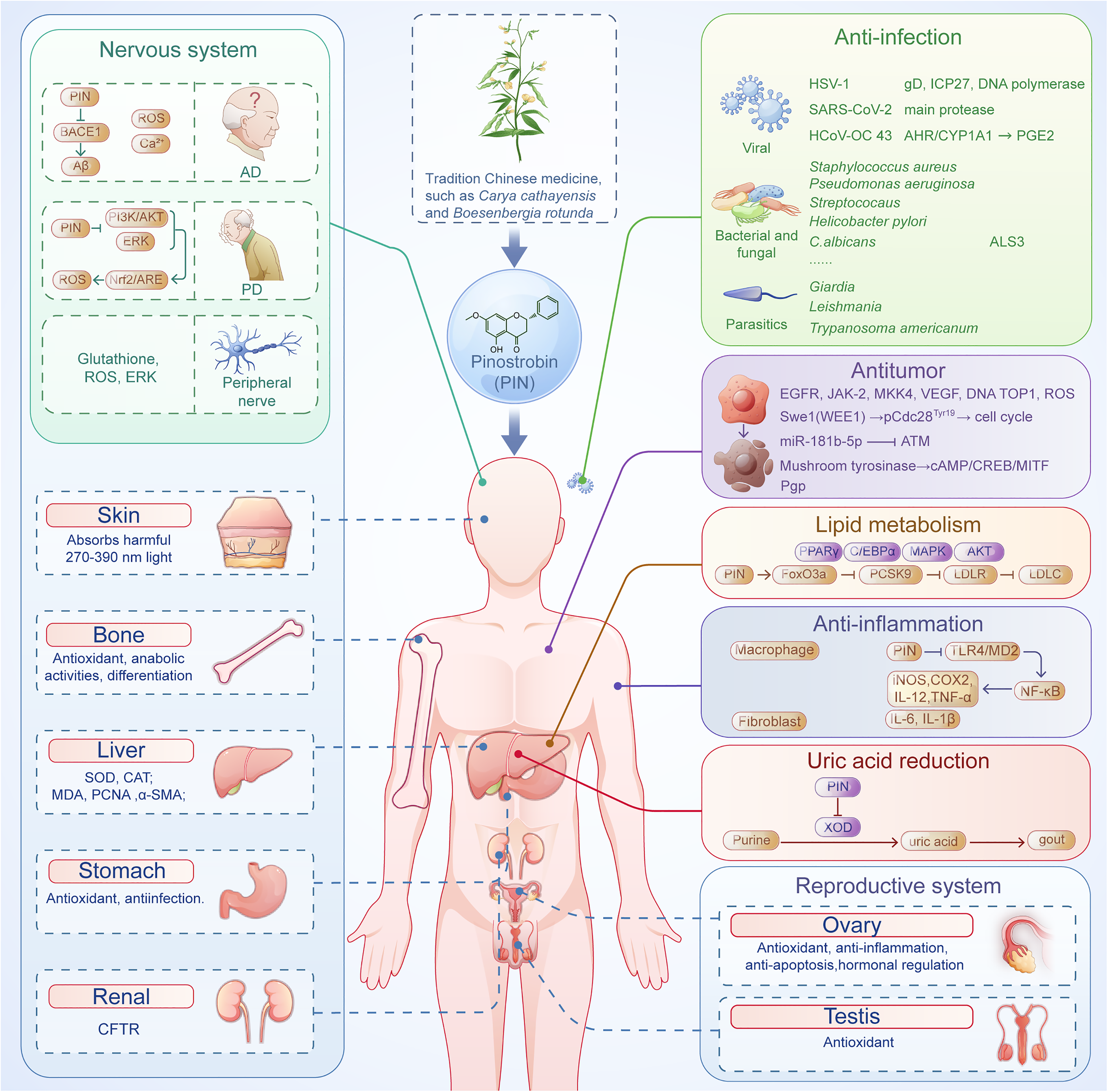
Pharmacological effects of pinostrobin. Pinostrobin is widely present in many traditional Chinese herbs, including Carya cathayensis leaves, Boesenbergia rotunda and propolis. Pinostrobin exhibits many pharmacological activities, such as antitumor, anti-inflammatory, neuroprotective, and lipid-lowering effects, and it can inhibit infection, reduce uric acid, and protect multiple organs.
Inhibiting Infection
Pinostrobin has been shown to have diverse antibacterial, antifungal, antiviral, and antiparasitic effects.
Antiviral Effects
Approximately 60% of people under the age of 50 are infected with herpes simplex virus type 1 (HSV-1) worldwide. After HSV-1 infects human epithelial cells, it can remain latent in neurons of the peripheral nervous system (PNS) and periodically reactivate, leading to relapse. 20 Pinostrobin binds to the glycoprotein gD of HSV-1, and inhibits the contact between gD and cell surface receptors, thereby inhibiting viral adsorption. Pinostrobin also inhibits the protein expression of gD and infected-cell protein 27 (ICP27), thus blocking the replication of HSV-1. In addition, pinostrobin inhibits HSV-1 DNA polymerase and DNA synthesis. 3
The novel coronavirus SARS-CoV-2 and human coronavirus OC43 (HCoV-OC 43) mainly infect the respiratory tract. Pinostrobin can bind to the main protease of SARS-CoV-2 and inhibit its activity through hydrophobic bonds. 14 Pinostrobin inhibits the proliferation of HCoV-OC 43 in human ileocecal colorectal adenocarcinoma cells by inhibiting the AHR/CYP1A1 pathway and increasing prostaglandin E2 (PGE2) levels. 21
Antibacterial and Antifungal Effects
Pinostrobin was reported to inhibit many bacteria including Bacillus subtilis, Staphylococcus aureus, Pseudomonas aeruginosa, Streptococcus, and Helicobacter pylori.6,22‐27 This partially results from its ability to reduce efflux pump activity and antibiofilm. 25 Pinostrobin also synergizes with ciprofloxacin to resist pellicle formation and reduce the minimum effective concentration of ciprofloxacin. 22 Pinostrobin reduces ALS3 mRNA levels, resulting in a decrease in C. albicans invasion and hydrophobicity of the biofilm. 5 Furthermore, pinostrobin inhibits the growth of yeast by reducing the activity of the protein kinase Swe1 in Ca2+-dependent manner.28,29
Antiparasitic Effect
Pinostrobin has cysticidal activity and can effectively cause glycogen granule and vacuole accumulation in the germ layer in a murine cysticercosis model. 23 In addition to inhibiting Giardia activity, pinostrobin effectively relieve symptoms caused by Leishmania and Trypanosoma americanum infections.30,31
Effects on Lipid Metabolism
Pinostrobin alters lipid metabolomics, especially folate and arachidonic acid metabolism, in HRT-18 cells. 21 It reduces triglyceride (TG) levels in C3H10T1/2 mouse embryonic mesenchymal stem cells and inhibits adipogenic differentiation. Peroxisome proliferator-activated receptor-γ (PPARγ) and CCAAT/enhancer-binding protein α (C/EBPα) are the most important transcription factors associated with adipogenesis and play a decisive role in adipogenic differentiation. FABP4 is a marker of adipogenic differentiation. Pinostrobin can inhibit the expression of these genes, thereby reducing the number of lipid droplets and adipogenic differentiation, which may be due to the regulatory roles of pinostrobin on the MAPK and AKT signaling pathways. 32
Low-density lipoprotein cholesterol (LDLC) is one of the most important risk factors for many vascular diseases such as atherosclerosis (AS). LDLC is also closely related to the occurrence and development of tumors. PCSK9 promotes endocytosis and degradation of the LDL receptor (LDLR), thereby inhibiting LDLC clearance. PCSK9 also upregulates the expression of lectin-type oxidized LDL receptor 1 (LOX-1) and promotes the uptake of oxidized LDLC (ox-LDLC), leading to macrophage transformation into foamy cells. PCSK9 is therefore an important target for the treatment of LDLC-mediated AS and cancer. 33 Interestingly, pinostrobin promotes the competitive binding of FoxO3a to the promoter of PCSK9 by upregulating FoxO3a protein levels in hepatocytes. This reduces the transcription of PCSK9 and ultimately increases the protein levels of LDLR and LDL uptake in hepatocytes. 13
Uric Acid Reduction
Excessive accumulation of uric acid causes diseases such as gout. Xanthine oxidase (XOD) plays an important role in the production of uric acid. Pinostrobin can reduce uric acid levels by decreasing serum levels of XOD. Pinostrobin (200 mg/kg) does not affect liver function or serum uric acid levels in normal mice, but it significantly reduces serum uric acid levels in an acute hyperuricemia mouse model. 15
Anticancer Effects
Traditional Chinese herbal medicines have broad antitumor activity.34,35 Pinostrobin inhibits many types of cancers, such as HT-29, HeLa, A549, and PC-3 cancer cells.9,36‐39 Molecular docking analysis showed that pinostrobin strongly bound to a variety of cancer-promoting molecules, such as epidermal growth factor receptor (EGFR), tyrosine-protein kinase (JAK-2), mitogen-activated protein kinase kinase 4 (MKK4), vascular endothelial growth factor (VEGF), and DNA topoisomerase I (TOP1). 40 Mutation is an important factor in tumor development and tolerance to chemoradiotherapy. Pinostrobin inhibits N-hydroxylation of DNA by MeIQ (mutagen) and shows some anti-mutagenic effects on Salmonella typhimurium. 41
Pinostrobin inhibits cancer stem cell proliferation and induces apoptosis by increasing intracellular reactive oxygen species (ROS)-mediated mitochondrial damage. 42 Metastasis and invasion of tumor cells are 2 main causes of tumor recurrence and chemoradiotherapy resistance. 43 Pinostrobin inhibits the migration of breast cancer cells by inhibiting focal adhesion formation and cell adhesion. 11 Tumor cells can avoid excessive DNA damage and reduce apoptosis through the G2 checkpoint. Pinostrobin inhibits the activity of protein kinase Swe1 (ortholog of the WEE1 gene in humans) in yeasts. This provides evidence to support the efficacy of pinostrobin during cancer chemotherapy. 28 In pinostrobin-treated leukemia cells, miR-181b-5 is reduced and the ataxia telangiectasia mutated gene (ATM) is activated, leading to cell apoptosis. 44
P-glycoprotein (Pgp) is critical for multidrug resistance in cancer cells. 45 It was reported that pinostrobin inhibits the activity of Pgp without affecting its expression, thus reversing cancer cell resistance to vincristine, taxol, and other drugs. 46 In highly metastatic melanoma B16F10 cells, pinostrobin binds to the polyphenol oxidase chain and C-type lectin-like fold domain of mushroom tyrosine through hydrogen bonds and noncovalent bonds. This inhibits enzymatic activity and downregulates melanogenesis through the cAMP-CREB-MITF signaling axis. Pinostrobin also reduces α-MSH-induced coloration without cardiotoxicity in zebrafish larvae. 47
Pinostrobin exhibits promising potential for leukemia treatment.44,48,49 For example, pinostrobin inhibits miR-410-5p, thereby increasing β-catenin degradation and the expression of SFRP5, which inhibits the Wnt/β-catenin signaling pathway. Furthermore, pinostrobin increased the expression levels of key apoptosis mediators Bax, caspase-3, and BAK while decreasing the anti-apoptotic proteins BCL-2, BCL-W, and MCL-1. These effects of pinostrobin ultimately induce apoptosis in NB4 and MOLT-4 acute leukemia cells.48,49 GO enrichment analysis revealed that pinostrobin is closely associated with terms related to the regulation of cancer cell progression including programmed cell death, hemopoiesis, cell differentiation, inflammatory response, DNA replication, chromosome segregation, and cell cycle checkpoints. Pinostrobin upregulates FOXO3 expression and nuclear translocation. Without affecting cyclin D2 (CCND2) or CDK6, pinostrobin induces cell cycle arrest at the G1 phase by upregulating cyclin-dependent kinase (CDK) inhibitors p21Waf1/Cip1 and p27Kip1 proteins while reducing cyclin E1 expression. Pinostrobin induces acute myelogenous leukemia (AML) cell differentiation by increasing the expression of the monocytic differentiation markers CD11b and CD14. Furthermore, pinostrobin plus cytarabine synergistically reduce the viability of AML cells. 49
Anti-Inflammatory Effects
Pretreatment with pinostrobin protects against gastric mucosal injury, peptic ulcers, submucosal edema and leukocyte infiltration induced by alcohol. 50 Lipopolysaccharide (LPS) binds the toll-like receptor 4 (TLR4)/myeloid differentiation protein-2 (MD2) complex on the cell membrane. This activates the nuclear translocation of NF-κB, resulting in the upregulation of proinflammatory factors, and causing inflammatory responses and endotoxemia. Pinostrobin can directly bind to the hydrophobic pocket of MD2 and TLR4, thereby inhibiting LPS/NF-κB induced expression of inducible nitric oxide synthase (iNOS), cyclooxygenase-2 (COX-2), interleukin 12 (IL-12), and tumor necrosis factor α (TNF-α) in macrophages. 51
The anti-inflammatory effect of pinostrobin has been extensively documented. Pinostrobin can inhibit the inflammatory response and reduce the protein and mRNA levels of IL-6 and IL-1β in human gingival fibroblasts (HGF-1) cells stimulated by silver nanoparticles. 10 Furthermore, pinostrobin reduces the levels of TNF-α and IL-1β in LPS-stimulated cells and rat inflammation models. 52
Multiple Organ Protection
Because of its extensive antioxidant and anti-inflammatory effects, pinostrobin can protect against organ injury caused by many factors.16,53,54 Pinostrobin absorbs ultraviolet light in the range 270 to 390 nm, which includes most of the wavelength range of UVB and UVA that are harmful to the human body. 54 Pinostrobin can inhibit the contraction of intestinal smooth muscle by regulating Ca2+ signaling. This suggests the potential role of pinostrobin in treating diarrhea, which still needs further in vivo investigation. 55 In addition, pinostrobin also has detoxification properties. Pinostrobin inhibits the activity of bothrops asper venom in vitro and in vivo. 56 Pinostrobin can also relieve phospholipase A2 (PLA2)-induced myotoxicity, edema and coagulation in a dose-dependent manner. 57
Liver
Pinostrobin protects against thioacetamide (TAA)-induced liver injury in rats, such as liver cirrhosis, hepatocyte fibrosis and propagation. Mechanistically, pinostrobin increases the activities of antioxidant enzymes including superoxide dismutase (SOD) and catalase (CAT), and decreases the expression of malondialdehyde (MDA), proliferating cell nuclear antigen (PCNA), and α-smooth muscle-actin (α-SMA). This ultimately reduces oxidative stress and lipid peroxidation. Pinostrobin also reduces the levels of TNF-α and IL-6, and increases the level of IL-10, resulting in a reduction in cellular inflammation and the modulation of inflammatory cytokines. 16
Kidney
Treatment with 10 or 50 μM pinostrobin for 6 days markedly decreased Type I Mardin Darby Canine Kidney (MDCK) cell-derived cyst number and growth, and reduced the number of cystic areas and cyst colonies in polycystic kidney mice. Mechanistically, pinostrobin significantly inhibited cystic fibrosis transmembrane conductance regulator (CFTR)-mediated transepithelial chloride secretion with an inhibitory concentration (IC50) approximately 28 μM without affecting CFTR protein expression and independent of the activity of Na -K+-ATPase. Moreover, pinostrobin reduced cyst expansion by inhibiting fluid secretion and cell proliferation by reducing the ERK phosphorylation levels. But this effect was not attributed to a decline in cell viability. 19
Bone
ROS can inhibit the osteogenic function of osteoblasts and disrupt the balance of bone formation and destruction. A study revealed that pinostrobin was an important compound in the extract of Blainvillea acmella (L.) Philipson (BaE). BaE exerts to antioxidant and anabolic effects on bone tissue. 58 BaE and pinostrobin can promote the proliferation, early and late differentiation, and mineralization of MC3T3-E1 mouse embryonic osteoblasts, which are essential for new bone formation.58,59 Alkaline phosphatase (ALP) and collagen (COL1) are 2 early osteogenic markers associated with matrix maturation and are essential enzymes for osteoblast differentiation. BaE increases in collagen synthesis and ALP activity in MC3T3-E1 cells, which may involve promoting interactions between the collagen matrix and integrin receptors. 58 Moreover, pinostrobin reversed the inhibitory effect of dexamethasone (DEX) on cell differentiation. Osteocalcin (OCN) is secreted in the late stage of osteoblast differentiation and is a marker of differentiation. 60 A study revealed that pinostrobin significantly increased the expression of OCN in a dose-dependent manner. 59
Reproductive System: Testis and Ovary
Polystyrene microplastics (PS-MPs) can induce severe injury to many organs such as the liver, kidney, brain, and testis. It was reported that PS-MPs increased oxidative stress and the levels of inflammatory cytokines such as IL-6, TNF-α, COX-2, and IL-1β by activating the p38 MAPK pathway in mouse testicular tissues.61,62 Pinostrobin is a well-known anti-inflammatory and antioxidant natural product. Pinostrobin increases the activities of glutathione reductase (GSR), glutathione peroxidase (GPx), superoxide dismutase (SOD), and catalase (CAT) while decreases the levels of MDA and ROS in the PS-MPs-treated rat model. Pinostrobin also increases luteinizing hormone (LH), plasma testosterone, follicle-stimulating hormone (FSH) concentration, and testicular steroidogenic enzymes such as 17β-HSD, steroidogenic acute regulatory protein (STAR), and 3β-HSD. Moreover, pinostrobin reduces Bax and caspase-3, and upregulates the antiapoptotic marker Bcl-2, which ultimately inhibits PS-MPs-induced apoptosis. Finally, pinostrobin alleviates PS-MPs -induced histomorphometric changes in testicular tissues (seminiferous epithelial tubule, tunica propria height, tunica propria width, luminal diameter, and interstitial space), morphological abnormalities in sperm (tail, mid sperm/neck, and head), and reduction in epididymal sperm count and sperm motility. 62
Interestingly, a recent study by using a methotrexate (MTX)-induced ovarian toxicity rat model demonstrated that pinostrobin significantly recovered ovarian histoarchitecture. Pinostrobin significantly decreases serum levels of LH and FSH, as well as ovarian levels of NO, MDA, caspase-3, NF-κB, IL-1β, IL-6, TNF-α, and iNOS. Pinostrobin also remarkably upregulated GSH, GPx, CAT, and SOD in the ovarian tissues and serum E2 and progesterone levels. 17
Stomach
Helicobacter pylori is a critical bacterium that infects the stomach and is a inducer of gastritis, stomach ulcers, and gastric cancer.63,64 As mentioned previously, pinostrobin can significantly act against Helicobacter pylori activity, suggesting that pinostrobin is promising for many stomach diseases. 24 In addition, a study reported that pinostrobin protected against ethanol-induced gastric injury, as evidenced by reductions in the ulcer area, mucosal contents, submucosal edema, leukocyte infiltration, and TBARS levels in gastric homogenate. This effect of pinostrobin is independent of COXs, NO, and the direct antioxidant mechanism. 50
Neuroprotective Effect
Cajanus cajan leaves have neuro-modulatory and protective effects, and pinostrobin is one of the main active components.12,65,66 Molecular docking analysis showed that pinostrobin had a strong affinity for 5-hydroxytryptamine receptor 2A (5-HT2A), α2-adrenoceptor (α2A-AR), and γ-aminobutyric acid sub type A (GABAA) receptors. This may account for why Cajanus cajan seed extract is an antidepressant that acts via the monoaminergic system (5-HT2A receptors, α1/α2-ARs, and dopamine D2 receptors) and NO-cGMP pathways, as well as the GABAA benzodiazepine receptor. 66 Pinostrobin alleviates chronic stress-induced cognitive impairment by exerting antioxidant effects, reducing neuronal cell damage, and improving the function of astrocytes glial fibrillary acidic protein (GFAP) and excitatory amino acid transporter 2 (EAAT2). 67 Pinostrobin is an antioxidant that lacks significant toxicity, which makes it promising for the treatment of neurodegenerative diseases such as PNS repair after injury, Alzheimer's disease (AD) and Parkinson's disease (PD).
Alzheimer's Disease
Amyloid-β (Aβ) deposition is one of the main triggers and pathological features of AD. β-Site amyloid precursor protein cleaving enzyme 1 (BACE1) is essential for Aβ production. Pinostrobin directly binds to the inactive region of BACE1 through hydrogen bonding, the inhibitory constant (Ki) is 30.9 µM and the binding energy is −7.6 kcal/mol. This leads to the inhibition of BACE1 activity in a noncompetitive manner and probably may inhibit Aβ production. 68 In addition, pinostrobin significantly inhibits Aβ25–35-mediated DNA fragmentation, lactate dehydrogenase activity and Bax-mediated apoptosis, which may be due to the antioxidant effect of pinostrobin and the inhibition of intracellular Ca2+ influx. 12
Parkinson's Disease
Oxidative stress-induced degeneration of dopaminergic neurons is an important reason for PD development. In a neurotoxin-induced zebrafish model of PD, pinostrobin attenuates MPTP-induced loss of dopaminergic neurons and ameliorated behavioral disturbances. In SH-SY5Y cells, pinostrobin inhibited the MPP+-induced apoptotic cascade, including the loss of mitochondrial membrane potential (ΔΨm) and activation of caspase-3. This is because pinostrobin activates PI3K/AKT and ERK pathway-mediated Nrf2 nuclear translocation and upregulates the expression of antioxidant proteins such as GSH-Px, SOD, and CAT and NAD/NADH through antioxidant responsive element (ARE), ultimately reducing the level of ROS and lipid peroxidation. 69
Peripheral Nerve Injury
Following nerve injury, ROS and inflammatory responses are increased. Oxidative stress causes neuronal death, axonal demyelination, and delays motor recovery. Pinostrobin decreases oxidative stress levels by upregulating endogenous GSH and reducing MDA in the injured sciatic nerve. This increases the axonal diameter, the number of dorsal root ganglion cells, and the expression of p-ERK1/2, which ultimately promotes faster recovery in the rat model of sciatic nerve injury within 4 weeks. 70
Conclusions
The main sources of natural pinostrobin, such as pecan leaves, cajan leaves, and propolis, have been widely used in lipid-lowering, anti-inflammatory, and immunomodulatory traditional Chinese medicines. Recent studies further showed that pinostrobin also has functions such as lowering uric acid, promoting injury repair, and exerting anti-tumor effects. Based on its multifunctional effects without significant toxicity, pinostrobin is a promising agent for many diseases including regenerative medicine and cancer therapy. However, the underlying mechanisms of pinostrobin are still not clear, and further investigation needed to promote the medicinal development of pinostrobin.
Footnotes
Author Contributions
Chaochu Cui, Xianwei Wang, and Zihan Wang conceived the idea. Zihan Wang, Yifan Chen, and Jinyu Zhao wrote the draft. Jianbo Yang, Gang Liu, and Yuqiao Chang revised the manuscript. Chaochu Cui and Xianwei Wang finally approved the version to be published. All authors have read and approved the manuscript.
Declaration of Conflicting Interests
The authors declared no potential conflicts of interest with respect to the research, authorship, and/or publication of this article.
Funding
The authors disclosed receipt of the following financial support for the research, authorship, and/or publication of this article: This work was sponsored by the Natural Science Foundation of Henan for Excellent Young Scholars (No. 202300410309) and Outstanding Young Scholars (No. 212300410012); Xinxiang Medical University grant for Talents (No. XYBSKYZZ201828) and grant of Scientific Research Innovation of College Students (No. xyxskyz202101).
