



Abstract
Terrein is one of the most important biomolecules of fungal origin being studied from a medicinal perspective. Secondary metabolites are the intermediate products produced during the metabolism of organisms for a large number of functions, for example, defense and communication signals. From the outset, terrein has largely been studied as an anticancer secondary biomolecule. Aspergillus terreus is the only fungal source of some valuable drugs and mycotoxins. From the beginning, a few species of Aspergillus were known to be viable chemical factories. Terrein is a potent biological molecule present in the fungus that is responsible for its medicinal and agricultural values. Numerous evaluations conducted on terrein showed it to have marked biological activities (antimicrobial, antiproliferative, anti-oxidative, and others). To date, terrein has emerged as a very attractive therapeutic regimen against cancer due to its dual targeting nature; tumor angiogenesis and cell proliferation. This focused review provides details of the therapeutic value of terrein and its modes of action as an anticancer agent. Besides this, terrein has other marked bioactivities and manifold uses in the field of medicine, which have also been discussed here.
Introduction
Fungal biomass is a large portfolio of proteins, vitamins, minerals, metabolites, and bioactive compounds for pharmaceutical applications, especially as antibiotics. 1 The fungus Aspergillus terreus is a storehouse of bioactive compounds and “terrein” is one of the most active biomolecules obtained from it. Terrein was first isolated and described in 1935, but its structure (4, 5-dihydroxy-3-[(E)-10-propenyl]-2-cyclopenten- 1-one, C8H10O3) was elucidated in the 1950s.2–4 Subsequently, it has been isolated from different sources like soil fungi Phoma, Microspora, Aspergillus sp., A. novofumigatus, Pencillium sp., Penicillium sp. KCTC 26245, and other natural sources.4–9 Later on, terrein was validated for multiple properties such as antibacterial, anti-inflammatory, melanogenesis inhibition, angiogenin secretion, and proteasomal inhibition.
Aspergillus terreus (JAS-2), an endophytic fungus linked with Achyranthus aspera, was found to secrete terrein as a potential metabolite.10,11 A scanning electron microscopy picture of A. terreus (JAS-2) endophytic fungal conidia is shown in Figure 1. Terrein exhibited 100-fold higher cytotoxicity as compared with paclitaxel against various cancer cells like pancreatic (PANC-1), breast (MCF-7), and liver (HepG2). Furthermore, terrein has shown several important biological actions, like antiproliferative, anti-oxidative, and antimicrobial.9,11–14 Buachan et al 15 reported that terrain inhibited crucial metastatic processes (cell adhesion, migration, and invasion) in human lung cancer cells. Terrein has shown protective effects on lipopolysaccharide (LPS)-induced endotoxemia in mice, which is mediated by potential mechanisms like blocking of interleukin-1β (IL-1β) and interleukin-6 (IL-6) production. 16 This versatile anticancer action of terrein against multiple cell lines has opened new avenues for cancer therapeutics. This focused review highlights the potency of terrein as an anticancer agent and other miscellaneous properties.

Scanning electron microscopy of the endophytic fungus Aspergillus terreus (JAS-2).
Biosynthesis of Terrein
In 1981, Hill et al 17 proposed that the cyclopentanone ring of terrein was derived from the dihydro isocoumarin ring by oxidative decarboxylation. Chemical biosynthesis of terrein through classical stable isotope labeling revealed the acetate condensation of 5 units, while the formula -C8H10O3 disguised the 4 acetate units. 18 The structure is also composed of free -OH groups at C-4 and C-5 of the ring (Figure 2). 9 Scale-up of terrein (single configuration) by chemical synthesis has been a tedious task due to 2 chiral carbon atoms. Apart from this, chemical synthesis routes are followed by many drawbacks, like low yield, drastic reaction conditions, nonstereoselectivity, costly reagents, and a predominance of racemic products.11,19,20 Terrein chemosynthesis was initiated in 1974, and later a “9-step approach” model was published.21,22 However, the investigational support for this 9-step approach model has been deficient, and the biosynthesis of terrein has also remained mysterious. Terrein PKS (polyketide synthase) produces a variety of products. 22
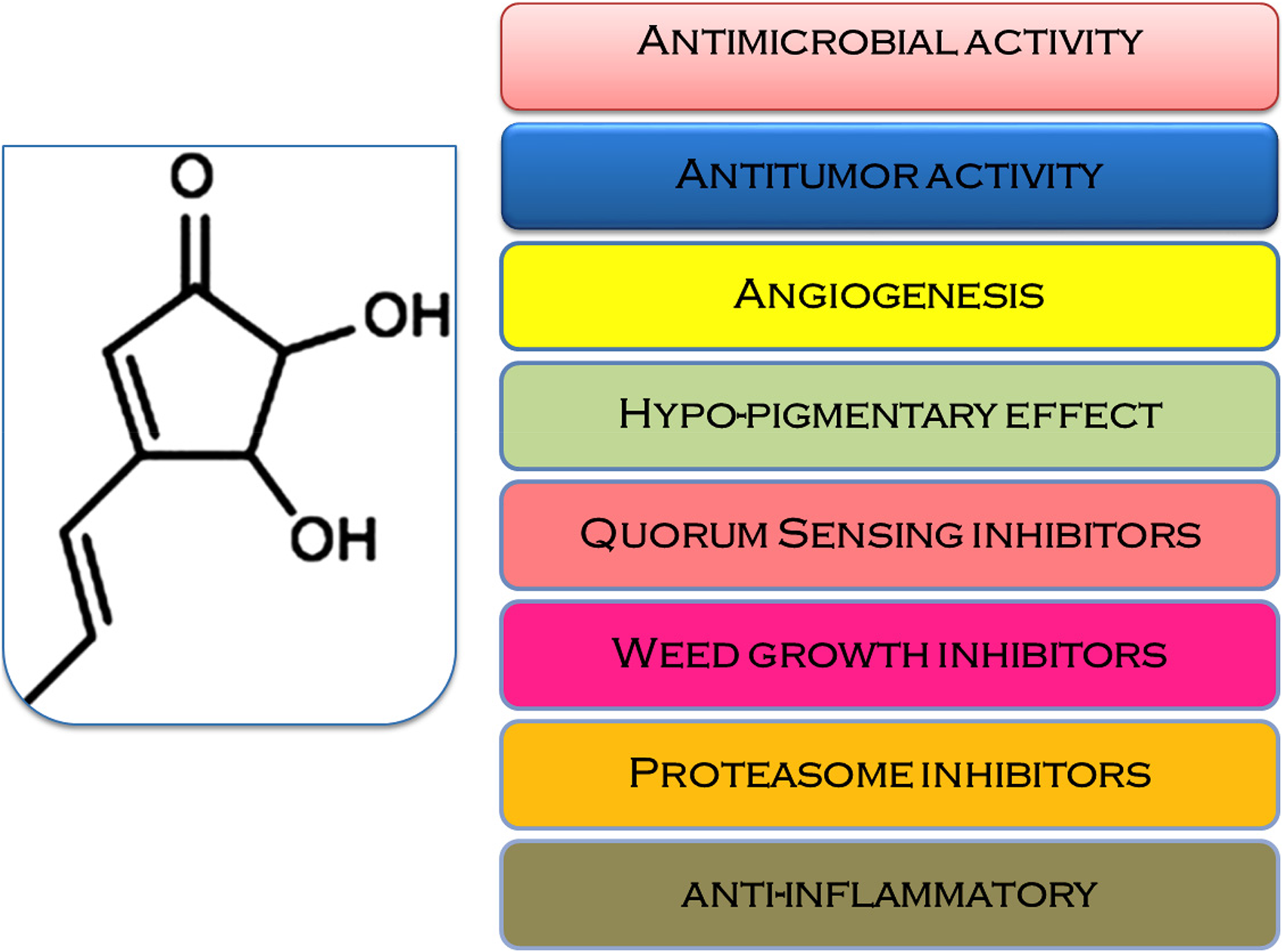
Terrein: a potential metabolite having multiple functional attributes.
Discovery of Terrein
Several studies on terrein biosynthesis and its related pathways have been reported in the literature. In a study where the PKS gene for conidia colors was being searched, a serendipitous gene named terA was discovered. The “terA” gene is crucial for the biosynthesis of terrain; it encodes the TerA protein in Aspergillus niger and yields a mixture of 4-hydroxy-6-methylpyranone, orsellinic acid, and 6, 7-dihydroxymellein. 23 Furthermore, research revealed that in terrein biosynthesis, 6-hydroxymellein was considered as a key intermediary molecule. Plant-derived media are the most efficient inducer of terrein production. Research has shown that terrein is considered as a biomolecule of multipotent applications (Figure 2). Recent research reported the various ways to produce terrein in an efficient manner from A. terreus.11,24 Most recently a study reported that the refactoring of global and pathway-specific transcription factors (StuA and TerR) enhanced terrein production. 24 Therefore, these strategies could be adopted for the scale-up of terrein and other secondary metabolite production from filamentous fungi.
Antitumor Activity
Since uncontrolled cell proliferation and apoptosis deficiency lead to cancer, molecules that target these processes could be considered as potential anticancer agents. Various molecules like doxorubicin, paclitaxel, cisplatin, and etoposide have been clinically used as apoptosis-inducing molecules.25–27 Thus, induction of apoptosis is the potential targeted step in the development of novel anticancer molecules. Numerous research has exposed that terrein has antiproliferative effects against various types of tumors and cancers.
Breast Cancer
Although terrein has been known for more than 80 years, the understanding of its biological activities is still fragmentary. Terrein displayed 100-fold stronger cytotoxicity than paclitaxel against the breast cancer cell line MCF-7. Breast cancer is considered a major health concern across the globe. Despite the low efficacy and severe side effects of advanced treatments such as surgery, radiotherapy and chemotherapy, breast cancer incidence and mortality rates continue to increase. 28 Apart from these, late-stage detection of cancer also makes it difficult to treat. Terrein targets multiple metabolic pathways to suppress uncontrolled growth in a breast cell, an observation made by different scientists globally. During severe oxidative stress, reduction in the level of the master antioxidant glutathione (GSH) can bring the cell into apoptotic pathways. 29 Drugs and molecules such as doxorubicin, paclitaxel, curcumin, and terrein could attenuate the level of reactive oxygen species (ROS) in mature human diploid fibroblast cells and induce anti-oxidant molecules such as heme oxygenase-1 and superoxide dismutase. 30 The intrinsic apoptotic pathways are triggered by ROS, which cause pores in the mitochondria to open and release cytochrome-c into the cytosol, followed by an apoptotic process in the later stage of the cell cycle. Similarly, terrein could increase the level of ROS and cause a reduction of cellular antioxidant GSH, which potentiates breast cancer cells (MDA-MB-231) to enter the death state, especially through the apoptosis mechanism. 31
Reduction in breast cancer resistance protein (BCRP) expression via multiple drugs leads the cancer cell into the apoptotic pathway. Among cancer cells, BCRP acts as a stem cell marker, which regulates the metabolic and signaling pathways by active efflux of the drugs that lead to drug resistance. This protein also maintains the self-renewal (sternness), and invasiveness (aggressiveness) properties of cancer cells. Hence blocking BCRP-mediated efflux via an anticancer drug could be a better therapeutic option against cancer. 32 According to the Food and Drug Administration, either BCRP or ABG2 proteins, which are recognized as drug transporters in humans, have shown a crucial role in drug–drug interactions, and could participate in drug resistance. 33 BCRP may expel the substances from the cells which affect the absorption, distribution, and secretion of drugs and endogenous molecules like folic acid, estrogens, and protoporphyrin.34,35 The general pathway followed by terrein to suppress cancer cell growth via the apoptotic mode of cell death is shown in Figure 3.

Schematic representation of terrein's antimicrobial, anti-oxidative, and anticancer activity. The elaborated and common anticancer mechanisms are shown by which terrein induces apoptosis and cell cycle delay in different types of cancer cells.
Terrein significantly reduced BCRP expression in cells via caspase-7 activation and Akt signaling inhibition, which reduced the cells expressing ABCG2 and its side-population phenotype. 14 Similarly, terrain, accompanied by asperjinone, a nor-neolignan, were found to suppress the expression of ABCG2 transporter in breast cancer.
Terrein promotes an apoptotic mode of cell death, which was studied on breast cancer cell lines (MCF-7 and MDA-MB-231). Terrein also inhibits cell migration and invasion which occurs due to alteration of extracellular matrix, cell adhesion, and cytoskeleton. 36 The molecular mechanisms have shown that the migration process is regulated by Rho GTPases, which regulate cell morphology and motility. 37 Till now 22 Rho family proteins have been identified, of which RhoA/B/C, Rac1/2/3, and Cdc42 are the best characterized, and regulate cell migration. 38 On stimulation, the chemokine gradient alters the dynamics of actin polymerization which controls the movement of the cell. Secondly, the role of matrix metalloproteinases (MMPs) is to degrade the extracellular matrix and facilitate migration. Terrein affects the role of Rho GTPases and MMPs during cell (MCF-7 and MDA-MB-231 cells) invasion and migration. A high concentration of terrein induced programmed cell death in both invasive and noninvasive breast cancer cell lines.
Terrein at 75 µM significantly decreased cell (MDA-MB-231 and MCF-7) migration after incubation for 24 h by approximately 10% and 40%, respectively, via the wound healing assay. Terrein decreased the messenger RNA levels of both MMP-9 and MMP-2 in a concentration-dependent manner. The anti-invasive property of terrein was correlated with distorted expression of MMP-9 and MMP-2. It also significantly decreases the RhoA, RhoB, and Rec1 levels without affecting the RhoC and Cdc42 expression levels. Therefore, inhibition of RhoB and Rac1 by terrein may disrupt actin cytoskeletal formation and arrangement, leading to a decrease in cell migration. Terrein-treated cells (MDA-MB-231 and MCF-7) showed a spotted pattern of migration, which indicated that Rac1 and RhoB suppression probably hindered the breast cancer cells’ migration. 39
Terrein Controls Neoplasmic Growth in Various Cancers
Neoplasm refers to new abnormal growth of tissue that may or may not metastasize. Despite the availability of numerous drugs in the pharmaceutical industry, cancer cells continue to develop resistance. In cancer/tumors drug resistance is also reported, which is probably due to gene amplification and mutations, or epigenetic changes that influence the export of drugs, uptake, and metabolism by cells. 40
Head and Neck Cancer
Head and neck cancer is the fifth most common type of cancer, which affects around 0.5 million patients annually. They arise from the oral cavity, pharynx, larynx, nasal cavity, and paranasal sinuses.41,42 Today obtaining a high cure rate while preserving organ structures and function is a major challenge. Molecules such as cisplatin, fluorouracil, docetaxel, and cetuximab emerged as the cancer-targeting drugs which confer a survival advantage in head and neck type cancer. 43 Synthetic terrein showed an inhibitory effect on the proliferation of head and neck type cancer cells (OSC-19), with an IC50 of 21 μM. It also suppressed angiogenic factor (ANG) secretion with an IC50 of 11 μM, and inhibited ribosome biogenesis.44,45 Ribosome biogenesis perturbations by chemotherapeutic drugs inhibit the transition of G1 to S-phase of the cell cycle. 46 IHC staining showed that treatment with synthetic terrein decreased the Ki67-positive cancer cells, CD31-positive vessels in the tumors, and ANG expression in cancer cells. Therefore, terrein exerted a direct antiproliferation effect in addition to its anti-angiogenesis effect by suppressing ANG expression in head and neck cancer. 47
Esophageal Cancer
Among the malignant types of tumor, esophageal cancer is one of the most common and cisplatin has shown to be effective against it. 48 The synergistic effect of terrein and cisplatin on Eca109 cells has been reported.49,50 Terrein arrested the G2/M phase of the cell cycle and suppressed Eca109 proliferation (esophageal cancer cells) in a time-dependent and dose-dependent manner via cyclin B1 regulation and Cdc-2 phosphorylation.
Ovarian Cancer
Terrein effectively inhibited primary human ovarian cancer cells (hOVCCs) and ovarian cancer cell proliferation by arresting the G2/M phase of the cell cycle, as well as suppressing Cdc-2 and cyclin B1 expression. 51 Expression of the lin28 gene was found to be downregulated, which plays a crucial role in Caenorhabditis elegans development and has been considered as a promoter of pluripotency. 52 In ovarian cancer cells terrein repressed LIN28 expression and arrested cell proliferation at the G2/M phase of the cell cycle.51–53 Therefore, LIN28 has been considered as an essential regulator. Epithelial ovarian cancer is a fatal gynecological malignancy which is linked with a 5-year survival rate in approximately 30% of cases. Progression of the cell cycle from the G2/M phase is guarded by M-phase promoting factor, along with over-expression of cyclin B1 and p-Cdc-2 at Tyr-15 in Eca109 cells. However, the Cdc-2 level was found to be unaffected. 54 Terrein treatment revealed that Cdc-25C (a dephosphorylation mediator of Cdc-2) was decreased.
Cervical Cancer
Globally, human cervical carcinoma ranked second among cancers in women. In patients with advanced cervical cancer, chemotherapy remains less effective because of decreased chemosensitivity against cervical cancer cells. 55 In cervical cells, terrein-induced apoptotic cell death via p53 and extracellular signal-regulated kinase (ERK) signaling. 56 Terrein-induced apoptosis was mediated by the death receptor and other mitochondrial pathways in human cervical carcinoma cells.
Terrein, a Novel Inhibitor of Proteasome
Proteasomes play a crucial role in the proliferation of cancer cells, DNA repair, and cell survival. 57 Proteasome inhibitors that promote cell death by apoptosis are considered to be antitumor agents. The underlying mechanisms of proteasome inhibitors directed to the death of cancer cells utilize multiple pathways. 58 Carfilzomib, bortezomib, and ixazomib are the inhibitors of the proteasome β5 subunit that hinders the catalytic activity. 59 The free hydroxyl groups of the cyclopentenone core of terrein are assumed to inhibit proteasome activity. 9 Catalytic inhibitors of the 20S proteasome were screened from the crude extract of various fungal sources such as A. niger, A. terreus, A. foetidus, Penicillium decumbens, and Rhizopus oryzae. Structural identification of the active compound from A. terreus showed it to be terrein. Demasi et al 9 revealed that the proapoptotic activity of terrein on the cell line NCI-H292 (human tumor cells) was due to the inhibition of the proteasome. Terrein inhibited the chymotrypsin-like and trypsin-like activities of the multicatalytic core particle of the 20S proteasome with an IC50 of 0.3 mM. 60
Terrein Inhibits Hepatoma
Among hepatic cell lines, terrein showed cytotoxic activity against the hepatic Bel-7402 cell line (human hepatoma), with an IC50 value of 11.63 μM. Terrein induced round-cell morphology of cell lines Bel-7402 and A549, but was unable to induce apoptosis. However, it inhibited the proliferation of Bel-7402 cells (human hepatoma) and arrested the cell cycle in the G2/M phase by decreasing the expression of genes (CCND2, CCNE2, CDKN1C, CDKN2B, ANAPC5, PKMYT1, CHEK2, and PCNA) related to the cell cycle. 61 Cell proliferation is regulated by negative as well as positive regulators of cell cycle, which determine the cell progress. 62
Hypopigmentary Effect of Terrein
Terrein can reduce pigmentation of the skin, as was observed in the cell line of immortalized mouse melanocytes. 63 Melanogenesis is regulated by tyrosinase, and its related proteins such as TRP-1 and TRP-2. Terrein (isolated from Penicillium sp KCTC 26245) inhibits the microphthalmia-associated transcription factor expression by activating ERK pathways. Hence melanin biosynthesis inhibition leads to a skin whitening effect. Thus, terrein can be effectively used as a skin trouble treating agent, a skin whitening agent, and a browning inhibitor. 63 Lee et al 22 isolated terrein from Penicillium sp. 20135, prepared it synthetically, and evaluated it for inhibition of melanin biosynthesis.
Terrein-Inhibited Angiogenesis
Progression of cancer requires nutrition as well as oxygen sources and angiogenesis is a crucial step in cancer progression. 64 Chemical signals from tumor cells trigger the angiogenesis (formation of new blood vessels from established vasculature), which is a fundamental process of tumor growth and metastasis. 65 Therefore, it performs critical steps in tumor therapy by employing angiogenic factors. On screening the fermented broth of Aspergillus sp. PF1381, terrein glucoside and terrein were found. These 2 compounds equally inhibited angiogenin secretion from androgen-dependent prostate cancer cells LNCaP-CR without affecting vascular endothelial growth factor (VEGF) secretion and other angiogenic factors. Terrein glucoside and terrein also inhibited the formation of tubules in human umbilical vein endothelial cells. In this way, terrein acts as a potent inhibitor of angiogenin secretion.
Terrein an Anti-Inflammatory Molecule
Inflammation is a response delivered by a host immune system against certain stimuli like endotoxin exposure, microbial infection, and tissue injury. Macrophages play a crucial role in the development of inflammation,66,67 but microbial metabolites and lipid mediators have been used to decrease inflammation. Pyrenocine A, produced by Penicillium paxilli, showed anti-inflammatory activity. 68 Terrein also exhibited anti-inflammatory properties by expressing ICAM-1 and VCAM-1 in human dental pulp cells under the influence of LPS-mediating signaling. 69 LPS-mediated translocation of nuclear factor kappa B (NF-kB) into the nucleus was blocked by inhibitors of extracellular signal-regulated kinase, terminal amino kinase, and c-jun NH2-terminal kinase.
Mandai and coworkers studied the effects of synthetic terrein on IL-6, which is a proinflammatory cytokine that regulates various biological functions such as progression of chronic inflammatory diseases. Suppression of IL-6/soluble IL-6 receptor (sIL-6R) induced the downstream signaling by phosphorylation of signal transducer and activator of transcription-3, extracellular signal-regulated kinase 1/2, and c-jun N-terminal kinase 1/2. Synthetic terrein also suppressed IL-6/sIL-6R-induced VEGF secretion in a concentration-dependent manner. 70 Sequentially, terrein also inhibited the activation of JAK1 that regulates the IL-6 signaling cascade and altered the expression of effector proteins in human gingival fibroblasts (HGFs). 71
Terrein as an Antimicrobial Agent
Among a series of biologically active drugs, terrein exhibited antagonistic activity against fungal and bacterial pathogens. In 1990, Ghisalberti supported the antagonistic activity of terrein against take-all (a plant disease caused by the fungus Gaeumannomyces graminis var. tritici). 72 A study reported that terrein inhibited the growth of Fusarium graminearum and Aspergillus fumigata. 73 The growth of bacterial pathogens (Enterococcus faecalis, Staphylococcus aureus, and Aeromonas hydrophila) was also found to be suppressed by terrein.10,11 Terrein also showed inhibition against the pathogenic fungi Bipolaris sorokiniana (57.14%), Aspergillus flavus (52.5%), and Alternaria alternata (91.25%). 10
Terrein was found to inhibit the production of virulence factors (pyocyanin, elastase, and rhamnolipid), as well as biofilm formation, in Pseudomonas aeruginosa, but did not affect its growth. Due to multidrug resistance of P. aureoginosa, fatality in cystic fibrosis patients has increased due to the formation of mucoid masses in the lungs, which cause pneumonia. 74 Interestingly, terrein also reduced intracellular c-di-GMP levels by decreasing the activity of a diguanylate cyclase. 75 Terrein and its associated analogs ( + )-Terrein, ( − )-6-Hydroxymellein, Cyclo-(S-Pro-S-Leu), Cyclo-(S-Pro-S-Val), and Butyrolactone I exhibited weed growth inhibition. Terrein was isolated from Aspergillus fischeri TISTR 3272. 76 It was isolated earlier in 1983 by Kamata et al and exhibited antibacterial and strong antifungal activity against Trichophyton mentagrophytes.77,78
Conclusions and Future Perspective
Many synthetic, semisynthetic, and biologically active anticancer molecules/drugs have been reported; further in-depth investigation into them might open a new avenue for future research. This review explored the multitasking function of the drug terrein in different types of cell lines. Here we also discussed the compound's activity and effectiveness against different cancer cells. Terrein also revealed its elevated function when used in combination with other synthetic drugs, like cisplatin. Nanocarrier-based drug delivery systems (folic acid-chitosan lined mesoporous silica nanoparticles) were also used against various cell lines such as A-549. These nanocarrier-based systems not only enhanced the anticancer effect of terrain, but also positively regulated its delivery to the tumor environment. 79 Terrein could be considered an effective drug if it is used with combinatorial chemistry as a therapeutic medicine. Moreover, its occurrence from natural sources could make it very cost-effective.
Footnotes
Authors Contributions
JG and DS conceived the idea and wrote the manuscript draft. VY and GP amended the manuscript during revision. JG, GS, and DS designed the figures. JG, GS, VY, GP, RNK, and DS critically edited the manuscript. All authors read and approved the final version of the manuscript.
Declaration of Conflicting Interests
The author(s) declared no potential conflicts of interest with respect to the research, authorship, and/or publication of this article.
Funding
The author(s) received no financial support for the research, authorship, and/or publication of this article.
