



Abstract
Introduction
Duliang formula was developed from the Duliang pill recorded in Shi Zhai Bai Yi Xuan Fang written by Wang Miu in the Song Dynasty of China (A.D. 960-1279) and is now included in the Chinese Pharmacopoeia (edition 2020). 1 It is composed of 2 traditional Chinese medicines (TCM), Angelica dahurica (Hoffm.) Benth. et Hook. f. ex Franch. et Sav. (hereinafter referred to as “A. dahurica”) and Ligusticum chuanxiong Hort (hereinafter referred to as “L. chuanxiong”), at 4:1 by mass ratio. Compared with most TCM formulae containing 3 or more herbs, Duliang formula has a simple composition and clear efficacy, which enables easier quality control during the modern preparation of it. A. dahurica and L. chuanxiong are both herbs for dispelling wind chill and relieving pain. In particular, A. dahurica is acrid in taste, mild in nature and fragrant in smell. It can dispel wind chill in the head, activate blood circulation and relieve pain, being an herb for principal usage in Duliang formula, and coumarins are one of its main active ingredients for pain relief, and the representative ingredient is imperatorin, which has anti-inflammatory and analgesic effects. 2 L. chuanxiong is a medicinal material in Duliang formula to assist A. dahurica to play its medicinal effect. It can also activate blood circulation, dispel wind chill, and relieve pain. Ferulic acid, a phenolic acid, is one of the main active components of L. chuanxiong. 3 It can significantly improve blood fluidity, inhibit platelet aggregation and prevent thrombosis. 4 The combined use of A. dahurica and L. chuanxiong in Duliang formula can eliminate wind chill, disperse cold, promote blood circulation, and dredge collaterals, and is used for headaches caused by wind chill, cold, and blood stasis-related vascular obstruction in clinical practice. These 2 herbs have complex chemical compositions. The complexity and diversity of the components of TCM is its prominent feature, and it is also the basis of the efficacy of the multitarget and multichannel synergy of TCM. Therefore, there may be mutual superimposition, antagonism, and competition among the components of TCM, to play a therapeutic role together. 5
TCM prescriptions are mostly taken by decoction, which is not conducive to the dissolution of fat-soluble components, such as volatile oil, and this is an important part of the medicinal herbs L. chuanxiong and A. dahurica in modern Duliang formula. In addition, with the development of TCM prescriptions and the change of people's living habits and medication methods, more and more TCM formulae are being made into Chinese patent medicines to be used in clinical practice. Therefore, how to better prepare such patent medicines and extract as many as possible of the active constituents from the herbs is one of the challenges in the field of the modern application of TCM formulae, and the advancement and appropriateness of the process directly affects the extraction quality of effective constituents. Current studies on the extraction process of Duliang formula mainly focus on the extraction of volatile oils and total coumarin in A. dahurica, which are extracted by steam distillation, and ethanol percolation, ethanol reflux, and supercritical fluid extraction (SFE-CO2) methods, as reported so far.6‐9 Other extraction processes have not been reported.
The common factors to optimize the extraction process include solvent volume fraction, liquid–solid ratio, extraction temperature, and times. In order to investigate the influence of multiple factors on the results and select the optimal extraction process, response surface methodology (RSM) is often used to optimize the extraction process, which is a technique integrating mathematics and statistics. When there are many factors affecting the process, and the relationship between effects and factors is not necessarily linear, it can choose the best effect area by describing the response surface of the effects on the investigated factors, and then deduce the value of independent variables to determine the best experimental conditions. RSM design includes factorial design, orthogonal design, and the commonly used central composite design (CCD).
We have investigated the experimental scope by single-factor investigation of the influencing factors (ethanol concentration, solvent volume, extraction times, and extraction duration); also we used CCD-RSM with ethanol concentration, solvent volume, and extraction times as the factors to carry out a comprehensive evaluation, according to the overall desirability for “Normalization Value” with the imperatorin content, ferulic acid content, and extract yield as investigation indicators, to determine the optimal ethanol-based extraction process for Duliang formula, and to provide a reference for the extraction process and industrial production of Duliang formula.
Instruments and Reagents
Instruments
Agilent 1200 high-performance liquid chromatograph (UV detector, Agilent, USA); 5-decimal scales (METTLER-TOLEDO); DK-98-IIA electric-heated thermostatic water bath (Tianjin Taisite Instruments Ltd); GZX-9030 electrothermal drying oven (Shanghai Boxun).
Reagents and TCM Decoction Pieces
Imperatorin and ferulic acid reference standard substances were provided by Chengdu Must Bio-technology Ltd (Batch No.: MUST-20031810, MUST-20060511); A. dahurica and L. chuanxiong decoction pieces were provided by Beijing Shengshilong Pharmaceutical Co., Ltd (Batch No.: 1912208, 2001033), which conformed to the provisions for A. dahurica and L. chuanxiong decoction pieces in Volume 1, the Pharmacopoeia of the People’s Republic of China 2020; the methanol and acetonitrile used were chromatographically pure and the water used was deionized.
Methods and Results
Determination of Imperatorin Content and Ferulic Acid Content
Chromatographic Conditions
Chromatographic column: Inertsil® octadecylsilyl (ODS-2) high performance liquid chromatography (HPLC) column (4.6 × 250mm, 5μm).10,11 Mobile phase: methanol (A) −0.05% phosphoric acid solution (B). Gradient elution for 0 to 6 min: 5% to 26% A; for 6 to 7 min: 26% to 60% A; for 7 to 12 min: 60% to 64% A; for 12 to 30 min: 64% to 70% A. Flow rate: 1.0 mL•min−1. Measurement wavelength: 254 nm. Column temperature: 35°C. Injection volume: 10 μL.
Preparation of Reference Standards Solution
An appropriate amount of imperatorin was accurately weighed, placed in a 10 mL volumetric flask, and dissolved in methanol to prepare a control solution of fixed volume and an imperatorin content of 0.466 mg/mL. The ferulic acid control was processed in the same way and prepared into a control solution containing 0.408 mg/mL ferulic acid.
Preparation of Test Solution
According to the composition of Duliang formula, the prepared slices of A. dahurica and L. chuanxiong were accurately weighed with a mass ratio of 4:1. (The ratio of the Duliang formula extract samples below is same.) An appropriate amount of solvent was added, and the mixture was refluxed and extracted 1 to 2 times. The extracts were filtered through gauze and then mixed and prepared with the extract of sample in a fixed volume. After that, an appropriate amount of the extract was accurately placed in an evaporating dish and steamed dry in a water bath. The residue was dissolved in methanol and made into a solution of fixed volume. The solution was then filtered through a 0.22 μm microporous filter membrane and the filtrate thus obtained was the test solution.
System Suitability Test
When the extract was examined by HPLC, imperatorin and ferulic acid were shown to be well separated from the adjacent chromatographic peaks (resolution ≥ 1.5), and the chromatogram of the test solution had chromatographic peaks with the same retention times as in the chromatogram of the plant extract.
Linear Relation Investigation
The imperatorin control solution of 1, 2, 5, 10, 14, and 40 μL and the ferulic acid control solution prepared in “Preparation of Reference Standards Solution” section were accurately injected, and determined under the chromatographic conditions listed in “Chromatographic Conditions” section. With the injection volume (μg) of either the imperatorin control or the ferulic acid control as the abscissa (X) and the peak area (mAU) as the ordinate, the linear regression equation for imperatorin was Yimperatorin = 2E + 06X + 60490, with R2 = 1.0000, and that for ferulic acid was Yferulic acid = 2E + 06X + 118450, with R2 = 1.0000, indicating that imperatorin has a very good linear relation when its injection volume was between 0.466 and 18.64 μg, and ferulic acid enjoyed the same when its injection volume was between 0.408 and 16.32 μg.
Precision Test
Test solution of 10 μL was accurately weighed and injected for 6 consecutive times under the conditions listed in “Chromatographic Conditions” section. As tested, the relative standard deviation (RSD) of the peak area of imperatorin was 0.58% and that of ferulic acid was 0.39%.
Stability Test
Test solution of 10 μL was accurately taken and tested under the conditions listed in “Chromatographic Conditions” section at Hours 1, 2, 4, 8, 12, and 24. As tested, the RSD of the peak area of imperatorin was 1.71% and that of ferulic acid was 1.28%, indicating that the test solutions were stable in 24 h.
Reproducibility Test
Six batches of A. dahurica decoction pieces were accurately weighed according to Duliang formula and were prepared into 6 identical test solutions according to “Preparation of Test Solution” section, which were then tested under the conditions listed in “Chromatographic Conditions” section. The same was performed on L. chuanxiong decoction pieces. As tested, the RSD of the peak area of imperatorin was 1.77% and that of ferulic acid was 1.83%, indicating reasonable reproducibility.
Sample Recovery Test
Six batches of A. dahurica decoction pieces of known imperatorin content were accurately weighed according to Duliang formula and to these were accurately added a certain amount of the ferulic acid control to prepare samples according to “Preparation of Test Solution” section, which were then tested one by one under the conditions listed in “Chromatographic Conditions” section. Similarly, 6 batches of L. chuanxiong decoction pieces of known ferulic acid content were accurately weighed according to the prescription, then accurately added a certain amount of the imperatorin control to prepare samples according to “Preparation of Test Solution” section, which were then tested one by one under the conditions listed in “Chromatographic Conditions” section. As tested, the mean sample recovery of imperatorin was 99.68% and that of ferulic acid was 100.15%, with RSDs being 1.79% and 1.84%, respectively.
Determination of Extract Yield
As mentioned in “Preparation of Test Solution” section, 20 mL of the extract of each sample was precisely absorbed into the evaporation dish of constant weight and dried by water bath, and then moved to the oven to dry. After drying for 3 h (at 105°C), the product was cooled for 30 min in a dryer, accurately weighed and the extract yield calculated. Calculation formula: dry extract yield (%) = dry extract weight/crude drug weight × 100%.
Single-Factor Investigation Experiment
In the early stage of the experiment, it was found that A. dahurica and L. chuanxiong were suitably extracted by ethanol. Therefore, to optimize the ethanol extraction conditions, 4 factors (ethanol concentration, solvent volume, extraction times, and extraction duration) were selected for single-factor investigation. Based on the content of imperatorin, ferulic acid, and extract yield, the formula OD = (D1 × D2 × Dx……)1/n was normalized, and the overall “normalized value” (OD) was used for comprehensive evaluation. 12
Effects of Ethanol Concentration on Imperatorin Content, Ferulic Acid Content, and Extract Yield
According to the formula, 5 batches of the above 2 herbs’ decoction pieces in known amounts were added 50%, 60%, 70%, 80%, and 90% ethanol of an amount 10 times that of the decoction pieces, respectively. The 5 mixtures were refluxed and extracted for 1.5 h once, and their extracts were filtered through gauze and then prepared into 5 sample extraction solutions of a fixed volume. After that, test solutions were prepared according to “Preparation of Test Solution” section and tested under the conditions listed in “Chromatographic Conditions” section, conducting a comprehensive evaluation based on the “normalized value” (OD) of general evaluation.
Results showed that the ODs of imperatorin content, ferulic acid content, and extract yield increased when the ethanol concentration was between 50% and 90%, but at 70%, increase of the OD value tended to be slight as shown in Figure 1. Hence the ethanol concentration for extraction was determined at 70%.

Effects of ethanol concentration on imperatorin content, ferulic acid content, and extract yield.
Effect of Extraction Solvent Volume on ODs of Imperatorin Content, Ferulic Acid Content, and Extract Yield
Five batches of the above 2 herbs’ decoction pieces were accurately weighed according to the formula, and to these was added 70% ethanol in amounts of 6, 8, 10, 12, and 14 times that of the decoction pieces, respectively. The 5 extracts were refluxed and extracted for 1.5 h once according to “Preparation of Test Solution” section for the 5 sample extracts. All extracts were tested by the specified method for imperatorin content, ferulic acid content, and extract yield, and their ODs were calculated. As shown in Figure 2, the results showed that the ODs kept increasing as the extraction solvent volume increased and had the most significant increase when the amount of 70% ethanol was 10 times the amount of the pieces. After that, they increased slowly with the increase in the solvent volume. Therefore, 70% ethanol of an amount 10 times that of the pieces was determined as the extraction solvent volume.

Effects of extraction solvent volume on ODs of imperatorin content, ferulic acid content, and extract yield.
Effects of Times of Extraction on Imperatorin Content, Ferulic Acid Content, and Extract Yield
Four batches of the above 2 herbs’ decoction pieces were accurately weighed according to the formula and were added solvent of an amount 10 times that of the decoction pieces, respectively. Reflux extraction for 1.5 h was for 1, 2, 3, and 4 times, respectively. The prepared extracts were concentrated to a fixed volume. After that, test solutions were prepared according to “Preparation of Test Solution” section and tested under the conditions listed in “Chromatographic Conditions” section for imperatorin content, ferulic acid content, and extract yield, and their ODs were calculated. The results are shown in Figure 3 that the ODs of the test solutions prepared after 2 extractions were the greatest, and those of test solutions prepared after 3 and 4 extractions dropped. Therefore, combined with the actual production, the extraction times were determined to be 2 times.

Effect of number of times of extraction on ODs of imperatorin content, ferulic acid content, and extract yield.
Effects of the Duration of Extraction on Imperatorin Content, Ferulic Acid Content and Extract Yield
Five batches of the above 2 herbs’ decoction pieces were accurately weighed according to the formula and to these was added 70% ethanol of an amount 10 times that of the decoction pieces. One of the 5 mixtures was refluxed and extracted for 0.5 h once, one for 1.0 h once, one for 1.5 h once, one for 2.0 h once, and one for 3.0 h once, to prepare 5 extracts. All were tested by the specified method for imperatorin content, ferulic acid content, and extract yield, and their ODs were calculated. The results are shown in Figure 4 that the ODs kept increasing as the duration of extraction was extended.

Effects of the duration of extraction on ODs of imperatorin contents, ferulic acid content, and extract yield.
Determination of Parameters of the Optimal Ethanol-Based Extraction Process by Central Composite Design and Response Surface Methodology
Because of the significance of the extracting twice method, 3 other prescription factors were selected as independent variables, namely ethanol concentration (X1), solvent amount ratio (X2), and extraction time (X3).13‐15 According to the principle of CCD, Design-Expert 8.0.6.1 software is used to design 3 factors and 5 levels of experiments (a total of 20 combination experiments were completed, as shown in Table 2. The levels of each factor are indicated by −α, −1, 0, 1, and α codes, respectively. The α was valued at 1.732. The value range and endpoint levels of each factor level were determined by previous experiments. The arrangements of experiments are shown in Table 1.
Experimental Factors and Levels in CCD.
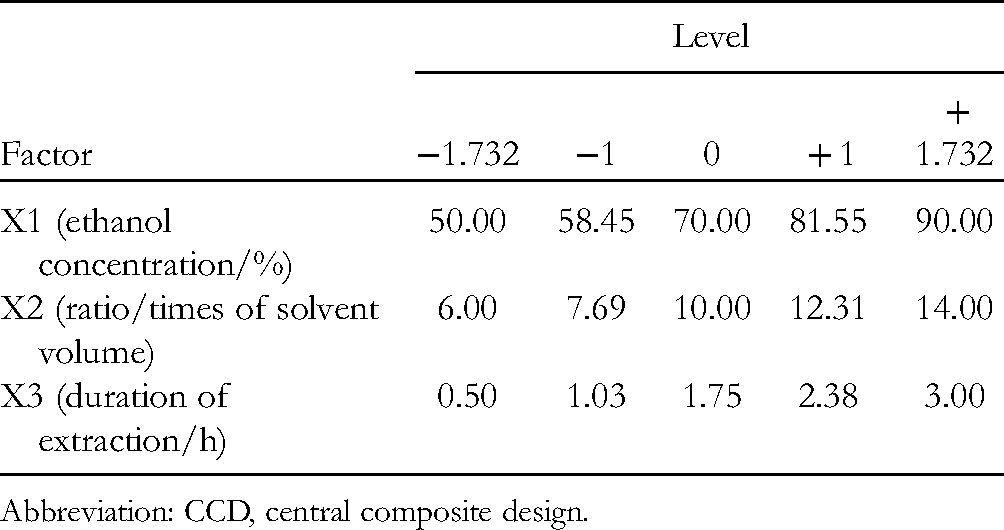
Abbreviation: CCD, central composite design.
Central Composite Design and Determined Imperatorin Contents, Ferulic Acid Contents, and Extract Yields of Extracting Solutions (%, n = 3).

Formula Optimization Process Validation
To prove the practical applicability of the process, the sample extraction solution was obtained by a similar experimental operation under section “Determination of parameters … response surface methodology,” according to the optimal ethanol concentration, solvent volume ratio, and extraction time obtained by the RSM optimization method. All extracts were tested by the specified method for imperatorin content, ferulic acid content, and extract yield, then calculating the OD value.
Data Process
CCD and statistical analysis were carried out using Design-Expert (8.0.6) software, and Sigmaplot 10.0 was used to plot.
Data Process and Response Surface Optimization
Conversion of OD for Comprehensive Evaluation
The determined imperatorin contents, ferulic acid contents, and extract yields of all extracting solutions were normalized for the ODs for comprehensive evaluation. The central composite design and test results are shown in Table 2.
Model Fitting Processing
Multiple linear regression and binomial fitting were performed on 3 factors, ethanol concentration (X1), times of solvent volume (X2), and duration of extraction (X3) with the ODs of different extracting solutions as dependent variables. The analysis of variance (ANOVA) is shown in Table 3.
Results of Variance Analysis of Quadratic Response Surface Mode.

*P is significant (P < .05), **P is extremely significant (P < .01).
Optimization and Prediction of Process Parameters
Response Surface Analysis
RSM was used to optimize the effects of ethanol concentration, solvent volume ratio, and extraction duration on the extraction process of Duliang formula.13‐21 The data were analyzed with Design-Expert (8.0.6) statistical software, and the multiple linear regression fitting equations were obtained:

ANOVA was used to verify the influence of various parameters in the CCD model and the interaction between them. 22 According to the result of ANOVA, the F and P values confirmed the significance of the model. The lack of fit (LOF) was not significant (P > .05), indicating the acceptability of the model. It showed that it has high reliability and good fitting. Therefore, the model can be used to predict and analyze the ethanol extraction process of Duliang formula.
Figure 5 shows the interaction between the independent variables of the response values. In all plots, the value of 1 factor was constant and the other 2 factors varied within the selected experimental range. It can be seen that the interaction model between X1/X2, X1/X3, and X2/X3 is P > .05, indicating that the interaction among ethanol concentration, solvent volume ratio, and extraction duration has no significant effect on the response value. Among them, the effect of X1 factor on the OD value is extremely significant (P < .01), indicating that X1 has a very significant effect on the arc surface of the response surface. It can be seen from the figure that when the concentration of X1 ethanol decreases, the response value decreases significantly. Considering that the extracted imperatorin and ferulic acid are fat-soluble components, it can be understood that the ethanol concentration has the greatest impact on the OD value, the concentration was selected as 90% according to the best value predicted by the response surface. X2 factor was significant (P < .05), indicating that X2 has a great influence on the arc surface of the response surface. The arc surface gradually rises before the ratio of solvent amount is 10.8 times, and after reaching 10.8 times, the arc surface decreased. That means the ratio of the amount of solvent can significantly affect the OD value, and the response value is the largest when the value is 10.8. This phenomenon can be explained when ethanol solution is used to extract Duliang formula, as the more ethanol solution is used (the larger the solvent volume ratio), the more fat-soluble components of Duliang formula can be extracted. However, due to the constant quality of Duliang formula, the components contained therein are also quantitative. Therefore, when the solvent volume ratio reaches a certain value, its influence on the extraction process of Duliang formula gradually decreases and the response value also decreases. The P value of the X3 factor is <0.05, indicating that the X3 factor has a significant effect on the radian of the response surface, and the response value reaches the maximum when the value is 2.51. That is, when the extraction duration is 2.51 h, the content of each component extracted from the Duliang formula is the largest.
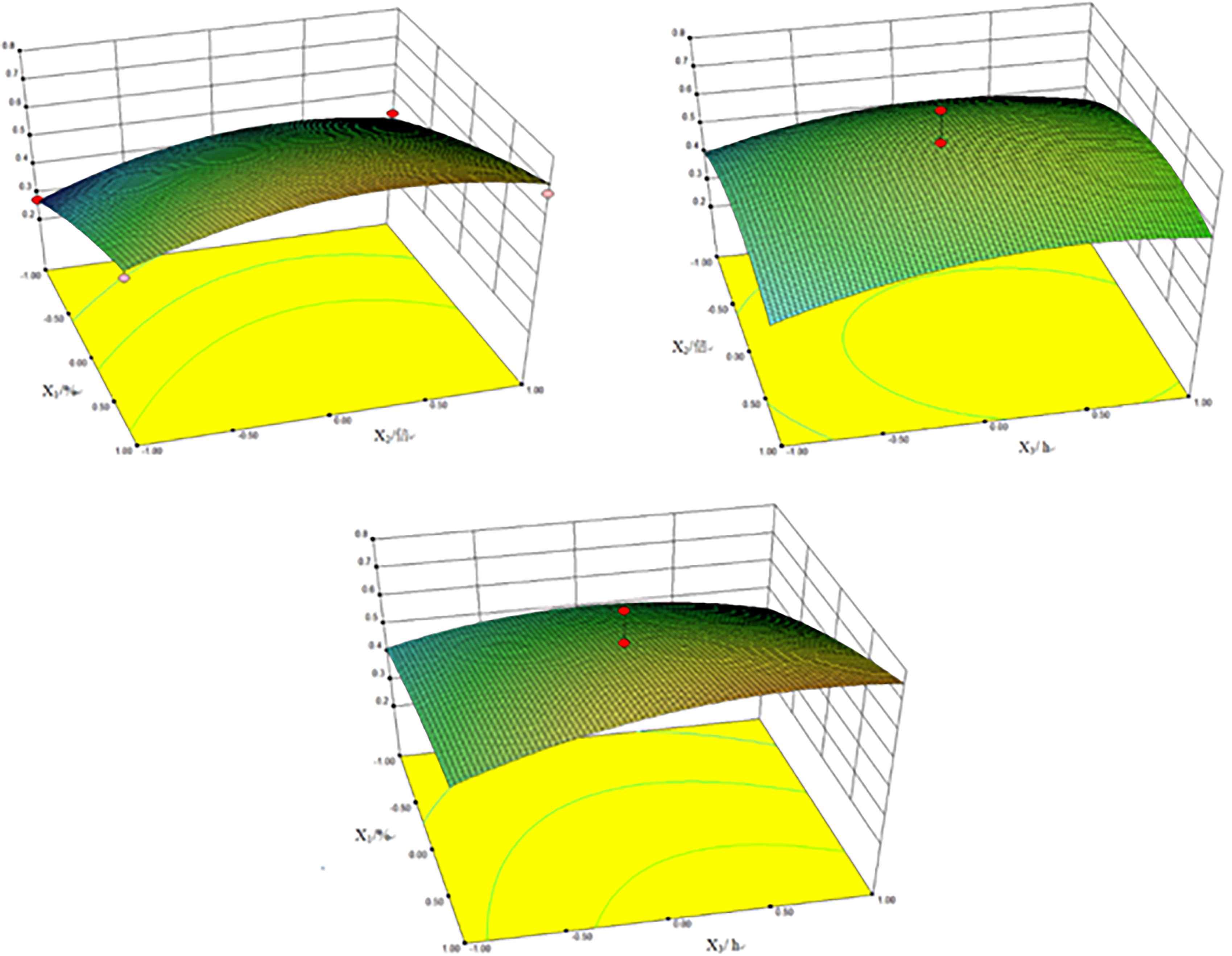
Effects of ethanol concentration (X1), solvent volume ratio (X2), and extraction times (X3) on the OD value.
As shown by the response surface analysis, all X1, X2, and X3 had the optimal regions within the selected range (50%-90% for X1, 6-14 times for X2, and 0.5-3.0 h for X3), indicating that the determination was appropriate, and all optimal points were within the “composite” range of central composite design. The predicted optimal ethanol concentration (X1) was 90%, the times of extraction solvent volume (X2) was 10.8 times, the duration of extraction (X3) was 2.51 h and OD was 0.7758.
Analysis of Verification Test
To confirm the good performance of the preferred process in practice, the extraction of Duliang formula was carried out under the optimal experimental conditions; the ethanol concentration was 90%, and to facilitate the actual process operation, the predicted solvent volume ratio was adjusted from 10.8 to 11 times, and the extraction duration adjusted to 2.5 h. All extracting solutions were tested by the specified method for imperatorin content, ferulic acid content, and extract yield, and their ODs for comprehensive evaluation were calculated. The imperatorin content was 0.18%, the ferulic acid content was 0.12%, and the extract yield was 20.4%. The calculated OD was 0.7681, with a deviation of −0.99% (n = 3) compared with the predicted value (0.7758), indicating that the mathematical model built after optimization was soundly reliable and stable, and the OD score of the optimal extraction process is high.
Discussion
Duliang formula is relatively simple in composition and has a definite curative effect. Existing studies on the extraction processes for Duliang formula have mainly focused on those for patent preparations such as Duliang pills, Duliang liquid pills, and Duliang soft capsules, all of which have been included in the Pharmacopoeia of the People’s Republic of China 2020, but rarely reported in other literature. The total imperatorin and isoimperatorin contents were taken as the indicators for the quality control of Duliang pills, while the imperatorin content was taken as the indicator for the quality control of Duliang soft capsules. Duliang formula contains complex chemical constituents, so only the imperatorin content (or total imperatorin content) and total isoimperatorin content were inspected in quality control and evaluation, which cannot be scientifically good to reflect fully its compounds and preparations. Also, a fully guaranteed effectiveness and safety of Duliang formula's products cannot be proved sufficiently, thereby affecting and restricting the development and clinical application of Duliang formula-based preparations.
RSM is a technology integrating mathematics and statistics, which is often used to optimize and improve the production process. When many factors are affecting the process, and the relationship between the effects and the factors is not necessarily linear, it can select the best effect area by describing the response surface of the effects on the investigated factors, and then deduce the value of the independent variables to determine the best experimental conditions. CCD-RSM is suitable for nonlinear model fitting. It has the advantages of fewer test times and high accuracy.
Huang et al. 23 showed that the optimal extraction process for imperatorin from A. dahurica was optimized by RSM as follows: the extraction temperature was 72°C, the liquid-to-material ratio was 8 times, and the extraction time was 1.5 h. Under these conditions, the extraction rate of imperatorin was 0.97%. The more effective way to extract coumarins from Radix A. dahurica was reflux extraction with 4 times the amount of 95% alcohol twice (1 h each time). The conclusions were that some solvents and extraction methods showed greater effects than others on the extraction efficiency of imperatorin. 24 The more effective way to extract ferulic acid from L. chuanxiong Hort was extraction with 8 times the amount of 40% ethanol under reflux for 3 h. 25 Cao yanjun et al. 26 found that imperatorin showed antihypertensive and antioxidant effects in renal injury of renovascular hypertensive rats, suggesting that it could be of therapeutic use in preventing renal injury-related hypertension. Pharmacokinetic studies demonstrated that oxidation metabolism is the main metabolic pathway of imperatorin. 27 De Yiyan et al. 28 found that imperatorin promotes osteogenesis and suppresses osteoclasts by activating AKT/glycogen synthase kinase 3β (GSK3 β)/β-catenin pathways. Budzynska's results demonstrate that imperatorin may offer protection against scopolamine-induced memory impairments and possesses antioxidant properties. 29 Many studies 30 have shown that ferulic acid can inhibit the phosphoinositide 3-kinases (PI3K)/AKT pathway, the reactive oxygen species production, and aldose reductase activity. The anti-inflammatory effect of ferulic acid is mainly related to the levels of peroxisome proliferator-activated receptor γ, complementary and alternative medicine and the nuclear factor-κB and p38 mitogen-activated protein kinases signaling pathways.
In this study, it was more scientific and prudent to determine the optimal extraction process for Duliang formula by comparing the ODs for a comprehensive evaluation, which was calculated by normalizing the imperatorin content and the ferulic acid content in the Duliang formula's extracts than using only the imperatorin content as the evaluation indicator. The deviation between the experimental results and the CCD model was −0.09%, which proves that the actual and predicted models fit well. The compatibility of the model was proved by LOF, F, and P values. The above experiments have obtained the best extraction process of the ingredients that play the main medicinal effects in Duliang formula. The main pharmacological components in the formula can be dissolved to a high degree, which provides support for Duliang formula to better exert its pharmacodynamic effects of relieving migraine, analgesic sedation, anti-inflammation, and promoting peripheral blood circulation.
In conclusion, the optimal ethanol-based extraction process determined by CCD-RSM was to add 11 times 90% ethanol to the Duliang formula and reflux the mixture for 2.5 h, twice. Verification results showed that the process was reliable and stable, and all operations and conditions are available and practical. It could provide experimental evidence for the extraction process and industrial production of Duliang formula. This article also intends to provide a reference for the modern application of TCM formulae.
Footnotes
Author Contributions
GY and DZ contributed equally to this article and designed the study with WX and TH together. Experimental work and data collection were conducted by GY, DZ, GS, and LY. MS, ZT, and YQ analyzed and interpreted the data. GY, DZ, and WX drafted the manuscript. CY, WY, LQ, and LD provided critical comments and revised the manuscript. All authors read and approved the final version of the manuscript.
Data Availability Statement
The original contributions presented in the study are included in the article, and further inquiries can be directed to the corresponding authors.
Declaration of Conflicting Interests
The author(s) declared no potential conflicts of interest with respect to the research, authorship, and/or publication of this article.
Funding
The author(s) disclosed receipt of the following financial support for the research, authorship, and/or publication of this article: This work was supported by the National Natural Science Foundation of China (grant number 82174275 & 81704077), the Shunde Science and Technology Bureau (grant number 2130218002569).
