A phytochemical component investigation of the bark of Ptychopetalum olacoides led to the isolation of 4 new clerodane-type diterpenoids, namely, ptycholide V (1), 7α,20-dihydroxykolavelool (2), ptycholide VI (3), and ptycholide VII (4). Their structures were elucidated by extensive spectroscopic data and comparison of NMR data with that obtained for known compounds.
The genus Ptychopetalum is a flowering plant of the Olacaceae family that is native to the Amazon rainforest. It is a shrub or small tree that reaches a height of about 4.3 m. The leaves are short-stalked, up to 7.6 cm in length and 5.1 cm in breadth, light green on the upper surface and dark brown on the lower surface. Indigenous names for the genus include marapuama, muirapuama, and mirantã, translating roughly to “potency wood.”1,2P olacoides is known as Muirapuama or Marapuama and is used to treat chronic degenerative conditions of the nervous system.3 Previous pharmacological studies have shown that the EtOH extract of P olacoides produces a series of beneficial effects on the central nervous system, consisting of neuroprotective, anti-stress, antidepressant, antioxidative, adaptogen-like activities, and inhibitory effects on acetylcholinesterase in mice.4‐10 As part of our ongoing research for natural products with neurotrophic activities, we have continued to investigate phytochemical constituents of the MeOH extract of the bark of P olacoides, which exhibits neurite outgrowth-promoting activity in NGF-mediated PC12 cells.11‐13 Further research of this plant led to the isolation of 4 new clerodane-type diterpenoids, named ptycholide V (1), 7α,20-dihydroxykolavelool (2), ptycholide VI (3), and ptycholide VII (4) (Figure 1). In this paper, we report the isolation and structure elucidation of 1-4.
Compound 1 was obtained as colorless oil, had the molecular formula of C21H30O5, as deduced by the high resolution-electron ionization-MS (HR-EI-MS) ion at m/z 362 (calcd for 362.2093). Its IR spectrum showed absorption bands at 3407 and 1762 cm−1, which are ascribed to a hydroxy group and a γ-lactone moiety, respectively. The NMR data for 1 (Table 1) were found to be similar to those for ptycholide II (5).13 Compound 5 was isolated as an acetal mixture, while compound 1 was isolated as a single compound. The structure of 1 was estimated to be a 15-hydroxy analogue. The methoxy group was shown to be connected to C-20, which was supported by the heteronuclear multiple bond coherence (HMBC) correlation of -OCH3 to C-20 (105.7 ppm) (Figure 2). The relative configuration of 1 was deduced to be the same as that of 5 by a nuclear Overhauser and exchange spectroscopy (NOESY) experiment (Figure 2). The absolute configuration on C-15 in 1 was assigned by Gawronski's method.14 Thus, the 15S configuration as the sole chromophore displays a positive n-π* Cotton effect at a wavelength of 244 nm and a negative π-π* Cotton effect at 215 nm (Figure 2). Thus, ptycholide V was represented as 1.
Structures of compounds 1-4.
Compound 2, obtained as a colorless oil, has the molecular formula C20H34O3, as assigned from the high resolution-fast atom bombardment-MS (HR-FAB-MS) ion at m/z 345. The IR spectrum showed the presence of a hydroxy group at 3289 cm−1. The 1H NMR was very similar to that for 7α-hydroxykolavelool (6)13 except an oxymethylene group in 2 replaced the H3-20 methyl in 6, implying that 2 is 7α,20-dihydroxykolavelool. The partial structures (bold line in Figure 3) were deduced from the 1H-1H correlation spectroscopy and heteronuclear multiple quantum coherence spectra for 2 with 5 carbons at 36.9, 43.2, 73.4, 145.0, and 145.4, and the connectivity between these partial structures and the quaternary carbons was established by HMBC experiments (Figure 3). As a result, the 13C NMR chemical shift value at C-20 is shifted to the low field to 65.7 ppm, and the HMBC correlation of H-11 to C-20 and H2-20 to C-9 (δC 43.2) indicate that the methyl group at the C-20 group is oxidized to a hydroxy group. The relative configuration of 2 was deduced by a NOESY experiment, as shown in Figure 3. The NOESY correlations of H-8 to H-6β, H-7 and H-10 and H3-19 to H2-20 and small vicinal J values of H-7 (3.4, 3.3, and 2.8 Hz) indicate that H-10 and the C-11∼C-16 side chain are β-oriented, and the C-19, C-20, and hydroxy groups at C-7 are α-oriented (Figure 3). Accordingly, the structure of 2 is elucidated to be 7α,20-dihydroxykolavelool.
COSY and selected HMBC (a) and NOESY (b) correlations for 1 and the CD spectrum of 1.
COSY and selected HMBC (a) and NOESY (b) correlations for 2.
Compound 3 was obtained as a colorless oil and its molecular formula C21H32O5 was assigned by HR-FAB-MS at m/z 387 [M + Na]+. The IR absorption bands at 1763 and at 3434 cm−1 indicated the presence of a γ-lactone group and a hydroxy group. The 1H and 13C NMR spectra for 3 were very similar to those of 2 considering the decalin part, while the side chain looks like that of 5. Surprisingly, the presence of a 1:1 as in 5 could not be ascertained. The HMBC correlation of OCH3 signal to C-15 implied an attachment of the methoxy group at C-15. The HMBC correlations of H-12 with the lactone carbonyl group as well as by a downfield shifted of H-14 (δC 141.4; δH 6.81) suggest that the position of the lactone carbonyl group is C-16. According to NOESY spectra of H-1∼H-12, H-18∼H-20 positions were the same as those of compound 2, indicating that the relative configuration of 3 is the same as that of 2, but stereochemistry of C-15 could not be determined. Thus, 3 was defined as ptycholide VI.
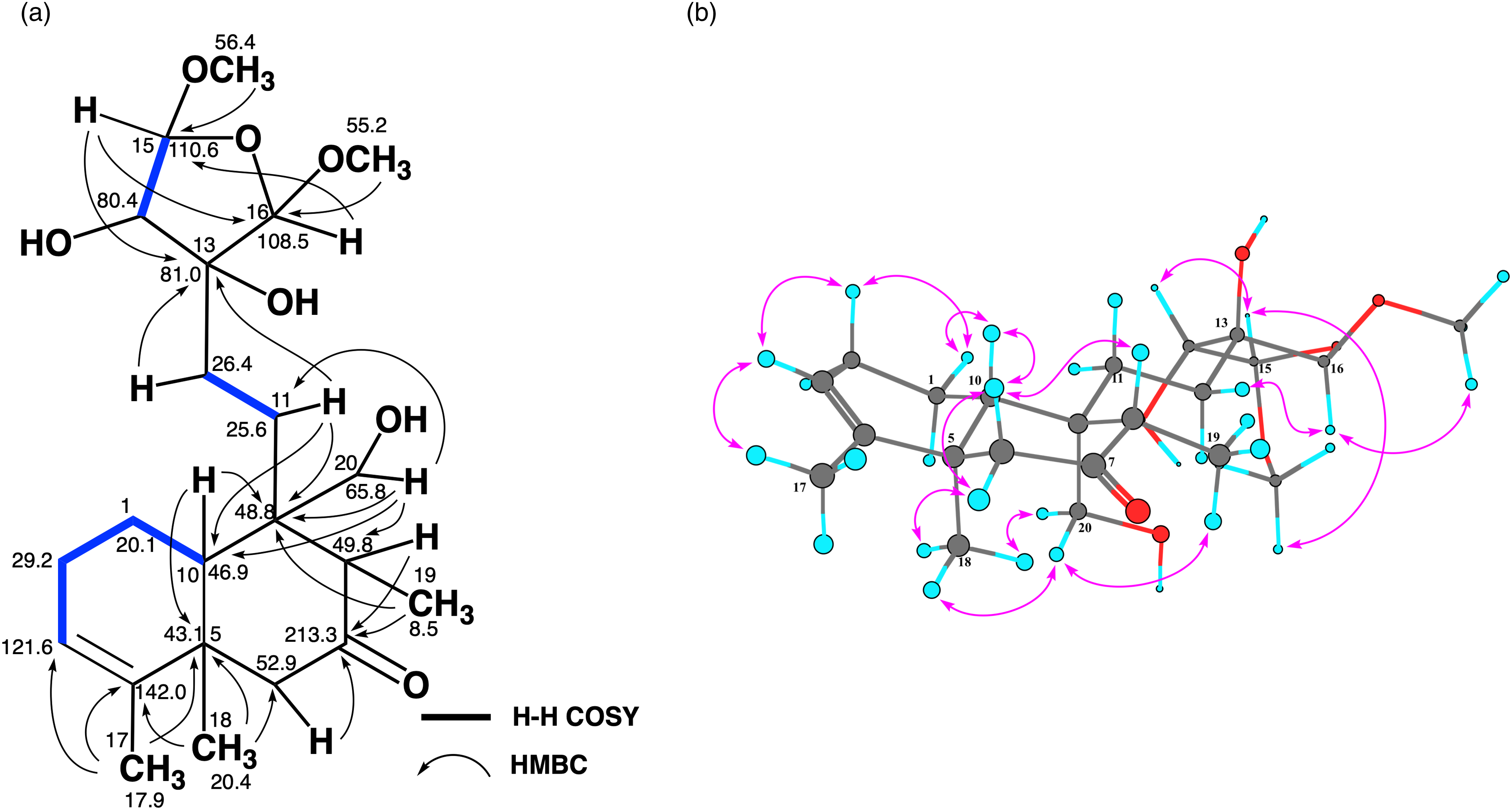
Compound 4 had a molecular formula of C22H36O7, as established by HR-FAB-MS. The IR spectrum showed the presence of a hydroxy group (3428 cm−1) and carbonyl group (1699 cm−1). The NMR data of 4 showed the presence of decalin parts as same as 3 and the 3 oxymethines (δC 80.4 [C-14], 110.6 [C-15], 108.5 [C-16]; δH 4.00 [s, H-14], 4.93 [d, J = 3.6 Hz, H-15], 4.81 [s, H-16]), and one quaternary carbon (δC 81.0 [C-13]) were present instead of the α,b-unsaturated γ-lactone ring moiety and the presence of a ketone group (δC 213.3 [C-7]). To determine these differences, NMR analysis was carried out. The key HMBC correlations for H-6, H-8, and H3-19 to C-7 indicate that 4 contains a carbonyl group at C-7. Additionally, HMBC correlations for 2 methoxy signals to the C-15 and C-16 oxymethines as well as H-15 to C-13 and C-16 and H-16 to C-15 indicate that the methoxy groups at δH 3.48 and 3.40 are connected to C-15 and C-16, respectively, which in turn form a 2,5-dimethoxytetrahydrofuran-3,4-diol unit through C-12∼C-16. Furthermore, the HMBC correlations of H2-12 and H2-11 to C-13 enable us to connect C-13 of the 2,5-dimetoxytetrahydrofuran-3,4-diol unit and C-12. In addition, the planar structure of compound 4 was estimated from the 2D NMR data analysis shown in Figure 4. The relative configuration of 4 was elucidated by NOESY experiments. Namely, NOESY correlations between H-15 and H-14, and between H-16 and H-12 suggest that the methoxy group at C-15 and the hydroxy group at C-14 have the same α-orientation, indicating a β-orientation for the methoxy group at C-16 and the hydroxy group at C-13. Thus, 4 was defined as ptycholide VII.
COSY and selected HMBC (a) and NOESY (b) correlations for 4.
Compounds 1-4 were isolated from the active fractions that promote neurite outgrowth. Thus, we evaluated their ability to induce neurite outgrowth in PC12 cells as previously our method.15 However, they had no effect on PC12 cells at concentrations ranging from 3 to 30 μM. This result suggests our previous conclusion that the furan ring in clerodane-type diterpenoids plays an important role for neurite outgrowth in PC12 cells.11‐13
Experimental
General Experimental Procedures
IR and UV spectra were recorded on JASCO FT-IR 410 infrared and Shimadzu UV-1650PC spectrophotometers, respectively. Optical rotations were measured with a JASCO P-1030 digital polarimeter. Circular dichroism spectra were recorded using a JASCO-J-725. 1H (600 MHz) and 13C NMR (150 MHz) spectra were measured with a Varian Unity 600 instrument. MS were recorded using JEOL JMS-HX 110 and JEOL AX-500 instruments. Silica gel (Merck, 70-230, 230-400 mesh, Wakogel C-300) was used for column chromatography (CC). Sephadex LH-20 was used for gel filtration chromatography. HPLC was performed using a JASCO PU-1580 HPLC equipped with a JASCO UV-1575 detector.
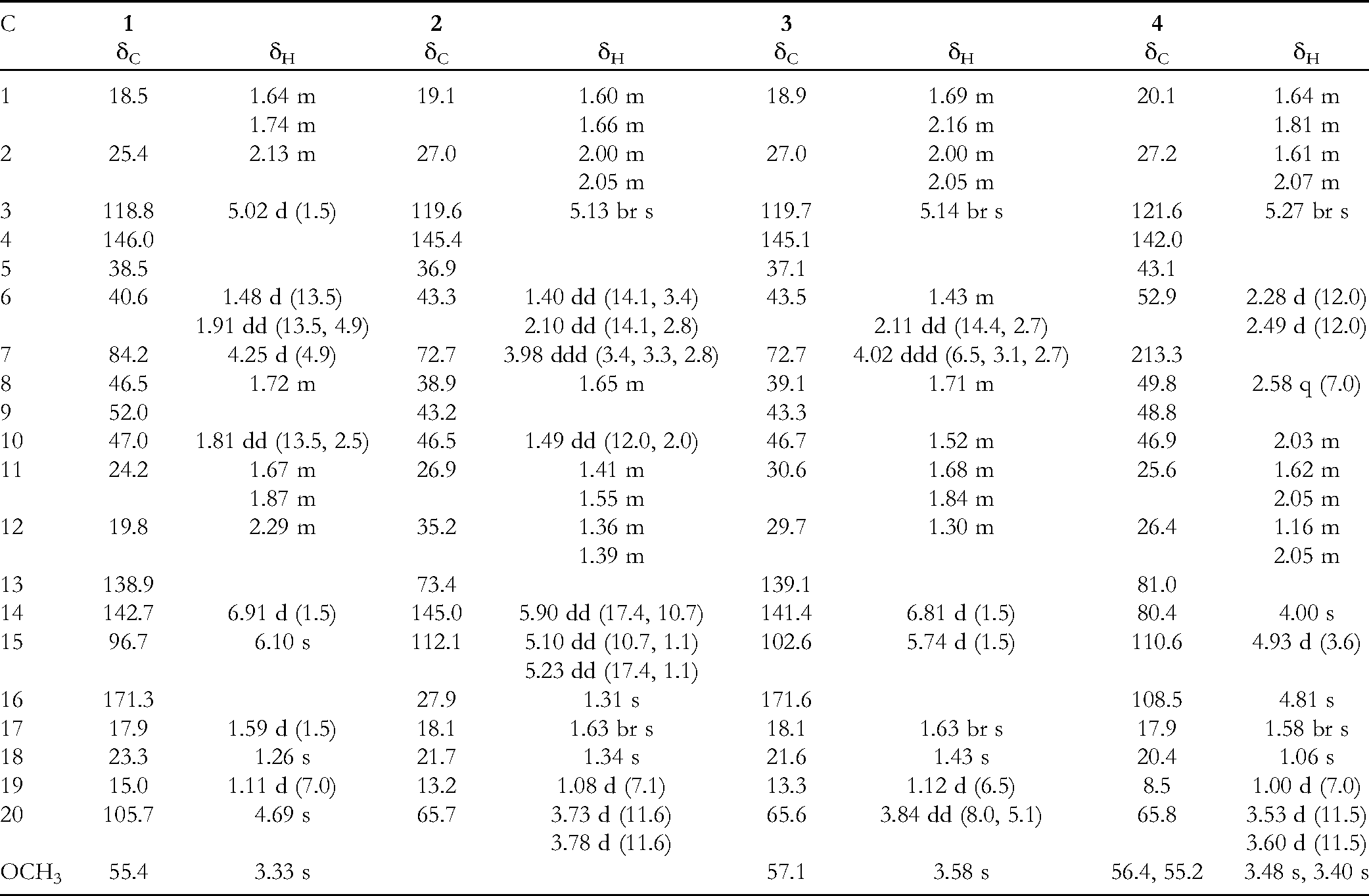
1H (600 MHz) and 13C NMR (150 MHz) Data for 1-4 in CDCl3.
C
1
2
3
4
δC
δH
δC
δH
δC
δH
δC
δH
1
18.5
1.64 m 1.74 m
19.1
1.60 m 1.66 m
18.9
1.69 m 2.16 m
20.1
1.64 m 1.81 m
2
25.4
2.13 m
27.0
2.00 m 2.05 m
27.0
2.00 m 2.05 m
27.2
1.61 m 2.07 m
3
118.8
5.02 d (1.5)
119.6
5.13 br s
119.7
5.14 br s
121.6
5.27 br s
4
146.0
145.4
145.1
142.0
5
38.5
36.9
37.1
43.1
6
40.6
1.48 d (13.5) 1.91 dd (13.5, 4.9)
43.3
1.40 dd (14.1, 3.4) 2.10 dd (14.1, 2.8)
43.5
1.43 m 2.11 dd (14.4, 2.7)
52.9
2.28 d (12.0) 2.49 d (12.0)
7
84.2
4.25 d (4.9)
72.7
3.98 ddd (3.4, 3.3, 2.8)
72.7
4.02 ddd (6.5, 3.1, 2.7)
213.3
8
46.5
1.72 m
38.9
1.65 m
39.1
1.71 m
49.8
2.58 q (7.0)
9
52.0
43.2
43.3
48.8
10
47.0
1.81 dd (13.5, 2.5)
46.5
1.49 dd (12.0, 2.0)
46.7
1.52 m
46.9
2.03 m
11
24.2
1.67 m 1.87 m
26.9
1.41 m 1.55 m
30.6
1.68 m 1.84 m
25.6
1.62 m 2.05 m
12
19.8
2.29 m
35.2
1.36 m 1.39 m
29.7
1.30 m
26.4
1.16 m 2.05 m
13
138.9
73.4
139.1
81.0
14
142.7
6.91 d (1.5)
145.0
5.90 dd (17.4, 10.7)
141.4
6.81 d (1.5)
80.4
4.00 s
15
96.7
6.10 s
112.1
5.10 dd (10.7, 1.1) 5.23 dd (17.4, 1.1)
102.6
5.74 d (1.5)
110.6
4.93 d (3.6)
16
171.3
27.9
1.31 s
171.6
108.5
4.81 s
17
17.9
1.59 d (1.5)
18.1
1.63 br s
18.1
1.63 br s
17.9
1.58 br s
18
23.3
1.26 s
21.7
1.34 s
21.6
1.43 s
20.4
1.06 s
19
15.0
1.11 d (7.0)
13.2
1.08 d (7.1)
13.3
1.12 d (6.5)
8.5
1.00 d (7.0)
20
105.7
4.69 s
65.7
3.73 d (11.6) 3.78 d (11.6)
65.6
3.84 dd (8.0, 5.1)
65.8
3.53 d (11.5) 3.60 d (11.5)
OCH3
55.4
3.33 s
57.1
3.58 s
56.4, 55.2
3.48 s, 3.40 s
Plant Materials
The bark of Ptychopetlum olacoides was collected in Sao Paulo, Brazil in 2005. Dr G. Hashimoto (Centro de Pesquisas de Historia Natural) identified the plant, and a voucher specimen (1762BK) was deposited at the Institute of Pharmacognosy, Tokushima Bunri University, Japan.
Isolation and Purification
The extraction procedure has been reported previously.13 The extract was separated by CC on silica gel using a linear gradient solvent system (100% n-hexane to 100% EtOAc) to give 15 fractions (1-15). Fraction 12 (2.1 g) was separated by LH-20 (CH2Cl2:hexane = 1:1) to give 5 fractions. Fraction 12-3 (926.8 mg) was subjected to silica gel CC (hexane:EtOAc = 6:4) to give ten fractions. Fraction 12-3-5 (55.3 mg) was purified by HPLC (Cosmosil 5C18 MS-II, i.d. 10 × 250 mm; MeOH: H2O [7: 3; 2.0 mL/min]; det. 225 nm) to give 1 (5.7 mg). Fraction 13 (1.44 g) was separated by LH-20 (MeOH) to give 7 fractions. The second fraction (1.0 g) was subjected to LH-20 (CH2Cl2:hexane = 1:1) to give 8 fractions. Fraction 13-5 (49.7 mg) was purified by HPLC (Cosmosil 5C18 MS-II, i.d. 10 × 250 mm; MeOH: H2O [6: 4; 2.0 mL/min]; det. 210 nm) to give 4 (7.3 mg). Fraction 13-6 (57.1 mg) was subjected to silica gel CC (CH2Cl2: EtOAc = 2: 3) to give 3 fractions. Fraction 13-6-2 (7.8 mg) was purified by HPLC (Cosmosil 5C18 MS-II, i.d. 10 × 250 mm; MeOH: H2O [7: 3; 2.0 mL/min]; det. 210 nm) to give 2 (1.5 mg). Fraction 13-6-1 (24.7 mg) was purified by HPLC (Cosmosil π-NAP, i.d. 10 × 250 mm; MeOH: H2O: CH3CN [67: 28: 5; 2.0 mL/min]; det. 210 nm) to give 3 (1.1 mg).
Compound 1
[α]D: −9.7 (c 0.0223, MeOH)
IR: νmax 3407 (OH), 2925, 1762 (lactone) cm−1
UV: λmax (logε) 207 (3.5) nm
EI-MS: m/z 362 [M]+
HR-EI-MS: m/z [M]+ calcd for C21H30O5: 362.2093; found 362.2097.
Compound 2
[α]D: −35.4 (c 0.0123, MeOH)
IR: νmax 3289 (OH), 2944 cm−1
UV: λmax (logε) 206 (4.3) nm
FAB-MS: m/z 345 [M + Na]+, 361 [M + K]+
HR-FAB-MS: m/z [M + Na]+ calcd for C20H34O3Na: 345.2406; found 345.2419.
Compound 3
[α]D: −28.5 (c 0.0036, MeOH)
IR: νmax 3434 (OH), 2918, 1763 (lactone) cm−1
UV: λmax (logε) 206 (3.7) nm
FAB-MS: m/z 387[M + Na]+, 403[M + K]+
HR-FAB-MS: m/z [M + Na]+ calcd for C21H32O5Na: 387.2147; found 387.2142.
Compound 4
[α]D: −28.0 (c 0.0248, MeOH)
IR: νmax 3428 (OH), 2925, 1699 (C = O) cm−1
UV: λmax (logε) 206 (3.2) nm
FAB-MS: m/z 435[M + Na]+
HR-FAB-MS: m/z [M + Na]+ calcd for C22H36O7Na: 435.2059; found 435.2365.
Screening for Neurite Outgrowth-Promoting Activity
PC12 (phenochromocytoma) cells were cultured in a 24-well plate at density of 8 × 10³ cells/mL in DMEM + 10% HS, 5% FBS, 100 IU/mL penicillin, and 100 μg/mL streptomycin at 37 °C under a humidified atmosphere of 95% air and 5% CO2 for 24 h. The culture medium was then changed to DMEM + 2% HS, 1% FBS, 100 IU/mL penicillin, and 100 μg/mL streptomycin. At the same time, different concentrations of test samples with or without 2 ng/mL NGF were added. One concentration experiment was repeated in 3 wells. After incubation with samples for 4 days, the cultures were fixed with 4% paraformaldehyde/PBS and stained with methylene blue. Cell morphology was observed under a phase-contrast microscope, and neurite length was quantified. Ten images were selected randomly under a microscope for each well, and 5 significantly differentiated cells were selected to measure the longest neurite length extending from a cell body for each picture. Statistical analyses were performed using Dunnett's t test.
Footnotes
Acknowledgments
We thank Dr Masami Tanaka and Dr Yasuko Okamoto (TBU) for measuring the 600 MHz NMR and mass spectra.
Declaration of Conflicting Interests
The authors declared no potential conflicts of interest with respect to the research, authorship, and/or publication of this article.
Funding
The authors received no financial support for the research, authorship, and/or publication of this article.
ORCID iD
Miwa Kubo
References
1.
ColomboRBatistaANdLBomfimGCC, et al.Validated high-performance liquid chromatographic method for the standardization of Ptychopetalum olacoides Benth., Olaceae, commercial extracts. Rev Bras Farmacog. 2010;20(5):781‐788. https://doi.org/10.1590/S0102-695X2010005000027
da SilvaALBardiniSNunesDSElisabetskyE. Anxiogenic properties of Ptychopetalum olacoides Benth. (Marapuama). Phytother Res. 2002;16(3):223‐226. https://doi.org/10.1002/ptr.825
5.
SiqueiraIRFochesattoCTorresILS,et al.Antioxidant activities of Ptychopetalum olacoides (“muirapuama”) in mice brain. Phytomedicine. 2007;14(11):763‐769. https://doi.org/10.1016/j.phymed.2006.12.007
6.
da SilvaALPiatoALSBardiniSNettoCANunesDSElisabetskyE. Memory retrieval improvement by Ptychopetalum olacoides in young and aging mice. J Ethnopharmacol. 2004;95(2–3):199‐203. https://doi.org/10.1016/j.jep.2004.07.019
7.
SiqueiraIRFochesattoCda SilvaAL,et al.Ptychopetlum olacoides, a traditional Amazonian “nerve tonic”, prossesses anticholinesterase activity. Pharmacol Biochem Behav. 2003;75(3):645‐650. https://doi.org/10.1016/S0091-3057(03)00113-8
8.
SiqueiraIRCimarostiHFochesattoC,et al.Neuroprotective effects of Ptychopetalum olacoides Bentham (Olacaceae) on oxygen and glucose deprivation induced damage in rat hippocampal slices. Life Sci. 2004;75(15):1897‐1906. https://doi.org/10.1016/j.lfs.2004.06.001
9.
PiatoALRizonLPMartinsBSNunesDSElisabetskyE. Antidepresant profile of Ptychopetalum olacoides Betham (Maraouama) in mice. Phytother Res. 2009;23(4):519‐524. https://doi.org/10.1002/ptr.2664
TangWXKuboMHaradaKHiokiHFukuyamaY. Novel NGF-potentiating diterpenoids from a Brazilian medicinal plant. Ptychopetalum olacoides. Bioorg Med Chem Lett. 2009;19(3):882‐886. https://doi.org/10.1016/j.bmcl.2008.11.100
13.
TangWXKuboMHaradaKHiokiHFukuyamaY. Eight new clerodane diterpenoids from the bark of Ptychopetalum olacoides. Nat Prod Commun. 2011;6(3):327‐332. https://doi.org/10.1177%2F1934578X1100600305
14.
GawronskiJKvan OeverenAvan der DeenHLeungCWFeringaBL. Simple circular dichroic method for the determination of absolute configuration of 5-substituted 2(5H)-furanones. J Org Chem. 1996;61(4):1513‐1515. https://doi.org/10.1021/jo951400l
15.
KuboMKishimotoYHaradaKHiokiHFukuyamaY. NGF-potentiating vibsane-type diterpenoids from Viburnum sieboldii. Bioor Medi Chem Lett. 2010;20(8):2566‐2571. https://doi.org/10.1016/j.bmcl.2010.02.085