




Abstract
Frullania is one of the largest and taxonomically most complex genus of leafy liverworts. Current morphology-based estimates of Frullania diversity are close to 400 species; however, species level-classification of Frullania has been regarded notoriously difficult and subject to many studies. The liverworts classified in this genus have been studied using morphological evidence and molecular markers but also in terms of secondary metabolite composition. Up to now 98 Frullania species have been chemically investigated. As a result, it is known that Frullania species are characterized by a remarkable chemical diversity. The most characteristic compounds present in this liverwort genus are sesquiterpene lactones with eudesamnolides as the most diverse group, and aromatic compounds belonging to bibenzyls. In this review paper we report the distribution of secondary metabolites in all chemically investigated Frullania species and discuss some aspects concerning the division of this genus into chemotypes.
Frullania Raddi is a genus of leafy liverworts and is characterized by its often reddish pigmentation and includes both narrow endemics and nearly cosmopolitan species. This liverwort genus has a worldwide distribution with centers of diversity in the humid tropics and warm temperate regions. Many species of Frullania occur not only in moist but also in rather dry vegetation. 1,2 Frullania is also the largest and taxonomically most complex liverwort genus classified in order Porellales within family Frullaniaceae. 3,4
Species of liverworts have traditionally been circumscribed using morphological evidence. It was the time that geographical or typological species concepts was preferred and liverwort species were regarded as largely invariant units with small ranges. Then, the intraspecific morphological variation concept was accepted, and it contributed to the reduction of local binomials to synonyms of widespread liverwort species. 4,5 More recently, morphology-based species concepts have been tested using evidence from molecular markers including isozymes, and variable regions of the nuclear and the plastid genomes, 2,6 as well as secondary metabolites. 7,8
In case of Frullania there are estimated 300‐375 species; 9 however, species level-classification of Frullania has been regarded notoriously difficult and subject to much controversy. 1 They have been various proposals for a subdivision of Frullania into natural species groups. 1,10 As a result, more than 15 subgenera and over 30 sections and subsections based on morphology were established. 11 Recently, Hentschel et al. (2009) 2 presented the most comprehensive molecular phylogeny of Frullania to date. The liverworts classified in genus Frullania have not only been studied using morphological evidence and molecular markers but also in terms of secondary metabolite composition. 12 -16 The use of the secondary metabolites as aids to plant taxonomy was popularized by the publication of Swain (1963). 17 Terpenoids not only sesquiterpene lactones, 18,19 but also flavonoids 20 are of value in the taxonomic and evolutionary investigations of plants. In this review paper we report the distribution of secondary metabolites in all chemically investigated Frullania species and discuss some aspects concerning the division of this genus into chemotypes.
Chemistry of Frullania Species
One of the outstanding features of the liverworts is their chemistry. They produce a wide array of secondary metabolites, and up to now over several hundred new terpenoids, and aromatic compounds including bibenzyls and bisbibenzyls with more than 40 new carbon skeletons have been isolated. 16,21,22
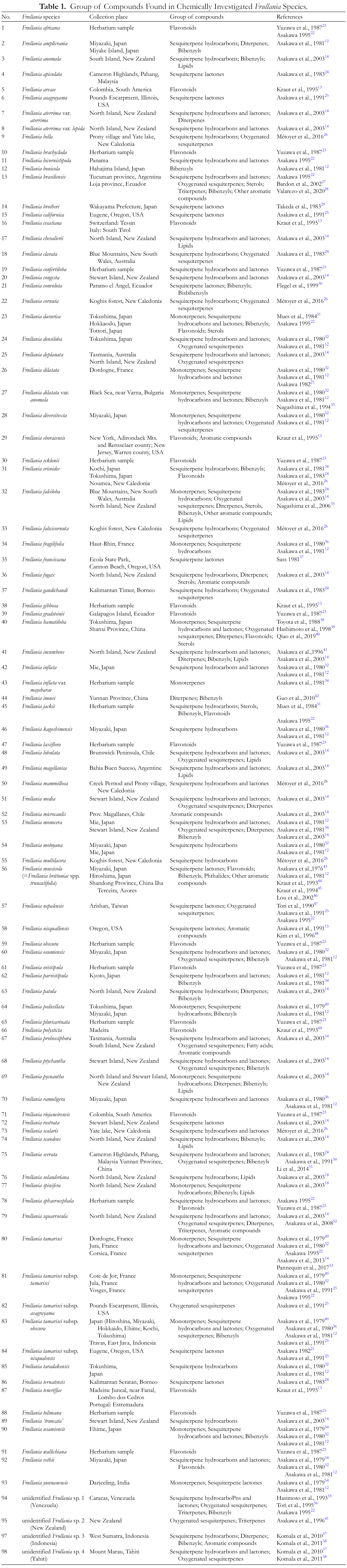
As a result of phytochemical studies, Frullania species are now known to produce a wide array of secondary metabolites. As shown in Table 1, 98 Frullania species have been chemically investigated. Most of the compounds either detected in or isolated from these species are terpenoids, aromatic compounds, and flavonoids. Among terpenoids, the sesquiterenes are the most diverse group, but the presence of mono-, di-, and triterpenes was also confirmed. α-Pinene (
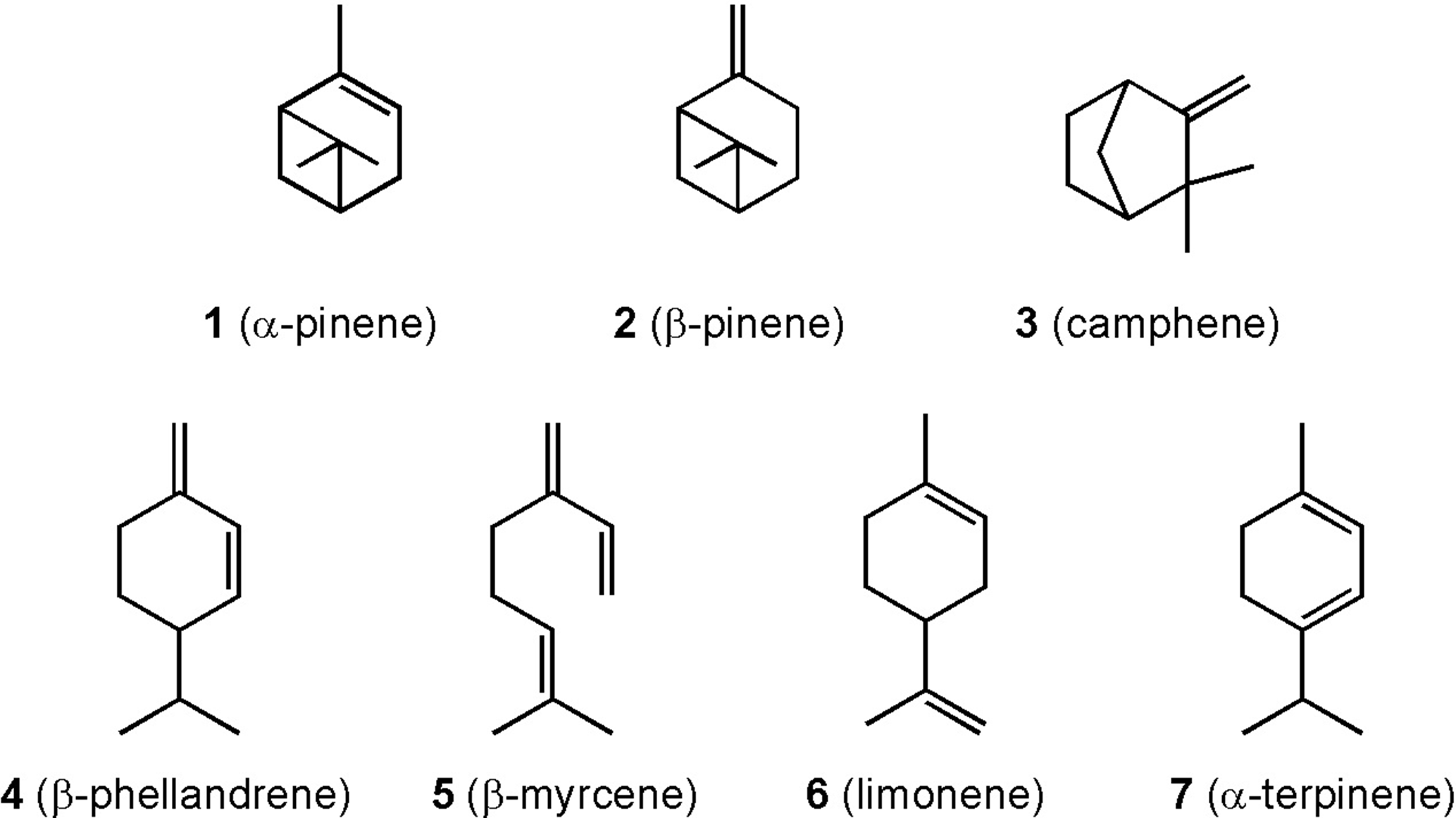
Monoterpenes found in Frullania species.
Group of Compounds Found in Chemically Investigated Frullania Species.
In comparison to monoterpenoids, the sesquiterpenoids present in this liverwort genus are characterized by a wide range of different sesquiterpene skeletons. There are especially eudesmanes, elemanes, eremophilanes, germacranes, bazzananes, pacifigorgianes, and other minor groups of sesquiterpenoids, like aromadendranes, africanes, barbatanes, cadinanes, cuparanes, drimanes, farnesanes, guaianes, monocyclofarmesanes, pinguisanes, and thujopsanes. The sesquiterpenoids, that seem to be the most characteristic of this genus are lactones (Figure 2). These components have been found in almost 50 Frullania species. Sesquiterpene lactones detected in and/or isolated from Frullania are mainly eudesmanolides The most characteristic compounds belonging to this group are (+)-frullanolide (

Sesquiterpene lactones characteristic for Frullania species.
Almost all sesquiterpene lactones found in Frullania possess a 12,6-olide moiety. The exception of this rule was the isolation of densilobolides A (
Another interesting feature of the sesquiterpene lactones occurring in Frullania is the presence of dimeric compounds. A good example is the isolation of two dimeric lactones with eudesmanolide structure called muscicolide A (
Frullania species, occasionally produce sesquiterpenes which are very rare in this genus and are characteristic for just a few species. The good example is the presence of pacifigorgianes (eg,

Other terpenoids present in genus Frullania.
Among the diterpenoids, labdane-, and fusicoccane-type compounds are most prevalent in Frullania, but kauranes have also been found in a few species. There are two Frullania species rich in labdane-type diterpenoids. These are F. hamatiloba and F. inouei and both produce manoyl oxide derivatives.
22,40
The most characteristic components for the former species are hamatilobenes (eg.,
Frullania species occasionally also produce triterpenoids and these mainly belongs to oleanane, taraxane, hopane, lupane, and friedelane group. The major component of an unidentified Frullania species collected in Venezuela was methyl 3α-hydroxyolean-18-en-28-onate (
Besides terpenoids, the second group of compounds with a great diversity are bibenzyls (eg.,

Bibenzyls and bisbibenzyls characteristic for Frullania species.
Flavonoids are ubiquitous minor components in the liverworts, also in genus Frullania. Among the flavonoids found in Frullania species more common are flavones, but also some flavanones were also detected. As in all liverworts, luteolin and apigenin derivatives dominate in this genus.
16
It is worth mentioning that the most common flavonoid glycosides are glucuronides, for example, luteolin-7-O-glucuronide (
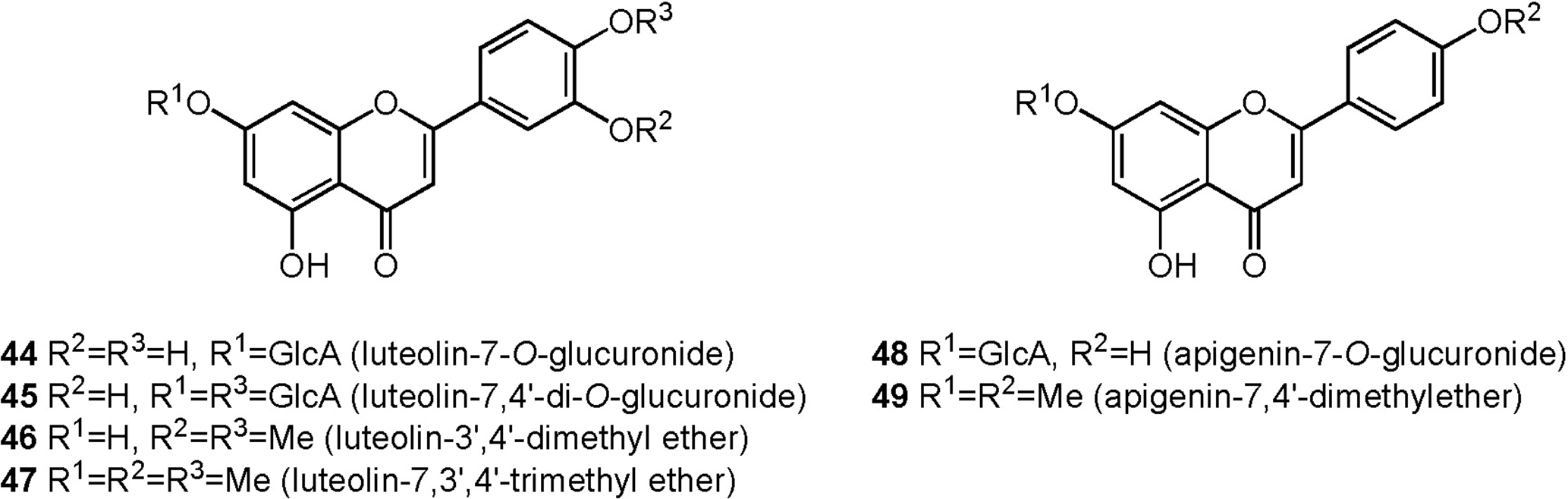
Flavonoids present in Frullania species.
Chemosystematic Approach
On the basis of the sesqui- and diterpenoids as well as bibenzyls composition, the Frullania species have been divided into six groups, namely, type I: sesquiterpene lactone-bibenzyl, type II: sesquitepene lactone, type III: bibenzyl, type IV: labdane, type V: bazzanane, and type VI: pacifigorgiane-type (Table 2). As shown in this table, the most significant markers of Frullania species are sesquiterpene lactones and bibenzyls. Five types of sesquiterpene γ-lactones have been recognized in Frullania species. There are the eudesmanolides, elemanolides, eremophilanolides, germacranolides, and guaianolides, and, among these, the eudesmane-type sesquiterpene lactones are the most prevalent. In case of bibenzyls found in Frullania, compounds possessing the methylenedioxy group and polymethoxylated bibenzyls occur much more often. 16,21,22
Chemotypes of Frullania Species.

Abbreviations: SES, sesquiterpenes; Pac, pacifigorgianes; Ger, germacranes; Baz, bazzananes; Eud, eudesmanes; SL, sesquiterpene lactones; DI, diterpenes; Lab, labdanes; Fus, fusicoccanes; BB, bibenzyls; BB2, bisbibenzyls; AR, aromatic compounds; MON, monoterpenes; FLA, flavonoids.
Thirteen among ninety-eight chemically investigated Frullania species were classified as chemotype I. These species produce sesquiterpene lactones and bibenzyls as the main components.
South American Frullania brasiliensis belongs to the type I since it elaborates sesquiterpene lactones (eg.,
From a Bulgarian collection of F. dilatata var. anomala which belongs to chemotype I, unusual spiroeudesmane-type lactones (
The Ecuadorian F. convoluta is chemically very characteristic. Together with sesquiterpene lactones and bibenzyls, acyclic bisbibenzyls, perrottetins E–G (
Two Venezuelan collections of an unidentified Frullania species have been chemically analyzed. Phytochemical studies showed that one collection should be classified within type I, since it produces 3-methoxy-3′,4′-methylenedioxybibenzyl, α-cyclocostunolide (
F. muscicola is another liverwort classified in chemotype I. It produces both sesquiterpene lactones and bibenzyls.
22,45
This liverwort is also known for the presence of dimeric sesquiterpene lactones, muscicolides A (
Frullania vethii, which was classified in chemotype II, produces guaianolides together with elemane-type sesquiterpene lactones. 21,34 Guaianolides have not been detected in the other Frullania species so far.
The New Zealand Frullania chevalieri (type II) elaborates eudesmane-type sesquiterpene lactones, with β-cyclocostunolide (
Frullania species classified in chemotype III do not produce sesquiterpene lactones at all, but these species are known for the presence of bibenzyls. Among eleven liverworts classified in this chemotype, 8 species elaborate bibenzyls possessing the methylenedioxy group; 3-methoxy-3′,4′-methylenedioxybibenzyl (
Frullania hamatiloba and F. fugax represent the labdane chemotype (IV), since both species produce structurally similar labdane-type diterpenoids. Manoyl oxide has been isolated from F. fugax,
14
while its derivatives, hamatilobenes A-E (eg.,
The New Zealand F. falciloba belongs to chemotype V of the Frullaniaceae, since it elaborates characteristic bazzanane-type sesquiterpenoids (
Chemical analysis of the New Zealand Frullania falciloba from different collections showed the presence of β-bazzanene (
Type VI of Frullania species produces the pacifigorgiane-type sesquiterpenoids. (–)-Tamariscol (
The phytochemical studies of the Asian collections of F. tamarisci subsp. obscura showed that this species is not homogenous and should be further divided into 2 subtypes, type-T and type-O.
22
Type-T produces the usual pacifigorgiane alcohol tamariscol (
There are other thirty-two Frullania species difficult to classify in terms of the six chemotypes indicated above, and further chemical analysis will be necessary. However, among these species, the New Zealand F. solanderiana produces very characteristic 2-alkanones, such as 2-undecanone, 2-tridecanone, and 2-pentadecanone, as the main components. 14 This is the first record of the identification of the 2-alkanones in the genus Frullania.
Frullania diversitexta produces a large amount of cyclocolorenone, an aromadendrane sesquiterpene ketone, together with other common sesquiterpenoids and fusicoccane-type diterpenoids. 34 Neither sesquiterpene lactones nor bibenzyls were present in F. diversitexta. Phytochemical analysis of F. gaudichaudii showed that this liverwort species is chemically very similar to F. diversitexta. 24 However, cyclocolorenone has been found in several other Frullania species. To describe another cyclocolorenone chemotype more chemical data are necessary.
Summary
Frullania species, although morphologically simple, are characterize by enormous diversity of secondary metabolites, especially terpenoids and aromatic compounds. The most characteristic compounds present in this liverwort genus are sesquiterpene lactones with eudesmanolides as the most diverse group, and aromatic compounds belonging to bibenzyls. It was already shown that the relationship between various types of liverworts can be predicted based on the similarity or differences in the chemical substances present in them. 15,16,22,62,63 Frullania is, however the largest and taxonomically most complex genus of leafy liverworts. Studies concerning these liverworts classification based on morphological evidence and molecular markers showed that species level-classification of Frullania is notoriously difficult. Up to now, over 30 sections and subsections of Frullania are described, and still new synonyms, new combinations, and names are proposed. 11 Here, we reported the distribution of secondary metabolites in all chemically investigated Frullania species, and discussed some aspects concerning the division of this genus into chemotypes. Based on the chemical composition, the Frullania species have been divided into six chemotypes, namely, type I: sesquiterpene lactone-bibenzyl, type II: sesquitepene lactone, type III: bibenzyl, type IV: labdane, type V: bazzanane, and type VI: pacifigorgiane-type. However, it does not appear that this research could be completed at this stage. Within some of the recognized chemotypes, there are some Frullania that could be divided into some sub-chemotypes, for example, Frullania tamarisci subsp. obscura, because of the chemical differences between different collections of particular species. There are also thirty-two Frullania species that could not be classified into the proposed six chemotypes. Further studies on secondary metabolites occurring in liverworts are still needed. The most valuable would be those conducted in parallel with the morphological and genetic studies. Despite the fact that around one quarter of the available species have already been studied chemically and the abundance of morphological and genetic data available, it is still difficult to suggest the division of the genus into some natural sections or propose phylogenetic tree of Frullania genus.
Footnotes
Declaration of Conflicting Interests
The author(s) declared no potential conflicts of interest with respect to the research, authorship, and/or publication of this article.
Funding
The author(s) received no financial support for the research, authorship, and/or publication of this article.
