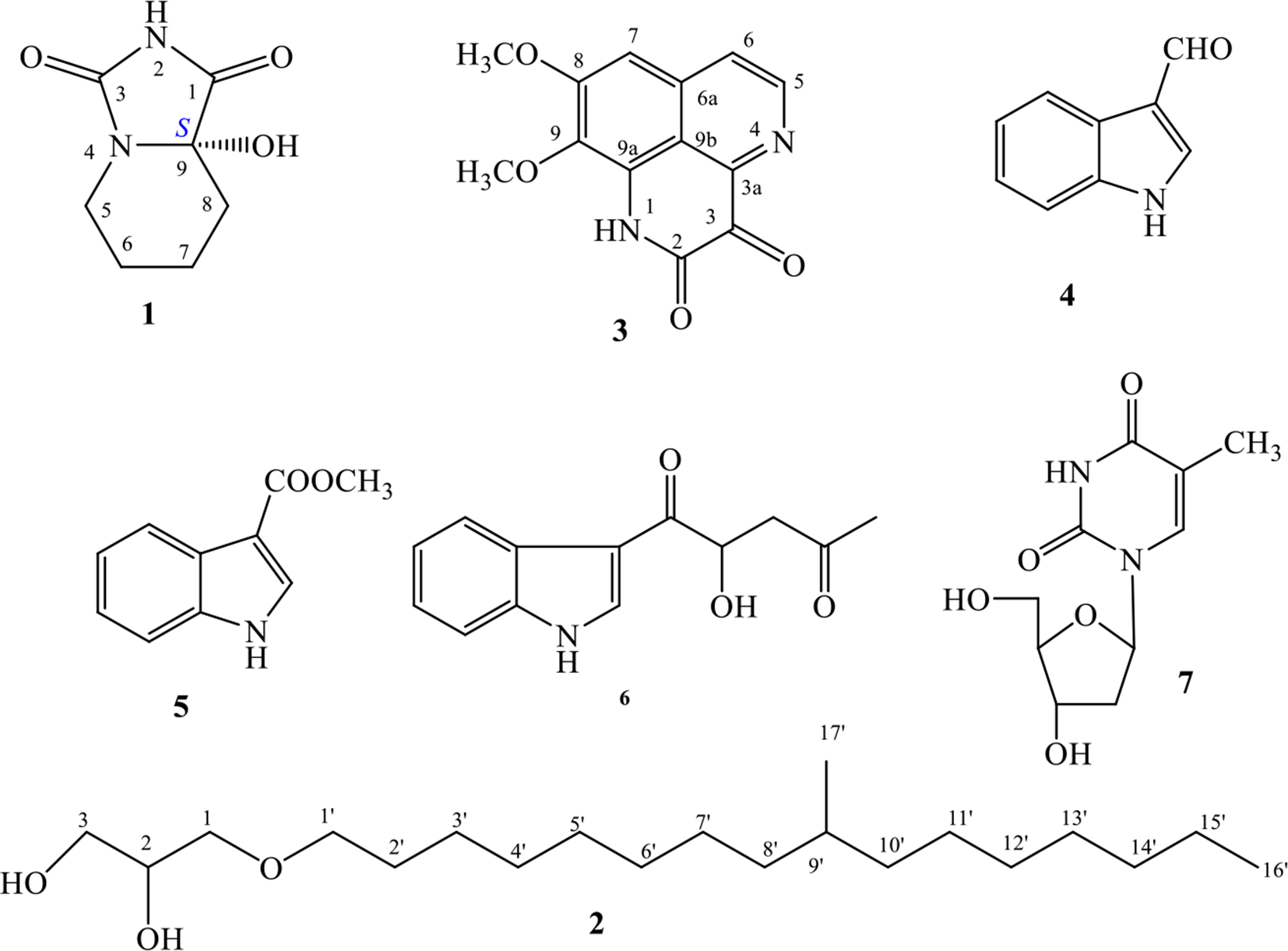
Seven compounds (1-7) were isolated from the marine sponge Aaptos aaptos living in the Vietnamese sea. Their structures were determined as 2 hours, 5H,7H,9H-9S-hydroxy-imidazo[1,5-α]pyridine-1,3-dione (1), 3-([9-methylhexadecyl]oxy)propane-1,2-diol 2, 2,3-dihydro-2,3-dioxoaaptamine (3), indol-3-aldehyde (4), methyl indole-3-carboxylate (5) 4-hydroxy-5-(indole-3-yl)−5-oxo-pentan-2-one (6), and thymidine (7) by extensive analysis of HR-ESI-MS, 1D, and 2D NMR spectral data, as well as by comparison of the spectral data with those reported in the literature. In addition, the absolute configuration of 1 was determined from the experimental ECD spectrum and comparison of this with the theoretical ECD calculations using the TDDFT method. Compounds 1 and 2 were isolated from nature for the first time. Compound 3 induced cytotoxic activity against SK-LU-1, MCF-7, HepG2, and SK-Mel-2 cell lines with IC50 values of 41.27 ± 2.63, 40.70 ± 2.65, 34.31 ± 3.43, and 36.63 ± 1.40 µM, respectively.
The genus Aaptos (Porifera, Demospongiae, Hadromerida, Suberitidae) comprises about 20 species, which are widely distributed in the marine ecosystem, including Vietnamese, Japanese, Indonesian, and Caribbean shallow waters. Phytochemical study of the genus has led to the isolation of 62 secondary metabolites, including 47 aaptamine alkaloids and 15 other compounds, which possess antioxidant, antiviral, antimicrobial, antifungal, antiparasitic, cytotoxic, and other activities.1 From A. aaptos living in the Vietnamese sea, 13 aaptamine alkaloids were previously isolated: aaptamine, isoaaptamine, 9-demethylaaptamine, aaptanone, N-demethylaaptanone, 4-N-methylaaptanone, 2,3-dihydro-2,3-dioxoaaptamine, 6-(N-morpholinyl)−4,5-dihidro-5-oxo-demethyl(oxy)aaptamine, 3-(methylamino)demethyl(oxy)aaptamine, 3-(phenethylamino)demethyl-(oxy)aaptamine, 3-(isopentylamino)-demethyl(oxy)aaptamine, demethyl(oxy)-aaptamine, and N-demethylaaptanone.2-7 As part of our ongoing search for bioactive compounds from Vietnamese sponges,8-11A. aaptos has come to our attention owing to its aforementional ability to metabolize various interesting secondary metabolites. This paper reports herein seven compounds isolated from the methanol extract of A. aaptos. Cytotoxic effects of the isolated compounds on lung carcinoma (SK-LU-1), breast carcinoma (MCF-7), hepatocellular carcinoma (HepG2), and melanoma cells (SK-Mel-2) were examined by sulforhodamine B assay.
Results and Discussion
As described in the Materials and Methods, after checking by TLC each fraction of the methanol extract of Aaptos aaptos, and using various chromatograph methods, compounds 1-7 were obtained. Compound 1 was isolated as a light yellow solid and the presence of OH and HN groups (3235.7 cm-1, broad band) and C = O groups (1771.7 and 1724.0 cm-1) were indicated by its IR spectrum (Supplemental Figure S6b). Its molecular formula was deduced to be C7H10N2O3 based on the cluster of quasi-molecular ion peaks in the high resolution electron spray ionization mass spectrum (HR-ESI-MS) atm/z 171.0757 [M + H]+ (Calcd. for [C7H11N2O3]+ and 171.0764) (positive ion mode), indicating 4 degrees of unsaturation (Supplemental Figure S1). The 1H NMR spectrum of 1 (Supplemental Figure S2) exhibited eight protons of four methylene groups at δH 3.04 (1H, dt, J = 13.0, 3.0 Hz, Ha-5)/3.92 (1H, dd, J = 13.0, 5.0 Hz, Hb-5), 1.42 (1H, m, Ha-6)/1.74 (1H, m, Hb-6), 1.78 (1H, m, Ha-7)/1.90 (1H, m, Hb-7), and 1.50 (1H, td, J = 13.0, 4.0 Hz, Ha-8)/2.06 (1H, m, Hb-8), and each pair of the protons had HSQC cross peaks to carbons at δC 37.2, 25.8, 19.7, and 32.8, respectively. The 13C NMR spectrum of 1 (Supplemental Figure S3) exhibited seven carbon signals, including four methylenes (δC 37.2, 25.8, 19.7, and 32.8), two carbonyl groups (δC 177.7 and 155.5), and one quaternary carbon bearing an oxygen atom at δC 84.2. From the above evidence, with 4 degrees of unsaturation, compound 1 was suggested to have two rings. Analysis of the chemical shift values, the proton couplings, and HSQC and HMBC correlations from positions C-5 to C-9 suggested that carbon C-9 (δC 84.2) linked to C-8 (δC 32.8), the nitrogen atom linked to C-5 (δC 37.2), and one ring was formed from C-9 to C-5 through a nitrogen atom (Supplemental Figure S4 and S5). Obviously, the other ring must be formed between two carbonyl carbons through NH group. From the HR-ESI-MS and NMR results, the chemical structure of 1 was suggested to form as a bicyclic skeleton, 2 hours, 5H,7H,9H-9-hydroxy-imidazo[1,5-α]pyridine-1,3-dione, as shown in Figure 1. These suggestions were further confirmed by the HMBC correlations. The HMBC interactions from H-5 (3.04/3.92) to carbons C-9 (84.2), C-6 (25.8), C-7 (19.7), and C-3 (155.5), as well as from H-8 (1.50/2.06) to C-1 (177.7), C-9 (84.2), and C-6 (25.8) confirmed that C-5 and C-9 were connected through a nitrogen atom, and the second ring was formed from C-1 to C-3 through the other nitrogen atom indicated from its molecular formula. As reported in previous papers, 2 hours, 5H,7H,9H-9-hydroxy-imidazo[1,5-α]pyridine-1,3-dione (C) was believed to be an intermediate product produced in the conversion of α-keto-ε-carbamidocaproic acid to 2 hours,5H,7H-imidazo[1,5-α]pyridine-1,3-dione (A) by enzymatic transamination in vivo (Supplemental Scheme S1)12; letter it was synthesized in 1983.13 The NMR data of 1 were consistent with those previously reported.13 The absolute configuration at C-9 of compound 1 was determined from the ECD spectrum. The experimental ECD spectrum of 1 was compared with the TDDFT calculated ECD spectra of the two enantiomers (9R and 9S). As shown in Supplemental Figure S6a, the experimental ECD of 1 appeared like that of the 9S-enantiomer, confirming the S configuration at C-9. From the above evidence, compound 1 was determined to be 2 hours, 5H,7H,9H-9(S)-hydroxy-imidazo[1,5-α]pyridine-1,3-dione, a new compound from nature and named as aaptos VN1.
Chemical structure of compounds 1-7 isolated from the marine sponge Aaptos aaptos.
Compound 2 was obtained as a colorless oil. Its molecular formula was deduced to be C20H42O3 based on the cluster of quasi-molecular ion peaks in the HR-ESI-MS atm/z 331.3205 [M + H]+ (Calcd. for [C20H43O3]+, 331.3207) (positive ion mode) (Supplemental Figure S7). The 1H NMR spectrum of 2 exhibited one methyl triplet at δH 0.88 (3H, J = 6.5 Hz), one methyl doublet at δH 0.84 (J = 6.5 Hz), seven protons belonging to four oxygenated carbons from δH 3.46 to 3.86, and a long alkyl chain from δH 1.00 to 1.60 ppm. The 13C NMR and HSQC spectra of 2 indicated the presence of three oxygenated methylene carbons at δC 64.2, 71.8, and 72.4, one oxygenated methine carbon at δC 70.6, two methyl carbons at δC 14.1 and 19.7, one methine carbon at δC 32.8, and 12 methylene carbons from δC 22.7 to 37.1. The above evidence suggested that compound 2 was a glyceryl ether derivative having a long alkyl chain. The NMR spectral data of 2 (measured in CDCl3: Supplemental Figures S8–11; measured in CD3OD + Py-d5, 1/1: Supplemental Figure S11b) were compared with the corresponding data of lysoplasmanglinositol (isolated from marine sponge Theonella swinhoei)14 and found to match, except for the lower field signal of C-3 of 2 (δC 64.2), indicating only one long alkyl chain linked to C-1 of the glyceryl molecules, which was further confirmed by HMBC correlations. However, the absolute configuration at C-2 of this compound has not yet been determined. Compound 2 was reported as a hydrolysis product of lysoplasmanglinositol,14 but its NMR data have not been reported. Consequently, compound 2 was identified as 3-((9-methylhexadecyl)oxy)propane-1,2-diol. This is the first report of 2 from nature.
Compounds 3-7 were identified as 2,3-dihydro-2,3-dioxoaaptamine(3)2 indol-3-aldehyde(4),15 methyl indole-3-carboxylate(5)16 4-hydroxy-5-(indole-3-yl)−5-oxo-pentan-2-one (6),17,18 and thymidine (7).19 The NMR spectral data of compounds 3-7 were consistent with those previously reported in the literature (Supplemental Figure S12–S31).
Compounds 1-7 were evaluated for their cytotoxic effects on lung carcinoma (SK-LU-1), breast carcinoma (MCF-7), hepatocellular carcinoma (HepG2), and melanoma (SK-Mel-2) cell lines at a concentration of 100 µM. As shown in Supplemental Table S1, compound 3 (100 µM) displayed highly cytotoxic effects against SK-LU-1, MCF-7, HepG2, and SK-Mel-2 cell lines with cell death percentages of 95.15% ± 3.14%, 99.34% ± 1.45%, 98.95% ± 1.56%, and 98.56% ± 2.12%, respectively. Further dose-dependent experiments found that compound 3 induced cytotoxic activity against SK-LU-1, MCF-7, HepG2, and SK-Mel-2 cell lines with IC50 values of 41.27 ± 2.63, 40.70 ± 2.65, 34.31 ± 3.43, and 36.63 ± 1.40 µM, respectively. The other compounds1,2,4-7 were inactive. Ellipticine was used as the positive control in all the experiments. At a concentration of 2 µg/mL, it exhibited a cytotoxic effect with cell death percentages of 74.78% ± 1.17%, 78.50% ± 1.38%, 80.26% ± 1.89%, and 75.96% ± 2.08%.
Material and Methods
General Experimental Procedures
Optical rotation was measured on a Jasco P-2000 polarimeter, NMR spectra on a Bruker 500 MHz spectrometer, and HR-ESI-MS on an Agilent 6530 Accurate Mass Q-TOF LC/MS. Flash column chromatography was performed using either silica gel or reversed phase (RP-18) resins as adsorbent. Thin layer chromatography was carried out on pre-coated silica gel 60 F254 and/or RP-18 F254S plates. TLC plates were visualized under UV irradiation (254 and 365 nm) or by spraying with H2SO4 solution (5%) followed by heating with a heat gun. HPLC was carried out using an AGILENT 1100 HPLC system.
Animal Material
The sponge samples were collected in Vanphong Bay, Nha Trang, Vietnam in May 2020 and identified as Aaptos aaptos (Schmidt, 1864) by Prof. Do Cong Thung, the Institute of Marine Environment and Resources, Vietnam Academy of Science and Technology (VAST). A voucher specimen (NCCT-B70) was deposited at the Institute of Marine Biochemistry, VAST.
Extraction and Isolation
The Aaptos fresh sponge samples (30 kg) were cut into small pieces and ultrasonically extracted in MeOH for three times (each 50 L, 2 hours at room temperature). The extract solution was filtered through filter paper and the solvent removed under reduced pressure to yield 490 g of a solid residue. The methanol extract was suspended in water and partitioned with dichloromethane to give a dichloromethane soluble fraction. This (FD, 215 g) was separated into seven smaller fractions FD1 - FD7 by silica gel column chromatography eluting with a gradient solvent system of dichloromethane/methanol (100:0 → 0:1, v/v). Fraction FD1 was chromatographed on a reversed phase C-18 (RP-18) column eluting with methanol/water (5/2, v/v) to give five fractions, FD2A - FD2E. Compound 2 (6.0 mg) were isolated from the fraction FD2C (1.5 g) by silica gel column chromatography, eluting with dichloromethane/acetone (12/1, v/v). Fraction FD2D (2.1 g) was chromatographed on a silica gel column eluting with n-hexane/ethyl acetate (2/1, v/v) to give compounds 5 (10.0 mg) and 6 (11.0 mg). Fraction FD2E (1.5 g) was chromatographed on a silica gel column eluting with ethyl acetate/methanol/water (9/1/0.1, v/v/v) to give compound 4 (21.0 mg). Fraction FD5 (21.3 g) was separated on a silica gel column, eluting with n-hexane/ethyl acetate (3/1, v/v) to yield five fractions FD5A- FD5E. Fraction FD5A (3.4 g) was chromatographed on a silica gel column eluting with dichloromethane/methanol (10/1, v/v) to obtain compound 3 (22 mg). Fraction FD5D (1.1 g) was chromatographed on a silica gel column eluting with n-hexane/ethyl acetate (2/1, v/v) to give three smaller fractions FD5D1-FD5D3. Compound 7 (5.0 mg) was isolated from fraction FD5D2 (150 mg) by silica gel column chromatography, eluting with dichloromethane/acetone (10/1, v/v) and then purified by HPLC using a J’sphere ODS H-80, 250 mm × 20 mm column, and ACN in H2O (25%). Fraction FD5D3 (100 mg) was purified by HPLC using J’sphere ODS H-80, a 250 mm × 20 mm column, and ACN in H2O (15%) to obtain compound 1 (10.0 mg).
Seven compounds(1-7) were isolated from the marine sponge Aaptos aaptos living in Vietnamese waters. Their structures were determined as 2 hours,5H,7H,9H-9-hydroxy-imidazo[1,5-α]pyridine-1,3-dione (1), 3-((9-methylhexadecyl)oxy)propane-1,2-diol (2), 2,3-dihydro-2,3-dioxoaaptamine (3), indol-3-aldehyde (4), methyl indole-3-carboxylate (5), 4-hydroxy-5-(indole-3-yl)−5-oxo-pentan-2-one (6), and thymidine (7) by extensive analysis of HR-ESI-MS, 1D, and 2D NMR spectral data, as well as by comparison of the spectral data with those reported in the literature. Compounds 1 and 2 were isolated from nature for the first time. Compound 3 induced cytotoxic activity against SK-LU-1, MCF-7, HepG2, and SK-Mel-2 cell lines with IC50 values of 41.27 ± 2.63, 40.70 ± 2.65, 34.31 ± 3.43, and 36.63 ± 1.40 µM, respectively.
Supplemental Material
Supplementary Material 1 - Supplemental material for Chemical Constituents of the Marine Sponge Aaptos aaptos (Schmidt, 1864) and Their Cytotoxic Activity
Supplemental material, Supplementary Material 1, for Chemical Constituents of the Marine Sponge Aaptos aaptos (Schmidt, 1864) and Their Cytotoxic Activity by Do Thi Trang, Bui Huu Tai, Dan Thuy Hang, Pham Hai Yen, Phan Thi Thanh Huong, Nguyen Xuan Nhiem and Phan Van Kiem in Natural Product Communications
Footnotes
Declaration of Conflicting Interests
The author(s) declared no potential conflicts of interest with respect to the research, authorship, and/or publication of this article.
Funding
The author(s) disclosed receipt of the following financial support for the research, authorship, and/or publication of this article: This research is funded by Vietnam Academy of Science and Technology under grant number TĐDLB0.01/20-22.
ORCID iD
Phan Van Kiem
Supplemental Material
Supplemental material for this article is available online.
References
1.
HeQ.MiaoS.NiN.ManY.GongK. A review of the secondary metabolites from the marine sponge of the Genus Aaptos. Nat Prod Commun. 2020;15(9):1-12.doi:10.1177/1934578X20951439
2.
ShubinaLK.MakarievaTN.DyshlovoySA.FedorovSN.DmitrenokPS.StonikVA. Three new aaptamines from the marine sponge Aaptos sp. and their proapoptotic properties. Nat Prod Commun. 2010;5(12):1881-1884.doi:10.1177/1934578X100050120821299112
3.
ShubinaLK.KalinovskyAI.FedorovSNet al. Aaptamine alkaloids from the Vietnamese sponge Aaptos sp. Nat Prod Commun. 2009;4(8):1085-1088.doi:10.1177/1934578X090040081319768988
4.
UtkinaNK.DenisenkoVA. N-Demethylaaptanone, a new congener of Aaptamine alkaloids from the Vietnamese marine sponge Aaptos. Nat Prod Commun. 2016;11(9):1259-1260.doi:10.1177/1934578X160110091630807015
5.
UtkinaNK.ChaikinaEL.AnisimovMM. Influence of aaptamine alkaloids on the growth of seedling roots of agricultural plants. Nat Prod Commun. 2017;12(9):1437-1438.doi:10.1177/1934578X1701200913
6.
UtkinaNK.DenisenkoVA.PushilinMA. Aaptanone, a novel zwitterionic metabolite of the aaptamine class with an oxygenated 1,6-naphthyridine core from the Vietnamese marine sponge Aaptos. Tetrahedron Lett. 2009;50(21):2580-2582.doi:10.1016/j.tetlet.2009.03.096
7.
UtkinaNK. Antioxidant activityofaromatic alkaloids from the marine sponges Aaptos and Hyrtios sp. Chem Nat Compd. 2009;45(6):849-853.doi:10.1007/s10600-010-9490-z
8.
DungDT.HangDTT.NhiemNXet al. Rhabdaprovidines D–G, Four new 6,6,5-tricyclic terpenoids from the Vietnamese sponge Rhabdastrella providentiae. Nat Prod Commun. 2018;13(10):1251-1254.
DungDT.YenPH.NhiemNXet al. New acetylated terpenoids from sponge Rhabdastrella providentiae inhibit no production in LPS stimulated BV2 cells. Nat Prod Commun. 2018;13(6):66-664.doi:10.1177/1934578X1801300602
11.
KiemPV.DungDT.YenPHet al. New isomalabaricane analogues from the sponge Rhabdastrella providentiae and their cytotoxic activities. Phytochem Lett. 2018;26:199-204.doi:10.1016/j.phytol.2018.06.003
12.
CooperAJ.MeisterA. Cyclic forms of the alpha-keto acid analogs of arginine, citrulline, homoarginine, and homocitrulline. J Biol Chem. 1978;253(15):5407-5410.doi:10.1016/S0021-9258(17)30386-1670205
13.
KleinC.SchulzG.SteglichW. Conversion of ω-guanidino and ω-ureido α-amino acids into α-keto acids and heterocycles derived therefrom. Liebigs Annalen der Chemie. 1983;9:1623-1637.
14.
MatsunagaS.NishimuraS.FusetaniN. Two new antimicrobial lysoplasmanylinositols from the marine sponge Theonella swinhoei. J Nat Prod. 2001;64(6):816-818.doi:10.1021/np010043911421754
15.
AshourMA.ElkhayatES.EbelR.EdradaR.ProkschP. Indole alkaloid from the Red Sea sponge Hyrtios erectus. Arkivoc. 2007;2007(15):225-231.doi:10.3998/ark.5550190.0008.f22
16.
YangQ-Q.MarchiniM.XiaoW-J.CeroniP.BandiniM. Visible-light-induced direct photocatalytic carboxylation of indoles with CBr4 /MeOH. Chemistry. 2015;21(50):18052-18056.doi:10.1002/chem.20150378726509744
17.
CardellinaJH.NighD.VanWagenenBC. Plant growth regulatory indoles from the sponges Dysidea etheria and Ulosa ruetzleri. J Nat Prod. 1986;49(6):1065-1067.doi:10.1021/np50048a015
18.
HeW-F.XueD-Q.YaoL-G.LiJ-Y.LiJ.GuoY-W. Hainanerectamines A-C, alkaloids from the Hainan sponge Hyrtios erecta. Mar Drugs. 2014;12(7):3982-3993.doi:10.3390/md1207398224983641
19.
BenoitRL.FrechetteM. 1 H and 13 C nuclear magnetic resonance and ultraviolet studies of the protonation of cytosine, uracil, thymine, and related compounds. Can J Chem. 1986;64(12):2348-2352.doi:10.1139/v86-387
Supplementary Material
Please find the following supplemental material available below.
For Open Access articles published under a Creative Commons License, all supplemental material carries the same license as the article it is associated with.
For non-Open Access articles published, all supplemental material carries a non-exclusive license, and permission requests for re-use of supplemental material or any part of supplemental material shall be sent directly to the copyright owner as specified in the copyright notice associated with the article.