Seven oxygenated sesquiterpenes 1 to 7 each with a drimane framework were isolated from an organic extract of the nudibranch Ardeadoris rubroannulata collected from Eastern Australia. The structure of pu’ulenal 2 was revised by 1D NOESY, providing a 9Z configuration, while isopu’ulenal 3 has the 9E configuration previously ascribed to pu’ulenal.
The drimane sesquiterpene polygodial (1) is a distinctive and bioactive natural product isolated from plants1-4 and from marine molluscs.5,6 In addition to anti-infective activity, this hot, peppery tasting bicyclic dialdehyde displays antifeedant activity linked to adduct formation with biological amines.7-9 Although nudibranch molluscs may acquire drimane sesquiterpenes from dietary marine sponges, some species of nudibranchs have been shown to produce polygodial via de novo biosynthesis.6,10-12 Herein, we report a study on the chemistry of a single specimen of Ardeadoris rubroannulata, a brightly-coloured nudibranch collected from Hancock Reef, S.E. Queensland, Australia, the mantle of which was found to contain polygodial. We also report six other oxygenated terpenes, including pu’ulenal (2) for which a structure revision was undertaken following the isolation of the double bond isomer isopu’ulenal (3). To our knowledge, this work constitutes the first chemical investigation of A. rubroannulata.
Results and Discussion
An organic extract from a single specimen of A. rubroannulata (#1649) collected near Coolum, S.E. Queensland, Australia, provided pu’ulenal 213 and isopu’ulenal 3 (Figure 1) along with the known metabolites polygodial 1,1-6,14 drimenin 4,15,16 isodrimenin 5,17,18 cinnamolide 6,3,16 and euryfuran 7.19 The isolated metabolites were separated by normal phase HPLC (20-30% EtOAc in hexanes) following silica flash chromatography. Known compounds were identified through comparison of mass spectrometric data, literature and in-house NMR data. The structures of pu’ulenal 2 and isopu’ulenal 3 were defined following detailed spectroscopic analysis and led to a revision of the C-9/C-11 configuration for 2.
Structures of sesquiterpenes 1 to 7.
The oxygenated sesquiterpene pu’ulenal (2) was isolated as an amorphous white solid and displayed a sodiated peak in the HRESIMS at m/z 299.1611 [M + Na]+. The corresponding molecular formula of C17H24O3, as well as an acetoxy methyl singlet (11-OCOCH3, δ 2.09) in the 1H NMR spectrum of 2 suggested there was an acetate group. Three singlet methyl signals at δH 0.88 (Me-13), δH 0.93 (Me-14) and δH 0.98 (Me-15) confirmed the presence of the trimethyl substituted cyclohexane moiety. The 500 MHz HSQC and 1H NMR spectra of 2 revealed a singlet aldehyde proton (H-12, δH 9.62) and signals for two alkenes at δH 6.76, δC 143.9 (H-7) and δH 7.13, δC 129.6 (H-11). In addition, the HMBC spectrum of 2 revealed two quaternary alkene carbons (C-8 δC 136.0 and C-9 δC 127.9), indicating two separate alkenes in the structure (Table 1, see Supplemental Material). There were also HMBC correlations from H-5 to C-3 and C-7, H-6 to C-7 and C-8, H-7 to C-9, H-11 to C-8, C-9, and the acetate carbonyl, while the aldehyde proton H-12 gave HMBC correlations to C-7, C-8, and C-9 (Figure 2).
Selected HMBC and NOESY correlations observed for pu’ulenal 2 and isopu’ulenal 3.
Chemical shifts referenced to 1H at δH 7.27 and δC 77.16.
Coupling constant in Hz.
At 500 MHz.
Values taken from 2D NMR data.
At 700 MHz.
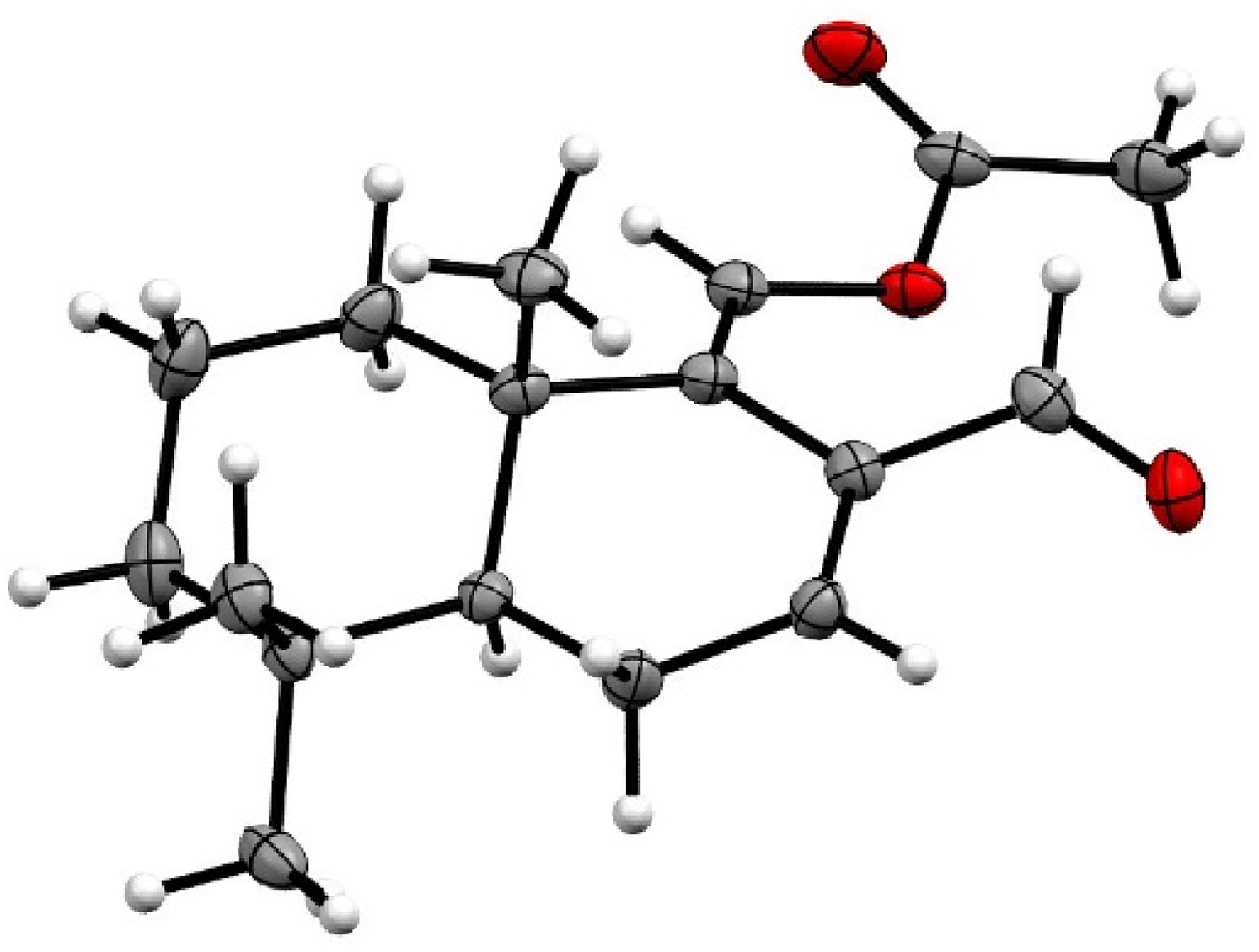
The marine natural products literature contains a single report of the isolation of pu’ulenal from the nudibranch Chromodoris albonotata by Schulte and Scheuer.13 Their study reported that the C-9/C-11 alkene of pu’ulenal possessed an E-geometry based on observations following the addition of an NMR shift reagent (Eu[fod]3). However, when we conducted an 1D NOESY experiment in which H-11 was irradiated, NOE correlations to H-1a, H-1b and Me-15 were revealed, suggesting that pu’ulenal instead possessed a Z-geometry (Figure 2). This was further supported through a 1D NOESY correlation observed to the acetoxy methyl (11-OCOCH3) on irradiation of the aldehyde proton H-12. Fortuitously, crystallization of a sample of 2 was achieved from 10% EtOAc/hexanes and a suitable crystal then subjected to x-ray crystallographic analysis at the Australian Synchrotron. Processing of this data produced the crystal structure shown in Figure 3, confirming that the C-9/C-11 alkene of pu’ulenal possesses a Z-geometry, and thereby correcting the initial erroneous assignment of the configuration by Schulte and Scheuer.13 In addition, the data allowed for the assignment of the absolute configuration of 2 as 5S,10S.
ORTEP representation of the crystal structure of pu’ulenal 2 shown with 50% probability ellipsoids.
Isopu’ulenal (3) was isolated as a white amorphous solid and displayed an adduct ion at m/z 299.1618 [M + Na]+ from HRESIMS, corresponding to a molecular ion of C17H24O3. The 1H NMR spectrum of 3 was closely analogous to that of 2, except that the H-11 alkene signal appeared at δH 8.28 as opposed to δH 7.13 in pu’ulenal. HSQC, HMBC and COSY data acquired at 700 MHz allowed for the chemical shift assignments of all protonated and quaternary carbons in 3, revealing again close similarities to the data obtained for 2. The combination of these results led to the conclusion that 3 possessed the same planar structure as pu’ulenal, differing only in its geometry across the C-9/C-11 alkene, and thereby matching the structure originally proposed for pu’ulenal by Schulte and Scheuer.13 To confirm the C-9/C-11 alkene E-geometry of 3, 1D NOESY experiments were performed, irradiating H-7, H-11 and H-12. Unexpectedly the only NOE correlation observed from these experiments was between H-7 and H-12, while the anticipated correlation between H-11 and H-12 was not observed (Figure 2). This suggested that the s-trans conformer of the C-7/C-8/C-12 α,β-unsaturated aldehyde in 3 is favoured over its s-cis conformer, a phenomenon that has been previously observed in polygodial (1), which possesses a similar structural motif.14
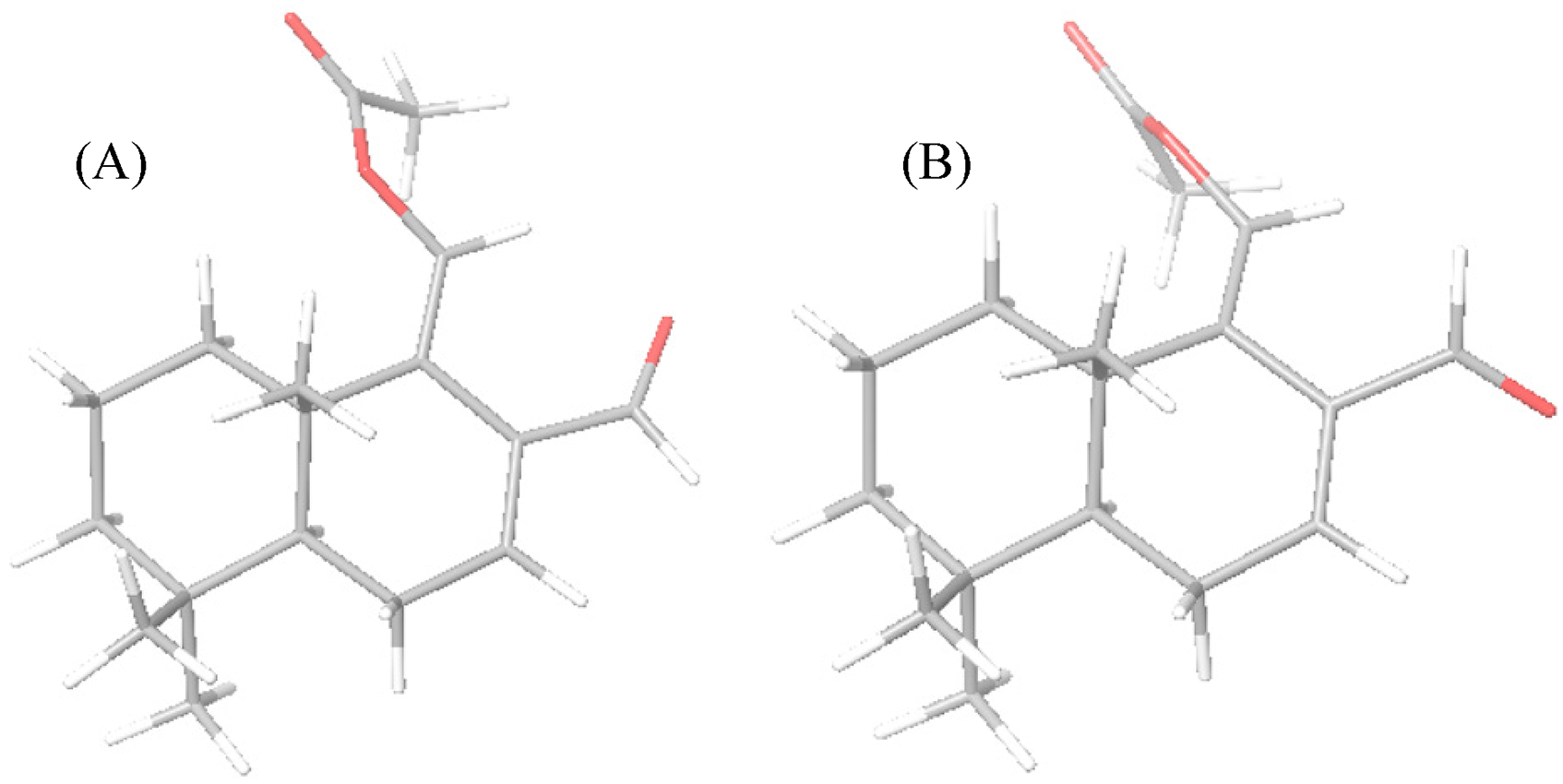
The conformation of 3 was explored using molecular modelling and DFT calculations. This study suggested that isopu’ulenal (3) possesses two major conformers (Figure 4), in one of which the aldehyde adopts the s-trans form (∼99%), while the other conformer adopts the s-cis orientation (∼1%). The preference for the s-trans conformer could arise due to a number of different effects such as secondary orbital interactions of the complex conjugated system present in 2 and 3 or through intramolecular attractions between H-11 and the carbonyl oxygen of C-12. This significant preference for the s-trans form also explains the large 1H chemical shift difference between the H-11 protons of 3 (δH 8.28) and 2 (δH 7.13). In 3, H-11 is directly in the plane of the C-12 carbonyl group and would be subject to the effects of its deshielding cone.
Transoid (A) and cisoid (B) conformers of isopu’ulenal 3.
Fortuitously both drimenin 4 and isodrimenin 5 crystallized after HPLC isolation, and their absolute configurations were therefore determined by x-ray crystallographic analysis and found as expected to be (5S, 10S) (Figures 5 & 6). Since the original structural studies on isodrimenin 417,18 reported 1H NMR data alone, we provide below the 13C NMR data to supplement the NMR assignment.
ORTEP representation of the crystal structure of drimenin 4 shown with 50% probability ellipsoids.
ORTEP representation of the crystal structure of isodrimenin 5 shown with 50% probability ellipsoids.
Experimental
General: Specific rotations were measured at 23 °C on a Jasco P-2000 polarimeter for solutions in CHCl3 using a 1 mL cell (10 cm path length). NMR data were measured on a Bruker Avance 500 MHz or a Bruker Avance III HD700 MHz spectrometer (5 mm TCI inverse cryoprobe) for solutions in CDCl3 at 298 K. HSQC and HMBC data were acquired using a 1JC−H of 145 Hz, while HMBC spectra were acquired using nJC−H of 8 Hz. Low resolution electrospray ionization mass spectrometry (LRESIMS) was performed on a Thermo LCQ Fleet ion trap spectrometer in positive mode. High resolution electrospray ionization mass spectrometry (HRESIMS) was performed on an Orbitrap Elite instrument with a standard ESI source (sodium formate) with MeOH as solvent. Normal phase high performance liquid chromatography (NPHPLC) was undertaken using a Waters 515 pump connected to a Gilson 132 series refractive index detector with a Waters μPorasil (10 μm, 7.8 × 300 mm) or a Phenomenex Luna (5 μm, 10 × 250 mm) column, and using isocratic elution conditions at flow rates between 1 to 2 mL/ min. Silica gel 60 G and silica TLC plates F254 were purchased from Merck. Solvents were either distilled or were of HPLC grade.
Animal material: The nudibranch specimen A. rubroannulata (#1649) was collected from Hancock Shoal, near Coolum, S.E. Qld in January 2017 and stored at −20 °C until extraction.
Extraction and isolation of metabolites: The frozen nudibranch (5.3 g) was dissected into its mantle (2.1 g), gut (1.3 g) and mantle rim (1.9 g). The individual body parts were finely chopped then extracted with acetone (6 × 3 mL) and sonicated (5 min). Each extract was filtered through cotton wool and concentrated to an aqueous suspension before partitioning between H2O (2 mL) and EtOAc (7 × 3 mL). The organic layer was dried over anhydrous Na2SO4, filtered through cotton wool and evaporated under N2 to yield a light orange oil for the mantle (49.6 mg), a dark green oil for the gut (15.7 mg) and a dark orange oil for the mantle rim (256.1 mg). NP flash column chromatography, with a stepwise solvent gradient (hexanes: hexanes/DCM: DCM: DCM/EtOAc: EtOAc: MeOH) was used to further separate the mantle extract. Fractions eluting from hexanes (100%) provided euryfuran 7 (0.8 mg). Fractions eluting from hexanes/DCM (1:1) and hexanes/DCM (1:4) were separated by NP HPLC (20% EtOAc in hexanes) to give drimenin 4 (1.2 mg), isodrimenin 5 (2.6 mg), cinnamolide 6 (0.6 mg), polygodial 1 (1.7 mg), pu’ulenal 2 (4.3 mg) and isopu’ulenal 3 (0.8 mg).
Pu’ulenal (2)
White crystals. [α]D: − 48 (c 0.18 CHCl3). HR-ESI-MS m/z [M + Na]+ calcd. for C17H24NaO3: 299.1618; found: 299.1611. 1H NMR (CDCl3, 500 MHz) and 13C NMR (CDCl3, 500 MHz) are presented in Table 1.
Isopu’ulenal (3)
Colorless oil. [α]D: − 45 (c 0.02 CHCl3). HR-ESI-MS m/z [M + Na]+ calcd. for C17H24NaO3: 299.1618; found: 299.1618. 1H NMR (CDCl3, 700 MHz) and 13C NMR (CDCl3, 700 MHz) are presented in Table 1.
Crystal Structure Determination of Pu’ulenal 2, Drimenin 4 and Isodrimenin 5
Data were collected at the MX1 beamline of the Australian Synchrotron with Silicon Double Crystal monochromated radiation at 100(2) K (λ = 0.7108 Å)20. Data integration and reduction were undertaken with XDS.21 Subsequent computations were carried out using Olex2.22 Structures were solved with ShelXT23 and refined and extended with ShelXL.24 Carbon-bound hydrogen atoms were included in idealised positions and refined using a riding model. The Flack25 parameter unambiguously confirmed the absolute structures. Crystallographic data is summarized below, and the CIFs have been deposited at the Cambridge Crystallographic Data Centre with CCDC numbers 2107013 to 2107015 for 2, 4 and 5, respectively. These data are available free of charge from the Cambridge Crystallographic Data Centre, 12 Union Road, Cambridge CB2 1 EZ, UK; fax: ( + 44) 1223-336-033; or e-mail: deposit@ccdc.cam.ac.uk
Crystal data for C17H24O3 (M = 276.36 g/mol): orthorhombic, space group P212121 (no. 19), a = 6.2730(12) Å, b = 11.436(2) Å, c = 20.720(4) Å, V = 1486.4(5) Å3, Z = 4, T = 100.15 K, μ(MoKα) = 0.083 mm−1, Dcalc = 1.235 g/cm3, 27 409 reflections measured (3.932° ≤ 2Θ ≤ 63.486°), 4489 unique (Rint = 0.0603, Rsigma = 0.0357) which were used in all calculations. The final R1 was 0.0473 (I > 2σ[I]) and wR2 was 0.1302 (all data).
Crystal data for C15H22O2 (M = 234.32 g/mol): orthorhombic, space group P212121 (no. 19), a = 7.2850(15) Å, b = 7.8310(16) Å, c = 22.516(5) Å, V = 1284.5(5) Å3, Z = 4, T = 100(2) K, μ(synchrotron) = 0.078 mm−1, Dcalc = 1.212 g/cm3, 21 314 reflections measured (5.508° ≤ 2Θ ≤ 56.566°), 3106 unique (Rint = 0.0363, Rsigma = 0.0198) which were used in all calculations. The final R1 was 0.0411 (I > 2σ[I]) and wR2 was 0.1123 (all data)
Crystal data for C15H22O2 (M = 234.32 g/mol): orthorhombic, space group P212121 (no. 19), a = 7.0990(14) Å, b = 7.7390(16) Å, c = 23.307(5) Å, V = 1280.5(4) Å3, Z = 4, T = 100(2) K, μ(synchrotron) = 0.078 mm−1, Dcalc = 1.216 g/cm3, 18 090 reflections measured (5.548° ≤ 2Θ ≤ 56.566°), 2919 unique (Rint = 0.0396, Rsigma = 0.0229) which were used in all calculations. The final R1 was 0.0342 (I > 2σ[I]) and wR2 was 0.0815 (all data).
Supplemental Material
sj-docx-1-npx-10.1177_1934578X211055025 - Supplemental material for Oxygenated Sesquiterpenes From the Indo-Pacific Nudibranch Ardeadoris rubroannulata: Structure Revision of Pu’ulenal
Supplemental material, sj-docx-1-npx-10.1177_1934578X211055025 for Oxygenated Sesquiterpenes From the Indo-Pacific Nudibranch Ardeadoris rubroannulata: Structure Revision of Pu’ulenal by Patrick T. Narbutas, Gregory K. Pierens, Jack K. Clegg and Mary J. Garson in Natural Product Communications
Supplemental Material
sj-cif-2-npx-10.1177_1934578X211055025 - Supplemental material for Oxygenated Sesquiterpenes From the Indo-Pacific Nudibranch Ardeadoris rubroannulata: Structure Revision of Pu’ulenal
Supplemental material, sj-cif-2-npx-10.1177_1934578X211055025 for Oxygenated Sesquiterpenes From the Indo-Pacific Nudibranch Ardeadoris rubroannulata: Structure Revision of Pu’ulenal by Patrick T. Narbutas, Gregory K. Pierens, Jack K. Clegg and Mary J. Garson in Natural Product Communications
Footnotes
Acknowledgments
The assistance of Dr T. Le (NMR) and P. Josh (MS) is acknowledged. The nudibranch specimen was collected under permit by Dr Karen Cheney (Permit # 183990 QLD General Fisheries). Part of this research was undertaken using the MX1 beamline at the Australian Synchrotron, part of ANSTO. The authors thank ANSTO beamline staff for their expertise.
Author Contributions
PTN carried out the experimental investigation, including NMR studies, and was involved in conceptualization of the study; GKP was involved in the NMR studies and undertook the modelling study; JKC undertook the x-ray crystallographic study; MJG was involved in data analysis and conceptualization of the study; all authors contributed to preparation of the manuscript and approved the final version.
Funding
We thank the School of Chemistry and Molecular Biosciences and The University of Queensland for financial support, and ANSTO for travel assistance. The author(s) received no financial support for the publication of this article.
Ethical Approval
Ethical approval is not applicable for this article.
ORCID iD
Jack K. Clegg
Gregory K Pierens
Mary J. Garson
Statement of Human and Animal Rights
This article does not contain any studies with human or living animal subjects.
Statement of Informed Consent
There are no human subjects in this article, and informed consent is not applicable’
Supporting Information
Supplemental material for this article is available online.
Trial Registration
Not applicable, as no clinical trials were involved.
Declaration of Conflicting Interests
The author(s) declared no potential conflicts of interest with respect to the research, authorship, and/or publication of this article.
Supplemental Material
Supplemental material for this article is available online.
References
1.
BarnesCSLoderJW. The structure of polygodial: a new sesquiterpene dialdehyde from Polygonum hydropiper L. Aust J Chem. 1962;15(2):322-327.
2.
KuboILeeYWPetteiMPilkiewiczFNakanishiK. Potent army-worm antifeedants from the East African Warbugia plants. J Chem Soc Chem Commun. 1976;(24):1013-1014.
3.
KioyDGrayAIWatermanPG. A comparative study of the stem-bark drimane sesquiterpenes and leaf volatile oils of Warbugia ugandensis and W. stuhlmannii. Phytochemistry. 1990;29(11):3535-3538.
4.
RihakKJBissemberACSmithJA. Polygodial: a viable natural product scaffold for the rapid synthesis of novel polycyclic pyrrole and pyrrolidine derivatives. Tetrahedron. 2018;74(12):1167-1174.
5.
CiminoGDe RosaSDe StefanoSSodanoG. The chemical defense of four Mediterranean nudibranchs. Comp Biochem Physiol. 1982;73B(2):471-474.
6.
CiminoGDe RosaSDe StefanoSSodanoGVillaniG. Dorid nudibranch elaborates its own chemical defense. Science. 1983;219(4589):1237-1238.
7.
AsakawaYDawsonGWGriffithsDC, et al.Zhong-Ning Z1 activity of drimane antifeedants and related compounds against aphids and comparative biological effects and chemical reactivity of (-) and ( + )-polygodial. J. Chem. Ecol.1988;14(10):1845-1855.
8.
CiminoGSpinellaASodanoG. Identification of an intermediate in the reaction between polygodial and methylamine in biomimetic conditions. Tet Letts. 1984;25(37):4151-4152.
9.
CaprioliVCiminoGColleRGavagninMSodanoGSpinellaA. Insect antifeedant activity and hot taste for humans of selected natural and synthetic 1,4-dialdehydes. J Nat Prod. 1987;50(2):146-151.
10.
GavagninMMolloECastelluccioFGhiselinMTCaladoGCiminoG. Can molluscs biosynthesize typical sponge metabolites? The case of the nudibranch Doriopsilla areolata. Tetrahedron. 2001;57(46):8913-8916.
11.
FontanaATramiceACutignanoAd’IppolitoGGavagninMCiminoG. Terpene biosynthesis in the nudibranch Doriopsilla areolata. J Org Chem. 2003;68(6):2405-2409.
12.
GasparHCutignanoAFerreiraTCaladoGCiminoGFontanaA. Biosynthetic evidence supporting the generation of terpene chemodiversity in marine molluscs of the genus Doriopsilla. J Nat Prod. 2008;71(12):2053-2056.
13.
SchulteGRScheuerP. Defense allomones of some marine mollusks. Tetrahedron. 1982;38(13):1857-1863.
14.
RodriguezBZapataNMedinaPViñuelaE. A complete 1H and 13C NMR data assignment for four drimane sesquiterpenoids isolated from Drimys winterii. Magn. Res. Chem.2005;43(1):82-84.
15.
RukachaisirikulVKhamthongNSukpondmaY, et al.Cyclohexene, diketopiperazine, lactone and phenol derivatives from the sea fan-derived fungi Nigrospora sp. PSU-F11 and PSU-F12. Arch Pharmacal Res. 2010;33(3):375-380.
16.
HollinsheadDMHowellSCLeySVMahonMRatcliffeNMWorthingtonPA. The diels-alder route to drimane related sesquiterpenes: synthesis of cinnamolide, polygodial, isodrimeninol, drimenin and warbuganal. J Chem Soc Perkin Trans I. 1983:1579-1589.
17.
WhiteJDBurtonLPJ. Syntheses of the insect antifeedant ( + )-cinnamodial and the drimane sesquiterpenoids ( + )-isodrimenin and ( + )-fragrolide. J Org Chem. 1985;50(3):357-364.
18.
AkitaHOishiT. Ozonolysis of phenolic dehydroabietane derivatives - syntheses of optically active ( + )-confertifolin, ( + )-valdiviolide, ( + )-winterin, ( + )-isodrimenin, and ( + )-pallescensin A. Chem Pharm Bull. 1981;29(6):1580-1587.
19.
HochlowskiJEWalkerRPIrelandCFaulknerDJ. Metabolites of four nudibranchs of the genus Hypselodoris. J Org Chem. 1982;47(1):88-91.
20.
McPhillipsTMMcPhillipsSEChiuHJ, et al.Blu-Ice and the distributed control system: software for data acquisition and instrument control at macromolecular crystallography beamlines. J Synchrotron Radiation. 2002;9(6):401-406.
21.
KabschW. Automatic processing of rotation diffraction data from crystals of initially unknown symmetry and cell constants. J Appl Cryst. 1993;26(6):795-800.
22.
DolomanovOVBourhisLJGildeaRJHowardJAKPuschmannH. OLEX2: a complete structure solution refinement and analysis program. J Appl Cryst. 2009;42(2):339-341.
23.
SheldrickGM. SHELXT-Integrated space-group and crystal-structure determination. Acta Cryst. 2015;A71(1):3-8.
24.
SheldrickGM. Crystal structure refinement with SHELXL. Acta Cryst. 2015;C71(1):3-8.
25.
FlackHD. On enantiomorph-polarity estimation. Acta Cryst. 1983;A39(6):876-881.
Supplementary Material
Please find the following supplemental material available below.
For Open Access articles published under a Creative Commons License, all supplemental material carries the same license as the article it is associated with.
For non-Open Access articles published, all supplemental material carries a non-exclusive license, and permission requests for re-use of supplemental material or any part of supplemental material shall be sent directly to the copyright owner as specified in the copyright notice associated with the article.