



Abstract
Ostericum koreanum Maxim., a perennial medicinal plant native to Asian countries, is traditionally exploited in Korean Oriental and Chinese Herbal Medicine. It has been used in the treatment of neuralgia, respiratory problems, and joint pain due to its rich content of phytochemicals. Therefore, the significant role of compounds present in O. koreanum should not be overlooked to explore and develop drugs against diseases. The purpose of this review is to provide a reference for researchers and to describe the phytochemical constituents and pharmacological activity of O. koreanum. In this mini review, we have collected the data from 1980 to 2020 regarding the phytochemicals present and pharmacological activities of this plant. Our findings indicated that this plant possesses a rich source of phytochemicals that have significant pharmacological activities, such as anti-microbial, anti-inflammatory, anti-pyretic, anti-influenza, anti-cancer, and neuroprotective. These phytochemicals have promising pharmacological activity which should be further explored for the treatment of various diseases.
Introduction
Historical records revealed that ancient civilizations had mastered the ability to use different plant parts such as stems, roots, leaves, and flowers to prepare therapeutic medication. 1 Herbal medicines contain a wide variety of bioactive compounds which have been utilized against a wide range of diseases. The data regarding these therapeutic substances have been aggregated and compiled in Traditional Chinese Medicine (TCM).2,3 Nowadays, about 90% of the population in Asia and other countries rely upon herbal medicine and its market is expected to increase by more than 50 billion US dollars. 4 In the 21st century, advanced chemical and physical techniques allowed us to obtain several bioactive compounds from medicinal plants. 5
Traditional Chinese medicine was introduced to Korea in the sixth century. 6 Many substances in Korean herbal medicines have been modified and developed separately from traditional Chinese medicines due to differences in location, climate, culture, and politics. As a result, several Korean herbal remedies that differ from conventional Chinese medications are employed in Korean medicine clinics. In addition to these considerations, the extraction processes used to prepare the herbal plants can affect the levels of bioactive chemicals in the extract. As a result, quality control of active components in herbal extracts is critical in both medical and nutritional applications.7,8
The importance of medicinal plants in the lives of most people around the world should not be underestimated. Herbal medicines have a long history in Korean Peninsula and are widely used around the world to prevent and treat human sickness. 9 One of the most important perennial traditional herbal medicine is Ostericum koreanum, which belongs to the Umbelliferae family and has been used to cure the common cold, fever, relieve rheumatic articular pains, headaches, and neuralgia (Figure 1). Its features include a pungent and warm sensation. 10 The biological and pharmacological properties of this plant include anti-tumor, 11 anti-bacterial, anti-microbial, 12 anti-inflammatory, 13 antioxidant, 14 acaricidal activity, 15 vasorelaxant effects, 16 and antiasthmatic. 17 Osterici Radix, the root of O. koreanum, is grown in Kangwon Province, Korea, where it is known as “Kanghwal.” The origins of this plant have been portrayed differently in Korean, Chinese, and Japanese pharmacopeias. The Chinese and Japanese pharmacopoeias only include Notopterygium incisum and N. forbesii as sources of “Kanghwal”, but the Korean pharmacopeias also include Ostericum koreanum.

Ostericum koreanum (whole plant, leaves, habit, flower). Figure from blog.daum.net and used under the creative common license.
O. koreanum is known as Kang Bow in South Korea, but also goes by the names of Hogangsaja, Howangsaja, Ganghwa, Ganghori, Ganggol, Gangcheong, Jamgang, and Dokyocho. The plant thrives in cold areas in mountain valleys in Korea. Harvesting takes place between the end of October and the beginning of November. Furthermore, there are two methods for raising this plant in Korea. One is a seeding method known as “Nam-kangwhoal (OK(S)), while the other is a root splitting method known as “Buk-kangwhoal (OK(N)). 18 However, this plant has received limited scientific investigation due to its vague taxonomical classification. Therefore, in this mini review, we have compiled the literature from the 1980s to 2021 about O. koreanum, including a list of its constituents, and its pharmacological activity in the treatment of various diseases.
Assessment of Compounds
An HPLC-UV detection method published by Lee et al
19
was the simplest and most sensitive approach for the simultaneous identification of four marker chemicals: bisabolangelone (
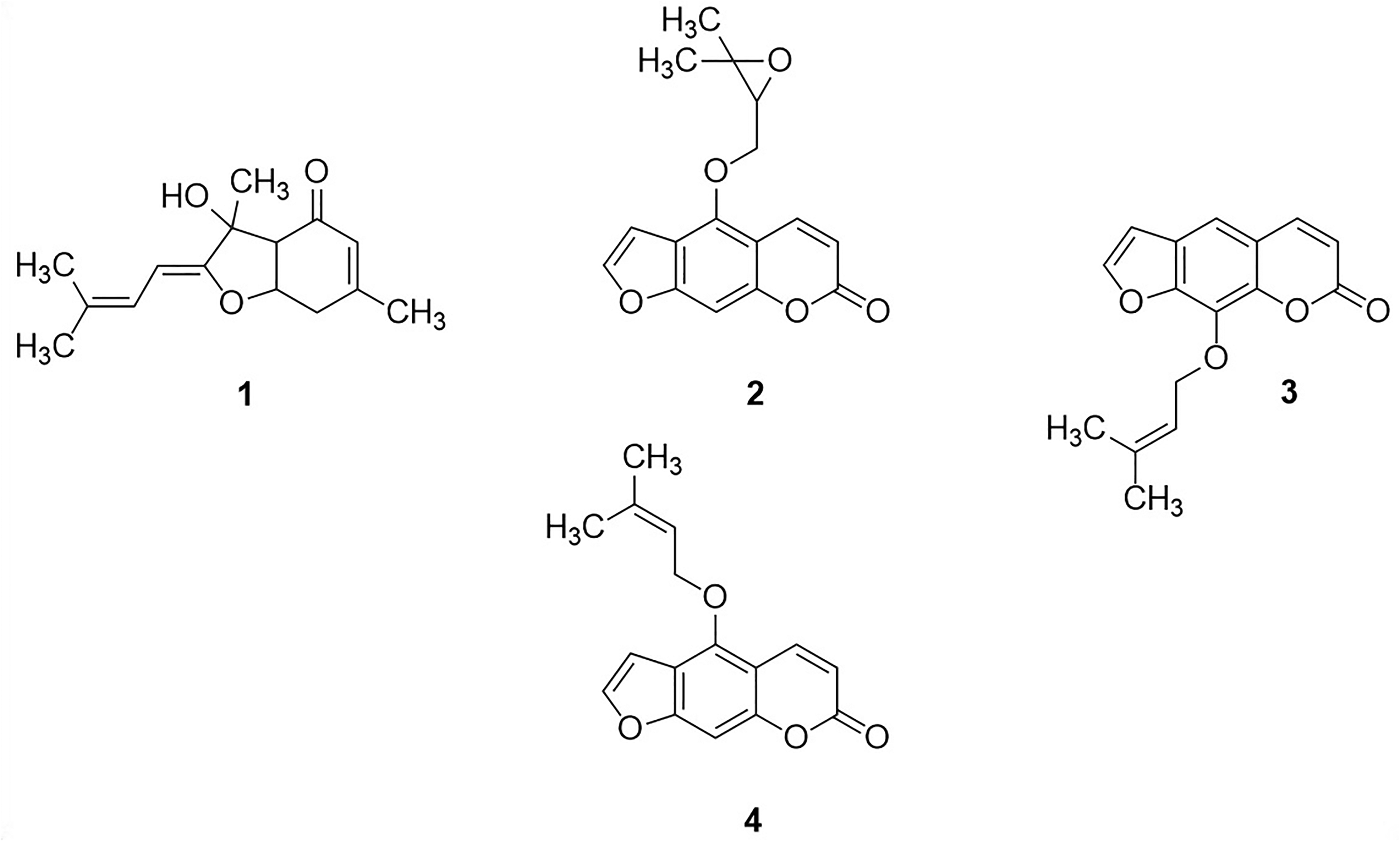
The chemical structures of bisabolangelone, oxypeucedanin, imperatorin, isoimperatorin.
Constituents of Ostericium koreanum and Their Pharmacological Activities
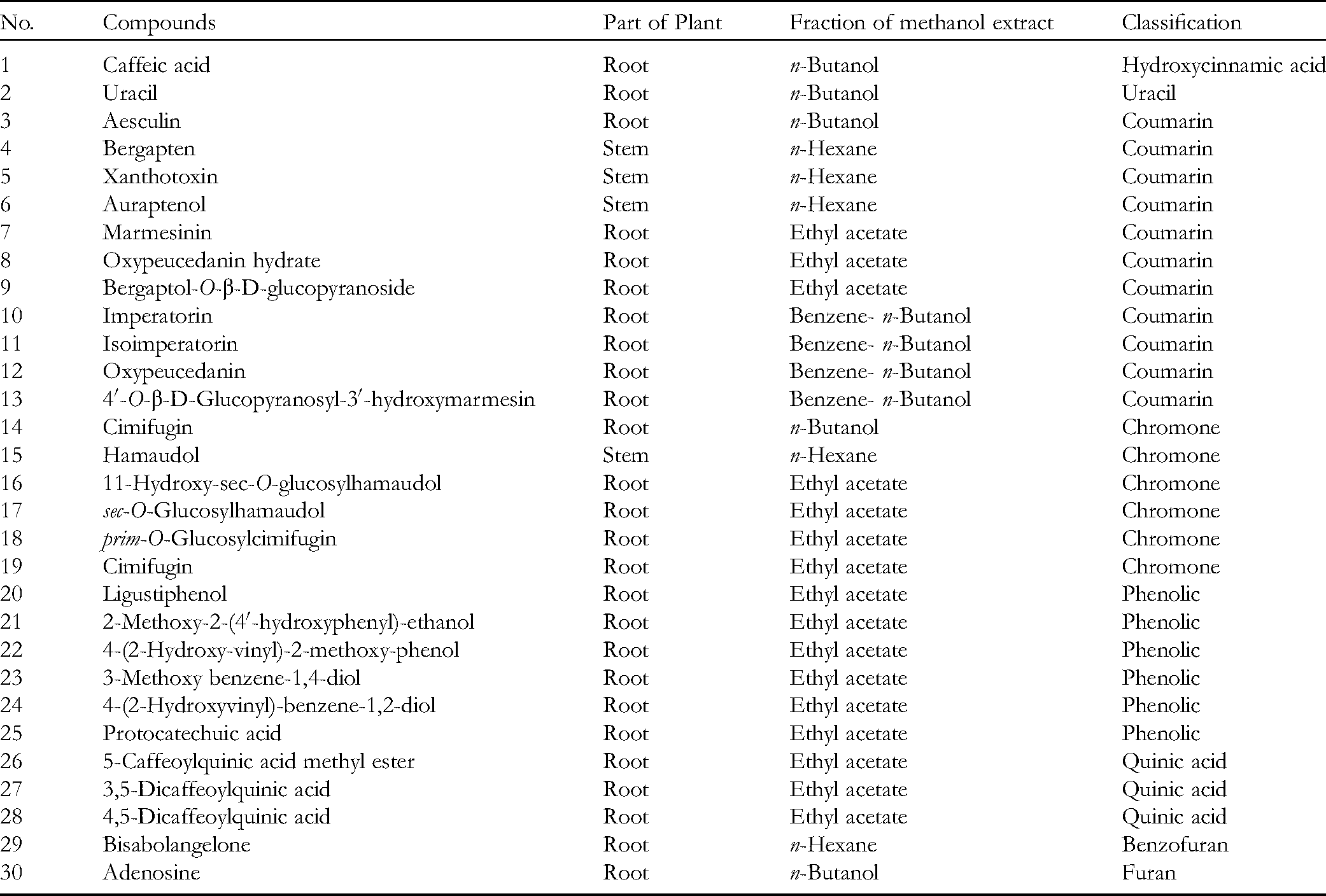
The constituents of the root and stem of O. koreanum are summarized in Table 1. Caffeic acid, aesculin, uracil, cimifugin, and adenosine were identified in the root,
20
and bergapten (

The structures of bergapten, xanthotoxin, auraptenol and hamaudol.
Constituents of Ostericum koreanum.
Jeon et al extracted essential oil and identified the components using gas chromatography-mass spectrometry (GC-MS). 23 β-Phellandrene (38.1%), α-bisabolol (9.4%), 3-methylphenol (6.7%), α-terpinolen (5.5%), 1-acetoxy-1,2-epoxycyclohexane (5.0%), 4′-hydroxy-3′-methylacetophenone (4.8%), isosafrole (4.1%), 2-methyl-3-ethylpentane (3.9%), isopentyl-3-methylbutanoate (3.6%), 2,5-dimethyl-3-hexanol acetate (3.4%), ( + )-3-carene (2.8%), limonene (2.%), tridecanolide (2.3%), 2,5-dimethyl-3-vinyl-1,4-hexadiene (2.1%), α-pinene (1.5%) and 4,7-dimethyl-5-decyne-4,7-diol (1.3%) were detected. The essential oil included terpene hydrocarbons, oxygenated terpene hydrocarbons, phenols, alcohols, and aliphatic hydrocarbons.
Another GC-MS study of the essential oil of O. koreanum was carried out in 2015. 24 This reported β-phellandrene (38.1%), α-bisabolol (9.4%), m-cresol (6.7%), terpinolen (5.5%), 1-acetoxy-1,2-epoxycyclohexane (5.0%), 4′-hydroxy-3′-methylacetophenone (4.8%), 2-methyl-3-ethylpentane (3.9%), isopentyl-3-methylbutanoate (3.6%), 2,5-dimethyl-3-hexanol acetate (3.4%), 3,7-dimethyl-13,6-octatriene (2.8%), limonene (2.3%), tridecanolide (2.3%), 2,5-dimethyl-3-vinyl-1,4-hexadiene (2.1%), α-pinene (1.5%) and 4,7-dimethyl-5-decyne-4,7-diol (1.3%).
Shin used steam distillation and diethyl ether extraction to isolate thirty-four essential oil components from the dried roots, which were identified using GC-MS. 12 The main components of this oil were α-pinene (41.1%), p-cresol (18.0%), 4-hydroxy-2-methylacetophenone (7.9%) sabinene (7.6%), α-bisabolol (2.0%), p-cymen-8-ol (2.0%), and camphene (1.9%). The variation between the reported results may have been caused by several factors, including plant part used (flower, leaves, root, and stem), the different conditions of the plant material used, the geographical location, climate, and soil type. 25
From the benzene-soluble and n-butanol-soluble portions of O. koreanum root, Kwon et al extracted four furocoumarins (imperatorin, isoimperatorin, oxypeucedanin and oxypeucedanin hydrate) and two dihydrofurocoumarin glycosides (marmesinin and 4′-O-β-D-glucopyranosyl-3′-hydroxymarmesin).
26
Kang et al isolated oxypeucedanin (
Park et al
14
used the ethyl acetate fraction of O. koreanum roots to isolate 11-hydroxy-sec-O-glucosylhamaudol (
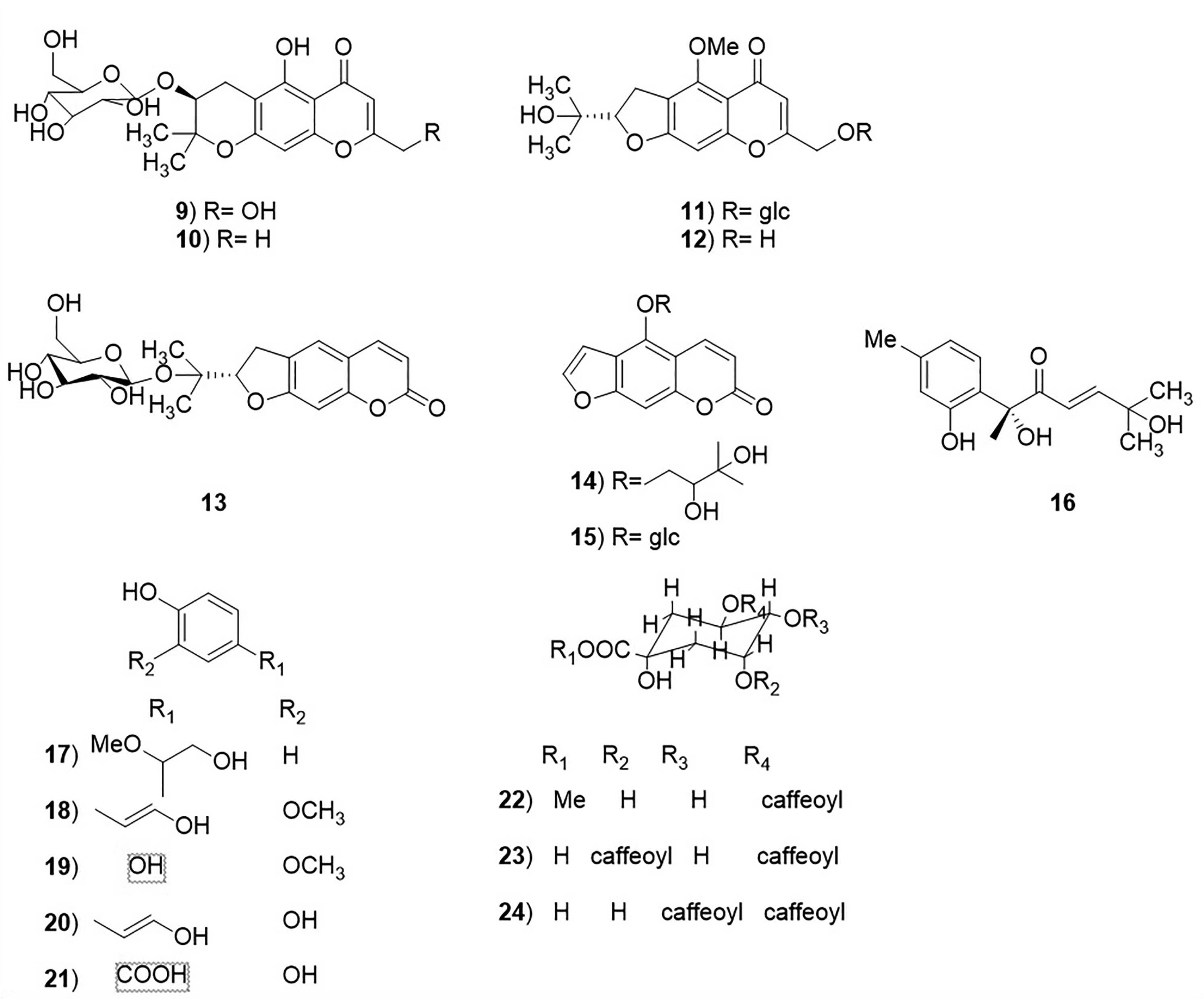
Compounds isolated from EtOAc extract of the roots of Ostericum koreanum.
In LPS-stimulated RAW264.7 cells, the ethyl acetate fraction of the methanol extract of O. koreanum root inhibited nitric oxide (NO) and prostaglandin E2 (PGE2) production efficiently. 38 It was believed that the extract had anti-inflammatory and therapeutic activities by decreasing the generation of inflammatory mediators in activated macrophages. Park et al 13 conducted another study on the anti-inflammatory and inhibitory effects of O. koreanum extract. They evaluated the down-regulated LPS-induced NO and cytokines production via repressing activation of mitogen-activated protein kinase (MAPKs) and degradation of inhibitory kappa Bα (Iκ-Bα). In 2008, the effects were studied of the ethyl acetate extract of O. koreanum on allergic inflammation in activated human mast cells. The extract showed anti-inflammatory properties by lowering the output of inflammatory mediators in activated mast cells, and that the blockage of the nuclear factor kappa-B (NFκB) route was due to its molecular mechanism. 39 Hee and Young reported LPS-induced NO and PGE2 synthesis produced by the ethanol extract of O. koreanum and concluded that the extract could be used for its analgesic and anti-inflammatory properties. 40
The effects of O. koreanum extract on lipopolysaccharide (LPS) induced bone loss in mice were investigated by studying bone structure and the levels of Receptor activator of nuclear factor kappa-Β ligand (RANKL) and osteoprotegerin (OPG) in serum and bone marrow fluid (BMF). Therefore, for the first time, a link between O. koreanum and bone diseases, particularly osteoporosis, was established, and the extract was shown to have the capacity to ameliorate bone-damaging diseases caused by extreme bone resorption. 41
O. koreanum root extract showed anti-allergic characteristics, improved rhinitis symptoms, inhibited histamine and IL-4 production in ovalbumin-induced allergic rhinitis mice, and inhibited mast cell de-granulation in compound 48/80-stimulated mast cells. 42 The root water extract was tested in a human mast cell line and shown to have anti-allergic properties. 43
An ethanol extract of O. koreanum root was studied for its mechanism of action and effect on vasorelaxant activity. The effects of the extract on several vasorelaxant and vasoconstriction variables were studied using isolated rat aortic rings. The induction of NO synthesis from l-arginine and NO-cGMP routes was thought to be produced by the vasorelaxant activity of the extract. 44 According to their findings, Osterici Radix may be a useful herbal medicine for the treatment of cardiovascular illnesses such as hypertension.
Fascinating results were obtained on the effect of the ethanolic extract of O. koreanum root on better learning and memory deficits generated by scopolamine in an in vivo and in vitro investigation. Beneficial effects were attributed to boosting the cholinergic nervous system. 45
Conclusions and Future Directions
In this mini review, the therapeutic activity of O. koreanum was highlighted, and essential phytochemicals found in this plant were summarized (Table 2). These phytochemicals play a vital role in providing anti-inflammatory properties through downregulation of inflammatory markers (PGE2, NO, cytokines and interleukins) and inflammatory pathways (NFκB, MAPK) implicated in the inflammation. These phytocompounds also reduce the growth of pathogenic microorganisms and cancer cells. In addition to these properties, they are recognized as neuroprotective, gastroprotective and cardioprotective. However, there are potential shortfalls which need to be addressed in future studies. The taxonomical position and its medieval utilization in traditional medicine are still in contradiction and no effort has been made to address this issue. Many research studies have focused on root and stem extracts and identified various phytochemicals and explored pharmacological activities. However, the pharmacological activity and phytochemical exploration from other plant components (leaves, flower, stem) are necessary to map and discover new promising compounds for various diseases. To the best of our knowledge, this plant's pharmacological activity has been explored between 1982 to 2017, but, recently, Ko et al 21 identified new phytochemicals from the stem of this plant, but their biological activity is unknown yet. The acute toxicity and safety profile of these phytochemicals has not been determined in most of the studies, which is a major setback to introduce them for clinical trials. The anticancer effects of this plant have only been researched in one study, but its activity against different cancer cells should be investigated further.
Summary of Pharmacological Activities Showed by Ostericum koreanum.

Footnotes
Acknowledgments
This work was supported by the National Research Foundation of Korea (NRF) funded by the Korean Government (MEST) (2020R1I1A3069699).
Declaration of Conflicting Interests
The author(s) declared no potential conflicts of interest with respect to the research, authorship, and/or publication of this article.
Funding
The author(s) disclosed receipt of the following financial support for the research, authorship, and/or publication of this article: This work was supported by the National Research Foundation of Korea (grant number 2020R1I1A3069699).
Ethical Approval
Not applicable, because this article does not contain any studies with human or animal subjects.
Informed Consent
Not applicable, because this article does not contain any studies with human or animal subjects.

Trial Registration
Not applicable, because this article does not contain any clinical trials.
Supplemental Material
Supplemental material for this article is available online.