



Abstract
For the first time the 4-dimethylaminopyridine (DMAP) catalyzed straightforward and efficient procedure has been developed for the synthesis of 3,3′-(arylmethylene)bis(2-hydroxynaphthalene-1,4-dione) derivatives starting from lawsone (2-hydroxy-1,4-naphthoquinone) and a variety of (hetero)aromatic aldehydes in ethanol under microwave irradiation. Three of nine synthesized compounds are new. This method provides notable advantages over existing procedures including use of non-traditional basic catalyst and environmentally benign solvent, mild reaction conditions, excellent yields, short reaction time and simple workup.
Introduction
2-Hydroxy-1,4-naphthoquinone (lawsone or hennotannic acid,
Due to the broad biological relevance of 3,3´-(arylmethylene)bis(2-hydroxynaphthalene-1,4-diones), considerable efforts have been paid on the improvement of synthetic approaches of this class of compounds for the past decades. Literature methods are mostly based on acid-catalyzed condensation between lawsone and aldehydes using LiCl,10,11 sulfuric acid,
12
sulfamic acid,
13
camphor sulfonic acid,
14
β-alanine/AcOH,
7
L-aminoacids,
6
and ionic liquilds
15
as catalyst. Several bio-derived catalysts such as lipase,
16
chitosan, and O-carboxymethyl chitosan
17
were employed in these reactions. However, the use of basic catalyst in the synthesis of bis-lawsone compounds have rarely been studied.
18
In recent times, 4-dimethylaminopyridine (DMAP) is well known as an outstanding catalyst for various synthetic transformations.19,20 The catalytic efficiency of DMAP is probably based on steric effects, the donor ability of the amine substituent, the good nucleophilic properties, and stabilization of pyridinium ion.
19
In that respect, considering the important bioactivities of 3,3´-(arylmethylene)bis(2-hydroxynaphthalene-1,4-dione) derivatives and reported reaction conditions for their synthesis, herein, we describe the synthesis of this class of compounds from lawsone (
Result and Discussion
In our initial investigation, the synthesis of 3,3'-(4-chloromethylene) bis(2-hydroxynaphthalene-1,4-dione)
Screening of the Catalyst and Solvent for the Synthesis of Compound 3,3'-(4-Chloromethylene) bis(2-Hydroxynaphthalene-1,4-Dione) 3a .
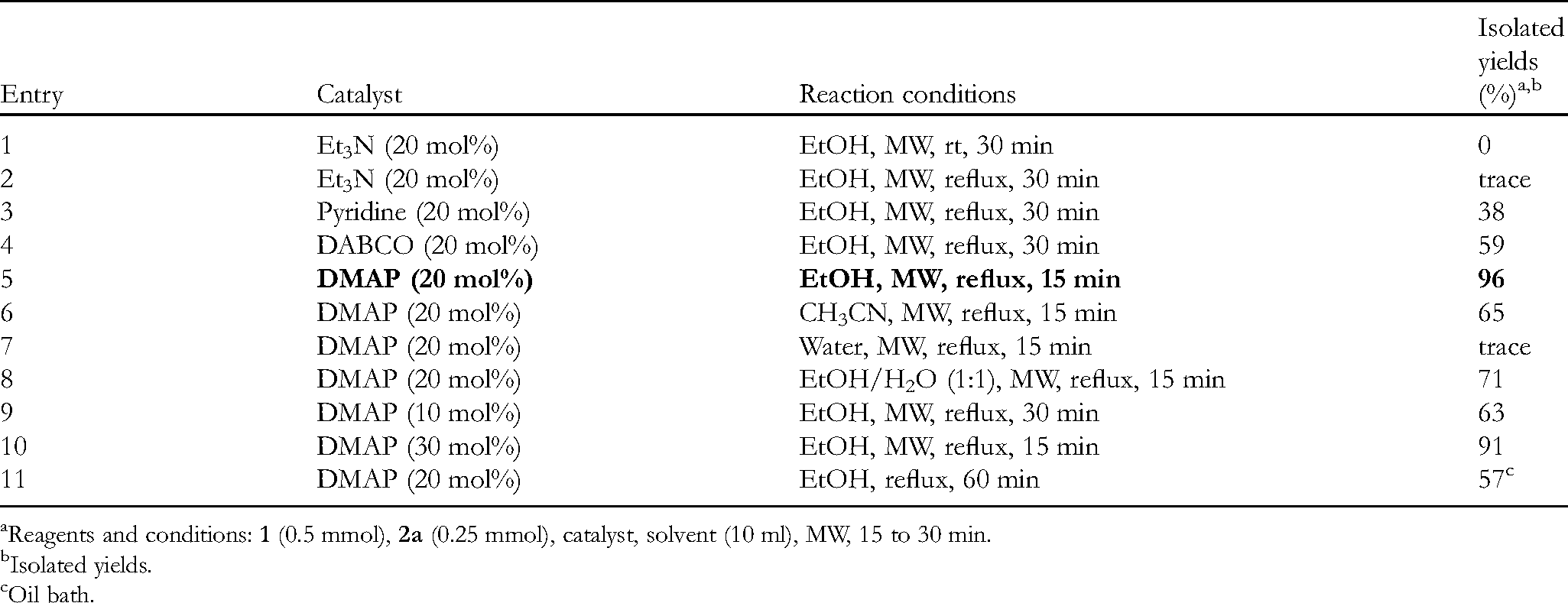
Screening of the Catalyst and Solvent for the Synthesis of Compound 3,3'-(4-Chloromethylene) bis(2-Hydroxynaphthalene-1,4-Dione)
Reagents and conditions:
Isolated yields.
Oil bath.
As shown in Table 1 (entries 5-8), water was not appropriate solvent for this reaction, meanwhile product
The effect of the amount of DMAP on the yield has also been investigated. The results revealed that the use of lower amount of DMAP (10 mol%) required a longer reaction time to furnish a comparable result (entry 9). At the same time, the yield was not further improved when an excess amount of catalyst (30 mol%) was loaded (entry 10). It is clear from the results, that 20 mol% of DMAP is sufficient to achieve the optimum yield of the product (entry 5).
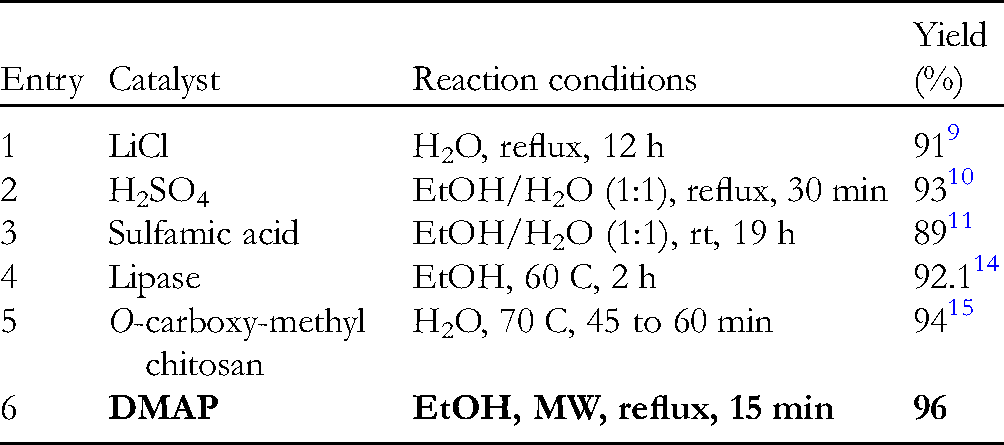
Furthermore, a comparison of the effect of DMAP and other catalysts, previously reported on the synthesis of compound
Effect of DMAP and Other Catalyst on the Synthesis of Compound
To demonstrate the efficiency and scope of the present procedure, the above optimized reaction conditions were applied to various benzaldehydes with electron-withdrawing groups (such as halogen, trifluoromethyl group) or electron-donating groups (including methyl, methoxy, phenyl) as well as heteroaromatic aldehydes (piperonal, pyridine-3-carbaldehyde, benzo[b]thiophene-2-carbaldehyde) to give good to excellent yields of the corresponding products (86%–96%) (Scheme 1). The chemical structures of compounds

Synthesis of compounds
The formation of 3,3'-(arylmethylene)bis(2-hydroxynaphthalene-1,4-diones)

Proposed reaction mechanism.
General Experimental Procedures
All reagents and solvents were purchased from Aldrich or Merck unless noted otherwise. Solvents were used directly as purchased unless otherwise indicated. The reaction was carried out in Anton Paar Microwave Synthetic Reactor Monowave 400. TLC was performed using Merck silica gel 60 F254 and visualized under UV light at 254 nm to check the progress of reactions and preliminary evaluation of compounds’ homogeneity. Purification of compounds was carried out using open silica gel column flash chromatography with Merck silica gel 60 (240-400 mesh) as stationary phase. Melting points were determined using a Buchi B-545 melting point apparatus and are uncorrected. IR analysis was recorded on Perkin Elmer Spectrum Two spectrometer in KBr pellet. 1H and 13C NMR spectra were recorded on a Bruker Avance III spectrometer (600 and 150 MHz, respectively) in DMSO-d6. TMS was used as internal standard. HRMS were recorded on a SCIEX X500 QTOF mass spectrometer in ESI + or ESI– mode.
Preparation of Compounds 3a-i
A vial containing a mixture of 2-hydroxy-1,4-naphthoquinone
3,3'-([4-Chlorophenyl]methylene)bis(2-hydroxynaphthalene-1,4-dione) (3a )
Reaction time 15 min. Yellow powder. Mp. 196 to 198 oC (198-200 C). 17 Yield 96%. IR (KBr) cm−1: 3445, 2909, 1651, 1615, 1591, 1488, 1462, 1371, 1342, 1281, 1221, 1092, 1062, 1014, 915, 832, 788, 733. 1H NMR (DMSO-d6, 600 MHz), δ (ppm): 7.97 (2H, d, J = 7.2 Hz), 7.88 (2H, d, J = 7.2 Hz), 7.76 (2H, td, J = 7.8 Hz, J = 1.2 Hz), 7.67 (2H, td, J = 7.2 Hz, J = 1.2 Hz), 7.20 (2H, d, J = 8.4 Hz), 7.14 (2H, d, J = 8.4 Hz), 6.67 (1H, s). 13C NMR (DMSO-d6, 150 MHz), δ: 183.6, 182.3, 161.7, 140.5, 133.8, 133.2, 131.9, 130.9, 129.3, 128.7 (2C), 127.6 (2C), 125.7, 125.1, 122.0, 32.6. HRMS: Found m/z 493.0451 [M + Na]+, calcd. for C27H15ClO6Na: 493.0455.
3,3'-([4-Bromophenyl]methylene)bis(2-hydroxynaphthalene-1,4-dione) (3b )
Reaction time 15 min. Yellow powder. Mp 213 to 215 C (214-216 C). 12 Yield 91%. IR (KBr) cm−1: 3452, 3076, 2909, 1647, 1595, 1571, 1484, 1371, 1282, 1222, 1062, 1008, 968, 914, 827, 731. 1H NMR (DMSO-d6, 600 MHz), δ: 7.96 (2H, d, J = 7.2 Hz), 7.88 (2H, d, J = 7.2 Hz), 7.76 (2H, td, J = 1.2 Hz, J = 7.8 Hz), 7.67 (2H, td, J = 1.2 Hz, J = 7.8 Hz), 7.33 (2H, d, J = 8.4 Hz), 7.08 (2H, d, J = 8.4 Hz), 6.64 (1H, s). 13C NMR (DMSO-d6, 150 MHz), δ (ppm): 183.5, 182.7, 141.1, 133.8, 133.2, 131.9, 130.9, 130.5, 129.2, 125.7, 125.1, 122.0, 117.7, 33.7. HRMS: Found m/z 515.0132 [M(79Br) + H]+, calcd. for C27H1679BrO6: 515.0130; m/z 517.0117 [M(81Br) + H]+, calcd. for C27H1681BrO6: 517.0110.
3,3'-([4-[Trifluoromethyl]phenyl]methylene)bis(2-hydroxy-naphthalene-1,4-dione) (3c )
Reaction time 15 min. Yellow powder. Mp 188 to 191 C (188-190 C). 12 Yield 92%. IR (KBr) cm−1: 3434, 2911, 1676, 1643, 1599, 1572, 1327, 1280, 1162, 1116, 1068, 1026, 968. 1H NMR (DMSO-d6, 600 MHz), δ (ppm): 7.98 (2H, d, J = 7.8 Hz), 7.89 (2H, d, J = 7.2 Hz), 7.77 (2H, t, J = 7.2 Hz), 7.68 (2H, t, J = 7.2 Hz), 7.51 (2H, d, J = 8.4 Hz), 7.35 (2H, d, J = 7.8 Hz), 6.75 (1H, s). 13C NMR (DMSO-d6, 150 MHz), δ: 183.5, 182.3, 160.4, 146.8, 133.8, 133.2, 132.0, 130.9, 127.6, 125.8, 125.5, 125.2, 124.6, 121.8, 33.2. HRMS: Found m/z 527.0722 [M + Na]+, calcd. for C28H15F3O6Na: 527.0718.
3,3'-(p-Tolylmethylene)bis(2-hydroxynaphthalene-1,4-dione) (3d )
Reaction time 20 min. Yellow powder. Mp 170 to 172 C (174-176 C). 12 Yield 94%. IR (KBr) cm−1: 3435, 2913, 1654, 1604, 1592, 1508, 1461, 1372, 1341, 1282, 1222, 1189, 1057, 1024, 914, 805, 762, 731, 689. 1H NMR (DMSO-d6, 600 MHz), δ (ppm): 7.96 (2H, d, J = 7.2, Hz), 7.87 (2H, d, J = 7.2 Hz), 7.75 (2H, td, J = 7.2 Hz, J = 1.2 Hz), 7.67 (2H, td, J = 7.2 Hz, J = 1.2 Hz), 6.99 (2H, d, J = 7.8 Hz), 6.95 (2H, d, J = 8.4 Hz), 6.64 (1H, s), 2.22 (3H, s). 13C NMR (DMSO-d6, 150 MHz), δ: 183.7, 161.9, 138.3, 133.7, 133.4, 133.3, 131.8, 130.9, 128.3, 126.7, 125.7, 125.0, 122.6, 32.6, 20.5. HRMS: Found m/z 451.1179 [M + H]+, calcd. for C28H19O6: 451.1182.
3,3'-([3-Methoxyphenyl]methylene)bis(2-hydroxynaphthalene-1,4-dione) (3e )
Reaction time 18 min. Yellow powder. Mp 186 to 187 oC (185-187 oC 10 ). Yield 90%. IR (KBr) cm−1: 3437, 2925, 1672, 1640, 1599, 1572, 1484, 1361, 1283, 1156, 1093, 1047, 970, 913, 825, 739.
1H NMR (DMSO-d6, 600 MHz), δ: 7.96 (2H, d, J = 7.8 Hz), 7.88 (2H, d, J = 7.2 Hz), 7.76 (2H, t, J = 7.8 Hz), 7.67 (2H, t, J = 7.8 Hz), 7.08 (1H, d, J = 7.8 Hz), 6.71 to 6.63 (4H, m), 3.62 (3H, s). 13C NMR (DMSO-d6, 150 MHz), δ (ppm): 183.7, 182.4, 159.0, 143.1, 133.8, 133.3, 131.9, 130.9, 128.6, 125.7, 125.1, 122.4, 119.4, 113.3, 109.5, 54.7, 33.0. HRMS: Found m/z 467.1141 [M + H]+, calcd. for C28H19O7: 467.1131.
3,3'-([Naphthalen-2-yl]methylene)bis(2-hydroxynaphthalene-1,4-dione) (3f )
Reaction time 20 min. Yellow powder. Mp 249 to 252 C (248-250 C). 13 Yield 90%. IR (KBr) cm−1: 3449, 3057, 2907, 1634, 1607, 1590, 1575, 1524, 1368, 1343, 1284, 1222, 1162, 965. 1H NMR (DMSO-d6, 600 MHz), δ (ppm): 7.99 (2H, d, J = 7.8 Hz), 7.91 (2H, d, J = 7.8 Hz), 7.80 to 7.74 (4H, m), 7.69 (3H, m), 7.60 (1H, br. s), 7.39 to 7.37 (2H, m), 7.30 (1H, d, J = 9.0 Hz), 6.84 (1H, s). 13C NMR (DMSO-d6, 150 MHz), δ: 183.7, 182.5, 157.2, 139.1, 133.8, 133.3, 133.1, 131.9, 131.3, 131.0, 127.4, 127.1, 127.08, 126.3, 125.8, 125.5, 125.1, 124.7, 124.4, 122.3, 33.4. HRMS: Found m/z 487.1172 [M + H]+, calcd. for C31H19O6: 487.1182.
3,3'-(Benzo[d][1,3]dioxol-5-ylmethylene)bis(2-hydroxynaphthalene-1,4-dione) (3g )
Reaction time 18 min. Yellow powder. Mp 217 to 218 C. Yield 89%. IR (KBr) cm−1: 3427, 2918, 1640, 1599, 1570, 1485, 1434, 1355, 1281, 1235, 1026. 1H NMR (DMSO-d6, 600 MHz), δ (ppm): 7.95 (2H, d, J = 7.8 Hz), 7.87 (2H, d, J = 7.8 Hz), 7.75 (2H, td, J = 1.2 Hz, J = 7.8 Hz), 7.66 (2H, td, J = 1.2 Hz, J = 7.8 Hz), 6.68 (1H, d, J = 8.4 Hz), 6.64 (1H, d, J = 1.8 Hz), 6.58 (1H, s), 6.61 (1H, d, J = 1.8 Hz), 5.90 (2H, s). 13C NMR (DMSO-d6, 150 MHz), δ (ppm): 183.7, 157.8, 147.0, 144.6, 135.4, 133.8, 133.3, 131.9, 131.0, 125.8, 125.2, 119.6, 107.6, 107.5, 100.5, 32.8. HRMS: Found m/z 503.1100 [M + Na]+, calcd. for C28H16O8Na: 503.0743.
3,3'-(Pyridin-3-ylmethylene)bis(2-hydroxynaphthalene-1,4-dione) (3h )
Reaction time 20 min. Yellow powder. Mp 218 to 219 oC. Yield 88%. IR (KBr) cm−1: 3447, 3057, 2887, 1672, 1641, 1597, 1572, 1459, 1366, 1277, 1255, 1118, 1010, 965, 938, 861. 1H NMR (DMSO-d6, 600 MHz), δ (ppm): 8.68 (1H, s), 8.61 (1H, d, J = 4.8 Hz), 8.24 (1H, d, J = 7.8 Hz), 7.97 (2H, d, J = 7.8 Hz), 7.93 (2H, d, J = 7.2 Hz), 7.79 (2H, t, J = 7.8 Hz), 7.76 to 7.70 (3H, m), 6.63 (1H, s). 13C NMR (DMSO-d6, 150 MHz), δ (ppm): 182.6, 182.4, 162.7, 142.8, 142.5, 140.7, 134.0, 132.9, 132.3, 130.8, 125.8, 125.5, 125.3, 120.5, 32.4. HRMS: Found m/z 436.0818 [M-H]−, calcd. for C28H14NO6: 436.0821.
3,3'-(Benzo[b]thiophen-2-ylmethylene)bis(2-hydroxynaphthalene-1,4-dione) (3i )
Reaction time 18 min. Yellow powder. Mp 174 to 175 oC. Yield 86%. IR (KBr) cm−1: 3427, 3070, 2919, 1672, 1641, 1597, 1571, 1458, 1427, 1334, 1278, 1157, 1024, 1004, 966, 902, 823. 1H NMR (DMSO-d6, 600 MHz), δ (ppm): 7.99 (2H, d, J = 7.8 Hz), 7.88 (3H, t, J = 7.2 Hz), 7.77 (2H, dt, J = 1.2 Hz, J = 7.2 Hz), 7.67 (2H, t, J = 7.2 Hz), 7.46 (1H, d, J = 7.8 Hz), 7.29 (1H, d, J = 1.2 Hz), 7.24 (1H, t, J = 7.2 Hz), 7.19 (1H, t, J = 7.8 Hz), 6.85 (1H, s). 13C NMR (DMSO-d6, 150 MHz), δ (ppm): 183.6, 182.2, 139.9, 138.6, 135.0, 133.9, 133.2, 132.0, 130.9, 125.9, 125.2, 123.7, 123.6, 122.9, 122.7, 121.6, 29.3. HRMS: Found m/z 491.0592 [M-H]−, calcd. for C29H15O6S: 491.0589.
Conclusions
In conclusion, 4-dimethylaminopyridine (DMAP) for the first time was used as catalyst for the efficient synthesis of 3,3′-(arylmethylene)bis(2-hydroxynaphthalene-1,4-dione) derivatives. This DMAP-catalyzed condensation reactions between 2-hydroxy-1,4-naphthoquinone
Supplemental Material
sj-doc-1-npx-10.1177_1934578X211045808 - Supplemental material for DMAP-catalyzed Efficient and Convenient Approach for the Synthesis of 3,3′-(Arylmethylene)bis(2-Hydroxynaphthalene-1,4-Dione) Derivatives
Supplemental material, sj-doc-1-npx-10.1177_1934578X211045808 for DMAP-catalyzed Efficient and Convenient Approach for the Synthesis of 3,3′-(Arylmethylene)bis(2-Hydroxynaphthalene-1,4-Dione) Derivatives by Le Nhat Thuy Giang, Dang Thi Tuyet Anh, Hoang Thi Phuong, Nguyen Ha Thanh, Nguyen Thi Quynh Giang, Nguyen Tuan Anh, Nguyen Van Tuyen and Phan Van Kiem in Natural Product Communications
Footnotes
Acknowledgments
This research is funded by the Vietnamese National Foundation for Science and Technology Development (NAFOSTED, code: 104.01-2020.09).
Declaration of Conflicting Interests
The author(s) declared no potential conflicts of interest with respect to the research, authorship, and/or publication of this article.
Funding
The author(s) disclosed receipt of the following financial support for the research, authorship, and/or publication of this article: This work was supported by the Vietnamese National Foundation for Science and Technology Development (NAFOSTED). (grant number 104.01-2020.09).
Trial Registration
Not applicable, because this article does not contain any clinical trials.
Statement of Human and Animal Rights
This article does not contain any studies with human or animal subjects.
Statement of Informed Consent
There are no human subjects in this article and informed consent is not applicable.
Ethical Approval
Our institution does not require ethical approval for reporting individual cases or case series.

Supplemental Material
Supplemental material for this article is available online.
References
Supplementary Material
Please find the following supplemental material available below.
For Open Access articles published under a Creative Commons License, all supplemental material carries the same license as the article it is associated with.
For non-Open Access articles published, all supplemental material carries a non-exclusive license, and permission requests for re-use of supplemental material or any part of supplemental material shall be sent directly to the copyright owner as specified in the copyright notice associated with the article.
