



Abstract
Qintengtongbi Decoction (QTTBD) is a traditional prescription for rheumatoid arthritis (RA) treatment in Ruikang Hospital Affiliated to Guangxi University of Chinese Medicine, Nanning, southern China's Guangxi Zhuang Autonomous Region. However, there is not yet any analysis on its active compounds or action mechanism for treating RA. Moreover, the prescription has not been investigated from the perspective of network pharmacology. Therefore, this study aimed to analyze the compounds QTTBD and their potential pharmacological effects and the mechanism by which they treat RA via an integrated network pharmacology approach. With the aid of the relevant database tools and research indices, 188 compounds and 272 related drug targets genes/proteins were collected from QTTBD through the compound-target network, and 175 common gene targets between the QTTBD and RA were obtained by Venn 2.1. Finally, the top 10 gene targets and pathways were identified through the protein–protein interaction network, gene ontology, and KEGG pathway analysis: the gene targets include AKT1, IL6, TP53, VEGFA, MAPK3, TNF, CASP3, JUN, EGF, and EGFR; the pathways include oxytocin signaling pathway, amphetamine addiction, graft-versus-host disease, ovarian steroidogenesis, cGMP-PKG signaling pathway, Rap1 signaling pathway, allograft rejection, cytokine–cytokine receptor interaction, regulation of lipolysis in adipocytes and inflammatory mediator regulation of transient receptor potential channels. Therefore, it is concluded that a network pharmacology-based approach can help reveal and clarify the anti-RA role of QTTBD, and provide a scientific basis for further research into the mechanism.
Keywords
Rheumatoid arthritis (RA) is a multisystem autoimmune disease with global significance. This diffuse connective tissue disease seriously undermines the life quality and mental health of patients and their families. 1 Statistics show that the incidence of RA is up to 0.5% to 1.0% worldwide. 2 RA patients have shorter median survival than the general population, due to complications like heart failure, myocardial infarction, hypertension, and stroke.3,4 Therefore, this disease has attracted growing attention.
The pathogenesis of RA is not yet fully understood and is generally attributed to genetic and environmental factors. The pathological process of RA is characterized by autoimmune inflammation of the synovial membrane, proliferation of synovial cells, and formation of pannus. This process involves the inflammatory factors produced by T cells, namely tumor necrosis factor (TNF), interleukin (IL), and rheumatoid factor (RF), and the participation of B cells in autoantibodies. The outbreak of RA can lead to such conditions as cartilage damage, bone destruction, and synovial tissue damage. 5
Several recent studies have elucidated important molecular and cellular mechanisms involved in the early and late/refractory phases of the disease. In the early phase, anti-citrulline protein antibodies are involved in RA induction, and the IL-23/Th17 axis plays a key role in controlling its pathogenicity. In the later phases, RA can be considered a cell-autonomic and epigenetic disorder, characterized by the altering of cell death pathways following prolonged exposure of synovial cells to inflammation. 6
Traditional Chinese Medicine (TCM) has been proved to be a great contributor to life quality and diseases treatment.7-9 It is widely recognized by westerners as a substitute and supplement for western medicine in the treatment of diseases. 10 So far, TCM has attracted more and more attention from all over the world, thanks to its outstanding clinical efficacy, especially when combined with western medicine.11-13
Qintengtongbi decoction (QTTBD) is a traditional prescription for RA in the Department of Rheumatology and Immunology, Ruikang Hospital Affiliated to Guangxi University of Traditional Chinese Medicine, Nanning, southern China's Guangxi Zhuang Autonomous Region. Based on the TCM holistic and syndrome differentiation treatment concept, the QTTBD prescription was originally created for RA prevention and treatment, but is still in use for RA patients due to its remarkable efficacy and its popularity. The QTTBD prescription contains eleven traditional Chinese herbs:
Gentianae Macrophyllae Radix (Qinjiao, QJ) Clematidis Radix et Rhizoma (Weilingxian, WLX) Cissus hastata (Miq.) Planch (Sifangteng, SFT) Sinomenii Caulis (Qingfengteng, QFT) Stephaniae Tetrandrae Radix (Fangji, FJ) Hedysarum multijugum Maxim., Astragali Radix (Huangqi, HQ) Epimedii Folium (Yinyanghuo, YYH) Aconiti Lateralis Radix Praeparata (Fuzi, FZ) Ephedrae Herba (Mahuang, MH) Poria cocos (Schw.) Wolf. (Fuling, FL) Glycyrrhizae Radix et Rhizoma (Gancao, GC)
The active ingredients include iridoids, lignans, flavonoids, triterpenoids, and alkaloids. The pharmacological effects are mainly anti-inflammation, analgesic, hepatoprotection, antivirus, antitumor, immunosuppression, and antihypertensive.
14
The active ingredients include saponins, flavonoids, lignans, phenols, and alkaloids. The pharmacological effects are mainly anti-inflammation, analgesic, antitumor, antibacterial, gallbladder and cartilage protection, and immunosuppression.
15
The active ingredients include steroids, triterpenes, coumarins, and organic acids. The pharmacological effects are mainly anti-inflammation and antitumor.
16
The active ingredients include alkaloids, triterpenes, anthraquinones, lignans, and butenolactones. The pharmacological effects are mainly anti-inflammation, analgesic, antitumor, and immunosuppression.
17
The active ingredients include alkaloids, steroids, and flavonoids. The pharmacological effects are mainly antitumor, anti-free radical damage, antineurotoxicity, antibacterial and antivirus, antiplatelet aggregation, and organ protection.
18
The active chemical components include polysaccharides, saponins, flavonoids, amino acids, trace elements, and sterols. The pharmacological effects are mainly antitumor, cardiovascular protection, immunity improvement, pulmonary protection, kidney protection, anti-liver damage, intestinal protection, blood regulation, anti-aging, osteoporosis prevention and treatment, antioxidative stress, peritoneal protection, radiation resistance, protection of retinal ganglion cells, and insulin sensitization, as well as prevention and treatment of diabetic vascular complications.
19
The active chemical components include flavonoids, lignans, organic acids, alkaloids, and polysaccharides. The pharmacological effects are mainly immunomodulation, cardiovascular improvement, anticancer, anti-osteoporosis, and anti-aging.
20
The active ingredients include alkaloids and other components. The pharmacological effects are mainly anti-inflammation, antitumor, analgesic, immunomodulation, and cardiovascular regulation.
21
The active ingredients include alkaloids, volatile oils, polysaccharides, and flavonoids. The pharmacological effects are mainly sweating, asthma alleviation, diuresis, lowering blood lipids, anticancer, and antivirus.
22
The active ingredients include triterpenes, polysaccharides, and amino acids. The pharmacological effects are mainly sedation, hypnosis, anti-inflammation, immunomodulation, antitumor, antioxidation and anti-aging, diuresis, and antivirus.
23
The active ingredients include triterpenoids, flavonoids, polysaccharides, and coumarins. The pharmacological effects are mainly antitumor, antibacterial, antivirus, anti-inflammation, immunoregulation, and antifibrosis.
24
All the Chinese herbs composed in the QTTBD are common and classic TCMs, which have been used for more than 3000 years in China. All of them show a wide range of bioactivities, such as anti-inflammation and antioxidation, as reported in modern pharmacological studies.25-33 From the perspective of TCM, QJ, WLX, SFT, and QFT work together to dispel wind and dampness, clear collaterals, and stop arthralgia; FJ can clear away heat, relieve dampness, clear collaterals, and alleviate pain; YYH can replenish deficiency, and strengthen the body, thereby removing evil spirits without damaging the body; FZ can drive away cold and dampness; MH can dispel wind and disperse cold, activate Yang, and cure arthralgia; HQ can protect the body, and prevent excessive spread of ephedra; FL can strengthen the spleen and clear dampness; GC can promote blood circulation, regulate the body, and remove arthralgia. The whole prescription has the effect of dispelling wind, removing dampness, dispersing cold, clearing collaterals, and relieving pain. Clinical data have shown that QTTBD has a significant pharmacological effect on the treatment of RA. However, the anti-RA mechanism of QTTBD remains unclear, because the prescription involves too many multitarget TCM herbals.
Network pharmacology, first proposed by Hopkins, 34 provides a new concept and approach for systematic investigation of TCM in the prevention and treatment of diseases. Network pharmacology elucidates the action mechanism of multicomponent TCM with an interactive network of drug components, targets, genes/proteins, pathways, and diseases, and involves multiple disciplines like chemoinformatics, bioinformatics, network biology, and pharmacology.35-37
In this study, the active ingredients in QTTBD have been identified by combined application of network pharmacology and genomics. Then, the mechanism of QTTBD in RA treatment was revealed by the compound-target genes/proteins network (CTGP) and protein–protein interaction (PPI) network, using Cytoscape 3.7.1. Finally, the molecular mechanisms and pathways related to the QTTBD for RA treatment were investigated through gene ontology (GO) enrichment analysis and KEGG pathway enrichment, and a drug-like component-target-pathway network was constructed. Figure 1 shows the overall workflow of this study. This is the first attempt to study and reveal the mechanism of QTTBD in the treatment of RA by means of network pharmacology.

Design and workflow of this study.
Results
Active Components Database of QTTBD
The candidate bioactive chemical components of QTTBD were retrieved via the Traditional Chinese Medicine Database and Analysis Platform (TCMSP) under the criteria of oral bioavailability (OB) ≥ 30% and drug likeness (DL) ≥ 0.18%. In this way, a total of 217 active ingredients were retrieved:
Two active ingredients were from QJ, including β-sitosterol and sitosterol; seven active ingredients were from WLX, including heptyl phthalate, embinin, clematosideA'-qt, and stigmasterol; five active ingredients were from SFT, including β-sitosterol, taraxerol, stigmasterol, betulinic acid, and campesterol; six active ingredients were from QFT, including β-sitosterol, 16-epi-isositsirikine, magnograndiolide, michelenolide, sinomenine, and stepholidine; three active ingredients were from FJ, including tetraneurin A, hesperetin, and β-sitosterol; 20 active ingredients were from HQ, including mairin, jaranol, hederagenin, and isorhamnetin; 23 active ingredients were from YYH, including 24-epicampesterol, linolyl acetate, poriferast-5-en-3β-ol, and chryseriol; 21 active ingredients were from FZ, including 11,14-eicosadienoic acid, delphin_qt, deltoin, and demethyldelavaine A; 23 active ingredients were from MH, including leucopelargonidin, herbacetin, resivit, and kaempferol; 15 active ingredients were from FL, including dehydroburicoic acid, hederagenin, poricoic acid A, and pachymic acid; 92 active ingredients were from GC, including inermine, mairin, glycyrol, jaranol, and medicarpin.
Figure 2 shows a diagram of bioactive ingredients of herbs in QTTBD, drawn with TBtools.
38
It can be observed that 29 ingredients in the database were identical, including 1 in QJ, 2 in WLX, 2 in SFT, 2 in QFT, 1 in FJ, 3 in HQ, 5 in YYH, 1 in FZ, 5 in MH, 1 in FL, and 5 in GC.

Bioactive ingredients of herbs in Qintengtongbi Decoction (QTTBD). Note: the yellow bar at the bottom left represents the number of active ingredients, the capital letters in the middle on the left represent medicinal herbs, the dot matrix at the bottom right represents the number of active ingredients, and the black bar graph at the top represents the number of duplicates.
After removing the duplicates, there were 188 different bioactive components (Table S1): 1 identical component respectively in groups QJ, WLX, SFT, QFT, FJ, and MH; groups QJ, YYH, FZ, and GC; groups QFT and YYH; groups WLX and MH; groups YYH and GC, groups MH and GC; and groups HQ and FL; 2 identical components respectively in groups HQ, YYH, MH, and GC and groups YYH and MH; 5 identical components respectively in HQ and GC; 2 other components in FJ, 4 in SFT and QFT, 5 in WLX, 12 in HQ, 14 in FL, 16 in YYH and MH, 20 in FZ, and 79 in GC.
Targets Database of Bioactive Components in QTTBD
Based on the TCMSP database, 3548 related targets were obtained for 190 candidate bioactive ingredients of QTTBD, including 41 for QJ, 12 for WLX, 33 for SFT, 115 for QFT, 47 for FJ, 467 for HQ, 500 for YYH, 30 for FZ, 499 for MH, 30 for FL, and 1774 for GC. Thus, 272 potential targets were obtained after excluding duplicates (Figure 3 and details in Table S2).

Target database of the bioactive ingredients diagram of herbs in Qintengtongbi Decoction (QTTBD).
It can be intuitively found from Figure 3 that 1 identical target is contained respectively in groups QJ, WLX, SFT, QFT, FJ, and MH; groups QJ, YYH, FZ, and GC; groups QFT and YYH; groups WLX and MH; groups YYH and GC; groups MH and GC; and groups HQ and FL; 2 identical targets are contained respectively in groups HQ, YYH, MH, and GC; groups YYH and MH; and group FJ; 4 targets are contained respectively in SFT and QFT; 5 identical targets are contained respectively in HQ and GC; WLX also contains 5 targets; the other targets 12 in HQ, 14 in FL, 20 in FZ, 79 in GC, 16 in YYH, and 16 in MH. In the network map, the bioactive ingredients and targets genes/proteins are represented as nodes, and the links between them as edges.
Disease-Targets Information in the Treatment of RA
Through the PharmGKB database, Online Mendelian Inheritance in Man (OMIM) database, and GeneCards database, 4424 genetic symbols were collected using the keyword “rheumatoid arthritis” (details in Table S3). The common targets between RA and the QTTBD were drawn using Venny 2.1 (Figure 4). As shown in Figure 4, 175 (3.9%) common potential targets were obtained, including progesterone receptor, prostaglandin G/H synthase 1 and 2, heat shock protein HSP 90, and phosphatidylinositol-4,5-bisphosphate 3-kinase catalytic subunit, gamma isoform. The information regarding these targets is provided in Table S4.
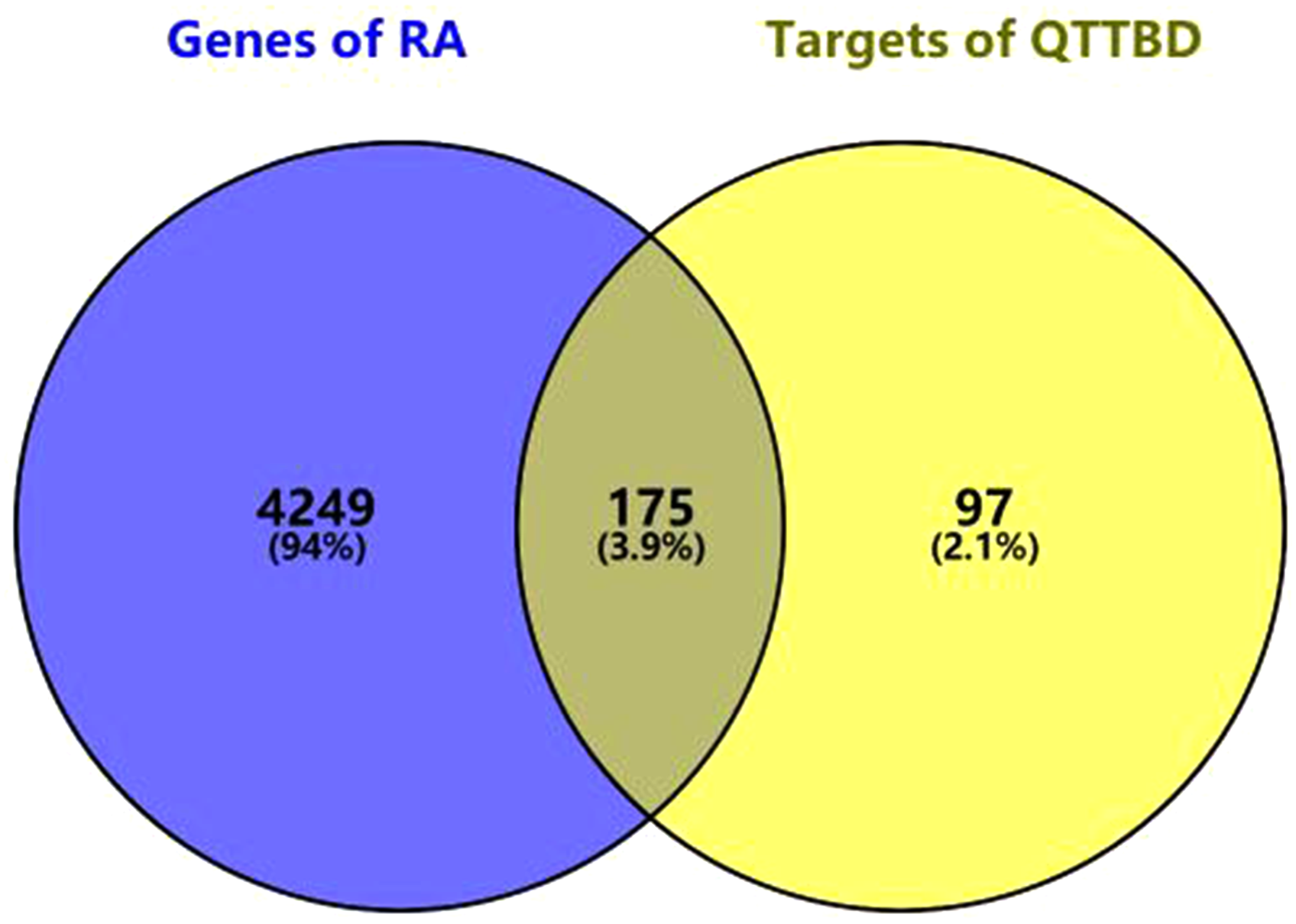
Matching of target genes between RA and QTTBD. Note: Blue is the genetic symbol for RA, yellow is the target for the QTTBD, and the intermediate cross region represents the common gene target of RA and QTTBD.
PPI Network Map of the Potential Targets
To reveal the significance of degree in compound targets, the authors created a PPI network about the relationship of the common targets. The 175 common potential targets of RA and QTTBD were inputted into the STRING database on line for PPI network analysis and visualized by Cytoscape 3.7.1 software (Figure 5a).
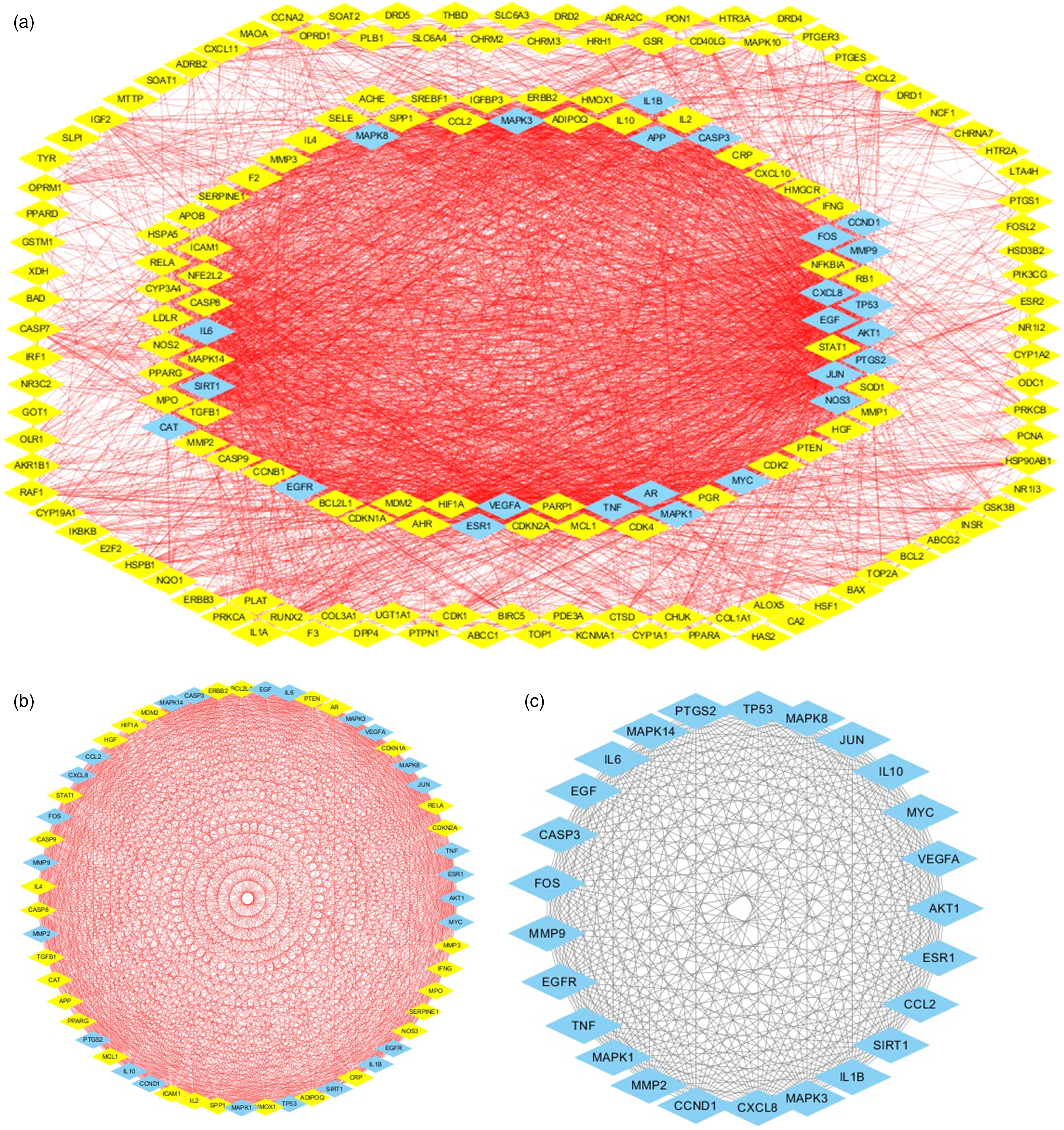
PPI network Map of the potential targets. (a) STRING and Cytoscape PPI network. (b) First topological analysis network. (c) Second topological analysis network. Note: The blue nodes are the core targets, and the yellow nodes the other targets.
As shown in Figure 5a and Table S5, excluding the 2 independent nodes, the PPI network involves a total of 173 nodes (eg, RAC-alpha serine/threonine-protein kinase, IL-6, and cellular tumor antigen p53), including 25 core targets (eg, RAC-alpha serine/threonine-protein kinase, IL-6, transcription factor AP-1 and TNF), and 3625 edges. The mean degree of freedom (DOF) of the nodes was 41.5, and the mean local clustering coefficient was 0.633.
Firstly, under the criteria of DC ≥ 41.9075, BC ≥ 144.6127, and CC ≥ 0.0322, 55 nodes and 1241 edges (Figure 5b) were obtained in the first topological analysis, including 25 cores targets. Next, under the criteria of DC ≥ 80.9100, BC ≥ 349.5881, and CC ≥ 0.00390, a core interaction network was obtained, which consists of 25 core nodes and 298 edges (Figure 5c). In the obtained data, the contribution of a node is positively correlated with its degree. A node with a high degree can be taken as a key target gene for further research. As can be seen from Figure 5c, the top 10 core targets for RA treatment are AKT1 (Degree = 132), IL6 (Degree = 119), TP53 (Degree = 114), VEGFA (Degree = 112), MAPK3 (Degree = 112), TNF (Degree = 109), CASP3 (Degree = 102), JUN (Degree = 101), EGF (Degree = 97), and EGFR (Degree = 96).
GO and KEGG Pathway Enrichment Analysis
To analyze further the functions of the common gene targets between RA and QTTBD, the 175 gene targets were imported into the Database for Annotation, Visualization and Integrated Discovery (DAVID) for GO and KEGG pathway enrichment analysis, using the 3 main indicators of biological process (BP), cellular component (CC), molecular function (MF).
Under the condition of P < .05 and false discovery rate (FDR) <0.01, 515 biological processes were obtained for GO-BP, including, but not limited to, the top 10 execution phase of apoptosis, negative regulation of symbiont growth in host, positive regulation of signaling pathway of vascular endothelial growth factor and its receptor, synaptic transmission-cholinergic, cellular thermal response, positive regulation of phosphatidylinositol 3-kinase signaling, estrogen response, blood pressure regulation, phospholipase C-activating G-protein coupled receptor signaling pathway and ERBB2 signaling pathway.
Besides, there are 50 cellular components for GO-CC, mainly including the top 10 postsynapse, axon, lysosome, neuron projection, apical plasma membrane, nuclear envelope lumen, endoplasmic reticulum lumen, neuronal cell body, perikaryon, nuclear envelope, and other cell sites.
Moreover, there are 89 molecular functions for GO-MF, namely, the top 10 zinc ion binding, cyclin binding, serine-type endopeptidase activity, dopamine neurotransmitter receptor activity-coupled via Gs, arylesterase activity, chemokine activity, transcription regulatory region DNA binding, acetylcholine binding, electron carrier activity, and peptidase activity.
In addition, there are 43 pathways for KEGG, including the top 10 oxytocin signaling pathway, amphetamine addiction, graft-versus-host disease, ovarian steroidogenesis, cGMP-PKG signaling pathway, Rap1 signaling pathway, allograft rejection, cytokine–cytokine receptor interaction, regulation of lipolysis in adipocytes, as well as inflammatory mediator regulation of TRP channels.
In this study, the top 10 goals of GO and the KEGG Pathway were selected for analysis and visualization. The results are shown in Figure 6 and the top 10 significant pathways are listed in Table 1. Judging by the P-value, the action pathways of QTTBD are mainly related to immune inflammation, cell proliferation, and angiogenesis. According to the correlation degree of disease and the order of P-value, the key targets of QTTBD in RA prevention and treatment have different pathways, which play a synergistic therapeutic effect. Combined with the results of network screening, PRKCA, INSR, PRKCB, AKT1, IFNG, IL1B, IL2, MAPK1, MAPK3, PIK3CG, PTGS2, RAF1, TNF, ADRB2, CD40LG, EGFR, FOS, IL10, IL4, IL6, JUN, MAPK14, and NOS3 have relatively high occurrence frequencies. These could be the key targets of QTTBD in RA prevention and treatment of RA, and are worthy of further study.

Top 10 goals of gene ontology (GO) and KEGG pathway enrichment analysis by DAVID database.
Information of the Top 10 Significant Pathways.
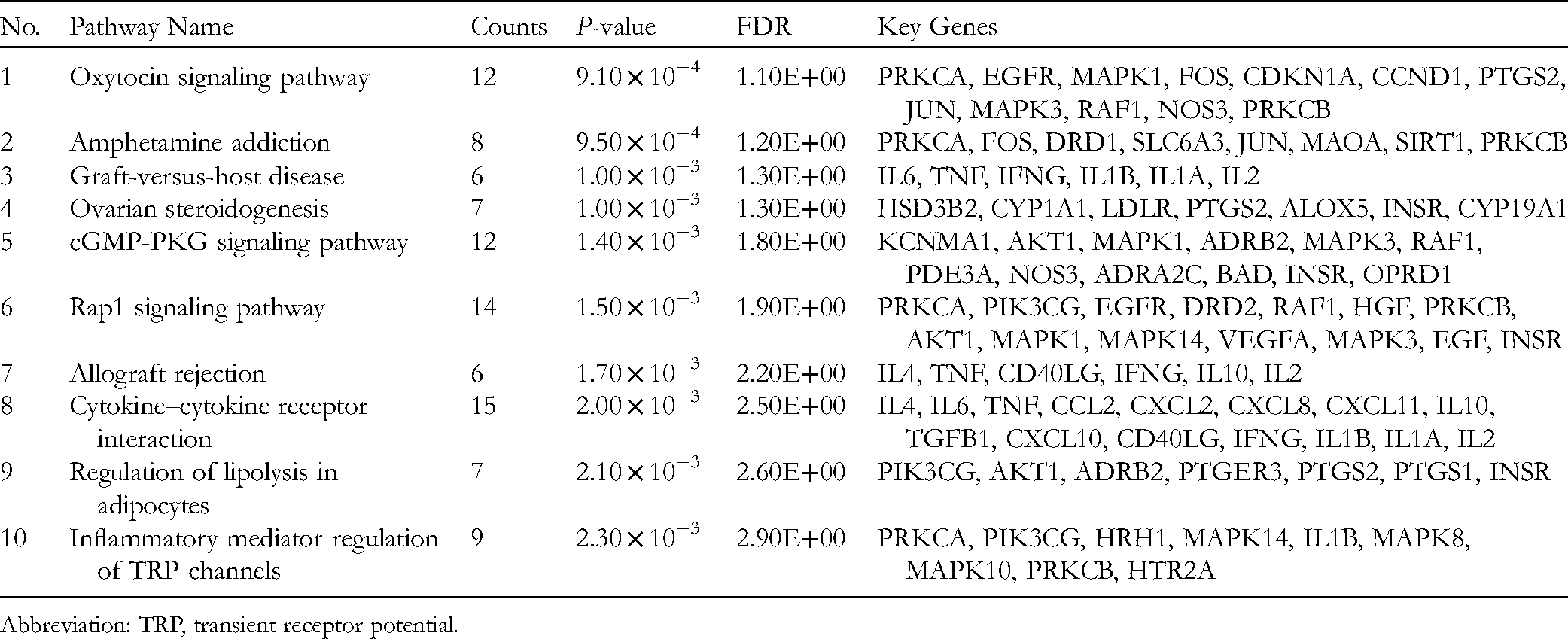
Abbreviation: TRP, transient receptor potential.
Discussion
QTTBD is a traditional clinical formula commonly used in hospitals in Guangxi. The formula plays an important complementary role in the prevention and treatment of RA. However, it is difficult to reveal thoroughly the active components and pharmacological mechanism of the formula in RA treatment, because of the complexity of the TCM components. Network pharmacology provides an excellent tool to overcome the difficulty. Using network pharmacology, a complex network can be established based on the correlations of drug-target-disease, and used to disclose the action mechanism of TCM in the prevention and curing of diseases.
In this study, eleven TCM herbs (QJ, WLX, SFT, QFT, FJ, HQ, YYH, FZ, MH, FL, and GC) were fully investigated. From QTTBD, 188 bioactive components and 272 potential targets were collected, of which 175 targets genes/proteins were involved in the treatment of RA. On this basis, the top 10 key proteins and pathways were identified, indicating that QTTBD most likely exerts its therapeutic effects on RA through interactions between genes of AKT1, IL6, TP53, VEGFA, MAPK3, TNF, CASP3, JUN, EGF, and EGFR through the following pathways: Oxytocin signaling pathway, amphetamine addiction, graft-versus-host disease, ovarian steroidogenesis, cGMP-PKG signaling pathway, Rap1 signaling pathway, allograft rejection, cytokine–cytokine receptor interaction, regulation of lipolysis in adipocytes and inflammatory mediator regulation of TRP channels.
Specifically, AKT1 is related to systemic inflammation and tissue remodeling; the oxytocin signaling pathway is crucial in maintaining innate immunity. 39 IL6 is a key proinflammatory cytokine released by adipocytes in RA progression, and a major player in immune responses, cancer progression and metastasis.40,41 It is speculated as a key target protein in regulating the inflammatory response of RA. Regulating the IL6 level could be an important means to treat RA. 40 The P53 protein has long been thought to be involved in regulating cell growth, and TP53, which shows importance in maintaining immune homeostasis, is generally lowly expressed in autoimmune diseases like RA.42,43 VEGFA is recognized as the most effective pro-angiogenic molecule promoting the angiogenic phenotype of RA, which may be related to its polymorphism and RA susceptibility.44,45 TNF is a key regulatory component of the immune system, and pleiotropic cytokines are implicated in the pathogenesis of RA. It could result in chronic inflammation and tissue damage because of deregulated TNF expression.46,47 According to previous studies, the EGF/EGFR families are critical for the hyperplastic growth of several tissues, and EGFR was confirmed to be predominantly expressed in RA-FLS and RA synovia. The occurrence of RA might be related to the increased mRNA level and protein concentration of VEGF in the synovial membrane of RA. 48
In most cases, the pathogenesis and development of diseases are the results of the interaction between multiple factors. 49 However, diseases are often treated with only one drug or one target, without considering the said interaction. The preparation of Chinese medicinal materials can deal with multiple targets at once, and prevent and treat diseases with holism. Our research demonstrates that network pharmacology can successfully predict the bioactive ingredients and the action mechanism of QTTBD in RA treatment. However, the results are inevitably limited due to variations in databases, screening indices of active ingredients, and analysis tools. Our findings will be further validated through additional experiments.
Conclusion
This study proves that network pharmacology analysis is helpful to elucidate the relationship between the complex active ingredients of TCM and its intervention for RA and other diseases. Network maps were constructed to demonstrate the interactions between bioactive compounds and their corresponding targets in QTTBD and target genes in RA. On this basis, the authors analyzed the targets of QTTBD on RA and the possible molecular mechanism. The results provide a theoretical basis for further research on QTTBD for RA treatment. However, our results require further pharmacological and genetic validations.
Materials and Methods
Establishment of Active Components Database
TCMSP is a unique TCM platform that provides pharmacological information, including OB, Caco-2 permeability (Caco-2), penetration of the blood–brain barrier (BBB), DL, and half-life (HL), as well as the relationship between herbal components, targets, and diseases. 50 Pharmacokinetic information, such as absorption, distribution, metabolism, and excretion (ADME), was often regarded as the key indicator of drug bioavailability. 51
The literature has shown that OB represents the % age of an orally administered fixed dose of drug that boosts systemic circulation, revealing the convergence of the ADME process. A high OB usually determines the drug-like property of bioactive molecules as therapeutic agents. 52 DL is a concept in drug design that quantifies the similarity of a prospective compound to a drug. This concept helps to optimize pharmacokinetic and pharmaceutical properties, eg, solubility and chemical stability. In traditional Chinese herbs, the compounds with a DL of 0.18% are considered as drug-like compounds. 53 In this study, the screening criteria for compounds were set as OB ≥ 30% and DL ≥ 0.18%.
In addition to SFT, the candidate bioactive chemical components of other herbs in QTTBD were retrieved from the TCMSP database under the above screening criteria,54,55 and their potential targets were retrieved. Being an ethnic medicine to Guangxi, SFT is not included in any Chinese medicinal materials. Hence, its bioactive chemical compositions were queried via the China National Knowledge Infrastructure (CNKI),56-59 using the same screening criteria.
Target Prediction of Bioactive Chemical Compounds
The information about candidate potential genes/proteins targets of QTTBD was retrieved and screened from the TCMSP database, and normalized to uniform generic names in reference to the UniProt database (https://www.uniprot.org/) 60 and GeneCards database (https://www.genecards.org/). 61 All the components and their objective targets were visualized for analysis on Cytoscape 3.7.1.
Mapping of CTGP Network
The CTGP network was plotted on Cytoscape 3.7.1 to investigate their relationship. In the network map, the bioactive ingredients and targets genes/proteins are represented as nodes, and the links between them as edges.
Collection of Disease-Targets Information
The information about disease targets was collected from PharmGKB database (https://www.pharmgkb.org/), 62 OMIM database (https://omim.org/), 63 and GeneCards database, using the keyword “rheumatoid arthritis.” The common targets between RA and QTTBD were screened with Venny 2.1 (https://bioinfogp.cnb.csic.es/tools/venny/). 64
Mapping of the PPI Network
The PPI network of compound-disease common genetic targets was plotted using the STRING database (https://string-db.org/), 65 a platform recording the interrelationships of almost all known proteins. The species was set as “Homo sapiens.” The results were imported into Cytoscape 3.7.1 for drawing the map, and analyzed with the main reference indicators of degree centrality (DC), betweenness centrality (BC), and closeness centrality (CC).66,67
GO and KEGG Pathway Enrichment Analysis
The BP, CC, MF, and KEGG pathway enrichment were analyzed using DAVID (https://david.ncifcrf.gov/). 68 The GO function of the screened common gene targets was annotated and analyzed on Cytoscape 3.7.1, and the results with a P-value <.05 were retained and visualized for further analysis.
Supplemental Material
sj-doc-1-npx-10.1177_1934578X211041421 - Supplemental material for Analysis of the Composition and Anti-Rheumatoid Arthritis Mechanism of Qintengtongbi Decoction Based on Network Pharmacology
Supplemental material, sj-doc-1-npx-10.1177_1934578X211041421 for Analysis of the Composition and Anti-Rheumatoid Arthritis Mechanism of Qintengtongbi Decoction Based on Network Pharmacology by Guo-Cheng Liang, Wen-Gui Duan, Shu-Yin Chen and Jian-Kang Fang in Natural Product Communications
Supplemental Material
sj-xls-2-npx-10.1177_1934578X211041421 - Supplemental material for Analysis of the Composition and Anti-Rheumatoid Arthritis Mechanism of Qintengtongbi Decoction Based on Network Pharmacology
Supplemental material, sj-xls-2-npx-10.1177_1934578X211041421 for Analysis of the Composition and Anti-Rheumatoid Arthritis Mechanism of Qintengtongbi Decoction Based on Network Pharmacology by Guo-Cheng Liang, Wen-Gui Duan, Shu-Yin Chen and Jian-Kang Fang in Natural Product Communications
Supplemental Material
sj-csv-3-npx-10.1177_1934578X211041421 - Supplemental material for Analysis of the Composition and Anti-Rheumatoid Arthritis Mechanism of Qintengtongbi Decoction Based on Network Pharmacology
Supplemental material, sj-csv-3-npx-10.1177_1934578X211041421 for Analysis of the Composition and Anti-Rheumatoid Arthritis Mechanism of Qintengtongbi Decoction Based on Network Pharmacology by Guo-Cheng Liang, Wen-Gui Duan, Shu-Yin Chen and Jian-Kang Fang in Natural Product Communications
Supplemental Material
sj-xls-4-npx-10.1177_1934578X211041421 - Supplemental material for Analysis of the Composition and Anti-Rheumatoid Arthritis Mechanism of Qintengtongbi Decoction Based on Network Pharmacology
Supplemental material, sj-xls-4-npx-10.1177_1934578X211041421 for Analysis of the Composition and Anti-Rheumatoid Arthritis Mechanism of Qintengtongbi Decoction Based on Network Pharmacology by Guo-Cheng Liang, Wen-Gui Duan, Shu-Yin Chen and Jian-Kang Fang in Natural Product Communications
Supplemental Material
sj-csv-5-npx-10.1177_1934578X211041421 - Supplemental material for Analysis of the Composition and Anti-Rheumatoid Arthritis Mechanism of Qintengtongbi Decoction Based on Network Pharmacology
Supplemental material, sj-csv-5-npx-10.1177_1934578X211041421 for Analysis of the Composition and Anti-Rheumatoid Arthritis Mechanism of Qintengtongbi Decoction Based on Network Pharmacology by Guo-Cheng Liang, Wen-Gui Duan, Shu-Yin Chen and Jian-Kang Fang in Natural Product Communications
Footnotes
Statement of Human and Animal Rights
This article does not contain any studies with human or animal subjects.
Statement of Informed Consent
There are no human subjects in this article.
Declaration of Conflicting Interests
The author(s) declared no potential conflicts of interest with respect to the research, authorship, and/or publication of this article.
Funding
The author(s) disclosed receipt of the following financial support for the research, authorship, and/or publication of this article: This work is supported by the Basic Ability Improvement Project of Young and Middle-Aged College Teachers, Department of Education, Guangxi Zhuang Autonomous Region, China (Grant No.: 2017KY0290, 2021KY0322, and 2021KY0286).
Trial Registration
Not applicable, because this article does not contain any clinical trials.
Ethical Approval
Not applicable.

Supplemental Material
Supplemental material for this article is available online.
References
Supplementary Material
Please find the following supplemental material available below.
For Open Access articles published under a Creative Commons License, all supplemental material carries the same license as the article it is associated with.
For non-Open Access articles published, all supplemental material carries a non-exclusive license, and permission requests for re-use of supplemental material or any part of supplemental material shall be sent directly to the copyright owner as specified in the copyright notice associated with the article.
