



Abstract
The objective of our present study is to scrutinize the analgesic and anti-inflammatory potentials of essential oil of Eucalyptus camaldulensis leaf using different in vivo assay models at doses of 100, 200, and 400 mg/kg body weight. Twenty chemical compounds, which were isolated from the leaves essential oil of E. camaldulensis, were docked using AutodockVina against cyclooxygenase 2, tumor necrosis factor-α, and interleukin-1β convertase to elucidate the analgesic and anti-inflammatory activity. The essential oil of E. camaldulensis exhibited noteworthy analgesic activities in the writhing test. In the tail immersion and hot-plate test, the essential oil significantly extended the latency period. The number of licks in the formalin-induced paw licking test was markedly reduced following essential oil administration. In addition, E. camaldulensis essential oil revealed notable anti-inflammatory responses in carrageenan-induced paw edema, xylene induced ear edema and cotton pellet induced granuloma methods. Among 20 compounds, 5 (cis-sabinol, globulol, α-eudesmol, β-eudesmol, and γ-eudesmol) showed better binding for cyclooxygenase-2 while β-eudesmol exhibited higher affinity for TNFα than that of TNF-alpha-IN-1 and standard drug. In the case of interleukin 1β convertase, maximum affinity was shown by α-eudesmol than the synthetic drug belnacasan. Chemical components of the essential oil interacted with diverse amino acid residues which were similar to the natural substrate and standard drugs. In conclusion, E. camaldulensis essential oil can be an effective source of analgesic and anti-inflammatory treatment and additional modification and docking studies will be required to justify the efficiency of globulol, α-eudesmol, β-eudesmol, and γ-eudesmol.
Inflammation is a protective biological response to a variety of stimuli and local injury for restoring the normal tissue assembly and function. 1 The acute inflammatory process is advantageous and comprises a series of cellular responses such as the release of the inflammatory mediators and the generation of reactive oxygen species (ROS). However, excess inflammatory mediators and toxic ROS in persistent inflammation induce a chronic inflammation which can lead to numerous fatal diseases such as cancer, diabetes, atherosclerosis, rheumatoid arthritis, neurological diseases and aging. 2 Although non-steroidal anti-inflammatory drugs (NSAIDs) are commonly used for treating inflammation they may result in gastric injury, ulceration and renal damage. 3 Similarly, potent analgesic opioids are frequently associated with addiction and dependence. 4 Therefore, preference for herbal medicines is growing day by day in the treatment of pain disorders and inflammation. 5
With the advancement of computer technology, in silico approaches have been commonly applied in efforts to illuminate the pharmacological basis of the purposes of traditional therapeutic plants. 6 Virtual screening and molecular docking study help us to predict the mechanism of action of chemical compounds of relevant medicinal plants. Based on in silico results, we can execute in vivo and in vitro biological tests for corroboration. Therefore, computer-aided docking techniques will greatly increase the efficiency of evaluating the biochemical activities of medicinal plants. 7
Eucalyptus camaldulensis Dehnh., one of the major fast-growing exotics in Bangladesh, is a tree of the family Myrtaceae. 8 The plants of the Myrtaceae possess essential oils that have different biological activities including antimicrobial, antifungal, cytotoxic and anti-inflammatory effects. The oils were used conventionally for the treatment of colds, influenza, cystitis, diabetes, gastritis, kidney disease, laryngitis. Nowadays, essential oils are also usually used in current cosmeceuticals, food additives, and pharmaceutical industries. 9 Different types of chemical compounds such as p-cymene, 1,8-cineole, β-pinene, thymol, α-terpinol, carvacrol, limonene, α- phellandrene, linalool, and terpinolene have been identified from the leaves essential oil of E. camaldulensis, 10,11 which possessed an inhibitory effect on inflammation in rats. They inhibit cyclooxygenase (COX) enzyme and pro-inflammatory cytokines, for example tumor necrosis factor-α (TNFα), interleukins (IL-1β, IL-6) and nuclear factor kappa-light-chain-enhancer of activated B cells (NF-κB). 12 -14 To clarify analgesic and anti-inflammatory activity we aimed to evaluate in vivo activity and in silico molecular docking analysis that give potent candidature.
Materials and Methods
Drugs, Chemicals, and Apparatus
Methanol was bought from SIGMA (Sigma-Aldrich, St. Louis, USA). Pentazocine and Diclofenac Na were obtained from Beximco Pharmaceuticals Ltd., Bangladesh. Heparin inj. was purchased from Rotexmedica, Germany. All the chemicals and reagents were of analytical grade.
Collection of Plant Material
Leaves of E. camaldulensis were collected from the local area of Savar and authenticated by an expert taxonomist of the National Herbarium of Bangladesh. A voucher specimen (Acc. No. 46863) was deposited in the herbarium for future reference.
Extraction of Essential Oil
The essential oil was obtained by hydro-distillation using a modified Clevenger apparatus coupled to a 2-L round bottom flask. A total of 1000 g of fresh plant material and 5 L of water were used for the extraction. Extraction process was performed in the Laboratory of Natural Product Research at Jahangirnagar University. The extraction was performed over an 8 hours period. The oil was transferred to black-colored vials, wrapped in parafilm and aluminum foil and stored at 4 °C until analysis. The yield (57 g) of the oil was calculated on the basis of the dry mass.
Animals and Experimental Setup
Sprague-Dawley female rats of 140‐160 g and Swiss albino female mice of 25‐30 g were obtained from Pharmacology Laboratory, Department of Pharmacy, Jahangirnagar University, and were acclimatized to normal laboratory conditions for 1 week prior to the study and were supplied with a pellet diet and water ad libitum. The temperature of the facility was 25 ± 3 °C and light/darkness alternated 12 hours apart. The animals were divided into 5 groups of 5 animals each. The study was conducted following the approval by the Institutional Animal Ethical Committee of Jahangirnagar University, Savar, Dhaka, Bangladesh [Approval Number: BBEC, JU/M 2018 (1)3].
Acute Toxicity Study
The acute oral toxicity test was performed following the guidelines of the Organization for Economic Cooperation and Development (OECD) for testing of chemicals, (Test Guideline 425) with some minor modifications (OECD 2008). Swiss albino male mice (25, 30 g) (n = 20) were divided into 4 groups with 5 animals each. Four different doses (100, 200, 400, and 800 mg/kg) of essential oil of E. camaldulensis were administered to each group via a stomach tube. Then, all the treated animals were observed for mortality and clinical signs of toxicity (ie, general behavior, respiratory pattern, cardiovascular signs, motor activities, reflexes and changes in skin and fur texture) following 1, 2, 3 and 4 hours of post-administration on the first day but only once daily for the next 3 days following administration of the extract. 15
Evaluation of Anti–Nociceptive Activity
Acetic acid induced writhing method
The method according to Hossain et al. was employed for this test. 16 Five groups (each group having six mice) were pretreated with water, diclofenacNa (100 mg/kg) and the extract (100, 200 and 400 mg/kg). Forty-five minutes later each mouse was injected i.p. with 0.7% acetic acid at a dose of 10 mL/kg body weight. After 15 minutes of i.p. administration of acetic acid, subsequent 5 minutes period and the number of writhing responses was recorded for each animal. The mean abdominal writhing for each group was obtained. The percentage inhibition of writhing was calculated using the following formula:

Tail immersion test
The tail immersion method is widely used for the evaluation of analgesic activity (a central mechanism). In this method, the pain is induced to the animal by thermal stimulus and it is done by dipping the end of the tail into hot water. 17 In this test, we use 30 mice, which were fasted for 16 hours with water ad libitum, divided into 5 different groups and each group consisted of 6 mice. The control group was only treated with water. The standard group was treated with pentazocine (10 mg/kg) a known analgesic available in the market place. The other 3 groups were treated with different extract active concentrations of E. camaldulensis 100, 200, and 400 mg/kg respectively. All the dosages were administered to mice through the oral route. The mice were held in a suitable restrainer with the tail extending out. The last 2 or 3 cm of the mouse tail was marked previously and immersed in the thermostatically controlled water bath which was ranged to 57° ± 2 °C. The exposure time of the tail into the hot water was noted as the reaction time or tail-flick latency. The maximum cutoff time was twenty seconds because it does not produce any injury. The initial reading was taken before the administration of the test and standard drugs. Four consecutive readings such as 1, 2, 3, and 4 hours were taken just after the administration of teat and standard drugs. After the administration of drug, the flick latency difference or mean an increase in latency indicates the analgesia produced by test and standard drugs.
Hot–plate test
In the hot-plate test, the mice are screened on the basis of their response when they are subjected to hot-plate. In this test, the test groups and the control group are treated as described previously at the proper dose. Here in this test the positive control received tramadol (5 mg/kg, i.p.). The pain is induced to the animals by placing the animals on hot-plate and temperature is maintained within 55 ± 0.5 °C range. 18 The response to a pain stimulus is indicated by paw licking or jumping off the plate. The response time is recorded for each group at 0, 30, 60, 120, and 180 minutes throughout the observation period. To avoid any accidental paw damage, the cut-off point of 15 s was considered. The reaction time of the test drug was compared with the control group.
Formalin-induced hind paw licking in mice
This experiment was followed by a similar procedure that was previously described by Mondal et al. 19 In the first phase, the animals were analyzed by formalin-induced licking. A subcutaneously injected 20 µL of 2.5% formalin solution (0.9% formaldehyde) made in phosphate buffer solution (PBS concentration: NaCl 137 mM, KCl 2.7 mM, and phosphate buffer 10 mM) under the surface of the right hind paw introduced to the animals. The time that the animals take licking the injected paw is considered as induction of pain. The initial nociceptive response normally peaks 5 minutes after the injection and later on 15‐30 minutes after formalin injection, representing the neurologic and the inflammatory pain response, respectively. All the mice were fasted for 24 hours before the introduction of the treatment but were allowed to access to water. A randomized 5 groups of mice, each containing 6 mice were used in this experiment. The control group received 10 mL/kg of normal saline, the standard group received diclofenac Na (100 mg/kg body weight) and the other 3 groups received 100, 200, and 400 mg/kg doses of the extract. The responses were recorded 5 minutes after (first phase) and 15‐30 after formalin injection (second phase).
Evaluation of Anti–Inflammatory Activity
Xylene induced ear edema test
Xylene-induced ear edema test was performed as it was described by Ramproshad et al. with a simple modification. 20 The positive control mice group received diclofenac Na (100 mg/kg) orally and other groups received plant extract of different (100, 200, and 400 mg/kg) concentrations. After 1 hour, each of the animals received 20 µL of xylene on the anterior and posterior surface of the right ear lobe. Here, in this case, the left ear was considered as control. The mice were sacrificed 1 hour after xylene application. After sacrificing the mice, a circular section was collected using a cork borer (which had a diameter of 3 mm) and the mass obtained using an electronic balance. The weight of edema was considered as the difference between the weight of ear treated with xylene (right ear) and weight of ear without xylene treatment (left ear). The percent inhibition can be calculated by from the following equation:

Cotton-pellet-induced granuloma model in rats
For this test, we divided the rats into 5 different groups and each of the groups having 6 rats. Inflammation was induced by the method described by Mondal et al. with a simple modification. 19 Here we used ketamine (50 mg/kg) to anesthetize the animals. The back skin was shaved and an incision was made at the lumber position followed by disinfecting with 70% ethanol. Sterilized and blunted forceps were used to make a subcutaneous tunnel and a pre-weighed cotton pellet (20 ± 1 mg) was placed at both sides in the scapular region. The control group was treated with water while the standard group was treated with diclofenac Na (100 mg/kg). The remaining 3 groups were treated with 100, 200, and 400 mg/kg of the plant extract respectively for 7 days. On the eighth day, the animals were sacrificed and the cotton pellets were removed from the back. These cotton pellets were then dried in the oven at 60 °C until the weight became stable. The net dry weight (initial- final) of the cotton pellets were determined by the following formulas:


Carrageenan-induced paw edema in rats
In this test, the acute inflammation was produced by injecting a 1% solution of carrageenan into the plantar surface of the left hind paw at a dose of 0.1 µL/gm body weight which was previously described method by Mondal et al. 19 with a simple modification. Here in this test, we used 5 groups of rats and each of the groups having 6 rats. 21 The control group received only the vehicle while the standard group received diclofenac Na (100 mg/kg, p.o.). The other 3 groups of rats were treated with different extractive concentrations of plant extract such as 100, 200 and 400 mg/kg, p.o., respectively. Thirty minutes after the administration all the 5 groups of rats were treated with a carrageenan solution. The paw volume was measured by dipping the foot into the mercury bath up to the anatomical hairline on lateral malleolus which was then compared with the control group which was treated only with a vehicle. The paw volume was measured by the digital plethysmometer (PLM 01, Orchid scientific, and Mumbai, India) which works on the principle of mercury displacement. The measurement was done as soon as possible before 1st, 2nd, 3rd, 4th, and 5th hour following carrageenan injection. The following formula was used to calculate edema inhibitory activity:

Evaluation of in-Silico Analgesic and Anti–Inflammatory Activity
In silico molecular docking analysis of the leaf essential oil of E. camaldulensis, which contains 21 essential oil constituents such as 1,8-cineole (PubChem CID: 2758), L-borneol (PubChem CID: 1201518), carvacrol (PubChem CID: 10364), cis-sabinol (PubChem CID: 12315160), globulol (PubChem CID: 101716), limonene (PubChem CID: 441245), linalool (PubChem CID: 6549), o-cymene (PubChem CID: 10703), p-cymene (PubChem CID: 7463), piperitone (PubChem CID: 6987), terpinen-4-ol (PubChem CID: 11230), terpinolene (PubChem CID: 11463), thymol (PubChem CID: 6989), α-eudesmol (PubChem CID: 12309818), α-phellandrene (PubChem CID: 7460), α-pinene (PubChem CID: 6654), α-terpinene (PubChem CID: 7462), α-terpineol (PubChem CID: 17100), β-eudesmol (PubChem CID: 91457), γ-eudesmol (PubChem CID: 6432005), and γ-terpinene (PubChem CID: 7461), 10,11 against human COX 2, TNF α and IL1 β proteins, which are the inducible proteins in the human body contributing to inflammatory pain. By using the online RCSB protein data bank, the crystal structures of proteins of interest were collected and the sources of protein groups were collected from Swiss Target Prediction online database. The proteins COX 2 (PDB ID: 5F1A), TNF α (PDB ID: 2AZ5), and IL1 β (PDB ID: 1BMQ) (Figure 1) have been selected from the search of the best-suited protein targets. Co-crystallized ligands and water molecules were removed from the structures using PYMOL (version 1.7.4.5) as only the chain taken from the crystallographic structure of the protein was used in this study. In Swiss PDB viewer v 4.1.0, the void atomic spaces and crystallographic disturbances corrected through energy minimization and all the optimized and minimized protein structures saved in “pdb” format. By utilizing the PubChem online database, the two (2D) dimensional structures and SMILES of essential oil components were obtained. The optimum conformational structures were accomplished by the geometrical optimizations of these ligands (Figure 2) which were saved as “sdf” format. Furthermore, by the utilization of Gaussian view 09 and Chem3DPro12.0 program packages the 2D structure of compounds converted to 3D structure and the structure was saved in “sdf” file. Finally, the “sdf” format was converted to “pdb” format by using PYMOL (version 1.7.4.5) software. All the selected ligands were prepared using Autodock tools and the appropriate binding orientations, and conformations of the ligands with the targeted protein were predicted by in silico molecular docking and by using AutoDockVina in PyRx platform, the preferred orientations of ligand that have maximum binding affinities for the active sites of proteins associated with structural pockets and cavities were calculated in this study. The binding of compounds with the specific amino acid residues was visualized in BIOVIA Discovery studio visualizer v 16.1.0.15350 after molecular docking and different non-bonded interactions including hydrogen bonds, hydrophobic bonds (alkyl-alkyl, pi-pi, pi-alkyl, pi-staked) with specific bond distance were also obtained. 22
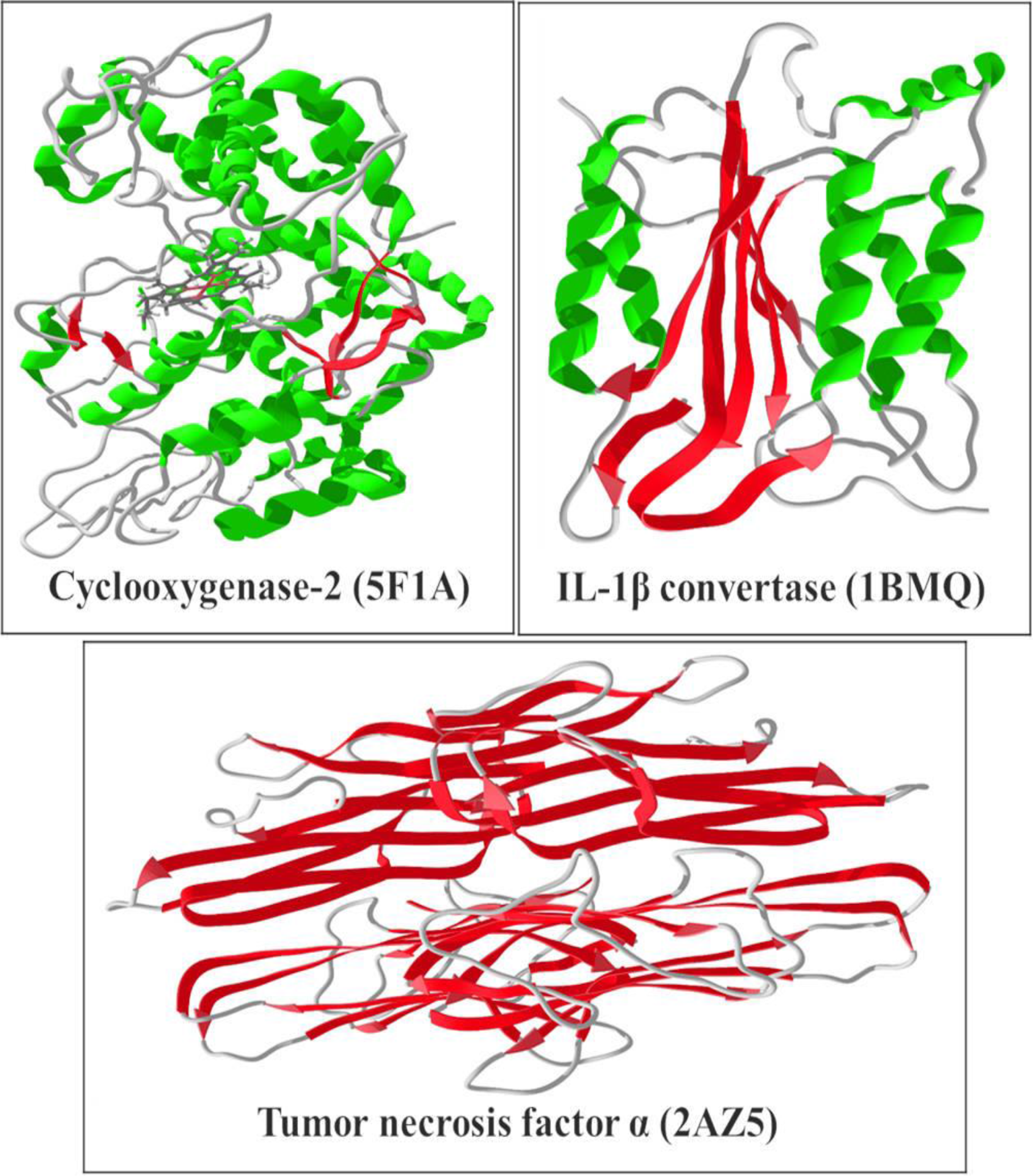
Ribbon structures of the proteins prior to docking.
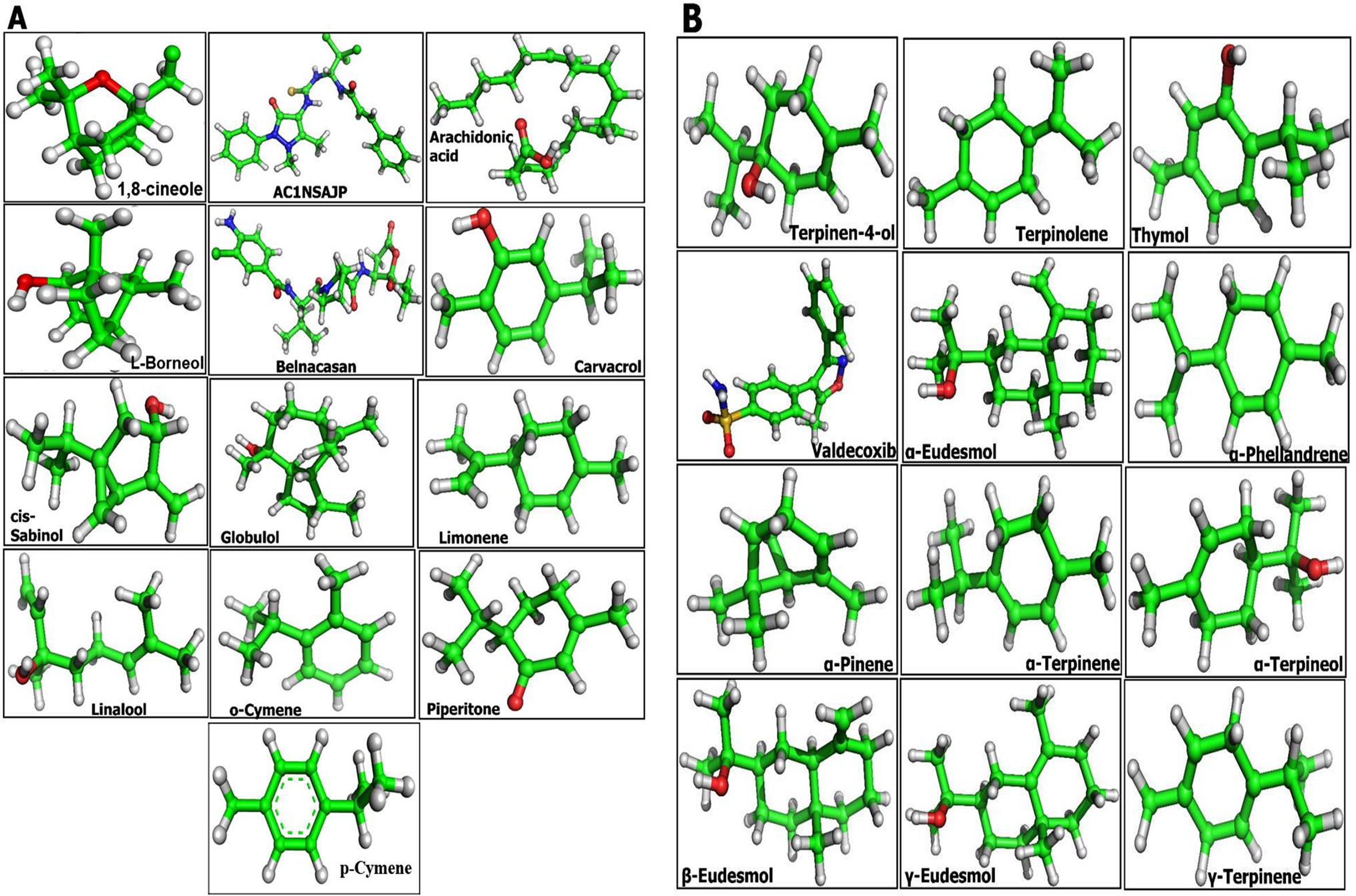
3D structures of Compounds.
Results
Acute Toxicity Study
Oral administration of the highest dose (800 mg/kg) of the leaf essential oil of E. camaldulensis did not lead to any mortality in the animals. There were also no signs of restlessness, respiratory distress, general irritation, coma, or convulsion. Thus, this extract is considered to be non-toxic and is considered safe for animal testing.
Evaluation of Anti-Nociceptive Activity
Acetic acid-induced writhing test
Table 1 shows the dose-dependent effect of E. camaldulensis leaf essential oil on acetic acid-induced writhing in mice. The 2 doses (200 and 400 mg/kg body weight) of the extract produced significant 29.40% and 55.60% writhing inhibition in test animals, respectively. The standard drug diclofenac Na showed 75.20% inhibition of writhing.
Antinociceptive Effect of Essential Oil of Eucalyptus camaldulensis Leaves in the Acetic Acid-Induced Writhing Test.

Values are presented as mean ± SEM (n = 6). One-way ANOVA followed by Dunnett’s multiple comparisons was performed to analyze this dataset. *P < 0.05 and **P < 0.01 were considered statistically significant when compared against control.
Tail immersion test
Table 2 indicates that the essential oil of E. camaldulensis had a significant dose-dependent effect on the latency of tail withdrawal reflex from hot water. The dose of 200 mg/kg produced a significant increase in latency time at 1st, 3rd, and 4th hour. Moreover, the dose of 400 mg/kg had a highly significant increase (P < 0.01) in latency time compared with the control group at all the time frames.
Antinociceptive Effect of Essential Oil of Eucalyptus camaldulensis Leaves on Tail Withdrawal Reflux Time (S) of Mice Induced by Tail Immersion Method.

Values are presented as mean ± SEM (n = 6). One-way ANOVA followed by Dunnett’s multiple comparisons was performed to analyze this dataset. *P < 0.05 and **P < 0.01 were considered statistically significant when compared against control.
Hot–plate test
Table 3 demonstrates the anti-nociceptive activity of the essential oil of E. camaldulensis leaves on the basis of the reaction time of mice in the hot plate test. The maximum latency time (14.48 ± 0.99 s) was shown by 400 mg/kg after +120 minutes of the administered extract, which is highly significant when compared with the control group. However, the standard tramadol showed the highest activity.
Anti-Nociceptive Activity of Essential Oil of Eucalyptus camaldulensis Leaves on the Reaction Time (S) of Mice in the Hot Plate Test.

Values are presented as mean ± SEM (n = 6). One-way ANOVA followed by Dunnett’s multiple comparisons was performed to analyze this dataset. *P < 0.05 and **P < 0.01 were considered statistically significant when compared against control.
Formalin-induced hind paw licking in mice
Table 4 shows that the anti-nociceptive effects of E. camaldulensis leaf essential oil where pain was induced by formalin in the animal model. The formalin was injected through the intra-plantar route resulted in a biphasic (first and second phase) characteristic repercussion. The result demonstrated that during the early phase, a significant retrenchment in the licking time (P < 0.05) after formalin administration (neurogenic) had occurred. The inhibition of paw licking was 11.69, 20.16%, and 44.50% with 100, 200 and 400 mg/kg of extract respectively. On the other hand, in the late phase, the inhibition of paw licking was 12.56, 21.74%, and 43.96% with 3 doses, which is also significant.
Effect of Essential Oil of Eucalyptus camaldulensis Leaves on the Reaction Time of Mice in the Formalin Test.

Values are presented as mean ± SEM (n = 6). One-way ANOVA followed by Dunnett’s multiple comparisons was performed to analyze this dataset. *P < 0.05 and **P < 0.01 were considered statistically significant when compared against control.
Evaluation of Anti–Inflammatory Activity
Xylene-induced ear edema test
The following Table 5 presents the effects of E. camaldulensis essential oil with different doses of concentration in xylene-induced ear edema model. The 400 mg/kg dose of this extract showed highly significant (P < 0.01) reduction of ear edema with maximum 67.75% inhibition while 200 mg/kg dose of the extract significantly reduce (P < 0.05) ear edema with inhibition 45.31%. Standard diclofenac Na was found to show the highest inhibition of 83.67%.
Effect of Essential Oil of Eucalyptus camaldulensis Leaves in Xylene-Induced Ear Edema Test.
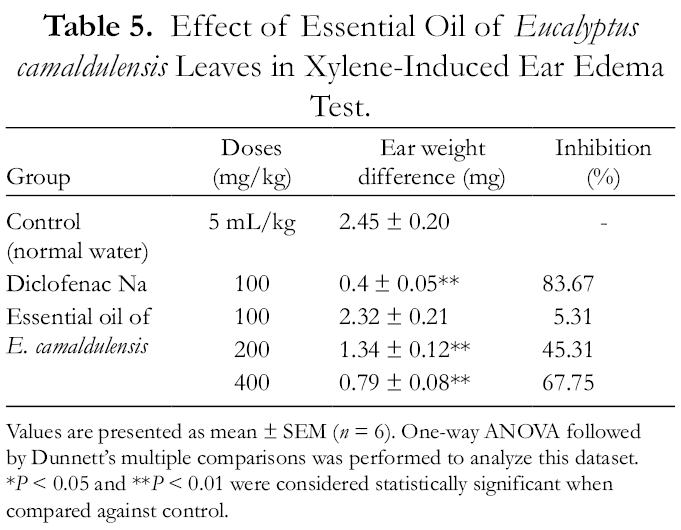
Values are presented as mean ± SEM (n = 6). One-way ANOVA followed by Dunnett’s multiple comparisons was performed to analyze this dataset. *P < 0.05 and **P < 0.01 were considered statistically significant when compared against control.
Cotton-pellet-induced granuloma model in rats
The following table (Table 6) demonstrates the inhibition of granuloma formation by the leaf essential oil of E. camaldulensis. The 400 mg/kg dose showed the highest % of inhibition in wet and dry content granuloma 48.15% and 59.77%, respectively. Both the 200- and 400 mg/kg doses showed a significant reduction (P < 0.05) of wet and dry content granuloma, while the standard drug diclofenac Na showed 60.49% and 66.38% in a wet and dry content granuloma, respectively.
Chronic Anti-Inflammatory Activity of Essential Oil of Eucalyptus camaldulensis Leaves on Cotton Pellet-Induced Granuloma Model in Rats.

Values are presented as mean ± SEM (n = 6). One-way ANOVA followed by Dunnett’s multiple comparisons was performed to analyze this dataset. *P < 0.05 and **P < 0.01 were considered statistically significant when compared against control.
Carrageenan-induced paw edema in rats
Anti-inflammatory activity of the essential oil of E. camaldulensis leaves was measured by the paw edema method induced by carrageenan is shown in Tables 7 and 8. At the dose 200 and 400 mg/kg in 1st, 2nd, 3rd, and 4th hour, paw edema was significantly inhibited after the carrageenan application compared to the control group. The results are shown in Table 7. Diclofenac Na 100 mg/kg (standard) also inhibited paw edema significantly in 1st, 2nd, 3rd, and 4th hour after carrageenan administration.
Effects of Essential Oil of Eucalyptus camaldulensis Leaves on Carrageenan-Induced Paw Edema in Rats.

Values are presented as mean ± SEM (n = 6). One-way ANOVA followed by Dunnett’s multiple comparisons was performed to analyze this dataset. *P < 0.05 and **P < 0.01 were considered statistically significant when compared against control.
Rate of Inhibition of Rat Paw Edema (%).

Table 8 presents the rate of inhibition of edema. The highest rate of edema inhibition was 89.50% by diclofenac Na 100 mg/kg. On the other hand, 400 mg/kg dose of E. camaldulensis essential oil showed the highest 79.23% inhibition among the other dose concentrations.
Evaluation of in-Silico Anti–Inflammatory Activity
Interaction and binding affinity of compounds with COX 2 (5F1A)
We used valdecoxib (PubChem CID: 119607), arachidonic acid (PubChem CID: 444899) and 21 major chemical constituents of the essential oil of E. camaldulensis (1,8-cineole, L-borneol, carvacrol, cis-sabinol, globulol, limonene, linalool, o-cymene, p-cymene, piperitone, terpinen-4-ol, terpinolene, thymol, α-eudesmol, α-phellandrene, α-pinene, α-terpinene, α-terpineol, β-eudesmol, γ-eudesmol, and γ-terpinene) for studying interactions and binding affinities of protein ligands. The results of the docking analysis are listed in Table 9. Valdecoxib was used as a standard drug and arachidonic acid was used as a standard natural substrate. Among twenty ligands, cis-sabinol, globulol, α-eudesmol, β-eudesmol, and γ-eudesmol (–7.7, –7.7, –7.5, –7.3, and −7.7 kcal/mol) showed closely related affinity to valdecoxib (−8.8 kcal/mol) and higher affinity than that of arachidonic acid (−6.9 kcal/mol) for COX-2 (Table 9). The valdecoxib binding pocket was identified with the following amino acid residues: HIS386, ASN382, HIS207, HIS386, ALA202, LEU391, and GLN203 and the arachidonic acid-binding pocket was identified with the following amino acid residues: ASN382, HIS386, VAL295, LEU391, PHE395, and TYR404 (Table 10).
Comparative Affinity Scores of Ligands Against Diverse Inflammatory Receptors.

aRepresents positive controls as a standard drug.
bRepresents positive controls as a standard natural substrate.
Interacting Residues of Diverse Inflammatory Receptors Against Various Ligands of Eucalyptus camaldulensis.

aRepresents positive controls as a standard drug.
bRepresents positive controls as a standard natural substrate. HBR represents hydrogen bonding residues. π-Int represents hydrophobic interactions. Red-colored texts indicate amino acid residues involved in the binding of standard drugs. Green-colored texts indicate amino acid residues involved in the binding of standard natural substrates. Blue-colored texts indicate amino acid residues involved in the binding of both standard drugs and standard natural substrates. Here, we only include the hydrogen bond and hydrophobic bond.
Interaction and binding affinity of compounds with TNFα (2AZ5)
Here, the binding affinities of tested compounds with TNFα (2AZ5) are displayed in Table 9. Standard drug 6, 7-dimethyl-3-((methyl-(2-(methyl-((1-(3-(trifluoromethyl) phenyl)indol-3-yl) methyl) amino) ethyl) amino) methyl)chromen-4-one (AC1NS1JP) (PubChem CID: 5331194) showed binding affinity (−6.8 kcal/mol) where TNF-alpha-IN-1(PubChem CID: 10270102) as standard natural substrate exhibited 6.4 kcal/mol affinity. β-Eudesmol (−6.8 kcal/mol), out of twenty compounds, showed a higher affinity for TNFα than that of TNF and AC1NSAJP. Additionally, γ-eudesmol (−6.5 kcal/mol) exceeded TNF in the case of binding affinity. The AC1NSAJP binding pocket was identified with the following amino acid residues: GLN61, TYR119, PRO117, TYR119, TYR115, and LEU63. However, TNF targets Tyr59 and Tyr151 of TNFα by forming π interactions, which were similar for β-eudesmol, γ-eudesmol, α-phellandrene, and terpinolene (Table 10).
Interaction and binding affinity of compounds with interleukin 1β convertase (1BMQ)
Here, we applied Belnacasan (L-Prolinamide, N-(4-amino-3-chlorobenzoyl)−3-methyl-L-valyl-N-[(2R,3S)−2-ethoxytetrahydro-5-oxo-3-furanyl]-Belnacasan) (PubChem CID: 11398092) as a standard drug for comparing the binding affinity of all the compounds of E. camaldulensis essential oil with interleukin 1β convertase (1BMQ) (Table 9). Maximum affinity was revealed by α-eudesmol (−7.5 kcal/mol) than belnacasan (−7.1 kcal/mol). β-Eudesmol (−6.8 kcal/mol) also showed a good docking score compared to the standard drug. The amino acid residues involved in all compounds of E. camaldulensis are shown in Table 10. The belnacasan binding pocket was identified with the following amino acid residues: ARG163, SER229, ALA141, ILE152, CYS136, ILE144, VAL279, ILE155, TRP145, and PHE231. α-Eudesmol interacted with ILE155, VAL279, PHE231 which are similar to belnacasan binding residues.
Discussion
This study was accomplished to explore the anti–nociceptive and anti-inflammatory effects of leaf essential oil of Eucalyptus camaldulensis, as well as to present an in silico investigation of its major phyto-constituents (1,8-cineole, borneol, carvacrol, cis-sabinol, globulol, limonene, linalool, o-cymene, p-cymene, piperitone, terpinen-4-ol, terpinolene, thymol, α-eudesmol, α-phellandrene, α-pinene, α-terpinene, α-terpineol, β-eudesmol, γ-eudesmol, and γ-terpinene).
Owing to peripheral nociceptive sensitization, acetic acid triggered an abdominal writhing response. Acetic acid-induced writhing reflex model in mice is also related to increased levels of prostanoids in general, for example, prostaglandin E2 (PGE2) and prostaglandin F2α (PGF2α) as well as lipoxygenase products in peritoneal fluids. 23 -26 Intra-peritoneal injection of acetic acid moreover instigates the discharge of endogenous substances like bradykinin, serotonin, and histamine, which encourage the central nociceptive neurons. 27,28 Chemicals that inhibit the acetic acid-induced writhing may have an analgesic effect probably via the inhibition of prostaglandin biosynthesis, which is actually known as a peripheral mechanism of pain inhibition. The significant analgesic effects were observed for the essential oil of E. camaldulensis leaf at the doses of 100, 200, and 400 mg/kg body weight which actually buttresses the anti-nociceptive activity of this essential oil. In our study, the leaf essential oil of E. camaldulensis at the dose of 400 mg/kg b.w. was found to exhibit the highest 55.60% writhing inhibitory response, where the reference drug diclofenac Na showed about 75.20% writhing inhibitory response at a dose of 100 mg/kg b.w.
A thermal nociception model like tail immersion method was used to evaluate the centrally-acting analgesic activity, which is known to elevate the neurological pain threshold of mice toward heat. 29 The tail-withdrawal response, an acute pain model is predominantly selective for centrally acting analgesics, implicating supraspinal analgesic pathways that are similar to the action of opioid agonists. The significant increase (*P < 0.05, **P < 0.01) of tail-withdrawal time by the essential oil suggests the involvement of central mechanisms of their analgesic effects where 400 mg/kg body weight showed the closely similar effect of traditionally used drug pentazocine at 100 mg/kg body weight. Tail immersion screens a spinal reflex concerning μ2- and δ-opioid receptors. Therefore, the results of this study suggest that the central analgesic effect essential oil extract of E. camaldulensis may be prominently due to interactions with μ opioid receptors. 30
Another well-known model of thermal nociception, the hot-plate test was employed to check on the possible involvement of spinal, supraspinal pathways, and μ-opiate receptor agonists in regulation (CNS modulation) of pain response. 31 Both hot plate and tail immersion tests are extensively used for evaluating central anti-nociceptive activities. Opioid agents display their analgesic effects both via supra-spinal and spinal receptors. 32 The present experiment, leaf essential oil of E. camaldulensis exhibited a statistically significant effect. It is evident that the essential oil of E. camaldulensis at 400 mg/kg dose has potency as a central anti-nociceptive effect that comparable to the conventionally used drug tramadol at 5 mg/kg body weight.
The formalin-induced hind paw licking response was used as a model for evaluating analgesics. 33 Mice were subcutaneously administered with 20 µL of 2.5% formalin solution (0.9% formaldehyde) on the dorsal part of the mouse hind paw. The formalin-induced pain that was long-lasting and classified into 2 phases as follows: early phase (0, 5 min), formaldehyde directly excites nerve endings; late phase (15, 20 min), inflammatory mediators are produced and released. 33,34 Previous studies verified that bradykinin participates in the first phase, whereas histamine, serotonin, prostaglandins, NO and bradykinin were involved in the second phase of the formalin test. 35 This experimental study showed that the leaf essential oil of E. camaldulensis produced a significant inhibitory effect during the first phase and the second phase of the formalin test. In the early phase, the maximum inhibition of paw licking was 44.50% with 400 mg/kg. On the other hand, in the late phase, the inhibition of paw licking was 43.96% with 400 mg/kg where diclofenac Na (100 mg/kg) was applied as the standard.
Xylene-induced ear edema is a commonly used acute inflammation model. This method has been frequently used to initiate acute inflammatory response which leads to serious edematous changes and vasodilation of skin when topically applied to the surfaces of the ears of mice. 36,37 Xylene initiates the release of inflammatory mediators, which promotes vasodilation and increasing vascular permeability, and causes ear edema. 36 In our study, it was shown that the essential oil of E. camaldulensis at 400 mg/kg dose can markedly inhibit (67.75%) the formation of xylene-induced ear edema while the standard diclofenac Na was found to show the highest inhibition 83.67%.
An excellent chronic inflammatory model, the cotton pellet granuloma in rats model, was selected to investigate chronic inflammation in the proliferative phase. This technique can be easily used for identifying diverse inflammatory responses like extravasations, the granuloma formation, and numerous biochemical exudates due to cotton pellets. 38 In our study, both 200- and 400 mg/kg doses exhibited significant reduction (P < 0.05) of wet and dry content granuloma while the 400 mg/kg dose of E. camaldulensis essential oil displayed the highest % of inhibition in wet and dry content granuloma 48.15% and 59.77%, respectively, which was carried out in rats where the diclofenac Na (100 mL/kg) was applied as a standard.
To further ascertain its anti-inflammatory activity, a carrageenan-induced paw edema test was performed. Carrageenan-induced edema is commonly used as an experimental model for acute inflammation and is proven to be biphasic where carrageenan is known to result in the step-wise discharge of the inflammatory endogenous mediators such as histamine, serotonin, and bradykinin, which are released in the initial phase of the inflammatory response, and prostaglandins, which are released in the late phase. 33,39 After carrageenan application, the paw edema was significantly inhibited at the dose 200 and 400 mg/kg in 1st, 2nd, 3rd and 4th hour where diclofenac Na 100 mg/kg (standard) also inhibited paw edema significantly in 1st, 2nd, 3rd and 4th hour and the 400 mg/kg dose of E. camaldulensis essential oil extract revealed highest 79.23% inhibition among the other dose concentrations.
Cyclooxygenase (COX) enzyme produces prostaglandins from arachidonic acid. Prostaglandins are important for signaling and housekeeping role in platelets, the gastrointestinal tract, lungs, and kidneys. 40,41 There are 2 isoforms of cyclooxygenase: one is cyclooxygenase-1 (COX-1) which is constitutive and another is cyclooxygenase-2 (COX-2) which is induced by cytokines and activated to cause inflammation. 42 Selective inhibitors of COX-2 are known to increase the risk of cardiotoxicity. 43 Valdecoxib is a selective COX-2 inhibitor with less effect on platelet aggregation and displays bridged gastrointestinal complications. 44,45 Arachidonic acid is a natural substrate that is metabolized to both pro-inflammatory and anti-inflammatory eicosanoids during and after the inflammatory response, respectively. For this reason, valdecoxib and arachidonic acid were selected as the positive control against the twenty chemical components present in the essential oil of E. camaldulensis. Hence, the compounds valdecoxib and arachidonic acid are the standard ligands for COX-2 (5F1A) induced inflammation (Figure 3). Five of the twenty compounds showed higher affinity for COX-2 than that of arachidonic acid (−6.9 kcal/mol) and were close in related affinity to valdecoxib (−8.8 kcal/mol) with the affinity observed for cis-sabinol, globulol, α-eudesmol, β-eudesmoland γ-eudesmol (-7.7,, 7.7, -7.5,‐7.3, and −7.7 kcal/mol). Molecular docking studies with the identified ligands against human COX-2 enzyme revealed that LEU391 residue of cyclooxygenase-2 presents in all the components of E. camaldulensis except piperitone compared to both valdecoxib (HIS386, ASN382, HIS207, HIS386, ALA202, LEU391, and GLN203) and arachidonic acid (ASN382, HIS386, VAL295, LEU391, PHE395, and TYR404). Our docking studies also showed that the target residues of all components of this essential oil with cyclooxygenase-2 compared to the target residues of both valdecoxib and arachidonic acid. Oral treatment with globulol has been shown to prevent the hyper-nociceptive response. 46 γ-Eudesmol has shown substantial anti-inflammatory properties due to its numerous pharmacological activities. 47 Pinheiro et al. found that the essential oil constituent α-eudesmol accounted for the inhibition of neurogenic inflammation. 48 These findings corroborate the anti-inflammatory capacity of E. camaldulensis essential oil constituents.

Binding site ligand-proteins.
Tumor necrosis factor-alpha (TNFα) is a critical cytokine involved in various autoimmune diseases as it plays a widespread role in the establishment and maintenance of inflammation. 49 TNFα plays a pathogenic role in many inflammatory ailments by acting as a vital controller of inflammatory pathways. 50 We selected the well-known inhibitor of TNFα namely 6,7-dimethyl-3-((methyl-(2-(methyl-((1-(3-(trifluoromethyl) phenyl)indol-3-yl) methyl) amino) ethyl) amino) methyl)chromen-4-one (AC1NS1JP) as a positive control. This is responsible for promoting disassembly of TNFα subunits. 51 On the other hand, TNF-alpha-IN-1 is a potent anti-inflammatory cytokine in autoimmune-mediated demyelination. 52 For this, we also selected a natural substrate, namely TNF-alpha-IN-1, as a positive control for comparing the anti-inflammatory activity of all compounds to present E. camaldulensis. Non-steroidal anti-inflammatory drugs (NSAIDs) may exacerbate the proinflammatory environment both within the rheumatoid arthritis joint and the systemic environment by reducing the level of PGE2. 53 By comparing the affinity for TNFα (2AZ5) of AC1NS1JP (−6.8 kcal/mol) and TNF-alpha-IN-1 (−6.4 kcal/mol), β-eudesmol (−6.8 kcal/mol) showed higher affinity for TNFα. Moreover, γ-eudesmol (−6.5 kcal/mol) exceeded TNF-alpha-IN-1with respect to binding affinity. AC1NS1JP targets GLN61, TYR119 of TNFα by forming hydrogen bonds while showing hydrophobic interaction with PRO117, TYR119, TYR115, and LEU63. On the other hand, TNF-alpha-IN-1 targets SER60 and LEU120 while showing hydrophobic interaction with TYR151 and TYR59. Seven compounds (cis-sabinol, globulol, limonene, o-cymene, terpinen-4-ol, α-eudesmol, and α-pinene) out of the 21 E. camaldulensis ligands target the analogous amino acid residues (LEU63, PRO117, TYR115) of TNFα compared to AC1NS1JP. β-Eudesmol, γ-eudesmol and p-cymene target TYR59 and TYR151 residues by hydrophobic interactions. Linalool and α-terpineol target the 3 similar residues (SER60, LEU120, and TYR59) of TNFα compared to TNF-alpha-IN-1. It was found that β-eudesmol blocks the nuclear factor kappa (NF-κB) pathway to hamper TNFα gene expression and the inflammatory reaction. 54 These findings clearly predict that E. camaldulensis essential oil may prove beneficial compared to chemical inhibitors in treating inflammatory conditions where TNFα is the concern.
Interleukin-1 (IL-1) is the prototypic pro-inflammatory cytokine, 55 which is divided in 2 forms IL-1α, and IL-1β and in most studies, their biological activities are indistinguishable. Interleukin 1β converting enzyme is a cytoplasmic cysteine protease that cleaves interleukin1β to its bioactive form 17-kD protein. 56,57 For this reason, interleukin 1β converting enzyme or interleukin1β convertase (IL-1BC) plays a key role in interleukin 1β-mediated inflammation. We selected a well-known inhibitor of interleukin 1β convertase (1BMQ) namely belnacasan as a positive control and compared the affinity of this inhibitor against the major components of the essential oil. 58 α-Eudesmol (−7.5 kcal/mol) showed more affinity toward interleukin 1β convertase compared to belnacasan (−7.1 kcal/mol). β-Eudesmol (−6.8 kcal/mol) also showed good docking scores, comparable to the standard drug. Belnacasan targets ARG163 and SER229 of interleukin 1β convertase by forming hydrogen bonds while showing hydrophobic interaction with ALA141, ILE152, CYS136, ILE144, VAL279, ILE155, TRP145, and PHE231. α-Eudesmol showed interactions with ILE155, PRO277, VAL279, and PHE231 by hydrophobic interactions. 1,8-Cineole targeted the maximum number of analogous amino acid residues (ILE155, CYS136, ILE144, ALA141, ILE152, and TRP145) compared to a positive control. Seo et al. indicated that β-eudesmol inhibited the production and expression of interleukin. 59 β-Eudesmol also down-regulates interleukin 1β (IL-1β), which is a downstream gene of NF-κB related to an inflammatory response. 54 This docking study predicts that E. camaldulensis essential oil may prove beneficial compared to chemical inhibitors in treating inflammatory conditions where IL-1BC is the concern.
Conclusion
The anti-nociceptive and anti-inflammatory activities of essential oil of E. camaldulensis leaves were evaluated in the present study. In agreement with the results from the anti-nociceptive tests and anti-inflammatory tests, the extract elicited anti-nociceptive and anti-inflammatory effects. On the other hand, the in silico docking approach of the constituents of the extract against diverse anti-inflammatory receptors (COX-2, TNFα, and IL-1β convertase) showed significant affinity compared to the approved drugs. Our in silico observations thus provide evidence that the molecular components of the essential oil possess significant anti-inflammatory potential. In summary, this work opens new avenues for the plant E. camaldulensis to be used as a substitute in complications arising out of nociceptive and inflammation including muscular dystrophies, rheumatoid arthritis, pain, and neuronal problems.
Footnotes
Acknowledgments
The authors would like to express their thanks to the Department of Pharmacy, Jahangirnagar University for providing necessary support to perform this study.
Statement of Human and Animal Rights
All of the experimental procedures involving animals were conducted in accordance with the Guide for the Care and Use of Laboratory Animals, Eighth Edition, which was approved by the Biosafety, Biosecurity and Ethical Committee, Jahangirnagar University, Savar, Dhaka, Bangladesh, [Approval Number: BBEC, JU/M 2018 (1)3].
Declaration of Conflicting Interests
The author(s) declared no potential conflicts of interest with respect to the research, authorship, and/or publication of this article.
Funding
The author(s) received no financial support for the research, authorship, and/or publication of this article.
