



Abstract
The effect of Schisandra chinensis extract (SCE) on the learning and memory ability of mice with learning and memory disorders was investigated. After mice were given SCE prophylactically, different methods were used to establish mouse learning and memory disorders, and the radial maze test was used for the observation of SCE on the learning and memory ability of mice with learning and memory disorders. A mouse aging model was established by subcutaneously injecting
Learning and memory are the main functions of the human brain and the advanced neurophysiological activity of the mammalian brain. 1 -3 Some people will suffer learning and memory disorders and other related symptoms with age. 4 -6 Therefore, the early prevention and treatment of these symptoms have become one of the hot spots in current research, with a broad market prospect. At present, the commonly used drugs for the treatment of learning and memory disorders include free radical scavengers, drugs that can prevent the deposition of β-amyloid, M-receptor agonists, and acetylcholinesterase inhibitors. However, the application of these drugs is limited either due to their severe side effects or their expense. Traditional Chinese herbal medicine has become a research hotspot for improving learning and memory ability because of its lower toxicity and better efficacy. 7 -9
Schisandra chinensis (Turcz.) Baill., a traditional Chinese medicine, has been used for thousands of years in China. Traditional Chinese medicine believes that this plant has the functions of calming the nerves, relieving cough and asthma, nourishing and strengthening the body, and protecting the liver.
10,11
Clinically, S. chinensis is mainly used for the treatment of prolonged cough and dyspnea due to deficiency, palpitation, insomnia, persistent diarrhea, thirst due to internal heat, and thirst due to fluid deficiency.
12
Studies have shown that the pharmacological effects of S. chinensis involve the central nervous, cardiovascular, digestive, reproductive, and urinary systems.
13
Schisandra chinensis contains multiple components, including lignans, polysaccharides, volatile oil, organic acids, fats and oil, amino acids, pigments, and tannins. Its main active components are lignans, polysaccharides, and volatile oil.
14
-16
Some studies have shown that S. chinensis can improve the learning and memory disorders of mice, but these studies lacked a systematic approach, and its mechanism was not studied in sufficient depth.
17
In this study, the models of memory acquisition disorder, memory consolidation disorder, memory reproduction disorder, and aging in mice were established by intraperitoneal injection of scopolamine, chloramphenicol, 40% ethanol, and subcutaneous injection of
Results and Discussion
Determination of Lignan Contents in SCE
The mixed reference and test solutions prepared in Section “Determination of lignans in SCE Deoxyschizandrin” were, respectively, injected into a high-performance liquid chromatography for the determination of lignan contents according to the method described in the Materials and Methods section. The regression equations of the 8 reference materials were drawn by taking the concentration of each reference as abscissa and the peak area as ordinate (Table 1), and the contents of the 8 lignans in the test solution were calculated according to the regression equations, as shown in Table 2.
Regression Equations of 8 Schisandra chinensis Lignans in Reference Solution.

Contents of 8 Lignans in Test Solution (mg/g, N = 3).

Abbreviation: LOD, limit of detection.
Effects of SCE on Memory Acquisition, Consolidation, and Reproduction Disorders in Mice
As shown in Table 3, the spatial cognitive function of mice in the model group was damaged; the time of mice passing through the maze in each SCE-treated group was significantly shorter than that in the model group (P < 0.01); compared with that in the model group, the number of mice entering the wrong channel in each SCE-treated group was significantly reduced, especially in the high-dose and middle-dose groups (P < 0.01), indicating that SCE could improve the memory acquisition disorder induced by scopolamine, the memory consolidation disorder induced by chloramphenicol, and the memory reproduction disorder induced by 40% ethanol in mice.
Effect of SCE on the Learning and Memory Behavior of Mice (N = 12).

Abbreviation: SCE, Schisandra chinensis extract.
Compared with the blank group: *P < 0.05, **P < 0.01; compared with model group: # P < 0.05, ## P < 0.01.
Effects of SCE on Antifatigue Ability and the Learning and Memory of d -Galactose-Induced Aging Mice
The results showed that the loaded swimming time of mice in the model group was shorter than that in the blank group (P < 0.05), indicating that the mouse
Effects of SCE on the Antifatigue Ability and the Learning and Memory of

Abbreviation: SCE, Schisandra chinensis extract.
Compared with the blank group: *P < 0.05, **P < 0.01; compared with the model group: # P < 0.05, ## P < 0.01.
Effects of SCE on the Antioxidant Capacity of Serum and Brain in d -Galactose-Induced Aging Mice
As shown in Table 5, the total antioxidant capacity (T-AOC) in the serum and brain of mice in the model group was significantly lower than that in the blank group (P < 0.01), and the T-AOC in the serum and brain of mice in the 3 SCE-treated groups was significantly higher than that in the model group (P < 0.01), similar to that in the blank group, indicating that SCE could improve the T-AOC of the body to resist effectively the oxidative stress in
Effects of SCE on the T-AOC of the Serum and Brain Tissue in
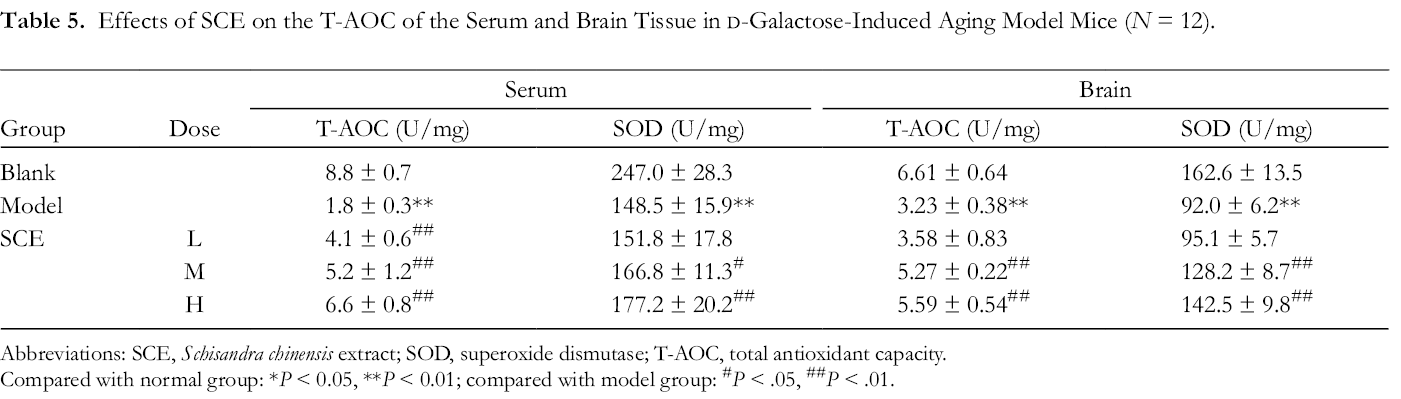
Abbreviations: SCE, Schisandra chinensis extract; SOD, superoxide dismutase; T-AOC, total antioxidant capacity.
Compared with normal group: *P < 0.05, **P < 0.01; compared with model group: # P < .05, ## P < .01.
Discussion
SCE can alleviate the learning and memory disorder caused by scopolamine, suggesting that the effect of SCE on learning and memory is related to the cholinergic system (promoting cholinergic transmission) at least in part.
18
SCE can significantly improve the memory consolidation disorder caused by chloramphenicol, suggesting that SCE can improve the nervous function of the body. SCE has a significant antagonistic effect on the memory reproduction disorder caused by a low concentration of ethanol with central inhibition, suggesting that SCE may improve the cytotoxic response caused by ethanol, and SCE can repair the cell damage caused by the phospholipid and fatty acid metabolism disorder, as well as increase the oxidative metabolites induced by the ethanol intake.
19
SCE can also improve the short-term spatial memory ability of aging model mice and improve the anti-fatigue ability of the body, which may be related to the regulation of SCE on the expression of related proteins to improve the antioxidant ability of the body. Oxidative stress is an important factor in the pathogenesis of Alzheimer’s disease (AD), and antioxidant therapy can improve the symptoms of AD by reducing oxidative stress.
20
However, most antioxidants cannot penetrate the blood-brain barrier and other membrane structures to reach the lesion site, so the therapeutic effect is not so significant. It was found in this study that SCE had a good effect on the learning and memory of model mice, speculating that part of the reason might be relayed to its increasing the activity of antioxidant enzyme SOD in the brain by regulating the transcription of the SOD gene through some way to increase the content of SOD messenger ribonucleic acid in the brain tissue, so as to resist the oxidative damage caused by
Materials and Methods
Animals and Reagents
C57BL SPF female mice, weighing 18-22 g (Experimental Animal Center of Jilin University, Changchun, China). Schisandra chinensis (Jilin Zhanqian Medicinal Material Market, Jilin, China); schisandrol A, schisantherin A, and anwulignan reference substances (National Institute for the Control of Pharmaceutical and Biological Products); schisandrol B, schisandrin A (deoxyschizandrin), schisandrin B, and schisandrin C reference substances, with a purity greater than 98.0% (Self-made in our laboratory, Jilin, China); schisanhenol reference substance, with a purity of 98.5% (Institute of Schisandra chinensis, Beihua University, Jilin, China); scopolamine (Bailingwei Technology Co., Ltd., China); T-AOC and SOD kits (Nanjing Jiancheng Bioengineering Research Institute, Nanjing, China); the remaining reagents were analytically pure.
Preparation of SCE
Schisandra chinensis powder (40.0 g) was extracted in 600 mL of 90% ethanol 3 times by an ultrasonic method, 20 minutes each time, and the 3 extracts were combined and mixed evenly. The ethanol was recovered under vacuum, and the residue freeze-dried to obtain S. chinensis extract (SCE).
Determination of Lignans in SCE Deoxyschizandrin
Ten milligrams of each of schisandrol A, schisandrin A, schisandrin B, and schisandrol B were dissolved in methanol to prepare 1 mg/mL reference solutions, and 8.0 mg of schisandrin C, schisantherin A, schisanhenol, and anwulignan each were dissolved in methanol to prepare 0.8 mg/mL reference solutions. One milliliter of each reference solution was added to methanol to fix the volume at 10 mL in a volumetric flask, then the flask was shaken well, and the solution filtered through a 0.45-µm filter membrane to obtain the mixed reference solution.
Ten gram of SCE was placed in a 10 mL volumetric flask, and methanol was added to make up to volume. The flask was shaken well, and the solution filtered through a 0.45-µm filter membrane to obtain the test solution.
An Agilent ZORBAX 300 SB-C18 column (4.6 mm × 250 mm, 5 µm) was selected as the chromatographic column and a Shimadzu GVP (4.6 mm) protective column was used for the detection by high-performance liquid chromatography, in which the mobile phase was methanol (A) and water (B); the column temperature was 27 °C, the flow rate 0.8 mL/min, the detection wavelength 230 nm, and the sample volume 10 µL. The gradient elution conditions are shown in Table 6.
Gradient Elution Conditions of High-Performance Liquid Chromatography.

Effects of SCE on the Learning and Memory Behavior in Mice
Female mice were fed with a limited amount of food, with free access to water. The mice were trained for 30 minutes every day using a radial maze analysis test system, successively for 7 days. During the training, the mice were put into 1 of 8 arms of the maze, then the exit at 1 end of the arms was opened and an appropriate amount of mouse food put there, while the exits of the other 7 ends were closed. After a certain period of adaptation, the mice could remember the spatial position of food in the maze. After the training, the mice with good memory were selected for the formal test. Taking the time of mice passing through the radial maze in the control group as the index, the time of mice passing through the radial maze correctly, and the times of entering the wrong maze channel in the model group and the SCE-treated groups were observed and recorded.
The selected mice were randomly divided into 3 batches, with 60 mice in each batch. The mice in each batch were randomly divided into a blank group, a model group, and a high-dose, medium-dose, and low-dose SCE group (150, 75, and 25 mg/kg, respectively). Mice in the SCE-treated groups were given the corresponding doses of SCE once a day by gavage continuously for 7 days, and those in the blank and model groups were given 10 mL/kg normal saline, followed by the maze training. Thirty minutes after the last administration, mice in the model group and SCE-treated groups from the first batch were intraperitoneally injected with 2 mg/kg of 0.02% scopolamine 15 minutes before the training to simulate the memory acquisition disorder of mice, and 30 minutes later, the mice were put into the maze system for observing the effect of SCE on the learning and memory acquisition disorder of mice. Mice in the model group and SCE-treated groups from the second batch were intraperitoneally injected with 200 mg/kg chloramphenicol immediately after the training to simulate the memory consolidation disorder of mice, and 30 minutes later, the mice were put into the maze system for observing the effect of SCE on the memory consolidation disorder of mice. After the training for 24 hours, mice in the model group and SCE-treated groups from the third batch were intraperitoneally injected with 10 mL/kg 40% ethanol 10 minutes before the test to simulate the memory reproduction disorder of mice, and the effect of SCE on the memory reproduction disorder of mice was observed. Blank mice from the 3 batches were given 10 mL/kg normal saline in the same way, respectively.
Effects of SCE on the Antifatigue Ability and Learning and Memory of d -Galactose-Induced Aging Model Mice
Sixty mice that were not trained were randomly divided into a blank group, a model group, and a high-dose, medium-dose, and low-dose SCE groups (150, 75, and 25 mg/kg, respectively). In addition to those in the blank group, mice in the other 4 groups were subcutaneously injected with 125 mg/kg

After modeling, 10 mice were randomly selected from each group for the radial maze test. By the end of modeling and before feeding, mice were trained to explore the exit of the maze twice, respectively, and 30 minutes later, the time of mice passing through the maze was measured to evaluate the effect of SCE on the spatial learning and memory ability of aging mice in a short time. After the test, the mice were sacrificed; the serum and brain tissue of mice taken, and the activity of T-AOC (ferric reducing ability of plasma) and SOD, as well as the content of malondialdehyde in the serum and brain tissue were detected according to the instructions for the kits. In addition, 5 mice from each of the above 6 groups were taken for the loaded swimming experiment (anti-fatigue experiment) of mice, in which the antifatigue effect of SCE was evaluated by the time that the mice swam in the glass jar until their heads sank into the water for 10 seconds and no longer floated.
Statistical Analysis
SPSS 10.0 statistical software was used for statistical analysis. The data were expressed as mean ± SD. The difference between groups was compared by t-test, and P < 0.05 was considered to be statistically significant.
Footnotes
Statement of Human and Animal Rights
All animal experiments were approved by the Ethical Committee of Jilin Medical College. All procedures were conducted in accordance with the guidelines for the care and use of laboratory animals (China).
Declaration of Conflicting Interests
The author(s) declared no potential conflicts of interest with respect to the research, authorship, and/or publication of this article.
Funding
The author(s) disclosed receipt of the following financial support for the research, authorship, and/or publication of this article: This work was financially supported by the Scientific and technological research planning project of the 13th five year plan of Jilin Provincial Department of Education (JJKH20200459KJ) and Science and technology project of Jilin Administration of traditional Chinese medicine (2017251).
