



Abstract
The medicinal aromatic plant Senecio filaginoides DC, which is very widespread in the Patagonia region, was harvested at the vegetative, flowering, and fructification stages. The materials were extracted by hydrodistillation, yielding in average 0.34% v/w of essential oils with a pleasant sweet and greenish scent. A total of 56 components were identified by gas chromatography using flame ionization detection and mass spectra measurements, representing 96.1%-97.6% of the total oil. The sesquiterpenoid 10αH-furanoeremophil-1-one (
Senecio (Asteraceae) is one of the largest genera worldwide, including about 3000 species, from which 270 species are reported in Argentina. 1 Senecio filaginoides DC is an aromatic and medicinal plant endemic to the Patagonia region. It is popularly known as charcao, 2 which is used in folk medicine for rheumatic pains, toothache, and in Mapuche birth ceremonies. 3
Essential oils are the best-known and most-used products of an aromatic plant and their analyses have been improved since the introduction of gas chromatography (GC). GC with mass spectrometry (MS) allowed ecological analysis and plant systematics 4 while the analytical evolution promoted strategies for the investigation of a plant volatile fraction, as mighty techniques have been introduced to allow the analyst to obtain valuable structural information of a compound in a short time period without prior isolation. 5 Nevertheless, structures of main compounds present in the essential oils of some species still remain as incorrectly identified, with many of them with systematic value as eremophilane derivatives found in Senecio species. 6 This shows that the need to have the pure compounds in hand is still a fact. 7
Reports on the chemical composition of the essential oils of S. filaginoides are scarce and incomplete. Balzaretti et al 8 identified only 9 components in the essential oil by GC-MS, with α-pinene and α-terpinene + p-cymene being the main constituents. Other studies were performed on nonpolar extracts providing a furanoeremophilone as the main compound, which was identified as 10βH-furanoeremophil-1-one by Bohlmann et al, 9 who named it as senberginone, and later Arancibia et al 10 identified the 10αH-furanoeremophil-9-one isomer by nuclear magnetic resonance (NMR) spectroscopy. Two other furanoeremophilane-type sesquiterpenoids, 6α-acetyloxy-10βH-furanoeremophil-1-one and 6α-tigloyloxy-10βH-furanoerermophil-1-one, were also isolated from this species 11 although Bohlman et al 9,12 suggested the 6β orientation for these molecules by nuclear overhauser effect differences spectroscopy.
Since a detailed knowledge of the essential oils composition of S. filaginoides is unavailable, and due to the ambiguities found in the configuration of the furanoeremophilane derivatives, the aim of this work was to analyze by GCMS the essential oils composition obtained by hydrodistillation at different plant phenological stages and to unambiguously define the structure of its main sesquiterpenoid constituent.
Results and Discussion
Hydrodistillation of the aerial parts of S. filaginoides at 3 plant phenological stages gave colorless oils with an aromatic pleasant odor, in average yield 0.34% v/w, as summarized in Table 1, which showed a relative density of 0.8707 g/mL and a refraction index of 1.4776 at 20°C. A gas chromatography flame ionization detection mass spectrometry (GC-FID-MS) with a special system configuration was used, which provided 3 identification parameters from a single GC run 13 : linear retention indices (LRIs) in the polar and the nonpolar columns, as well as the mass spectrum of each compound. All experimental data were compared with those found in commercial libraries, 14,15 in the literature, 16 -20 or with those of our own laboratory-developed mass spectra library built-up from constituents of known oils.
Essential Oil Yields (mL/kg) of Senecio filaginoides Var. Filaginoides at 3 Plant Phenological Stages.
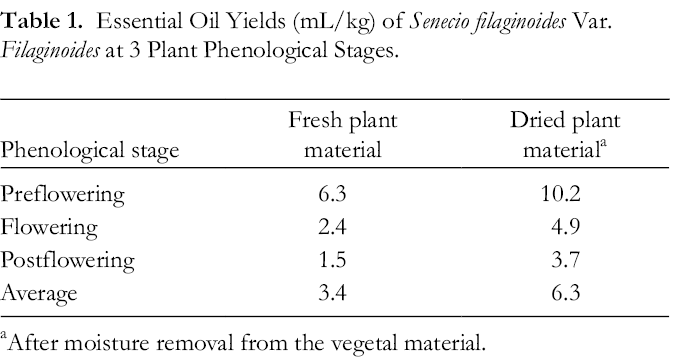
aAfter moisture removal from the vegetal material.
We were able to identify 56 constituents in the essential oils, as shown in Table 2, accounting for 96.1%-97.6% of the total oil composition according to the plant phenological stage. The analysis revealed a dominance of 1-nonene (2.0%-4.7%), α-pinene (28.3%-40.5%), sabinene (1.5%-1.9%), β-pinene (4.7%-5.4%), δ-3-carene (1.8%-5.7%), (Z)-β-ocimene(3.5, 7.2%), limonene (1.1%-2.2%), β-phellandrene (1.2%-1.6%), and the sesquiterpenoid 10αH-furanoeremophil-1-one (

Formula of 10αH-furanoeremophil-1-one (1).
Percentage Composition of the Essential Oil Constituents of Senecio filaginoides Var. Filaginoides at Different Plant Phenological Stages. a

Abbreviations: exp., experimental; lit., literature; LRI, linear retention index.
aCompounds listed in elution order from the nonpolar column.
bLRI DB-5 column.
cLRI DB-Wax column.
dTentative identification.
eMass spectrum in Supplemental Material.
Other authors have also detected a furanoeremophilane in the nonpolar extracts of this species 9,10 using NMR for the identification, but different structures were proposed to this compound. Although GC was not used in these studies, this is a quite volatile molecule having a high LRI, just in the range where the assignment of exact structures turns more erratic.
Salmeron et al 11 also isolated 2 furanoeremophilane-type sesquiterpenoids: 6α-acetyloxy-10βH-furanoeremophil-1-one and 6α-tigloyloxy-10βH-furanoeremophil-1-one after extracting the aerial parts of S. filaginoides with petroleum ether followed by CC fractionation with hexane–cyclohexane mixtures. Their structures were elucidated from spectroscopic data. Meanwhile, from the roots and aerial parts of S. pinnatus, 11 1α-hydroxy-6β-angeloyloxy-10αH-furanoeremophil-9-one was isolated and identified using the same methods. 11 Thus, both Senecio species gave furanoeremophilane derivatives with different C-10 stereochemistry than that specified herein. In addition, Bisht et al 21 could confirm the 1,10β-epoxy-6-oxofuranoeremophilane configuration for the main Senecio royleanus constituent using X-ray diffraction (XRD) analysis. The furanoeremophil-1-one with the same C-10 stereochemistry as that herein determined was found by Bohlmann et al 9 in Senecio bergii and S. bracteolatus, and by Bohlmann and Zdero 12 after extraction of the roots of Smyrnium olusatrum (Apiaceae) with nonpolar solvents. Mölleken 20 also isolated this compound from the essential oils obtained by hydrodistillation from the latter species. More recently, Papaioannou et al 22 reported furanoeremophil-1-one as a major component of the stem and leaf oils from Smyrnium olusatrum (54.3% and 28.7%, respectively) without specifying its configuration.
Since 10αH-furanoeremophil-1-one (
As a definitive proposal of identification of the essential oil composition, we employed a specially built GC-FID-MS system having 2 columns of different polarity.
13
In addition, simple separation and purification methods were used to obtain pure pale-yellow crystals of the main compound. Conventionally, isolation and purification of main compounds from plant extracts are performed by recrystallization, which is a low-cost and easy-to-handle strategy. Purified crystals were analyzed by single-crystal XRD to determine the tridimensional structure of the molecule. This allowed to ascertain the absolute stereochemistry of 10αH-furanoeremophil-1-one (

PLUTO plot of the X-ray crystal structure of (1).
Conclusions
The present study is a contribution to the knowledge of Senecio filaginoides, which is a very abundant aromatic plant in the Patagonia region. The results highlight the great specificity of biosynthetic processes in nature, generating different stereochemical structures according to the species. The use of classical separation and analytical methods remains as a very useful strategy for the correct identification of compounds present in the volatile fraction of a plant. The pleasant scent of the essential oil of this plant suggests its potential use in the fragrance industry.
Experimental Section
Plant Material
The aerial parts were collected from the neighboring areas of Gualjaina River, some 30 km NE of Esquel, Futaleufú Departament, Chubut Province, Argenina (42° 59′ 46.5″ S, 70° 46′ 29.5″ W) between October 2008 and February 2009. The plant material was identified as Senecio filaginoides DC var. filaginoides by Lic. María Elena Arce and a voucher specimen is in deposit at Herbario Regional Patagónico under number HRP 6761.
Essential Oils Extraction
Essential oils were extracted from the air-dried grounded materials by hydrodistillation using a Clevenger-type apparatus for 4 hours following the method described in the Farmacopea Argentina. 23 After cooling, settling, and drying over anhydrous sodium sulfate, the oils were recovered and stored at 4°C until analysis. The yields are expressed as mL essential oil/kg plant material in Table 1.
Isolation of 10αH-Furanoeremophil-1-One (1)
After storing the essential oil at 4°C overnight, a pale-yellow crystalline residue separated. The solid was separated by filtration and washed with cold n-hexane. It was purified by slow recrystallization using a n-hexane/AcOEt (9:1) mixture. The crystals were insoluble in dichloromethane, petroleum ether (35°C-38°C), and n-hexane, although freely soluble in ethyl acetate and ethanol. Melting point: 75°C-76°C, The MS is shown in Supplemental Figure S1.
Gas Chromatography With Flame Ionization Detection and Mass Spectra Analysis
The essential oils were analyzed by GC-FID-MS using a Perkin-Elmer Clarus 500 instrument with a modified configuration, equipped with a single split/splitless injector connected by a flow splitter to 2 capillary columns: a polyethylene glycol MW ca. 20 000 Da column and a 5%-phenyl-95%-methyl silicone column, both 60 m × 0.25 mm id with 0.25 µm of fixed phase (J&W Scientific). The polar column was connected to an FID, whereas the nonpolar column was connected simultaneously to an FID and to a quadrupole mass detector (70 eV) by a MS-Vent system. Helium was used as the carrier gas (flow rate: 1.87 mL/min). The column temperature was programmed according to the gradient: 90°C for 5 minutes, increasing at a rate of 3°C/min-230°C and maintained for 13 minutes. The injector temperature was 255°C. Both FID temperatures were 240°C, and the temperatures for the transference line and the ionic source were set at 180 and 150°C, respectively. Mass range (m/z) and scan time were 40‐350 Da and 1 second, respectively. The manual sample injection volume was 0.2 mL of the oils and the split ratio was 80:1. A mixture of aliphatic hydrocarbons (C6-C24, Sigma Aldrich) in n-hexane was coinjected to calculate the LRI using a generalized equation.
Compound identification was done comparing the LRI relative to C8-C24 n-alkanes, obtained in both columns, with those of reference compounds and from the literature. 16 -20 Additionally, each experimental MS was compared with those from commercial libraries 14,15 and from our own data basis. The percentage composition of the essential oil components was calculated by peak area normalization of FID responses without considering corrections for response factors. The lowest response obtained from both columns for each component was considered.
Single-Crystal XRD Study of 10αH-Furanoeremophil-1-One (1)
A crystal measuring 0.42 × 0.24 x 0.22 mm was mounted on a glass fiber and data were collected on an Enraf Nonius Bruker CAD4 diffractometer. The crystal was orthorhombic, space group P212121, with cell dimensions a = 8.339(2) Å, b = 10.956(1) Å, c = 14.525(2) Å, V = 1326.9(4) Å3, ρ calc = 1.163 g/cm3 for Z = 4, C15H20O2, MW = 232.31, and F(000) = 504 e. A total of 1009 reflections were collected using graphite-monochromated Cu Kα radiation (λ = 1.54184 Å) within the 6.09-59.88° θ range for 0 ≤ h ≤ 9, 0 ≤ k ≤ 12, 2 ≤ l ≤ 16. The structure was solved by direct methods using the SIR2004 software. For the structure refinement, the non-hydrogen atoms were treated anisotropically, and the hydrogen atoms were refined isotropically. The unique reflections were 968, the observed reflections were 934, and final discrepancy indices, refining 166 parameters, were R F = 3.3% and R w = 9.2%. The final difference Fourier map was essentially featureless, with the highest residual peak and hole having residual densities of 0.086 and −0.102 e/Å 3 , respectively. Crystallographic data, excluding structure factors, have been deposited at the Cambridge Crystallographic Data Centre under number 1414005. Copies of the data can be obtained free of charge on application to CCDC, 12 Union Road, Cambridge CB2 IEZ, UK. Fax: +44-(0)1223, 336033 or e-mail: deposit@ccdc.cam.ac.uk.
Supplemental Material
Figure S1 - Supplemental material for GC-FID-MS and X-ray Diffraction for the Detailed Evaluation of the Volatiles From Senecio filaginoides
Supplemental material, Figure S1, for GC-FID-MS and X-ray Diffraction for the Detailed Evaluation of the Volatiles From Senecio filaginoides by Catalina M. van Baren, Silvia B. González, Arnaldo L. Bandoni, Paola Di Leo Lira, María A. Bucio, Angelina Hernández-Barragán and Pedro Joseph-Nathan in Natural Product Communications
Footnotes
Acknowledgments
The authors thank Lic. María Elena Arce, UNP “SJB”, Comodoro Rivadavia, for the identification of the plant material.
Declaration of Conflicting Interests
The author(s) declared no potential conflicts of interest with respect to the research, authorship, and/or publication of this article.
Funding
The author(s) received no financial support for the research, authorship, and/or publication of this article.

Supplemental Material
Supplemental material for this article is available online.
References
Supplementary Material
Please find the following supplemental material available below.
For Open Access articles published under a Creative Commons License, all supplemental material carries the same license as the article it is associated with.
For non-Open Access articles published, all supplemental material carries a non-exclusive license, and permission requests for re-use of supplemental material or any part of supplemental material shall be sent directly to the copyright owner as specified in the copyright notice associated with the article.
