



Abstract
Plant-derived products are employed in various public health practices and have been considered as a major source of medicines. The genus Plectranthus (Lamiaceae) has been widely respected for its nutritional properties, its essential oil, and its therapeutic values. In the present work, the chemical characterization, antimicrobial, antiparasitic, and cytotoxic properties of the essential oil from Plectranthus amboinicus (Lour.) Spreng and its main compound carvacrol were studied. Twenty-one components were identified in the oil by gas chromatography coupled with a mass spectrometric detector. In this oil, carvacrol constitutes the major compound (71%), which represented the more abundant chemotype. The essential oil did not inhibit growth of Escherichia coli, Staphylococcus aureus, Candida albicans, Trypanosoma cruzi, or Leishmania infantum, but displayed activity against Plasmodium falciparum (half-maximal inhibitory concentration [IC50] = 5.9 µg/mL), Trypanosoma brucei (IC50 = 34.9 µg/mL), and Leishmania amazonensis (IC50 = 58.2 µg/mL), and the human tumor-derived cell lines MCF-7 (IC50 = 29.1 µg/mL), MDA-MB-231 (IC50 = 41.5 µg/mL), and 22Rv1 (IC50 = 29.6 µg/mL), but no cytotoxicity was observed against nonmalignant macrophages. The antiproliferative activity of the oil could be attributed to carvacrol. However, this compound showed certain level of cytotoxicity, which suggests unspecific activity. This study provides evidence about antimicrobial and anticancer potential of the essential oil from P. amboinicus against protozoa and neoplastic diseases, particularly as an antimalarial natural product.
The World Health Organization (WHO) estimated that about 80% of the world’s population still depend on traditional herb-based medicines due to their low cost, easy accessibility, and less prominent side effects. 1,2 In fact, plant-based medicines are widely employed in various public health practices throughout the globe as they are generally safe and cost-effective, and efficiently combat various deadly diseases and help in maintaining good health; while pharmaceutical industries have also considered natural products as a major source of medicaments. 3,4 This has led to an increased global demand for medicinal plants in the modern era of natural medicine, leading to exploration and exploitation of new plant sources for their medicinal properties. 4 In addition, molecular diversity of plant metabolites is still unsurpassed by pharmaceutical synthetic chemistry.
In the scientific literature, over 85% of documentation about the Plectranthus L´Hér. genus (Lamiaceae) have been attributed to therapeutic benefits of this genus followed by its nutritional, horticultural properties due to its aromatic nature and its essential oil (EO). 5 -7 Currently, more than 300 species of Plectranthus are reported all over the tropical and warm regions of the world, including America, Asia, Africa, and Australia. 8 In this sense, Plectranthus amboinicus (Lour.) Spreng. (syn. Coleus amboinicus Lour., Coleus aromaticus (Roxb.) Benth., Figure 1) is a perennial herb that naturally grows throughout the tropics and warm regions with therapeutic and nutritional properties attributed to its natural phytochemical compounds. It is widely used in folk medicine to treat conditions like cold, asthma, constipation, headache, cough, fever, and skin diseases, while scientific studies have reported numerous pharmacological properties, including antimicrobial, anti-inflammatory, diuretic, antidiabetic, antitumor, wound-healing, antiepileptic, larvicidal, antioxidant, and analgesic activities. 7,9 -11
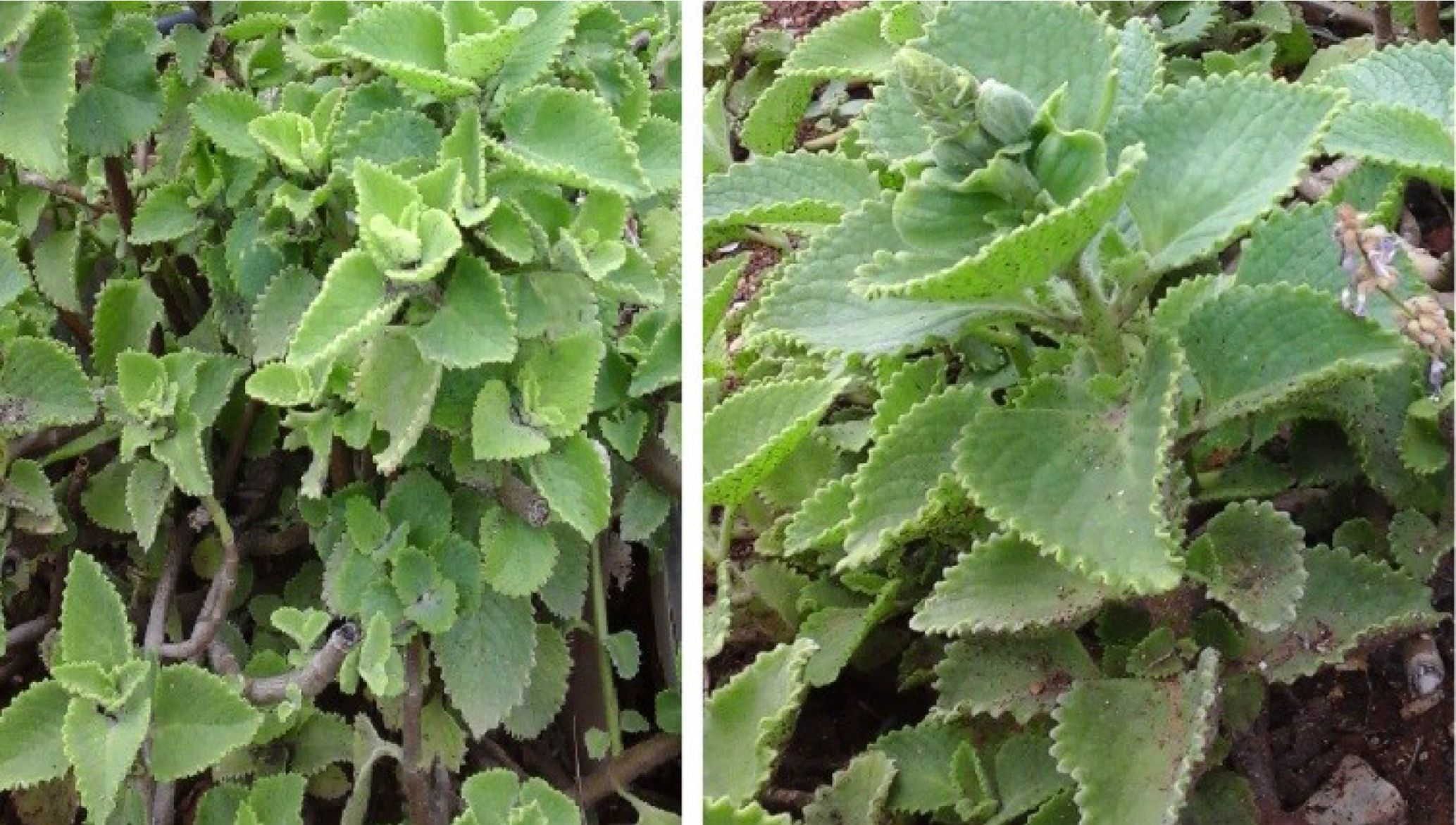
Photographs of Plectranthus amboinicus (Lour.) Spreng. in the natural habitat (photographs taken by the authors during and after the collection of the plant).
Some studies about the pharmacological activity of P. amboinicus cultivated in Cuba have been documented, such as their properties as diuretic, 12 antitussive and expectorant, 13,14 antiepileptic, antidepressant, 15 antioxidant, 16 and antibacterial 13 activity using, in general, plant extracts. However, in regard to the EO from P. amboinicus (EO-Pa), the pharmacological studies are scarce, although an antioxidant 17 activity has been documented. Nevertheless, major attention has been focused on toxicity 18 -20 due to popular and traditional use by the Cuban population.
It has been well documented that plant-derived products, in particular EOs, have played critical roles in modern drug development, especially for antimicrobial and antitumor agents. 1 In addition, some authors have suggested that the EO-Pa and its components could be used as a tool for the development of novel and more efficacious antimicrobial 21 and anticancer 22 agents. Furthermore, associated antimicrobial and anticancer activities of P. amboinicus plants in Cuba 13 have been suggested. Therefore, in this study, we performed a chemical characterization and antiproliferative activity assessment of EO-Pa collected in Havana, Cuba and its main compound carvacrol.
Results and Discussion
Hydrodistillation of the aerial parts of P. amboinicus gave the EO in 0.70%-0.75% yield. To characterize the EO-Pa, the chemical composition was analyzed by gas chromatography coupled with a mass spectrometric detector (GC-MS). Detected compounds are listed in Table 1, which indicate that 21 components were identified representing 100% of EO. Carvacrol constitutes the major compound with 71% (Figure 2). This compound is present abundantly in the EOs of many medicinal plants and well known for its numerous biological properties, such as antimicrobial, antiviral, antioxidant, antitumor, anti-inflammatory, hepatoprotective, spasmolytic, wound-healing, and vasorelaxant activities. 23 -26

Dendrogram obtained from the agglomerative hierarchical cluster analysis of Plectranthus amboinicus (Lour.) Spreng. essential oil compositions from the literature and chemical structure of carvacrol, the main compound of the studied essential oil.
Essential Oil Composition From Plectranthus Amboinicus (Lour.) Spreng Growing in Cuba.

Abbreviations: RIcalc, retention index (determined with respect to a homologous series of n-alkanes on a ZB-5 column); RIdb, retention index from the databases.
Bold letters indicate main compound.
Comparing the literature data, our result is in agreement with a previous study by Pino et al. 27 that showed 64% carvacrol in the EO-Pa cultivated also in Havana. Nevertheless, this component has shown wide variation in concentration. For example, as the main compound and in the same range, carvacrol comprised 65.2% from Mérida in Venezuela 28 and 64% from Cartagena in Colombia. 17 However, a higher concentration of carvacrol was observed from EO-Pa collected in Cariré and Ceará from Brazil, with 88.2% 29 and >90%, 30 respectively. Nevertheless, it is known that the chemical constituents of EO-Pa differed from those of the collected samples from diverse geographical places, in which more than 70 different constituents have been described. 7
An agglomerative hierarchical cluster (AHC) analysis was carried out using the chemical compositions of 37 EO-Pa reported in the literature. 15,25 -52 The oil studied herein showed a clear carvacrol-rich chemotype (Figure 2), which is consistent with the major cluster and most abundant chemotype. The carvacrol-rich chemotype had an average of 69.4% carvacrol, which ranged from 32.3% to 98.0%. In addition, 2 other chemotypes can also be described. One, a thymol-rich chemotype, has abundant concentrations of thymol (average of 67.3%, ranging from 35.0% to 94.3%) and relatively low concentrations of carvacrol (average 0.8%, range 0.0%-3.1%), for example, a sample from Rajahmundry, India, was found to have 94.3% thymol but only 1.2% carvacrol, 46 and a sample from Nainital, India, was composed of 83.4% thymol and 0.5% carvacrol. 47 In contrast, there is a chemotype that has relatively low concentrations of either carvacrol (average 10.8%, range 0.0%-29.3%) or thymol (average 6.1%, range 0.0%-21.7%), e.g., neither carvacrol nor thymol were detected in samples of P. amboinicus from Crato-Ceará, Brazil, 50 or Pelotas, Brazil, 51 while only low concentrations of carvacrol and thymol were found in samples from Cairo, Egypt. 53 Interestingly, the chemotype distribution seems to be randomly distributed around the world and not dependent on geographical location. Thus, for example, all 3 chemotypes are represented in samples from Brazil and India, while the carvacrol-rich chemotype has not yet been reported in Egypt.
In general, no effect on bacteria and fungi was observed. In contrast, however, antimicrobial activities of EO-Pa, including carvacrol 28,30 and thymol 54 chemotypes, have been reported. In these cases, differences between the EO-Pa in the different studies could be related to other components and their respective concentrations; the mixtures of EO components may cause either “synergistic” or “antagonistic” effects. 55
In contrast, protozoa and cancer cells were inhibited. In particular, a better activity was observed against P. falciparum >cancer cells (MCF7 ~22Rv1 > MDA MB-231) >T. brucei > L. amazonensis. For carvacrol, a similar activity (P > .05) was displayed against P. falciparum (Table 2) compared to EO-Pa, while statistical smaller half-maximal inhibitory concentration (IC50) values (P < .05) were observed against S. aureus, L. amazonensis, and the 3 cancer cell lines. In contrast, the activity disappeared against T. brucei. Relations between EO-Pa and carvacrol in each evaluated system can be visualized in Figure 3.
In Vitro Antiproliferative Activity (IC50, μg/mL) of Essential Oil Extracted by Hydrodistillation From Plectranthus Amboinicus (Lour.) Spreng Growing in Cuba and Main Compound Carvacrol.

Abbreviations: IC50, median inhibitory concentration with the 95% CI; MCF-7, human breast cancer cell line; MDA-MB-231, human breast cancer cell line; 22Rv1, human prostate carcinoma cell line.
*Statistical differences between IC50 of carvacrol and the essential oil from P. amboinicus (P < .05).

Relation of biological activity of essential oil from Plectranthus amboinicus (Lour.) Spreng. growing in Cuba and carvacrol, the main compound using a qualitative and quantitative map visualization (heat map was created according to biological data obtained in this study, where the color range from red to green indicates biological activity from high to low).
The best activity of EO-Pa in this study was observed against P. falciparum, with an IC50 value of 5.9 µg/mL. This parasite is the causal agent of malaria, one of the major health problems in developing countries that affect large numbers of people everyday. Resistance of the Plasmodium parasite to the existing drugs (including chloroquine, mefloquine, and artemisinin-based combination therapy) is a serious global issue in malaria treatment and control. Therefore, development of new natural therapeutic alternatives as novel antimalarial drugs is an urgent need, in particular due to the fact that plants have been the main source of the 2 prominent antimalarial lead compounds, namely quinine and artemisinin. 56 Previously, antiplasmodial potentialities of P. amboinicus, including an ethanolic extract 57 and the EO carvacrol chemotype, 58 collected in Malaysia have been suggested.
In addition, it is notable that carvacrol showed same activity of EO-Pa against P. falciparum (Figure 3), which could suggest that antiplasmodial activity is caused by the main active compound. Similar results were shown by Tasdemir et al., 59 who previously reported an IC50 value for carvacrol of 6.4 ± 0.9 µg/mL against P. falciparum K1 strain (chloroquine- and pyrimethamine-resistant).
In parallel, EO-Pa possessed some antitrypanosomal activity against T. brucei and antileishmanial activity against L. amazonensis. Ethnopharmacological uses of this plant to treat cutaneous leishmaniasis by endemic people in Brazil 60 and the antiparasitic properties of EO-Pa against L. braziliensis MHOMBR-94-H3227 61 have been described.
Nevertheless, the effect of carvacrol was only observed against L. amazonensis, which corroborates previous reports by our group in in vitro 62 and in vivo models of leishmaniasis. 63 The activity of carvacrol on Trypanosomatidae parasites has shown contradictory results in the scientific literature. For example, against L. donovani MHOM/ET/67/L82, T. brucei rhodesiense STIB 900 strain, 59 and T. cruzi strain 215, KP Luna CINTROP 64 IC50 values of 13.1, 0.15, and 27.3 µg/mL were documented, respectively, while no activities against L. chagasi MHOM/BR/74/PP75 64 and T. cruzi Tulahuen strain C2C4 59 were reported. These reports illustrate the importance to test products against different species of the same genus and different strains/isolated of the same species to account for intraspecific variety. 65
The potential in vitro antiprotozoal activities of the EO-Pa and carvacrol encouraged us to test these products on cancer cell lines due to the following properties: (1) proliferative properties of protozoa and cancer cells 66 ; (2) in general more than one target has been described to a compound; (3) different diseases share common molecular pathways or targets in the cell 67 ; and (4) 50% of the approved anticancer drugs from 1940 to 2014 originated from natural products or directly derived therefrom. 68 In this sense, our results also showed that EO-Pa was able to inhibit proliferation of 3 cancer cell lines. Plectranthus amboinicus is a recognized plant with an anticancer potential. 69,70 For example, a carvacrol-thymol chemotype showed activity on lung cancer cell line A549 71 and an aqueous extract produced antineoplastic effect in ascetic form of Ehrlich carcinoma in mice. 72
In the follow-up assay with cancer cell lines, a statistically significant higher activity (P > .05) of carvacrol with respect to EO-Pa was found. However, these differences are minimal, and thus not relevant in term of efficacy, which suggest that the anticancer properties of EO-Pa could also be attributed to the presence of carvacrol, which can be visualized in Figure 3. In this sense, the antiproliferative activity of carvacrol has been demonstrated against various human cancer cell lines, such as lung A549, 24 prostate LNCaP, 73 colon HCT116 and LoVo, 74 cervical HeLa and SiHa 75 cell lines, and against a tumor caused by Sarcoma 180 in rodents. 76
In general, the mode of action of carvacrol has received special attention. First, due to the hydrophobic character and its partition coefficient in octanol–water (log P = 3.64) it can interfere with the lipid bilayer of cytoplasmic membranes bringing loss of integrity and increasing its fluidity/permeability. 25 Then, hypotheses for mechanistic action included membrane depolarization, oxidative burst, and release of DNA, proteins, and ion-mediated apoptosis. 77 On the other hand, Bakkali et al. 78 demonstrated that in eukaryotic cells, carvacrol acts as a prooxidant affecting inner cell membranes and organelles such as mitochondria. In Leishmania parasites, Monzote et al. 62 also showed that carvacrol caused a breakdown of membrane mitochondrial potential. Further investigation about the antiparasitic and anticancer mechanisms of action of EO-Pa and carvacrol would be helpful to a better understanding of mechanism for activity on different cells.
Antiproliferative activity of other minor components has also been described. In this sense, antiprotozoal and/or anticancer effects of p-cymene, γ-terpinene, terpinen-4-ol, β-caryophyllene 59,79,80 and caryophyllene oxide 62,81 have been described.
With respect to cytotoxicity, no effects at the highest tested concentration of EO-Pa (64 µg/mL) were observed on nonmalignant cells, although a selectivity index (SI) >10 was only observed for P. falciparum (Table 3). The same result was documented by de Lima et al. 61 on RAW267.4 macrophage cells. Pure carvacrol, however, showed some cytotoxicity against mammalian cells, including MRC-5 and peritoneal macrophage from BALB/c mice (PMM) in this study (Table 3), as well as L6 cells, 59 and Vero cells, 64 with CC50 values of 48.8 and 28.3 µg/mL, respectively. Then, in comparison with previous described activities, SI of carvacrol results in small values, including for P. falciparum.
Cytotoxicity (CC50, μg/mL) and Selectivity of Essential Oil Extracted by Hydrodistillation From Plectranthus amboinicus (Lour.) Spreng Growing in Cuba and Main Compound Carvacrol.

Abbreviations: CC50, Median cytotoxic concentration with the 95% CI; IC50, half-maximal inhibitory concentration; PMM, peritoneal macrophage from BALB/c mice.
Selectivity index: CC50 / IC50.
*Statistical differences between CC50 of carvacrol and the essential oil (p < 0.05).
When comparing the potentialities of EO-Pa and carvacrol, the analysis of the SI constitutes one of the more important criteria to select “hits” for drug development. An SI ≥10 suggests some safety in the use of the tested product in mammalian cells because it indicates that the biological efficacy is not due to its cytotoxicity in these cells. 65 Based on the results presented previously, the EO-Pa could be considered as promising since it had an SI >11 for P. falciparum, while an SI <5 was observed for other protozoa and cancer cells. In contrast, carvacrol displayed a low SI on all models studied. Nevertheless, carvacrol is generally considered safe for consumption.
It has been approved by the Federal Drug Administration for its uses in food and is included by the Council of Europe in the list of chemical flavorings that can be found in alcoholic beverages, baked goods, chewing gum, condiment relish, frozen dairy, gelatin pudding, nonalcoholic beverages, and soft candy. 82,83 Differences related to cytotoxicity of EO-Pa in comparison with carvacrol could be explained by the fact that the studied oil contains a large number of compounds as minor constituents, which could counteract certain effects of carvacrol. 55
Thus, our results are in agreement with the literature and corroborate the antiproliferative activity of EO-Pa growing in Cuba against protozoa and cancer cells in in vitro cultures, which may be related to the main compound, namely carvacrol. In particular, it is interesting to highlight that better potentialities of EO-Pa were found against P. falciparum, due to (1) high activity (IC50 <10 µg/mL) and (2) low cytotoxicity. In addition, other bioactivities reported for P. amboinicus could be encouraging for infectious and cancer diseases. In this regard, we can mention, for example, antioxidant activity, analgesic action, and anti-inflammatory properties due to inhibition of proinflammatory mediators and could act as an antiseptic and promote healing of skin diseases. 7 Among other particularities of this plant, it is important to realize that P. amboinicus is a species that grows abundantly in many gardens, has been extensively used in culinary purposes, and presents bioactive constituents and nutrients. All these features make this plant an available material to endemic populations with considerable safety for human health. Nevertheless, its potential usefulness in clinical applications necessitates extensive in vivo evaluations to confirm the pharmacological properties.
Materials and Methods
Plant Material
During early hours of June 2017, plants of P. amboinicus (Figure 1) were collected from the Institute of Pharmacy and Food of Havana University, located in La Lisa Municipality, Havana Province (23°01´29´´N, 82°27´47´´W, 60 m asl). A plant specimen was identified by M.Sc. Ramón Scull, authenticated by M.Sc. Eldys Bécquer and deposited in the Herbarium of Cuban Flora (HFC) at National Botany Garden of Havana, Cuba, under the voucher number HFC-88353.
EO Extraction, Chemical Characterization, and Main Compound
The aerial parts of P. amboinicus (500 g) were completely rinsed with abundant water and manually crushed into pieces. The EO was then obtained by hydrodistillation using a Clevenger type apparatus for 5 hours. For the biological assays, the EO was dissolved in dimethyl sulfoxide (DMSO; AppliedChem, Panreas, Germany) at 20 mg/mL.
Chemical characterization of EO-Pa was carried out by GC-MS using a Shimadzu GCMS-QP2010 Ultra (Shimadzu Scientific Instruments, Columbia, MD, USA), which was operated in the electron impact mode (electron energy = 70 eV), scan range = 40-400 atomic mass units, scan rate = 3.0 scans/s, and GC-MS solution software. The GC column was a ZB-5 fused silica capillary column with a (5% phenyl)-polymethylsiloxane stationary phase and a film thickness of 0.25 µm, a length of 30 m, and an internal diameter of 0.25 mm (Phenomenex, Torrance, CA, USA). The carrier gas was helium with a column head pressure of 552 kPa and flow rate of 1.37 mL/min. Injector temperature was 250 °C and the ion source temperature was 200 °C. The GC oven temperature program was programmed for 50 °C initial temperature, and temperature increased at a rate of 2 °C/min to 260 °C. A 5% w/v solution of the sample in CH2Cl2 was prepared and 0.1 µL was injected with a splitting mode (30:1). Identification of the oil components was based on their retention indices determined by reference to a homologous series of n-alkanes, and by comparison of their mass spectral fragmentation patterns with those reported in the literature, 84 and in our in-house Sat-Set library. 85
Carvacrol was obtained from Fluka (Germany), with a purity >98%. Compound was dissolved in DMSO at 20 mg/mL.
Hierarchical Cluster Analysis
A total of 37 previously reported EO-Pa compositions were used and treated as operational taxonomic units. The 25 most abundant EO components were used to determine the chemical relationship among samples by AHC analysis using the XLSTAT software, version 2018.1.1.60987 (Addinsoft, Paris, France). Euclidean distance was used to measure dissimilarity, and Ward’s method was used for cluster definition in order to identify the different chemotypes.
Microorganisms and Cells
An integrated panel of microbial agents in 96-well plates was adopted from Cos et al., 86 including the Gram-negative E. coli (ATCC 8739), the Gram-positive S. aureus (ATCC 6538), the yeast C. albicans (B 59630) and the parasitic protozoa P. falciparum (Ghana), T. brucei brucei (Squib-427), T. cruzi (Tulahuen CL2), L. infantum (MHOM/MA(BE)/67), and L. amazonensis (MHOM/77BR/LTB0016). Three cancer cell lines were used, 2 human breast cancer MCF-7 (ATCC HTB-22) and MDA-MB-231 (ATCC HTB-26), and human prostate carcinoma cell line 22Rv1 (ATCC CRL-2505).
For comparison, cytotoxicity was also assayed using 2 models of nonmalignant mammalian cells: MRC-5, a diploid human cell culture line composed of fibroblasts (ECACC, UK); and PMM obtained by peritoneal washing in RPMI medium (Sigma, St Louis, MO, USA) and antibiotics (100 µg of streptomycin/mL and 100 U of penicillin/mL; Sigma, St. Louis, MO, USA) at the moment of use from normal BALB/c mice.
Reference Drugs
In parallel, reference drugs were tested. Chloramphenicol for E. coli and erythromycin for S. aureus were obtained from Sigma-Aldrich (Bornem, Belgium), while miconazole for C. albicans was purchased from Janssen Pharmaceuticals (Beerse, Belgium). Chloroquine, benznidazol, suramine, and miltefosine for P. falciparum, T. cruzi, T. brucei, and L. infantum, respectively, were donated by the Special Program for Tropical Diseases Research from the WHO. Pentamidine for L. amazonensis was supply by Richet, Buenos Aires (Argentina). Cisplatin (Teva, Petah Tikya, Israel) was used as reference drug for tumor cell cytotoxicity assays.
Antibacterial and Antifungal Assays
Antibacterial assays were carried out with cultures of E. coli and S. aureus in Mueller Hinton broth (Sigma-Aldrich, St. Louis, MO, USA) medium, while the antifungal assay was performed with C. albicans in RPMI medium. In all assays, 5 × 10³ colony-forming units/well were distributed and different concentrations of products, were added and incubated at 37 °C for 17 hours. Then, viability was determined fluorometrically using resazurin (Sigma-Aldrich, St. Louis, MO, USA) method. 87
Antiprotozoal Assays
Antiplasmodial activity was measured with parasites cultured in RPMI-1640 culture medium, supplemented with human erythrocytes A+, 0.5% g/v Albumax under an atmosphere of 3% O2, 4% CO2, and 93% N2 at 37 °C. 88 Infected human red blood cells (1% parasitemia, 2% hematocrit) and different concentrations of evaluated products were added and the plate was incubated under the same conditions. After 72 hours of incubation, parasites were quantified using Malstat (Flow Inc., Portland, OR, USA) reagent as was described. 89
Antitrypanosomal activity was performed using 4 × 10⁴ amastigotes of T. cruzi in 4 × 10³ MRC-5 cells cultured in minimal essential medium (Life Technologies, Carlsbad, CA, USA) and supplemented with 20 mM L-glutamine, 16.5 mM sodium bicarbonate, and 5% of inactivated fetal calf serum (Invitrogen, Belgium). Then, different concentrations of products were added to amastigotes and the plate was incubated for 7 days at 37 °C and 5% CO2. Parasite growth was assessed by β-galactosidase method. 90 In parallel, trypomastigotes of T. brucei, cultured in Hirumi-9 medium supplemented with 10% heat-inactivated fetal calf serum at 37 °C and 5% CO2 was also tested. 91 Assays were performed by adding 1.5 × 10⁴ trypomastigotes/well to the different concentrations of EO. After 72 hours of incubation under the same conditions, parasite growth was assessed fluorometrically by adding resazurin for 24 hours at 37 °C as described above.
Antileishmanial activities against intracellular amastigotes of L. infantum and L. amazonensis were also determined. For L. infantum, 3 × 10⁴ PMM were infected with amastigotes obtained from an infected hamster at a density of 15 parasites per cell and the plate was incubated for 48 hours at 37 °C and 5% CO2, while for L. amazonensis, 106/mL PMM were infected with stationary-phase promastigotes at a 4:1 parasite/macrophage ratio for 4 hours at the same conditions. In both cases, different concentrations of each product were added and the plates were incubated (120 hours for L. infantum and 48 hours for L. amazonensis). 92 Then, the supernatant was discarded, cells were fixed with methanol, stained with Giemsa and microscopically examined.
Tumor Cell Antiproliferative Assays
MCF-7 and MDA-MB-231 cells were cultured in standard 4.5 g/L glucose Dulbecco’s modified Eagle medium (Gibco-Life Technologies, Paisley, UK), while 22Rv1 cells in RPMI-1640 medium (Gibco-Life Technologies) supplemented with RPMI-1640 vitamins (PanEco, Moscow, Russia). Culture medium was supplemented with 10% fetal calf serum (HyClone, Logan, UT, USA), antibiotics (50 µg of streptomycin/mL and 50 U of penicillin/mL, PanEco), and 0.1 mg/mL sodium pyruvate (Santa Cruz Biotechnology, Dallas, TX, USA). The growth inhibitory activities of EO, carvacrol, and reference compounds were assessed using the 3-[4,5-dimethylthiazol-2-yl]−2,5-diphenyltetrazolium bromide (MTT; AppliChem GmbH, Darmstadt, Germany) assay. 93,94
Cytotoxicity Assay
The cytotoxicity of products was determined on MRC-5 cell line and PMM. For MRC-5 cells, cell viability was assessed fluorometrically after 72 hours of incubation with tested products by resazurin method. In parallel, PMM were treated during 48 hours and viability was measurement using MTT method. 95 SIs were calculated for antimicrobial and tumor cell cytotoxic activities, through the ratio of the CC50 for MRC-5/PMM cells and the IC50 for microorganism or cancer cells.
Statistical Analysis
In each assay, 3 experiments were performed and percentage growth inhibition for each product concentration was calculated compared to the untreated cultures (negative control). The IC50 for antibacterial, antifungal, and antiprotozoal assays were determined, while CC50 were obtained in cytotoxicity experiments (lineal dose–response curves). In the tumor cell, IC50 was obtained from dose–response sigmoidal curves. In all cases, results are expressed with 95% CI. To compare the IC50 and CC50 values between EO-Pa and the main compound, statistical differences were determined using Mann–Whitney with Statistica for Windows Program (Version 13.1, StatSoft, Inc 2016), considering statistical differences as P <.05. Finally, biological data for each cellular target were subjected to the heat map for qualitative and quantitative comparison of EO-Pa and carvacrol.
Footnotes
Acknowledgments
This study is a contribution to the Research Network Natural Products against Neglected Diseases (ResNetNPND, http://www.resnetnpnd.org/Start/) and to the Aromatic Plant Research Center (APRC,  ).
).
Declaration of Conflicting Interests
The author(s) declared no potential conflicts of interest with respect to the research, authorship, and/or publication of this article.
Funding
The author(s) disclosed receipt of the following financial support for the research, authorship, and/or publication of this article: This work was partly supported by the Russian Foundation for Basic Research and Ministry of Science, Technology and Environment of the Republic of Cuba (RFBR №18-53-34005).