



Abstract
Diospyros lotus L. leaves are used as a functional tea and folk medicine in several Asian countries. This study aimed to evaluate the effects of phenolic extracts of the leaves on scavenging nitrite and inhibiting N-nitrosamines (NAs) formation and to determine the active ingredients responsible for these effects. Of the 7 fractions (Fr1-Fr7) prepared from the extract of D. lotus leaves, Fr5 contained the highest phenolic content and exhibited the strongest activity. Five active ingredients of Fr5 were discovered, and 4 of them were identified as myricitrin (Mytr), myricetin (Myt), myricetin-3-O-β-
N-nitrosamines (NAs) can cause a variety of cancers 1 and also affect fetal health through the placenta. 2 In 1978, the International Agency for Research on Cancer (IARC) classified a number of NAs with respect to their cancer risk for humans. The IARC considers N-nitrosodimethylamine (NDMA) and N-nitrosodiethylamine (NDEA) in the group of “probably carcinogenic to humans,” and N-nitrosodibutylamine (NDBA), N-nitrosopiperidine (NPIP), and N-nitrosopyrrolidine (NPYR) in the group of “possibly carcinogenic to humans.” 3 NAs can be formed by the reaction of nitrite reagents and secondary amines in vitro and in vivo. 4,5 Some studies reported that NAs are formed in some food during processing and storage. 6 NAs could also be formed in the human stomach and mouth. 5,7 So, humans are inevitably exposed to NAs through endogenous and exogenous sources such as foods, cosmetics, and other daily necessities. 3,8 Nitrite is a common meat additive 9 , and together with its precursor nitrate, is widely found in the various food raw materials and living environment. 10 Nitrite could convert into nitrous acid that is unstable and easily decomposed into nitrous anhydride (N2O3). N2O3 is an active nitrosation compound that may be nitrosated with amino acids and amines to form NAs under acidic conditions. 11 Therefore, nitrite scavenging is an effective way to inhibit NAs formation. The materials that could scavenge nitrite or inhibit NAs formation are of interest, and there have been a lot of reports about nitrite scavenging and NAs formation inhibition by natural ingredients. 4,12 Plant phenolics (green tea phenolics and grape seed extract) and α-tocopherol have been reported to decrease significantly lipid oxidation, residual nitrite content, and inhibit the NDMA formation of dry-cured bacon. 4 Extracts of crude phenolics from Indian grapes exhibited inhibitory activity on nitrite-mediated N-nitrosation of dimethylamine and N-methylaniline, and the inhibitory activity appeared to correlate significantly with the total phenolic contents. 13 Extracts of sugarcane tops have been confirmed to have antioxidant and nitrite-scavenging capacities, which correlated positively with the total phenolic contents. 14 These findings suggested that plant phenolics possess strong antioxidant, nitrite scavenging, and inhibition of NAs formation activities, and the nitrite-scavenging activity was more closely related to their antioxidant activity. 15
Diospyros lotus L., family Ebenaceae, is a deciduous tree that is naturally distributed in China and other Asian countries. 16,17 It also has been cultivated in several countries for its edible fruits, 17 which are used for their sedative, astringent, nutritive, antiseptic, antidiabetic, antitumor, and laxative properties, as well as for the treatment of diarrhea, dry cough, and hypertension. 17,18 The seeds have been proved to have antioxidant, antihemolytic, and nephron-protective activities. 19 The leaves, which are rich in phenolics, are used as a function tea 20 and in folk medicine 21 in some Asian countries. Recent studies have found that the leaves have various activities, such as liver protection, 22 antiultraviolet damage, 23 and antipruritic. 24 Phenolic compounds isolated from the fruits and leaves of D. lotus, including gallic acid, methyl gallate, ellagic acid, kaempferol, quercetin, myricetin (Myt), myricetin 3-O-β-glucuronide, and myricitrin (Mytr), showed antioxidant activity. 17,25 However, there are no reports about nitrite scavenging and inhibition of NAs formation by D. lotus leaves and their active ingredients. Here we report the results of an extensive study on the antioxidant, nitrite scavenging, and inhibition of NAs formation by phenolic extracts from D. lotus leaves and the active ingredients responsible for these effects.
Materials and Methods
Materials
Diospyros lotus leaves were collected at Yangquan, Shanxi, China in July 2018 and were identified by Professor LiWei Zhang at the Institute of Molecular Science, Shanxi University. Then the leaves were shade dried at room temperature, powdered, passed through a 50-mesh sieve, sealed, and stored at −20 °C until analysis.
Chemicals and Reagents
Standards of myricitrin (Mytr) and myricetin-3-O-β-
Preparation of Isolated Fractions
Based on the references, 26,27 a macroporous adsorption resin column was used to separate the water extract and prepare the active fractions of D. lotus leaves. After repeated experiments, the optimal separation conditions were determined. The specific sample preparation methods are as follows. First, dry, powdered D. lotus leaves (500 g) were soaked in water (5000 mL) at room temperature (RT) for 24 hours, then were refluxed at 80‐90 °C for 1 hour and filtered. The filtration residue was extracted 3 times by the above protocol. The filtrates were combined and concentrated at 50 °C under vacuum until the volume was reduced to 10% of the original. The concentrated liquid was mixed and stirred with 95% ethanol at a ratio of 1:3 (v/v). After being kept at 4 °C for 2 hours, the above mixture was filtered. The resulting precipitates were again extracted with 70% ethanol for 2 hours and filtered. After exhausting with ethanol, the filter residues were freeze-dried to obtain Fr1 (53.6 g). The filtrates were concentrated at 40 °C under vacuum and freeze-dried to obtain Fr2 (95.1 g). Second, Fr2 (30 g) was dissolved in water (5 L) and separated on a D101 macroporous resin column in batches. The ratio of diameter to a bed height of the column was 1:12. The volume of the loading sample was 2 bed volumes (BVs). The flow rate of sample loading was 2 BVs/hour. Then, the column was in turn eluted with 3 BVs of water, 20%, 40%, 60%, and 80% ethanol solution at a flow rate of 3 BVs/hour, and the effluent was respectively collected and concentrated at 40‐50 °C under vacuum and then freeze-dried to obtain Fr3 (10.6 g), Fr4 (7.3 g), Fr5 (9.8 g), Fr6 (1.1 g), and Fr7 (0.5 g). The specific preparation process for Fr1-Fr7 is shown in Figure S1, Supplementary Material 1.
Determination of Phenolic Contents
The phenolic contents of Fr1-Fr7 were determined following the published method, with some changes. 13 At first, Fr1-Fr7 at 1 mg/mL and the various concentrations of gallic acid (1.3-9.2 μg/mL) were separately prepared in 50% ethanol solution. Then, 1 mL of each sample solution was added to a mixture of 1 mL of Folin-Ciocalteu reagent (0.1 N) and 10 mL of 50% ethanol solution and incubated in the dark at RT for 5 minutes. Afterward, 10 mL of 7% sodium carbonate solution was added to the mixture, which was diluted to 25 mL with a 50% ethanol solution. Subsequently, the mixture was incubated in the dark at RT for 30 minutes. Finally, the absorbance of the mixture was tested at 760 nm using an ultraviolet (UV) spectrophotometer (CARY 50, Varian, USA). The phenolic content in the sample was expressed in terms of gallic acid and calculated from the standard curve equation (Y = 0.1074X + 0.0246, R 2 = 0.9993).
DPPH-Scavenging Assay
DPPH-scavenging activities of Fr1-Fr7 were determined following the reported procedure. 28 Briefly, the various concentration solutions (1-350 μg/mL) of Fr1-Fr7 were prepared in 50% ethanol, and the DPPH solution of 0.1 mM was made in ethanol. Then, 2 mL of each sample solution was mixed with 2 mL of DPPH solution, and the mixture was placed in the dark at RT for 30 minutes. Afterward, the absorbance of the mixture was measured at 517 nm using a UV spectrophotometer (CARY 50, Varian, USA). Vc was used as positive control. The DPPH scavenging rate by the sample was calculated using the following equation:

where A x is the absorbance of the sample mixed with DPPH, A j is the absorbance of the sample mixed with ethanol, A o is the absorbance of DPPH mixed with 50% ethanol, and A b is the absorbance of ethanol mixed with 50% ethanol.
A dose-effect relationship curve was established based on the sample concentration and the scavenging rate, and the concentration of the sample at the scavenging rate of 50% (IC50) was determined from the curve.
The same method was used to determine the IC50 of Mytr, Myt, Myt-Glc, Myt-Gal, and Fr5 on the DPPH-free radical.
Nitrite-Scavenging Assay
The nitrite-scavenging activities of Fr1-Fr7 were determined according to the reported method. 14 Briefly, the various concentration solutions (0.1-4 mg/mL) of Fr1-Fr7 were prepared in 50% ethanol, and sodium nitrite (NaNO2) solution of 5 mg/L was prepared in water. Each sample solution of 1 mL was mixed with 1 mL of NaNO2 solution and 1 mL of citrate buffer (pH = 3, 0.5 M), and then the mixture was incubated for 30 minutes in a water bath (37 °C). Next, 1 mL of 4 g/L amino benzene sulfonic acid sodium (in 20% hydrochloric acid) was added to the mixture; 3 minutes later, 0.5 mL of 2 g/L hydrochloric acid naphthalene ethylenediamine (in water) was also added. After another 15 minutes, the absorbance (A x) at 538 nm was measured using a UV spectrophotometer (CARY 50, Varian, USA). A control experiment (A o) was conducted under the same conditions with the same volume of 50% ethanol instead of the sample solution. A blank experiment (A xj) was performed under the same conditions with the same volume of deionized water in place of NaNO2. Vc was used as the positive control. The nitrite-scavenging rate was calculated by the following equation:

A dose-effect relationship curve was established based on the sample concentration and the scavenging rate, and the concentration of the sample at the scavenging rate of 50% (IC50) was determined from the curve.
The same method was used to determine the IC50 of Mytr, Myt, Myt-Glc, Myt-Gal, and Fr5 on nitrite.
Inhibition of NAs Formation Assay
Formation of NAs under simulated gastric juice conditions
The inhibition effects of Fr1-Fr7 on NDMA and NDEA formation were studied in vitro simulated gastric juice according to the published method. 29 The various concentration solutions (1.5-30 mg/mL) of Fr1-Fr7 were prepared in dimethyl sulfoxide (DMSO). Briefly, 0.5 mL of dimethylamine hydrochloride (0.4 M) and 0.5 mL of NaNO2 (0.1 M) were added to 7 mL of sodium citrate-hydrochloric acid buffer (pH = 3, 0.1 M), and the resulting mixture was called the original synthetic solution of NDMA. Then, 2 mL of each sample solution was added to the original synthetic solution of 8 mL to obtain a reaction solution of the sample (Fr1-Fr7); 2 mL of each sample solution was added to 7 mL of sodium citrate-hydrochloric acid buffer (pH = 3,0.1 M) and 1 mL water to obtain the blank solution of the sample (Fr1-Fr7); 2 mL of DMSO was added to 8 mL of the original synthetic solution to obtain the control reaction solution. Afterward, the reaction solution, blank solution of sample, and the control reaction solution were incubated in a water bath (37 °C) for 4 hours, after which the reaction was quenched by adding ammonium sulfamate (500 mg). Vc was used as the positive control. For the synthesis of NDEA, 0.5 mL of diethylamine hydrochloride (0.8 M) and 0.5 mL of NaNO2 (0.2 M) were added to 7 mL of sodium citrate-hydrochloric acid buffer (pH = 3,0.1 M) as the original synthetic solution. The other steps were the same as in the NDMA formation experiment.
Determination of NAs
The resulting NDMA and NDEA in the above final solutions were extracted with dichloromethane following the published method. 13 NaCl (5 g) was added to the final solution, and then the mixture was extracted twice with 20 mL of dichloromethane each time. The dichloromethane solution was dried with sodium sulfate and filtered. The sodium sulfate was washed twice with dichloromethane. Next, the dichloromethane solutions were combined and concentrated to 5 mL with a KD concentrator and filtered through a 0.45 µm syringe filter. The peak area of NDMA and NDEA in the dichloromethane-concentrated solution and standard solutions (0.5-10 μg/mL in dichloromethane) were tested on a high-performance liquid chromatography (HPLC) system (Agilent 1260, Agilent, USA) equipped with a Zorbax XDB C18 reversed-phase column (250 mm × 4.6 mm, 5 µm), according to the reported method. 30 HPLC parameters were set as follows: injection volume 10 µL, flow rate 1 mL/min, column temperature 32 °C and detection wavelength of 230 nm. The mobile phase was methanol/water (10:90 V/V).
The peak area was plotted against the concentration of NDMA and NDEA to generate a standard curve and obtain the standard curve equation: Y = 9852.3010 X − 12.5912 (R 2 = 0.9996) for NDMA and Y = 4461.6113 X − 1.2903 (R 2 = 0.9999) for NDEA. The contents of NDMA and NDEA in the dichloromethane-concentrated solution were calculated from the standard curve equation. The inhibition rate of the sample on NDMA and NDEA formation was calculated by the following equation:

where P x is the content of either NDMA or NDEA in the sample reaction solution and P b is the content of either NDMA or NDEA in the control reaction solution.
A dose-effect relationship curve was established based on the sample concentration and the inhibition rate, and the concentration of the sample at the inhibition rate of 50% (IC50) was determined from the curve.
The same method was used to measure the inhibition rate of Mytr, Myt, Myt-Glc, Myt-Gal, and Fr5 at concentrations of 0.5, 1, and 2 mg/mL on NDMA formation.
Analysis and Identification of the Active Ingredients in Fr5 by LC-MS and HPLC
The reaction solution and blank solution of Fr5 were prepared according to the method described in the “Inhibition of NAs Formation Assay” section. The stock solution of Fr5 was prepared in chromatography grade methanol. The concentrations of the above 3 solutions of Fr5 were kept the same.
LC-MS analysis
The 3 solutions of Fr5 were filtered through a 0.22 µm syringe filter and analyzed using an LC system (Dionex UltiMate 3000, Dionex, USA) equipped with a Hypesil GOLD column (100 mm × 2.1 mm, 1.9 µm) and a diode array detector (DAD). The analysis was carried out by gradient elution with a mobile phase of 0.1% formic acid and methanol mixture at a flow rate of 0.2 mL/min. The percentage of methanol in the mobile phase was programmed as follows: 11% (0 minutes)-11% (2 minutes)-15% (6 minutes)-20% (10 minutes)-26% (13 minutes)-60% (15 minutes). The other experimental conditions were: injection volume 2 µL, column temperature 25 °C, and detection wavelength 210‐400 nm.
Then, the chromatograms of the 3 solutions were compared to discover peaks of the active ingredients that inhibited the formation of NAs. Finally, the possible active ingredient peaks were analyzed by a Thermo Scientific Q Exactive (Thermo, USA) equipped with an electrospray ionization (ESI) source. ESI-MS was applied for qualitative analysis under negative ion (MS) mode. The parameters were set as: mass scan range m/z 100‐1500, capillary voltage 2500 V, ion transmission tube temperature 320° C, sheath gas velocity 35 arb, and auxiliary air velocity 10 arb.
HPLC analysis
Standards of Mytr, Myt, Myt-Gal, and Myt-Glc were used to verify the qualitative results of liquid chromatography-mass spectrometry (LC-MS) and to measure their contents in Fr5 and D. lotus leaves by HPLC. The specific method was as follows.
Mixed standard solutions (1-2000 μg/mL) of Mytr, Myt, Myt-Gal, and Myt-Glc were prepared in chromatography grade methanol. Fr5 was dissolved in methanol of HPLC grade. The D. lotus leaves were ultrasonically extracted in 70% methanol solution for 1 hour using a ratio of 2 g/30 mL (solid/liquid), with the parameters of 50 °C, 40 kHz, and 180 W (SB-3200, Ningbo, China).
The above standard and sample solutions were filtered through a 0.45 µm syringe filter and analyzed by HPLC (Agilent 1260, Agilent, USA) equipped with a Tnature C18 column (250 mm × 4.6 mm i.d., 5 µm), according to the method established in our laboratory, with slight modification. 31 In brief, the analysis was carried out by gradient elution with a mobile phase of 0.05% phosphoric acid and acetonitrile mixture at a flow rate of 1 mL/min. The percentage of acetonitrile in the mobile phase was programmed as follows: 13% (0 minutes)-18% (20 minutes)-18% (33 minutes)-20% (40 minutes)-20% (45 minutes)-22% (47 minutes)-22% (60 minutes). The other experimental conditions were: injection volume 10 µL, column temperature 25 °C, and detection wavelength 360 nm.
The contents of the 4 active ingredients in Fr5 and D. lotus leaves were calculated from the standard curve:
Y = 14.2141X + 79.9970 (R 2 = 0.9999) for Mytr, Y = 25.4123X + 15.1781 (R 2 = 0.9998) for Myt, Y = 14.3140 X− 9.0952 (R 2 = 0.9998) for Myt-Gal, and Y = 14.9452 X − 3.1762 (R 2 = 0.9999) for Myt-Glc.
Statistical Analysis
Statistical analysis was conducted with SPSS 22.0 software (USA), and the experimental results were expressed as means ± SD of triplicate measurements. Values of P < 0.05 were considered significant, which was determined by Duncan’s multiple range test.
Results and Discussion
The Phenolic Contents of Isolated Fractions
The Folin-Ciocalteu method was used to determine the phenolic contents of Fr1-Fr7 (Table 1), which were significantly different (P < 0.05); the sequence was Fr5 > Fr4 > Fr2 > Fr6 > Fr7 > Fr3 > Fr1. The phenolic content of Fr5 was up to 49.8 g/100 g, which was significantly higher than that of the other fractions (P < 0.05). The nature of the eluent dramatically influenced the phenolic content of the isolated fractions, which was highest in Fr5. Gao et al 32 and Kim et al 21 proved that different solvents had different extracting effects on the phenolics of D. lotus fruits and leaves. Gao et al 32 reported that the content in the water extract of the fruit was higher than that of the methanol and acetone extracts. Kim et al 21 found that the phenolic contents in various solvent extracts (n-hexane, chloroform, ethyl acetate, and n-butanol) obtained from the methanol extract of the leaves were different. The phenolic content in the ethyl acetate fraction was higher than those of other fractions. At the same time, the phenolic contents of 8 isolated fractions prepared from the ethyl acetate fraction by silica gel column chromatography were significantly different. The phenolic content in fraction 7 was the highest (255.6 ± 1.4 mg/g) but was still significantly lower than that of Fr4 and Fr5. This showed that the conditions used in the study had a better separation effect on the phenolics in the extracts of D. lotus leaves.
The Phenolic Contents, DPPH-Scavenging, Nitrite-Scavenging, and Inhibition of NAs Formation Activities of Fr1-Fr7.

Abbreviations: Abbreviations: DPPH, 1,1-diphenyl-2-trinitrophenyl hydrazine; IC50, half-maximal inhibitory concentration; NDEA, N-nitrosodiethylamine; NDMA, N-nitrosodimethylamine.
Different letters of a, b, c, d, e, f, g, h in the same column indicate the significant difference (P < 0.05); “-” indicated that the sample had no activity within the measure concentration range; “>6” indicated that the inhibition rate was still less than 50% with the maximum concentration of sample.
Antioxidant, Nitrite Scavenging, and NAs Formation Inhibitory Activity of Isolated Fractions
The antioxidant activities of Fr1-Fr7 were measured using the DPPH-scavenging assay. 33 As shown in Table 1, the 7 isolated fractions presented DPPH-free radical scavenging capacity to some extent, with IC50 values from 2.8 ± 0.1 to 89.9 ± 1.1 µg/mL. Fr5 showed the strongest scavenging ability, followed by Fr4, Fr2, Fr6, Fr7, Fr3, and Fr1. This order is consistent with the sequence of the phenolic content of the isolated fractions. Thus, the extracts from D. lotus leaves have a strong effect on scavenging of the DPPH-free radical, which is well correlated with the total phenolic content, consistent with the results of Kim et al. 21 However, Loizzo et al 17 reported a higher IC50 value (72.6 ± 1.5 µg/mL) against DPPH-free radical of the crude extract of D. lotus fruits due to a relatively lower phenolic content in the crude extract.
The nitrite-scavenging activities of Fr1-Fr7 are shown in Table 1. Fr1 had no significant effect on nitrite within the measured concentration range. Fr2-Fr7 had a certain scavenging effect; their effects were proportional to their phenolic contents and scavenging activities on the DPPH-free radical. These are consistent with the reported results. 14,15 These studies also found that the nitrite-scavenging activities of the phenolics were more closely related to their antioxidant activities. In this study, the scavenging activity of Fr5 on nitrite, with an IC50 value of 47.8 ± 1.1 µg/mL, was significantly greater than those of other fractions (P < 0.05).
The stomach is the main organ for the formation of NAs in the human body. 11 NDMA and NDEA are the most common types of NAs and are classed as 2A group carcinogens by IARC. 34 In the study, samples were added to the original synthetic solution of NDMA and NDEA to evaluate their inhibitory effect on the formation of NDMA and NDEA in simulated gastric juice conditions. The contents of NDMA and NDEA in the control reaction and sample reaction solutions were determined by HPLC. The chromatographic peaks of NDMA and NDEA had good symmetry and perfect separation under the detection conditions. As shown in Table 1, the effects of Fr1-Fr7 on the formation of NDMA and NDEA were quite different (P < 0.05). Within the measured concentration range, Fr1 and Fr3 had no significant effects on NDMA and NDEA formation; Fr2, Fr6, and Fr7 exhibited weak effects, but Fr5 efficiently inhibited NDMA and NDEA formation (P < 0.05).
All of the above results indicated that the capacities of antioxidant, nitrite scavenging, and inhibition of NAs formation of Fr1-Fr7 were significantly related to their phenolic contents. Fr5 was the main active fraction and the phenolics were the main chemicals for these activities.
Active Ingredients in Fr5
The chromatograms of the reaction, blank, and stock solutions of Fr5 were compared to discover the active ingredients in Fr5 that inhibited the synthesis of NAs. The chromatograms of Fr5 blank and stock solutions showed no difference, which indicated that the composition of Fr5 had not significantly changed in the system for the synthesis of NAs. However, the chromatographic peaks of the 5 ingredients (A, B, C, D, and E) in the Fr5 reaction solution were significantly decreased when compared with the corresponding peaks in the other 2 solutions. This suggested that the 5 ingredients played a major role in the inhibition of NAs synthesis by Fr5.
LC-MS was used for qualitative analysis of the 5 ingredients. By comparison with reference compounds and literature data, A was identified as Mytr, 35 B as Myt, 36 C as Myt-Gal, 36 D as Myt-Glc, 37 and E as myricetin-3-O-α-arabinoside (Myt-Ara). 38 The UV and mass spectra are shown in Figures S2 and S3 and the structures in Figure S4. The retention times of A, B, C, and D in Fr5 and the extract of D. lotus leaves were consistent with Mytr, Myt, Myt-Gal, and Myt-Glc in the mixed standard solution, which further verified the above presumption of the 4 compounds. However, E was not confirmed due to the lack of a corresponding standard.
The contents of Mytr, Myt, Myt-Gal, and Myt-Glc in Fr5 and D. lotus leaves are shown in Table 2. The contents of Mytr in Fr5 and D. lotus leaves were as high as 28240.7 mg/100 g and 2107.5 mg/100 g, which was significantly higher than that of Myt, Myt-Gal, and Myt-Glc (P < 0.05). Cho et al 23 previously measured the contents of Mytr, Myt-Gal, and Myt in the extract of D. lotus leaves, with Mytr as the main ingredient.
Active Ingredients and Their Contents in Fr5 and Diospyros lotus Leaves.

Abbreviations: Abbreviations: DB, dry basis; MSn, tandem mass spectrum; MW, molecular weight; Myt, myricetin; Myt-Ara, myricetin-3-O-α-arabinoside; Myt-Gal, myricetin-3-O-β-
λmax is the maximum absorption wavelength.
Contents (mg/100 g DB) indicates the contents of the compound in Fr5 or D. lotus leaves; “-” means that the content of E in Fr5 and D. lotus leaves was not measured due to the lack of a corresponding standard; different letters of a, b, c, and d in the same column indicate significant difference (P < 0.05).
The Activities of Mytr, Myt, Myt-Gal, and Myt-Glc
The effects of Mytr, Myt, Myt-Gal, and Myt-Glc on DPPH-free radical, nitrite, and NDMA formation were tested. As shown in Table 3, the IC50 of Myt and Mytr on the DPPH-free radical and nitrite was significantly lower than those of Myt-Glc, Myt-Gal, and Fr5 (P < 0.05). The IC50 of Myt-Glc and Myt-Gal on the DPPH-free radical and nitrite had no significant difference from Fr5 (P > 0.05). The above results showed that the scavenging activity of Mytr and Myt on the DPPH-free radical and nitrite were significantly stronger than those of Myt-Glc, Myt-Gal, and Fr5 (P < 0.05). As shown in Figure 1, at the measured concentrations of 0.5, 1, and 2 mg/mL, Mytr, Myt, Myt-Gal, and Myt-Glc all presented inhibition effects on NDMA formation, and the inhibition rate was positively correlated with their concentration. Mytr, Myt, Myt-Gal, and Myt-Glc shown in Figure S4 have a common structure of resorcinol (A ring), which has been reported to promote the formation of NAs at low concentration and inhibit their formation at high concentration. 39 The carbonyl group at C4 in the B ring (a pyran ring) strongly reduces the nucleophilicity of the A ring, and the adjacent phenolic hydroxyl group on the C ring has a strong effect on inhibiting the formation of NAs, 39 together resulting in a greater inhibition effect on NAs formation. The effects of Myt and Mytr against NDMA formation were significantly stronger than those of Myt-Glc, Myt-Gal, and Fr5 (P < 0.05). Although the activities of Myt against the DPPH-free radical, nitrite, and NDMA formation were stronger than those of Mytr (P < 0.05), the contents of Mytr in Fr5 and D. lotus leaves were much higher than those of Myt (P < 0.05), indicating that Mytr was the main active ingredient of the leaves responsible for these activities. Many studies showed that Mytr has many physiological functions such as antioxidant, anti-mutagenic and anti-inflammatory activities and has been used as a flavor modifier in snack foods, dairy products, and beverages. 40
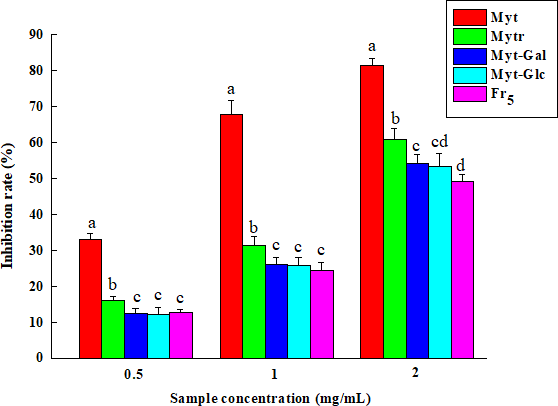
The inhibition rate of Fr5, myricitrin (Mytr), myricetin (Myt), myricetin-3-O-β-
The DPPH-Scavenging and Nitrite-Scavenging Activities of Myt, Mytr, Myt-Gal, and Myt-Glc.
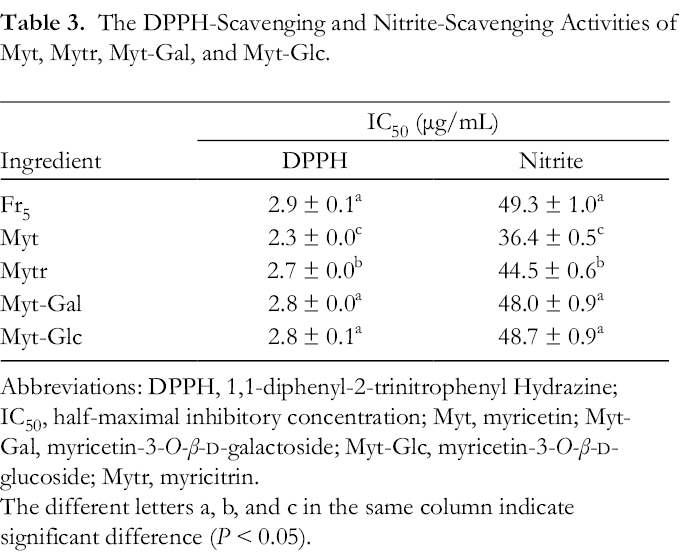
Abbreviations: Abbreviations: DPPH, 1,1-diphenyl-2-trinitrophenyl Hydrazine; IC50, half-maximal inhibitory concentration; Myt, myricetin; Myt-Gal, myricetin-3-O-β-
The different letters a, b, and c in the same column indicate significant difference (P < 0.05).
Conclusion
In this study, the effects of the phenolic extracts from D. lotus leaves on scavenging nitrite and inhibiting NAs formation were evaluated, and the active ingredients accounting for these effects were determined. Fr5 exhibited the strongest activity because of its highest phenolic content among the 7 isolated fractions prepared from the water extract of the leaves by ethanol precipitation and D101 macroporous resin column separation, which showed that Fr5 was the main active fraction of the D. lotus leaves. Five active ingredients for inhibiting NDMA were found in Fr5; 4 of them were identified as Myt, Mytr, Myt-Glc, and Myt-Gal. Of the 4 ingredients, Mytr and Myt were confirmed to have greater antioxidant, nitrite scavenging, and inhibition of NAs formation activity. The content of Mytr achieved 28240.7 mg/100 g in Fr5 and 2107.5 mg/100 g in D. lotus leaves, which was much higher than the contents of the other 3 ingredients, showing that Mytr was the main active ingredient of D. lotus leaves. This study revealed that D. lotus leaves, Mytr and Myt have antioxidant, nitrite scavenging, and inhibition of NAs formation effects. However, this study was only conducted in vitro and further experiments are needed in vivo.
Supplemental Material
Supplementary Material 1 - Supplemental material for Nitrite Scavenging and Inhibition of N-Nitrosamines Formation by Phenolic Extracts From Diospyros lotus L. Leaves and Active Ingredients
Supplemental material, Supplementary Material 1, for Nitrite Scavenging and Inhibition of N-Nitrosamines Formation by Phenolic Extracts From Diospyros lotus L. Leaves and Active Ingredients by YanHua Tian, HuiZhi Du, Li Wang, ShiFei Li, Lu Zhang and LiWei Zhang in Natural Product Communications
Footnotes
Declaration of Conflicting Interests
The author(s) declared no potential conflicts of interest with respect to the research, authorship, and/or publication of this article.
Funding
The author(s) disclosed receipt of the following financial support for the research, authorship, and/or publication of this article: Department of Science and Technology (the Key Projects of Shanxi Province Key R&D Program, China) (Nos. 201603D14010 and 201603D3114015).

Supplemental Material
Supplemental material for this article is available online.
References
Supplementary Material
Please find the following supplemental material available below.
For Open Access articles published under a Creative Commons License, all supplemental material carries the same license as the article it is associated with.
For non-Open Access articles published, all supplemental material carries a non-exclusive license, and permission requests for re-use of supplemental material or any part of supplemental material shall be sent directly to the copyright owner as specified in the copyright notice associated with the article.
