



Abstract
Endostemon tereticaulis (poir.) M.Ashby is a species of the Lamiaceae family present in Niger. This plant is used in traditional medicine due to its various biological potentialities. The present study investigated the chemical composition of the essential oil and the antibacterial activity of the essential oil and ethanolic extract of Endostemon tereticaulis against resistant pathogenic bacteria. Gas chromatography-mass spectrometry analysis of the essential oil led to the identification of 43 compounds representing 99.55% of the total essential oil. The major components were caryophyllene oxide (15.17%) followed by α-humulene (13.96%), α-copaene (11.75%), (E)-β-caryophyllene (8.44%), and δ-cadinene (6.78%). The antibacterial activity was tested against multiresistant Acinetobacter baumannii P1483, Salmonella spp. H1548, extended-spectrum β-lactamase-Escherichia coli Bu8566, Enterobacter cloacae Bu147, Proteus mirabilis Bu190, Pseudomonas aeruginosa (ATCC 27853), Klebsiella pneumoniae (ATCC 700603), Escherichia coli (ATCC 25922), Enterococcus faecium H3434, methicillin-resistant Staphylococcus aureus P1123, and Staphylococcus aureus (ATCC 25923). The antibacterial assays revealed that the essential oil was more active than the ethanolic extract against the studied bacteria with minimal inhibitory concentration (MIC) and minimal bactericidal concentration (MBC) values ranging from 0.06 to 2 mg/mL. Also, the ethanolic extract was effective against the bacteria tested with MIC and MBC values ranging from 0.12 to 3 mg/mL. This study showed that Endostemon tereticaulis essential oil is rich in bioactive compounds. Ethanolic extract and essential oil exhibited potential antibacterial activity. These results provide a scientific basis for the use of this plant in traditional medicine. The current study described for the first time the antibacterial activity of Endostemon tereticaulis.
The increasing resistance to antibiotics by pathogenic bacteria has emerged as a public health concern causing high morbidity and mortality rates. 1,2 Pathogenic bacteria have been recovered from humans with various clinical manifestations and multidrug resistance (MDR). 3,4 It has been proven that pathogenic bacteria have a strong adaptive capacity and have developed different mechanisms of resistance to antibiotics, known as MDR. 5 -7 Due to such concern, new research must be launched to find new sources of antibiotic agents or treatment strategies. 8 Therefore, medicinal and aromatic plants have gained the great interest for researchers as an alternative source of antibiotic agents and as an effective approach for the treatment of infection. 9 Several previous studies have reported antibacterial activity potential of essential oils (EOs) and extracts of aromatic and medicinal plants, against various microorganisms. 10 -14 Among these plants, Endostemon tereticaulis (Poir.) M.Ashby, 15 locally known as “Kimba-bayou” and “Gandji-gabu” in Niger, is a perennial herb of the Lamiaceae family. This species is expanded from Senegal to Ethiopia, and Niger. 16 Endostemon tereticaulis has many traditional uses in Niger to treat some diseases such as hemorrhoids, rheumatism, stomachache, hypertension, stomach disease, evil spirit, and as decoctions for baby. Other studies have reported the biological activities and traditional uses of this plant. Odalo et al 17 have reported the repellent activity of Endostemon tereticaulis EO against the adults of Anopheles gambiae. The whole plant is used as topical against the evil eye in Ethiopia. 18 The decoction of the aerial parts of this plant is used in the treatment of asthenia and weight loss in Niger. 16 The present study aims to investigate the chemical composition of the EO as well as evaluating the antibacterial activity of the EO and ethanolic extract of Endostemon tereticaulis against resistant pathogenic bacteria. At this date, Endostemon tereticaulis has not been examined yet for antibacterial activity.
Results and Discussion
Chemical Composition of the EO
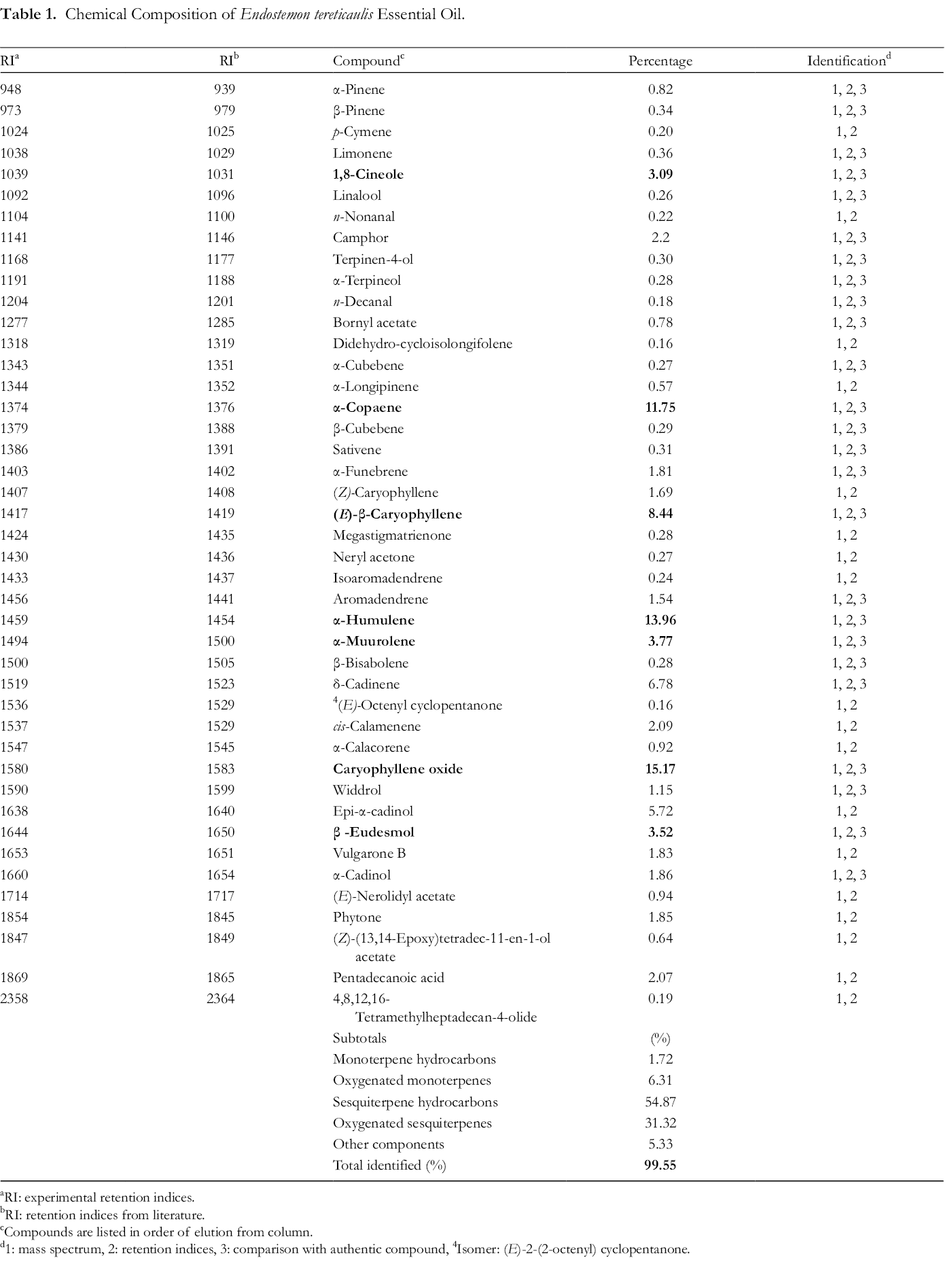
The EO extraction yield of Endostemon tereticaulis was 0.08%. The chemical composition of the EO was analyzed by gas chromatography mass spectroscopy (GC-MS) method, which is a modern sensitive and appropriate method for the identification and quantification of chemical constituents from herbal raw material. 19,20 The EO chemical composition analysis results are presented in Table 1. The constituents were identified by comparing their retention indices (RI) determined by using a homologous series of n-alkanes and mass spectral fragmentation with those stored in the NIST08.LIB mass spectral libraries of the GC-MS data system and from the literature data. In total, 43 compounds were identified in the EO of Endostemon tereticaulis representing 99.55% of the total oil (Table 1).
Chemical Composition of Endostemon tereticaulis Essential Oil.
aRI: experimental retention indices.
bRI: retention indices from literature.
cCompounds are listed in order of elution from column.
d1: mass spectrum, 2: retention indices, 3: comparison with authentic compound, 4Isomer: (E)-2-(2-octenyl) cyclopentanone.
The main compounds of the EO were caryophyllene oxide (15.17%), followed by α-humulene (13.96%), α-copaene (11.75%), (E)-β-caryophyllene (8.44%), δ-cadinene (6.78%), epi-α-cadinol (5.72%), α-muurolene (3.77%), β-eudesmol (3.52%), and 1,8-cineole (3.09%). Some of these chemical constituents identified were reported to have biological properties. Among them, caryophyllene oxide, α-copaene, δ-cadinene, limonene, 1,8-cineole, camphor, linalool, bornyl acetate, α-terpineol, α-pinene, and β-pinene were reported to have antimicrobial properties. 21 -23 Furthermore, α-copaene, δ-cadinene, caryophyllene oxide, α-humulene, β‐pinene, 1,8-cineole, limonene, terpinen-4-ol, α-terpineol, linalool, and bornyl acetate have been reported to have anti-inflammatory activity. 24,25 The antioxidant activity of α‐copaene, caryophyllene oxide, and α‐pinene has also been reported. 24,26 Sesquiterpene hydrocarbons (54.87%) and oxygenated sesquiterpenes (31.32%) represented the main classes of compounds in the EO obtained from Endostemon tereticaulis aerial parts, while oxygenated monoterpenes (6.31%) and monoterpene hydrocarbons (1.72%) were found in less significant quantities. Our results are different from the results reported by Odalo et al 17 on the EO composition of Endostemon tereticaulis from Kenya. They identified 32 constituents in the oil and the major components were limonene (7.54%), terpinen-4-ol (6.23%), α-pinene (5.51%), β-pinene (5.07%), (E)-β-caryophyllene (4.69%), δ-amorphene (3.41%), fenchone (3.96%), α-ylangene (3.00%), and α-humulene (2.69%). This quantitative and qualitative difference found in the chemical composition of the EO of Endostemon tereticaulis aerial parts must be due to the used part of the plant, 27 the vegetative stage, 28 or even the genetic factors. 29 However, we have found more constituents and noticed a difference in the major compounds. This is the first report on the chemical composition of the EO of this species from Niger.
Antibacterial Activity
The antibacterial activity of the EO and the ethanolic extract of Endostemon tereticaulis were determined against some human pathogenic bacteria including various Gram-negative ones: multiresistant Acinetobacter baumannii P1483, Salmonella spp. H1548, extended-spectrum β-lactamase (ESBL)-Escherichia coli Bu8566, Enterobacter cloacae Bu147, Proteus mirabilis Bu190, Pseudomonas aeruginosa (ATCC 27853), Klebsiella pneumoniae (ATCC 700603), and Escherichia coli (ATCC 25922); and Gram-positive ones: Enterococcus faecium H3434, methicillin-resistant Staphylococcus aureus P1123, and Staphylococcus aureus (ATCC 25923).
Antibiotic Susceptibility Test
To evaluate the antibiotic resistance of the pathogenic bacteria studied, we decided to analyze their antibiotic susceptibility against certain antibiotics. The results of the studied bacteria’s sensibility to antibiotics are shown in Table 2. The results were interpreted according to the guidelines of the Clinical and Laboratory Standards Institute 30 based on the diameters of inhibition zones.
The Studied Bacteria's Sensibility to Antibiotics .

ATCC, American Type Culture Collection; S. aureus, Staphylococcus aureus; E. coli, Escherichia coli; ESBL, extended-spectrum β-lactamase; I, intermediate; KP, Klebsiella pneumoniae; MRAB, multiresistant Acinetobacter baumannii; MRSA, methicillin-resistant Staphylococcus aureus; PA, Pseudomonas aeruginosa; R, resistant;S, susceptible.
It was observed that 6 of the bacteria tested were resistant to gentamicin (Salmonella spp. H1548, Escherichia coli ATCC 25922, ESBL-Escherichia coli Bu8566, Enterobacter cloacae Bu147, Enterococcus faecium H3434, and KP ATCC 700603) and 8 of them were resistant to oxacillin (MRAB P1483, Salmonella spp. H1548, Escherichia coli ATCC 25922, ESBL-Escherichia coli Bu8566, Enterobacter cloacae Bu147, Enterococcus faecium H3434, KP ATCC 700603, and PA ATCC 27853). Only 3 pathogenic bacteria were resistant to imipenem (IPM) (MRAB P1483, Enterobacter cloacae Bu147, and Enterococcus faecium H3434). Colistin was ineffective to 4 bacteria strains (Escherichia coli ATCC 25922, Enterobacter cloacae Bu147, KP ATCC 700603, and PA ATCC 27853), and also, tetracycline was not active against 4 bacteria strains (MRAB P1483, Enterobacter cloacae Bu147, Enterococcus faecium H3434, and Proteus mirabilis Bu190). Thus, 5 pathogenic bacteria were resistant to chloramphenicol (MRAB P1483, MRSA P1123, Enterobacter cloacae Bu147, Enterococcus faecium H3434, and KP ATCC 700603). However, MRAB P1483, Enterobacter cloacae Bu147, Enterococcus faecium H3434, and PA ATCC 27853 have not shown any susceptibility to all the antibiotics tested while KP ATCC 700603 was susceptible only to IPM and Escherichia coli ATCC 25922 only to chloramphenicol. The present pathogenic bacteria tested are responsible for several human diseases. 31 These pathogenic bacteria were also found to be resistant to multiple antibiotics. 32 -34 At the United States in 2017, the Center for Disease and Control Prevention announced that at least 2 million people are infected with antibiotic-resistant bacteria each year and at least 23 000 of them die. 35 Therefore, in order to treat illness with multidrug-resistant human pathogenic bacteria, there is a need to select an appropriate antibiotic from the susceptibility test.
Agar Disc Diffusion Assay
The antibacterial activity of the EO and the ethanolic extract of Endostemon tereticaulis was investigated against numerous human pathogenic Gram-positive and Gram-negative bacteria. The bacteria strains tested in this study are known as the pathogenic bacteria that caused many kinds of human infections such as respiratory tract, urinary tract, gastrointestinal tract, nosocomial infections, pneumonia, bacteremia, meningitis, septicemia, diarrhea, abscesses, osteomyelitis, pustules, furuncles, ulcers, and boils. 6,36 -41 The antibacterial potential was determined by measuring the inhibition zone diameter of bacterial growth around the discs by the agar disc diffusion method. The bacteria sensitivity to the EO, the ethanolic extract, and chloramphenicol as a positive control was estimated by the diameter of the inhibition zones as described by Ponce et al. 42 The results are presented in Figure 1.

Zone diameter of inhibition (mm) from the action of chloramphenicol and Endestemon tereticaulis essential oil and ethanolic extract against the pathogenic bacteria. E. cloacae, Enterobacter cloacae; E. coli, Escherichia coli; E. faecium, Enterococcus faecium; ESBL, extended-spectrum β-lactamase; K. pneumoniae, Klebsiella pneumoniae; MRSA, methicillin-resistant Staphylococcus aureus; P. aeruginosa, Pseudomonas aeruginosa; P. mirabilis, Proteus mirabilis; S. aureus, Staphylococcus aureus.
The antibacterial potential was variable according to the samples and bacteria tested. The EO, ethanolic extract, and chloramphenicol have shown a wide antibacterial spectrum against the microorganisms tested. The EO was more active than the ethanolic extract and chloramphenicol against MRSA P1123 and Enterococcus faecium H3434. The higher inhibitory diameter was obtained for MRSA P1123 (18 mm). The ethanolic extract has proved to be more active than the EO and chloramphenicol against MRAB P1483, Enterobacter cloacae Bu147, and Pseudomonas aeruginosa ATCC 27853, with the high inhibitory diameter for ESBL-Escherichia coli Bu8566 and Pseudomonas aeruginosa ATCC 27853 (13 mm). Chloramphenicol was more active than the EO and ethanolic extract against Proteus mirabilis Bu190, Salmonella spp. H1548, Escherichia coli ATCC 25922, ESBL-Escherichia coli Bu8566, Klebsiella pneumoniae ATCC 700603, and S. aureus ATCC 25923. The higher inhibitory diameter was obtained for Salmonella spp. H1548 (30 mm). These results indicated that Gram-positive bacteria are more sensitive than Gram-negative bacteria to the EO and ethanolic extract of Endostemon tereticaulis. This difference must be due to the cell wall structure of the bacteria. The Gram-positive bacteria have a thick peptidoglycan layer comparing to the Gram-negative bacteria that have a double lipid layer, which contains lipopolysaccharides. 43 Moreover the Gram-negative bacteria have been reported to be more resistant to the effect of natural products such as EO and extracts, due to the external lipopolysaccharide membrane that enables them to be more resistant. 44
Microdilution Assay
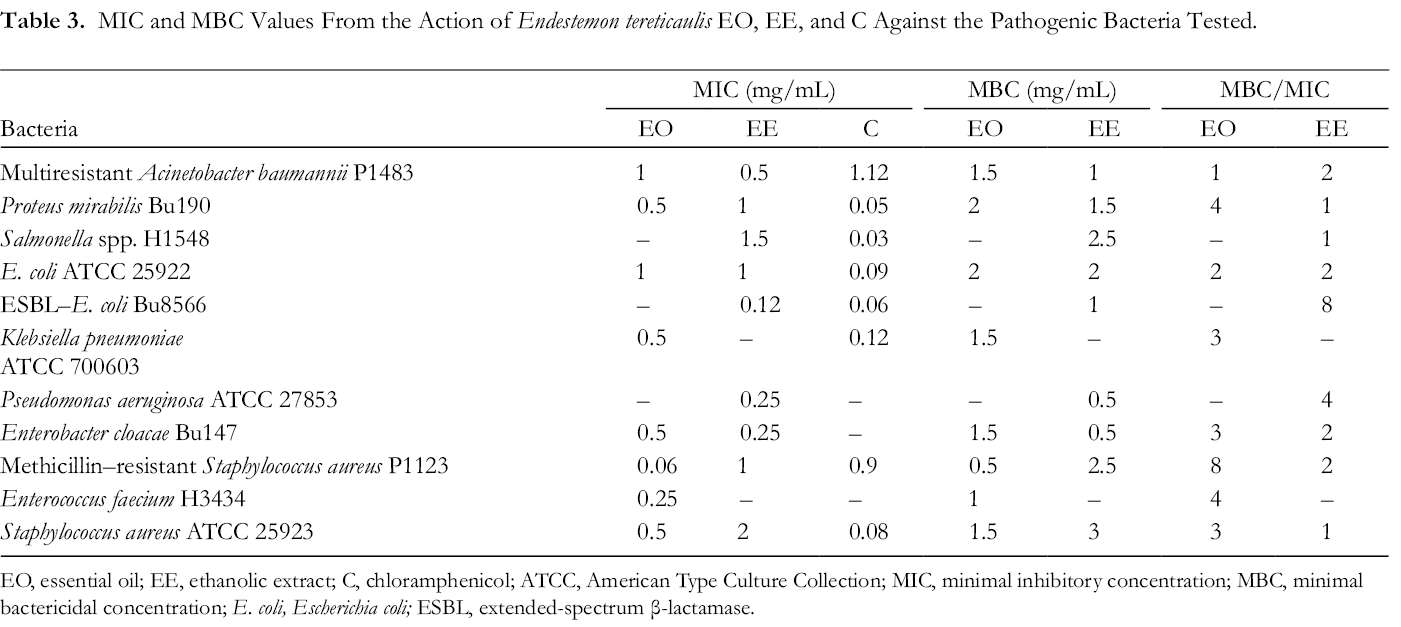
The antibacterial activity of EO and ethanolic extract of Endostemon tereticaulis was also estimated by determining the minimal inhibitory concentration (MIC) and the minimal bactericidal concentration (MBC). The MIC was determined for the essential oil and the ethanolic extract that showed antibacterial potential in the agar disc diffusion assay. The MBC was determined for the inoculate aliquots of culture from the MIC wells that showed no visible growth of bacteria. The MBC/MIC ratio was used to determine the antibacterial powers of the EO and the ethanolic extract. When this ratio is greater than 4, the EO or the ethanolic extract is considered as bacteriostatic, and when it is lower than or equal to 4, it is bactericidal. 45 The MIC and MBC values from the microdilution assay are shown in Table 3.
MIC and MBC Values From the Action of Endestemon tereticaulis EO, EE, and C Against the Pathogenic Bacteria Tested.
EO, essential oil; EE, ethanolic extract; C, chloramphenicol; ATCC, American Type Culture Collection; MIC, minimal inhibitory concentration; MBC, minimal bactericidal concentration; E. coli, Escherichia coli; ESBL, extended-spectrum β-lactamase.
The evaluation of MIC values showed variability of sensitivity among the bacteria strains tested, with values ranging from 0.03 to 2 mg/mL. The EO has shown strong antibacterial effect against methicillin-resistant Staphylococcus aureus P1123 and Enterococcus faecium H3434 corresponding to the lowest MIC values of 0.06 and 0.25 mg/mL, respectively. The lowest MIC value (0.12 mg/mL) of the ethanolic extract was obtained against ESBL-Escherichia coli Bu8566. Salmonella spp. H1548 showed the highest sensitivity against chloramphenicol (MIC = 0.03 mg/mL), which means that chloramphenicol was more effective against this strain. The MBC values were identical to or greater than MIC values. The MBC/MIC ratio showed a bacteriostatic effect of the EO to methicillin-resistant Staphylococcus aureus P1123 and a bacteriostatic effect of the ethanolic extract to ESBL-Escherichia coli Bu8566. These results showed the effective antibacterial capacity of the EO and ethanolic extract of Endostemon tereticaulis against the pathogenic bacteria tested. The antibacterial potential variation of the EO and the ethanolic extract may arise from variation in their chemical compositions and percentage content of active constituents. Some researchers associated the antibacterial properties of EO and extracts of plants to their oxygenated monoterpenes constituents, such as terpinen-4-ol, α-terpineol, α-pinene, and other compounds such as γ-terpinene,β-caryophyllene, and sabinene. 46 -48 Some authors have attributed the antibacterial effect of EO and extracts of plants to the hydrophobicity characters of these EO and extracts of plants. 49,50 However, the EO and extracts of plants are constituted of various major to minor constituents; therefore, the synergistic effects of these compounds should be taken into consideration for the result of the antibacterial activity. To our knowledge, there are no reports on the antibacterial activity of Endostemon tereticaulis to compare our results.
Conclusions
The GC-MS analysis of Endostemon tereticaulis EO revealed the remarkable presence of compounds that possess antioxidant, antibacterial, and anti-inflammatory properties such as caryophyllene oxide, α‐copaene, and α‐pinene. The EO and the ethanolic extract of Endostemon tereticaulis have shown a good antibacterial effect against the human pathogenic Gram-positive and Gram-negative bacteria tested. The results obtained in the present study suggested that Endostemon tereticaulis, which proved to be potentially effective against the pathogenic bacteria tested, can be considered as a natural source of bioactive compounds, and it could be used as a possible alternative way to treat some infectious diseases caused by those human pathogenic bacteria. Further studies are needed to assess the toxicity and potential of using this plant EO and extracts. These results constituted scientific data in order of the valorization of aromatic and medicinal plants of Niger. To our knowledge, this report is the first study on the antibacterial activity of Endostemon tereticaulis.
Materials and Methods
Antibiotics, Broth, and Chemical Reagents
Dimethyl sulfoxide (DMSO), ethanol, ascorbic acid, iron III chloride (FeCl3), potassium ferricyanide (K3Fe(CN)6), and all other chemical reagents used in this study were obtained from Sigma-Aldrich. Sterile paper discs and culture media (nutrient broth, nutrient agar) were products of Becton, Dickinson & Co (New Jersey, USA). Standard antibiotics were purchased from OXOID (UK) while the sterile 96-well microtiter plates were purchased from CITOTEST (China).
Plant Material Collection and EO Extraction
The aerial parts of Endostemon tereticaulis were collected from the Dosso region, located in the South of Niger (Altitude 219 m, latitude (N) 13°05′698″, Longitude (E) 003°35′064″) during October 2017. The plant materials were air-dried at room temperature away from light. The identification of the plant was made by a botanist, Professor M. Saadou, Department of Biology, Faculty of Sciences and Techniques, Abdou Moumouni University of Niamey, Niger. A voucher number (NA/05) was given to the plant. The EO was obtained by hydrodistillation using a Clevenger-type apparatus. 51 A hundred grams of dried aerial parts of the plant were hydrodistilled for 3 hours and the EO obtained was stored at 4 °C until analyses.
Ethanolic Extract Preparation
The dried aerial parts of the plant were ground to powders with a grinder (FRITSCH, Pulverisette 6). Forty grams of powder from the aerial parts of the plant were placed in 200 mL of ethanol and left under agitation for 24 hours at room temperature. The mixture was filtered on filter paper, and the solvent was evaporated to dryness under reduced pressure with a rotary evaporator (BUCHI Rotavapor R-210) at 50 °C. The dry residues obtained were weighed using a scale (WADWAG AS310.R1) and dissolved in few milliliters of solvent.
GC-MS Analysis of EO
The qualitative and quantitative analysis of the EO by GC-MS technique was carried out using a GCMS-QP2010SE Gas Chromatograph Mass Spectrometer (Shimadzu Corporation, Columbia, USA) equipped with 2 columns, a Zebron ZB-5ms (20 m × 0.18 mm × 0.18 µm) and Zebron ZB-WAX (20 m × 0.18 mm × 0.18 µm), and coupled with a mass analyzer single quadrupole system, operating in Scan/SIM mode. The sample was injected by using split mode (1/30), the volume injected was 1 µL, and nitrogen was used as carrier gas (1 mL/min). The injector temperature was at 280 °C. The initial temperature of the columns was maintained at 50 °C for 3 minutes and increased at 2 °C/min until 280 °C, and then maintained at 280 °C for 30 minutes. The mass spectrometer ionization mode was the electronic impact mode. Acquisition mass range 20-500, scan time 0.2 seconds. GC/flame ionization detection analysis was performed under the same experimental conditions as described for the GC/MS. Constituents were identified by comparing their RI determined by using a homologous series of n-alkanes and mass spectral fragmentation patterns with those stored in the NIST08.LIB mass spectral libraries of the GC-MS data system and from the literature data. 52 Component relative concentrations were calculated based on GC peak areas without using correction factors.
Antibacterial Activity
The antibacterial activity evaluation experiments were performed at the Laboratory of Microbiology and Virology of Mohamed VI University Hospital Center in Marrakech, Morocco.
Bacterial Strains
Eleven pathogenic bacteria strains were used in the current study, including Gram-negative ones: Multiresistant acinetobacter baumannii P1483, Salmonella spp. H1548, ESBL-Escherichia coli Bu8566, Enterobacter cloacae Bu147, Proteus mirabilis Bu190, Pseudomonas aeruginosa (ATCC 27853), Klebsiella pneumoniae (ATCC 700603), Escherichia coli (ATCC 25922); and Gram-positive ones: Enterococcus faecium H3434, methicillin-resistant Staphylococcus aureus P1123, and Staphylococcus aureus (ATCC 25923). All the clinical strains tested were recovered from clinical specimens received at the Laboratory of Microbiology and Virology of Mohamed VI University Hospital Center in Marrakech, Morocco. The identification of the bacteria was carried out using an automated system: Phoenix BD system (BD Diagnostic Systems, Sparks, MD, USA). The reference strains (ATCC: American Type Culture Collection Center, Manassas, VA, USA) were obtained from the culture collection of the Laboratory of Microbiology and Virology of Mohamed VI University Hospital Center in Marrakech (Morocco).
Antibiotic Susceptibility Test
In order to evaluate the antibiotic resistance of the studied pathogenic bacteria, they were also tested against some antibiotics according to the method described by Bauer et al. 53 Discs of the following antibiotics were placed on Petri dishes containing the Mueller-Hinton Agar seeded with confluent growth of bacteria (108 CFU/mL) and incubated at 37 °C for 24 hours: Gentamycin (10 µg/disc), chloramphenicol (C; 30 µg/disc), tetracycline (TE; 30 µg/disc), oxacillin (5 µg/disc), colistin (CT; 10 µg/disc), and imipenem (10 µg/disc).
Agar Disc Diffusion Assay
The antibacterial activity of the different samples was investigated by using the agar disc diffusion method. 54 The test bacteria were seeded on Petri dishes containing the Mueller-Hinton Agar and incubated for 24 hours at 37 °C, in order to obtain a youth culture of bacterial colonies. Twenty-four hours after incubation, these colonies are taken and placed in 3 mL of sterile physiological water at 0.9% salt (NaCl) to prepare a bacterial suspension adjusted to 0.5 McFarland (108 CFU/mL) standard turbidity by a spectrophotometer (BD PhoenixSpec). Sterile paper discs Whatman N°1 (6 mm in diameter) were placed on the surface of the Petri dishes containing the Mueller-Hinton Agar seeded with the pathogenic bacteria and the discs were impregnated with 10 µL of EO or ethanolic extract. Discs impregnated with ethanol and DMSO were used as negative control, while chloramphenicol was used as a positive control. All Petri dishes were incubated in an incubator at 37 °C for 24 hours for bacterial growth. The antibacterial activity was evaluated by measuring the diameter of inhibition zones of bacterial growth around the discs; each experiment was repeated in triplicate.
Microdilution Assay
The MIC was determined using the microdilution method as described by(Chrysargyris et al.,2017; Selim et al.,2014) 55,56 with some modifications. The MIC values of the EO and ethanolic extract were determined for the bacterial strains, which have shown sensitivity in the agar disc diffusion assay. A range of concentrations from 0.03 to 10 mg/mL was prepared in DMSO. The microdilution assay was carried out using sterile 96-well microtiter plates. The 96-well plates were prepared by putting 90 µL of Mueller-Hinton broth (MHB) and 10 µL of the inoculum into each well. The inoculum of the bacterial strains was prepared from 24-hour broth cultures and suspensions were adjusted to 0.5 McFarland (108 CFU/mL) standard turbidity. One hundred microliters of each concentration of the serial dilution of the EO and the ethanolic extract were added and the final volume in each well was 200 µL. The positive control was prepared containing 90 µL of MHB, 10 µL of the inoculum, and 100 µL of chloramphenicol, and the negative control was also prepared containing 90 µL of MHB, 10 µL of the inoculum, and 100 µL of sterile DMSO solution (without extract) in the last wells of each strip. After mixing the wells, they were covered and incubated at 37 °C for 24 hours. The MIC value was defined as the lowest concentration of the EO or the extract that inhibited the visible growth of the microorganism test after 24 hours of incubation. To determine the MBC, the content of each well without any visible growth of bacteria was seeded on Petri dishes containing the Mueller-Hinton Agar and incubated for 24 hours at 37 °C. 57 The MBC was considered as the concentration of the EO or ethanolic extract that did not exhibit any viable organism in the culture after 24 hours of incubation.
Footnotes
Acknowledgments
The author(s) are grateful to Professor Jean Luc-Pirat ENSC, Montpellier France and Dr. Nabila Soraa, Laboratory of Microbiology and Virology, Faculty of Medicine and Pharmacy, Cadi Ayyad University, Marrakech, Morocco.
Declaration of Conflicting Interests
The author(s) declared no potential conflicts of interest with respect to the research, authorship, and/or publication of this article.
Funding
The author(s) received no financial support for the research, authorship, and/or publication of this article.
