



Abstract
In leaf cuticular wax of Pinus pinaster, content of nonacosan-10-ol is high (77.1% on average). n-Alkanes ranged from C18 to C35 with the most dominant C29 (24.8%). The carbon preference index (CPItotal) ranged from 3.1 to 5.6 (4.0 on average), while the average chain length (ACLtotal) ranged from 14.0 to 17.0 (14.8 on average). Long-chain n-alkanes (n-C25-35) strongly dominated (80.1%) over middle-chain (n-C21-24
Keywords
Pinus pinaster Miller, also known as Pinus maritima (Maritime pine 1 or Cluster pine 2 ), is a 2-needle pine which belongs to family Pinaceae, genus Pinus, subgenus Pinus, section Pinus, and subsection Pinaster (classification of Gernandt et al 3 ). This Mediterranean pine naturally spreads from France to Italy, from Morocco to Tunisia as well as at islands Sardinia and Corsica. 4
n-Alkanes are among the most common hydrocarbons in cuticular waxes of numerous higher plants. Cuticular waxes and especially n-alkanes have often been studied in conifer species trees. 5,6 They were also studied in herbaceous plants. 7 -13 They have already been investigated and were also used in chemosystematic and phylogenetic studies, hybrid detection, etc. 6 -13 Sometimes, they were used in studies of air pollution. 14 Cuticular waxes and n-alkanes of many Pinus species have already been reported. 14 -18 Recently, they were investigated at population level (in the case of relic pines, Pinus heldreichii, Pinus nigra, and Pinus peuce). 19 -22
The secondary alcohol, nonacosan-10-ol, is a dominant compound in many gymnosperms and angiosperms. 18 -20 The aim of this study is to examine for the first time the amount of nonacosan-10-ol content as well as n-alkane profile in P. pinaster leaf (needle) cuticular wax . Also, furthermore, these results could be used in chemotaxonomic investigations, comparing P. pinaster with other pines of section Pinaster.
Results and Discussion
Nonacosan-10-ol content is higher in spring (79.0%) than in autumn needles (75.2%). Mean value is 77.1%. Inside the subsection Pinaster, nonacosan-10-ol of P. pinaster is equal and is similar to nonacosan-10-ol of P. halepensis (77.1%), 18 but higher than in wax of relic species, relic P. heldreichii (55.5%). 19
n-Alkanes of P. pinaster ranged from C18 to C35, where C29 (24.8%, mean value) was the most dominant one (Figure 1; Table 1). Spring needles ranged from C18 to C35, while autumn needles ranged from C20 to C33. C29 was more abundant in spring (26.5%) than in autumn needles (23.0%). In P. heldreichii, this range is narower, C18 to C33, with the most dominant C23. 19
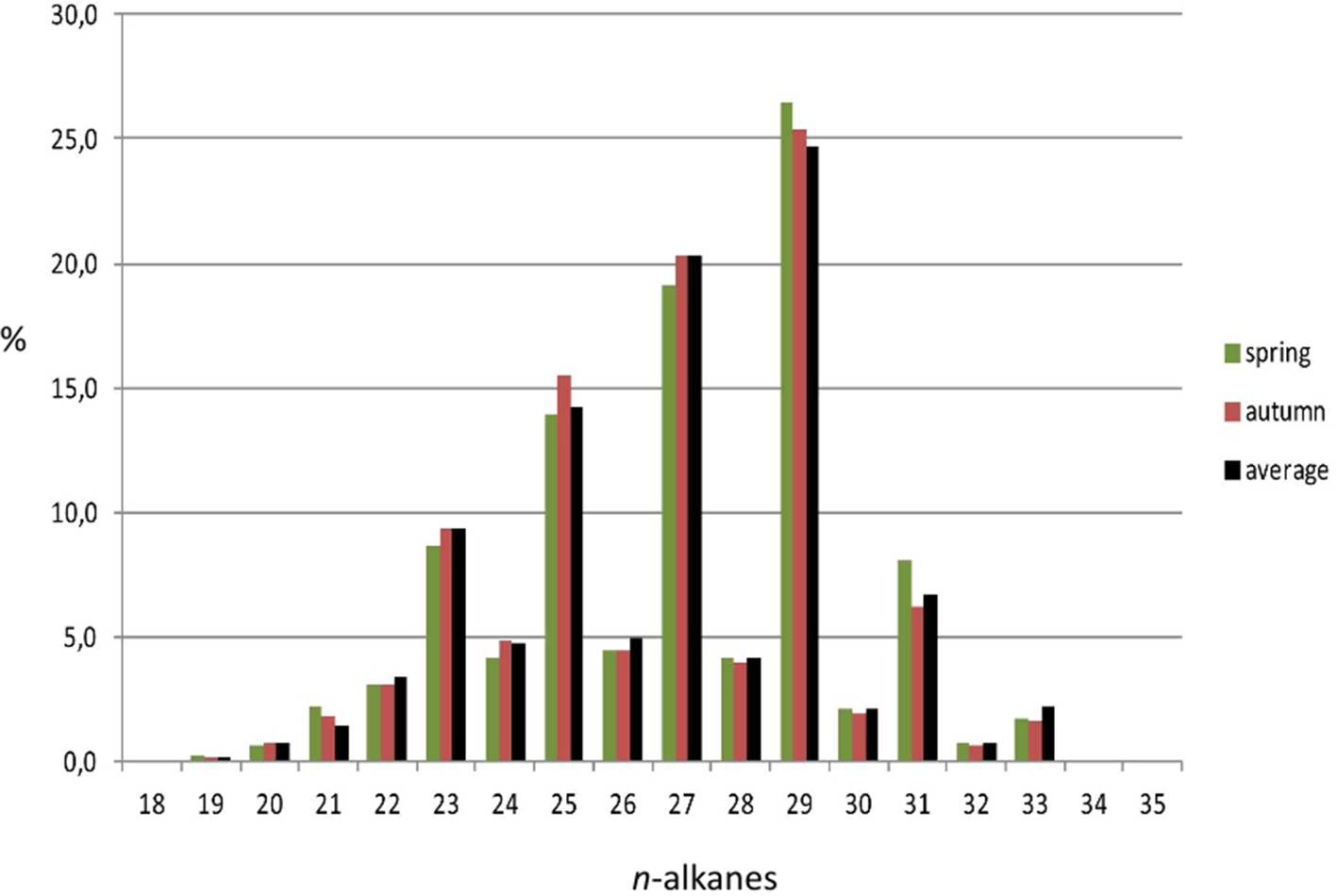
Profile of n-alkanes (%) in needle waxes of Pinus pinaster.
The Most Abundant n-Alkanes; Carbon Preference Indices; Average Chain Lengths; and Relative Proportions of Short-, Mid-, and Long-Chain n-Alkanes in the Needle Wax of Pinus pinaster.

aCmax: 3 to 4 most abundant n-alkanes are given in the row Range and the most abundant among them in the row Mean.
bCPItotal = Ʃodd C n /Ʃeven C n 23 ; C n is the concentration of alkane containing n C-atoms.
cCPI25-33 = [Ʃ(C25 – C33)odd/Ʃ(C24 – C32)even + Ʃ(C25 – C33)odd/Ʃ(C26 – C34)even]/2. 24
dCPI20-36 = [Ʃ(C20 – C36)odd/Ʃ(C19 – C35)even + Ʃ(C20 – C36)odd/Ʃ(C21 – C37)even]/2. 24
eCPI15-21 = [Ʃ(C15 – C21)odd/Ʃ(C14 – C20)even + Ʃ(C15 – C21)odd/Ʃ(C16 – C22)even]/2. 24
fCPI25-31 = [Ʃ(C25 – C31)odd/Ʃ(C24 – C30)even + Ʃ(C25 – C31)odd/Ʃ(C26 – C32)even]/2. 24
gACLtotal = (ƩC n × n)/ƩC n . 25
hACL23–35 = (23 × C23 + 25 × C25 + 27 × C27 + 29 × C29 + 31 × C31 + 33 × C33 + 35 × C35)/(C23 + C25 + C27 + C29 + C31 + C33 + C35). 25
i n-C18-20, n-C21-24, and n-C25-35: relative proportions (%) of short-, middle-, and long-chain n-alkanes, respectively, calculated according to Kuhn et al 26 and expressed as percentage of the total n-alkanes (C18-35).
The carbon preference index (CPItotal) 23 of P. pinaster ranged from 2.6 to 5.6 (4.0 on average) (Table 1). Larger range was in spring needles. In P. heldreichii, it ranged from 0.8 to 3.1 (1.6 in average). 19 All CPIs of P. pinaster (Table 1) exhibited odd/even predominance (OEP) (because CPI > 1 indicates OEP, CPI < 1 denotes OEP). 23 The same situation was with P. halepensis 18 which also belonged to subsection Pinaster.
The average chain length (ACL total) in P. pinaster ranged from 14.0 to 17.0 (14.8 on average) (Table 1), where long-chain n-alkanes dominated (80.1%). Similar results were found in P. halepensis. 18 In P. heldreichii, ACL total ranged from 20.9 to 26.5 (24.4 in average), where long-chain n-alkanes did not strongly dominate (middle chain: 37.9% and long chain: 49.6%). 19
This study was done in small number of trees of P. pinaster. Full variability of nonacosan-10-ol and n-alkanes contents could be obtained in further population studies.
Experimental
Plant Material
Twigs with 1-, 2-, and 3-year-old needles from the lowest third of the full tree crown of several P. pinaster trees were collected in spring and autumn 2015 from Croatia, Island Korčula. The collected twigs were stored at –20°C prior to further needle analyses.
Extraction of Needle Wax for the Investigation of Nonacosan-10-ol Content
A concentrated sample of epicuticular wax was collected from each tree by immersing 3 g of needles in 10 mL of n-hexane (HPLC grade; Merck, Darmstadt) for 45 seconds. The samples were then dried under vacuum at 60°C, and aliquots of 1 mL of these samples were used to determine the nonacosan-10-ol content by gas chromatography-mass spectrometric (GC-MS) analysis.
Extraction of Needle Wax for the Investigation of the n-Alkanes
The concentrated extracts, obtained as described above, were chromatographed on small-scale columns using a Pasteur pipette filled with silica gel 60 (SiO2, 0.2-0.5 mm; Merck) previously activated at –20°C. 23 The wax samples were obtained by elution with 5 mL of hexane and stored at –20°C until further analysis.
Gas Chromatography and Gas Chromatograpy-Mass Spectrometric Analyses of Needle Wax
Gas chromatography and GC-MS analyses were performed using an Agilent 7890A GC equipped with an inert 5975C XL EI/CI mass selective detector and flame ionization detector (FID) connected by capillary flow technology 2-way splitter with make-up. A HP-5MS capillary column (30 m × 0.25 mm × 0.25 μm) was used. The GC oven temperature was programmed from 60°C to 315°C at a rate of 3°C/min and held for 15 minutes. Helium was used as the carrier gas at 16.255 psi (constant pressure mode). An auto-injection system (Agilent 7683B Series Injector) was employed to inject 1 µL of sample. The sample was analyzed in the splitless mode. The injector temperature and the detector temperature were 300°C. Mass spectrometric data were acquired in the EI mode with scan range 30 to 550 m/z, source temperature 230°C, and quadrupole temperature 150°C; the solvent delay was 3 minutes.
Identification of Needle Wax Components
The components were identified based on their retention indices and comparison with reference spectra (Wiley and NIST databases) as well as by the retention time locking (RTL) method and the RTL Adams database. The retention indices were experimentally determined using the standard method of Van Den Dool and Kratz 27 involving retention times of n-alkanes injected after the sample under the same chromatographic conditions. The relative abundance of the n-alkanes was calculated from the signal intensities of the homologs in the GC-FID traces.
Footnotes
Acknowledgment
The authors are grateful to Dr Dragan Kovačević from Serbia and Ing. Milan Vojinović from Croatia, who collected plant material.
Declaration of Conflicting Interests
The author(s) declared no potential conflicts of interest with respect to the research, authorship, and/or publication of this article.
Funding
The author(s) disclosed receipt of the following financial support for the research, authorship, and/or publication of this article: This research was supported by the Ministry of Education, Science and Technological Development of the Republic of Serbia (Grant nos. 173029, 173021, and 172053).
