Nine compounds were isolated from leaves of Dendrobium officinale, including 1 new bibenzyl derivative, denofficin (1), and 8 known structurally related compounds, dendrocandin B (2), dendrocandin U (3), 3,4-dihydroxy-5,4′-dimethoxy bibenzyl (4), moscatilin (5), 4,4′-dihydroxy-3,5-dimethoxy bibenzyl (6), (S)-3,4,α-trihydroxy-5,4′-dimethoxy bibenzyl (7), gigantol (8), densiflorol A (9). The structures of these compounds were identified by spectroscopic methods. All isolated compounds were screened for their cytotoxicity against human cervical cancer cell line HeLa cells. Of them, compounds 1-3, 5, 6, and 8 were found to have the capabilities of proliferation inhibition against HeLa cells with half-maximal inhibitory concentration values ranging from 8.0 to 92.4 μM.
Dendrobium officinale, an herb plant endemic to China, belongs to a member of Dendrobium plants (Orchidaceae) and mainly distributed in eastern and southeastern China. The dried or fresh stems of this plant have been used as the precious traditional Chinese medicine for antipyretic, eyes-benefiting, and tonic purposes for thousands of years. In the Chinese Pharmacopoeia (2010 Edition), D. officinale has been recorded officially as the original material of “Tiepishihu”.1 In the process of making “Tiepishihu”, the leaves of D. officinale are usually removed, which leads to a huge waste of biological resources. Although multiple phytochemical studies focusing on stems of D. officinale have displayed the occurrence of polysaccharides, essential oils, alkaloids, and bibenzyls, etc,2 the chemical constituents of its leaves still remain unknown. As a part of the comprehensive development and utilization of leaf resources of D. officinale, the phytochemical investigation was performed. Herein, we described the isolation, structural elucidation of one new bibenzyl derivative, denofficin (1), as well as 8 structurally related known compounds, dendrocandin B (2), dendrocandin U (3), 3,4-dihydroxy-5,4′-dimethoxy bibenzyl (4), moscatilin (5), 4,4′-dihydroxy-3,5-dimethoxy bibenzyl (6), (S)-3,4,α-trihydroxy-5,4′-dimethoxy bibenzyl (7), gigantol (8), densiflorol A (9). Besides, their cytotoxic potential for human cervical cancer cell line HeLa cells was evaluated.
Denofficin (1), a whitish amorphous powder, has a positive reaction with ferric chloride reagent, proving the presence of the phenolic moiety. The molecular formula was determined to be C36H38O10 by the high-resolution electrospray ionisation mass spectrometry (HR-ESI-MS) (supplemental Figure S1) which afforded the quasi-molecular ion peak at m/z 629.2388 ([M − H]−, calcd. for C36H37O10, 629.2392). The infrared spectrum (supplemental Figure S2) of 1 displayed the absorptions for hydroxyl group (3519 and 3445 cm−1), methoxy group (2936 and 2852 cm−1), carbonyl group (1733 cm−1), and aromatic ring (1606, 1516, and 1454 cm−1). The ultraviolet absorption (Figure S3) maxima at λmax 273 nm suggested the presence of a bibenzyl skeleton.3-5 The 1H and 13C NMR data (Table 1) of 1 is highly similar to those of the known bibenzyl derivative, dendrocandin B (2, Figure 1).3 The main difference is the extra appearance of a set of signals assigned for p-hydroxylphenyl propionyl group (δH 7.04 [2H, d, J = 8.3 Hz], 6.70 [2H, d, J = 8.3 Hz], 2.83 [2H, m], and 2.58 [2H, m]; δC 132.4, 129.4, 115.4, 154.1, 29.9, 35.9 and 172.4) in 1. This indicated that 1 was the p-hydroxylphenyl propionyl acylation derivative of dendrocandin B, which was further supported by the HR-ESI-MS data. The p-hydroxylphenyl propionyl acylation took placed at the hydroxyl of C-9″, as suggested by the heteronuclear multiple bond correlation (HMBC) correlations (Figure 2 and supplemental figure S11) from Hα-9″ (δH 4.34)/Hβ-9″(δH 4.02) to C-9″′ (δC 172.4). Interpretation of the 1H-1H correlation spectroscopy (COSY), heteronuclear single quantum correlation (HSQC), and HMBC spectra (supplemental Figures S9-S11) of 1 confirmed the substitution pattern and fully assigned all 1H and 13C nuclear magnetic resonance (NMR) signals. The relative configuration between C-7″ and C-8″ was assigned as trans in view of the diaxial coupling constant J7″,8″ = 7.9 Hz.3 As for the absolute configuration of 1, it can be determined by the biogenetic law. The compound 2 was reported previously to have S configuration both at C-7″ and C-8″,3 and it was isolated from D. officinale where 1 was also found herein; from the biogenetic point of view, 1 and 2 would share some similar biosynthetic pathways and consequently have the same stereochemical configuration, which was further supported by the fact that they possess the same rotation value (−5.8 for 1 and −4.6 for 2). Thus, the structure of 1 was elucidated as ((2S,3S)-3-(4-hydroxy-3,5-dimethoxyphenyl)-8-methoxy-6-(4-methoxyphenethyl)-2,3-dihydrobenzo[b][1,4]dioxin-2-yl)methyl 3-(4-hydroxyphenyl)propanoate (Figure 1) and it was named denofficin.
1H and 13C Nuclear Magnetic Resonance Data of Compound 1 and Dendrocandin B (2) in Deuterated Chloroform (CDCl3).
aBruker Avance 600 spectrometer; chemical shifts (ppm) referred to CDCl3 (δH 7.26; δC 77.16).
Structures of compounds 1 and 2.
The key heteronuclear multiple bond correlations (H→C) of 1.
Together with the new bibenzyl derivative (1), 8 known structurally related compounds (2-9) were isolated from D. officinale. By comparison of their 1H, 13C NMR and ESI-MS spectral data with those reported in literatures, the known compounds were identified as dendrocandin B (2),3 dendrocandin U (3),5 3,4-dihydroxy-5,4′-dimethoxy bibenzyl (4),6 moscatilin (5),7 4,4′-dihydroxy-3,5-dimethoxy bibenzyl (6),8 (S)-3,4,α-trihydroxy-5,4′-dimethoxy bibenzyl (7),9 gigantol8,10 densiflorol A (9).11 Among them, compounds 5 and 9 were reported here from the title plant for the first time.
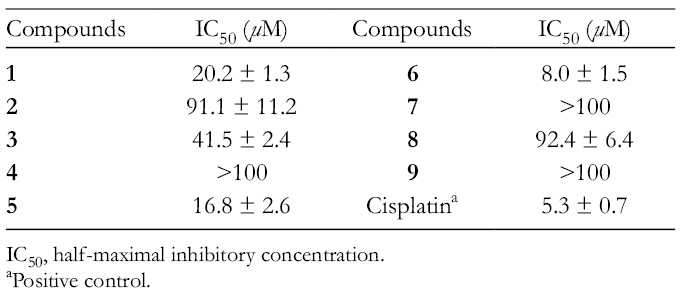
The cytotoxicity of all isolated compounds against human cervical cancer cell line HeLa cells was evaluated by a colorimetric cell counting kit-8 (CCK-8) assay described previously.12 As shown in Table 2, compound 6 revealed the highest cell proliferation inhibition against HeLa cells among the isolated compounds, with a half-maximal inhibitory concentration (IC50) value of 8.0 µM, which was comparable to that of the positive control, 5.3 µM. Compounds 1-3, 5, and 8 also exhibited mild cytotoxicity against HeLa cells with IC50 values ranging from 16.8 to 92.4 µM, while compounds 4, 7, and 9 were found to be inactive. It is worth noting that the preliminary structure-activity relationship could be inferred from these activity data. For example, for the common bibenzyls, the phenolic hydroxyl group at C-4′ might be important for their cytotoxicity. This was supported by the observation that compounds 5, 6, and 8, the three common bibenzyls with a hydroxyl substitution at C-4′, are active, while those ones without substitution or bearing methoxy group at C-4′ (4, 7, and 9) displayed no activity. For those structurally complex bibenzyl derivatives with a phenylpropane unit linked to the C6–C2–C6 skeleton through a dioxane bridge, the hydroxyl group at C-4′, however, appears inessential to their cytotoxicity. This was suggested by the observation that 1 bearing methoxy group at C-4′ is over twofold more active than 3 (with hydroxyl substitution at C-4′) and also 2. Our results indicated, in part, that the cell proliferation inhibition abilities of this special class of bibenzyl derivatives might be strengthened by the p-hydroxylphenyl propionyl acylation substitution at C-9″. However, the structure–activity relationship proposed here is preliminary and activity data of more bibenzyl derivatives will be required to confirm it.
Cytotoxicity of Bibenzyls 1-9 From D. officinale Against HeLa Cells.
IR spectrum was executed on Shimadzu Iraffinity-1 fourier-transform infrared spectrometer with potassium bromide disc (Shimadzu Co., Kyoto, Japan). Optical rotation was determined on a JASCO P-1020 polarimeter (JASCO International Corp., Ltd, Tokyo, Japan) at room temperature. NMR spectra were recorded on a Bruker Avance 600 spectrometer (Bruker Biospin, Rheinstetten, Germany) using CDCl3 as a solvent. HR-ESI-MS analyses were implemented on an AB SCIEX Triple TOF 5600+ mass spectrometer (AB SCIEX Co., Framingham, MA, USA). Column chromatography (CC) was performed on HP-20 (75-150 μm, Mitsubishi Chemical Co., Tokyo, Japan), octadecylsilyl (ODS) gel (75-150 μm, YMC Co., Kyoto, Japan), MCI GEL CHP20P (75-150 μm, Mitsubishi Chemical Co., Tokyo, Japan), and Sephadex LH-20 (25-100 μm, GE Healthcare Bio-Sciences, Amersham, Sweden). Precoated thin layer chromatography plates with silica gel GF254 (10-40 μm; Yantai Jiang You silicone Development Co., Ltd., Yantai, China) were used to detect the purity of the isolates achieved by coating with 10% sulfuric acid (H2SO4) in ethanol (EtOH), followed by heating. Preparative high-performance liquid chromatography (PHPLC) was executed on a LC3000 liquid chromatograph (Beijing Tong Heng Innovation Technology Co., Ltd, Beijing, China) armed with an ODS column (5 µm, 250 mm × 30 mm i.d., Sepax Technologies, Inc.).
Plant Materials
The leaves of D. officinale were collected from the planting base of Yueqing Yanfeixue Shihu Co. Ltd., Yueqing city, Zhejiang province, China, in December 2014, and identified by Dr Xu Cheng, associate researcher of College of Life Sciences, Zhejiang University. The voucher specimen (TCM20140151) was deposited in the Herbarium of the Department of Pharmacognosy, Research Center of Natural Resources of Chinese Medicinal Materials and Ethnic Medicine, Jiangxi University of Traditional Chinese Medicine.
Extraction and Isolation
The air-dried and powdered leaves of D. officinale (11.0 kg) were extracted with 95% EtOH 3 times (100 L for each extraction) at room temperature. The filtrate was evaporated in vacuo to produce a residue (485.6 g), which was fractionated by a HP-20 macroporous resin column chromatography (CC) (15 × 45 cm) eluted with a gradient of EtOH/water (H2O) (0% → 95%) to give 10 fractions (frs. H1–H10). Fr. H5 (5.8 g) was subjected to MCI CHP-20P resin CC (4 × 30 cm) eluted with a gradient of EtOH/H2O (30% → 95%) to yield 10 subfractions (Frs. H5M1–H5M10). Fr. H5M4 (1.4 g) was further separated by Sephadex LH-20 gel CC (2 × 200 cm) eluted with 100% methanol to afford 4 subfractions (Frs. H5M4L1–H5M4L4). Fr. H5H4L3 (63.4 mg) was then purified by PHPLC (ODS, 5 µm, 2 × 25 cm) eluting with 45% methanol to obtain compound 6 (5.4 mg, tR 25 minutes). Fr. H5M5 (0.8 g) was further fractioned by CC (3 × 25 cm) on silica gel (300 mesh) eluted with petroleum/ethyl acetate (11:1, 10:1, 9:1, 8:1, v/v) to give 7 subfractions (Frs. H5M5S1–H5M5S7). Fr. H5M5S1 (0.3 g) was purified by Sephadex LH-20 gel CC (2 × 200 cm) eluted with 100% methanol, followed by PHPLC (ODS, 5 µm, 2 × 25 cm) eluted with 30% acetonitrile to give 4 (2.6 mg, tR 21 minutes). In a similar manner, 5 (2.3 mg, tR 24 minutes) was obtained from Fr. H5M5S1. Fr. H6 (9.3 g) was subjected to MCI CHP-20P resin CC (4 × 30 cm) eluted with a gradient of EtOH/H2O (40%→90%) to produce 6 subfractions (Frs. H6M1–H6M6). Fr. H6M5 (0.7 g) was separated by CC (2 × 200 cm) over Sephadex LH-20 gel eluted with 100% methanol to afford 5 subfractions (Frs. H6M5L1-H6M5L5). Fr. H6M5L4 (51.9 mg) was purified by PHPLC (ODS, 5 µm, 2 × 25 cm) eluted with 70% acetonitrile to obtain 9 (2.1 mg, tR 28 minutes). In a similar manner, 2 (40.7 mg, tR 31 minutes), 7 (5.1 mg, tR 20 minutes) and 8 (3.5 mg, tR 36 minutes) were obtained from Fr. H6M3 (2.7 g), respectively. Fr. H7 (23.6 g) was subjected to CC over MCI CHP-20P resin (4 × 30 cm) eluted with a gradient of EtOH/H2O (20% → 90%) to yield 8 fractions (Frs. H7M1–H7M8). Fr. H7M6 (3.3 g) was separated by CC (2 × 200 cm) over Sephadex LH-20 gel eluted with 90% methanol to afford 10 subfractions (Frs. H7M6L1–H7M6L10). H7M6L6 (143.2 mg) was purified by PHPLC eluted with 50% acetonitrile to obtain 1 (5.8 mg, tR 32 minutes) and 3 (2.2 mg, tR 26 minutes), respectively.
HR-ESI-MS: m/z [M − H]− calcd. for C36H37O10629.2392; found: 629.2388.
Evaluation for in Vitro Cytotoxicity Against HeLa Cells
One day after exponentially growing HeLa cells were seeded at 5 × 10³ cells/well in a 96-well plate, the culture medium was changed to the experimental medium supplemented with compounds tested at a series of concentrations. After incubation for 24 hours, 10 µL of CCK-8 was added and incubated for an additional 3 hours, and then optical density (OD) value was measured by spectrophotometer under 450 nm. Cell inhibitory rate was calculated as follows: cell inhibitory rate = (ODcontrol − ODexperiment) / (ODcontrol − ODblank) × 100%.
Supplemental Material
Supplementary material - Supplemental material for Bibenzyl Derivatives From Leaves of Dendrobium officinale
Supplemental material, Supplementary material, for Bibenzyl Derivatives From Leaves of Dendrobium officinale by Gang Ren, Wen-Zan Deng, Yan-Fei Xie, Chun-Hua Wu, Wen-Yan Li, Chuan-Yun Xiao and Yun-Long Chen in Natural Product Communications
Footnotes
Declaration of Conflicting Interests
The author(s) declared no potential conflicts of interest with respect to the research, authorship, and/or publication of this article.
Funding
The author(s) disclosed receipt of the following financial support for the research, authorship, and/or publication of this article. This study was supported by the Scientific Foundation of Double World-classes Subject Development of Jiangxi University of Traditional Chinese Medicine (No. JXSYLXK-ZHYAO027), the Foundation of Zhejiang Educational Committee (No. Y201122277), and the Subject of Nanchang Science and Technology Bureau (No. 2018-NCZDSY-005).
ORCID ID
Gang Ren
References
1.
Chinese Pharmacopoeia Commission. Pharmacopoeia of the People’s Republic of China. Beijing: Chemical Industry Press; 2010:265-266.
2.
TangH.ZhaoT.ShengY.ZhengT.FuL.ZhangY. Dendrobium officinale Kimura et Migo: a review on its ethnopharmacology, phytochemistry, pharmacology, and industrialization. Evid Based Complement Alternat Med. 2017;2017(5):1-19.doi:10.1155/2017/7436259
3.
LiY.WangC-L.GuoS-X.YangJ-S.XiaoP-G. Two new compounds from Dendrobium candidum. Chem Pharm Bull. 2008;56(10):1477-1479.doi:10.1248/cpb.56.1477
4.
LiY.WangC-L.ZhaoH-J.GuoS-X. Eight new bibenzyl derivatives from Dendrobium candidum. J Asian Nat Prod Res. 2014;16(11):1035-1043.doi:10.1080/10286020.2014.967230
5.
YangL.LiuS-J.LuoH-Ret al. Two new dendrocandins with neurite outgrowth-promoting activity from Dendrobium officinale. J Asian Nat Prod Res. 2015;17(2):125-131.doi:10.1080/10286020.2014.942294
6.
BiZ-M.WangZ-T.XuL-S. Chemical constituents of Dendrobium moniliforme. Acta Bot Sin. 2004;46(1):124-126.
7.
MajumderP-L.SenR-C.MoscatilinS-R-C. Moscatilin, a bibenzyl derivative from the orchid Dendrobium moscatum. Phytochemistry. 1987;26(7):2121-2124.doi:10.1016/S0031-9422(00)81777-X
8.
ZhouJ.ZhouX-L.LiangC-Qet al. Chemical constituents of Dendrobium officinale. Chin Trad Herb Drugs. 2015;46(9):1292-1295.
9.
LiY.WangC-L.ZhaoH-J.GuoS-X. A novel o-Benzoquinol and a new bibenzyl from Dendrobium candidum. Chem Nat Compd. 2015;51(6):1052-1054.doi:10.1007/s10600-015-1489-z
10.
LiY-P.JiangJ-H.LiuY.ChenY-G. Studies on the chemical constituents from Dendrobium nobile Lindl. Lishizhen Med Mater Med Res. 2010;21(1):39-40.
11.
FanC.WangW.WangY.QinG.ZhaoW. Chemical constituents from Dendrobium densiflorum. Phytochemistry. 2001;57(8):1255-1258.doi:10.1016/S0031-9422(01)00168-6
12.
BaiL.ZhangH.LiuQet al. Chemical characterization of the main bioactive constituents from fruits of Ziziphus jujuba. Food Funct. 2016;7(6):2870-2877.doi:10.1039/C6FO00613B
Supplementary Material
Please find the following supplemental material available below.
For Open Access articles published under a Creative Commons License, all supplemental material carries the same license as the article it is associated with.
For non-Open Access articles published, all supplemental material carries a non-exclusive license, and permission requests for re-use of supplemental material or any part of supplemental material shall be sent directly to the copyright owner as specified in the copyright notice associated with the article.