Brown algae of the genus Dilophus contain plenty of biologically active secondary metabolites with diverse structures. Excellent progress has been made in the discovery of diterpenes with extensive chemical defense activity from this genus. Most of these diterpenes exhibit significant biological activities, such as antifungal, cytotoxic, and feeding-deterrent activities. In the present review, we summarized diterpenes isolated from the brown algae of the genus Dilophus.
Diterpenes are a group of natural products derived from both terrestrial and marine organisms.1-3 Some diterpenes, including paclitaxel,4 andrographolide,5 and ginkgolide,6 have been widely used in clinical practice due to their remarkable pharmacological activities. In the past few decades, excellent progress has been made in the discovery of marine diterpenes with diverse chemical structures.2,7 Previous studies have proved that marine brown algae of the family Dictyotaceae are excellent sources of bioactive secondary metabolites with diverse structural features.8,9 Some Dictyotaceae diterpenes are of chemosystematic value. Biogenetic considerations allow us to subdivide some Dictyotaceae diterpenes into 3 groups, depending on the first cyclization of the common geranylgeraniol precursor.10 While other Dictyotaceae diterpenes, including cubebane-style diterpenes,11 have not been discussed in the literature10 (Figure 1). The genus Dictyota is the most representative genus of the family, and chemotaxonomic study of diterpenes from the genus Dictyota has been reported.12
The major structure skeletons of diterpenes from the family Dictyotaceae.
Species of the genus Dilophus are mainly distributed in the tropical zone of the world.13Dilophus, a genus closely related to Dictyota, consists of species producing prolific bioactive secondary metabolites.9 At present, hundreds of natural bioactive products, including terpenes, lipids,14 phlorotannins,15 fatty acids, and sterols,16 have been isolated from Dilophus species. Diterpenes from members of the genus Dilophus generally exhibit potent feeding-deterrent activities, which greatly conduces to their successful survival and reproduction in the highly complex marine environments.10,17 Most of the diterpenes from Dilophus species share the same structural skeletons with those from Dictyota species since they are taxonomically related genera (Dilophus and Dictyota).18 Some diterpenes from Dilophus species, especially the compounds with the natural cubebane skeleton derivatives, are deemed as the characteristic secondary metabolites of this genus and possess chemotaxonomic significance.11 Diterpenes from the Dilophus species generally exhibit potent biological activities, such as antibacterial and feeding-deterrent activities.10,19
In 2013, linear diterpenes from the marine brown alga Bifurcaria bifurcate were reviewed.20 Diterpenes derived from the brown algae of the genus Dictyota were also reviewed in 2018.21 In the present review, we systematically summarized the structures and bioactivities of diterpenes derived from Dilophus species, with more than 60 references cited. Up to the present time, a total of 124 diterpenes have been reported from members of the genus Dilophus, most of which are discovered from the marine brown alga Dilophus spiralis. Many of these diterpenes have exhibited concerned activities, including antibacterial and feeding-deterrent activities. In order to clarify the structural characteristics of diterpenes derived from Dilophus species, they are divided into 4 groups, including groups I to III and others, according to the literature on chemotaxonomic study of diterpenes from Dictyota species10,11 (Figure 1).
Diterpenes of Group I
According to the widely cited literature on chemotaxonomy, group I consists of diterpenes obtained by the first formal cyclization of the geranyl-geraniol precursor between C-1 and C-10.12 Up to present, a total of 41 diterpenes of group I have been purified from Dilophus species with diverse skeletons, including secospatane, spatane, prenylated-guaiane, and prenylated-bicyclogermacrane. Among these diterpenes, main compounds are diterpenes with secospatane skeletons. Tables 1 and 2 summarize 41 diterpenes of group I derived from brown algae of the genus Dilophus (Figures 2 and 3; Tables 1 and 2).
Chemical structures of 1-19.
Chemical structures of 20-41.
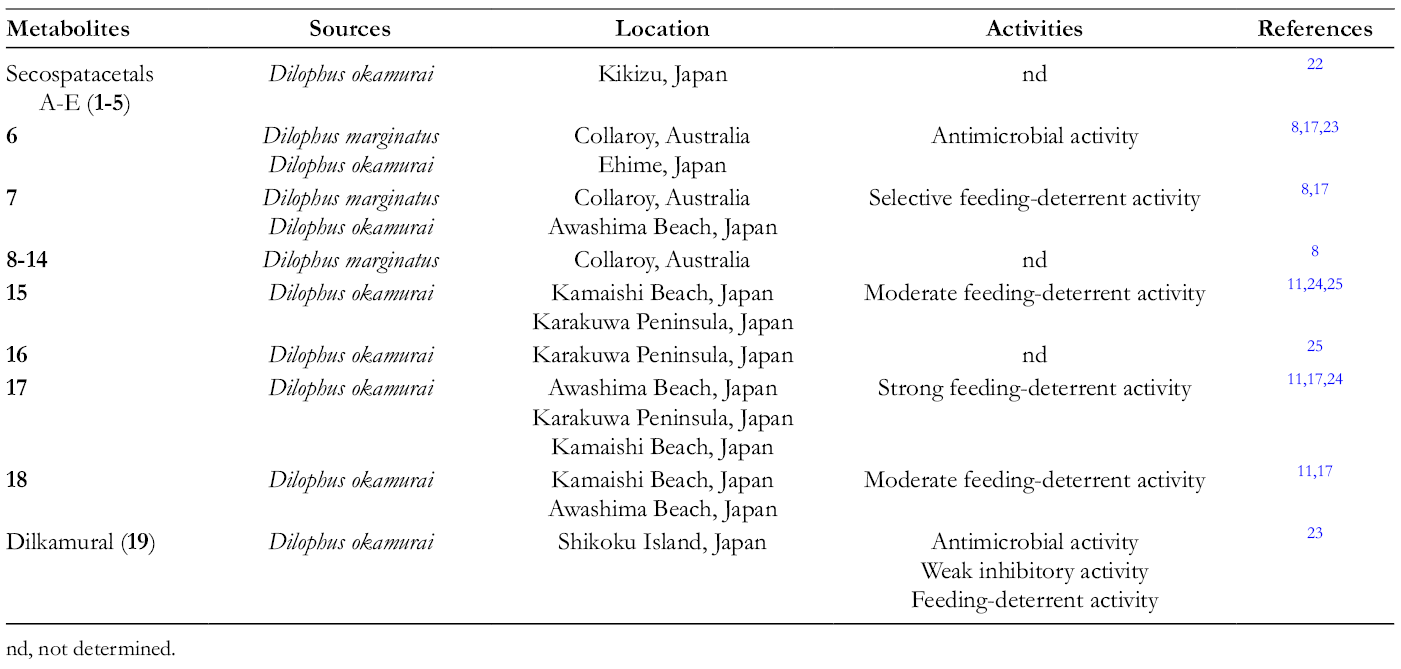
Bioactivities of Secospatane Diterpenes (1-19) From the Genus Dilophus.
Up to the present day, a total of 19 secospatane diterpenes have been isolated from Dilophus species, almost half of which are reported from the alga Dilophus okamurai (Table 1). Most of the secospatane diterpenes have exhibited feeding-deterrent activity.23 The chemical structures of compounds 1 to 19 are shown in Figure 2.
A family of secospatane diterpenes, named secospatacetal A to E (1-5), has been isolated from D. okamurai, which is collected at Kikizu beach of Ehime Prefecture, Japan.22 Nine secospatane diterpenes (6-14) are isolated from the brown alga Dilophus marginatus collected from Collaroy, New South Wales, Australia.8 Compounds 6 and 7 are also obtained from the brown alga D. okamurai.17,23 Compound 6 shows an antimicrobial activity against the bacteria Bacillus subtilis.23 Compound 7 displays selective feeding-deterrent activity against the young abalone Haliotis discus hannai with an electivity index (Ei) value of 0.49.17 Another diterpene, compound 15, is obtained from the brown alga D. okamurai collected on the coast of Kamaishi, Iwate Prefecture, Japan.11 Compound 15 also shows moderate feeding-deterrent activity against the young abalone Haliotis discus hannai.24,25 Compound 16, a feeding-deterrent diterpene, is isolated from the brown alga D. okamurai collected at Karakuwa Peninsula, Japan.25 Two secospatane diterpenes with feeding-deterrent activity, compounds 17 and 18, are obtained from the brown alga D. okamurai collected on the coast of Kamaishi, Iwate Prefecture, Japan.11 They are also isolated from the same alga collected from the west coast of Awashima, Niigata Prefecture, Japan.17 Compounds 17 and 18 show strong feeding-deterrent activity against the young abalone Haliotis discus hannai with an Ei value of 0.85 and 0.65, respectively.17 Another diterpene, named dilkamural (19), is isolated from the brown alga D. okamurai collected from Shikoku Island of Japan. Compound 19 displays an antimicrobial activity against the bacteria B. subtilis, a Gram-positive microorganism, showing a clear zone with diameter of 12 mm at 10 µg/disk in the agar-disk diffusion method. Compound 19 also exhibits weak inhibitory activity against a species of plant pathogenic mold (Colletotrichum lagenarium) and feeding-deterrent activity. Besides, as a chemical defense substance, compound 19 shows feeding-deterrent activity against mollusks and fish.23
Spatane Diterpenes
Up to the present time, 9 spatane diterpenes have been found in D. marginatus or D. okamurai (Figure 3; Table 2). Five spatane compounds (20-24) are isolated from the brown alga D. marginatus collected from Collaroy, New South Wales, Australia.8 Compounds 21 and 22 are also isolated from the brown alga D. okamurai collected on the coast of Kamaishi, Iwate Prefecture, Japan.11 Compounds 21 and 22, 2 configurational isomers,8 inhibit the settlement and metamorphosis of the swimming larvae (veliger) of the abalone Haliotis discus hannai Ino.25 Additionally, compound 22 exhibits strong feeding-deterrent activity against the young abalone with an Ei value of 0.66.17,26 Four spatane diterpenes, compounds 25 to 28, are obtained from the brown alga D. okamurai collected at Karakuwa Peninsula, Japan.27 Compound 25 is also isolated from the brown alga D. marginatus collected from Collaroy, New South Wales, Australia.8 Compound 25 displays feeding-deterrent activities against the young abalone Haliotis discus hannai with an Ei value of 0.90.17 Compared with compounds 21 and 22, compound 26 shows stronger feeding-deterrent properties against the young abalone Haliotis discus hannai Ino.25
Prenylated-Guaiane Diterpenes
Up to present, 7 prenylated-guaiane diterpenes with the perhydroazulene skeleton have been obtained from Dilophus species (Figure 3; Table 2).
Two prenylated-guaiane ditepenes, termed pachydictyol A (29) and isopachydictyol A (30), are isolated from the brown alga D. okamurai from the west coast of Awashima, Niigata Prefecture, Japan.17 Two compounds are also isolated from the brown alga D. spiralis collected from Elafonissos Island, Greece.28 Compound 29 exhibits moderate cytotoxicity against hepatoma (HepG2), fibroblast (WI-38), African green monkey kidney (VERO), and breast cancer cells (MCF-7) with IC50 values of 40.2, 24.6, 27.4, and 37.5 µg/mL, respectively.29 Compound 30 shows moderate cytotoxicity against 4 different cell lines HepG2, WI-38, VERO, and MCF-7 with IC50 values of 39.2, 22.4, 28.3, and 39.2 µg/mL, respectively.29 Compounds 29 and 30 display potent antithrombotic activity against thrombin with 50% inhibition at 0.68 mM.30 Compound 29 displays remarkable antifouling activity against the invasive freshwater mussel Limnoperna fortunei at the concentration of 4.7 µg/cm2.31 Moreover, a total synthesis of compound 29 has been accomplished.32 Two prenylated-guaiane diterpenes, termed dictyols C (31) and E (32), are separated from the algae Dilophus mediterraneus.33 They are also obtained from the alga Dilophus fasciola.34 Compound 32 is also isolated from the brown algae Dilophus guineensis, Dilophus ligulatus, and D. spiralis.28,35,36 Compound 31 displays moderate antifouling activity against the freshwater mollusk L. fortunei at the concentration of 9.5 and 12 µg/cm2 without any toxic activity.31 Compound 31 shows weak protective activity against DNA damage and low antioxidant activity for 2,2’-azinobis-(3-ethylbenzothiazoline)-6-sulfonic acid(ABTS) and erythrocytes hemolysis.29 Compound 32 shows moderate inhibitory activity against rat liver diacyl glycerol acyl transferase with IC50 values of 46.0 µM.37 A prenylated-guaiane diterpene, termed dictyoxide (33), is isolated from the brown alga D. ligulatus collected at Aci Castello, Sicily, Italy.38 Compound 33 is also separated from the alga D. spiralis collected from Elafonissos Island, Greece.28 Another prenylated-guaiane diterpene, termed dictyone (34), is purified from the brown alga D. okamurai collected from the west coast of Awashima, Niigata Prefecture, Japan.17 Compound 34 displays powerful cytotoxicity against 3 proliferating mouse cell lines, including a normal fibroblast line NIH3T3 and 2 virally transformed forms SSVNIH3T3 and KA3IT, with IC50 values ranging from 5 to 20 µg/mL.40 A prenylated-guaiane diterpene, named dictytriene B (35), is obtained from the brown alga D. spiralis collected from Elafonissos Island, Greece.28
Other Diterpenes of Group I
Four prenylated-bicyclogermacrane diterpenes, compounds (36-39), are separated from the brown alga Dilophus prolificans collected from the New South Wales coast near Sydney, Australia.41 A prenylated-germacrane diterpene, named dilophol (40), is isolated from the brown alga D. ligulatus collected from the littoral zone of the east coast of Sicily (Porto Palo), Italy.42 Obscuronatin (41) is extracted from the brown alga D. spiralis collected in Greece.34 In addition, a total synthesis of compound 41 has been achieved.43 The chemical structures of compounds 20 to 41 are shown in Figure 3.
Diterpenes of Group II
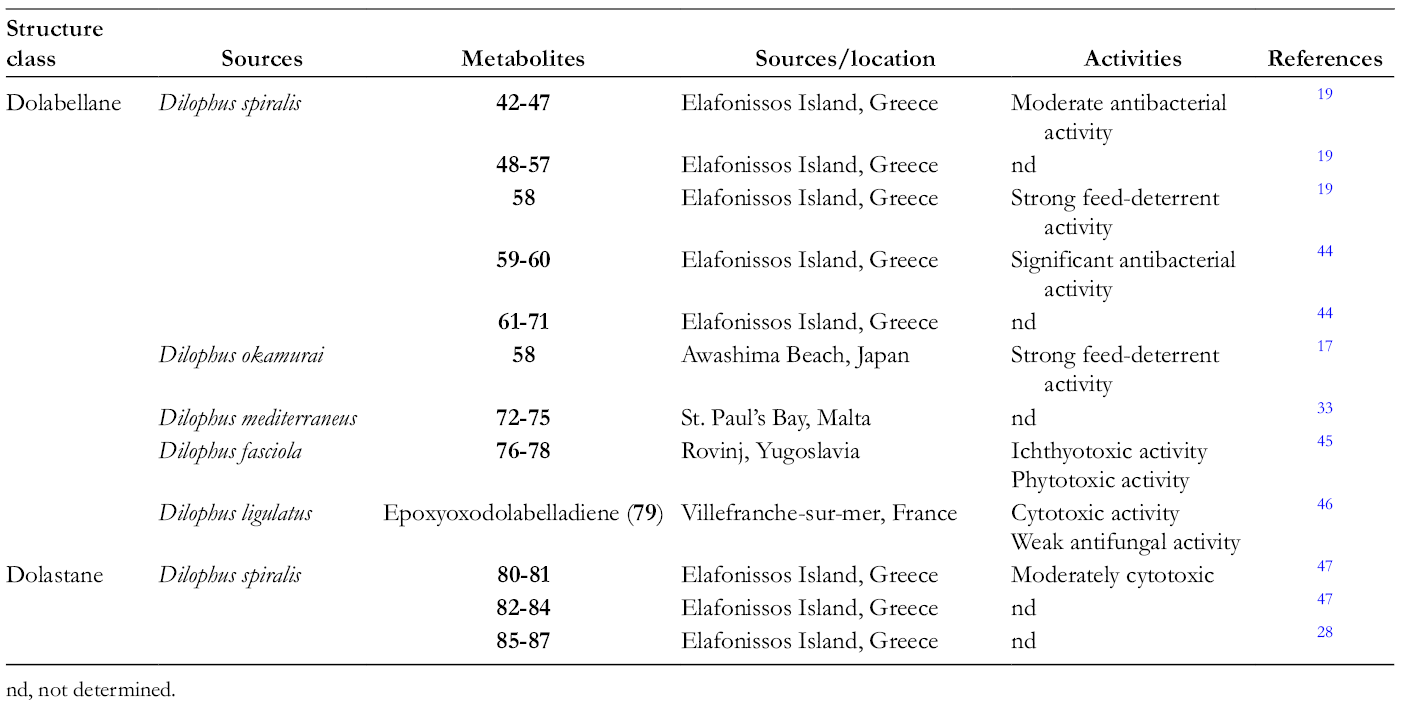
According to the literature widely cited, diterpenes of group II include those derived by the first formal cyclization of the geranyl-geraniol precursor between C-1 and C-11.12 The diterpene skeletons of group II consist of dolabellane, dolastane, and so on. Up to the present time, a total of 46 diterpenes of group II have been separated from Dilophus species, and almost of them are dolabellane diterpenes. Table 3 summarizes 46 diterpenes of group II identified from Dilophus species. The chemical structures of compounds 42 to 87 are shown in Figure 4.
Chemical structures of 42-87.
Bioactivities of Group II Diterpenes (42-87) From the Genus Dilophus.
Dolabellane natural products have been obtained from a variety of marine organisms, including marine algae, sponges, herbivore sea hare, and terrestrial plants.48,49 Dolabellane diterpenes possess a 5,11-carbobicyclic skeleton, which is generally substituted by hydroxyl, epoxide, and glucoside functional groups.18 Dolabellane diterpenes exhibit significant biological activities, such as antiviral,50 cytotoxic,51 molluscicidal, and phytotoxic activities.52 A total of 38 dolabellane diterpenes have been isolated from the genus Dilophus, among which 30 are obtained from the brown alga D. spiralis (Figure 4; Table 3).
A series of dolabellane diterpenes, compounds 42 to 71, have been isolated from the brown alga D. spiralis collected on Elafonissos Island, Greece.19,44 Moreover, compound 58 is also separated from the brown alga D. okamurai collected from the west coast of Awashima, Niigata Prefecture, Japan.17 Compounds 42 to 47 exhibit powerful antibacterial activity against the strain of epidemic methicillin-resistant Staphylococcus aureus (EMRSA-16), with minimal inhibiting concentration (MIC) values of 16, 16, 16, 8, 4, and 8 µg/mL, respectively.19 Compound 58 shows strong feed-deterrent activity with an Ei value of 0.93.17 Compound 59 shows significant antibacterial activity against standard laboratory strain ATCC 25923, strain epidemic MRSA-15 (EMRSA-15), EMRSA-16, macrolide-resistant variant RN4220, multidrug-resistant effluxing strains SA1199B and XU212 with MIC values of 8, 8, 2, 8, 8, and 8 µg/mL, respectively. Compound 60 also exhibits powerful antibacterial activity against ATCC 25923, EMRSA-15, EMRSA-16, RN4220, SA1199B, and XU212 with MIC values of 4, 4, 2, 2, 4, and 4 µg/mL, respectively.44 Four dolabellane diterpenes, compounds 72 to 75, are obtained from the brown alga D. mediterraneus collected from St. Paul’s Bay, Malta.33 Three ichthyotoxic diterpenes, compounds 76 to 78, are isolated from the brown alga D. fasciola collected near Rovinj, Yugoslavia.45 In fish toxicity bioassay, compounds 76 to 78 display potent ichthyotoxic activity against Gambusia patruelis at a concentration of 50 ppm.45 In root growth bioassay, compounds 76 to 78 show moderate phytotoxic activity against Hordeum vulgaris at a concentration of 100 ppm.45 A dolabellane diterpene, named epoxyoxodolabelladiene (79), is separated from the brown alga D. ligulatus collected from the Bay of Villefranche-sur-Mer, France.46 Compound 79 exhibits moderate cytotoxic activity against KB (human nasopharynx carcinoma), NSCLCN6-L16 (human nonsmall cell lung carcinoma), and P-388 (murine leukemia) cells with ED50 values of 25.39, 16.66 to 16.78, and 6.5 µg/mL, respectively. Compound 79 shows moderate antifungal activity against Aspergillus fumigatus, Microsporum canis, and Trichophyton mentagrophytes with MIC values of 160, 130, and 130 µg/mL, respectively.46
Dolastane Diterpenes
Dolastane diterpenes possessing fused 5,7,6-tricyclic skeleton are another class of classified diterpenes isolated from marine organisms, including Dilophus species.53 Five dolastane diterpenes (80-84) are isolated from the alga D. spiralis collected from Elafonissos Island, Greece.47 Compound 80 displays moderate cytotoxic activity against NSCLCN6-L16 and nonsmall cell lung cancer (A549) cells with ED50 values of 11.2 and 12.6 µg/mL, respectively. Compound 81 displays moderate cytotoxic against HeLa, prostate adenocarcinoma cell line (PC-3), MCF-7, human colon cancer cell line (HT29), and human lung cancer cell line (A431) with ED50 values of 17.3, 17.7, 18.5, 19.6, and 21.4 µg/mL, respectively.47 Other dolastane diterpenes, compounds 85 to 87, are also obtained from the alga D. spiralis collected from Elafonissos Island, Greece28 (Figure 4; Table 3).
Diterpenes of Group III
According to the widely cited literature on chemotaxonomy, group III includes diterpenes obtained by the first formal cyclization of the geranyl-geraniol precursor between C-2 and C-10.12 The diterpene skeletons of group III include xenicane, cycloxeniane, crenulidane, and crenulane. Up to the present day, 23 diterpenes of group III have been separated from Dilophus species. Major diterpenes of group III from species of Dilophus are xenicane-type diterpenes functionalized with oxidation, epoxidation, and condensation to form monocyclic, bicyclic, and tricyclic structures. Tables 4 and 5 summarize 23 diterpenes of group III identified from Dilophus species. (Figures 5 and 6; Tables 4 and 5).
Chemical structures of 88-97.
Chemical structures of 98-110.
Bioactivities of Xenicane Diterpenes (88-97) From the Genus Dilophus.
Metabolites
Sources
Activities
References
Acetyldictyolal (88)
Dilophus ligulatus, Villefranche-sur-mer, France Dilophus spiralis, Greece Dilophus fasciola, Greece
Xenicane diterpenes, possessing cyclodecane skeleton with as a common structural feature, are a large class of marine diterpenes. Up to the present time, 10 xenicane diterpenes have been separated from members of the genus Dilophus (Table 4). The chemical structures of compounds 88 to 97 are shown in Figure 5.
A series of xenicane diterpenes, including acetyldictyolal (88), dictyotalide B (89), neodictyolactone (90), and dictyolactone (91) and (92), are purified from the brown alga D. ligulatus collected from the Bay of Villefranche-sur-Mer, France.46 Both compounds 88 and 89 are also separated from the brown algae D. fasciola and D. spiralis, respectively.34 Compound 91 is also extracted from the brown alga D. okamurai collected from the west coast of Awashima, Niigata Prefecture, Japan.17 Compound 88 exhibits significant cytotoxic activity against P-388, KB, and NSCLCN6-L16 cells with ED50 values of 1.50 to 1.66, 9.1, and 5.55 to 5.80 μg/mL, respectively. Compound 88 shows weak antifungal activity against A. fumigatus, M. canis, and T. mentagrophytes.46 Compound 89 displays moderate cytotoxic activity against P-388, KB, and NSCLCN6-L16 with ED50 values of 16.6 to 19.56, 26.43, and 21.22 µg/mL, respectively. Compounds 90 to 92 show strong cytotoxic activity against P-388, P388/DOX (murine leukemia expressing the multidrug-resistance gene, MDR), KB, and NSCLCN6-L16 cells.46 Compound 91 also exhibits strong feed-deterrent activity with an Ei value of 0.74.17 A cytotoxic diterpene, named fukurinolal (93), is isolated from the brown algae D. ligulatus and D. okamurai, respectively.9,54 Compound 93 exhibits significant cytotoxic activity against KB, P-388, P388/DOX, and NSCLC-N6 cells with ED50 values of 2.1, 3.9, 9.3, and 10 µg/mL, respectively.9 Two antibacterial diterpenes, termed dictyodial (94) and isodictyohemiacetal (95), are obtained from the brown alga D. mediterraneus collected from St. Paul’s Bay, Malta.33 Compound 94 shows potent antibacterial activity against Staphylococcus aureus and B. subtilis as well as antifungal activity against Candida albicans.55 Moreover, a total synthesis of compound 94 has been accomplished.56 Two xenicane diterpenes, termed dilophic acid (96) and compound (97), have been separated from the brown alga D. guineensis collected from Vega Baja, Puerto Rico. Compound 96 shows slight Gram-positive antimicrobial activity and weak ichthyotoxic activity against goldfish Carassius auratus at a dose of 50 µg/mL.35
Cycloxeniane Diterpenes
Cycloxeniane-type diterpenes possessing 2,6-cyclo-xenicane skeleton are rare diterpenes from marine organisms.34 Up to the present time, 7 cycloxeniane diterpenes have been found from Dilophus species34 (Figure 6; Table 5). A series of cycloxeniane diterpenes (98-103) have been isolated from the alga D. fasciola collected in Tunisia.34 Compound 104 is obtained from the alga D. spiralis collected in Greece.34
Crenulidane Diterpenes
Crenulidane diterpenes bearing the bicyclo nonane skeleton exhibit diverse activities, including antimicrobial, cytotoxic, and antifungal activities.39,46 Up to the present, 4 crenulidane diterpenes have been isolated from the genus Dilophus (Figure 6; Table 5).
Four crenulidane diterpenes, named crenuladial (105), pachylactone (106), isoacetoxycrenulatin (107), and acetoxycrenulide (108), have been purified from the brown alga D. ligulatus.9,39,46 Compound 106 is also separated from the brown alga D. spiralis collected in Greece.34 Compound 105 exhibits moderate antimicrobial activity against S. aureus and Micrococcus luteus with MIC values of 75 and 75 µg/mL, respectively.39 Compound 106 shows significant cytotoxic activity against P-388, P388/DOX, KB, and NSCLCN6-L16 cells with MIC values of 1.1, 1.8, 3.7, and 1 µg/mL, respectively.46 Compound 107 shows cytotoxic activity against P-388, P388/DOX, KB, and NSCLCN6-L16 cells with MIC values of 4.8, 7.9, 5.2, and 1.6 µg/mL, respectively.46 Compounds 106 and 107 exhibit weak antifungal activity against A. fumigatus, M. canis, and T. mentagrophytes.46 Compound 108 shows weak cytotoxic activity against KB, P-388, P-388/DOX, and NSCLC-N6 cells.9 In addition, total synthesis of compounds 106 and 108 has been accomplished.57,58
Crenulane Diterpenes
A crenulane diterpene, termed fukurinal (109), has been isolated from the brown alga D. okamurai.54 Another crenulane diterpene, named sanadaol (110), is obtained from the brown alga D. mediterraneus collected from St. Paul’s Bay, Malta.33 Compound 110 is also separated from the alga D. fasciola collected in Tunisia.34 This compound exhibits strong (>95%) algicidal activity against the red-tide phytoplankton Heterosigma akashiwo and Karenia mikimotoi at a dose of 10 to 20 μg/mL.59 Moreover, a total synthesis of compound 110 has been accomplished.60 The chemical structures of compounds 98 to 110 are shown in Figure 6.
Others
Except for the above-mentioned diterpenes of groups I to III, some diterpenes have been discovered from members of the genus Dilophus. Up to the present day, a total of 14 diterpenes with new skeleton have been separated from Dilophus species, most of which are cubebane diterpenes. Table 6 summarizes 14 other diterpenes identified from Dilophus species. The chemical structures of compounds 111 to 124 are shown in Figure 7.
Chemical structures of 111-124.
Bioactivities of Diterpenes (111-124) From the Genus Dilophus.
Cubebane-type diterpenes possessing unprecedented [5,3,6] tricyclic ring skeleton generally exhibit feeding-deterrent properties8 (Figure 1).
A feeding-deterrent cubebane diterpene, compound 111, is isolated from the brown alga D. okamurai.25 Compound 111 exhibits weak feeding-deterrent activity against the young abalone Haliotis discus hannai Ino.25 Three cubebane diterpenes, compounds 112 to 114, are obtained from the brown alga D. okamurai collected on the coast of Kamaishi, Iwate Prefecture, Japan.11 Compound 112 displays weak feeding-deterrent activity against the young abalone Haliotis discus hannai Ino.25 Compounds 113 and 114 show moderate feeding-deterrent activity.11 Three cubebane-type diterpenes, compounds 115 to 117, are obtained from the brown alga D. marginatus collected from Collaroy, New South Wales, Australia.8 The stereochemistry of compounds 115 to 117 cannot be determined due to the limitation of analytical techniques8 (Figure 7; Table 6).
Other Diterpenes
Two cytotoxic diterpenes possessing a cyclobutenone moiety [4,5], named acetylcoriacenone (118) and isoacetylcoriacenone (119), have been isolated from the brown alga D. ligulatus collected from the Bay of Villefranche-sur-Mer, France.9 Compound 118 exhibits powerful cytotoxic activity against P-388 and NSCLC-N6 cells with ED50 values of 4.4 and 5.4 µg/mL, respectively. Compound 119 shows cytotoxic activity against P-388 and NSCLC-N6 cells with ED50 values of 6 and 6.82 µg/mL, respectively.9 Two rare diterpenes, named dilospiranes A (120) and B (121), are isolated from the brown alga D. spiralis collected from the coast of Elafonissos Island, Greece.61 Compounds 120 and 121 have no significant inhibitory effect on the regulation of hypoxia-inducible factor-1.61 Compound 121 exhibits in vitro antitumor activity against the human glioblastoma cell line (HS683), PC-3, MCF-7, glioma (U373), A549, and melanoma cell lines (SKMEL-28) with ED50 values of 68 ± 1, 58 ± 7, 67 ± 1, 70 ± 1, 66 ± 2, and 65 ± 2 µg/mL, respectively.62 Dictyterpenoids A and B (122 and 123) are obtained from the brown alga D. okamurai collected from the west coast of Awashima, Niigata Prefecture, Japan.17 Compounds 122 and 123 exhibit selective feeding-deterrent activity against the young abalone Haliotis discus hannai with Ei valsues of 0.59 and 0.23, respectively.17 A rare diterpene, named fasciola-7,18-dien-17-al (124), is isolated from the brown alga D. fasciola collected from the beach of Portopalo, Italy63 (Figure 7; Table 6).
Conclusion
The genus Dilophus is a rich source of various natural products with novel pharmacological and biological activities. Significant progress has been made in the discovery of biologically active secondary metabolites from this genus. More than 200 new natural compounds have been isolated from this genus at the present time, most of which are diterpene compounds (124 compounds). More than half of these diterpenes belong to groups I and II (41 and 46 compounds, respectively). A total of 124 diterpenes of 17 skeletal classes have been reported and are distributed as follows: group I (41 diterpenes of 5 skeletal classes), group II (46, 2), group III (23, 4), and others (14, 6). The alga D. spiralis has been proved to be an important producer of diterpenes since 50 structurally diverse diterpenes, including 30 dolabellane diterpenes and 8 dolastane diterpenes, have been isolated from this species. It appears that D. spiralis is the most representative species of the genus. Secospatane diterpenes are mainly found in 3 species, D. okamurai, D. marginatus, and D. spiralis. Most of these diterpenes from Dilophus species exhibit strong feeding-deterrent activity. The fact proved that diterpenes from Dilophus species may play a central role in survival of marine organisms in the complex marine environment. Moreover, 14 compounds with novel skeletons, compounds 111 to 124, have been separated from Dilophus species, exhibiting the genus-genus biosynthetic diversity between 2 genera Dilophus and Dictyota.
However, there are some problems for further drug discovery from the genus Dilophus, including the development of new technologies for the collection of more algae of this genus, multitarget screening assays, isolation of minor components, and total synthesis. First, over the past decade, only 48 diterpenes have been isolated from Dilophus species. Moreover, most diterpenes from this genus are derived from the algae collected from the coastal areas of Japan, Greece, and Australia. It is necessary to collect more algae of this genus from different countries and regions. Combination of related disciplines and technologies, including multitarget screening assay, isolation of minor components, and bioassay-directed separation with liquid chromatography-mass spectrometry (LC/MS)-based analysis methods, would greatly promote the discovery of more bioactive diterpenes from the genus Dilophus in further studies. Second, the total syntheses of 6 compounds, including compounds 29, 41, 94, 106, 108, and 110, have been successfully achieved. More efforts should be devoted to promote the total synthesis of the active diterpenes from the genus Dilophus. Successful total synthesis will benefit structural optimization of natural diterpenes for further bioactivity assessment, as well as for pharmacological and clinical applications. Third, various biological activity assays should be developed, including multitarget screening assays, virtual screening, in vivo animal studies, and in vitro experiments, to promote the discovery of new promising lead drugs.
In the present review, we summarized the diterpenes derived from members of the genus Dilophus at the present time, and our study provided valuable insights into new diterpenes from the genus Dilophus.
Footnotes
Declaration of Conflicting Interests
The author(s) declared no potential conflicts of interest with respect to the research, authorship, and/or publication of this article.
Funding
The author(s) disclosed receipt of the following financial support for the research, authorship, and/or publication of this article: This work was financially supported by the National Natural Science Foundation of China (41406163), the China Agriculture Research System (CARS-50), the Ningbo Marine Algae Biotechnology Team (2011B81007), the LiDakSum Marine Biopharmaceutical Development Fund, the National 111 Project of China, Synthesis of Biosurfactants from Seafood Processing Waste (CPR/17/101), Ningbo Public Service Platform for High-Value Utilization of Marine Biological Resources (NBHY-2017-P2), the Scientific Research Foundation for Returned Scholars of ZJHRSS, and the K.C.Wong Magna Fund in Ningbo University.
ORCID ID
Jinrong Zhang
References
1.
BisioA.PedrelliF.D’AmbolaMet al. Quinone diterpenes from Salvia species: chemistry, botany, and biological activity. Phytochem Rev. 2019;18(3):665-842.doi:10.1007/s11101-019-09633-z
WaniMC.TaylorHL.WallME.CoggonP.McPhailAT. Plant antitumor agents. VI. The isolation and structure of taxol, a novel antileukemic and antitumor agent from Taxus brevifolia. J Am Chem Soc. 1971;93(9):2325-2327.doi:10.1021/ja00738a045
5.
ZhouB.ZhangD.WuX. Biological activities and corresponding SARS of andrographolide and its derivatives. Mini Rev Med Chem. 2013;13(2):298-309.
6.
NabaviSM.HabtemariamS.DagliaMet al. Neuroprotective effects of ginkgolide B against ischemic stroke: a review of current literature. Curr Top Med Chem. 2015;15(21):2222-2232.doi:10.2174/1568026615666150610142647
7.
WangX.YuH.ZhangY.LuX.WangB.LiuX. Bioactive Pimarane-Type diterpenes from marine organisms. Chem Biodivers. 2018;15(1):e1700276.doi:10.1002/cbdv.201700276
8.
RaviBN.WellsRJ. A series of new diterpenes from the brown alga Dilophus marginatus (Dictyotaceae. Aust J Chem. 1982;35(1):129-144.doi:10.1071/CH9820129
9.
BouaichaN.PesandoD.PuelD.TringaliC. Cytotoxic diterpenoids from the brown alga Dilophus ligulatus. J Nat Prod. 1993;56(10):1747-1752.doi:10.1021/np50100a013
10.
KelecomA.TeixeiraVL. Diterpenes of marine brown algae of the family dictyotaceae: their possible role as defense compounds and their use in chemotaxonomy. Sci Total Environ. 1986;58(1-2):109-115.doi:10.1016/0048-9697(86)90081-1
11.
TaniguchiK.KurataK.SuzukiM.ShiraishiK. Feeding-deterrent activity of diterpenes from the brown alga Dilophus okamurai against the abalone haliotis discus hannai. Nippon Suisan Gakkaishi. 1992;58(10):1931-1936.doi:10.2331/suisan.58.1931
12.
TeixeiraVL.KelecomA. A chemotaxonomic study of diterpenes from marine brown algae of the genus Dictyota. Sci Total Environ. 1988;75(2-3):271-283.doi:10.1016/0048-9697(88)90040-X
13.
HayME.FenicalW.GustafsonK. Chemical defense against diverse coral-reef herbivores. Ecology. 1987;68(6):1581-1591.doi:10.2307/1939850
14.
AmicoV.OrienteG.PiattelliMet al. (-)-(R)-1-O-Geranylgeranylglycerol from the brown alga Dilophus fasciola. Experientia. 1977;33(8):989-990.doi:10.1007/BF01945922
15.
SternJL.HagermanAE.SteinbergPD.WinterFC.EstesJA. A new assay for quantifying brown algal phlorotannins and comparisons to previous methods. J Chem Ecol. 1996;22(7):1273-1293.doi:10.1007/BF02266965
16.
KarawyaMS.Abdel-WahabSM.SallamLA.El-RefaiAMH.HamdyAHA. Study of lipid content of certain red sea algae. Egypt J Pharm Sci. 1987;28:247-254.
17.
SuzukiM.YamadaH.KurataK. Dictyterpenoids A and B, two novel diterpenoids with feeding-deterrent activity from the brown alga Dilophus okamurae. J Nat Prod. 2002;65(2):121-125.doi:10.1021/np010234b
18.
GörnerC.HirteM.HuberS.SchrepferP.BrückT. Stereoselective chemo-enzymatic oxidation routes for (1R,3E,7E,11S,12S)-3,7,18-dolabellatriene. Front Microbiol. 2015;6:1115.doi:10.3389/fmicb.2015.01115
19.
IoannouE.QuesadaA.RahmanMM.GibbonsS.VagiasC.RoussisV. Dolabellanes with antibacterial activity from the brown alga Dilophus spiralis. J Nat Prod. 2011;74(2):213-222.doi:10.1021/np1006586
20.
MuñozJ.CulioliG.KöckM. Linear diterpenes from the marine brown alga Bifurcaria bifurcata: a chemical perspective. Phytochem Rev. 2013;12(3):407-424.doi:10.1007/s11101-012-9246-4
21.
ChenJ.LiH.ZhaoZet al. Diterpenes from the marine algae of the genus Dictyota. Mar Drugs. 2018;16(5):159.doi:10.3390/md16050159
22.
YamaseH.UmemotoK.OoiT.KusumiT. Structures and absolute stereochemistry of five new secospatanes and a spatane isolated from the brown alga Dilophus okamurai Dawson. Chem Pharm Bull. 1999;47(6):813-818.doi:10.1248/cpb.47.813
23.
NinomiyaM.HiroharaH.Onishi JiJ.KusumiT. Chemical study and absolute configuration of a new marine secospatane from the brown alga Dilophus okamurae. J Org Chem. 1999;64(15):5436-5440.doi:10.1021/jo9902190
24.
KurataK.TaniguchiK.ShiraishiK.SuzukiM. Structures of secospatane-type diterpenes with feeding-deterrent activity from the brown alga. Tetrahedron Lett. 1989;30(12):1567-1570.doi:10.1016/S0040-4039(00)99521-2
25.
KurataK.TaniguchiK.ShiraishiK.SuzukiM. Feeding-deterrent diterpenes from the brown alga Dilophus okamurai. Phytochemistry. 1990;29(11):3453-3455.doi:10.1016/0031-9422(90)85256-F
26.
KurataK.ShiraishiK.TakatoT.TaniguchiK.SuzukiM. A new feeding-deterrent diterpenoid from the brown alga Dilophus okamurai Dawson. Chem Lett. 1988;17(10):1629-1632.doi:10.1246/cl.1988.1629
27.
KurataK.SuzukiM.ShiraishiK.TaniguchiK. Spatane-type diterpenes with biological activity from the brown alga Dilophus okamurai. Phytochemistry. 1988;27(5):1321-1324.doi:10.1016/0031-9422(88)80185-7
28.
IoannouE.VagiasC.RoussisV. Isolation and structure elucidation of three new dolastanes from the brown alga Dilophus spiralis. Mar Drugs. 2013;11(4):1104-1112.doi:10.3390/md11041104
29.
AyyadS-EN.MakkiMS.Al-KayalNSet al. Cytotoxic and protective DNA damage of three new diterpenoids from the brown alga Dictoyota dichotoma. Eur J Med Chem. 2011;46(1):175-182.doi:10.1016/j.ejmech.2010.10.033
30.
PereiraR.LourençoA.TerraL.AbreuP.Laneuville TeixeiraV.CastroH. Marine diterpenes: molecular modeling of thrombin inhibitors with potential biotechnological application as an antithrombotic. Mar Drugs. 2017;15(3):79.doi:10.3390/md15030079
31.
SilessGE.GarcíaM.PérezM.BlusteinG.PalermoJA. Large-scale purification of pachydictyol A from the brown alga Dictyota dichotoma obtained from algal wash and evaluation of its antifouling activity against the freshwater mollusk Limnoperna fortunei. J Appl Phycol. 2018;30(1):629-636.doi:10.1007/s10811-017-1261-9
32.
GreeneAE. Highly stereoselective total syntheses of (+)-pachydictyol A and (-)-dictyolene, novel marine diterpenes from brown seaweeds of the family dictyotaceae. J Am Chem Soc. 1980;102(16):5337-5343.doi:10.1021/ja00536a036
33.
GoezCE.WrightAD.KönigGM.SticherO. Diterpenes from the brown alga Dilophus mediterraneus. Phytochem. Anal.. 1994;5(2):68-73.doi:10.1002/pca.2800050205
34.
IoannouE.ZervouM.IsmailA.KtariL.VagiasC.RoussisV. 2,6-Cyclo-xenicanes from the brown algae Dilophus fasciola and Dilophus spiralis. Tetrahedron. 2009;65(51):10565-10572.doi:10.1016/j.tet.2009.10.081
35.
SchlenkD.GerwickWH. Dilophic acid a diterpenoid from the tropical brown seaweed dilophus guineensis. Phytochemistry. 1987;26(4):1081-1084.doi:10.1016/S0031-9422(00)82354-7
36.
DaniseB.MinaleL.RiccioRet al. Further perhydroazulene diterpenes from marine organisms. Experientia. 1977;33(4):413-415.doi:10.1007/BF01922182
37.
ChoiBW.LeeHS.LeeKB.LeeBH. Isolation of diacyl glycerol acyl transferase (DGAT) inhibitors from Pachydictyon coriaceum. Phytother Res. 2011;25(7):1041-1045.doi:10.1002/ptr.3391
38.
AmicoV.OrienteG.PiattelliM.TringaliC. Dictyoxide, a new diterpene from the brown alga Dilophus ligulatus. Phytochemistry. 1979;18(11):1895-1897.doi:10.1016/0031-9422(79)83087-3
39.
TringaliC.OrienteG.PiattelliM.GeraciC.NicolosiG.BreitmaierE. Crenuladial, an antimicrobial diterpenoid from the brown alga Dilophus ligulatus. Can J Chem. 1988;66(11):2799-2802.doi:10.1139/v88-432
40.
AyyadS-EN.Abdel-HalimOB.ShierWT.HoyeTR. Cytotoxic hydroazulene diterpenes from the brown alga Cystoseira myrica. Z Naturforsch C: Biosci. 2003;58(1-2):33-38.doi:10.1515/znc-2003-1-205
41.
KazlauskasR.MurphyPT.WellsRJ.BlountJF. A series of novel bicyclic diterpenes from (brown alga, dictyotaceae). Tetrahedron Lett. 1978;19(43):4155-4158.doi:10.1016/S0040-4039(01)95169-X
42.
AmicoV.OrienteG.PiattelliMet al. Dilophol, a new ten membered ring diterpene alcohol from the brown alga Dilophus ligulatus. J Chem Soc. 1976:1024-1025.
43.
KodamaM.OkumuraK.KobayashiY.TsunodaT.ItôS. Synthesis of macrocyclic terpenoids by intramolecular cyclization IX. Total synthesis of (±)-obscuronatin and (±)-biflora-4,10(19),15-triene. Tetrahedron Lett. 1984;25(50):5781-5784.doi:10.1016/S0040-4039(01)81685-3
44.
IoannouE.QuesadaA.RahmanMM.GibbonsS.VagiasC.RoussisV. Structures and antibacterial activities of minor dolabellanes from the brown alga Dilophus spiralis. European J Org Chem. 2012;2012(27):5177-5186.doi:10.1002/ejoc.201200533
45.
De RosaS.De StefanoT.S. Macura‡†. Chemical studies of North Adriatic seaweeds-I new dolabellane diterpenes from the brown alga dilophus Fasciola. Tetrahedron. 1984;40(23):4991-4995.doi:10.1016/S0040-4020(01)91338-9
46.
BouaïchaN.TringaliC.PesandoD.MalléaM.RoussakisC.VerbistJF. Bioactive diterpenoids isolated from Dilophus ligulatus. Planta Med. 1993;59(3):256-258.doi:10.1055/s-2006-959663
47.
IoannouE.QuesadaA.VagiasC.RoussisV. Dolastanes from the brown alga Dilophus spiralis: absolute stereochemistry and evaluation of cytotoxicity. Tetrahedron. 2008;64(18):3975-3979.doi:10.1016/j.tet.2008.02.042
48.
IrelandC.FaulknerDJ. Diterpenes from Dolabella californica. J Org Chem. 1977;42(19):3157-3162.doi:10.1021/jo00439a010
49.
CaiX-H.WangY-Y.ZhaoP-J.LiY.LuoX-D. Dolabellane diterpenoids from Aglaia odorata. Phytochemistry. 2010;71(8-9):1020-1024.doi:10.1016/j.phytochem.2010.03.005
50.
Cirne-SantosCC.SouzaTML.TeixeiraVLet al. The dolabellane diterpene Dolabelladienetriol is a typical noncompetitive inhibitor of HIV-1 reverse transcriptase enzyme. Antiviral Res. 2008;77(1):64-71.doi:10.1016/j.antiviral.2007.08.006
51.
DuhCY.ChiaMC.WangSK.ChenHJ.El-GamalAA.DaiCF. Cytotoxic dolabellane diterpenes from the Formosan soft coral Clavularia inflata. J Nat Prod. 2001;64(8):1028-1031.doi:10.1021/np010106n
52.
PiattelliM.TringaliC.NeriP.RoccoC. Stereochemistry and conformation of dolabellane diterpenes: an NMR and molecular mechanics study. J Nat Prod. 1995;58(5):697-704.doi:10.1021/np50119a007
53.
CrewsP.KleinTE.HogueER.MyersBL. Tricyclic diterpenes from the brown marine algae Dictyota divaricata and Dictyota linearis. J Org Chem. 1982;47(5):811-815.doi:10.1021/jo00344a012
54.
OchiM.MasuiN.KotsukiH.MiuraI.TokoroyamaT. The structures of fukurinolal and fukurinal, two new diterpenoids from the brown seaweed Dilophus okamurai Dawson. Chem Lett. 1982;11(12):1927-1930.doi:10.1246/cl.1982.1927
55.
FinerJ.ClardyJ.FenicalWet al. Structures of dictyodial and dictyolactone, unusual marine diterpenoids. J Org Chem. 1979;44(12):2044-2047.doi:10.1021/jo01326a040
56.
NagaokaH.KobayashiK.YamadaY. Total synthesis of (−)- and (+)-sanadaol: The absolute configuration of sanadaol and dictyodial. Tetrahedron Lett. 1988;29(46):5945-5946.doi:10.1016/S0040-4039(00)82235-2
57.
PaquetteLA.WangT-Z.PinardE. Total synthesis of natural (+)-acetoxycrenulide. J Am Chem Soc. 1995;117(4):1455-1456.doi:10.1021/ja00109a041
58.
Booker-MilburnKI.JiménezFD.SharpeA. Model studies towards the total synthesis of pachylactone. Synlett. 1995;1995(07):735-736.doi:10.1055/s-1995-5056
59.
KimJY.AlamsjahMA.HamadaA.FujitaY.IshibashiF. Algicidal diterpenes from the brown alga Dictyota dichotoma. Biosci Biotechnol Biochem. 2006;70(10):2571-2574.doi:10.1271/bbb.60281
60.
NagaokaH.KobayashiK.MatsuiT.YamadaY. Total synthesis of (±)-sanadaol. Tetrahedron Lett. 1987;28(18):2021-2023.doi:10.1016/S0040-4039(00)96035-0
61.
IoannouE.VagiasC.RoussisV. Dilospiranes A and B: diterpenes featuring novel carbocyclic units from the brown alga Dilophus spiralis. Tetrahedron Lett. 2011;52(23):3054-3056.doi:10.1016/j.tetlet.2011.04.035
62.
Genta-JouveG.IoannouE.MathieuVet al. Determination of the absolute configuration and evaluation of the in vitro antitumor activity of dilospirane B. Phytochem Lett. 2012;5(4):747-751.doi:10.1016/j.phytol.2012.08.005
63.
TringaliC.PiattelliM.NicolosiG. Fasciola-7, 18-dien-17-al, a diterpenoid with a new tetracyclic ring system from the brown alga Dilophus Fasciola. J Nat Prod. 1986;49(2):236-243.doi:10.1021/np50044a007