



Abstract
Deep eutectic solvents (DESs) were proposed for the extraction of polysaccharides from Poria cocos (PCPs). Six types of DESs were prepared, and the DES composed of choline chloride and oxalic acid was proved to be suitable. Based on the results of single-factor test, the Box-Behnken experimental design with response surface methodology was carried out, giving the optimal extraction conditions including mole ratio of 1:2 (choline chloride:oxalic acid) and extraction 15 minutes at 100°C. Under the optimal extraction conditions, the extraction yield (46.24% ± 0.13%) was 8.6 times higher than that of hot water. The reusability of DES was demonstrated by a 6-run test, and an extraction yield of PCP was 38.40% ± 0.23% after reusing for 6 times without adding any additional chemicals. Moreover, molecular weight distributions of the resulting PCP were analyzed, and then mainly distributed in the range of 753 to 3578 g/mol. Therefore, DESs were proved to be an excellent extraction solvent alternative to the extraction of PCP.
Poria cocos (P. cocos), called Fuling, Tuckahoe, Hoelen, or Indian bread, is an edible fungus commonly found on dead bark and roots of pine trees in China, Korea, Japan, and North America. As reported previously, it contains a wide variety of constituents, including triterpenes, 1 polysaccharides, 2 steroids, 1 and various small-molecule constituents. 3 Modern pharmacological studies have proven that P. cocos polysaccharides (PCPs) exhibit a series of remarkable bioactivities, such as antitumor, 3 antihyperglycemia, anti-inflammatory, antibacterial, immunoregulatory, diuretic, immunostimulatory, and antioxidant activities. 4 Porio cocos polysaccharides can be used to treat many conditions, including spleen deficiency, lack of appetite, and loose stool. 2
Due to their remarkable biological activities, PCPs show great potential in medicinal and functional food applications. To date, researchers have explored many technologies for PCP extraction, such as hot water extraction, 5 ultrasonic-assisted extraction, 6 microwave-assisted extraction, 7 and enzyme-assisted extraction. 5 However, hot water extraction is time-consuming and energy-consuming, and others like ultrasonic treatment, enzyme treatment, and microwave treatment are mainly based on the mechanical effect or catalytic action, which may influence the biological activities. 5 Furthermore, supercritical fluid extraction as a modern technique has been used to extract the active constituents. But it is limited because of its narrow scope of the only extraction low or medium polar active constituents and high cost. 8
During the extraction of natural products, the concept of green chemistry is getting more attention. There appears a new generation of green solvents named deep eutectic solvents (DESs). 9,10 Deep eutectic solvents are usually eutectic mixture consisting of hydrogen bond acceptor (HBA) (usually choline chloride) and hydrogen bond donor (HBD) (generally natural plant-based organic ions, such as amino acids, organic acids, and sugars). 11 The components of DESs are not only capable of associating with each other through hydrogen bonds but also capable of donating or accepting exterior electrons or protons to form hydrogen bonds. 12 As one kind of green solvent, DESs present many advantages, such as biodegradable, 13 recyclable, 14 low toxicity, abundant ingredients, easy-to-prepare, and low cost. 15,16 At present, DESs have been applied in the extraction of some specific biopolymers like flavonoids, 17 polyphenols, 18 and alkaloids. 19 And they are used as an alternative solvent for dissolving the polysaccharides 20 (ie, cellulose, 21 xylose, 22 arabinose, 23 starch, 24 and chitin 25 and lignin 26 present in biomass). 27 In view of the previous reports, 28 the physicochemical characterization (including electrical conductivity, water activity, soluble solids, dynamic viscosity, and density) of several DESs used for the extraction of polysaccharides were tested. Deep eutectic solvents have also been used for the extraction of polysaccharides from sample matrices like brown seaweed, 29 banana puree, 28 and Dioscorea opposita Thunb. 30 However, the current knowledge considering DES-based extraction of PCP is relatively rare.
The critical structures for PCPs were proven to be branched glucans with (1-3)-β-linkages, 31 it is water-insoluble and difficult to be used effectively. Therefore, the objective of this study was to investigate the deep eutectic solvent-based extraction of PCP (DES-PCP) based on the screening of single-factor experiment design and optimize the corresponding extraction conditions by Box-Behnken design (BBD) combined with response surface methodology (RSM). To the end, the reusability of DES was demonstrated.
Results and Discussion
Single-Factor Experimental Analysis
Effect of Different Types of DES on the Extraction Yield
During the extraction of target compounds from samples, it is necessary to concentrate on the physicochemical properties of extraction solvents, which directly determine the penetration of extraction solvents into sample matrices and the mass transport of target compounds from sample cell to solution. With the other conditions fixed (an extraction time of 60 minutes, an extraction temperature of 100°C, and a solid-liquid ratio of 1:20), 6 different ChoCl-based DES containing urea (DES-1), ethylene glycol (DES-2), imidazole (DES-3), citric acid monohydrate (DES-4), oxalic acid (DES-5), and glycerol (DES-6) were used as HBD to test their extraction efficiency for the PCP. As shown in Figure 1, DES-4 and DES-5 significantly improved the extraction yield of PCP up to 3.1 and 4.3 times, respectively, in comparison with hot water. No significant statistical difference was obtained between DES-1 and -3, which may be due to lower hydrogen bonding ability and more electrostatic interactions of DES with PCP than those of other DES. 32 As shown, the extraction yield varied considerably dependent on the compositions of DES. And DES-5 showed the highest overall PCP yield of 22.96%, which may be due to its stronger hydrogen bonding ability and electrostatic interactions with PCP. 32,33 In addition, ChoCl and oxalic acid are nontoxic substances that occur naturally in foods; therefore, DES-5 (ChoCl/oxalic acid) was suitable for the extraction of PCP.

Comparison between conventional extraction methods (hot water), DES-1, DES-2, DES-3, DES-4, DES-5, and DES-6 extraction yield for Poria cocos polysaccharides. Mean values (n = 3) ± standard deviation were obtained at optimal condition for each extraction method. Different letters on the top of column showed differences among different extraction methods for the same response measured by Tukey’s honestly significant difference (HSD) test (P < 0.05).
Effect of Mole Ratio on the Extraction Yield
The molar ratio of the HBA and HBD in the eutectic solvent was varied, which changed the viscosity and surface tension of DES. And the appropriate molar ratio has a substantial impact on the extraction efficiency of polysaccharides. In our study, with the other conditions fixed (a DES of ChoCl/oxalic acid, an extraction time of 60 minutes, an extraction temperature of 100°C, and a solid-liquid ratio of 1:20), the influence of different composition of DES-5 on the PCP extraction yield was investigated and the results were shown in Figure 2(a). The extraction yield decreased with the increase of mole ratio between ChoCl and oxalic acid. And this might be due to the fact that the increasing ratio of ChoCl in DES-5 could reduce the interactions between oxalic acid and choline chloride. 34,35 In detail, the molar ratio of 1:2 was found to provide the highest PCP yield, reaching 23.90% ± 0.20%. And the yield of the PCP extraction would decrease to 9.96% ± 0.43% when the molar ratio was increased to 2:1. Due to this, a mole ratio between ChoCl and oxalic acid of 1:2 was chosen for the following experiments.

Effect of different extraction parameters on the Poria cocos polysaccharide extraction yield. Effect of different (a) mole ratios, (b) extraction temperatures, (c) extraction times, and (d) solid-liquid ratios.
Effect of Extraction Temperature on the Extraction Yield
As reported previously, the target active polysaccharides are adsorbed on the sample matrices by means of physical adsorption and chemical interactions, and high temperature will tend to decrease these physical adsorption and chemical interactions, also the viscosity of extraction solvents, thus increasing the yield of target compounds. 30,35,36 With the other conditions fixed (a DES of ChoCl/oxalic acid, a mole ratio between ChoCl and oxalic acid of 1:2, an extraction time of 60 minutes, and a solid-liquid ratio of 1:20), the PCP extraction efficiency was determined under different extraction temperatures (80°C, 100°C, 110°C, and 120°C). Seen from Figure 2(b), the extraction temperature of 80°C supplied highest extraction yield of 27.2% ± 0.59% than other tested extraction temperature and the PCP extraction yield decreased with increasing temperature. When the extraction temperature was increased to 100°C, the yield of extraction decreased dramatically to 9.02% ± 0.22%. The cause of low extraction yield might be due to the thermo degradation of polysaccharides. 37 As a result of this, the extraction temperature of 80°C was selected for the study. Since the temperature is less than 80°C, the deep eutectic solvent crystallized, so the temperatures below 80°C were not attempted.
Effect of Extraction Time on the Extraction Yield
To some extent, the extraction yield is always proportional to the extraction time. Seen from Figure 2(c), with the other conditions fixed (a DES of ChoCl/oxalic acid, a mole ratio between ChoCl and oxalic acid of 1:2, an extraction temperature of 80°C, and a solid-liquid ratio of 1:20), the yield of PCP increased with the increase of extraction of time from 15 to 45 minutes. But, the extraction yield decreased with the further increase of extraction time from 45 to 75 minutes, which can be attributed to the hydrolysis of polysaccharides under high temperature and long extraction time. 38 For this reason, the extraction time was controlled in the range of 45 minutes.
Effect of Solid-Liquid Ratio on the Extraction Yield
The content of DES determines whether the raw materials can be fully infiltrated and whether the active components can be effectively dissolved. 39 During the experiments, with the other conditions fixed (a DES of ChoCl/oxalic acid, a mole ratio between ChoCl and oxalic acid of 1:2, an extraction temperature of 80°C, and an extraction time of 45 minutes), different solid-liquid ratios including 1:10, 1:20, 1:30, 1:40, and 1:50 were tested and the results were presented in Figure 2(d). The solid-liquid ratio of 1:10 supplied highest extraction yield of 33.67% ± 0.16% than the other tested solid-liquid ratio, and the PCP extraction yield decreased with increasing of solid-liquid ratio. When the solid-liquid ratio was increased to 1:50, the yield of extraction decreased substantially to 24.86% ± 0.61%. This is a totally different phenomenon that the extraction yield could not keep constant with the continuous increase of liquid-solid ratio. This difference can be explained by the fact that a low volume of media can reach the extraction equilibrium; although a higher volume of solvent can improve the extraction yield of key substances, it leads to wastage of the extraction solvent and makes extracting the key compounds from the solvent more difficult. 30 Hence, the solid-liquid ratio of 1:10 was high enough to ensure the extraction yield.
In other words, the preliminary optimization of experimental factors were a DES of ChoCl/oxalic acid, a mole ratio between ChoCl and oxalic acid of 1:2, an extraction time of 45 minutes, an extraction temperature of 80°C, and a solid-liquid ratio of 1:10.
Box-Behnken Design and Analysis
Statistical Analysis and Model Fitting
To further screen the experimental factors, BBD combined with RSM was carried out to check the effects on the extraction yield. Table 1 shows the process variables and experimental data. The results of the analysis in variance, goodness-of-fit, and the adequacy of the models are summarized. The yields ranged from 9.36% to 46.53%. The maximum extraction yield of 46.53% was achieved under the experimental conditions of a molar ratio of 1:2, an extraction time of 15 minutes, and an extraction temperature of 90°C. The application of RSM based on estimates of the parameters offers an empirical relationship between the response variable (extraction yield of polysaccharides) and the test variables under consideration. By applying multiple regression analysis to the experimental data, the response variable and the test variables are related by the following second-order polynomial equation:

Box-Behnken Experimental Design and Results of the Yield of Poria cocos Polysaccharide.

Statistical testing of the model was performed using analysis of variance (ANOVA), which was required to test the significance and adequacy of the model. As shown in Table 2, the data showed a good fit that was statistically acceptable at the P < 0.01 level, and the coefficient of determination (R 2) was 0.9396, indicating that only 6.04% of the total variation was not explained by the model.
Variance Analysis of the Regression Model.

Note. *<0.05 significant differences; **<0.01 very significant differences.
The correlation measure for testing the goodness-of-fit of the regression equation is the adjusted determination coefficient (R 2Adj). The value of R 2Adj (0.8620) confirmed that the model was highly significant, and indicated a high degree of correlation between the observed and predicted values. Additionally, a very low coefficient of variation (CV of 0.1586) clearly indicated a very high degree of precision and a good deal of reliability in the model. The F-value for the lack of fit was insignificant (P > 0.05), confirming the validity of the model. 40 The P-values were used as tools to verify the significance of each coefficient, which in turn could be used to indicate a pattern in the interactions between the variables. Smaller P-values indicate more significant corresponding coefficients. Table 2 shows that the linear coefficients (X 1, X 2, and X 3), the coefficients of the quadratic terms (X 22 and X 32), and the coefficients of the cross products (X 1 X 2 and X 1 X 3) were significant with very small P-values (P < 0.05), whereas the coefficients of the other terms were not significant (P > 0.05). Moreover, it can be concluded from the data presented in Table 2 that the importance order was X 1 > X 2 > X 3 (mole ratio > extraction temperature > extraction time) in terms of P value. The mole ratio of DES can influence the hydrogen bond between hydrogen donor and hydrogen acceptor of DES, which may be the reason why the molar ratio becomes most influential.
Response Surface Plots
The 3D response surface and 2D contour plots drawn with BBD are shown in Figure 3. These plots described the regression equation using a graphical approach, which provides a method to visualize the mutual effects of the test variables at different levels on the extraction yield and the reciprocal interactions among test variables. That is, the 3D response surface plot illustrated the mutual influences of the variables on the extraction yield of PCP, while the 2D contour plot indicates the reciprocal interactions between test variables. Circular contour plots indicate negligible interactions between the corresponding variables, while elliptical contour plots indicate significant interactions between the corresponding variables. 41

Contour plots and response surface plots of the interactions of various factors on the yield of polysaccharides.
The 3D response surface is shown in Figure 3, and it reflects the relationship between 2 independent variables and shows the interactions of the mole ratio (X 1), extraction temperature (X 2), and extraction time (X 3) on the yield of PCP. The yield of PCP increased linearly with increases in these 3 independent variables over a certain range. The effects of the mole ratio (X 1) and extraction temperature (X 2) and their interactions on PCP yield are shown in Figure 3(a) and (b). The PCP yield increased when the mole ratio (X 1) decreased and the extraction temperature (X 2) increased in the range of 1.0°C to 0.5°C and 80 °C to 100 °C, respectively, and as shown in Figure 3(c) and (d), with increasing extraction temperature (X 2) from 80°C to 100°C, a linear increase in PCP yield was obtained with increasing extraction time (X 3). The yield of PCP reached a maximum of 46.53%. As shown in Figure 3(e) and (f), the yield of PCP decreased when the mole ratio (X 1) and the extraction time (X 3) were over 0.5 and 15 minutes, respectively.
Verification of the Predictive Model
To validate the adequacy of the model equations (Equation (1)), a verification experiment was carried out under the optimal conditions (within the experimental range): mole ratio of 1:2, extraction temperature of 100°C, and extraction time of 15 minutes. Under the optimal conditions, the model predicted a maximum response of 49.9%. To ensure that the predicted result was not biased toward the experimental value, the experiment using these deduced optimal conditions was performed multiple times. A mean value of 46.24% ± 0.13% (N = 3) was obtained from the experiments, demonstrating the validity of the RSM model. The good correlation between these results confirmed that the response model was adequate for this optimization. The results of the analysis indicated that the experimental values were in good agreement with the predicted values, suggesting that the model given by Equation (1) is satisfactory and accurate.
The optimized PCP extraction conditions using a DES-ChoCl/oxalic acid, provided a polysaccharide yield of 46.24% ± 0.13%, this yield was 8.6 times higher than that achieved with a hot water extraction (5.40%). At the same time, this yield was 4.6 times than that achieved with a typical microwave-assisted extraction (ie, 9.95%). 5
Reusability of DES
The properties of DES, especially low costs, and others like biopolymer dissolution ability, biodegradability, nontoxicity, polarity, and recyclability make them appropriate media for polysaccharides processing. 20 Therefore, the reusability of DES-ChoCl/oxalic acid in the system was investigated. After reaction, ethanol was added in the extracting solution. Then, the precipitate was removed by filtration and the DES was refreshed after removing the ethanol by distillation, the regenerated DES was then reused for PCP extraction under the optimized conditions. These recycling experiments were repeated 6 times. The results of recycling the DES are presented in Figure 4. The extraction yield of DES recycled 6 times were 46.23% ± 0.20%, 42.13% ± 0.08%, 42.29% ± 0.12%, 40.33% ± 0.31%, 39.61% ± 0.36%, and 38.40% ± 0.20%, respectively. After the sixth recycling extraction, the yield of polysaccharides decreased slightly, which may be caused by the waste of reagent in the experiment. These results indicate that the DES can be recycled at least 6 times to achieve a reasonably high level of PCP extraction yields.

Results of reusability deep eutectic solvent-choline chloride/oxalic acid.
Molecular Weight Distribution
The molecular weight (Mw) plays an important role in biological properties of polysaccharides. 42 In this work, the Mw distributions of DES-PCP and hot water extraction of PCP (HW-PCP) were determined by high-performance gel permeation chromatography (HPGPC) and compared. As shown in Figure 5, the Mw of DES-PCP is lower than that of HW-PCP, which may be due to the fact that the DES destroys the complex structure and intra- and intermolecular interactions of the polysaccharides to a great extent than water at the same extraction temperature, 27 resulting in a relatively higher degree of degradation of the PCP and macromolecules into smaller molecules. The Mw of DES-PCP was distributed in the range of 753 to 49 132 g/mol (Table 3), and the RI signal of the polysaccharides exhibited 4 sharp peaks, indicating that the PCPs contained 4 polysaccharide fractions with different concentrations and molecular weights. The peaks are referred to as D1, D2, D3, and D4. Among these fractions, D2 and D4 were the major constituents, accounting for 87.85% of the total polysaccharide (Figure 6), suggesting that the molecular weights of the PCPs were mainly distributed in the range of 753 to 3578 g/mol. The Mw values of HW-PCP were referred to as P1, P2, P3, P4, and P5; the molecular weight distribution indicated that P2 and P5 were the major constituents, accounting for 61.78% of the total polysaccharides, suggesting that the molecular weights of the PCPs were mainly distributed in the range of 1196 to 17 530 g/mol.
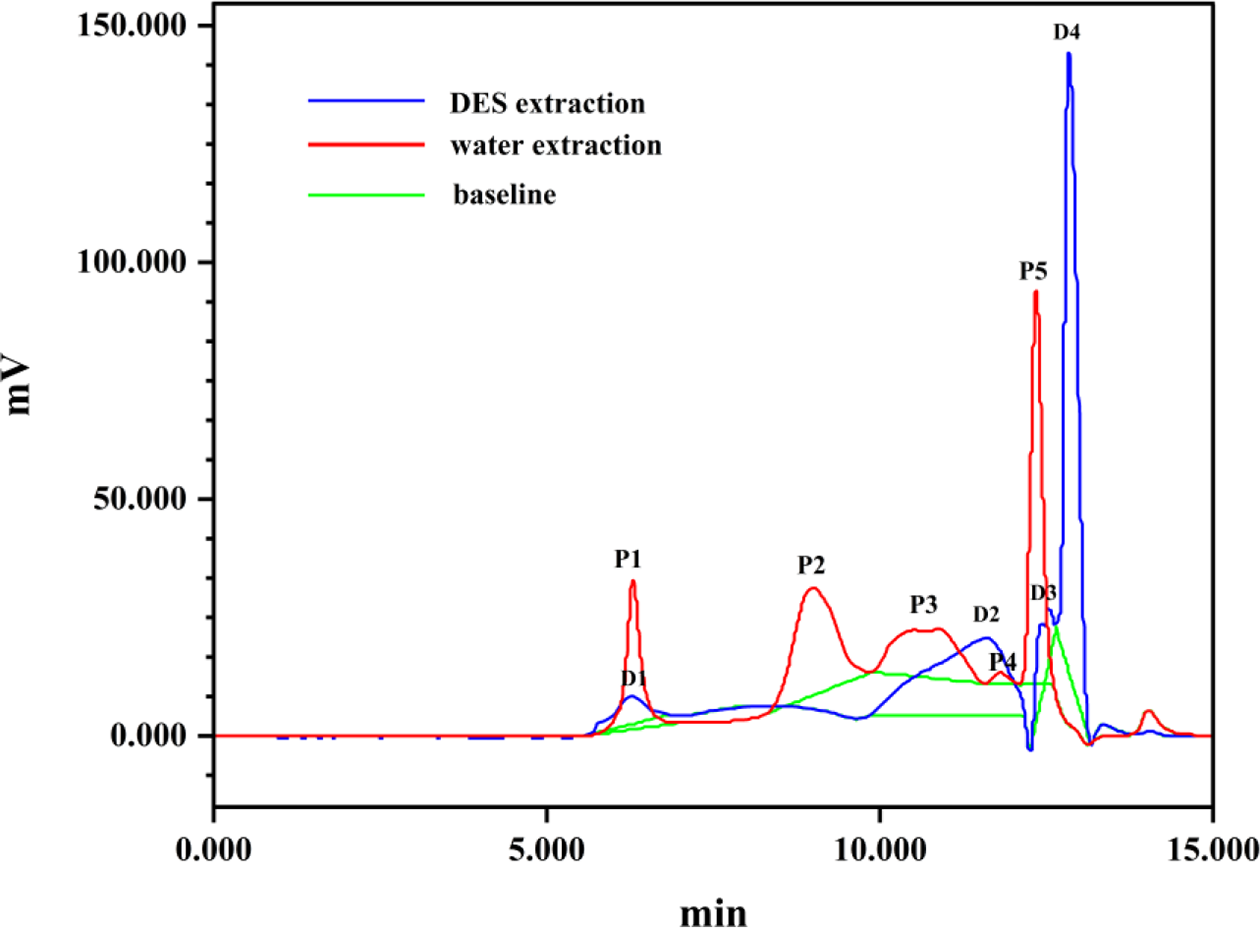
High-performance gel permeation chromatogram of Poria cocos polysaccharide.
The Molecular Weight of Polysaccharide Samples.
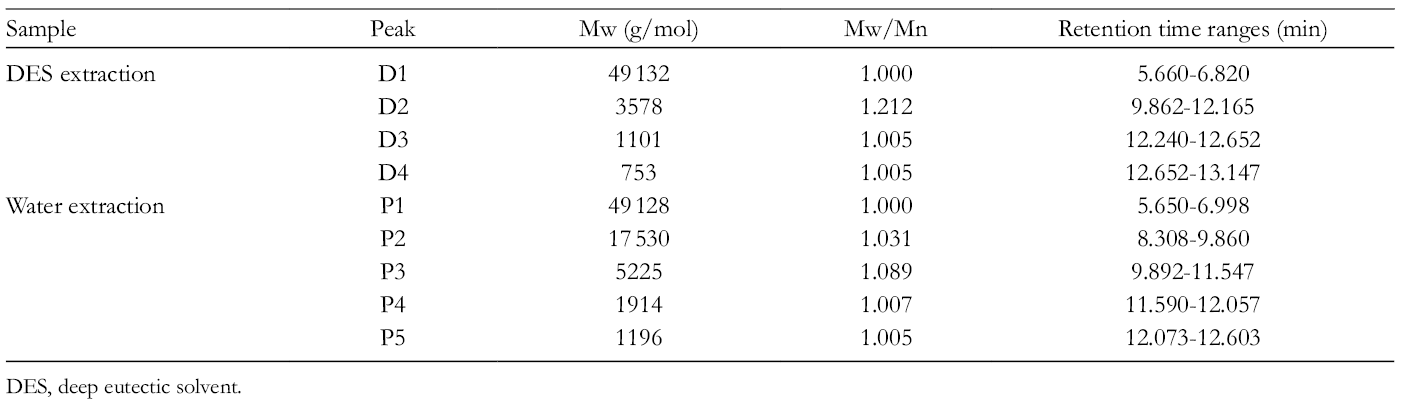
DES, deep eutectic solvent.

Mass fractions of different peaks of Poria cocos polysaccharides.
Materials and Methods
Materials
Poria cocos were harvested in Jinzhai (Anhui, China).
Poria cocos Pretreatment
The Poria cocos powder was obtained by ultrafine grinding and then dried at 60°C for 3 hours, then filtered through a standard 80 mesh sieve. The homogeneous powder was stored at room temperature in a vacuum-packed container prior to extraction. 5
All reagents used in the synthesis of DES were purchased from Sinopharm Chemical Reagent Co., LTD (Shanghai, China). Others were all of analytical grade and were purchased from Aladdin (Shanghai, China).
Preparation of DES
Different types of DES were prepared by the heating method 43,44 and used to extract PCP. That is, 2 components of each type of DES were capped in a bottle, heated in a certain condition, and agitated with a stirring bar until the formation of a homogeneous liquid. Six types of DES were prepared with the heating method (Table 4), including choline chloride-urea (DES-1), choline chloride-ethylene glycol (DES-2), choline chloride-imidazole (DES-3), choline chloride-citric acid monohydrate (DES-4), choline chloride-oxalic acid (DES-5), and choline chloride-glycerol (DES-6). DES-5 (chloride-oxalic acid) was suggested in this study.
The Synthesis of Deep Eutectic Solvents by Using Choline Chloride as the Hydrogen Bond Acceptor and Different Hydrogen Bond Donors.

HBA, hydrogen bond acceptor; HBD, hydrogen bond donor.
Deep Eutectic Solvent-Based Extraction of PCP
Deep Eutectic Solvent-Based Extraction Procedure
Pretreated P. cocos powder (0.5 g) was mixed with 10 mL DES to water bath 100°C 30 (or oil bath) for 1 hour. And the extraction solution was filtered to collect the filtrate. Then, the collected filtrate was concentrated to one-fifth of the initial volume using vacuum distillation. The concentrate was added with anhydrous ethanol to a final concentration of 80% (v/v) to complete the precipitation, which was dried to obtain the crude PCP. Using d-glucose as the standard substance, the content of PCP was measured by the phenol-sulfuric acid method 45 and the extraction yield of PCP (%) was calculated as follows 5 :

where C is the polysaccharide content, M represents the sample dry weight, D is the dilution ratio, and V is the total volume after polysaccharide resolubility.
Hot Water Extraction Procedure
To evaluate the DES-based extraction of PCP, HW-PCP was also done. That is, 5.0 g pretreated sample powder was extracted with 100 mL boiling water (100°C) for 1 hour. 5 After 3 repeated extractions, the extraction solutions were combined and the alcohol precipitation was performed to obtain the crude PCP.
Single-Factor Experiment Design
The effects of types of DES, mole ratio of DES, extraction temperature, extraction time, and solid-liquid ratio on the extraction yield of PCP were firstly investigated using single-factor experiment design. Each experiment factor was optimized, while others were kept constant. Each experiment was performed in triplicate.
Box-Behnken Design and Statistical Analysis
Based on the single-factor experiments, RSM was used to estimate the effects of 3 independent variables (molar ratio, X 1; extraction temperature, X 2; and extraction time, X 3) at 3 levels on the extraction yield of PCP (%). A BBD was employed for designing the experiments. Response surface methodology was applied to the experimental data using the commercial statistical package Design-Expert version 8.0.7.1 (Minneapolis, United States). Experiments were randomized to minimize the effects of unexplained variability in the observed responses due to extraneous factors. The range and center point values of 3 independent variables presented in Table 5 were based on the results of preliminary experiments.
Independent Variables and Their Levels Used for Box-Behnken Design.
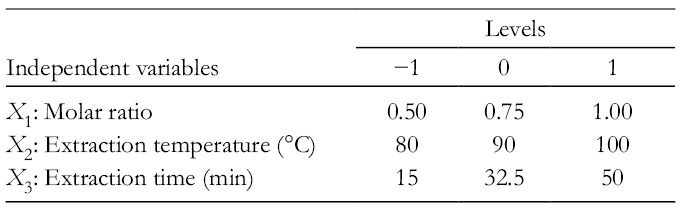
The entire design consisted of 17 experimental points, which were performed in random order, as presented in Table 1. These conditions were based on the results of the preliminary experiments. For statistical calculations, each variable was coded at 3 levels: −1, 0, and 1; the complete design consisted of 17 experiments including 12 factorial experiments and 5 replicates at the center point. Each experiment was performed in triplicate.
Reusing of DES-ChoCl/Oxalic Acid
Poria cocos powder (30.0 mg) and a known amount of DES-ChoCl/oxalic acid were added into the reactor in a constant temperature water bath at 100°C. After stirring for the desired time 15 minutes, the reaction system was cooled to room temperature immediately. Then, the reactant was added 5 times to anhydrous ethanol and centrifuged to collect filtrate. The collected filtrate containing the DES and ethanol from the reaction was distilled under reduced pressure at 70°C using a rotatory evaporator (Büchi rotavapor R114, Switzerland) in a water bath. Then, the recycled DES phase was used directly for the next run, where the procedure was the same as that described above. The recycling was repeated 6 times without the use of any additional chemicals. Each experiment was performed in triplicate.
Molecular Weight Distributions Determination
The molecular weight distributions were measured by HPGPC. 46 Samples (20 mg) were dissolved in 2 mL of 0.02 M phosphate buffer solution and centrifuged at 15 000 rpm for 10 minutes. Then, 20 µL of the aqueous phase was filtered through a 0.22 µm filter and injected into a Shodex SB-804 HQGPC column (300 × 8 mm). Dextran standards with different molecular weights were used to calibrate the column and establish a standard curve. 47
Statistical Analysis
All experimental results were statistically analyzed using SPSS (Statistical Package for the Social Sciences) version 22.0. Data in the text and tables were expressed as mean ± standard deviation (±SD), and error bars in the figures indicate SD. Differences between means were analyzed by the ANOVA test, followed by the post hoc Tukey’s test. A significant difference was considered at the level of P < 0.05.
Conclusion
In this work, DES was developed for the extraction of PCP. Based on the initial screening of single factor experiment (included mole ratio, extraction temperature, extraction time, and solid-liquid ratio), RSM was used to further optimize the extraction conditions and giving the optimal extraction conditions included the mole ratio of DES-5 in 1:2 (choline chloride:oxalic acid) and extraction 15 minutes at 100°C. The predicted extraction yield of PCP was within the range of the extraction yield supplied by the optimal extraction conditions. Furthermore, the DES extraction was better than hot water extraction considering the extraction yield. In addition, the reusability of DES was demonstrated by reusing it 6 times without decreasing the reaction efficiency and high reusability efficiency could be achieved without the use of any additional chemicals. Moreover, molecular weight distributions of the resulting PCP were characterized. Therefore, the deep eutectic solvent extraction proved to be a green, fast, and effective extraction method for the extraction of polysaccharides from sample matrices. The structure and bioactivity of PCP need further investigation.
Footnotes
Author Contributions
W.Z. and S.C. collaborated in the extraction experiments; X.Z. and X.H. participated in the design of the study and critically discussed the concept and data; J.S. and G.C. supervised the development of the entire experimental work in the discussion and interpretation of the results; and H.P. supervised the project.
Declaration of Conflicting Interests
The author(s) declared no potential conflicts of interest with respect to the research, authorship, and/or publication of this article.
Funding
The author(s) disclosed receipt of the following financial support for the research, authorship, and/or publication of this article: This work was supported by a grant from the National Natural Science Foundation of China (NSFC 21576142 and 21776142); Research project of young- and middle-aged leading scientists, engineers, and innovators in Xinjiang production and construction corps (2018CB024); and Innovation project for the south-forward development for Xinjiang production and construction corps (2018DB002).
