



Abstract
Dihydrochalcone class of compounds displays good performance in taste modulation on several natural non-caloric/low-caloric sweeteners. Compounds such as hesperetin dihydrochalcone (HDC) and hesperetin dihydrochalcone-4′-O-β-d-glucoside (HDCG) were reported to be found in nature. However, the evidence was not complete to support their natural presence. The Coca-Cola Company has been working on the identification of natural sources of reported dihydrochalcones, as well as the exploration of new natural dihydrochalcones. During the investigation on plant Balanophora harlandii, the natural presence of HDCG was confirmed, and 3 new analogs have been identified. In this paper, detailed structural elucidation of known HDCG and 3 new analogs have been described.
Nowadays, many natural, non-caloric/low-caloric sweeteners have been applied to satisfy an increasing demand by consumers in the food and beverages. But none of them can really replace sucrose. Terpene glycosides, such as rebaudiosides from Stevia rebaudiana and mogrosides from Siraitia grosvenorii (monkfruit, Luo Han Guo), are natural sweeteners available on the market. The major components (e.g., rebaudioside A and mogroside V) from these sweeteners, however, are reported to exhibit sweet linger, bitter aftertaste, or licorice-like taste. 1,2 Addition to the discovery and development of minor components with improved taste profiles (e.g., rebaudioside M, siamenoside I), 2,3 another strategy is to design sweetener systems containing taste modulators to modify the taste perceptions.
Since the discovery and application of the sweet tasting agent, neohesperidin dihydrochalcone (NHDC), 4 in the food industries, a couple of decades ago, the exploration of dihydrochalcones (DCs) has never been stopped. NHDC is a semisynthetic derivative of neohesperidin which can be isolated from the Citrus species. It was reported to be 250-1800 times sweeter than different concentration levels of sucrose. 4 Although NHDC has a slower sweet onset than sucrose and lingering aftertastes, it performs great in bitterness blocking, sweetness enhancing, and mouthfeel improving. 4,5 Its analogs, hesperetin dihydrochalcone (HDC) and hesperetin dihydrochalcone-4′-β-d-glucoside (HDCG), share similar characteristics in sweetness and taste improvement. 5
Few publications reported the natural presence of NHDC in Oxytropis myriophylla
6
and HDCG in Balanophora harlandii.
7
However, neither of the paper provided supportive data to differentiate the substituent groups on C-3 and C-4 (Figure 1). Balanophora harlandii is a parasitic plant widely distributed in the southwest of China.
8
Several other DCs, such as phloretin and its analogs have been identified from the species.
7,8
During our investigation on B. harlandii, the natural source of HDCG (
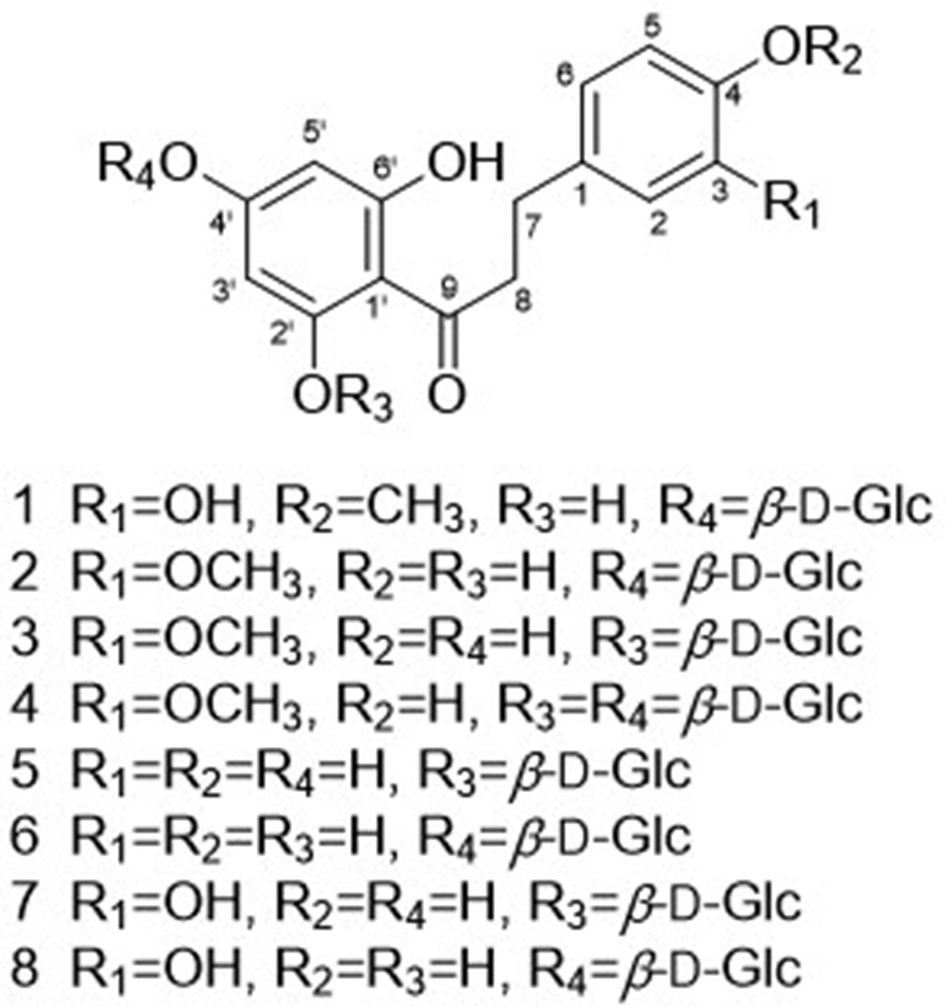
Structures of dihydrochalcone glycosides from B. harlandii.
Compound
NMR Spectra of Compounds 1

DMSO-d 6, dimethyl sulfoxide-d 6.

Key HMBC and ROESY correlations of 1.
Compound

Key HMBC and ROESY correlations of 2.
Compound
Compound
The absolution configuration of sugar moieties on compounds
Compound
Compound
Compound
Compound
The sensory profile of compound
Experimental
Chemicals and Reagents
Ninety-five percent ethanol (EtOH), methanol (MeOH), n-butanol (n-BuOH), and ethyl acetate (EtOAc) (all in AR grade) were purchased from Cinc High Purity Solvents (Shanghai) Co., Ltd. Hydrochloric acid, sodium hydroxide (NaOH), pyridine, and n-hexane (all in AR grade) were purchased from Sinopharm Chemical Reagent Co. Ltd. Acetonitrile for semipreparative high-performance liquid chromatography (HPLC grade) was provided by Merck KGaA. l-cysteine methyl ester hydrochloride, 1-trimethylsilylimidazole, d-glucose Reference Standard and l-glucose Reference Standard (all in LR grade) were purchased from Shanghai Macklin Biochemical Co., Ltd. NHDC was purchased from Sigma Aldrich. HDC and HDCG reference compounds were prepared from NHDC by The Coca-Cola Company. 5
Instruments
1D and 2D NMR data were recorded on a Bruker 600 MHz Avance Ⅲ HD spectrometer, and the 1H and 13C NMR chemical shifts were referenced to the residual solvent peaks for dimethyl sulfoxide-d 6 (δH 2.50 and δC 39.52). HPLC was performed on an Agilent 1290 system using Agilent Eclipse plus C18 column (1.8 µm, 2.1 × 50 mm). HRMS was performed in the negative ion mode with a Sciex Triple TOF 4600 spectrometer. MS/MS data were acquired by using data-dependent acquisition mode. GC–MS was performed on an Agilent 7890A/5977A GC/MSD System using an Agilent HP-5MS column (30 m × 0.25 mm × 0.25 μm). Semipreparative HPLC was carried out on an Agilent 1260 infinity with a UV detector using a Boston Green ODS-AQ column (10 × 250 mm, 5 µm). Preparative HPLC was carried out on a Shimadzu LC-20AP system using a YMC Actus Hydrosphere C18 column (30 × 250 mm, 5 µm). Column chromatography (CC) was performed using AB-8 resin (Sunresin New Materials Co. Ltd., China), MCI gel CHP-20 (Mitsubishi Chemical Systems, Inc. Japan), and Sephadex LH-20 (GE Healthcare Bio-Sciences AB, Sweden). Lyophilization was carried out on a Scientz-18N freeze dryer (Ningbo Scientz Biotechnology Co., Ltd.).
Plant Material
The whole plant of B. harlandii was collected from AnShun, GuiZhou during November 2017. All the materials were dried under the sun. The identification and description of B. harlandii are according to the “Flora of China” 14 and “Flora of GuiZhou”. 15 Plants are dioecious. The rhizome is yellowish to brownish. Scapes are red (especially in females) to yellow. Leaves are about 6-12, yellow to reddish, usually clustered on the base of scape, decussate, subopposite, or spiraled, scaly. Male inflorescences are subspheroid to ovoid-ellipsoid, 1.8-2.5 cm × 1.5-2 cm. Bracts truncate with expanded liplike margin, fused side by side into a hexagonal alveolus. Male flowers: pedicellate, inserted basally in the alveolus, trimerous, 1.5-3 mm in diameter. Perianth lobes broadly deltoid. Synandria subdiscoid; anthers 3, transversely dehiscent. Female inflorescence is ovoid to ellipsoid. Spadicles obovoid, shortly stiped; cuticular ridges of apical cells labyrinthlike. Female flowers: only on the main axis of inflorescences (supplemental figure S39).
Plant Extraction
The dried powder of B. harlandii (10 kg) was extracted with 80% EtOH (100 L) at 70 °C for 4 hours. After the evaporation of EtOH, the solution was concentrated to a small volume (5 L).
LC-MS-Guided Isolation
The concentrated solution was subjected to an AB-8 resin column and eluted with 10% EtOH (100 L) and 95% EtOH (60 L). The 95% EtOH eluates were applied to an MCI column and gradually eluted with MeOH/water (H2O) (1:4→4:1) to afford 5 fractions.
Approximately 200 µg/mL of NHDC, HDC, HDCG reference compounds, and 10 mg/mL of each fraction were prepared in MeOH, respectively. After being centrifuged at 12,000 rpm for 5 minutes, each supernatant was subjected to the LC–MS system using conditions listed in supplemental table S1. HRMS of NHDC, HDC, and HDCG were extracted and MS/MS data of each extracted ion chromatogram (XIC) matched signal was used to identify potential target compounds in the fractions. Candidates with m/z (either fragment or quasimolecular ion) match to the HRMS of HDCG were observed from Fr.1 to Fr.4, among which the signal with Rt = 4.99 in Fr.4 was identified as HDCG by comparing to reference compound (supplemental figures S40-S43). One candidate with m/z match to the HRMS of HDC was detected in Fr.5 (supplemental figure S44). However, further isolation of this candidate was not pursued due to limited yield.
Fr.1 (70 g) was dissolved with H2O (3 L) and pH was adjusted to 1 with hydrochloric acid, partitioned with EtOAc (3 L). The water fraction (30 g) pH was adjusted to 7 with 1% NaOH solution and concentrated to 20 mL. The 20 mL sample was subjected to a Sephadex LH-20 column, followed by preparative HPLC (YMC Actus Hydrosphere C18, 30 × 250 mm, 5 µm) with H2O–acetonitrile (74:26) at 30 mL/min to yield compound
Fr.2 (60 g) was dissolved in water (3 L) and pH was adjusted to 1 with hydrochloric acid, then extracted with EtOAc (3 L) two times. The EtOAc fractions were combined and concentrated to get semi-solid (20 g), which was dissolved in 50 mL MeOH–H2O (1:1) and chromatographed on an MCI column, a Sephadex LH-20 column, finally further purified on preparative HPLC with H2O–acetonitrile (79:21) at 30 mL/min to obtain compounds
Fr.3 (100 g) was isolated on preparative HPLC with H2O–acetonitrile (78:22) at 30 mL/min, yielding compounds
Fr.4 (60 g) was dissolved with 4% NaOH and pH was adjusted to 10 with hydrochloric acid, subsequently extracted with n-BuOH (4 L). The water phase pH was adjusted to 5 and partitioned with n-BuOH (4 L) one more time. The second n-BuOH fraction (25 g) was chromatographed over Sephadex LH-20, eluting with 50% EtOH to yield mixture (430 mg) containing compounds
Sugar Analysis
A solution of each compound (
Sensory Evaluation of HDCG
Samples of rebaudioside M (Reb M), HDCG with Reb M, siamenoside I (Sia I), and HDCG with Sia I in acidified (citric acid) water were prepared, respectively, as described in the patent WO2018200663 A1. 5 Taste tests were carried out with two panelists. Panelists were asked to evaluate the sweetness of samples and describe the difference of taste profile using 3%, 5%, and 8% sucrose in acidified (citric acid) water solution as references. Panelists were instructed to sip, evaluate the sweetness, and then spit the samples. Mineral water was given to panelists to rinse their mouth before tasting and between tasting different samples. Unsalted crackers were also given to panelists to eat followed by rinsing their mouth with mineral water before tasting the next sample.
Supplemental Material
Supplementary material - Supplemental material for Dihydrochalcone Glycosides From Balanophora harlandii
Supplemental material, Supplementary material, for Dihydrochalcone Glycosides From Balanophora harlandii by Indra Prakash, Yong Qian, Bin Wang, Zhenqiang Xin, Gil Ma, Zhou Yang, Juvenal Higiro, Goran B. Petrovic, Wenshuai Tian and Tianpei Xie in Natural Product Communications
Footnotes
Declaration of Conflicting Interests
The author(s) declared no potential conflicts of interest with respect to the research, authorship, and/or publication of this article.
Funding
The author(s) received no financial support for the research, authorship, and/or publication of this article.

References
Supplementary Material
Please find the following supplemental material available below.
For Open Access articles published under a Creative Commons License, all supplemental material carries the same license as the article it is associated with.
For non-Open Access articles published, all supplemental material carries a non-exclusive license, and permission requests for re-use of supplemental material or any part of supplemental material shall be sent directly to the copyright owner as specified in the copyright notice associated with the article.
