



Abstract
The heartwood of Pterocarpus marsupium is called as “Asana” in Ayurveda. Its aquatic infusion was used for treating “prameha,” which indicates a polyuria disease in modern medicine. In our research program to investigate a novel agent to improve hyperuricemia, we focused on the extract of Asana as a xanthine oxidase (XOD) inhibitor. Asana extract (50% ethanolic extract, PM-ext) showed 11%, 35%, and 38% inhibition at 50, 200, and 500 µg/mL, respectively. Subsequently, PM-ext was partitioned with ethyl acetate (AcOEt), butanol, and water. Among them, AcOEt-soluble fraction indicated the most potent XOD inhibitory activity and was consecutively fractionated using various liquid chromatography to obtain liquiritigenin (
In Ayurveda, ancient Indian medicine, the term “prameha” indicates a polyuria disease, including diabetes mellitus. Aquatic infusion from a tumbler made from the heartwood of “Asana” is a traditional medicine for treating “prameha.” Asana (Pterocarpus marsupium) is a Fabaceae plant which grows in the Deccan Plateau. The anti-diabetes activities of Asana were demonstrated by extensive research. Ahmad et al reported that an ethyl acetate soluble fraction obtained from an ethanolic extract of Asana heartwood showed hypoglycemic activity and increased insulin blood levels using alloxan-induced diabetes model rats. 1 Manickam et al reported that the active principles responsible for the hypoglycemic activities in streptozotocin-induced diabetes model rats were marsupin and pterostilbene. 2 Diabetes mellitus causes vascular endothelial damage through glycation of intravascular cells and/or tissues, leading to thrombosis and bad blood circulation. Regarding this point, we already reported that oral administration of 50% ethanolic extract obtained from Asana heartwood improved the fluidity of poor blood circulation in lipopolysaccharide-induced disseminated intravascular coagulation (DIC) model rats. Furthermore, pterostilbene was identified as one of the active principles that inhibited platelet coagulation via cyclooxygenase inhibition. 3
Diabetes mellitus is categorized as a lifestyle-related noncommunicable disease (NCD). NCD are a group of lifestyle-related diseases, ie, cardiovascular disease, cancer, diabetes, and chronic respiratory disease. The mortality rate due to NCD accounted for 71% of global annual deaths in 2016 according to a statistics report published by the World Health Organization. 4 Bad habits, ie, smoking, unhealthy diet, physical inactivity, and excessive alcohol consumption, are the key risk factors for NCD and metabolic abnormalities of sugar, lipids, nucleic acid, and hormones. 5 -7 Personalized lifestyle medicine can reduce some risks and is recognized as a first-line therapy for NCD. 8 However, it is difficult to personalize lifestyle medicine due to the diversity of lifestyles.
We believe consumption of functional and/or supplemental foods could be a treatment option for NCD. Our research group has screened various natural plant resources as potential materials to improve hyperuricemia, benign prostate hyperplasia (BPH), and blood fluidity. Among the plant resources screened, we investigated an extract from rhizomes of Kaempferia parviflora (Zingiberaceae) as a potential agent for hyperuricemia based on its xanthine oxidase (XOD) inhibitory activity, BPH based on its improvement in BPH and inhibition against 5α-reductase in model rats, and improvement in blood fluidity in DIC model rats. 9 -11
In our research project to identify a novel agent to improve hyperuricemia, we focused on Asana heartwood. Asana showed an improvement in blood fluidity as mentioned in our previous report. Therefore, we extended our research on Asana to demonstrate its potential to treat hyperuricemia.
Hyperuricemia is a disease caused by metabolic impairment of uric acid and blood levels of this acid remain high. Hyperuricemia causes inflammation of joints due to the precipitation of uric acid and is widely recognized as one of the factors that cause heart disease. 12 Agents with XOD inhibitory activity are effective to treat hyperuricemia and XOD inhibitors have been already approved as effective medicines. Among them, allopurinol is a purine-type inhibitor widely used in hyperuricemia treatment. Allopurinol can also be effective for controlling cardiovascular disease. 13 These facts prompted us to investigate Asana as a multi-potent remedy for hyperuricemia. In this report, data on inhibition of XOD by Asana extract and its active principles are presented.
PM-ext inhibited XOD by 11%, 35%, and 38% at 50, 200, and 500 µg/mL, respectively (Figure 1). This result prompted us to determine the active principle of XOD inhibition. Subsequently, PM-ext was partitioned between water and AcOEt, and water and BuOH. Each fraction was tested for XOD inhibitory activity. As a result, the AcOEt-soluble fraction showed the most potent activity among the fractions obtained with 20% and 42% inhibition at 50 and 200 µg/mL, respectively (Figure 2).
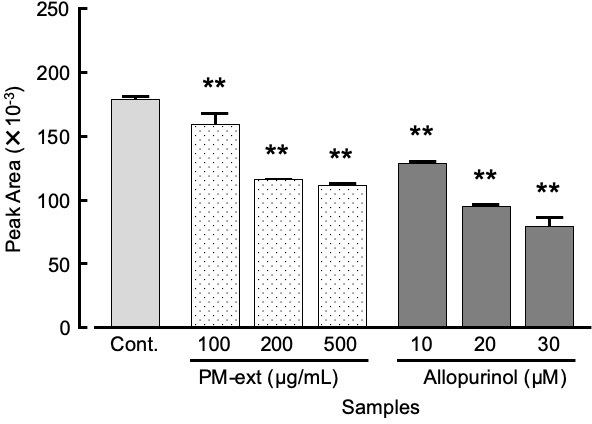
XOD inhibitory effects of PM-ext. Each value represents the mean ± SD of triplicates. Significantly different from control group, **: P < 0.01. XOD, xanthine oxidase.

XOD inhibitory effects of AcOEt-, BuOH-, and H2O-soluble fractions obtained from PM-ext. Each value represents the mean ± SD of triplicates. Significantly different from control group, **: P < 0.01. XOD, xanthine oxidase.
The AcOEt-soluble fraction was further fractionated with silica gel column chromatography into 5 fractions, Fr. A, B, C, D, and E. Following an XOD assay of these fractions, Fr. D showed the most potent activity with 52% and 65% of inhibition at 50 and 100 µg/mL, respectively. Fr. C showed the second highest activity with 23% and 35% of inhibition at 50 and 100 µg/mL, respectively. Fr. B showed 14% inhibition at 100 µg/mL and Fr. E showed 16% and 24% inhibition at 50 and 100 µg/mL, respectively (Figure 3).

XOD inhibitory effects of Fr. A, B, C, D, and E. Each value represents the mean ± SD of triplicates. Significantly different from control group, **: P < 0.01. XOD, xanthine oxidase.
Purification with preparative HPLC led us to isolate

XOD inhibitory effects of liquiritigenin (1) and isoliquiritigenin (2). Each value represents the mean ± SD of triplicates. Significantly different from control group, **: P < 0.01. XOD, xanthine oxidase.
On the other hand, Fr. D showed the most potent XOD inhibitory activity among Fr. A to E. We prepared Fr. D2 that was equivalent to Fr. D. From Fr. D, a benzofuranone,

XOD inhibitory effects of marsupsin. Each value represents the mean ± SD of triplicates. Significantly different from control group, **: P < 0.01. XOD, xanthine oxidase.
From these results, PM-ext is a promising candidate material for improving hyperuricemia due to its XOD inhibitory activity. Previously, we reported that PM-ext improved blood fluidity. Moreover, Asana has been used to treat diabetes since the 16th century, supporting its potential as a lifestyle-related medicine. Here, Asana was recognized as an effective material against NCD and is expected to be developed as a functional ingredient. Further study to determine the other active principles in Asana is now underway in our laboratory.
Experimental
Reagents
Reagents used in this study were purchased from Fujifilm Wako Pure Chemicals (Osaka, Japan), Nacalai Tesque (Kyoto, Japan), or Sigma-Aldrich (St Louis, MO, USA), unless otherwise stated.
Preparation of Extracts From Heartwood of P. marsupium
Heartwood of P. marsupium was harvested in Kerala, India, on April 10, 2014, and provided from Inabatakoryo Co., Ltd. in May 2014. The voucher specimen of this plant is deposited at the Faculty of Pharmacy, Kindai University (Voucher No. PM-20140410).
Pulverized heartwood (400 g) was extracted with 50% ethanol (EtOH, 4 L) under reflux for 2 hours. The filtrates were combined and the solvent was evaporated under reduced pressure and lyophilized to give a brown powder (PM-ext, 46.4 g, 11.6%).
Fractionation of PM-Ext
The PM-ext (40 g) was suspended in water (600 mL) and extracted with ethyl acetate (AcOEt, 600 mL × 3). The water was then extracted with n-butanol (BuOH, 600 mL × 3). The yields of AcOEt, BuOH, and water fractions were 6.0, 8.8, and 21.0 g, respectively. The AcOEt-soluble fraction (5.6 g) was subjected to silicic gel column chromatography (75 g, Merck, 3.5 i.d. × 16 cm). Elution was performed with mixtures consisting of A: n-hexane (Hex), B: AcOEt (A:B = 5:1, 3:1, 1:1, and 1:3) and methanol (MeOH), and each fraction was monitored with TLC [Merck No. 1.05735 silica gel 60 F254, Hex/AcOEt = 1:1 (v/v), detection; UV and 10% H2SO4 followed by heating]. The fractions were combined into 5 fractions (Fr. A, B, C, D, and E) according to the TLC data. Fr. C (970 mg) was subjected to silicic acid column chromatography (50 g, 1.24 i.d. × 25 cm) using a mixture of chloroform/MeOH in gradient condition from 1:0 to 0:1 to obtain 50 fractions, which were then combined into 6 fractions (Fr. C-1-C-6) according to TLC analysis. Fr. C-3 (155.5 mg) was then subjected to preparative HPLC under the following conditions: column: Waters SunFire C18 column (19 i.d. × 250 mm); mobile phase: 35% acetonitrile (MeCN) containing 0.1% formic acid; column temperature: ambient; flow rate: 10 mL/min; detection: UV 254 nm to obtain liquiritigenin (
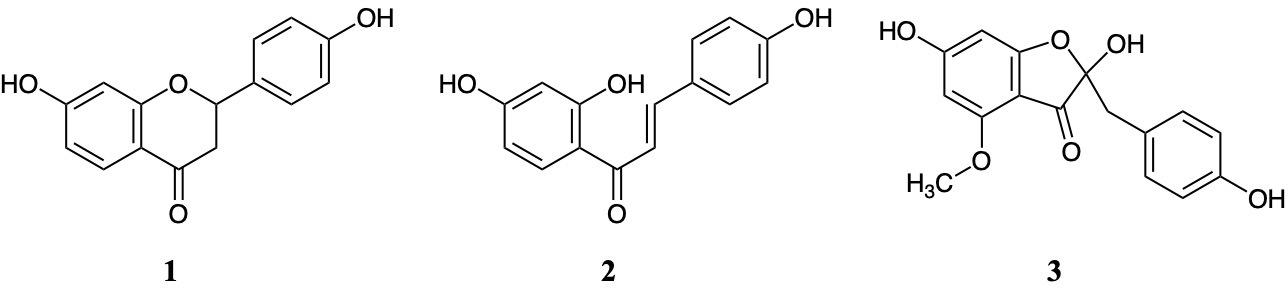
Chemical structures of liquiritigenin (1), isoliquiritigenin (2), and marsupsin (3).
Fractionation of Fr. D was performed according to the method reported previously as shown in Figure 7.
17
The other part of PM-ext (47.2 g) was partitioned with AcOEt and water to give AcOEt-soluble fraction 2 (AcOEt fr2, 4.7 g) and insoluble fraction (Insoluble fr2, 42.5 g). Then, AcOEt fr2 was subjected to silicic acid column chromatography (Universal Premium 2 L, 3.0 i.d. × 20.0 cm, Yamazen Co. Ltd, UW104) using EPCLC AI-580 (Yamazen Co. Ltd). Elution was performed with mixtures consisting of A: n-hexane (Hex), B: AcOEt (A:B = 85:15, 3:1, 1:1, and 1:3) and MeOH, and 5 fractions were obtained as Fr. A2, B2, C2, D2, and E2. The yields of Fr. A2, B2, C2, D2, and E2 were 332, 122, 372, 308, and 2.9 mg, respectively. Fr. D2 (309 mg) was then subjected to preparative HPLC under the following conditions: column: Waters SunFire C18 column (10 i.d. × 250 mm); mobile phase: 20% MeCN containing 0.1% formic acid; column temperature: ambient; flow rate: 5.0 mL/min; detection: UV 369 nm to obtain marsupsin (
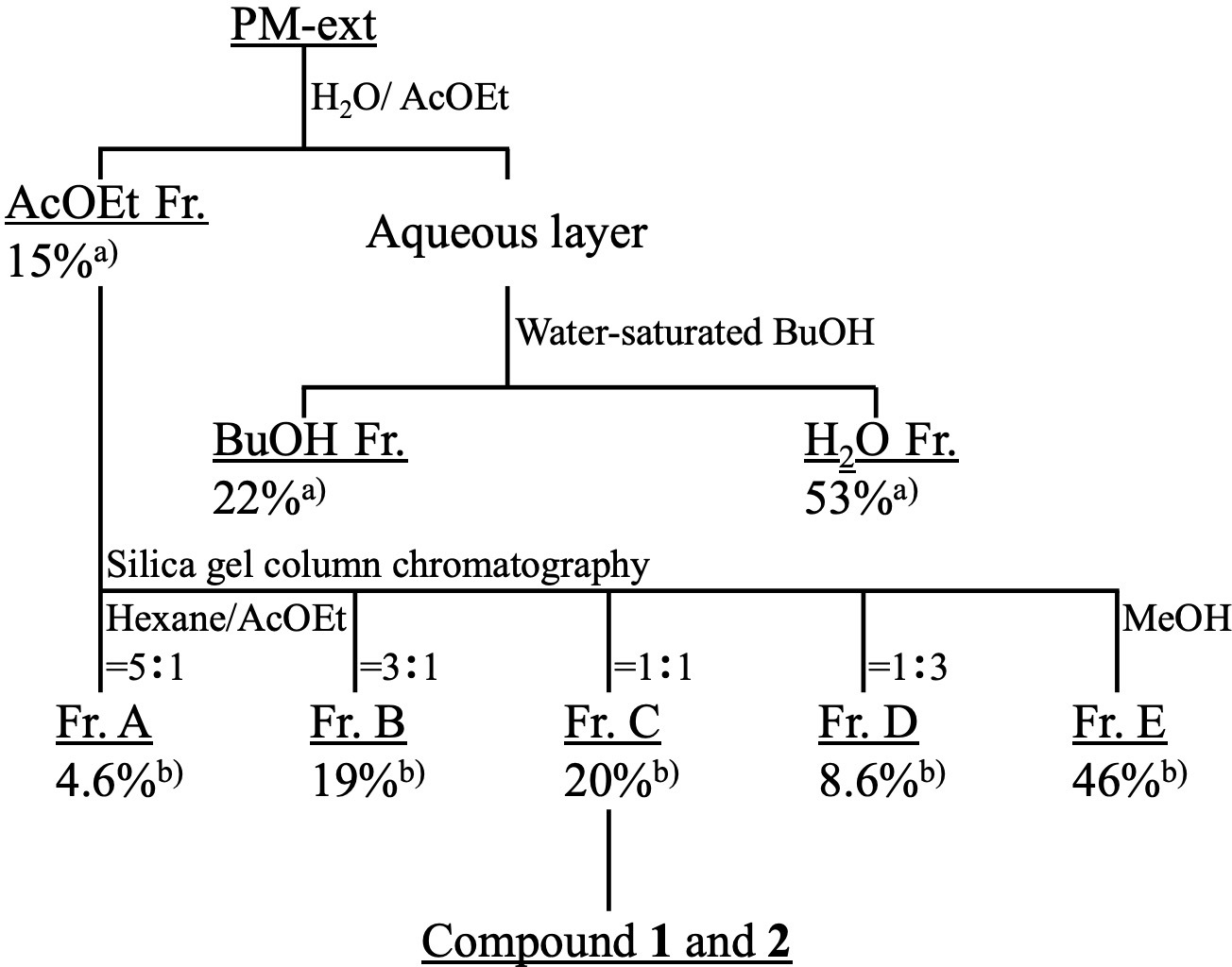
Scheme for fractionation of Fr. A to E. (a) Yield from PM-ext; (b) yield from AcOEt Fr.; (c) yield from Fr. D.

Scheme for isolation of 3. (a) Yield from PM-ext; (b) yield from AcOEt fr2; (c) yield from Fr. D2.
Assay of XOD Inhibitory Activities
XOD inhibition was evaluated according to a previous method with minor modifications. 9 Polyoxyethylene (20) sorbitan monooleate solution (0.1%) was prepared using 0.1 M sodium phosphate buffer (pH 7.8). to yield 0.1%. Xanthine (4.27 mg) was dissolved in 100 mL of buffer with sonication to give 245 µM xanthine buffer. The assay mixture, consisting of 100 µL of the test sample dissolved in dimethylsulfoxide (DMSO) and 800 µL of xanthine buffer, was pre-incubated at 25°C for 10 minutes. The reaction was initiated by the addition of 100 µL of enzyme solution (0.2 units/mL XOD in buffer) and incubated at 25°C for 3 minutes. To stop the reaction, 100 µL of 1 N hydrochloric acid was added. The reaction mixture was subjected to HPLC analysis to determine the amount of uric acid produced. HPLC conditions were as follows: column: Develosil RPAQUEOUS Guard column (4.6 i.d. × 10 mm, Nomura Chemical, Seto, Japan) and Develosil RPAQUEOUS (4.6 i.d. × 250 mm); mobile phase: 20 mM potassium dihydrogen phosphate; column temperature: 40°C; flow rate: 1 mL/min; detection: UV 290 nm; injection volume: 10 µL. Allopurinol was used as a reference drug. The inhibition (%) was calculated as follows:
Inhibition (%) = (peak area of control – peak area of test solution)/peak area of control × 100
Statistical Analysis
The experimental data were statistically analyzed with Statcel3 (Publisher, OMS, Tokorozawa, Japan) add-in software for Excel using one-way analysis of variance. Statistical significance was analyzed by Bonferroni/Dunn’s multiple range tests.
Footnotes
Declaration of Conflicting Interests
The author(s) declared no potential conflicts of interest with respect to the research, authorship, and/or publication of this article.
Funding
The author(s) received no financial support for the research, authorship, and/or publication of this article.
