A new optical biflavonoid, (2”R)-2″,3″-dihydrorobustaflavone 7,4′-dimethyl ether (1), and 6 known compounds (2-7) were isolated for the first time from the 70% ethanol extract of Selaginella trichoclada Alsto. The structures of the compounds were confirmed by extensive spectroscopic data analyses. Racemic compound 1 was separated by chiral-phase high-performance liquid chromatography, and the absolute configurations of (±)-1 were defined by circular dichroism spectroscopic data. Compound 1 exhibited moderate cytotoxicity against MCF-7, A549, and HepG2 human cancer cell lines.
The genus Selaginella (Selaginellaceae) is composed of approximately 70 species, many of which are distributed in China where many have been used for treating bleeding, jaundice, gonorrhea, and idiopathic thrombocytopenic purpura in traditional Chinese medicine.1 The genus is known as a rich source of secondary metabolites including flavonoids,2 selaginellin,3 alkaloids,4 lignans,5 and steroids,6 which have been reported to exhibit diverse pharmacological activities, such as antitumor,7,8 antibiosis,9,10 antiviral,11 and antioxidant.12S. trichoclada Alsto, commonly known as “boyundan, yanbaicao and tubozi” in folk medicine, is mainly distributed in the southern area of China, where it is used widely as a herbal medicine for clearing heat and promoting diuresis and relieving cough.13 As a part of a systematic search for bioactive natural products from the 70% EtOH extracts of S. trichoclada, we report here the isolation and structural elucidation of (±)-2″,3″-dihydrorobustaflavone 7,4′-dimethyl ether (1) and 6 known compounds (2-7), as shown in Figure 1. The structures of these compounds were identified on the basis of extensive spectroscopic data, including UV-vis, infrared (IR), 1-dimensional (1D)-2D nuclear magnetic resonance (NMR), high-resolution electrospray ionization mass spectra (HRESIMS), and circular dichroism (CD). Compound 1 was a diastereoisomeric pair of enantiomers due to the presence of a chiral center at C-2″, but after being subjected to chiral-phase high-performance liquid chromatography (HPLC) analysis, finally yielded (±)-1. It is rare to obtain stereoisomers of a biflavonoid from the genus Selaginella. Compound 5 was isolated from the genus Selaginella for the first time. The cytotoxicity of compounds 1 to 7 was evaluated against 3 human cancer cell lines (MCF-7, A549, and HepG2).
The structures of compounds 1 to 7 from Selaginella trichoclada.
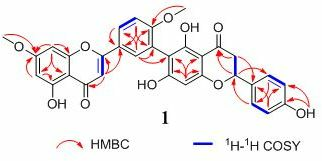
Compound 1, a racemic mixture, was a yellow amorphous powder with the molecular formula of C32H24O10, as determined from the [M + H]+ ion peak at m/z 569.1441 (calculated for 569.1442) in the HRESIMS (supplemental material Figure S4). The UV spectrum of 1 in methanol, showing absorption maxima at 224, 292, and 331 nm (supplemental material Figure S1), in combination with the IR spectrum (supplemental material Figure S2), and a positive result after spraying with AlCl3, suggest that 1 was a biflavonoid. Analysis of the 1H- and 13C-NMR spectroscopic data (supplemental material Figures S5 and S6) showed that 1 was a type of dihydrobiflavonoid from the characteristic resonances of 3 aliphatic resonances at δH 5.47 (1H, dd, J = 2.7, 12.3 Hz, m, H-2″), 3.25 (1H, m, H-3″ax), and 2.64 (1H, m, H-3″eq), 1 proton signal at δH 6.97 (1H, H-3), as well as 2 carbonyl group signals (δC 196.8 and 182.4).14 The 1H NMR and 1H-1H correlation spectroscopy (COSY) data (supplemental material Figures S5 and S7) showed the characteristic resonances at δH 8.11 (1H, dd, J = 1.9, 8.7 Hz, H-6′), δH 7.82 (1H, d, J = 1.9 Hz, H-2′), and δH 7.22 (1H, d, J = 8.7 Hz, H-5′) for an ABX coupling system. The flavanone II B-rings units of compound 1 showed A2X2 coupling system signals at δH 7.35 (2H, dd, J = 2.9, 8.1 Hz, H-2″/H-6″) and 6.82 (2H, dd, J = 2.9, 8.1 Hz, H-3″/H-5″). Moreover, 2 meta-coupled proton resonances appeared at δH 6.37 (1H, m, H-6) and 6.87 (1H, m, H-8), and 1 aromatic proton signal of the flavanone II A-ring units at δH 6.02 (1H, s, H-8"). The key correlations of H-8″ to C-6″, C-7″, and C-9″, of H-2′ to C-3′ and C-6″, and of H-5′ to C-3′ in the heteronuclear multiple bond correlation (HMBC) spectrum (Figure 2) indicated that the interlinkage position between the flavanone unit I B-rings and the flavanone unit II A-ring of compound 1 was linked between C-3′ and C-6″, corresponding to the robustaflavone series.15 Two methoxyl groups were located at C-7 and C-4′, respectively, based on distortions enhancement by polarization transfer (DEPT), heteronuclear single quantum correlation (HSQC), and HMBCs (supplemental material Figures S8–S10). In the 1D-NMR spectrum, it is remarkable that a hindered rotation isomerism phenomenon of some signals was observed, such as H-3 (δH 6.96, 6.97), H-6 (δH 6.36, 6.37, 6.38), H-8 (δH 6.86, 6.87, 6.88), H-2″ (δH 5.44, 5.51), OCH3-7 (δH 3.86, 3.87), OCH3-4′ (δH 3.80, 3.81), C-2″ (δC 79.2, 79.4, 79.6), C-6″ (δC 105.2, 105.3), C-8″ (δC 93.1, 93.2), C-2″′/6″′ (δC 128.7, 128.8), and C-3″′/5″′ (δC 115.5, 115.7), due to the chirality of C-2″.16 The lack of optical activity and Cotton effect in the CD spectrum indicated that 1 was a racemic mixture. Compound 1 was successfully resolved by HPLC using a CHIRALPAK AD-H column to afford 2 enantiomers of (+)-1 ( = +25.6, tR = 10.18 minutes) and (−)-1 ( = +23.5, tR = 12.07 minutes). Compound (−)-1 displayed a positive Cotton effect at 289 nm and a negative Cotton effect at 327 nm in the experimental CD data (supplemental material Figure S3), suggesting that the absolute configuration of (−)-1 was assigned as 2″R.15,17 The absolute configuration of (+)-1 was defined as 2″S by comparing the CD data of (+)-1 and (−)-1 (supplemental material Figure S3). Thus, the structure of 1 was identified as 2″,3″-dihydrorobustaflavone 7,4′-dimethyl ether; (−)-1 was defined as a new optical compound, (2″R)-2″,3″-dihydrorobustaflavone 7,4′-dimethyl ether.
Key HMBC and 1H-1H COSY correlations of compound 1. COSY, correlation spectroscopy; HMBC, heteronuclear multiple bond correlation.
By analysis of spectroscopic data (UV-vis, IR, 1D/2D NMR, and HRESIMS) and comparison with literature values, the structures of 6 known compounds (3-7) were elucidated as (2″S)-2″,3″-dihydrorobustaflavone 4′-methyl ether,15 (2″S)-2″,3″-dihydrorobustaflavone,15 1H-indole-3-carboxaldehyde,18 phenazine-1-caroxamide,19 honokid,20 and magnolol,20 respectively.
Additionally, compounds 1 to 7 were tested for their cytotoxic activity against 3 human cancer cell lines, MCF-7, A549, and HepG2 by MTT assay (Table 1). Oxaliplatin was used as the positive control. Compound 1 had a moderate cytotoxic activity against MCF-7, A549, and HepG2 cell lines with half-maximal inhibitory concentration values of 41.6, 35.2, and 37.8 µM, respectively.
Cytotoxicity of Compounds 1 to 7 Against Human Cancer Cell Lines.
Compound
MCF-7
A549
HepG2
1
41.6 ± 0.1
35.2 ± 0.2
37.8 ± 0.1
2
52.2 ± 0.7
63.5 ± 1.2
48.5 ± 0.9
3
58.7 ± 0.3
67.1 ± 0.4
64.6 ± 1.3
4
68.8 ± 0.3
72.1 ± 0.5
72.5 ± 0.9
5
69.6 ± 0.5
43.5 ± 0.2
39.6 ± 0.3
6
>100
>100
>100
7
>100
>100
>100
Oxaliplatin
5.2 ± 0.2
6.5 ± 0.1
4.3 ± 0.1
aResults expressed as the mean half-maximal inhibitory concentration values in μM from triplicate measurements.
Experimental
General Experimental Procedures
HRESIMS were recorded on an Agilent 1290 UPLC linked with a Q-TOF mass spectrometer. The UV spectra were measured on a UV-2450 spectrometer (SHIMADZU, Kyoto, Japan). NMR spectra, including 1H- and 13C-NMR, 1H-1H COSY, DEPT, HSQC, and HMBC, were recorded on an Avance III 400 MHz Bruker spectrometer (Bruker BioSpin, Rheinstetten, Germany). Silica gel GF-254 (Qingdao Marine Chemical Factory, Qingdao, China) was used for thin-layer chromatography (TLC), and Sephadex LH-20 (TOYOPEARL TOSOH, Tokyo, Japan) for column chromatography (CC). Semipreparative HPLC was accomplished using an Agilent 1200 HPLC system carried out on a preparative YMC Pack ODS-A (10 µm, 250 × 10 mm, YMC Co., Ltd., Kyoto, Japan). Optical rotations were measured with a Rudoph AUTOPOL IV polarimeter. CD spectra were measured on an Applied Photophysics spectrometer.
Plant Material
Whole herbs of S. trichoclada were collected from Shaoyang (Hunan province, China) in July 2016, and authenticated by the authors. A voucher specimen was deposited in School of Pharmaceutical Sciences, Hunan University of Medicine.
Extraction and Isolation
The air-dried whole herbs of S. trichoclada (8.0 kg) were cut into pieces and refluxed in 70% EtOH-H2O (80 L × 2, 2 hours/each). The extract was concentrated under reduced pressure, and the concentrate (358.6 g) partitioned into H2O, light petroleum (22.5 g), EtOAc (44.6 g), and n-BuOH (68.2 g) fractions, successively. The EtOAc fraction (44.6 g) was subjected to silica gel CC, eluting with a gradient of Cl2H2/MeOH (from 100:0 to 0:100), to obtain 8 fractions A-H (Fr. A-H). Then, Fr. C was separated on Sephadex LH-20 with MeOH/H2O (60:40, v/v, isocratic elution) to yield 6 subfractions (Fr. C1-6), based on TLC analyses (Cl2H2/MeOH, 15:1, with 2 drops of acetic acid). Fr. C3 was further purified by semipreparative HPLC, eluting with ACN/H2O (45:55, v/v, 3.0 mL/min) to yield compounds 1 (1.3 mg), 2 (3.9 mg), and 3 (2.8 mg). By using chiral-phase HPLC (CHIRALPAK AD-H, 5 µm, 4.6 mm × 250 mm, cyclohexane/isopropanol [60:40, v/v], 1.0 mL/min), racemic compound 1 was further resolved into (+)-1 and (−)-1. Fr. C4 was repeatedly purified by semipreparative HPLC eluting with ACN/H2O (45:55, v/v, 3.0 mL/min) to obtain compounds 4 (3.1 mg), 5 (3.4 mg), 6 (4.8 mg), and 7 (5.3 mg).
aMultiple signals by rotation isomerism due to the presence of chirality at C-2″.
HRESIMS: m/z 569.1441 [M + H]+ (calculated for C32H25O10, 569.1442).
Cell Cytotoxicity Assay
Compounds 1 to 7 were tested for cytotoxicity against MCF-7 (breast cancer), A549 (lung cancer), and HepG2 (liver cancer) cell lines using the MTT method. The cells were treated with compounds 1 to 7 dissolved in DMSO at various concentrations (1, 4, 16, 64, and 100 µg/mL). Oxaliplatin (5 µg/mL), dissolved in DMSO, was used as the positive control. These cell lines were then cultured in 96-well plates at a cell density of 4000 cells/well. After incubation of the cells with compounds 1 to 7 for 24 hours, 10 µL of MTT (0.5 mg/mL) solution was added to each well and incubated for 4 hours at 37°C. DMSO (100 µL) was then added to each well and incubated for another 10 minutes. The optical density value of each well was measured at 490 nm using an ELISA reader.
Supplemental Material
Supplementary material - Supplemental material for A New Optical Biflavonoid, (2″R)-2″,3″-Dihydrorobustaflavone 7,4′-Dimethyl Ether, and Other Constituents from Selaginella trichoclada Alsto
Supplemental material, Supplementary material, for A New Optical Biflavonoid, (2″R)-2″,3″-Dihydrorobustaflavone 7,4′-Dimethyl Ether, and Other Constituents from Selaginella trichoclada Alsto by Peng Yang, Mei-Long Lu, Ke Li and Qun Zhou in Natural Product Communications
Footnotes
Declaration of Conflicting Interests
The author(s) declared no potential conflicts of interest with respect to the research, authorship, and/or publication of this article.
Funding
The author(s) received no financial support for the research, authorship, and/or publication of this article.
ORCID ID
Qun Zhou
References
1.
Flora of China Editorial Committee. Flora of China. Beijing: Science Press; 2004:86.
2.
NimmanapalliPR.BandiAKR.DuvvuruGet al. A new biflavonoid from Selaginella rupestris. Nat Prod Commun. 2007;2(6):659-662.
3.
ZhangG-gang.JingY.ZhangH-meiet al. Isolation and cytotoxic activity of selaginellin derivatives and biflavonoids from Selaginella tamariscina. Planta Med. 2012;78(4):390-392.doi:10.1055/s-0031-1298175
4.
YaoC-P.ZouZ-X.ZhangYet al. New adenine analogues and a pyrrole alkaloid from Selaginella delicatula. Nat Prod Res. 2019;33(14):1985-1991.doi:10.1080/14786419.2018.1482892
5.
ChenX.XuP-S.ZouZ-Xet al. Sinensiols B-G, six novel neolignans from Selaginella sinensis. Fitoterapia. 2019;134:256-263.doi:10.1016/j.fitote.2019.02.034
6.
KunertO.SwamyRC.KumarBRet al. Two novel spirostene glycosides from Selaginella chrysocaulos and their chemotaxonomic significance. Nat Prod Commun. 2015;10(6):887-889.doi:10.1177/1934578X1501000624
7.
LeeIS.NishikawaA.FurukawaF.KasaharaK.KimSU. Effects of Selaginella tamariscina on in vitro tumor cell growth, p53 expression, G1 arrest and in vivo gastric cell proliferation. Cancer Lett. 1999;144(1):93-99.doi:10.1016/S0304-3835(99)00202-5
8.
CaoY.ZhaoM.ZhuYet al. Diselaginellin B, an unusual dimeric molecule from Selaginella pulvinata, inhibited metastasis and induced apoptosis of SMMC-7721 human hepatocellular carcinoma cells. J Nat Prod. 2017;80(12):3151-3158.doi:10.1021/acs.jnatprod.7b00404
9.
JungHJ.SungWS.YeoS-Het al. Antifungal effect of amentoflavone derived from Selaginella tamariscina. Arch Pharm Res. 2006;29(9):746-751.doi:10.1007/BF02974074
10.
LeeJ.ChoiY.WooE-R.LeeDG. Antibacterial and synergistic activity of isocryptomerin isolated from Selaginella tamariscina. J Microbiol Biotechnol. 2009;19(2):204-207.doi:10.4014/jmb.0810.566
ChenK.PlumbGW.BennettRN.BaoY. Antioxidant activities of extracts from five anti-viral medicinal plants. J Ethnopharmacol. 2005;96(1-2):201-205.doi:10.1016/j.jep.2004.09.020
13.
Editorial Committee of Flora of Hunan. Flora of Hunan. Hunan: Hunan Science and Technology Press; 2004:912.
14.
AguilarMI.RomeroMG.ChávezMI.King-DíazB.Lotina-HennsenB. Biflavonoids isolated from Selaginella lepidophylla inhibit photosynthesis in spinach chloroplasts. J Agric Food Chem. 2008;56(16):6994-7000.doi:10.1021/jf8010432
15.
LinL-C.KuoY-C.ChouC-J. Cytotoxic Biflavonoids from Selaginella delicatula. J Nat Prod. 2000;63(5):627-630.doi:10.1021/np990538m
16.
HiroakiS.KazuhikoM.KiyotakaKet al. New biflavonoids from Chephalotaxus harringtonia var. fastigiata (Cephalotaxaceae). Heterocycles. 2008;75:939-946.
17.
HanA-R.LeeN-Y.NamJ-W.WiryawanA.SeoE-K. Identification of a new biflavonoid from Selaginella doederleinii Hieron. Bull Korean Chem Soc. 2013;34(10):3147-3149.doi:10.5012/bkcs.2013.34.10.3147
18.
ZhouH.JianR.KangJet al. Anti-inflammatory effects of caper (Capparis spinosa L.) fruit aqueous extract and the isolation of main phytochemicals. J Agric Food Chem. 2010;58(24):12717-12721.doi:10.1021/jf1034114
19.
WuC.van WezelGP.Hae ChoiY.GillesPVW.YoungHC. Identification of novel endophenaside antibiotics produced by Kitasatospora sp. MBT66. J Antibiot. 2015;68(7):445-452.doi:10.1038/ja.2015.14
20.
YaharaS.NishiyoriT.KohdaA.NoharaT.NishiokaI. Isolation and characterization of phenolic compounds from magnoliae cortex produced in China. Chem Pharm Bull. 1991;39(8):2024-2036.doi:10.1248/cpb.39.2024
Supplementary Material
Please find the following supplemental material available below.
For Open Access articles published under a Creative Commons License, all supplemental material carries the same license as the article it is associated with.
For non-Open Access articles published, all supplemental material carries a non-exclusive license, and permission requests for re-use of supplemental material or any part of supplemental material shall be sent directly to the copyright owner as specified in the copyright notice associated with the article.