Conformational analysis suggests that thujopsene (1) can exist as 2 possible conformations, steroidal and nonsteroidal. The conformation of 1 has been investigated using a NMR spectroscopic method. Analyses of the 1H NMR, ROESY, and long-range 1H-1H COSY spectra indicate that 1 exists in a steroidal conformation. Although the conformations of related compounds 2 and 3 were originally assigned as nonsteroidal, careful reexamination of the published NMR data indicates that both compounds exist in a steroidal conformation.
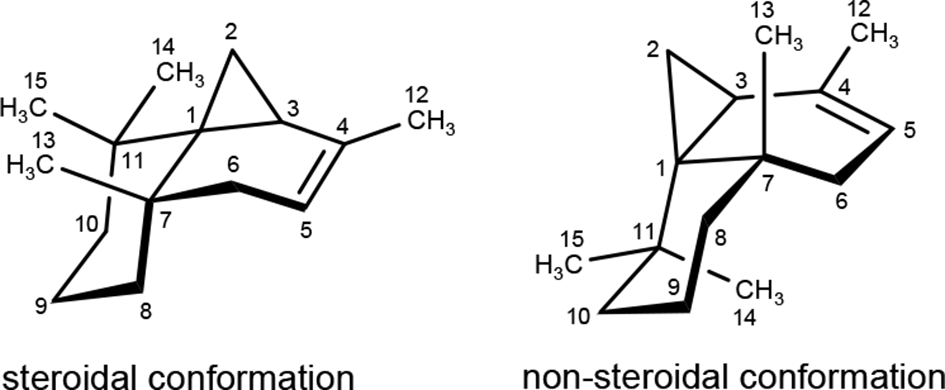
Thujopsene (1) is the main constituent of the essential oil of Thujopsis dolabrata (Cupressaceae) and is a tricyclic sesquiterpene (Figure 1).1,2 The molecular model of 1 indicates the presence of considerable flexibility arising from the cis ring junction. The molecule may adopt either the steroidal or nonsteroidal conformation (Figure 2).3 Previously, Acharya and Brown4 reported that 1 reacts preferentially in the steroidal conformation in hydroboration and probably exists preferentially in that form. In addition, there is a report that the steroidal conformation is the preferred form for 1 from its reactivity in photooxidation.5,6 However, there is no record confirming the proposed conformation of 1. On the other hand, Bombarda et al7 showed that the oxidation of 1 using m-chloroperbenzoic acid gave ketone 2, and the reduction of 2 using LiAlH4 gave alcohol 3 (Figure 1). Although the conformations of 2 and 3 were assigned as nonsteroidal from the nuclear magnetic resonance (NMR) data by Bombarda et al,7 the proposed conformation does not fit well with the reported NMR data. Therefore, reexamination of the conformation of the compounds was necessary. In this paper, we report the conformational assignments of 1 to 3.
Structures of compounds 1 to 3.
Possible conformations of compound 1.
Prior to examining the conformation of 1, full assignment of the 1H-NMR spectrum of 1 was performed on the basis of two-dimensional NMR techniques (Table 1). The present 1H NMR assignments for 1 are mainly the same as those of Yarovaya et al,8 but 1H-1H correlation spectroscopy (COSY) correlations allowed unambiguous assignments of the H-2, H-8, H-9, and H-10 pairs of methylene protons. The rotating frame nuclear overhauser effect spectroscopy (ROESY) cross peaks observed between H-2exo and H-3, H-2exo and Me-14, H-2endo and H-6β, H2-6 and Me-13, H-9β and Me-13, H-9β and Me-15, and H2-10 and Me-14 implied that rings A and B are in chair and boat-like conformations, respectively, and 1 exists in a steroidal conformation (Figure 3). This was supported by W-type long-range couplings observed between H-8α and Me-13, and H-10α and Me-15 in the long-range 1H-1H COSY spectrum, and the 1H shielding of Me-14 influenced by the anisotropy of the cyclopropane ring.9 From the above evidence, the previously proposed conformation of 1 was confirmed as the steroidal conformation.
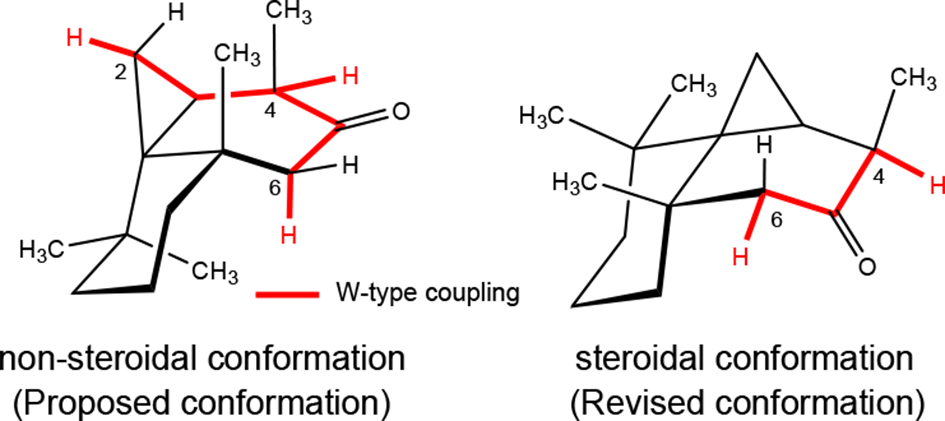
Regarding compound 2, Bombarda et al7 concluded that “The stereochemistry of the ketone 2 was deduced by examination of the 1H NMR spectra, and particularly coupling constants between H-3 and H-4 (3J = 7.2 Hz) and the characteristic ‘W’ coupling constant between H-4 and H-6α, and H-2exo and H-4 (4J = 1.4 Hz) which indicate that H-4 adopts a pseudo-equatorial position.” Along with the above description, the nonsteroidal conformation of 2 has been proposed (Figure 4). However, in the proposed conformation, the hydrogens between H-4 and H-6α, and H-2exo and H-4 do not show the W arrangement. The 4J coupling between H-4 and H-6α can be explained by changing to the steroidal conformation (Figure 4). In addition, even in the steroidal conformation, it was confirmed that H-4 adopts a pseudo-equatorial position (Figure 4). On the other hand, Block et al10 reported that the non-W long-range coupling is observed in the cyclopropane derivatives, which is attributed to the unsaturated character of the ring. This indicates that, in cyclopropane derivatives, caution should be used in assigning stereochemistry on the basis of the presence of long-range coupling.10 Based on the above, the 4J coupling observed between H-2exo and H-4 is considered to be non-W coupling. Thus, the proposed conformation of 2 was revised to the steroidal conformation.
Proposed and revised conformations of compound 2.
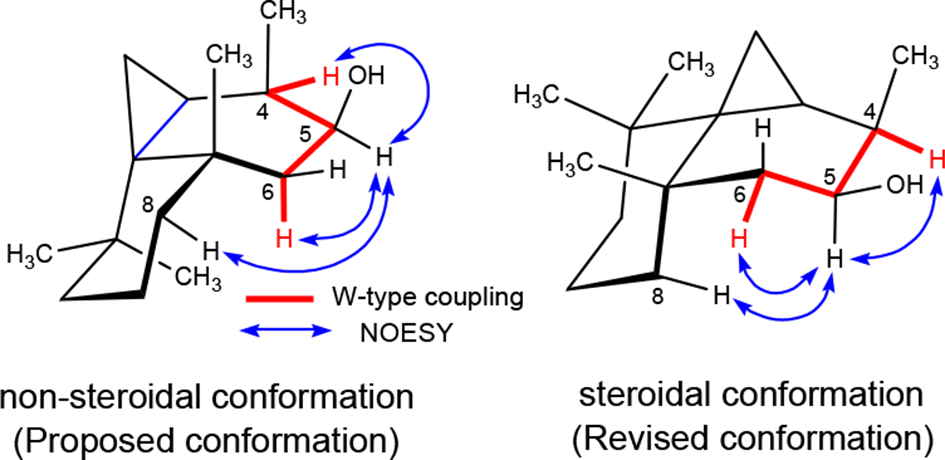
In compound 3, Bombarda et al7 reported W-type long-range coupling between H-4 and H-6α (4J = 1.3 Hz), and nuclear overhauser effect spectroscopy (NOESY) cross peaks between H-4 and H-5, H-5 and H-6α, and H-5 and H-8α. Along with the above NMR data, the nonsteroidal conformation of 3 has been proposed (Figure 5). However, the proposed conformation does not fit well with the NMR data. The 4J coupling between H-4 and H-6α can be explained by changing to the steroidal conformation (Figure 5). Although the nuclear overhauser effects (NOEs) observed between H-4 and H-5, and H-5 and H-6α can be explained by the proposed conformation, the NOE observed between H-5 and H-8α cannot be explained. When changing to the steroidal conformation, the distance between H-5 and H-8α is close enough to produce the NOE correlation, and the other NOE correlations can also be explained (Figure 5). Therefore, the proposed conformation of 3 was revised to the steroidal conformation.
Proposed and revised conformations of compound 3.
In conclusion, the previously proposed steroidal conformation of 1 was confirmed by a NMR method for the first time. In addition, by careful reexamination of the published NMR data, the proposed conformations of 2 and 3 were revised to the steroidal conformation.
Experimental
General
(−)-Thujopsene was purchased from Sigma-Aldrich and was used as received. NMR spectra were recorded at 600 MHz (1H NMR) and 150 MHz (13C NMR) on a JEOL JNM-ECZ 600R spectrometer. NMR spectra are referenced to residual solvent peaks (CDCl3: δ = 7.27 for 1H NMR and δ = 77.0 for 13C NMR), and chemical shifts are reported in parts per million.
We are grateful to Mr S. Sato and Mr T. Matsuki of this university for measurement of the NMR spectra.
Declaration of Conflicting Interests
The author(s) declared no potential conflicts of interest with respect to the research, authorship, and/or publication of this article.
Funding
The author(s) received no financial support for the research, authorship, and/or publication of this article.
References
1.
NozoeT.TakeshitaH.ItoS.OzekiT.SetoS. Structure of Thujopsene. Chem Pharm Bull. 1960;8(10):936-937.doi:10.1248/cpb.8.936
2.
NorinT.HedstenU.JonssonB. The chemistry of the natural order Cupressales. 40. The structure of Thujopsene and Hinokiic acid. Acta Chem Scand. 1961;15:1676-1694.doi:10.3891/acta.chem.scand.15-1676
3.
DjerassiC. Optical Rotatory Dispersion. New York, NY: McGraw-Hill; 1960:1-293.
4.
AcharyaSP.BrownHC. Hydroboration of terpenes. VIII. Hydroboraction of (-)-thujopsene. Configurations of the isomeric 3-thujopsanols and 3-thujopsanones. J Org Chem. 1970;35(11):3874-3879.doi:10.1021/jo00836a064
5.
ItôS.TakeshitaH.MuroiT.ItoM.AbeK. Sensitized photooxidation of thujopsene: synthesis of thujopsadiene. Tetrahedron Lett. 1969;10(36):3091-3094.doi:10.1016/S0040-4039(01)88356-8
6.
OhloffG.StricklerH.WillhalmB.BorerC.HinderM. Über En-Synthesen mit Singulett-Sauerstoff [1] II. Die Farbstoff-sensibilisierte Photooxygenierung von (-)-Thujopsen und die Stereochemie der dargestellten Thujopsanole. Helv Chim Acta. 1970;53(3):623-637.doi:10.1002/hlca.19700530321
ForsénS.NorinT. Anisotropic effects of three-membered rings in proton magnetic resonance. Tetrahedron Lett. 1964;5(39):2845-2849.doi:10.1016/S0040-4039(00)70433-3
10.
BlockE.OrfHW.WinterREK. The nuclear magnetic resonance spectra of bicyclo[2.1.0]pentanes: a comparative study. Tetrahedron. 1972;28(17):4483-4496.doi:10.1016/0040-4020(72)80030-9