



Abstract
Chemical constituents of Cremanthodium angustifolium, C. brunneopilosum, C. campanulatum, C. daochengense, C. discoideum, C. ellisii, C. helianthus, C. lineare, C. nobile, C. potaninii, C. principis, C. pulchrum, C. rhodocephalum, C. stenactinium, C. pleurocaule, and C. stenoglossum were reviewed. They produced mainly sesquiterpenoids–bicyclic and/or tricyclic eremophilanes, bisabolanes, bakkanes–and related compounds. Cremanthodium was shown to be close to Ligularia in chemical constituents.
Many sesquiterpenoids have been isolated from plants of family Asteraceae tribe Senecioneae, among which the genus Ligularia Cass. is known to be a rich source. 1,2 We are investigating chemical and genetic diversity of Ligularia and related species growing in the Hengduan Mountains area of China (usually more than 3000 m in elevation). 3,4 To date, we found the presence of intra-specific diversity in many species, and have isolated many sesquiterpenoids, such as eremophilanes, bisabolanes, bakkanes, oplopanes, and other related terpenoids. Among them, furanoeremophilanes were found in most of the major species, and we proposed a hypothesis that furanoeremophilane-producing species or intra-specific groups are ecologically advantageous than the species producing non-furanoeremophilanes. 3,4
The genus Cremanthodium Benth. is taxonomically very close to Ligularia. 5 The morphological difference between Ligularia and Cremanthodium is recorded in the shape of involucre; cylindric for Ligularia and campanulate for Cremanthodium. 6 While Ligularia species are found widely in Europe and Asia, distribution of Cremanthodium species are limited to the Tibetan and the adjacent area. 6 Plants are mostly grown on alpine meadows of more than 3000 m (mostly around 4000 m) in elevation. Many species distribute from northwestern Yunnan Province to southeastern Xizang (Tibet) Autonomous Region. Due to their small plant size, it is difficult to collect kilograms of plants for chemical studies. Thus, not many studies on the chemical constituents have been reported. In this short review article, we describe chemical constituents of Cremanthodium species reported until today (Table 1), mainly our own works recently carried out. A photo of C. campanulatum is shown in Figure 1 as a representative example of Cremanthodium. Sesquiterpene skeletons appeared in this review and their numberings are shown in Figure 2. Compounds of each species are listed in Table 1. In the case of our own works, specimen numbers are listed (first 4 digits; the year of collection: the last 2 or 3 digits; specimen number of that year).

Cremanthodium campanulatum.

Major sesquiterpene skeletons and their numberings.
Localities of 49 Samples of Cremanthodium and Isolated Compounds.

Specimen no. for our samples, and the year of collection for others.
County. Province in parenthesis; G = Gansu, Q = Qinghai, S = Sichuan, Y = Yunnan.
Not described.
Isolated Compounds From Cremanthodium Species
Eighty-nine compounds

Bicyclic eremophilanes (eremophilanes without a furan or a 12,8-olide moiety).

Tricyclic eremophilanes (furanoeremophilanes and eremophilan-12,8-olides).

Bakkanes (rearranged eremophilanes).

Bisabolanes. See text (section on “On the Structures of Bisabolanes”) for the drawings.

Other sesquiterpenoids (oplopanes, germacranes, guaianes, eudesmanes, and others). See text (section on “C. Potaninii C. w inkler and C. pleurocaule (Franchet) R. D. Good”) for the structure of 75.

Triterpene, lignans, and other compounds.
Cremanthodium angustifolium W. W. Smith
We collected 5 samples (samples 1-5) in Yunnan and Sichuan Provinces (Table 1).
7,8
From samples 1 and 2, eremophila-1(10),11-diene (
Cremanthodium brunneopilosum S. W. Liu
This species is relatively large in plant size, as most of Ligularia species. From samples 6 to 8 (Table 1), petasin (
He et al reported the chemical constituents of C. brunneopilosum collected in Lhasa (sample 9).
10
Fourteen compounds were isolated from the petroleum ether soluble part of the MeOH extracts, 5 of which were terpenoids. Compound
Cremanthodium campanulatum Diels
The roots of samples 13 to 15 collected in Yunnan and Sichuan Provinces were extracted with EtOAc (Table 1). Bisabolane-type sesquiterpenoids were isolated as the major components.
11
From sample 13, compounds
Because the absolute configuration of a 6-membered ring in a bisabolane was established, 32 absolute configuration in the cyclohexane ring of our compound was drawn as depicted in the formula (see section on “On the Structures of Bisabolanes” for structure drawing of bisabolanes).
Cremanthodium helianthus (Franchet) W. W. Smith
Three samples (samples 26-28) were collected in Yunnan Province and analyzed (Table 1). Bicyclic eremophilanes were isolated from all the samples. Sample 26 produced both C-7 isomers of eremophila-9,11-dien-8-ones
Cremanthodium lineare Maximowicz
Seven samples (samples 29-35) were collected in Sichuan Province (Table 1). Sample 29 produced 1β,10β-epoxy-6β-(2-methylpropanoyloxy)furanoeremophilan-9-one (
Cremanthodium rhodocephalum Diels
Two samples were collected in 2002 and 2007 (Table 1). Although no decisive compound was isolated from sample 41,
7
sample 42 was found to produce 2 bisabolane-type hydroperoxides

Structure of 61.
Cremanthodium stenactinium Diels
Two samples were collected in 2009 in Sichuan Province (Table 1).
27
Sample 43 produced 7βH-13-(3-methylbutanoyloxy)eremophila-9,11-dien-8-one (
Cremanthodium nobile (Franchet) Diels ex Léveillé, C. principis (Franchet) R. D. Good, C. pulchrum R. D. Good, and C. daochengense Y. Ling & S. W. Liu
We analyzed major chemical constituents of these species, all of which are very small in plant size. Eremophilanes were isolated from C. nobile and C. pulchrum. From the former (sample 36), bicyclic eremophilanes
Cremanthodium ellisii (J. D. Hooker) Kitamura
In 1994 to 1997, Jia’s group reported isolation of 10 compounds from 4 samples (samples 19-22, Table 1).
16
-19
Compound
Jia’s group further studied the chemical constituents of the same species collected in Huzhu County, Qinghai Province (samples 23-25).
20
-22
Four bisabolanes
In contrast, completely different compounds were isolated from sample 25 collected in the same county.
22
None of the terpenoids was isolated, instead many aromatic compounds
Cremanthodium discoideum Maximowicz
Jia’s group studied the chemical constituents of C. discoideum collected in Qinghai Province (samples 17 and 18, Table 1). There are 4 reports
12
-15
from the same group and these 2 samples seem to be based on the same extracts. Five bisabolanes
C. Potaninii C. Winkler and C. pleurocaule (Franchet) R. D. Good
A commercial sample of C. potaninii (sample 37) was analyzed (Table 1).
25
The chemical constituents were inuviscolide (
The extracts of C. pleurocaule (sample 45) were analyzed by GC and 60 compounds were identified. 28 C. pleurocaule is identical to Ligularia pluerocaulis (Franchet) Handel-Mazzetti, 6 from which various eremophilane sesquiterpenoids have been isolated. 37 -40

Hybrids Between C. stenoglossum Y. Ling & S. W. Liu and Ligularia nelumbifolia (Bureau & Franchet) Handel-Mazzetti
In the course of our search, we found a sample of C. stenoglossum (sample 46) and 2 morphologically intermediate samples between C. stenoglossum and Ligularia nelumbifolia (samples 47 and 48) at the same field in Sichuan Province.
29
Genetic analysis confirmed that samples 47 and 48 were hybrids. From sample 46, an eremophilane
On the Structures of Bisabolanes
Drawing the structures of bisabolanes needs a comment. The bisabolane skeleton has a plane of symmetry (Figures 2 and 6). Thus, compound

Drawing bisabolanes.
The ORTEP drawing of the acetate of
The absolute configuration of highly oxygenated bisabolane sesquiterpenoids having a carbonyl group at C-2 position was discussed with ECD data 41 or X-ray crystallography. 42 Kuroda et al recently established the absolute configurations at C-8 and C-10 in a side chain of some bisabolane compounds by total synthesis. 43,44
Biological Activities
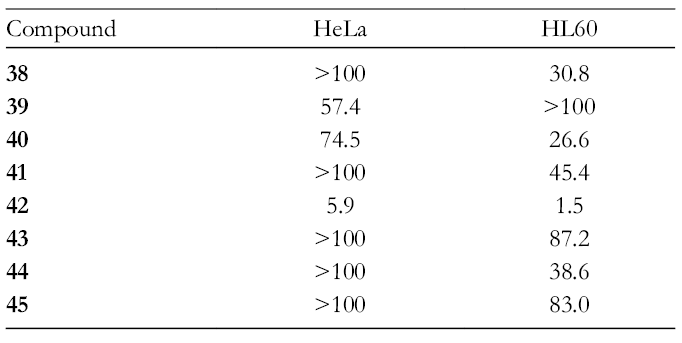
Finally, biological activities of compounds
Biological Data of Compounds 38 to
Conclusion
Although 69 species were listed in the genus Cremanthodium, 6 only 17 species have been studied as shown in Table 1. This is partly because they grow mostly on alpine meadows of more than 4000 m in elevation and the size is rather small. The chemical constituents are mainly sesquiterpenoids of eremophilane and bisabolanes. They can be divided roughly into 3 groups (species with only 1 sample are not listed here); (i) eremophilane- and bakkane-producing species: C. angustifolium, C. brunneopilosum (samples 6-8), C. helianthus, C. lineare, C. pulchrum, and C. stenactinium, (ii) bisabolane-producing species: C. campanulatum, C. discoideum, and C. ellisii (samples 21 and 24), (iii) others: C. brunneopilosum (sample 9), C. ellisii (samples 22, 23, and 25). The close relationship between Ligularia and Cremanthodium was shown by the chemical constituents. More samples of Cremanthodium need to be analyzed in the future.
Footnotes
Acknowledgments
The authors wish to thank Kunming Institute of Botany for research coordination. The authors also thank all the collaborators in this project for their help in sample collection, valuable discussion, and measuring spectra.
Declaration of Conflicting Interests
The author(s) declared no potential conflicts of interest with respect to the research, authorship, and/or publication of this article.
Funding
The author(s) received no financial support for the research, authorship, and/or publication of this article.