

Resveratrol derivatives containing a primary amine functional group were synthesized by an introduction of N-Boc-bromoethylamine to resveratrol using Williamson ether synthesis and subsequent deprotection of the Boc group with trifluoroacetic acid. After conjugation of fluorescent NBD-F or rhodamine B with isothiocyanate (Rhd B-ITC) using the amine group, resveratrols modified with NBD or Rhd B (Resveratrol-NBD and Resveratrol-Rhd B, respectively) were successfully obtained.
Resveratrol (compound 1) is a natural polyphenol containing a stilbene functional group in its molecular framework and it is found in fruits, such as grapes, berries, peanuts, and some medicinal plants. Resveratrol is known to inhibit the formation of reactive oxygen species to control intracellular redox balance and exhibit relevant biological activities such as anticarcinogenic, anti-inflammatory, and anti-aging activities.1-4 More recently, anti-amyloid effects5 and antimicrobial effects6 of resveratrol derivatives have also been revealed. The biological activities of resveratrol can be further improved by chemical modification of the phenolic hydroxyl groups. For example, pterostilbene which is a methylated resveratrol derivative exhibits high cardioproteiction effects.7 Moreover, glycosylated resveratrol, the so-called piceid, shows much higher tyrosinase inhibitory activity than resveratrol.8
For further applications of these relevant biological activities of resveratrol, chemical modifications of the phenolic hydroxyl groups would be a promising way because of high flexibility in molecular designs. Although biotransformations of resveratrol such as glycosylation by plant culture cells have been reported so far,6 synthetic strategies for chemical modification of resveratrol have not been well studied. Primary amine is a useful functionality that reacts quantitatively under mild conditions with various functional groups such as electron-deficient aromatic groups or isothiocyanate functionalities.9 To functionalize protein surface with amine functionalities, a lot of amine-reactive molecules including fluorescent probes are commercially available. Here, we report a versatile route via a primary amine to chemically synthesize resveratrol derivatives allowing for modifications of various molecules. This modification was completed just in 3 synthetic steps, and in the present work, we introduced fluorescent NBD-F and rhodamine B with isothiocyanate (Rhd B-ITC) using the primary amine generated at the second step to obtain fluorescently labeled resveratrols (Resveratrol-NBD and Resveratrol-Rhd B, respectively).
Figure 1 shows the synthetic route to obtain Resveratrol-NBD and Resveratrol-Rhd B. As a first step, resveratrol was coupled with N-Boc-bromoethylamine by Williamson ether synthesis in DMF solvent containing potassium carbonate. After an incubation of the mixture at 50°C for 2 days, the solvent and potassium carbonate were removed by a separation operation. The reaction proceeded properly as confirmed by TLC. The resulting compounds were purified by silica gel column chromatography although the mixture contained 2 regioisomers (compounds 2 and 3), where N-Boc-bromoethylamine reacted with different hydroxyl groups of resveratrol. As the second step, the Boc protecting group was deprotected by trifluoroacetic acid (TFA) in EtOAc. The reaction proceeded quickly and we could obtain Resveratrol-NH2•HCl (compounds 4 and 5) after a separation.
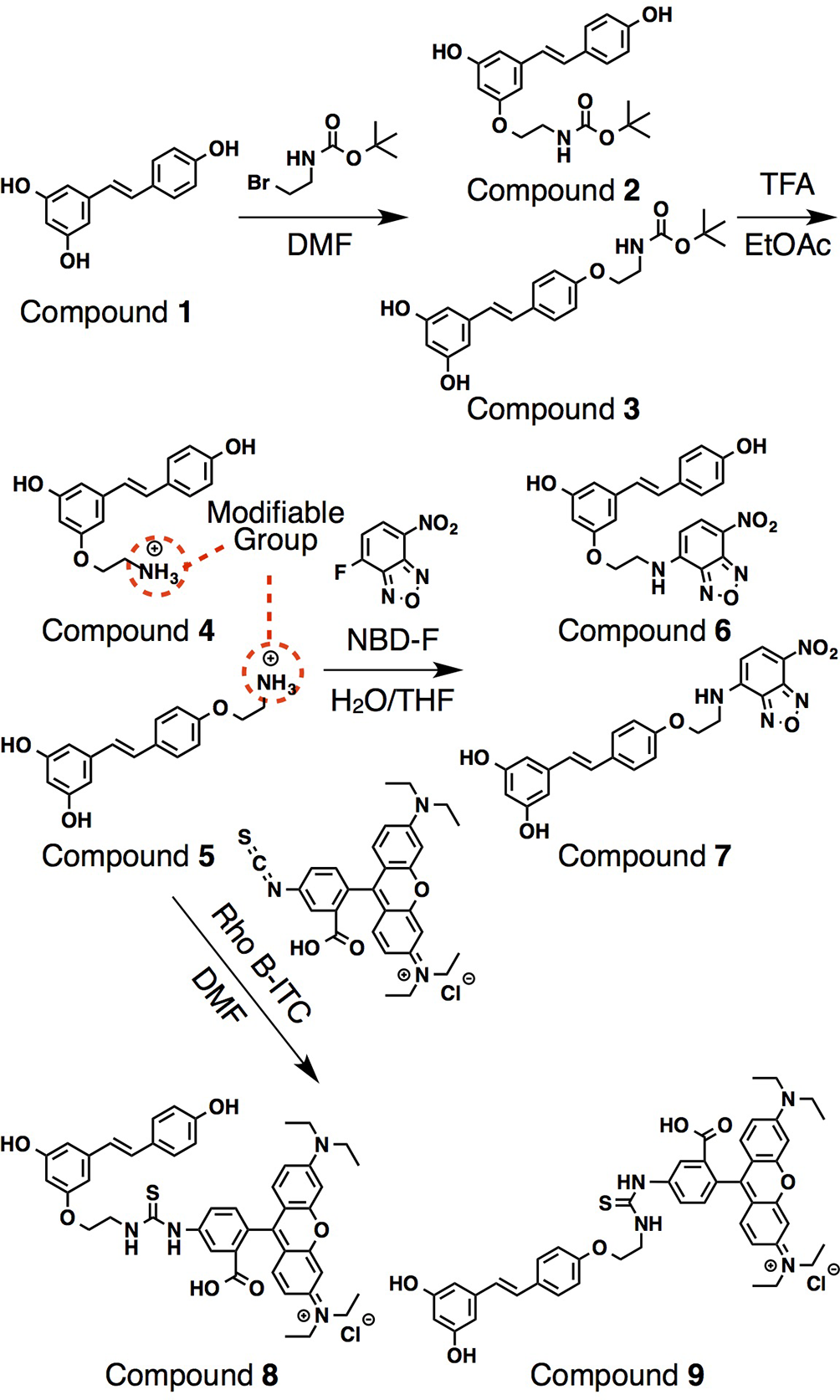
Synthetic route for fluorescently labeled resveratrols: Resveratrol-NBD (compounds 6 and 7) and Resveratrol-Rhd B (compounds 8 and 9).
As a final step, the Resveratrol-NH2•HCl was allowed to react with NBD-F in an aqueous solution to give NBD-labeled resveratrol (Resveratrol-NBD; compounds 6 and 7) (Figure 2(b)). The primary amine would enable to functionalize a variety of amine-reactive groups to resveratrol. In fact, Rhd B-ITC which is a representative amine-reactive functional group also successfully reacted with Resveratrol-NH2 forming rhodamine B-labeled resveratrol (Resveratrol-Rhd B; compounds 8 and 9) (Figure 2(c)).
Photographs of Resveratrol-NH2•HCl (a), Resveratrol-NBD (b), and Resveratrol-Rhd B (c) in DMSO.
Here, we described a versatile synthetic route for chemical modifications of resveratrol via a primary amine functional group. Conjugation of fluorescent NBD-F or Rhd B-ITC molecule to the primary amine allows for fluorescent-labeled resveratrols. The synthetic route in this study enables chemical modifications not only in resveratrol but also in various stilbene skeletons, suggesting wide applicability of stilbene compounds. For example, we have reported biotransformation of stilbene compounds using plant culture cells.10 It would be interesting to see if even chemically modified resveratrol could be converted to glycosylated resveratrol by the plant culture cells because it would enable to produce a variety of water-soluble resveratrol derivatives. The research on the subject is under investigation.
Experimental
General
1H NMR spectra were recorded on a Bruker type Ascend-600 spectrometer. Matrix-assisted laser desorption ionization time-of-flight (MALDI-TOF) mass spectra were recorded on a Bruker type autoflex speed spectrometer. Resveratrol, NBD-F, were purchased from TCI. Rhodamine B with isothiocyanate was purchased from Aldrich.
Synthesis
To a DMF (10 mL) solution of a mixture of resveratrol (600 mg, 2.6 mmol) and K2CO3 (726 mg, 5.2 mmol), N-Boc-bromoethylamine (583 mg, 2.6 mmol) was added, and the mixture was stirred under argon atmosphere at 50°C for 2 days. Then, the resultant mixture was extracted with EtOAc. The organic extract was evaporated to dryness under reduced pressure, and chromatographed on silica gel to allow the isolation of compounds 2 and 3 in 53% yield (519 mg). The resulting compounds 2 and 3 (259 mg, 77.6 mmol), dissolved in EtOAc, were treated with an excess of TFA, and the mixture was stirred overnight at room temperature. Then, aqueous solution of NaHCO3 was slowly added to the reaction mixture, and the resultant mixture was extracted with EtOAc. The extract was evaporated to dryness under reduced pressure, and the counter ion was exchanged by chloride ion by adding HCl in dioxane and subsequently evaporated to obtain Resveratrol-NH2 (compounds 4 and 5) in 17% yield (32 mg). 1H NMR (600 MHz, DMSO-d6): δ 3.93 (4H), 6.59 (2H), 6.68 (1H), 6.90-7.00 (4H), 7.46 (2H). 13C NMR (600 MHz, D2O): δ 60.8, 69.8, 73.3, 76.7, 77.1, 100.6, 102.7, 104.7, 107.1, 115.5, 125.1, 127.9, 128.5, 129.9, 139.3, 157.2, 158.2, 158.8. MALDI-TOF MASS: m/z 311.33 [M+K]+.
To a H2O/THF (5 mL) solution of Resveratrol-NH2•HCl (compounds 4 and 5; 10.0 mg, 32.5 μmol) and NBD-F (13.5 mg, 65.0 μmol), lithium hydroxide (LiOH; 1.7 mg, 35.7 μmol) was added, and the mixture was stirred overnight at room temperature. Precipitate formed through the reaction was centrifuged and washed with water to obtain Resveratrol-NBD (compounds 6 and 7) in 38% yield (5.3 mg). 1H NMR (600 MHz, DMSO-d6): δ 3.65 (2H), 4.01 (2H), 6.33 (3H), 6.52 (1H), 6.60-7.10 (4H), 7.70 (2H). 8.30 (1H). MALDI-TOF MASS: m/z 473.55 [M+K]+.
The mixture of Resveratrol-NH2•HCl (compounds 4 and 5; 3.0 mg, 9.7 μmol) was precipitated in aqueous solution containing NaOH (100 mM). The precipitate was dissolved in DMF (4 mL), and subsequently, Rhd B-ITC (3.0 mg, 5.6 μmol) was added. After the mixture was stirred overnight at room temperature, the reaction mixture was slowly added to EtOAc. The precipitate thus formed was washed with water to obtain Resveratrol-Rhd B (compounds 8 and 9) in 30% yield (2.4 mg). 1H NMR (600 MHz, DMSO-d6): δ 1.05-1.15 (12H), 2.00 (8H), 4.00-4.10 (4H), 6.30-8.10 (19H). MALDI-TOF MASS: m/z 771.41 [M+H]+.
Footnotes
Declaration of Conflicting Interests
The author(s) declared no potential conflicts of interest with respect to the research, authorship, and/or publication of this article.
Funding
The author(s) received no financial support for the research, authorship, and/or publication of this article.
References
1.
JangM.CaiL.UdeaniGOet al. Cancer chemopreventive activity of resveratrol, a natural product derived from grapes. Science. 1997;275(5297):218-220.doi:10.1126/science.275.5297.218
2.
LeiroJ.ÁlvarezE.ArranzJA.LagunaR.UriarteE.OralloF. Effects of cis-resveratrol on inflammatory murine macrophages: antioxidant activity and down-regulation of inflammatory genes. J Leukoc Biol. 2004;75(6):1156-1165.doi:10.1189/jlb.1103561
3.
BaurJA.PearsonKJ.PriceNLet al. Resveratrol improves health and survival of mice on a high-calorie diet. Nature. 2006;444(7117):337-342.doi:10.1038/nature05354
4.
IngramD.SandersK.KolybabaM.LopezD. Case-Control study of phyto-oestrogens and breast cancer. The Lancet. 1997;350(9083):990-994.doi:10.1016/S0140-6736(97)01339-1
5.
PengRM.LinGR.TingY.JYH. Oral delivery system enhanced the bioavailability of stilbenes: resveratrol and pterostilbene. Biofactors. 2018;44(1):5-15.doi:10.1002/biof.1405
6.
PanL-F.WangX-B.XieS-S.LiS-Y.KongL-Y. Multitarget-Directed resveratrol derivatives: anti-cholinesterases, anti-β-amyloid aggregation and monoamine oxidase inhibition properties against Alzheimer's disease. Medchemcomm. 2014;5(5):609-616.doi:10.1039/c3md00376k
7.
RinehA.DollaNK.BallARet al. Attaching the NorA efflux pump inhibitor INF55 to methylene blue enhances antimicrobial photodynamic inactivation of methicillin-resistant Staphylococcus aureus in vitro and in vivo. ACS Infect Dis. 2017;3(10):756-766.doi:10.1021/acsinfecdis.7b00095
8.
UesugiD.HamadaH.ShimodaK.KubotaN.OzakiS-I.NagataniN. Synthesis, oxygen radical absorbance capacity, and tyrosinase inhibitory activity of glycosides of resveratrol, pterostilbene, and pinostilbene. Biosci Biotechnol Biochem. 2017;81(2):226-230.doi:10.1080/09168451.2016.1240606
9.
NicolasJ.MuraS.BrambillaD.MackiewiczN.CouvreurP.DesignCP. Design, functionalization strategies and biomedical applications of targeted biodegradable/biocompatible polymer-based nanocarriers for drug delivery. Chem Soc Rev. 2013;42(3):1147-1235.doi:10.1039/C2CS35265F
10.
ImaiH.KitagawaM.IshiharaKet al. Glycosylation of trans-resveratrol by plant-cultured cells. Biosci Biotechnol Biochem. 2012;76(8):1552-1554.doi:10.1271/bbb.120126