



Abstract
In the cultivation of Citrus fruit, pruning in late winter after harvest is important to obtain excellent flower buds in the next spring and a rich harvest of superior fruit in the following winter; a large number of pruned leaves are usually discarded. The purpose of this study was to determine the utility value of pruned leaves of Citrus unshiu. A methanol extract of pruned C. unshiu leaves showed a porcine pancreatic lipase inhibitory activity. Fractionation of C. unshiu leaf extract (CUL-ext) followed by bibliographic and chromatographic analyses revealed that a part of the pancreatic lipase inhibitory activity of CUL-ext was attributable to nobiletin (
Obesity is recognized as a major lifestyle-related disease, especially in the developed countries. Pancreatic lipase is well known as a key enzyme for lipid absorption by hydrolysis of total dietary fats. 1 Two pancreatic lipase inhibitors, namely orlistat (Xenical) 2 in the United States and cetilistat (Oblean) 3 in Japan, have been approved so far for the treatment of obesity. To search for novel pancreatic lipase inhibitors from natural resources, the screening of plant extracts has been considered as one of the successful strategies. Hitherto, several extracts derived from plants parts, such as Trigonella foenum-graecum seeds, 4 Cornus mas and Cornus alba fruits, 5 and Leopoldia comosa aerial parts 6 have been reported to have lipase inhibitory activities.
In a preceding paper, 7 we reported the utility value of pruned mango leaves, which were discarded hitherto during the cultivation of mango fruits. A methanol extract of old mango dark green leaves possessed a porcine pancreatic lipase inhibitory activity. In this study, we focused on the utility of pruned Citrus unshiu (satsuma mandarin) leaves, which were discarded hitherto during the cultivation of mandarin fruits. Thus, to identify the utility of pruned Citrus leaves, we examined the anti-obesity effects of the Citrus leaf extract by means of a lipase inhibitory activity assay.
In the preliminary study, the methanol C. unshiu leaf extract (CUL-ext) inhibited a porcine pancreatic lipase activity using 4-methylumbelliferyl oleate (4-MU) as a substrate with an IC50 value of 44 µg/mL as shown in Table 1. There is a large amount of literature on Citrus plants and their constituents, among which there is a report that mixed extracts of C. unshiu peel and Diospyros kaki fruit exhibited an inhibitory effect on lipase activity with an IC50 value of 507 µg/mL 8 though this is the first report on the inhibitory effect on lipase activity of C. unshiu leaves.
Inhibitory Activities of Citrus unshiu Leaf Extract and Fractions Obtained From Citrus unshiu Leaf Extract on Pancreatic Lipase.
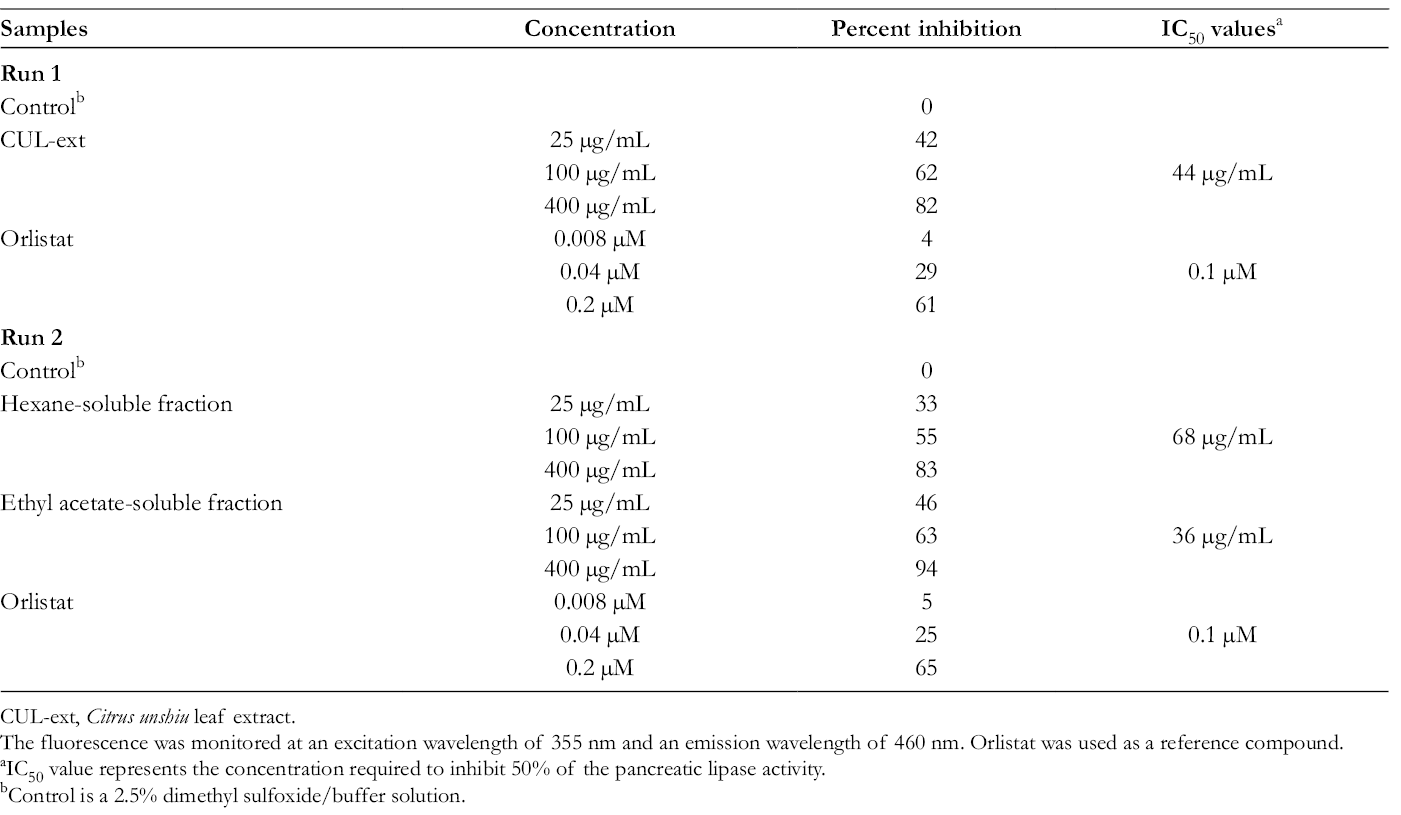
CUL-ext, Citrus unshiu leaf extract.
The fluorescence was monitored at an excitation wavelength of 355 nm and an emission wavelength of 460 nm. Orlistat was used as a reference compound.
IC50 value represents the concentration required to inhibit 50% of the pancreatic lipase activity.
Control is a 2.5% dimethyl sulfoxide/buffer solution.
To identify the active constituents, the CUL-ext was fractionated by solvent extraction to give a hexane-soluble fraction, ethyl acetate-soluble fraction, water-soluble fraction, and ethyl acetate-water-insoluble intermediate fraction, as described in the section “Fractionation of CUL-ext.” Among these fractions, the hexane-soluble and ethyl acetate-soluble fractions showed potent activities against pancreatic lipase with IC50 values of 68 and 36 µg/mL, respectively (Table 1). On the contrary, the water-soluble and ethyl acetate-water-insoluble intermediate fractions were almost inactive at the concentrations tested. A known pancreatic lipase inhibitor, orlistat, was used as a reference compound; the IC50 value of orlistat was 0.1 µM (corresponding to 0.0495 µg/mL) in accordance with the reported IC50 value (0.05 µg/mL)
9
as cited in Table 1. On the basis of thin-layer chromatography (TLC)
10
and liquid chromatography-electrospray ionization-mass spectrometry/mass spectrometry (LC-ESI-MS/MS) analyses
11
of these active hexane-soluble fractions and ethyl acetate-soluble fractions, it was found that nobiletin (
Inhibitory Activities of Nobiletin (1) and Rutin (2) on Pancreatic Lipase.

Orlistat was used as a reference compound.
IC50 value represents the concentration required to inhibit 50% of the pancreatic lipase activity.
In addition, the pancreatic lipase inhibitory activities of other flavonoids, such as
Considering these reported data, a part of the pancreatic lipase inhibitory activity of CUL-ext described above was attributable to
In the cultivation of Citrus fruit, pruning in late winter (March) after fruit harvest is important to obtain excellent flower buds in next spring and a rich harvest of superior fruit in the following winter; a large number of pruned leaves are usually discarded. In conclusion, we found that pruned C. unshiu leaves may be a reasonable natural resource for the preparation of ingredients with lipase inhibitory activity.
Experimental
Plant Materials
Leaves of C. unshiu (cv. Miyagawa wase in Japanese) were collected in the Experimental Farm, Kindai University (34°2′N, 135°11′E, 17 m ASL), located in Wakayama Prefecture, Japan in March 2015. The C. unshiu trees are commercially grown. Pruned leaves were collected from 3000 trees, which were propagated by grafting (height of trees, 2.5 m; canopy width, 3.6 m; age of trees, 30-45 years; and life span of trees, 50-70 years) (Figure 1(a)).The data of the cultivation environment were as follows: annual mean temperature, 18.0°C; maximum temperatures, 35.1°C and 30.4°C (soil); minimum temperatures, 1.8°C and 8.3°C (soil); and annual rainfall, 2152 mm/year. Physical data of leaves (n = 20) were as follows: width of leaves, 51 ± 7 mm; length of leaves, 111 ± 13 mm; and fresh weight of leaves, 1.6 ± 0.3 g (Figure 1(b)). The samples were identified by the Experimental Farm, Kindai University, air-dried at 50°C for 72 hours in an automatic air-drying apparatus (Vianove Inc., Tokyo, Japan), and powdered using a blender. Voucher specimens of leaves (C. unshiu leaves: CUL201503) are deposited at the Experimental Farm, Kindai University.

Photographs of (a) pruning in late winter and (b) pruned Citrus unshiu leaf.
Reagents
4-Methylumbelliferyl oleate, lipase (type II, from porcine pancreas, Lot #: SLBN3801V), authentic
Extraction
The leaf powder (10 g) was extracted with methanol (MeOH, 200 mL) for 72 hours at room temperature. The extract solution was evaporated under reduced pressure to produce MeOH extract. The yield of MeOH extract of leaves was 15% (w/w).
In Vitro Pancreatic Lipase Inhibition Assay
Porcine pancreatic lipase (type II, from porcine pancreas) activity was measured according to the method described by Nakai et al 16 with minor modifications. The test sample was dissolved with dimethyl sulfoxide (DMSO) and diluted with 13 mM Tris-HCl buffer containing 150 mM NaCl, 1.3 mM CaCl2 (pH 8.0) to a final DMSO concentration of 2.5% v/v. 4-Methylumbelliferyl oleate was used as a substrate. The substrate and the enzyme were both diluted in the above-mentioned buffer immediately before use. An aliquot of 25 µL of the test solution and 50 µL of 0.1 mM 4-MU solution was mixed in black microtiter plates, followed by the addition of 25 µL of 0.2 mg/mL enzyme solution to each well to start the reaction. After incubation for 30 minutes at 37°C, 100 µL of 0.1 M citrate buffer (pH 4.2) was added to stop the reaction. The fluorescence associated with the enzymatically released 4-methylumbelliferone product was monitored at an excitation wavelength of 355 nm and an emission wavelength of 460 nm using a multi-label counter (PerkinElmer 2030 ARVO X4; PerkinElmer Life and Analytical Sciences). Orlistat, a known inhibitor of pancreatic lipase, was used as a reference compound. The activity of negative control was also evaluated by adding stop solution before the enzymatic reaction. The inhibition activity was calculated using the following formula:
where A is the fluorescence with enzyme and substrate, but without test substance (adding stop solution after enzymatic reaction); B is the fluorescence with enzyme and substrate, but without test substance (adding stop solution before enzymatic reaction); C is the fluorescence with enzyme, substrate, and test substance (adding stop solution after enzymatic reaction); and D is the fluorescence with enzyme, substrate, and test substance (adding stop solution before enzymatic reaction).
Each concentration of samples was confirmed in triplicate (P-value <0.01). The IC50 value represents the concentration required to inhibit 50% of pancreatic lipase activity.
Fractionation of CUL-Ext
A suspension of the CUL-ext (10 g) in water (100 mL) was extracted with hexane (200 mL × 3) followed by ethyl acetate (200 mL × 3). Evaporation of the solvent resulted in a hexane-soluble fraction (1.4 g), an ethyl acetate-soluble fraction (0.9 g), a water-soluble fraction (5.7 g), and an ethyl acetate-water-insoluble intermediate fraction (1.5 g), which was obtained as an intermediate layer during the process of ethyl acetate extraction. The pancreatic lipase inhibition percentage in each fraction was evaluated.
Thin Layer Chromatography Analysis
Thin layer chromatography analysis was carried out according to the method described by Tosa et al
10
with minor modifications. Each dissolved sample (in MeOH, 5 mg/mL) was spotted on TLC (silica gel 60F254), and developed (solvent, chloroform/MeOH/water, 6:4:1 v/v; detection, UV 254 nm; and 10% H2SO4 followed by heating). Under the above condition, the Rf-value of
Flavonoid Content
Flavonoid content of the CUL-ext was determined (n = 3) by LC-ESI-MS/MS according to the method described by Liu et al 11 with minor modifications. The LC-ESI-MS/MS system consisted of LC-20A (Shimadzu; Kyoto, Japan) and QTRAP (ABSciex). The samples were analyzed by using an Inertsil ODS-3 reverse phase column (2.1 × 150 mm, GL Sciences; Tokyo, Japan) and the column temperature was set at 40°C. The mobile phase was as follows: solvent A: 0.1% HCOOHaq and solvent B: acetonitrile containing 0.1% HCOOH. The linear gradient program was as follows: initial condition was set at 20% B and maintained for 5 minutes, followed by a linear gradient from 20% to 35% B for 17 minutes, and then from 35% to 75% for 10 minutes. Concentrations of flavonoids were evaluated by multiple reaction monitoring (MRM). Multiple reaction monitoring transition reactions were 611.1 > 303.0 for hesperidin and rutin, 403.1 > 373.1 for nobiletin, and 373.1 > 343.0 for tangeretin.
Statistical Analysis
The experimental data were evaluated for statistical significance using Bonferroni/Dunn’s multiple-range test with GraphPad Prism for Windows, Ver. 5 (GraphPad Software Inc., 2007).
Footnotes
Acknowledgment
We are grateful to all technical staff of Yuasa Experimental Farm, Kindai University for the collection of Citrus unshiu leaves. I am deeply grateful to Dr Shunsuke Naruto for his invaluable guidance and advice.
Declaration of Conflicting Interests
The author(s) declared no potential conflicts of interest with respect to the research, authorship, and/or publication of this article.
Funding
The author(s) received no financial support for the research, authorship, and/or publication of this article.