




Abstract
Ultraviolet radiation induces skin photoaging, which is associated with the elevation of matrix metalloproteinase-1 (MMP-1) and the decrease of procollagen. Nasturtium officinale plays a well-known role in the treatment of sulfur-containing compounds and their important role in protecting human health. However, their skin protective activity toward UVB-induced photodamage remains unclear. In the present study, we investigated the protective effect of indole 3-acetonitrile-4-methoxy-2-S-β-d-glucopyranoside (IAMG) from N. officinale on UVB-irradiated normal human dermal fibroblasts (NHDF). Our results show that IAMG enhanced NHDF cell migration. The UVB-induced increases in MMP-1 and decrease in type I procollagen were ameliorated by IAMG treatment. Taken together, our data strongly suggest that IAMG from N. officinale could reduce UVB-induced photodamage.
Aging of skin is a complex process that is affected by both intrinsic factors such as hormonal changes and metabolic processes and extrinsic factors such as solar radiation, pollution, and chemical exposure. 1 Among the various complex factors, ultraviolet radiation is a major extrinsic factor that is divided into 3 wavelength ranges: 315 to 400 nm (UVA), 280 to 315 nm (UVB), and 100 to 280 nm (UVC). 2 UVB is mostly absorbed by the upper epidermis. Severe and chronic UVB irradiation causes photoaging by damage to cell structures, 3 which induces matrix metalloproteinase-1 (MMP-1) expression and type 1 procollagen degradation. Specifically, MMP-1, an interstitial collagenase or fibroblast collagenase, degrades transforming growth factor-β1, collagen, and elastin in the extracellular matrix (ECM). 4
Nasturtium officinale R. Br. (Brassicaceae) is a hardy perennial herb of Europe, commonly called as “watercress” or “cresson”, and is one of the brassica vegetables, such as broccoli, wasabi, and horseradish. The plant has aroused interest because of the presence of sulfur-containing compounds and their important role in protecting human health. 5 The extract of N. officinale possesses a variety of anti-inflammatory, antioxidant, anticancer, hepatoprotective, anti-hypercholesterolemia, and anti-hyperlipidemia properties. 6 Phytochemical analysis has revealed the presence of glucosinolates, 7 flavonoids, and phenolics as major compounds in this plant. 8 Although N. officinale is widely known for its supplements and biological activities, its effects on skin aging have not been investigated. Therefore, we investigated the efficacy of indole 3-acetonitrile-4-methoxy-2-S-β-D-glucopyranoside (IAMG) from N. officinale on UVB irradiation-induced aging in normal human dermal fibroblasts (NHDF).
IAMG (Figure 1) was obtained as an amorphous white powder. Its molecular formula was determined as m/z 403.0931 (calcd for C17H20N2O6SNa+: 403.0940) by high-resolution electrospray ionization mass spectroscopy (HR-ESI-MS) [M+Na]+. The compound was confirmed by comparison of its recorded spectroscopic data as reference. 9 NHDF were exposed to UVB irradiation (144 mJ/cm2) and then treated with IAMG (1, 10, 20 µM). Following UVB irradiation, NHDF density decreased noticeably, with a cell viability of only 76.5% (Figure 2) of the normal control (UVB non-irradiation). At the indicated concentrations, IAMG had no significant cytotoxic effect on the cells. In fact, treatment with IAMG improved the cell viability of UVB-irradiated NHDF. The MMPs are a family of calcium-dependent, zinc-containing endopeptidases that can degrade all kinds of proteins in the ECM. After UVB irradiation, the secretion of MMP-1 increased to 365.3% of that found in normal NHDF cells. Treatment with 20 µM of IAMG after exposure to UVB suppressed the expression of MMP-1 by 56.4% (Figure 3). We also found that IAMG recovered the collagen degradation induced in NHDF by UVB irradiation. In the UVB-irradiated cells, type I procollagen secretion decreased by 51.4% compared to untreated control cells (Figure 3). However, IAMG (20 µM) significantly reversed the decrease by 89.6%. In this study, 140 mJ/cm2 of UVB resulted in significantly decreased cell viability. Treatment with IAMG did not cause obvious alterations to cell viability. NHDF play a key role in healing skin wounds. They proliferate and migrate to the wound surface where they synthesize ECM. 10 We found that IAMG markedly improved the migratory ability of NHDF. Drugs derived from natural products can eliminate free radicals to prevent UVB-induced photoaging with few or no side effects. 11 The MMPs are a family of Ca2+-dependent, Zn2+-containing endopeptidases that can break down most proteins within the ECM. 10 UVB irradiation can activate MMP-1, which then cleaves all types of collagen. 12 UVB irradiation increased the production of MMP-1, whereas decreased the production of type I procollagen. However, we found that IAMG (20 µM) downregulated MMP-1 secretion and upregulated type I procollagen synthesis in UVB-exposed NHDF. IAMG shows higher UVB protective activity, which also demonstrated that the molecule plays an important role in the UVB protective activity of sulfur-containing compound. In summary, the present study indicates that IAMG protected in vitro NHDF cells against UVB-induced photoaging. This preliminary study demonstrates the protective effects of IAMG against UVB-induced photoaging. Further investigation of IAMG and its function in photoaging in in vivo animal models is warranted.
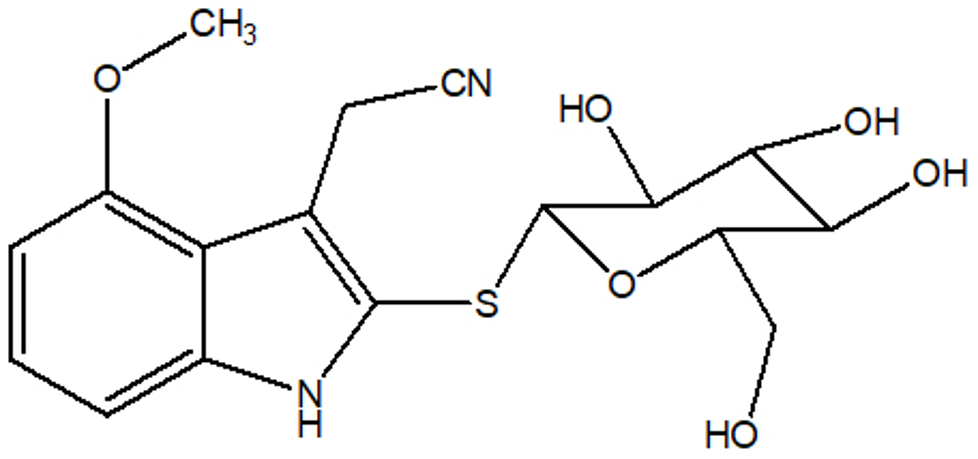
Chemical structures of indole 3-acetonitrile-4-methoxy-2-S-β-D-glucopyranoside from Nasturtium officinale R. Br.

Effects of IAMG on cell viability. Cell viability after 72 hours with or without UVB (140 mJ/cm2) and IAMG (1, 10, 20 µM). *p < 0.05 versus the non-irradiated control. IAMG, indole 3-acetonitrile-4-methoxy-2-S-β-D-glucopyranoside.

Effect of IAMG (1, 10, 20 µM) on the secretion of MMP-1 and type I procollagen. The production of (
Experimental
General
The seeds of N. officinale R. Br. were purchased in August 2018 in local market, Kyunggi-do, South Korea. A voucher specimen (Skedrm-20180818) has been deposited at the raw material room, SKEDERM Cosmetic R&D Center, South Korea. Nuclear magnetic resonance (NMR) spectra were recorded on a Varian Inova-400 FT-NMR spectrometer (CA, USA) with tetramethylsilane as an internal standard, δ in ppm, J in Hz. HR-ESI-MS spectra were measured on Bruker APEXII mass spectrometer in m/z. Silica gel (200–300 mesh) was obtained from Merck Co. Ltd. Dulbecco’s modified Eagle medium (DMEM), penicillin-streptomycin, and fetal bovine serum (FBS) were all purchased from Gibco (Grand Island, NY, USA). 2,2′-Azino-bis (3-ethylbenzothiazoline-6-sulfonic acid) diammonium salt, potassium persulfate, 3-(4,5-dimethylthiazol-2-yl)-2,5-diphenyltetrazolium bromide (MTT), and dimethyl sulfoxide (DMSO) were purchased from Sigma-Aldrich (St Louis, MO, USA). An enzyme-linked immunosorbent assay (ELISA) kit for type I procollagen and MMP-1 was purchased from ABcam (Cambridge, UK).
Extraction and Isolation
The air-dried whole plants of N. officinale (2 kg) was extracted with 95% EtOH (3 × 20 L, 7 days each) with 1800 W ultrasonications (INEFU) at room temperature and EtOH was removed under reduced pressure to give a residue (215 g), which was suspended in distilled water and extracted with hexane, CHCl3, EtOAc, and BuOH, yielding 34, 8, 6, and 26 g of dried organic extracts, respectively. The BuOH-soluble layer was chromatographed over a normal-phase silica gel column chromatography eluting with mixtures of CHCl3-MeOH-H2O (7:1:0.1, 5:1:0.1, 3:1:0.1, and 1:1:0.1) to obtain 6 fractions (A-F). Fraction B (1.3 g) was applied to an RP-C18 silica gel column chromatography eluting with 20% aqueous MeOH to give 7 subfractions (B1-B7). Subfraction B5 (511 mg) was applied to a silica gel column chromatography (CHCl3-MeOH-H2O, 5:1:0.1 → 1:1:0.1) to afford 6 subfractions (B51-B56). IAMG (12.3 mg) was isolated from subfraction B53 (102 mg) by Sephadex LH-20 column chromatography (100% MeOH) and purified with semi-preparative reversed phase silica gel HPLC with an isocratic solvent system of 25% aqueous acetonitrile (flow rate of 2.0 mL/min).
Cell Culture, UVB Irradiation, and Sample Treatment
NHDF cells were obtained by skin biopsy from a healthy young male donor (MCTT Bio, Inc., Seoul, Korea). 13 The cells were cultured in DMEM containing 1% penicillin-streptomycin and 10% FBS at 37°C in a 5% CO2 humidified incubator. When the cells reached 80% to 90% confluency, the NHDF were subjected to UVB (140 mJ/cm2) irradiation using a Bio-Link BLX-312 (Vilber Lourmat GmbH, Vilber Lourmat, Marne-la-Vallée, France). 14 Afterward, the cells were rinsed with phosphate-buffered saline and immediately treated with IAMG (1, 5, 20 µM) in serum-free DMEM. Non-irradiated control cells were fed with serum-free DMEM medium.
Cell Viability
The viability of NHDF treated with IAMG (1, 10, 20 µM) after UVB irradiation was evaluated using the MTT assay, as described previously. 15 NHDF cells (2 × 10⁵/35 mm2 dish) were exposed to UVB (140 mJ/cm2) and then treated with NHDF (or not for UVB-irradiated control cells). After 72 hours of treatment, 1 mL of MTT (100 µg/mL) was added and incubated at 37°C for 3 hours. Then the MTT solution was discarded, and the purple formazan crystals were resolved in 800 µL of sterile DMSO. Finally, the dishes were shaken for 10 minutes at room temperature. The optical density values of 100 µL portions of formazan dissolved in DMSO were documented using a microplate reader (Molecular Devices FilterMax5; San Francisco, CA, USA).
Determination of MMP-1 and Type I Procollagen
After 72 hours of IAMG (1, 10, 20 µM) treatments, commercial ELISA kits were used to measure the production of MMP-1 and type I procollagen in the culture supernatant. All of the experimental procedures were performed following manufacturer’s protocols. 16
Statistical Analysis
Data are presented as means ± SD. Statistical analyses used the one-way analysis of variance followed by Dunnett’s test. *p < 0.05, **p < 0.01, and ***p < 0.001 were considered to be statistically significant.
Footnotes
Acknowledgment
This work was carried out with the support of Classys Inc (project title: Construction of high purity, concentration extracts techniques from natural materials).
Declaration of Conflicting Interests
The author(s) declared no potential conflicts of interest with respect to the research, authorship, and/or publication of this article.
Funding
The author(s) received no financial support for the research, authorship, and/or publication of this article.