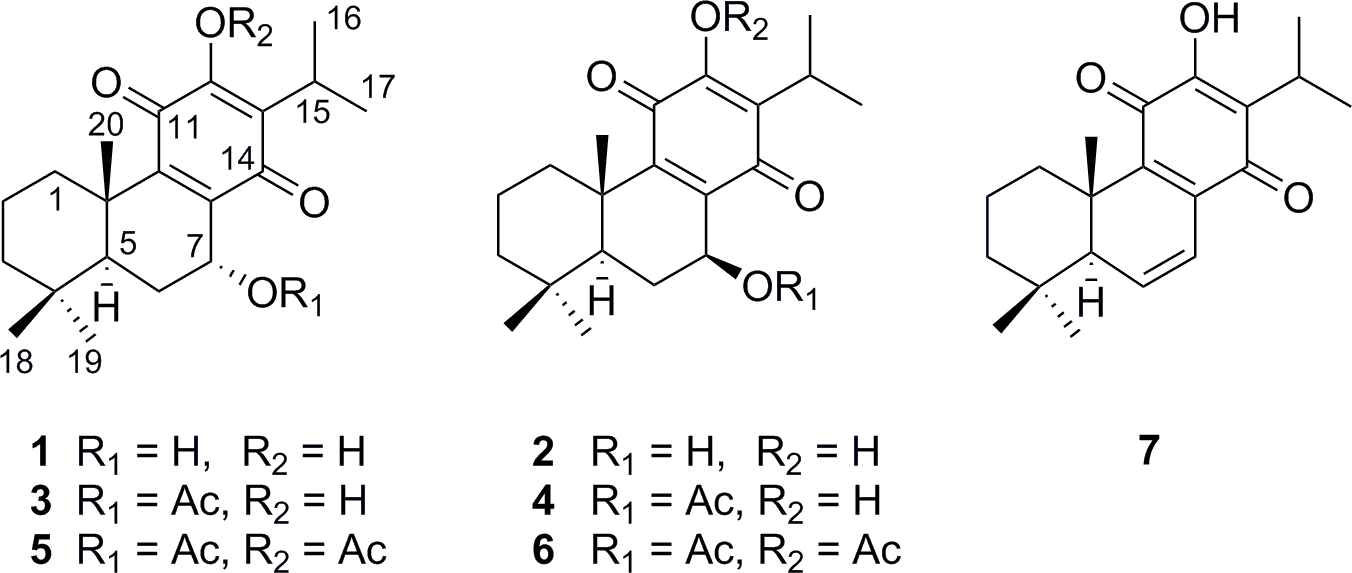
The known diterpenoids horminone (1) and taxoquinone (2) as a mixture, and pure 6,7-dehydroroyleanone (7) were isolated from the aerial parts of not yet studied Salvia concolor Lamb. Although 1 and 2 are known, the 1H Nuclear Magnetic Resonance (NMR) data of their acetyl derivatives 4 to 6 are only partially described. Moreover, the 13C NMR data assignments for 4 and 6 show some inconsistencies and reveal better agreement with those we obtained for diastereoisomeric 3 and 5. Since stereochemical aspects were in doubt, it was considered as mandatory to unambiguously determine the absolute configuration of 3 to 6 using vibrational circular dichroism spectroscopy, which then allowed the complete 1H and 13C NMR chemical shift assignments of 4 to 6.
The genus Salvia (Lamiaceae) groups around 1000 species1 from which 312 are found in Mexico.2Salvia concolor Lamb is a species distributed from southwest to central Mexico3 for which phytochemical studies are not reported. Herein, we describe the isolation of the epimeric abietane diterpenoid mixture of horminone (1) and taxoquinone (2), as well as 6,7-dehydroroyleanone (7) from the aerial parts of S. concolor, the configurational analysis of these compounds, and the 1H and 13C Nuclear Magnetic Resonance (NMR) chemical shifts assignment of their mono- 3 and 4, and diacetyl derivatives 5 and 6 (Figure 1).
Formulas of abietanes 1, 2, and 7 isolated from Salvia concolor and of acetylated derivatives 3 to 6.
Royleanones 1 to 3 and 7 have been isolated from different genera of the Lamiaceae family,4-6 while 2 has also been described from species of the Taxodiaceae family.7,8 Some of these compounds exhibit antibacterial,9-11 cytotoxic,12 antiviral,13 gastroprotective,14 and antiparasitic15,16 activities.
In 1958, it was reported that the yellow pigment from the roots of Inula royleana D.C. owed its color to a mixture of diterpenoid quinones which were named royleanones.17,18 The C-5 and C-10 configuration of these compounds was established by chemical correlation with the meroterpene ferruginol and, in the case of synthetic 1 to 3, the configuration at C-7 was determined by measuring the half-height width of the H-7 signal.19
Preparation of mono- and diacetyl derivatives of epimers 1 and 2 allowed determination of infrared (IR) and electronic circular dichroism (ECD) spectra, and partial 1H NMR assignment,20 while acetylation of 7-acetoxyroyleanone, whose structure indeed corresponds to 7-O-acetyltaxoquinone (4), was described, and the complete 13C NMR data assignment for mono- and diacetylated compounds was reported.21
Column chromatography separation of the defatted hexanes extracts of the aerial parts of S. concolor gave a mixture of horminone (1), taxoquinone (2), and 6,7-dehydroroyleanone (7), which upon rechromatography allowed separation of 7 from the epimeric mixture of 1 and 2. The fractions containing the 1:1 mixture of 1 and 2 were combined and acetylated. The peracetylated reaction outcome, as evidenced by 1H NMR measurements, contained diacetates 5 and 6, which upon chromatography on silica gel experienced partial hydrolysis at C-12 to yield small quantities of monoacetates 3 and 4, which upon reacetylation provided again 5 and 6.
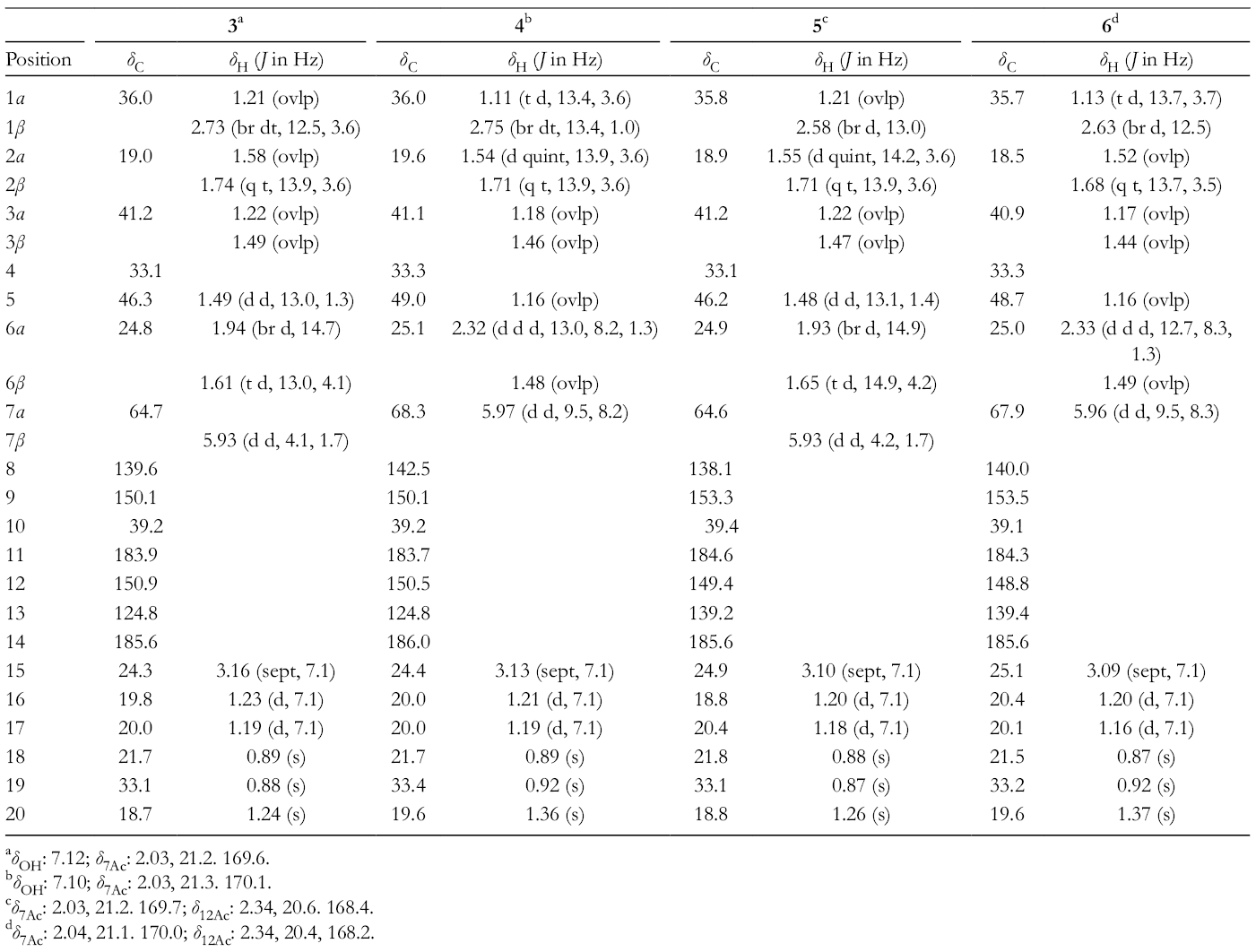
A search for NMR data provided partial assignment of the 1H signals of 4 to 6,20 while total 13C NMR data assignment for 3,224, and 621 was available. However, data of C-5, C-7, C-8, and the acetoxy carbonyl at C-7 assigned21 at δ 46.32, 64.76, 139.83, and 169.46 for 4 and at 45.91, 64.21, 138.83, and 169.12 for 6 match better with our measurements for 3 and 5, respectively. Furthermore, signal pairs for C-9/C-13, C-11/C-14, C-15/C-18, and C-19/C-20 at δ 125.05/150.22, 185.63/184.10, 33.07/24.37, and 18.66/21.00 for 4 and at δ 137.85/149.05, 185.05/179.92, 32.83/24.61, and 18.48/20.92 for 6 are interchanged. Thus, a simple diastereoisomeric exchange reveals that some 13C NMR data are wrongly assigned. The discrepancies between the reported and our values made as mandatory to confirm the absolute configuration (AC) of 3 to 6 using vibrational circular dichroism (VCD) spectroscopy.
The AC determination of compounds is more relevant when they have a pharmacological effect because AC has a direct influence on the drug selectivity in receptors.23 The importance of knowing the AC of a molecule is not limited to pharmacology as it is also useful to investigate biosynthetic pathways24 and can be useful as a criterion for taxonomic classification.25 In this context, VCD has been consolidated as a reliable tool for the AC assignment of natural products.26–29 The AC assignment of 3 to 6 has started generating diastereoisomeric molecular models 5S,7R,10S and 5S,7S,10S in the Spartan 04 software. Molecular mechanics conformational searches were achieved using the Monte Carlo protocol, rendering 8 conformers for 4 within ΔE = 10 kcal/mol. All conformers were submitted to single-point energy calculation using density functional theory (DFT) at the B3LYP/6-31G(d) level with the same software to afford 4 conformers in a 2.3 kcal/mol energy gap which contribute with 99.3% of the conformational population. These conformers were optimized using DFT at the B3PW91/DGDZVP level of theory as implemented in the Gaussian’03 software. The 2 most stable conformers in a 0.31 kcal/mol energy window contribute to the total conformational population. The calculations reveal that the diterpene ring system is quite rigid, as conformers 4a and 4b (Figure 2), showing the A-ring as a chair and the B-ring as a half-chair, mainly differing in the isopropyl group orientation, showing C-12−C-13−C-15−H-15 dihedral angles of +5.6° and −179.2°, respectively. The IR and VCD frequency calculations for 4a and 4b were done using the same level of theory and their ΔG = 0.32 kcal/mol difference was used as the criterion to obtain the weighted IR and VCD spectra (Figure 3), the corresponding thermochemical parameters being summarized in Table 1.
The most stable density functional theory B3PW91/DGDZVP conformers of 3 to 6.
Comparison of the experimental IR and vibrational circular dichroism spectra of (−)-7-O-acetylhorminone (3) (top) and (+)-7-O-acetyltaxoquinone (4) (bottom) with their respective density functional theory B3PW91/DGDZVP calculated spectra for (5S,7R,10S)-3 and (5S,7S,10S)-4.
Comparison of the experimental IR and vibrational circular dichroism spectra of (+)-7,12-di-O-acetylhorminone (5) (top) and (+)-7,12-di-O-acetyltaxoquinone (6) (bottom) with their respective density functional theory B3PW91/DGDZVP calculated spectra for (5S,7R,10S)-5 and (5S,7S,10S)-6.
Similarly, 6 also gave 10 conformers in a 10 kcal/mol energy window after MMFF94 search, which were reduced to 4 conformers in a ΔE = 1.24 kcal/mol window after single-point energy calculations. These 4 conformers remained through the complete calculation procedure and finally appeared in a 0.28 kcal/mol energy gap. As for 4, the ring skeleton is very rigid and 4 conformers arise from 2 isopropyl group orientations and two 12-O-acetyl group orientations. The C-12−C-13−C-15−H-15 dihedral angles for 6a, 6b, 6c, and 6d are +4.7°, +5.0°, –176.8°, and +176.7°, respectively, while the C-12−O-12−C(=O)−Me dihedral angles for 6a, 6b, 6c, and 6d are −162.5°, +164.1°, +161.6°, and −158.6°, respectively. The conformers are shown in Figure 2, the IR and VCD spectra are shown in Figure 3, and the thermochemical parameters are given in Table 1. The same procedure was followed for 3 and 5 in order to obtain their weighted IR and VCD spectra (Table 1; Figures 3 and 4). The conformational differences for the isopropyl and acetyl groups of 2 final conformers of 3 and 4 conformers of 5 were very similar to those observed for 4 and 6, respectively.
Thermochemical Parameters of the Most Stable Density Functional Theory B3PW91/DGDZVP Conformers of 3 to 6.
Relative to 3a (E = 44.52 kcal/mol), 4a (E = 45.07 kcal/mol), 5a (E = 50.56 kcal/mol), and 6a (E = 45.65 kcal/mol).
Calculated according to ΔE ≈ −RT ln K.
Relative to 3a (E = −773 427.99 kcal/mol), 4b (E = −773 426.74 kcal/mol), 5a (E = −869 205.46 kcal/mol), and 6a (E = −869 207.81 kcal/mol).
Relative to 3b (E = −773 221.42 kcal/mol), 4b (E = −773 220.66 kcal/mol), 5a (E = −868 981.49 kcal/mol), and 6a (E = −868 974.74 kcal/mol).
Relative to 3b (E = −772 949.43 kcal/mol), 4b (E = −772 948.48 kcal/mol), 5a (E = −868 689.89 kcal/mol), and 6b (E = −868 644.23 kcal/mol).
Although visual comparison of experimental and calculated IR and VCD spectra of 3 to 6 looks adequate (Figures 3 and 4), numerical data were obtained using the CompareVOA software,30 which validates AC assignment (Table 2). The validity of the comparison methodology is evidenced by cross-comparisons of the calculated and experimental spectra of 3 to 6 also shown in Table 2.
Comparison of experimental and DFT B3PW91/DGDZVP calculated IR and VCD spectra for 3-6.
VCD spectral similarity for the correct enantiomer (%).
VCD spectral similarity for the incorrect enantiomer (%).
Enantiomersimilarity index calculated as (SE−S−E).
Confidencelevel for the AC determination.
Comparison of the VCD spectra of 3 and 5 with those of their diastereoisomers 4 and 6 revealed that they are phase sensitive regarding the C-7 stereocenter. Thus, 3 and 5 show negative bands at 1253 and 1240 cm−1, respectively, while 4 and 6 show positive bands at 1259 and 1240 cm−1, respectively. These bands are attributed, according to a GaussView software evaluation, to the C-7−O-7−C(=O)−Me asymmetric stretching, accompanied by CH2-6 and CH-7 asymmetric bendings.
Although some abietanes have been studied by ECD,13 VCD is a quite superior approach for AC determination since it is a multiband methodology26 instead relaying on a single Cotton effect.
Once the AC of 3 to 6 was secured, the 1H and 13C NMR chemical shifts were assigned using 1D and 2D experiments including heteronuclear multiple bond correlations (HMBC), heteronuclear single quantum correlations (HSQC), and nuclear Overhauser enhancement spectroscopy (NOESY) measurements. The 1H NMR spectrum of 4 showed H-7α at δ 5.97 as a dd (3J7α,6β = 9.5 and 3J7α,6α = 8.2), while H-15 appears at δ 3.13 as a septet J = 7.1 Hz. The individual assignment of hydrogen atoms on methylene groups and the distinction of the Me-18 and Me-19 signals followed from NOESY experiments (Figure 5), since the angular Me-20 singlet at δ 1.36 shows interaction with the signals at δ 2.75, 1.71, and 1.48 and at δ 2.75, 1.71, 1.48, and 0.89 which were assigned to H-1β, H-2β, H-6β, and Me-18, respectively. The H-5α signal at δ1.16 showed correlation with that at δ 0.92 thereby assigning Me-19. Some coupling constant values which can directly be extracted from the spectra are given in Table 3.
Density functional theory minimum energy structure for 4 showing relevant NOESY correlations.
1H (500 MHz) and 13C (125 MHz) NMR Data (in CDCl3) for Acetylated Royleanones 3 to 6.
Once the 1H NMR signals were assigned, the 13C chemical shifts follow trivially from HSQC and HMBC plots, the data being in Table 2. The same strategy was applied for 3, 5, and 6, whose 1H and 13C NMR data are also summarized in Table 2.
In this paper, the AC of epimeric pairs of monoacetylated 3 and 4, and of diacetylated 5 and 6 abietane-type diterpenoids was confirmed using VCD, and the 1H and 13C NMR chemical shift assignments of 3 to 6 were done using one- and two-dimensional NMR experiments.
Experimental
General Experimental Procedures
Melting points were determined with an Electrothermal IA9100X1 apparatus and are uncorrected. Optical rotation was recorded in CHCl3 using a JASCO DIP-370 polarimeter. 1H, 13C, and 2D NMR experiments were obtained using a Varian Mercury 500 (125 MHz for 13C) spectrometer in CDCl3 solutions and tetramethysilane as internal reference.
Plant Material
The aerial parts of S. concolor Lamb were collected from La Marquesa, State of Mexico, in June 2015. A voucher specimen was authenticated by M.C. Ernestina Cedillo Portugal and was deposited at the Herbarium “Jorge Salas Espinosa,” Universidad Autónoma de Chapingo, Texcoco, Mexico under voucher number 61066.
Isolation of Royleanones
Powdered dried aerial parts of S. concolor (212 g) were macerated with hexanes (3 × 4 L) for 3 days, filtered, and the solvent was evaporated under reduced pressure. The residue (43 g), dissolved in acetone, was kept at 4°C for 14 hours and filtrated to remove fatty materials. The filtrate was evaporated under reduced pressure to afford 13 g of residue which was column chromatographed on silica gel (Mesh 200-300, Natland International Corp.). Elution with hexane-AcOEt (9:1) gave 5 g of a mixture of horminone (1), taxoquinone (2), and 6,7-dehydroroyleanone (7). Rechromatography using the same polarity allowed separation of 7 (1.2 g) from the mixture of 1 and 2 (3.2 g).
Monoacetyl Derivatives
A mixture of 1 and 2 (114.1 mg) in pyridine (0.4 mL) and Ac2O (0.4 mL) was stirred at room temperature for 30 minutes, poured over ice-H2O, and extracted with AcOEt. The organic layer was washed with 10% HCl, water, aqueous 10% NaHCO3, and water, dried over anhydrous Na2SO4, filtered, and evaporated under reduced pressure. The peracetylated crude reaction mixture, as evidenced by 1H NMR measurements, was column chromatographed using a hexane-AcOEt (49:1) mixture to afford 7-O-acetyltaxoquinone (4) (2 mg) and a mixture of 3 and 4 (109.4 mg). The monoacetate mixture was dissolved in MeOH and, after successive crystallizations by slow evaporation gave 13.2 mg of 3.
Diacetyl Derivatives
Solution of 3 or 4 (10 mg) in pyridine (0.2 mL) and Ac2O (0.2 mL) was treated as above for 0.5 hours to give 5 or 6, respectively, in quantitative yields.
Vibrational circular dichroism spectra were measured on a dual photoelastic modulator BioTools ChiralIR2X FT-VCD spectrophotometer operated at a resolution of 4 cm−1. Chloroform-d 100% atom-D 0.14, 0.20, 0.13, and 0.14 M solutions of 3, 4, 5, and 6, respectively, were placed in a BaF2 cell with a path length of 101 µm. Five 1-hour data blocks were added for each measurement. The baseline was corrected by subtracting the spectrum of the solvent acquired under the same conditions.
Computational Methods
Monte Carlo searches of 3 to 6 were performed using MMFF94 as implemented in the Spartan’04 software (Wavefunction Inc., Irvine, CA, United States). The single-point energy of each conformer was calculated using DFT with the B3LYP functional and the 6-31G(d) basis set. The selected conformers were submitted to further conformational optimization using DFT at the B3PW91/DGDZVP levels of theory using the Gaussian’03 software (Gaussian Inc., Wallingford, CT, United States). The IR and VCD frequencies’ calculations were carried out at the same levels of theory. All minimum energy geometries were tested for the absence of imaginary frequencies, and their relative free energies were used to calculate their Boltzmann distribution. The Boltzmann-weighted IR and VCD spectra were calculated with Lorentzian functions and a bandwidth of 6 cm−1. Calculated and experimental spectra were compared using the CompareVOA software (BioTools).30
Footnotes
Acknowledgments
M.D.F. thanks CONACyT for doctoral scholarship 473101. We thank M.C. Ernestina Cedillo-Portugal for identification of the botanical specimen.
Declaration of Conflicting Interests
The author(s) declared no potential conflicts of interest with respect to the research, authorship, and/or publication of this article.
Funding
The author(s) disclosed receipt of the following financial support for the research, authorship, and/or publication of this article: This work was supported by SIP-IPN (Grants 20171355, 20181801, and 20195548).
References
1.
WalkerJB.SytsmaKJ.TreutleinJ.WinkM. Salvia (Lamiaceae) is not monophyletic: implications for the systematics, radiation, and ecological specializations of Salvia and tribe Mentheae. Am J Bot. 2004;91(7):1115-1125.doi:10.3732/ajb.91.7.1115
2.
RamamoorthyTP.ElliotM. Lamiaceae de México: diversidad, distribución, endemismo y evolución. In: RamamoorthyTP.ByeR.LotA.FaJ., eds.Diversidad biológica de México: orígenes y distribución. México: Instituto de Biología, Universidad Nacional Autónoma de México; 1998:501-525.
UlubelenA.EvrenN.TuzlaciE.JohanssonC. Diterpenoids from the roots of Salvia hypargeia. J Nat Prod. 1988;51(6):1178-1183.doi:10.1021/np50060a021
5.
KusumiT.OoiT.HayashiT.KakisawaH. A diterpenoid phenalenone from Salvia miltiorrhiza. Phytochemistry. 1985;24(9):2118-2120.doi:10.1016/S0031-9422(00)83136-2
6.
SabriN.Abou-DoniaA.AssadAet al. Abietane diterpenes quinones from the roots of Salvia verbenaca and S. lanigera. Planta Med. 1989;55(6):582.doi:10.1055/s-2006-962111
7.
BajpaiVK.RatherIA.KangSC.ParkY-H. A diterpenoid taxoquinone from Metasequoia glyptostroboides with pharmacological potential. Indian J Pharm Educ. 2016;50(3):458-464.doi:10.5530/ijper.50.3.20
8.
NamanCB.GromovskyAD.VelaCMet al. Antileishmanial and cytotoxic activity of some highly oxidized abietane diterpenoids from the bald cypress, Taxodium distichum. J Nat Prod. 2016;79(3):598-606.doi:10.1021/acs.jnatprod.5b01131
9.
BúfaloJ.CantrellCL.JacobMRet al. Antimicrobial and antileishmanial activities of diterpenoids isolated from the roots of Salvia deserta. Planta Med. 2016;82(1-2):131-137.doi:10.1055/s-0035-1557875
10.
BatistaO.DuarteA.NascimentoJ.SimõesMF.de la TorreMC.RodríguezB. Structure and antimicrobial activity of diterpenes from the roots of Plectranthus hereroensis. J Nat Prod. 1994;57(6):858-861.doi:10.1021/np50108a031
11.
BajpaiVK.NaM.KangSC. The role of bioactive substances in controlling foodborne pathogens derived from Metasequoia glyptostroboides Miki ex Hu. Food Chem Toxicol. 2010;48(7):1945-1949.doi:10.1016/j.fct.2010.04.041
12.
FronzaM.LamyE.GüntherS.HeinzmannB.LauferS.MerfortI. Abietane diterpenes induce cytotoxic effects in human pancreatic cancer cell line MIA PaCa-2 through different modes of action. Phytochemistry. 2012;78:107-119.doi:10.1016/j.phytochem.2012.02.015
13.
YangLB.LiL.HuangSXet al. Anti-Hepatitis B virus and cytotoxic diterpenoids from Isodon lophanthoides var. gerardianus. Chem Pharm Bull. 2011;59(9):1102-1105.doi:10.1248/cpb.59.1102
14.
ArecheC.Schmeda-HirschmannG.TheodulozC.RodríguezJA. Gastroprotective effect and cytotoxicity of abietane diterpenes from the Chilean Lamiaceae Sphacele chamaedryoides (Balbis) Briq. J Pharm Pharmacol. 2009;61(12):1689-1697.doi:10.1211/jpp.61.12.0015
15.
EbrahimiSN.ZimmermannS.ZauggJ.SmieskoM.BrunR.HamburgerM. Abietane diterpenoids from Salvia sahendica– antiprotozoal activity and determination of their absolute configurations. Planta Media. 2013;79:150-156.
16.
JassbiAR.EghtesadiF.HazeriNet al. The roots of Salvia rhytidea: a rich source of biologically active diterpenoids. Nat Prod Res. 2017;31(4):477-481.doi:10.1080/14786419.2016.1188096
17.
HandaKL.ChaudharySS.JamwalKS. Chemistry and pharmacology of Inula royleana, part II. Ind J Pharm. 1958;20:211-213.
18.
EdwardsOE.FeniakG.LosM. Diterpenoid quinones of Inula royleana D. C. Can J Chem. 1962;40(8):1540-1546.doi:10.1139/v62-232
19.
MatsumotoT.HaradaS. Synthesis of taxoquinone, 7α-acetoxyroyleanone, dehydroroyleanone, horminone, 7-oxoroyleanone, and inuroyleanol. Chem Lett. 1976;5(12):1311-1314.doi:10.1246/cl.1976.1311
20.
HenschM.RüediP.EugsterCH. Horminon, taxochinon und weitere royleanone aus 2 abessinischen Plectranthus -Spezies (Labiateae). Helv Chim Acta. 1975;58(7):1921-1934.doi:10.1002/hlca.19750580707
21.
FaucherA-M.BurnellRH. The conversion of 7-acetoxyroyleanone to 14-methoxytaxodione. Can J Chem. 1989;67(1):1-4.doi:10.1139/v89-001
22.
TezukaY.KasimuR.LIJXet al. Constituents of roots of Salvia deserta Schang (Xinjiang-Danshen). Chem Pharm Bull. 1998;46(1):107-112.doi:10.1248/cpb.46.107
23.
BatistaANL.dos SantosFM.BatistaJM.CassQB. Enantiomeric mixtures in natural product chemistry: separation and absolute configuration assignment. Molecules. 2018;23(2):492-510.doi:10.3390/molecules23020492
CronquistA. On the taxonomic significance of secondary metabolites in angiosperms. In: KubitzkiK., ed.Flowering Plants. Plant systematics and Evolution/Entwicklungsgeschichte und Systematik der Pflanzen. 1. Vienna: Springer; 1977.
26.
Joseph−NathanP.Gordillo-RománB. Vibrational circular dichroism in absolute configuration determination of natural products. In: KinghornAD.FalkH.KobayashiJ., eds.Progress in the Chemistry of Organic Natural Products. 100. Switzerland: Springer; 2015:311-452.
27.
BatistaJM. Stereoselective synthesis of drugs and natural products. 41. Amsterdam: Elsevier; 2014:1571-1600.
28.
BatistaJM.BlanchEW.BolzaniVdaS. Recent advances in the use of vibrational chiroptical spectroscopic methods for stereochemical characterization of natural products. Nat Prod Rep. 2015;32(9):1280-1302.doi:10.1039/C5NP00027K
29.
Burgueño-TapiaE.Joseph-NathanP. Vibrational circular dichroism: recent advances for the assignment of the absolute configuration of natural products. Nat Prod Commun. 2015;10(10):1785-1795.doi:10.1177/1934578X1501001036
30.
DebieE.De GussemE.DukorRK.HerreboutW.NafieLA.BultinckP. A confidence level algorithm for the determination of absolute configuration using vibrational circular dichroism or Raman optical activity. ChemPhysChem. 2011;12(8):1542-1549.doi:10.1002/cphc.201100050