



Abstract
Natural products are important resources for the development of agrochemicals. In this paper, the pesticide activities study of the P olygonum cuspidatum crude extracts and the active ingredient resveratrol was carried out. By the method of high-performance liquid chromatography, the active ingredient resveratrol in the P. cuspidatum extracts was qualitatively and quantitatively analyzed. The pesticide activities of the P. cuspidatum extracts and resveratrol were also researched. The content of resveratrol in P. cuspidatum used in the experiment was measured to be 0.516 mg g−1. The activity results showed that the resveratrol exhibited excellent activity against tobacco mosaic virus (TMV) in vivo (inactivation activity, 48.9%/500 mg L−1 and 15.3%/100 mg L−1 ; curative activity, 50.2%/500 mg L−1 and 22.8%/100 mg L−1 ; and protection activity, 45.2%/500 mg L−1, and 19.5%/100 mg L−1 ), and the activities were higher than that of commercial anti-TMV agent ribavirin. The inactivation activity of P. cuspidatum extracts against TMV in vivo was 38.1%/500 mg L−1 and was equal to that of ribavirin. Polygonum cuspidatum extracts and resveratrol also showed the fungicidal activity, herbicidal activity, and insecticidal activity. In this paper, the results showed that the resveratrol has good prospect of the research and development; it provided necessary data support for further strengthening its application research.
Keywords
In agriculture, plant diseases and pests are largely controlled by agricultural chemicals. The vast majority of these pesticides are synthetic compounds, some of which are toxic to environment and human health. Thus, pesticides with environmental and toxicological safety are needed. 1,2
Natural products have been used for the benefit of humankind for many thousands of years, be it for food, clothing, cosmetics, construction of shelters and traps, tools and weapons, poisons for game and fish, medicines, or crop protection agents. Some of the earliest pesticides were natural products. These compounds have formed the basis of chemical synthesis programs to derive new chemical products. Some have been used as starting materials for semisynthetic derivatives. Furthermore, they often have molecular target sites that are not exploited by currently marketed pesticides. Therefore, natural products are a source of new chemical classes of pesticides, as well as environmentally and toxicologically safer molecules than many of the currently used pesticides. 3,4
Polygonum cuspidatum is one of the traditional Chinese medicines in common use with its rhizome, which belongs to Polygonaceae a perennial herb plant. Stilbene and anthraquinone are the dominant chemical compositions of this plant which have a variety of medicinal value. In recent years, stilbene-resveratrol has gained wide attention. 5 -7 Modern research showed that resveratrol had a wide range of pharmacological activities including the antioxidant activity, antibacterial, antiviral, preventing cancer, and inhibiting platelet aggregation. 8,9 It becomes a kind of molecule which is good for us to pay much attention on the domain of medical chemistry. Resveratrol (3,5,4′-trihydroxy-trans-stilbene, Figure 1) is a natural phytoalexin with polyphenol structure, which can be activated by adverse conditions of plants, protecting plants against fungal infections. 10,11 First isolated in 1940 from Veratrum grandiflorum by Takaoka, 12 gradually resveratrol was also found in grapes, knotweed, peanuts, and other plants, and later, it has been obtained in larger quantities from the roots of P.cuspidatum. 13,14 It attracted wider attention only in 1992 when its presence in wine was suggested as the explanation for cardioprotective effects.

Structural formula of resveratrol.

High-performance liquid chromatography chromatograms of resveratrol and Polygonum cuspidatum extracts.
As resveratrol belongs to a molecular class of phytoalexins, which are defense compound and produced by higher plants in response to pathogenic attack or other stress conditions, it was found that resveratrol had the effect to resist the infection of gray mold (Botrytis cinerea), therefore, also known as “phytoncide.” The in-depth study on the resveratrol confirmed that the material not only has an antibacterial effect but also there are significant pharmacological effects in resveratrol which promote huge development of resveratrol in the pharmacological industry. In addition, resveratrol is also widely applied in food, chemical, and cosmetics industries. 15 -18
Resveratrol is produced by plants as an antifungal chemical. However, reports of the research of the resveratrol in the field of pesticide are rather rare, and no examples are documented in the recent literature. In view of this, in this paper, by means of high-performance liquid chromatography (HPLC), the active ingredient resveratrol in P . cuspidatum extracts was qualitatively and quantitatively analyzed. The anti-TMV activity, fungicidal activity, insecticidal and acaricidal activity, and herbicidal activity of resveratrol were tested for the first time.
Experimental
General
High-performance liquid chromatography analyzer (Agilent 1260), KDM-type adjustable temperature electric jacket, JM-A20002 electronic balance, P. cuspidatum, anhydrous ethanol (Analytical Reagent), ultrapure water (18.25 MΩ cm), methanol (Guaranteed Reagent), and resveratrol (98%).
Sample Solution Preparation of Polygonum cuspidatum
To a 5 L round bottom flask, giant knotweed (500 g) and anhydrous ethanol (2 L) were added, and then the mixture was refluxed for 24 hours for extraction. The extraction (500 µL) was taken out and diluted 4 times with anhydrous ethanol. The test sample solution was got. The solution was filtered with 0.45 µm microporous membrane and determined by HPLC.
Analysis of HPLC
Hypersil ODS2 C18 HPLC column was about 4.6 mm × 250 mm, 5 µm, the column temperature was 40°C, and the detection wavelength was 305 nm. Injection volume was 10 µL and the flow rate was 1.0 mL min−1. Mobile phases were methanol and water, and the gradient elution was programmed as 10% to 90% methanol in 0 to 30 minutes and 90% methanol in 30 to 40 minutes in Table 1.
Gradient Elution Schedule.

The Drawing Standard Curve
A total of 2 mg resveratrol was accurately weighed, dissolved in anhydrous ethanol, and quantitatively transferred into 10 mL volumetric flask, and the constant volume was diluted to scale line. The mass concentration of 0.2 mg mL−1 of resveratrol standard stock solution was obtained, diluted with anhydrous ethanol to get the mass concentration of 100, 50, 25, 12.5, and 6.25 mg L−1 of standard solution. Analyzed by HPLC, with the concentration of resveratrol (mg L−1) as the abscissa and the peak area as the ordinate, the standard curve was drawn. The linear regression equation is established as follows: y = 110.63x − 64.61R 2 = 0.9999.
Calculation of Content
The calculating formula for the content of resveratrol in giant knotweed is as follows: α = CV/M, where α is the content of resveratrol in giant knotweed (mg g−1), C is the mass concentration of resveratrol in P.cuspidatum extracts (mg mL−1), V is the volume of P. cuspidatum extracts (mL), and M is the quality of giant knotweed (g).
Bioassay for Anti-TMV Activity
The procedure for purifying TMV, the method to test the protective effect, the inactivation effect, and the curative effect against TMV in vivo were the same with those reported previously in the literature. 19 -21
Fungicidal Biological Assay
The compounds were evaluated in mycelial growth tests in artificial media against 14 plant pathogens at rate of 50 mg L−1.
Test compound was dissolved within a suitable amount of acetone and diluted with water containing 0.1% TW-80 to the concentration of 500 mg L−1. To each petri dish, 1 mL of such solution and 9 mL of culture medium were added to make a 50 mg L−1 of medicated tablet, whereas to another petri dish 1 mL of sterilized water and 9 mL of culture medium were added as a blank control. A diameter of 4 mm of hyphae was cut by a hole puncher along the hyphae for bacteria to the outer plate and moved to the medicated tablet. Each treatment was performed 3 times. The dishes were stored in controlled environment cabinets (24°C ± 1°C) for 48 hours after which the diameter of mycelia growth was investigated and percentage inhibition was calculated:
Percentage inhibition (%) = (averaged diameter of mycelia in blank controls – averaged diameter of mycelia in medicated tablets) / averaged diameter of mycelia in blank controls
Insecticidal Activity Assay
Detailed bioassay procedures for the insecticidal activities are described in our published literature. 22
Herbicidal Activity Assay
The herbicidal activities were tested using our previously reported methods. 23
Results and Discussion
Qualitative Analysis of Resveratrol in Giant Knotweed
By the comparison of retention time of the components of the extracts with resveratrol by HPLC (Figure 1), it was confirmed that the ingredient was resveratrol.
Quantitative Analysis of Resveratrol in Giant Knotweed
According to the standard curves of resveratrol, it is calculated that the content of resveratrol in giant knotweed is 0.516 mg g− 1.
The anti-TMV activity of resveratrol and P. cuspidatum extracts was first tested. The commercial plant virucide Ribavirin was used as the control. The antiviral results against TMV of resveratrol and P. cuspidatum extracts in vivo (protection, inactivation, and curative effect assays using whole plants) are listed in Table 2. They were tested at both 500 and 100 mg L−1. The results indicated that they all displayed antiviral activity against TMV. Especially, the activity of resveratrol in 3 test modes was higher than that of control Ribavirin.
The Anti-Tobacco Mosaic Virus Activity of Polygonum cuspidatum Extracts and Resveratrol.

aPositive control.
Biological Activities
At the concentration of 500 mg L−1, inactivation activity, curative activity, and protection activity of resveratrol were 48.9%, 50.2%, and 45.2%, respectively, while inactivation activity, curative activity, and protection activity of ribavirin were 39.1%, 37.6%, and 39.7%, respectively. At 100 mg L−1, inactivation activity, curative activity, and protection activity of resveratrol were 15.3%, 22.8%, and 19.5%, respectively, while inactivation activity, curative activity, and protection activity of ribavirin were 10.4%, 13.5%, and 15.1%, respectively.
The fungicidal activities of giant knotweed extracts and resveratrol against 14 kinds of plant pathogenic fungi were tested. As shown in Tables 3 and 4, both giant knotweed extract and resveratrol displayed antifungal activities, and most of the fungicidal activity of resveratrol was higher than that of giant knotweed extracts.
The Fungicidal Activity of Polygonum cuspidatum Extracts and Resveratrol.

A.s, Alternaria solani; B.c, Botrytis cinerea; F.g, Fusarium graminearum; P.c, Phytophthora capsici; P.i, Phytophthora infestans; R.s, Rhizoctonia solani; S.s, Sclerotinia sclerotiorum.
aPositive control.
The Fungicidal Activity of Polygonum cuspidatum Extracts and Resveratrol.

B.m, Bipolaris maydis; C.h, Cercospora arachidicola hori; F.c, Fusarium oxysporium f. sp. cucumeris; F.m, Fusarium moniliforme; P.p, Physalospora piricola; R.c, Rhizoctonia cerealis; W.a, Watermelon anthracnose.
aPositive control.
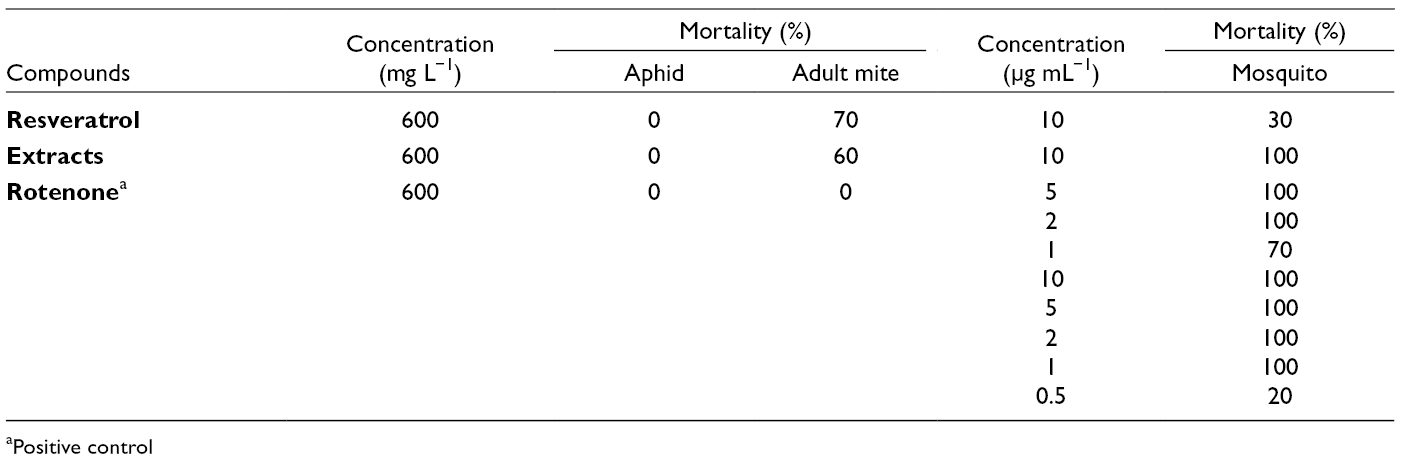
The insecticidal activities of giant knotweed extracts and resveratrol against lepidoptera pests including oriental armyworm, cotton bollworm, corn borer, and diamondback moth were listed in Table 5. The insecticidal activities of giant knotweed extracts and resveratrol against aphid, mite, and mosquito were listed in Table 6. It can be seen that both giant knotweed extracts and resveratrol exhibited insecticidal activities. However, the giant knotweed extracts showed 50% mortality rate against diamondback moth at 600 µg mL−1, while resveratrol showed no activity. By calculation, the content of resveratrol in giant knotweed extracts is 0.906 mg g−1. So, it is very likely that the other ingredients of giant knotweed extracts play insecticidal activitives. Moreover, giant knotweed extracts and resveratrol also displayed acaricidal activity.
The Insecticidal Activity of Polygonum cuspidatum Extracts and Resveratrol.

aPositive control
The Insecticidal Activity of Polygonum cuspidatum Extracts and Resveratrol.
The herbicidal activities of giant knotweed extracts and resveratrol were tested. As shown in Table 7, the results showed that the giant knotweed extracts and resveratrol exhibited weaker herbicidal activity.
The Herbicidal Activity of Polygonum cuspidatum Extracts and Resveratrol (100 g/666.7 m2, Efficacy %).

A.r, Amaranthus retroflexus; B.c, Brassica campestris; D.s, Digitaria sanguinalis; E.c, Echinochloa crusgalli.
aPositive control.
In this paper, the content of resveratrol in giant knotweed extracts was qualitatively and quantitatively analyzed by HPLC. The pesticide activities of giant knotweed extracts and resveratrol were first tested. The results showed that resveratrol showed good activity in vivo against TMV, much better than that of commercialization ribavirin. It has great realistic significance for the development of novel plant virus inhibitors. Furthermore, resveratrol also displayed fungicidal activity, insecticidal activity, and herbicidal activity.
Supplemental Material
Supplementary data - Supplemental material for Study in Pesticide Activities of Polygonum cuspidatum Extracts and its Active Ingredient Resveratrol
Supplemental material, Supplementary data, for Study in Pesticide Activities of Polygonum cuspidatum Extracts and its Active Ingredient Resveratrol by Wenqiang Yang, Fenglu Li, Xiaoyi Xing, Zhen Wang, and Xiuling Yu in Natural Product Communications
Footnotes
Declaration of Conflicting Interests
The author(s) declared no potential conflicts of interest with respect to the research, authorship, and/or publication of this article.
Funding
The author(s) disclosed receipt of the following financial support for the research, authorship, and/or publication of this article: This work was supported by A Project of Shandong Province Higher Educational Science and Technology (J18KA156), Research Fund for the Doctoral Program of Higher Education of Linyi University (LYDX2016BS097), National Training Program of Innovation and Entrepreneurship for Undergraduates (201710452179, 201810452010), the Key Research and Development Plan Program of Shandong Province (2017YYSP027), and the National Natural Science Foundation of China (21602095).
References
Supplementary Material
Please find the following supplemental material available below.
For Open Access articles published under a Creative Commons License, all supplemental material carries the same license as the article it is associated with.
For non-Open Access articles published, all supplemental material carries a non-exclusive license, and permission requests for re-use of supplemental material or any part of supplemental material shall be sent directly to the copyright owner as specified in the copyright notice associated with the article.
