



Abstract
Objective
Traditional Chinese medicine processing typically employs a significant amount of water and heat, and thus is classified as an environmentally unfriendly process. Additionally, diverse processing methods will produce variations in composition and content among the products, resulting in inconsistent quality. The present study aims to develop processing methods for several common traditional Chinese medicines using microwave reactions.
Methods
Several common traditional Chinese medicines, including Armeniacae Semen, Arctii Fructus, Scutellariae Radix, and Gardeniae Fructus, were processed by microwave heating. These medicinal materials are evaluated by investigating the differences in chemical composition between the raw plants and processed traditional Chinese medicines using high performance liquid chromatography (HPLC). The suitable analytical targets are selected based on the concept of Chemistry, Manufacturing, and Controls (CMC) management.
Results
In this study, the developed microwave-processed protocols took only a few minutes. Moreover, the medicinal materials were analyzed by HPLC, in which the analytical method exhibits good precision and accuracy, and further the microwave processing parameters were optimized.
Conclusion
Traditional processing of herbal medicines typically consumes large amounts of energy and requires several hours or days. In contrast, microwave processing completes within minutes, representing substantial reduction in both time and energy. Furthermore, comparative chemical analyses between raw and processed materials revealed distinct variations in indicator compounds, providing evidence of compositional changes induced by processing.
Keywords
Introduction
Pao-Zhi was a general term for the processing techniques used in all traditional Chinese medicines, including but not limited to washing, soaking, boiling, steaming, fermenting, drying, roasting, honey frying, wine frying, earth frying, vinegar frying, calcining, and others. 1 One of the most common goals of processing traditional Chinese medicines was to maintain the bioactivity of herbs, which was to kill the enzymes and retain the bioactive compounds in their natural form. In Chinese herbal medicine, glycosides are common secondary metabolites that often contribute to various therapeutic activities, depending on their structure. However, some glycosides are unstable and decompose through enzyme-catalyzed reactions. Pao-Zhi can inactivate enzymes that hydrolyze glycosides. For example, bitter almonds contained high levels of amygdalin (3-5%) and developed a characteristic cyanide aroma with moisture. The disruption of the kernel tissue enabled amygdalin to contact the hydrolytic enzymes to produce benzaldehyde and hydrogen cyanide.2,3 Thus, to maintain the pharmacological activity of bitter almonds, some processing methods, such as blanching or roasting, were usually performed on the fresh seeds to keep the amygdalin constant.4,5
Microwave technology has been utilized in chemical laboratories for moisture analysis and wet-ashing procedures involving biological materials for several decades. 6 Microwave absorption could heat the target water molecules without heating the entire object. The rapid heating capability of the microwave has been applied to extract the plant materials to afford mixtures, considerably saving time and energy. 7 Compared with traditional Chinese medicine processing protocols, such as frying and roasting, microwave technology was relatively simple and quick, saving energy and reducing waste significantly. 8 While several applications of microwave processing in traditional Chinese medicines have already been reported, most of these studies focused on single herbs or specific chemical components. The experimental data related to long-term stability, quality control, and optimization of microwave processing parameters remain limited. To address these gaps, this study wishes to systematically develop the microwave processing protocols of four representative herbal materials. A protocol was designed for traditional Chinese medicine using microwave to generate processed herbal medicine, which was assessed by HPLC following the concept of chemistry, manufacturing, and controls (CMC), which was known as an essential part of pharmaceutical quality in a quality control system. In recent years, the design of a CMC technical framework for Chinese medicine has been implemented in the manufacturing processes. 9 Therefore, the present study aims to establish a feasible microwave platform for processing the traditional Chinese medicines. In addition, the variations of the indicator compounds between the raw and microwave-processed traditional Chinese medicines were further evaluated by HPLC.
Materials and Methods
General
Armeniacae Semen, Arctii Fructus, Scutellariae Radix, and Gardeniae Fructus samples were purchased from the Chinese medicine markets at Tainan, Taiwan, in 2021. The materials were identified by the co-author, Prof. T. S. Wu, and all the voucher specimens (NCKU_2021001∼004) have been deposited in the School of Pharmacy, National Cheng Kung University, Tainan, Taiwan. All the analytical standard compounds were purchased from Sigma-Aldrich (St Louis, MO, USA) unless specified, and their purities were higher than 98%. Liquid chromatography was performed on a Shimadzu LC-2030C liquid chromatographic system (Kyoto, Japan) equipped with a UV-VIS detector (SPD-20A), a degasser (DGU-20A5R), two gradient pumps (LC-30AD), an autosampler (SIL-30AC), and the system control (CBM-20A). Acetonitrile and methanol were HPLC grade from Merck (Darmstadt, Germany), distilled water was purified by a Milli-Q system (Millipore, Milford, MA, USA), and all other chemicals were analytical grade.
Sample Preparation for HPLC Analysis
The weight of dried powder samples (1.0 g) was measured accurately and transferred to a clean Erlenmeyer flask. Additionally, 10 mL of 70% methanol was added to the above solution. The mixture was sonicated for 5 min at room temperature. The supernatant part was collected after centrifugation, repeating the above steps 3 times, and combining all solutions into a 50 mL quantitative bottle. The filtration of the solution was implemented through a 0.45 μm filter membrane and then injected into the HPLC system for analysis.
HPLC Conditions
All solutions of samples and standards were filtered using a 0.22 µm membrane filter before analysis. A Discovery HS C18 column (250 × 4.6 mm I.D., 5.0 μm) was utilized to separate the four plant extracts at room temperature. The mobile phase, gradient elution program, and flow rate are listed below. (a) Armeniacae Semen: phase A (methanol) and B (0.1% formic acid in water), using a gradient elution of 80% B at 0 min, 80–55% B at 0–30 min, 55–80% B at 30–40 min, 80% B at 40–50 min, with the flow rate 0.5 mL/min; (b) Arctii Fructus: phase A (methanol) and B (water), using a gradient elution of 55% B at 0–2 min, 55–30% B at 2–25 min, 30–55% B at 25–35 min, 55% B at 35–40 min, with the flow rate 0.5 mL/min; (c) Scutellariae Radix: phase A (methanol) and B (0.1% formic acid in water), using a gradient elution of 50% B at 0–2 min, 50–30% B at 2–25 min, 30–50% B at 25–35 min, 50% B at 35–40 min, with the flow rate 0.75 mL/min; (d) Gardeniae Fructus: phase A (methanol) and B (0.1% formic acid in water), using a isocratic elution (35:65), with the flow rate 0.5 mL/min.
Method Validation
For the method validation, calibration curves were constructed from HPLC quantitative data by serially diluting the stock solutions to appropriate concentrations with five parallel repetitions. The limits of detection (LODs) and limits of quantification (LOQs) under the optimized HPLC conditions were determined at the signal-to-noise ratio (S/N) of 3 and 10, respectively. The precision of the developed method depended on inter- and intra-day variations in terms of measurements of retention times and peak areas upon three replicate injections of the qualified solutions (low, middle, and high concentrations) within three days and three times per day. The recovery percentage was calculated using the quantities of added standards and the actual amounts (measured amount – original amount) obtained by HPLC analysis. In addition, the investigation of matrix effects was considered in comparison with the peak sections requested from the compounds added after the extraction with the standard solutions at three QC concentration levels. The ratio of 1 indicates the matrix does not suppress or enhance the response at all.
Statistical Analysis
Statistical analysis was performed using Microsoft Excel (Microsoft 365 for Enterprise). The Excel-based dataset calculator was applied to organize and analyze the data. Descriptive statistics, including mean, standard deviation, and range, were computed using built-in Excel functions such as AVERAGE() and STDEV.S(). Calibration curves were constructed in Excel by plotting the peak area (y-axis) against the concentration of standards (x-axis). A linear regression trendline was applied to obtain the calibration equation (y = ax + b) and the corresponding coefficient of determination (R2) was automatically generated to assess the linearity of the relationship. The slope and intercept from the regression formula were subsequently used for quantifying sample concentrations.
Microwave Heating of Four Traditional Chinese Medicine Herbs
A home-use microwave oven (Sampo, RE-1002SM, 30 L) capable of generating 900 W power at 2450 MHz was used for the roasting experiments. A serving of 20.0 g of raw material (Armeniacae Semen, Arctii Fructus, Scutellariae Radix, or Gardeniae Fructus) was weighed in glass plates and processed in the microwave oven. Power (270, 540, 720, 900 W), processing time (1 min, 2 min), and repetition were adjusted to produce processed materials that were monitored by smell and appearance to explore the most similar samples with the commercial ones.
Quantification of the Indicator Compounds in Raw, Commercial, and Microwave-Processed Samples
HPLC analysis was performed on several batches of raw herbs, commercial, and microwave-processed samples. A Discovery HS C18 column was used, and chromatographic parameters were optimized, and the contents of the indicator compounds were calculated by the calibration curve constructed by standard compounds.
Quantification of the Indicator Compounds in Microwave-Processed Samples After Some Months
To investigate the preservation of naturally active ingredients in microwave processed samples, the contents of indicator compounds were analyzed by HPLC immediately after microwave treatment. After the microwave-processed samples were stored in the herbarium for several months (1 to 5), HPLC analysis was performed again under the above-mentioned conditions to compare the changes in the contents of the indicator compounds.
Anti-Inflammatory Bioactivity Examination
The anti-inflammatory bioactivity examination was handled by Prof. T. L. Hwang (Chang Gung University of Science and Technology, Taoyuan, Taiwan). The application of this study was supported by the Institutional Review Board of Chang Gung Memorial Hospital (IRB No. 201902217A3; 201902217A3C601; 201902217A3C501; 2019072217A3C602; 2019072217A3C603). From blood samples of donated humans, the isolation and purification of neutrophils were implemented following the previously described protocols. 10 According to the preceding defined procedure, the assay of measuring superoxide anion generation was conducted through the SOD-inhibitable reduction of ferricytochrome and degranulation of azurophilic granules, respectively.
Results
Optimization of HPLC Conditions and Method Validation
The optimizations of gradient and isocratic HPLC conditions for different compounds were investigated following the protocols previously published by our group. 11 The chemical structures and resulting chromatograms of standards 1–7 are illustrated in Figures 1 and 2, respectively. All these standards were clearly separated from other signals in the extracts of the examined herb materials.

Chemical structures of the standard compounds 1–7.

HPLC chromatograms of the standard compounds 1–7. (A) amygdalin (1). (B) arctiin (2). (C) arctigenin (3). (D) baicalin (4). (E) baicalein (5). (F) geniposide (6). (G) genipin (7).
Regarding the precision of the method, the calibration curve for each compound was prepared at various concentrations ranging from 0.0625 to 0.25 mg/mL, using the ratio of the peak area of the compound and the internal standards. Amygdalin (1), arctiin (2), arctigenin (3), baicalin (4), baicalein (5), geniposide (6), and genipin (7) were found to show good linearity with r2 higher than 0.99 (Table 1). There were determinations of LOD and LOQ for each compound, in which samples were diluted serially, and the resulting signal-to-noise ratios were calculated. Successively, the LODs/LOQs for standards 1–7 were determined as shown in Table 1. Intra- and inter-day precisions were utilized to evaluate the repeatability of the method. As shown in Table 2, the method showed good repeatability with all the RSDs under 1.92%. The recovery of the indicator compound was determined by the addition of a sample with known concentration to the standard solution, and the mean recovery rates were found to be in the range from 93.10 to 108.53% with satisfactory RSDs in the range between 0.03 and 1.20% (Table 3). These data indicated that the reproducibility and recovery of these analytical processes were acceptable. According to the present data (Table 4), no significant matrix effects were observed for the analytical targets.
HPLC Calibration Curves, LODs and LOQs for the Seven Standard Compounds.

Intra-day and inter-day Accuracy and Precision Values of the Seven Standard Compounds for the HPLC Method.

Recovery Study of the Seven Standard Compounds by HPLC Method (n = 3).

Matrix Effect of the Seven Standard Compounds by HPLC Method (n = 3).

Quantification of the Indicator Compounds in Raw and Commercial Samples by HPLC
The raw materials and commercial samples of Armeniacae Semen, Arctii Fructus, Scutellariae Radix, and Gardeniae Fructus were examined for their indicator compounds by the HPLC methods developed above. The analysis data of raw materials and commercial samples were included in Table 5.
The Contents of Indicator Compounds in raw and Commercial Processed Chinese Herbal Medicine Samples.

Optimization of the Microwave Processed Parameters
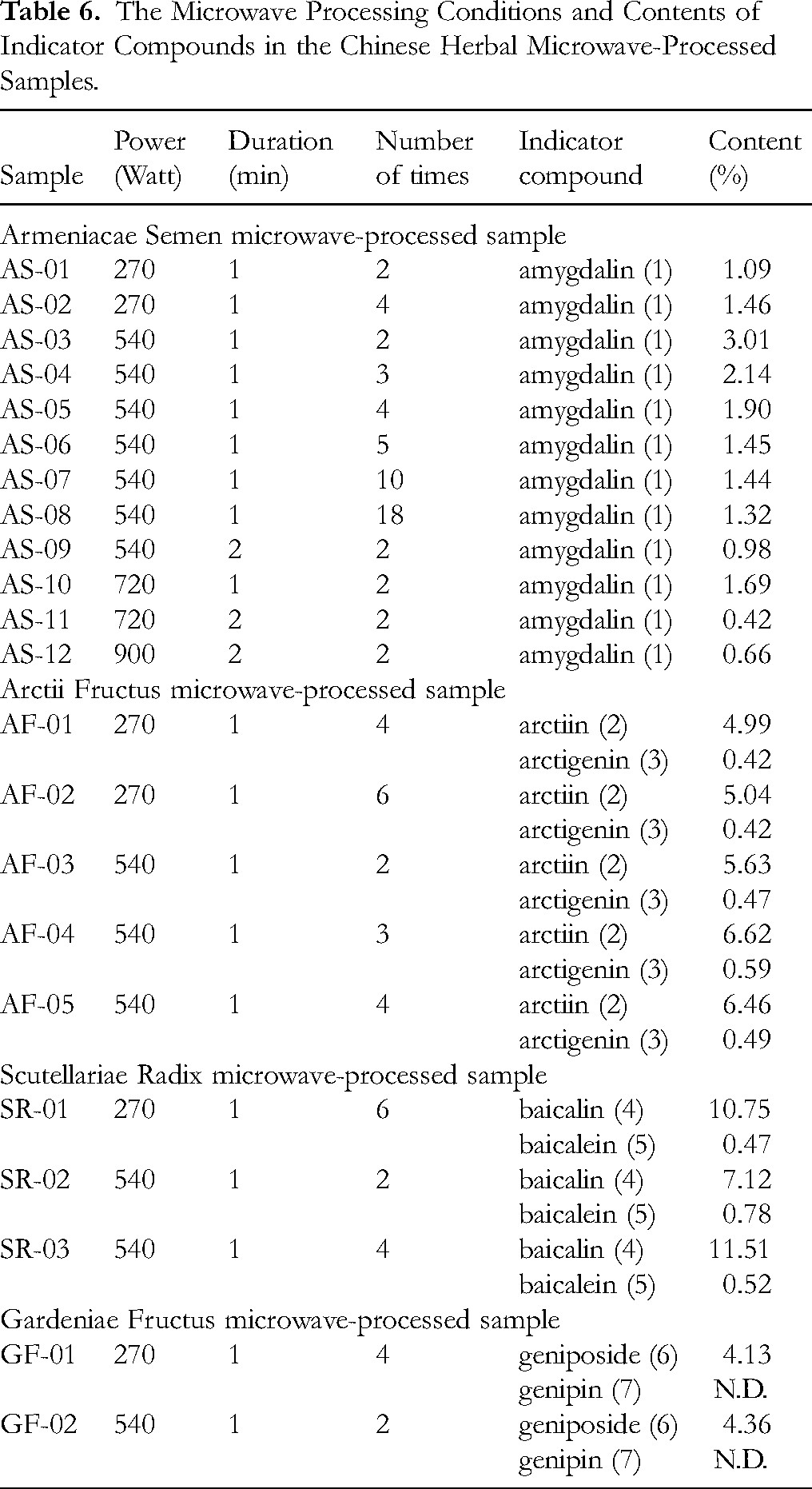
A microwave oven commonly used in-house capable of generating 900 W power was used to process the raw materials of traditional Chinese medicines. Various power (270, 540, 720, or 900 W), processed time (1 or 2 min), and repetitions were attempted to produce the processed materials. The Armeniacae Semen, Arctii Fructus, Scutellariae Radix, and Gardeniae Fructus raw materials 001-A, 002-A, 003-A, and 004-A were subjected to microwave processing to produce samples AS-01∼12, AF-01∼05, SR-01∼03, and GF-01∼02, respectively. These microwave-processed herbal materials are further evaluated by investigating the difference in chemical composition between the raw plants and processed traditional Chinese medicines using high performance liquid chromatography. The analytical targets are selected based on the concept of chemistry, manufacturing, and controls (CMC) management recorded in Pharmacopeia. Microwave conditions and corresponding analysis results by HPLC are shown in Table 6. The criteria in Taiwan Herbal Pharmacopeia 12 and the best-fit condition of microwave-processed herbs are provided in Table 7.
The Microwave Processing Conditions and Contents of Indicator Compounds in the Chinese Herbal Microwave-Processed Samples.
The Quantity of Indicator Compound in the Best-fit Sample of Microwave-Processed Herbs and Standard set in Taiwan Herbal Pharmacopeia.

The Contents of Indicator Compounds After Microwave Processing and Storage for Some Months
Furthermore, the microwave-processed samples should be preserved in good condition so that the natural bioactive compounds in the herbal materials are present in enough quantities after a period of time. Therefore, the indicator compounds in samples that have been stored for several months after microwave processing were analyzed quantitatively (see Table 8).
The Contents of Indicator Compounds in Microwave-Processed Samples Have Been Stored for a Long Time After Microwave Processing.

Anti-Inflammatory Bioactivity Examination of the Raw and Microwave Processed Scutellariae Radix Samples
To study the influence of microwave processing on the activity of medicinal materials, the raw and microwave processed Scutellariae Radix samples were extracted with methanol, and the afforded extracts were subjected to the evaluation of their potential to inhibit superoxide anion generation by human neutrophils in response to fMLF/CB. 10 The experimental data (Table 9) indicated that at the tested concentration (10 μg/mL), the microwave-processed sample displayed a higher inhibitory percentage (77.50 ± 1.19%) than that of the raw sample (62.44 ± 3.12%). The bioactivity examination data indicated that the microwave-processed sample displayed a higher inhibitory percentage than that of the raw sample for inhibiting superoxide anion generation by human neutrophils in response to fMLF/CB.
The Effects of Scutellariae Radix Crude Extracts on Superoxide Anion Generation in FMLP/CB-Induced Human Neutrophils.

Percentage of inhibition (Inh %) at 10 μg/ml. Results are presented as mean ± SEM (n = 3).
*** p < 0.001 compared with the control (DMSO).
Discussion
The quality of traditional Chinese medicines depended on the bioactive compounds present in the herb materials. Therefore, there were usually some criteria regarding the contents of bioactive or indicator compounds set in the Pharmacopoeia. 12 The microwave method was initially applied to Armeniacae Semen. The outcomes demonstrated that high microwave power levels (720 and 900 W) led to visible charring of the herbal materials. In parallel, the content of the indicator compound amygdalin (1) declined as the microwave power increased, suggesting that elevated microwave energy not only induces physical degradation of the material but also accelerates the decomposition or transformation of its key bioactive constituents. Therefore, in the subsequent microwave processing of herbal materials, we mainly focus on the research of power 270 and 540 W. At medium power, the microwave reaction was able to fully exert its enzyme-killing and glycoside-preserving effects, appropriately retaining the active ingredients. However, at microwave powers exceeding 720 W, the glycosides may decompose due to the high temperature, resulting in the loss of active ingredients. Furthermore, microwave processing data for Armeniacae Semen, Arctii Fructus, and Scutellariae Radix also showed that repeated microwave treatments at medium power produced more optimal processing results than single high-power microwave treatments. Extending the duration of a single microwave treatment (ie, longer than one minute) did not significantly improve processing efficiency.
The best-fit sample of microwave-processed Armeniacae Semen sample exhibited the contents of 1 of 30.1 mg/g, which was consistent with the standard of Taiwan Herbal Pharmacopoeia (amygdalin (1) > 3.0%), and all the microwave-processed samples could not observe the presence of benzaldehyde. The best-fit sample of microwave-processed Arctii Fructus sample exhibited the contents of 2 of 66.2 mg/g, which matched the standard of Taiwan Herbal Pharmacopoeia well (arctiin (2) > 5.0%). Although there were no standard set for the aglycone arctigenin (3), the contents of 3 were also examined in this study. However, the content of 3 in the optimized microwave-processed sample was only 5.9 mg/g, which corresponds to the insignificant hydrolytic condition of glycoside 2. For Scutellariae Radix, as observed in Taiwan Herbal Pharmacopoeia, there was only a standard set for baicalin (4) (>8.0%), the best-fit microwave-processed Scutellariae Radix sample also displayed high concentration of glycoside baicalin (4) (115.1 mg/g) and comparatively low concentration of hydrolytic aglycone baicalein (5) (5.2 mg/g), which represented the good preservation condition for the bioactive compound. The best-fit sample of microwave-processed Gardeniae Fructus sample exhibited the contents of 6 of 43.6 mg/g, which matched the standard of Taiwan Herbal Pharmacopoeia well (geniposide (6) > 1.8%). In addition, there were no genipin (7) observed in all the tested samples, corresponding to the lower enzyme concentration in the herb materials. The processing of these herbs adjusts the chemical composition of the herbal materials to enhance the bioactivity or exert a specific therapeutic effect. Based on the current HPLC analysis results, the microwave processing method developed in this study can produce products that meet the pharmacopoeia criteria.
From the perspectives of storage stability and bioactivity, we also conducted an evaluation. The processing of herbal materials can dry out the moisture in the medicinal materials, inactivate enzymes, stabilize the ingredients, and greatly improve the storage stability and shelf life of most medicinal materials. According to the analytical data, the water vaporized and retained the contents of the indicator compounds after storing for some months. As for bioactivity investigation, previous studies have demonstrated that baicalin (4) can be hydrolyzed to baicalein (5) in vivo, which exhibits more potent anti-inflammatory activity. In this study, the microwave processing effectively inactivated endogenous enzymes and preserved chemical constituents, resulting in a higher retention of the target constituents. These findings are consistent with the traditional concept that appropriate processing technologies can improve the efficacy and bioactivity of traditional Chinese medicines.
Hopefully, the work could be established as the manufacturing and quality control standard for processed traditional Chinese medicines. The microwave-processed technology efficiently saves time and energy. However, this study focuses on investigating the changes in selected indicator compounds before and after processing, rather than conducting a comprehensive chemical profiling of the entire plant matrix. Additionally, the current scope of our work offers only a limited investigation into bioactivity. In future studies, if more suitable pharmacological targets can be identified for the medicinal materials examined in this work, a more in-depth evaluation of the efficacy changes resulting from Chinese medicine processing will be possible. The efficacy of Chinese herbal medicine processing has long been a complex and intriguing topic worthy of further exploration. Our research provides a perspective on quality control strategies based on chemical constituent analysis, contributing to the ongoing development of processing science.
Conclusion
In the present study, several common traditional Chinese medicines, including Armeniacae Semen, Arctii Fructus, Scutellariae Radix, and Gardeniae Fructus were processed by microwave heating. The traditional processed protocols of these herbal medicines used a lot of water and energy, and it usually took several hours to heat, even over several days. In comparison, the microwave-processing protocols only took a few minutes. The enormous time and energy saved deserved further development in this new field. Moreover, the medicinal materials were investigated for the difference in chemical composition between the raw plants and processed traditional Chinese medicines, and the analytical results of the changes in chemical composition were evidenced to elucidate the variation of indicator compounds between the raw and processed traditional Chinese medicines.
Supplemental Material
sj-docx-1-npx-10.1177_1934578X251412701 - Supplemental material for A Feasible Method of Reducing Carbon Emission for Processing Traditional Chinese Medicine
Supplemental material, sj-docx-1-npx-10.1177_1934578X251412701 for A Feasible Method of Reducing Carbon Emission for Processing Traditional Chinese Medicine by Hao-Ze Li, Hong Nhung Phan, Chia-Hung Wu, Yi-Hung Wu, Tsong-Long Hwang, Mei-Lin Yang, Tian-Shung Wu and Ping-Chung Kuo in Natural Product Communications
Footnotes
Acknowledgments
The authors gratefully acknowledge the use of the 400 MHz Nuclear magnetic resonance spectrometer belonging to the Core Facility Center of the National Cheng Kung University.

Ethical Approval
The protocols of anti-inflammatory bioactivity examination in this study was approved by the Institutional Review Board of Chang Gung Memorial Hospital (Taoyuan, Taiwan, IRB No. 201902217A3, approved date Feb 26, 2020; IRB No. 201902217A3C601, approved date Dec 24, 2020; IRB No. 201902217A3C501, approved date Apr 21, 2022; IRB No. 201902217A3C602, approved date Oct 26, 2022; IRB No. 201902217A3C603, approved date Sep 28, 2023). Written informed consent was obtained from all participants.
Author Contribution
T.-S.W. and P.-C.K.: conceptualization and supervision; H.-Z.L., H.N.P., Z.-H.J., C.-H.W., and M.-L.Y.: investigation and data curation; Y.-H.W., T.-L.H.: methodology, T.-S.W., H.-Z.L., H.N.P., and P.-C.K.: writing—original draft preparation; H.-Z.L., P.-C.K.: writing—editing. All authors have read and agreed to the published version of the manuscript.
Funding
The authors are grateful for financial support from the National Science and Technology Council (NSTC), Taiwan awarded to T.-S. Wu and P.-C. Kuo. Authors also wish to thank Kaiser Pharmaceutical Co. Ltd, Tainan, Taiwan, for the partial financial support of the present research.
National Science and Technology Council, Kaiser Pharmaceutical Co. Ltd., Tainan, Taiwan, (grant number NSTC).
Declaration of Conflicting Interests
The authors declared no potential conflicts of interest with respect to the research, authorship, and/or publication of this article.
Supplemental Material
Supplemental material for this article is available online.
References
Supplementary Material
Please find the following supplemental material available below.
For Open Access articles published under a Creative Commons License, all supplemental material carries the same license as the article it is associated with.
For non-Open Access articles published, all supplemental material carries a non-exclusive license, and permission requests for re-use of supplemental material or any part of supplemental material shall be sent directly to the copyright owner as specified in the copyright notice associated with the article.
