



Abstract
Leaves from Flabellaria paniculata Cav (Malpighiaceae) are used in traditional medicine for wound dressing, and to treat ulcers and inflammation in Nigeria. The present study evaluates the gastroprotective activity of the ethyl acetate fraction of the methanolic leaf extract and reports on the chemical constituents from the fraction. The methanolic crude extract and solvent fractions (100 mg/kg, PO) were screened using an ethanol-induced ulcer model. The activity of the most active EtOAc fraction (25, 50, and 100 mg/kg, PO) was further evaluated in indomethacin and pylorus ligation-induced ulcer models. The EtOAc fraction was chromatographed and chemical structures of the isolated compounds were elucidated by nuclear magnetic resonance spectroscopy. The MeOH extract of F. paniculata and EtOAc fraction from this extract displayed significant gastroprotective effects. Two triterpenoids (friedelin and friedelinol), two steroids (sitosterol and sitosterol-β-d-glucoside), and a flavonoid glycoside (kaempferol-3-O-α-l-rhamnopyranosyl-(1→6)-β-d-glucopyranoside) were identified from the EtOAc fraction. This is the first report on the isolation of these compounds from the plant. The identified compounds could be responsible in part for the observed gastroprotective effect of the EtOAc fraction.
Flabellaria paniculata Cav. (Malpighiaceae) is used in Nigerian traditional medicine as a remedy for skin infections, wound dressing, and treatment of ulcers and conditions associated with pain and swelling. 1,2 Previous reports demonstrated the wound-healing, antibacterial, and antioxidant properties of the plant. 3,4 The subchronic toxicity study of the leaf extract has also been reported. 5 In our earlier investigation, the antiulcer activity and acute toxicity of the leaves and root of the plant were described. 6 The study revealed that the leaves demonstrated significantly higher antiulcer activity than the root. The indication of significant antiulcer properties of the leaves with little or no phytochemical reports prompted the present research. The present study evaluates the gastroprotective property of the ethyl acetate (EtOAc) fraction of the leaves and reports on the isolation and identification of compounds from the fraction.
The crude extract and hexane (Hex), dichloromethane (DCM), EtOAc, and aqueous (Aq) fractions (fr) from the leaves of F. paniculata at the dose of 100 mg/kg were screened using an ethanol-induced ulcer model. The gastroprotective activity of the methanol extract was high (71.4%) and comparable to that of misoprostol (76.2%) (Table 1). The solvent fractions reduced the level of ulcer to a varying degree; the order of activity was EtOAc >Aq > DCM >Hex. The ethanol-induced gastric ulcer model is extensively used for the assessment of gastroprotective activity. Ethanol rapidly penetrates the gastric mucosa causing membrane damage, exfoliation of cells, and erosion. 7 The inhibition of ethanol-induced ulcers is produced through the actions of agents that enhance mucosal defensive factors, such as prostaglandins. 8 The results indicated that the methanol extract is more active than the fractions obtained from it, effectively prevented ethanol-induced acute gastric mucosal injury in rats thereby showing a cytoprotective effect, and that its constituents could perhaps have a synergistic effect. Of the different fractions, the EtOAc fraction performed the best. Further experiments were, therefore, carried out on the EtOAc fraction at various doses (25-100 mg/kg).
Effect of Extract and Fractions (Fr.) from Flabellaria paniculata Leaves on Ethanol-Induced Ulcer Model in Rats.

DCM, dichloromethane; SEM, standard error of the mean; EtOAc, ethyl acetate; Aq, aqueous.
Values are expressed as mean ± SEM (n = 5). *P < 0.05, **P < 0.01 are different, when compared to the control group. (One-way analysis of variance followed by Dunnett’s test.)
The gastric ulcer production by indomethacin occurs since this compound inhibits the synthesis of cytoprotective prostaglandins, synthesized by cyclooxygenase 1 and cyclooxygenase 2 in stomach tissue, which in turn inhibits the release of mucus, a defensive factor against gastrointestinal damage. 9,10 The EtOAc fraction demonstrated significant protection of the gastric mucosa against damage caused by indomethacin compared to the control (Figure 1). The mean ulcer index of the control group was 4.0 ± 0.5, while that of the EtOAc fr-treated groups at 50 and 100 mg/kg were 2.3 ± 0.4 and 1.0 ± 0.2, which corresponded to 42.5% and 75.0% inhibition, respectively. The results suggest possible involvement of endogenous prostaglandins in the gastroprotective effect of the EtOAc fr.
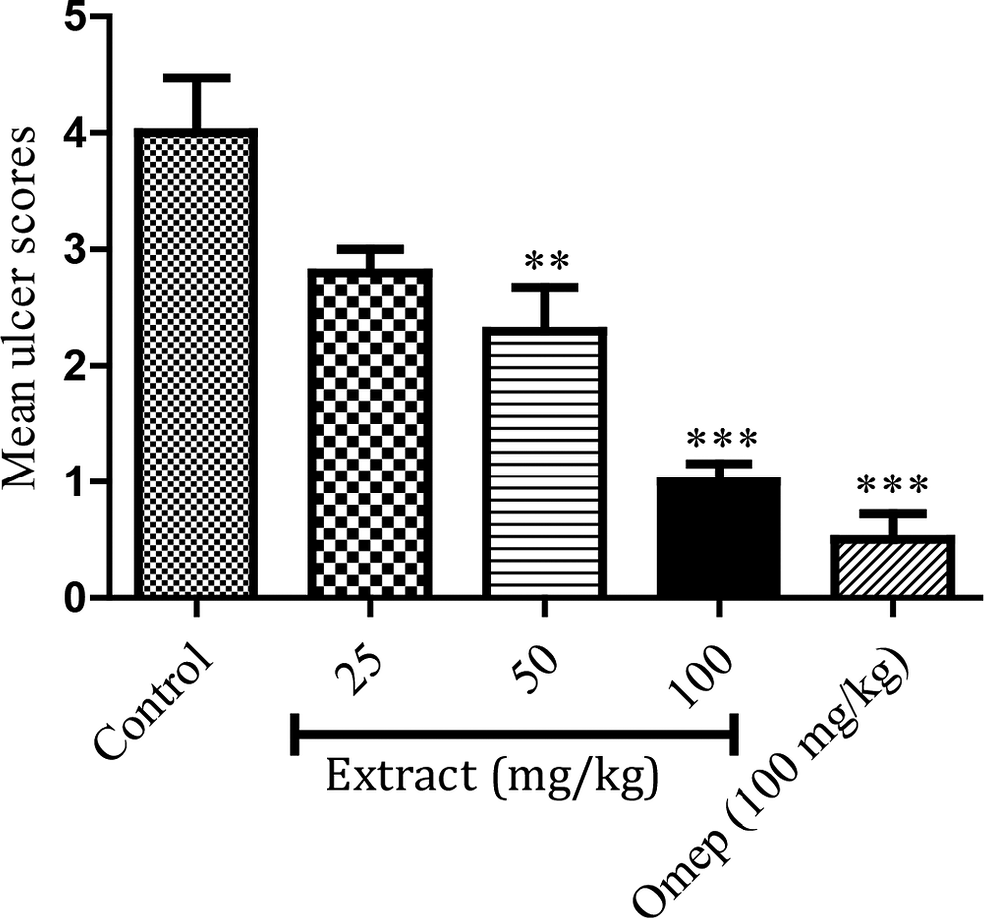
Effect of ethyl acetate fraction of Flabellaria paniculata on indomethacin-induced gastric lesion in rats (n = 5). **P < 0.01, ***P < 0.001 significantly different, when compared to the control group. Omep: omeprazole.
Pylorus ligation is an important procedure that shows possible changes of parameters for gastric content, such as volume of gastric juice, total acidity, and pH. 11 Formation of pylorus ligated ulcers results from the collection of gastric acid, which leads to autodigestion of gastric mucosa and consequently gastric lesions. 12 The EtOAc fr produced a dose-dependent inhibition of ulcers. At the dose of 100 mg/kg, the fraction showed an ulcer protection effect of 65.9%, accompanied by a significant reduction in gastric acid level (Table 2). No significant difference was recorded in the gastric pH and volume of gastric juice compared to the control. Cimetidine (100 mg/kg), on the other hand, produced a significant inhibition of lesion formation (72.7%), accompanied by a significant increase in gastric pH and reduction in gastric acid level. The results showed that the EtOAc fr exerted gastroprotective activity in the pyloric ligation test, which could be mediated through an antisecretory mechanism. No mortality and significant behavioral changes of the animals were observed post-acute oral administration of the EtOAc fr, suggesting the extract could be relatively safe.
Effect of the EtOAc Fr. of Flabellaria paniculata on Pylorus Ligation-Induced Gastric Ulcers in Rats.

EtOAc fr., ethyl acetate fraction.
Values are expressed as mean ± standard error of the mean (n = 5). *P < 0.05, **P < 0.01 are different, when compared to the control group. (One-way analysis of variance followed by Dunnett’s test.)
The chromatographic purification of the EtOAc fraction yielded 5 known compounds friedelin
The ability of sitosterol and sitosterol glucoside to inhibit ulcer has been reported. 20,21 Friedelin and friedelinol have been reported inactive as gastroprotective compounds when tested on an indomethacin-induced ulcer model in rats. 22 However, a recent report showed that friedelin contained significant gastroprotective effects in an ethanol-induced gastric ulcer. 23 There is no report on the gastroprotective effect of Kaempferol-3-O-α-l-rhamnopyranosyl(1→6)-β-d-glucopyranoside. Due to the small quantity of sample isolated, we could also not test for activity.
In summary, the results of the present study indicated that the EtOAc fr. of the leaf extract of F. paniculata displayed gastroprotective effects against gastric ulcers in rats, probably mediated via cytoprotective and antisecretory mechanisms. In addition, the presence of secondary metabolites and, in particular, the chemical compounds isolated from the plant may contribute at least in part to the observed gastroprotective effect.
Experimental
General
NMR spectra were recorded at room temperature on a 400 MHz Bruker Avance III spectrometer using tetramethylsilane as an internal standard. Mass spectrometry was carried out using a Shimadzu gas chromatograph mass spectrometer and a matrix-assisted laser desorption ionization time-of-flight mass spectrometry (positive mode) Auto flex III Smart Beam instrument (Bruker, Germany).
Plant Material
Flabellaria paniculata leaves were collected from Ilaro, Egbado in Ogun State (7°09′N 2°55′E), Nigeria. Taxonomic identification was done by Mr T.K. Odewo and a voucher specimen (LUH 2778) was deposited in the herbarium of the Department of Botany, University of Lagos.
Extraction and Fractionation
Powdered leaves of F. paniculata (1 kg) were exhaustively extracted with 100% methanol (7.5 L) for 48 hours, yielding 110 g crude methanolic extract (11%). A 70 g sample was redissolved in an equal volume of methanol and water and partitioned successively with Hex, DCM, and EtOAc. Each fr. was concentrated to yield 4.8 g (6.9% Hex fr.), 12.0 g (17.1%DCM fr.), 5.9 g (8.4%EtOAc fr.), and 20 g (28.6%Aq fr.).
Isolation and Purification of Compounds From the Active EtOAc Fraction
The EtOAc fr. (5 g) was fractioned by column chromatography using a step gradient of Hex, EtOAc, and CH3OH, starting with 100% hex. Twenty fractions of 50 mL each were collected for each step and combined according to their thin-layer chromatography profiles, into 12 major fr. (1-12). Fr. 8 and 9 eluted with Hex-EtOAc (97:3) and washed with hex to yield
Animals
Male Wistar rats (110-130 g) were housed in standard cages at room temperature in the Animal House of the College of Medicine, University of Lagos, Nigeria. They were provided with food and water ad libitum. The Organization for Economic and Co-operation and Development guidelines for animal welfare was employed. 24 The research protocol was approved by the Institutional Ethical Committee of the College of Medicine of the University of Lagos, Lagos, Nigeria (CM/COM/08/VOL.XXV).
Acute Toxicity Study
Acute toxicity of the EtOAc fr. (2.0 g/kg, PO) was conducted using the guidelines of OECD. 24
Evaluation of Gastroprotective Activity
Ethanol-Induced Ulcer Model
The crude extract and fractions of F. paniculata dissolved in 3% Tween 20 were orally administered to fasted male Wistar rats at the dose of 100 mg/kg, considering our previously published data. 4 One hour later, each rat received 1 mL of absolute ethanol to induce gastric lesions. 25 The animals were sacrificed by cervical dislocation 1 hour after treatment with the ulcerogenic agent. The stomachs were then excised and cut along the greater curvature, washed carefully with normal saline, and the ulcer scored as reported by Galati et al. 26
Indomethacin-Induced Ulcer Model
The model was done on the EtOAc fr. Lower doses were used in addition to 100 mg/kg in order to test the dose dependency effect of the EtOAc fr. Male Wistar rats (n = 6) were orally treated with the vehicle (3% Tween 20, 10 mL/kg), omeprazole (100 mg/kg), or EtOAc fr. (25-100 mg/kg). One hour after treatment, gastric lesions were induced using indomethacin (60 mg/kg, PO). 27 The animals were sacrificed by cervical dislocation 4 hours after indomethacin administration. The stomachs were removed, opened along the greater curvature, washed carefully with normal saline, and the ulcer scored.
Pylorus Ligation-Induced Model
Male Wistar rats were deprived of food, but not water, for 48 hours before the experiment. On the day of the experiment, cimetidine and the EtOAc fr. (25-100 mg/kg) were administered orally 1 hour prior to pyloric ligation. Animals were then anesthetized using urethane (5 mL/kg, IP) and the abdomen opened by a small midline incision below the xiphoid process. The pyloric portion of the stomach was slightly lifted out, and ligated avoiding traction to the pylorus or damage to its blood supply. The stomach was replaced carefully, and the abdominal wall closed by interrupted sutures. The animals were deprived of both food and water during the postoperative period and were sacrificed 4 hours after the operation. 28 The stomach was dissected out, the contents drained into a tube, centrifuged, and analyzed for pH and total acidity. The stomach was then cut open along the greater curvature and examined for any ulceration.
Statistical Analysis
Results were expressed as the mean ± standard error of the mean. Data were analyzed statistically with Graph Pad Prism version 5.0 for Windows (GraphPad, San Diego, CA, USA) using one-way analysis of variance followed by Tukey’s multiple comparison test. The degree of significance was set at P <0.05.
Supplemental Material
Supplementary material - Supplemental material for Gastroprotective Effect and Chemical Constituents of Flabellaria paniculata (Malpighiaceae)
Supplemental material, Supplementary material, for Gastroprotective Effect and Chemical Constituents of Flabellaria paniculata (Malpighiaceae) by Margaret O. Sofidiya, Elizabeth Taiwo, Victoria Awolola, James Habila, and Neil A. Koorbanally in Natural Product Communications
Footnotes
Acknowledgments
Mr J. Olowe, Department of Physiology, University of Lagos, is acknowledged.
Declaration of Conflicting Interests
The author(s) declared no potential conflicts of interest with respect to the research, authorship, and/or publication of this article.
Funding
The author(s) disclosed receipt of the following financial support for the research, authorship, and/or publication of this article: NK is supported by the National Research Foundation South Africa for a Competitive Grant for Rated Researchers (Grant No. 118534) and Incentive Funding for Rated Researchers (Grant No. 114817).
References
Supplementary Material
Please find the following supplemental material available below.
For Open Access articles published under a Creative Commons License, all supplemental material carries the same license as the article it is associated with.
For non-Open Access articles published, all supplemental material carries a non-exclusive license, and permission requests for re-use of supplemental material or any part of supplemental material shall be sent directly to the copyright owner as specified in the copyright notice associated with the article.
