



Abstract
A new chlorinated polyketide setosphaerine A (
Insect entomogenous fungi have proved to be a rich and important source of secondary metabolites with a variety of chemical structures and biological activities.
1
-4
They are an ecologically specialized group of micro-organisms,
5,6
which, during the long-time co-evolution with their hosts, have had more chances to acquire unique traits in their physiology and metabolite pathways.
7,8
In our continuing search for more natural-product-derived bioactive metabolites, we have investigated a cytotoxic MeOH extract of a rice culture of Setosphaeria rostrata, an entomogenous fungus isolated from the tissue of Harmonia axyridis. Fractionation of this extract led to the isolation of a new chlorinated polyketide setosphaerine A (
The molecular formula of setosphaerine A (
13C NMR (150 MHz) and 1H NMR (600 MHz) Data of Compound 1.
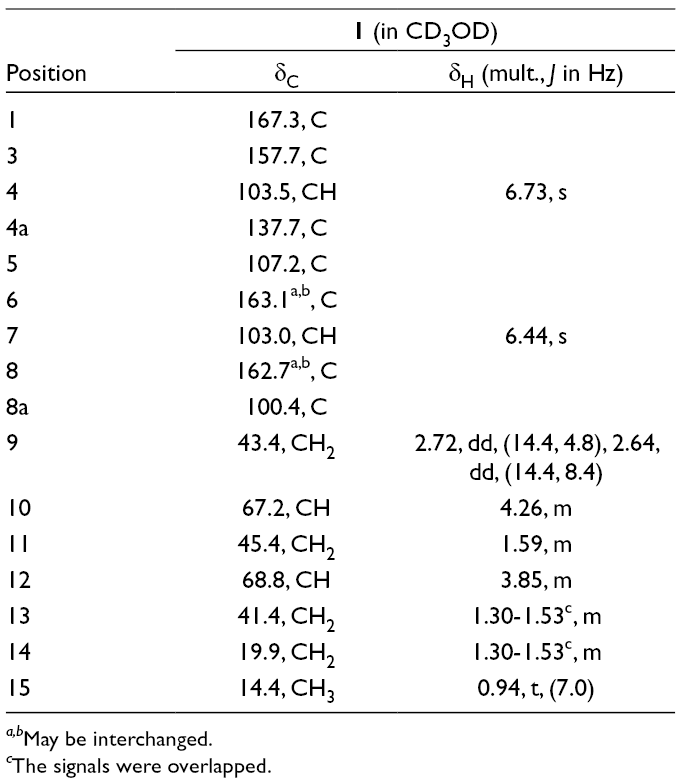
a,b May be interchanged.
c The signals were overlapped.

Key Heteronuclear Multiple Bond Correlation (HMBC) (arrows) and COSY (bold) correlations for compound 1.

Chemical structures of compounds 1 to
Compounds
All isolated compounds were evaluated for their cytotoxic activities against 3 human tumor cell lines MCF-7, MGC-803, and Hela using the MTT Assay method; paclitaxel was selected as the positive control. The results (Table 2) revealed that compounds
Cytotoxic Activities of Compounds 1 to

Experimental
General
Optical rotations, Perkin-Elmer 341 spectropolarimeter; IR, Perkin-Elmer 577 instrument; UV, UV-210 spectrometer; NMR, Bruker AM-600 spectrometer; HR-MS, Bruker apex-ultra 7.0T spectrometer; column chromatography (CC), silica gel (SiO2; 200-300 mesh; Sephadex LH-20 gel (25-100 μm); and Thin Layer Chromatography, silica gel GF254 plates.
Fungal Material and Fermentation
The strain LGWB-10 was isolated from H. axyridis collected in Baoding, Hebei Province of China. The voucher specimen of the fungus is deposited at Key Laboratory of Medicinal Chemistry and Molecular Diagnosis of the Ministry of Education, College of Life Science of Hebei University. Setosphaeria rostrata was cultured on a culture dish of potato dextrose agar (PDA; 20.0 g glucose, 18.0 g agar, 200.0 g potato in 1 L of distilled H2O) at 28°C for 6 days, and then inoculated into a 500 mL Erlenmeyer flask containing 200 mL of Potato D-glucose medium (20.0 g glucose, 200.0 g potato in 1 L of distilled H2O). Flask cultures were incubated at 25°C on a rotary shaker at 120 rpm/min for 4 days. Fermentation was carried out in 100 Erlenmeyer flasks (500 mL), each containing 80 g of rice (grains)/100 mL of distilled H2O; 5 mL of culture liquid was transferred as seed into each flask and incubated at 25°C for 40 days.
Extraction and Isolation
The fermented material was extracted 3 times with methanol (20 L for each time), and the methanol extract was concentrated in vacuo to yield a yellow oily residue (125.0 g). This was subjected to silica gel CC and eluted with a gradient of PE/EtOAc (100:0, 90:10, 80:20, 60:40, 50:50, 40:60, 20:80, 10:90, and 0:100 (v/v)) to obtain nine fractions Frs. 1-9. Fr. 6 (1.6 g) was repeatedly purified by CC and Sephadex LH-20 (MeOH) to afford compounds
Compound 1
White powder
UV (MeOH) λ max (log ε): 245 (4.90).
IR (KBr) v max: 3423, 2954, 2915, 2848, 1735, 1465, 1032, 1018, 853 cm−1.
1H- and 13C- NMR: Table 1.
HR-ESI-MS: m/z 341.0794 [M+H]+ (calcd for C16H18O6Cl, 341.0797).
Cytotoxicity Assay
The cells were cultured in Roswell Park Memorial Institute (RPMI1640, Hyclone, Logan, UT, United States, MCF-7) and Dulbecco’s modified Eagle’s medium (DMEM, Hyclone, Logan, UT, United States, MGC-803, Hela) supplemented with 10% fetal bovine serum (FBS, Hyclone, Logan, UT, United States) at 37°C under an atmosphere of 5% CO2, and were seeded on each well of 96-well plates containing 100 µL of tumor cells suspension (5 × 10⁴ cells/mL). After 48 hours, the test compounds from Dimethyl Sulfoxide (DMSO) (Sigma, St. Louis, MO, United States) dissolved stock solution (2 µL [2 mg/mL]) was added to each well with final concentrations of 40, 20, 10, 5, and 2.5 µg/mL , and incubated for another 24 hours. Twenty microliters of MTT solution (1 mg/mL, Beijing Cellchip Biotechnology Co., Ltd) was added to each well, and the plate was incubated for 4 hours under the same conditions. Then, the plate was centrifuged, and the supernatants were removed and cells dissolved in 100 µL of DMSO to determine the IC50 values. The absorbance in control and drug-treated wells was measured in a Microplate Reader (Thermo Scientific, United States) at 570 nm (emission) wavelength. All experiments were carried out in triplicate and repeated twice. The cytotoxicity was expressed as IC50 values (50% inhibitory concentration).
Supplemental Material
Supporting information - Supplemental material for Setosphaerine A: A New Chlorinated Polyketide Isolated From the Entomogenous Fungus Setosphaeria rostrata
Supplemental material, Supporting information, for Setosphaerine A: A New Chlorinated Polyketide Isolated From the Entomogenous Fungus Setosphaeria rostrata by Wen-Bin Gao, Sha-Sha Liu, Ying-Chao Tian, Qian Dong, Jun Zhang, Jian-Chun Qin, and Du-Qiang Luo in Natural Product Communications
Footnotes
Declaration of Conflicting Interests
The author(s) declared no potential conflicts of interest with respect to the research, authorship, and/or publication of this article.
Funding
The author(s) disclosed receipt of the following financial support for the research, authorship, and/or publication of this article: This work was funded by the National Key Research and Development Program of China (2017YFD0201400 and 2017YFD0201401), National Natural Science Foundation of China (31672070), Changjiang Scholars and Innovative Research Team in University (IRT_15R16), the High-Level Talents Programs of Hebei Province (GCC2014034), and the National Major Increase or Decrease Project-Construction of the sustainable utilization capacity of famous traditional Chinese medicine resources (2060302).
References
Supplementary Material
Please find the following supplemental material available below.
For Open Access articles published under a Creative Commons License, all supplemental material carries the same license as the article it is associated with.
For non-Open Access articles published, all supplemental material carries a non-exclusive license, and permission requests for re-use of supplemental material or any part of supplemental material shall be sent directly to the copyright owner as specified in the copyright notice associated with the article.
