From the dried fruiting bodies of Ganoderma lucidum, 2 new unsaturated lactones, dayaolingzhilactones A and B (1 and 2), and 1 new meroterpenoid, dayaolingzhiol H (3), together with 10 known compounds (4-13), were isolated. Their chemical structures were identified by using spectroscopic data and calculated specific rotation. The inhibitory activities of compounds 1 and 2 toward acetylcholinesterase (AchE) were assessed in vitro with tacrine as the positive control. Both of them exhibited moderate AchE inhibitory activities at the concentration of 50 μM.
Ganoderma lucidum (Ganodermataceae), a fungus registered in the Pharmacopoeia of China and American Herbal Pharmacopoeia and Therapeutic Compendium, has been used in China for thousands of years for promoting health, longevity and spiritual growth.1 Currently, it is widely used for the treatment of bronchitis, allergies, hepatitis, hypertension, immunological disorders, neurasthenia, and diabetes.2,3 Previous chemical studies revealed that polysaccharides and triterpenoids are the 2 main pharmacologically active constituents in G. lucidum.4 In addition, a few other structural types of compounds have also been reported sporadically such as alkaloids, steroids, lactones, and fatty acids.4 As part of our chemical studies on Ganoderma genus, the title material was investigated, resulting in the isolation of 2 new unsaturated lactones (1 and 2), a new meroterpenoid (3), along with 10 known compounds (4-13) (Figure 1). Besides, the inhibitory activities of compounds 1 and 2 toward acetylcholinesterase (AchE) were assessed. Our efforts are described below.
Chemical structures of compounds 1 to 13.
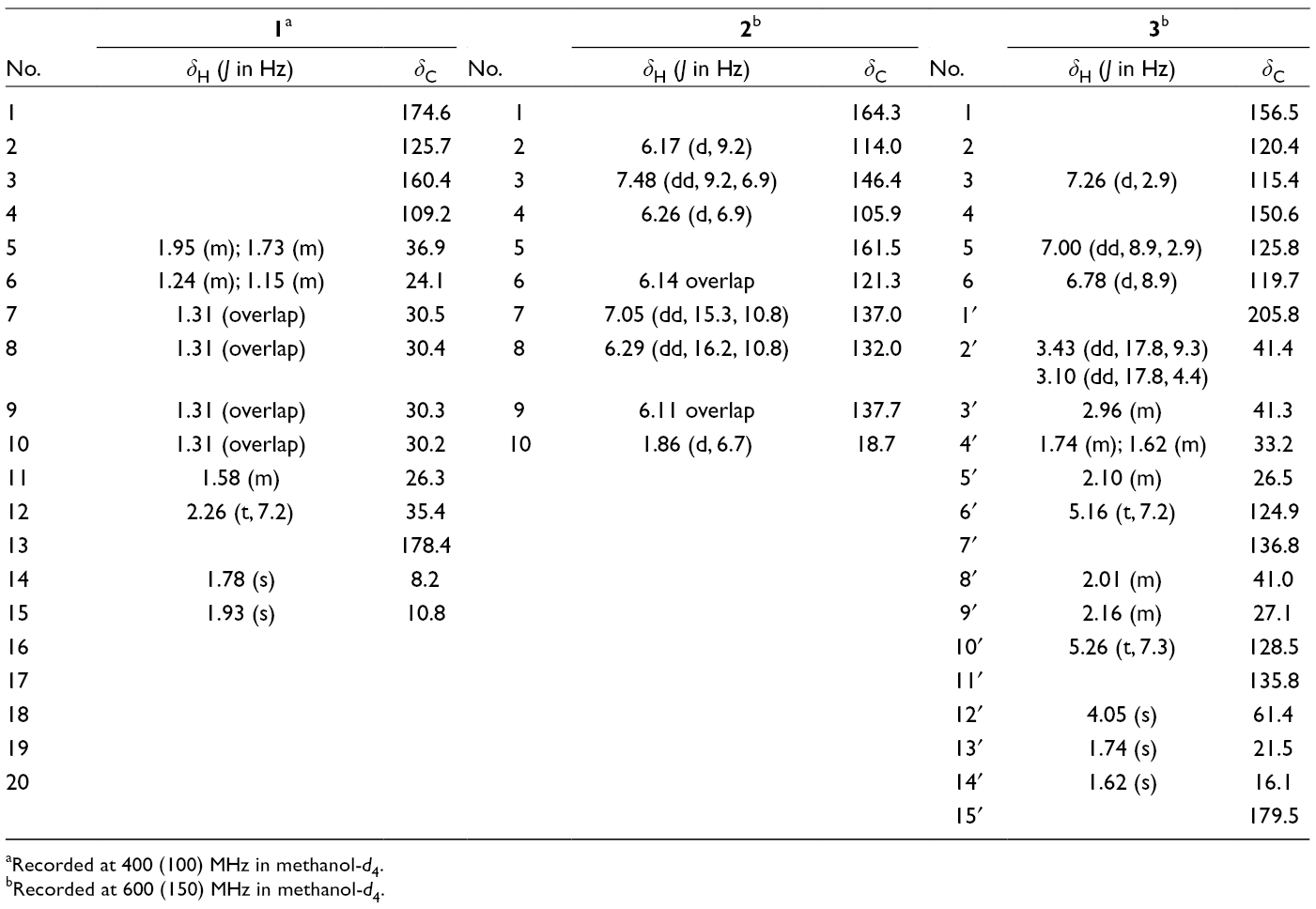
Compound 1, a colorless oil, has the molecular formula C15H24O5 based on the analysis of its HRESIMS m/z 283.1551 [M−H]–, 13C NMR, and DEPT spectra, with 4 degrees of unsaturation. The 1H NMR data (Table 1) of 1 show 2 methyls [δH 1.93 (3H, s, CH3-15); 1.78 (3H, s, CH3-14)]. The 13C NMR and DEPT spectra display 15 carbons including 2 methyls, 8 methylenes, and 5 nonprotonated carbons (1 ester carbonyl, 1 carboxylic acid, 2 sp2 carbons, and 1 oxygenated sp3 carbon). The architecture of 1 was constructed by 2D NMR experiments. Interpretation of 1D and 2D NMR data discloses that the structure of compound 1 resembles that of 5-hydroxy-3,4-dimethyl-5-pentyl-2(5H)-furanone (4)5 but differs in the structure of the side chain. The 1H-1H COSY (Figure 2) correlations of H2-5/H2-6/H2-7 and H2-10/H2-11/H2-12, together with the HMBC correlations of H2-6/C-8, H2-11/C-9, and H2-11, H2-12/C-13 (δC 178.4), suggest the length of the side chain, and the additional carboxylic acid group is at the terminal of the chain. In addition, HMBC correlations of H3-14/C-2, C-3, H3-15/C-2, C-3, C-4, and H2-5/C-4 secured the presence of an unsaturated 5-membered lactone. Thus, the planar structure of 1 has been deduced. Finally, there is 1 chiral center in the structure of 1; its absolute configuration at C-4 in 1 was identified as 4R by comparing its specific rotation { –11.8 (c 0.17, MeOH)} with the reported { +5.4 (c 0.18, MeOH)} for 4S of sinularone I.6,7 This conclusion was further supported by the calculated optical values of model compounds (–54.0 for 4R, +54.0 for 4S) at B3LYP/6-311G(d,p) level in MeOH (see Supplementary Material 1, Table S1). Thus, the structure of 1, named dayaolingzhilactone A, was identified.
1H and 13C NMR Data of 1 to 3 (δ in ppm, J in Hz).
Compound 2 possesses a molecular formula of C10H10O2 based on its HRESIMS, 13C NMR, and DEPT data, with 6 degrees of unsaturation. The 1H NMR spectrum of 2 (Table 1) shows signals assignable to 1 methyl [δH 1.86 (3H, d, J = 6.7 Hz, CH3-10)] and 7 olefinic/aromatic protons [δH 7.48 (1H, dd, J = 9.2, 6.9 Hz, H-3), 7.05 (1H, dd, J = 15.3, 10.8 Hz, H-7), 6.29 (1H, dd, J = 16.2, 10.8 Hz, H-8), 6.26 (1H, d, J = 6.9 Hz, H-4), 6.17 (1H, d, J = 9.2 Hz, H-2), 6.14 (1H, overlap, H-6), 6.11 (1H, overlap, H-9)]. The 13C NMR and DEPT spectra display 10 carbons which are classified into 1 methyl, 7 sp2 methines, and 2 nonprotonated carbons (1 ester carbonyl and 1 oxygenated sp2 carbon), accounting for 5 degrees of unsaturation. The 1H-1H COSY (Figure 2) gives the correlations of H-2/H-3/H-4 and H-6/H-7/H-8/H-9/H3-10. The remaining 1 degree of unsaturation could be attributed to the presence of a ring formed by the oxygen bridge between C-1 (δC 164.3) and C-5 (δC 161.5), which was further certified by the HMBC correlations of H-2, H-3/C-1 and H-4, H-6/C-5. The couple constants of J6,7 value (15.3 Hz) and J8,9 value (16.2 Hz) suggest the configurations of the double bonds Δ6(7) and Δ8(9) are both of trans-orientation. Thus, the structure of 2 was determined (Figure 1).
The molecular formula of compound 3 was determined to be C21H28O6 (8 degrees of unsaturation) based on its HRESIMS, 13C NMR, and DEPT data. The 1H NMR spectrum of 3 (Table 1) contains resonances for a typical ABX aromatic spin system [δH 7.26 (1H, d, J = 2.9 Hz, H-3), 7.00 (1H, dd, J = 8.9, 2.9 Hz, H-5), 6.78 (1H, d, J = 8.9 Hz, H-6)] and 2 olefinic protons [δH 5.26 (1H, t, J = 7.3 Hz, H-10′), 5.16 (1H, t, J = 7.2 Hz, H-6′)], suggesting the presence of a 1,2,4-trisubstituted aromatic ring and 2 double bonds in 3. The 13C NMR and DEPT spectra contain 21 carbons, attributed to 2 methyls, 6 methylenes (including 1 oxygenated), 6 methines, and 7 nonprotonated carbons (1 ketone carbonyl, 1 ester carbonyl, 2 sp2 carbons, and 3 aliphatic carbons including 2 oxygenated). The 1H-1H COSY correlations of H2-2′/H-3′/H2-4′/H2-5′/H-6′ and H2-8′/H2-9′/H-10′, together with the HMBC correlations of H2-12′, H3-13′/C-10′, C-11′, H3-14′/C-6′, C-7′, C-8′, H-3′/C-1′ (δC 205.8), and H2-2′, H2-4′/C-15′ (δC 179.7), reveal the structure of the side chain from C-1′ to C-15′ in 3 as shown (Figure 1), and the HMBC correlations of H2-2′/C-2 and H-3/C-1′ suggest the side chain is attached to C-2. For the geometry of the double bonds, the ROESY correlations of H-6′/H2-8′ and H-10′/H3-13′ indicate that the configurations of the Δ6′(7′)and Δ10′(11′)double bonds are both E-form. Thus, the planar structure of 3 was deduced. Compound 3 was proved to be optically pure by chiral HPLC analysis, and its absolute configuration was determined as 3′R by comparing its optical rotation (OR) { +17.2 (c 0.06, MeOH)} with { +10.5 (c 0.07, MeOH)} of applanatumol S.6,7
The known compounds were identified by comparing their spectroscopic data with the literature data. They are 5-hydroxy-3,4-dimethyl-5-pentyl-2(5H)-furanone (4),5 4-methoxy-6-styryl-2H-pyran-2-one (5),8 ganoleucoin E (6),9 ganoderal A (7),10 ganoderol A (8),11 ganoderic acid S (9),11 ganoderic acid Y (10),11 ganoderol B (11),11 lumichrome (12),12 and cinnamic acid (13).13
In this study, only the new compounds with the exception of 3 were evaluated for their inhibitory property toward AchE. It was found that both of them (50 µM) exhibit moderate inhibitory activities with the inhibition rate of 49.69% ± 0.63% and 35.45% ± 3.37%, respectively (tacrine as a positive control with the inhibition rate of 60.68% ± 2.85% at the concentration of 0.33 µM).
Experimental
General
ORs were recorded on a Jasco P-1020 digital polarimeter. UV spectra were measured on a Shimadzu UV2401PC spectrometer. CD spectra were measured on an Applied Photophysics Chirascan instrument. NMR spectra were measured on a Bruker AV 400, or 600 MHz spectrometer, with TMS as an internal standard. ESIMS and HRESIMS were measured on an Agilent 1290 UPLC/6540 Q-TOF instrument. RP-18 (40-60 µm, Daiso Co., Japan), MCI gel CHP 20P (75-150 µm, Tokyo, Japan), silica gel GF254 (80-100 mesh, Qingdao Marine Chemical Inc., China), and Sephadex LH-20 (Amersham Biosciences, Sweden) were used for column chromatography. Semipreparative HPLC was carried out using an Agilent 1200 liquid chromatograph (Agilent Technologies, Santa Clara, CA, USA). The columns used were YMC-Pack ODS-A (250 mm × 10 mm, i.d., 5 µm) and Daicel Chiralpak IC (250 mm × 10 mm, i.d., 5 µm).
Fungal Material
The fruiting bodies of G. lucidum were collected from Dayao County of Yunnan Province, China, in December 2015. The material was identified by Prof Zhu-Liang Yang at Kunming Institute of Botany, Chinese Academy of Sciences, and a voucher specimen (CHYX0596) has been deposited at the School of Pharmaceutical Sciences, Shenzhen University, since November 2017.
Extraction and Isolation
The dried material (4.0 kg) was soaked with 80% EtOH (20 L × 3 × 24 hours) to give a crude extract, which was extracted with EtOAc to afford an EtOAc-soluble extract (0.12 kg). The EtOAc extract was divided into 10 parts (Fr.1-Fr.10) by using an MCI gel CHP 20P column chromatography eluted with aqueous MeOH (40%-100%). Fr.5 (5.1 g) was passed through Sephadex LH-20 (MeOH) to yield 4 fractions (Fr.5.1-Fr.5.4). Fr.5.2 (0.4 g) was further separated by preparative HPLC (MeOH/H2O, 60%) followed by semipreparative HPLC (ACN/H2O, 40%) to give 6 (1.3 mg, tR = 11.1 minutes, 3 mL/min). Fr.6 (3.7 g) was filtered by Sephadex LH-20 (MeOH) to give Fr.6.1 to Fr.6.6. Fr.6.3 (30.0 mg) was purified by semipreparative HPLC (ACN/H2O, 48%) to yield 2 (1.3 mg, tR = 14.3 minutes, 3 mL/min). Fr.6.4 (0.1 g) was first separated by preparative HPLC (MeOH/H2O, 60%) and then purified by semipreparative HPLC (ACN/H2O, 41%) to obtain 3 (2.6 mg, tR = 23.7 minutes, 3 mL/min). Fr.6.5 (80.0 mg) was also first separated by preparative HPLC (MeOH/H2O, 60%) to provide Fr.6.5.1 to Fr.6.5.7. Fr.6.5.2 (11.0 mg), Fr.6.5.4 (12.0 mg), and Fr.6.5.6 (8.0 mg) were further purified by semipreparative HPLC (ACN/H2O, 45%, 42%, and 41%) to provide compounds 13 (8.8 mg, tR = 19.2 minutes, 3 mL/min), 1 (2.5 mg, tR = 9.7 minutes, 3 mL/min), and 4 (3.2 mg, tR = 24.0 minutes, 3 mL/min), respectively. Fr.6.6 was submitted to semipreparative HPLC (MeOH/H2O, 59%) to yield 12 (2.3 mg, tR = 13.1 minutes, 3 mL/min). Fr.9 (36.0 g) was fractionated by Sephadex LH-20 (MeOH) to give Fr.9.1 to Fr.9.6. Fr.9.1 (50.0 mg) was then purified by Sephadex LH-20 (MeOH) followed by semipreparative HPLC (ACN/H2O, 61%) to afford 5 (1.5 mg, tR = 17.3 minutes, 3 mL/min). Fr.9.6 (6.4 g) was submitted to Sephadex LH-20 (MeOH) to give Fr.9.6.1 to Fr.9.6.4. Fr.9.6.2 (60.0 mg) was further separated by semipreparative HPLC (ACN/H2O, 90%) to obtain 10 (10.5 mg, tR = 16.3 minutes, 3 mL/min) and 11 (2.8 mg, tR = 26.9 minutes, 3 mL/min). Fr.9.6.3 (35.0 mg) was also separated by semipreparative HPLC (ACN/H2O, 95%) to afford 7 (10.4 mg, tR = 20.4 minutes, 3 mL/min). Fr.9.6.4 (0.3 g) was first separated by preparative TLC (CHCl3/MeOH/formic acid, 18:1:0.05) and then purified by semipreparative HPLC (ACN/H2O, 91% and 90%) to produce compounds 8 (10.4 mg, tR = 21.5 minutes, 3 mL/min) and 9 (8.3 mg, tR = 21.3 minutes, 3 mL/min).
Compound 1
Colorless oil
: –11.8 (c 0.17, MeOH)
UV (MeOH) λmax (log ε): 207 (3.93) nm
ESIMS m/z: 283 [M–H]–
HRESIMS m/z: 283.1551 [M–H]– (calcd for C15H23O5, 283.1551).
The OR calculation was performed by a Gaussian 09 program package. The conformational search generating low-energy conformers within a 6 kcal/mol was deduced by Conflex 7 to optimize the low-energy conformations. Then, the OR calculations were conducted at the B3LYP/6-311G(d,p) level in MeOH, and the results were processed using previously described methods.14
Biological Evaluation
Inhibition of AchE was assayed using a microplate as previously described.15,16 The concentration of the compounds is 50 µM, and tacrine was used as a positive control with the concentration of 0.33 µM. The assay was done in triplicate and the results are expressed as mean ± SD.
Supplemental Material
Supplementary data - Supplemental material for New Unsaturated Lactones and a Meroterpenoid from Ganoderma lucidum
Supplemental material, Supplementary data, for New Unsaturated Lactones and a Meroterpenoid from Ganoderma lucidum by Qi-Hang Xin, Qi Luo, Ze-Hong Wu, Jiao-Jiao Zhang, Li-Zhong Liu, and Yong-Xian Cheng in Natural Product Communications
Footnotes
Declaration of Conflicting Interests
The author(s) declared no potential conflicts of interest with respect to the research, authorship, and/or publication of this article.
Funding
The author(s) disclosed receipt of the following financial support for the research, authorship, and/or publication of this article: This work was supported by National Key Research and Development Program of China (2017YFA0503900) and National Science Fund for Distinguished Young Scholars (81525026).
References
1.
YuenJWM.GohelMDI. Anticancer effects of Ganoderma lucidum: a review of scientific evidence. Nutr Cancer. 2005;53(1):11-17.doi:10.1207/s15327914nc5301_2
2.
XuZ.ChenX.ZhongZ.ChenL.WangY. Ganoderma lucidum polysaccharides: immunomodulation and potential anti-tumor activities. Am J Chin Med. 2011;39(1):15-27.doi:10.1142/S0192415X11008610
3.
ZhouY.YangX.YangQ. Recent advances on triterpenes from Ganoderma mushroom. Food Rev Int. 2006;22(3):259-273.doi:10.1080/87559120600694739
4.
OsujiC.AbubakarS.MowobiG. A review of pharmacological significance and need for proper authentication of Ganoderma lucidum. J Sci Technol Adv. 2016;1(1):1-7.
5.
CuiCW.SunCL.ChenQC.ZouXH.HuangXM.ChenHF. Preliminary study on chemical constituents separated from Cayratia japonica. Chin J Chin Mater Med. 2012;37(19):2906-2909.
6.
ShiH.YuS.LiuD.van OfwegenL.ProkschP.LinW. Sinularones A-I, new cyclopentenone and butenolide derivatives from a marine soft coral Sinularia sp. and their antifouling activity. Mar Drugs. 2012;10(6):1331-1344.doi:10.3390/md10061331
7.
LuoQ.YangX-H.YangZ-L.TuZ-C.ChengY-X. Miscellaneous meroterpenoids from Ganoderma applanatum. Tetrahedron. 2016;72(30):4564-4574.doi:10.1016/j.tet.2016.06.019
8.
WangL.LuoYP.YangXD.ZhaoJF.LiangL. Chemical constituents of Litsea pedunculata. J Yunnan Univ. 2010;32(5):568-571.
9.
WangK.BaoL.XiongWet al. Lanostane triterpenes from the Tibetan medicinal mushroom Ganoderma leucocontextum and their inhibitory effects on HMG-CoA reductase and α-glucosidase. J Nat Prod. 2015;78(8):1977-1989.doi:10.1021/acs.jnatprod.5b00331
10.
GonzálezAG.LeónF.RiveraAet al. New lanostanoids from the fungus Ganoderma concinna. J Nat Prod. 2002;65(3):417-421.
DingZG.ZhaoJY.YangPWet al. 1H and 13C NMR assignments of eight nitrogen containing compounds from Nocardia alba sp.nov (YIM 30243T). Magn Reson Chem. 2010;47(4):366-370.
13.
WangD.WuXM.ZhangDD.ZhuBR.JiaQ.LiYM. Chemical constituents of carboxylic acid and its derivatives in Cinnamomi ramulus. Chin Tradit Herbal Drugs. 2019;50(1):8-12.
14.
LuoQ.YangZ-L.YanY-M.ChengY-X. Ganotheaecolin A, a Neurotrophic Conjugated Ergosterol with a Naphtho[1,8-ef]azulene Scaffold from Ganoderma theaecolum. Org Lett. 2017;19(3):718-721.doi:10.1021/acs.orglett.7b00012
15.
IngkaninanK.TemkitthawonP.ChuenchomK.YuyaemT.ThongnoiW. Screening for acetylcholinesterase inhibitory activity in plants used in Thai traditional rejuvenating and neurotonic remedies. J Ethnopharmacol. 2003;89(2-3):261-264.doi:10.1016/j.jep.2003.08.008
16.
EllmanGL.CourtneyKD.AndresV.FeatherstoneRM.GmelinG. A new and rapid colorimetric determination of acetylcholinesterase activity. Biochem Pharmacol. 1961;7(2):88-95.doi:10.1016/0006-2952(61)90145-9
Supplementary Material
Please find the following supplemental material available below.
For Open Access articles published under a Creative Commons License, all supplemental material carries the same license as the article it is associated with.
For non-Open Access articles published, all supplemental material carries a non-exclusive license, and permission requests for re-use of supplemental material or any part of supplemental material shall be sent directly to the copyright owner as specified in the copyright notice associated with the article.