



Abstract
Aqueous methanol extracts of Acmella oleracea inhibited the growth of roots and shoots of cress (Lepidum sativum), lettuce (Lactuca sativa), Italian ryegrass (Lolium multiflorum), and barnyard grass (Echinochloa crus-galli) with the extract concentration-dependent manner. The extracts were then purified and 2 growth inhibitory substances were isolated and identified by spectral data as (E,E)-2,4-undecadien-8,10-diynoic acid isobutylamide (compound
Acmella oleracea (L.) R.K. Jansen (synomym: Spilanthes acmella Murr.) is herb species in the Asteraceae family and distributed worldwide throughout tropical and subtropical areas. 1 The family Asteraceae is one of the largest families of vascular plants. Acmella oleracea is known as a toothache plant because it relieves toothache symptoms. 2 It has also been used in Ayurveda and folklore medicinal treatments for headache, asthma, rheumatism, fever, sore throat, and hemorrhoids. 2 -4 Biological properties of A. oleracea mainly depend on N-alkylamides and the major constituent of the N-alkylamides group is spilanthol. 5 Spilanthol is responsible for strong local anesthetic, analgesic, 6,7 and insecticidal activities. 8 In addition, the extracts of A. oleracea has been shown to possess antioxidant activity in vitro conditions. 9,10 We also found growth inhibitory activity of the extracts of A. oleracea on several plants. However, there has been no report on the compounds with growth inhibitory activity in A. oleracea. Therefore, in this study 2 plant growth inhibitory substances in A. oleracea were isolated and characterized and their biological activities were determined.
Acmella oleraces extracts showed the growth inhibitory activity on the root and shoot growth of cress, lettuce, Italian ryegrass, and barnyard grass in an extract-concentration dependent manner (Figure 1). The extract obtained from 30 mg of A. oleracea inhibited cress, lettuce, Italian ryegrass, and barnyard grass resulting in root growth of 4.7%, 0%, 21.3%, and 57.1% compared with that of control root growth, respectively, and inhibited cress, lettuce, Italian ryegrass, and barnyard grass resulting in shoot growth of 7.8%, 0%, 43.4%, and 98.9% compared with that of control shoot growth, respectively.
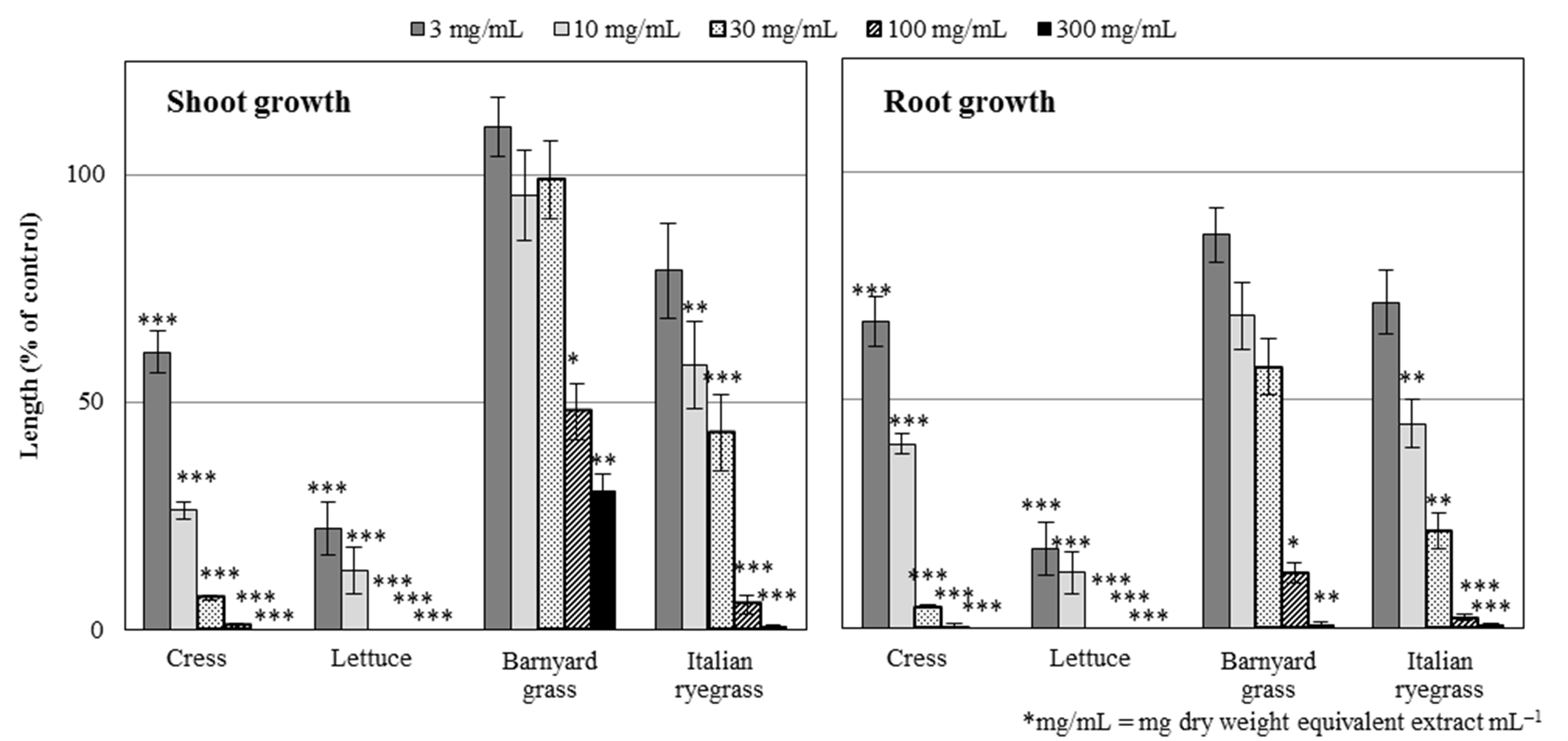
Effects of aqueous methanol extracts of A. oleracea on root and shoot growth of cress, lettuce, Italian ryegrass, and barnyard grass. Means ± SE from 4 independent experiments with 10 seedlings for each determination are shown. Asterisks indicate significant difference between control and treatment: *P < 0.05, **P < 0.01, ***P < 0.001.
IC50 values of the extracts on roots of cress, lettuce, Italian ryegrass, and barnyard grass were 5.9, 0.4, 25.9, and 7.8 mg dry weight equivalent extract/mL, respectively, and those on shoots of cress, lettuce, Italian ryegrass, and barnyard grass were 4.3, 0.8, 126.0, and 15.1 mg dry weight equivalent extract mL–1.
The extract of A. oleraces therefore had an inhibitory effect on both the dicotyledonous (cress and lettuce) and monocotyledonous (Italian ryegrass and barnyard grass) plants. These results suggest that A. oleraces may possess growth inhibitory activity and contain growth inhibitory substances.
The extracts of A. oleracea were separated with a silica gel column and the biological activity of all separated fractions was determined by cress bioassay. The active fraction was further purified by Sephadex LH-20, reverse-phase C18 Sep-Pak cartridges, and high-performance liquid chromatography (HPLC), and 2 active compounds
The molecular formula of compound

Chemical structure of (E,E)-2,4-undecadien-8,10-diynoic acid isobutylamide (compound 1) and nona-(2Z)-en-6,8-diynoic acid 2-phenylethylamide (compound 2).
The molecular formula of compound
Compound
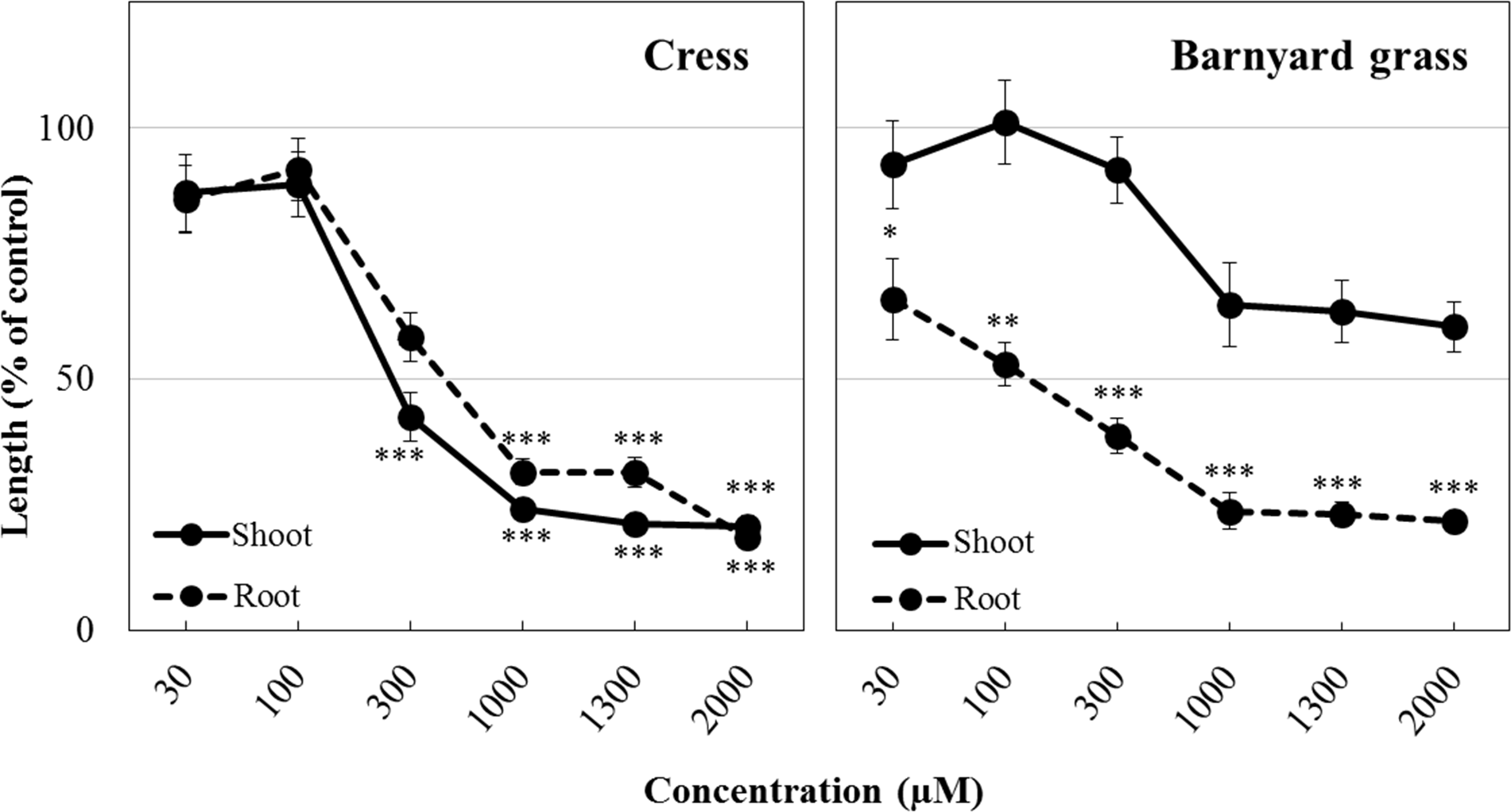
Effects of (E,E)-2,4-undecadien-8,10-diynoic acid isobutylamide on the growth of roots and shoots of cress and barnyard grass. Means ± SE from 4 independent experiments with 10 seedlings for each determination are shown. Asterisks indicate significant difference between control and treatment: *P < 0.05, **P < 0.01, ***P < 0.001.

Effects of nona-(2Z)-en-6,8-diynoic acid 2-phenylethylamide on the growth of roots and shoots of cress and barnyard grass. Means ± SE from 4 independent experiments with 10 seedlings for each determination are shown. Asterisks indicate significant difference between control and treatment: *P < 0.05, **P < 0.01, ***P < 0.001.
Experimental
Plant Material
The whole plants of A. oleracea was collected in Chiang Mai province, Thailand, in August 2012. The plant was dried, ground into a powder, and kept at 4°C until extraction. Biological activity was determined using cress (Lepidium sativum L.), lettuce (Lactuca sativa L.), Italian ryegrass (Lolium moltiflorum Lam.), and barnyard grass (Echinochloa crus-galli (L.) P. Beauv.).
Extraction and Bioassay
Powder of A. oleracea (100 g) was extracted twice with 700 mL of 70% (v/v) aqueous methanol for 2 days and filtered using filter paper (No. 2; Toyo Ltd., Japan). The residue was extracted again with 1 L of methanol for 1 day and filtered. Two filtrates of the extracts were combined and evaporated to dryness at 40°C. The extract was dissolved with 200 mL of methanol, and an aliquot of the extract at 5 concentrations (3, 10, 30, 100, and 300 mg dry weight equivalent extract mL–1) was added to a sheet of filter paper in Petri dishes (28 mm) and the solvent was dried in a fume hood. The filter paper was moistened with 0.6 mL of 0.05% (v/v) aqueous solution of polyoxyethylenesorbitan monolaurate (Tween 20; Nacalai, Kyoto, Japan) and 10 seeds of cress, lettuce, and 10 pre-germinated seeds of Italian ryegrass and barnyard grass were then placed on it. Only Tween 20 solution was used in control treatment. All treatments were incubated in the dark at 25°C for 48 hours. The length of roots and shoots of those seedlings were measured and calculated comparing with the length of control seedlings. Concentrations required for 50% growth inhibition (IC50) on the roots and shoots of the test plants were determined using a logistic regression function based on the bioassay.
Isolation of Active Compounds
Powder of A. oleracea was extracted with 70% (v/v) aqueous methanol and concentrated to produce an aqueous residue as described above. The aqueous residue was adjusted to pH 7.0 with 1 M phosphate buffer and partitioned 3 times against an equal volume of ethyl acetate. The ethyl acetate fraction was evaporated to dryness after drying over anhydrous Na2SO4. The residue of ethyl acetate fraction was subjected to a column of silica gel (60 g, silica gel 60, 70-230 mesh; Nacalai, Kyoto, Japan) and eluted with 20%, 30%, 40%, 50%, 60%, 70%, and 80% ethyl acetate in n-hexane (v/v; 100 mL per step), ethyl acetate (100 mL), and methanol (300 mL). The biological activity of all separated fractions was determined using a cress bioassay. A growth inhibitory active fraction was obtained by elution with 60% ethyl acetate in n-hexane. After evaporation of the active fraction, the residue was subjected to a column of Sephadex LH-20 (100 g; Amersham Pharmacia Biotech, Buckinghamshire, UK) and eluted with 20%, 40%, 60%, and 80% (v/v; 150 mL per step) aqueous methanol and methanol (200 mL per step). The active fraction obtained by elution with 80% aqueous methanol was evaporated to dryness and subjected to a reverse phase C18 cartridge (1.2 × 6.5 cm; YMC Ltd., Kyoto,) eluted with 20%, 30%, 40%, 50%, 60%, 70%, and 80% (v/v; 15 mL per step) and methanol (30 mL). The active fractions were eluted with 60% aqueous methanol and evaporated to dryness. The residue was finally separated using reverse-phase HPLC (ODS AQ-325, 10 mm i.d. × 50 cm; YMC Ltd.) and eluted at a flow rate of 1.5 mL min−1 with 60% aqueous methanol and detected at 220 nm. Inhibitory activity was found in peak fractions eluted between 108 to 112 minutes (compound
Biological Activity of the Isolated Compounds
Compounds
Statistical Analysis
All experiments were performed with 3 replicates (10 seeds/replicate) and repeated twice (n = 60). The bioassay data were analyzed by SPSS (ver. 21) using one-way ANOVA and the differences between treatments were evaluated by Tukey’s test.
Footnotes
Declaration of Conflicting Interests
The author(s) declared no potential conflicts of interest with respect to the research, authorship, and/or publication of this article.
Funding
The author(s) received no financial support for the research, authorship, and/or publication of this article.