



Abstract
A plant growth inhibitory substance was isolated from Heliotropium indicum by bioassay-guided purification and characterized to be (+)-isoamericanol A. (+)-Isoamericanol A significantly inhibited seedling growth of cress at a concentration greater than 0.1 mM. The concentrations of (+)-isoamericanol A required for 50% growth inhibition of cress roots and hypocotyls were 0.5 and 0.4 mM, respectively. This inhibition indicates that (+)-isoamericanol A had a growth inhibitory activity and may contribute to the allelopathic effect of H. indicum. This report is the first on the plant growth inhibitory activity of (+)-isoamericanol A as an allelopathic substance.
Heliotropium indicum L., family Boraginaceae, is an annual herb, up to 100 cm tall. The plant is widely distributed throughout tropical and subtropical regions in the world and can be found in the fields of rice and corn, in wasteland and roadsides, in moist sandy soils, or in shallow swamps. 1,2 The plant has been used in folklore medicine. 3,4 Extracts of the plants have been shown to possess pharmacological activities 5,6 and reported to contain several compounds with pharmacological properties. 7-9 In addition, an allelopathic activity of ethanolic extracts of the plants has been shown. 10 However, there has been no report on the isolation and identification of allelopathic substances from the plant. Therefore, in this study, a plant growth inhibitory substance with allelopathic activity in H. indicum was isolated and characterized and its biological activity determined.
Powdered H. indicum was extracted with aqueous methanol and the extract partitioned with ethyl acetate. The ethyl acetate fraction was further subjected to bioassay-guided fractionation to isolate active substances, and a growth inhibitory substance was obtained by high-performance liquid chromatography (HPLC). Comparison of the spectral data with the literature 11-13 identified the compound as (+)-isoamericanol A (Figure 1). (+)-Isoamericanol A significantly inhibited the growth of cress roots and hypocotyls at concentrations greater than 0.1 and 0.3 mM, respectively. Hypocotyl and root growth of cress seedlings were decreased by increasing (+)-isoamericanol A concentrations (Figure 1). The concentrations required for 50% growth inhibition were 0.4 mM for the roots and 0.5 mM for the hypocotyls.
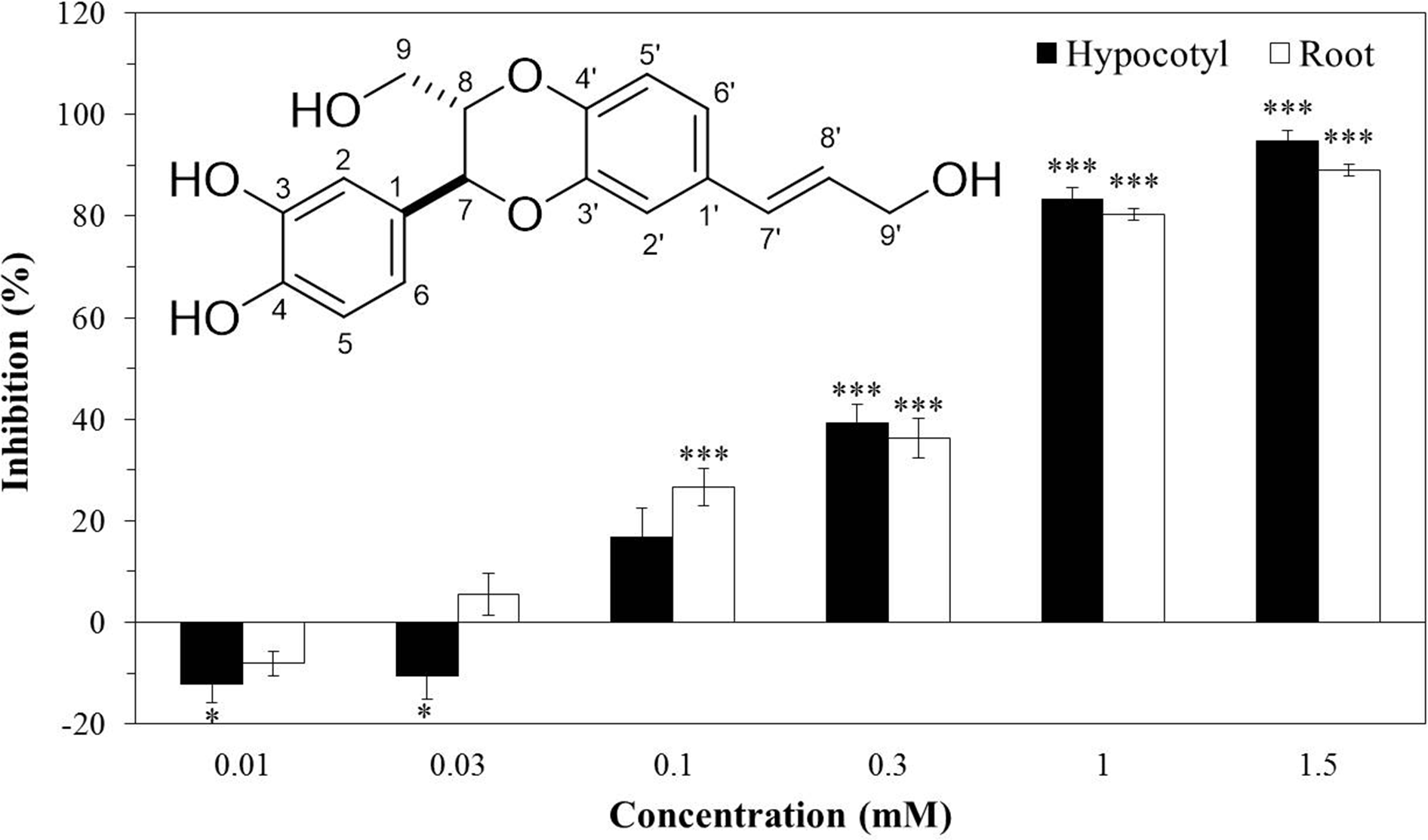
Growth inhibitory activity of (+)-isoamericanol A on hypocotyl and root growth of cress seedlings. Asterisks indicate significant difference between control and treatments: *P < 0.05 and ***P < 0.001.
The neolignan, (+)-isoamericanol A, was first found in the seeds of Phytolacca americana (Phytolaccaceae) 11 and then in the seeds of Artabotrys hexapetalus (Annonaceae), 14 Joannesia princeps 12 and Jatropha curcas (Euphorbiaceae), 15 and in the tubers of Colocasia antiquorum (Araceae). 16 The compound has been reported to possess neurotrophic activity on rat cells, 11 antimelanogenic activity on Melan-a cells, 16 anticancer activity on human cancer cell lines, 15,17 and in vitro antioxidative activity. 18,19 However, plant growth inhibitory activity of the compound has not been reported, and, therefore, this may be the first report of such activity of (+)-isoamericanol A.
Extracts of the aerial part of H. indicum showed an allelopathic activity on the growth of lettuce and black gram. 10 The present results suggest that (+)-isoamericanol A may contribute to the growth inhibitory effect of H. indicum and may play an important role in the allelopathic effect of H. indicum.
Experimental
Plant Materials
Whole plants (roots, stems, and leaves) of H. indicum were collected from Chiang Rai, Thailand, in September 2015. Soil particles were removed from the plants by washing with running tap water. The plants were dried and ground into a powder and kept at 4°C until extraction. Cress (Lepidium sativum L.) was selected as the test plant for evaluating the biological activity.
Extraction and Purification of Growth Inhibitory Substance
The plant powder (500 g) was extracted with 2.5 L of 70% (v/v) aqueous methanol for 48 hours and filtered through a filter paper (No.2; Toyo, Tokyo, Japan). The plant residue was extracted again with methanol for 24 hours and filtered. The two filtrates were combined and concentrated with a rotary evaporator at 40°C to produce an aqueous residue. This was adjusted to pH 7.0 with 1 M phosphate buffer and partitioned 3 times with an equal volume of ethyl acetate. The ethyl acetate fraction was dried over anhydrous Na2SO4, filtered, and evaporated to dryness. The ethyl acetate fraction was then loaded onto a column of silica gel (60 g, silica gel 60, 70-230 mesh; Nacalai, Kyoto, Japan) and eluted with 20%, 30% ,40%, 50%, 60%,70%, 80%, and 90% of ethyl acetate in n-hexane (v/v; 150 mL per step) and methanol (300 mL). The biological activity of all the separated fractions was determined using a cress bioassay, as described later. The inhibitory fraction eluted by ethyl acetate was evaporated to dryness. The active residue was dissolved in 20% (v/v) aqueous methanol and loaded onto a reverse-phase C18 cartridge (1000 mg/6 mL, 6 nm, YMC Dispo SPE, YMC Ltd., Kyoto) and eluted with 20%, 30%, 40%, 50%, 60%, 70%, 80%, and 90% of aqueous methanol (v/v; 15 mL per step) and methanol (30 mL). The active fraction eluted by 40% aqueous methanol was evaporated to dryness and the residue was finally purified by reverse phase HPLC (250 × 4.6 mm, Inertsil ODS-3, GL Sciences Inc., Japan) by eluting with 45% (v/v) aqueous methanol at a flow rate of 0.5 mL/min, and detected at 220 nm. A compound with growth inhibitory activity was eluted at a retention time of 27 minutes, as an oily pink residue and identified as (+)-isoamericanol A. 11-13
Cress Bioassay
An aliquot of all the separated fractions (at final assay concentrations of 100 and 300 mg dry weight equivalent extract per milliliter) was separately added to a sheet of filter paper (No. 2) in 28 mm Petri dishes and the solvent evaporated in a laminar flow cabinet. Ten cress seeds were arranged on the filter paper that was then moistened with 0.6 mL of 0.05% (v/v) aqueous solution of Tween 20 (Nakalai, Kyoto). An aqueous solution of Tween 20 was used as the control treatment. The hypocotyl and root length of cress were measured after incubation for 48 hours in darkness at 25°C. The inhibition percentage of hypocotyl and root growth of the treated seedlings were calculated with reference to the length of hypocotyl and root of control seedlings. The bioassay was conducted in 2 independent experiments with 3 replications (10 seedlings/replication) in a completely randomized design for each experiment.
Bioassay of (+)-Isoamericanol A
The growth inhibitory activity of (
Footnotes
Declaration of Conflicting Interests
The author(s) declared no potential conflicts of interest with respect to the research, authorship, and/or publication of this article.
Funding
The author(s) received no financial support for the research, authorship, and/or publication of this article.