



Abstract
Using a recently developed analytical protocol, distributions of 5 aporphine alkaloids, nuciferine (
Lotus flower (the flower buds of Nelumbo nucifera Gaertn., Nymphaeaceae) is extensively cultivated in east Asian countries and has been used for the treatment of vomiting blood, bleeding caused by internal and external injuries, and various skin diseases, along with use as a sedative and anti-inflammatory agent in traditional Asian medicines.
1,2
In the course of our exploratory studies of bioactive constituents in the flower buds of N. nucifera, we have reported that a practical liquid chromatography-mass spectrometry (LC-MS)-based method was developed for the simultaneous quantitative determination of 5 aporphine alkaloids, nuciferine (
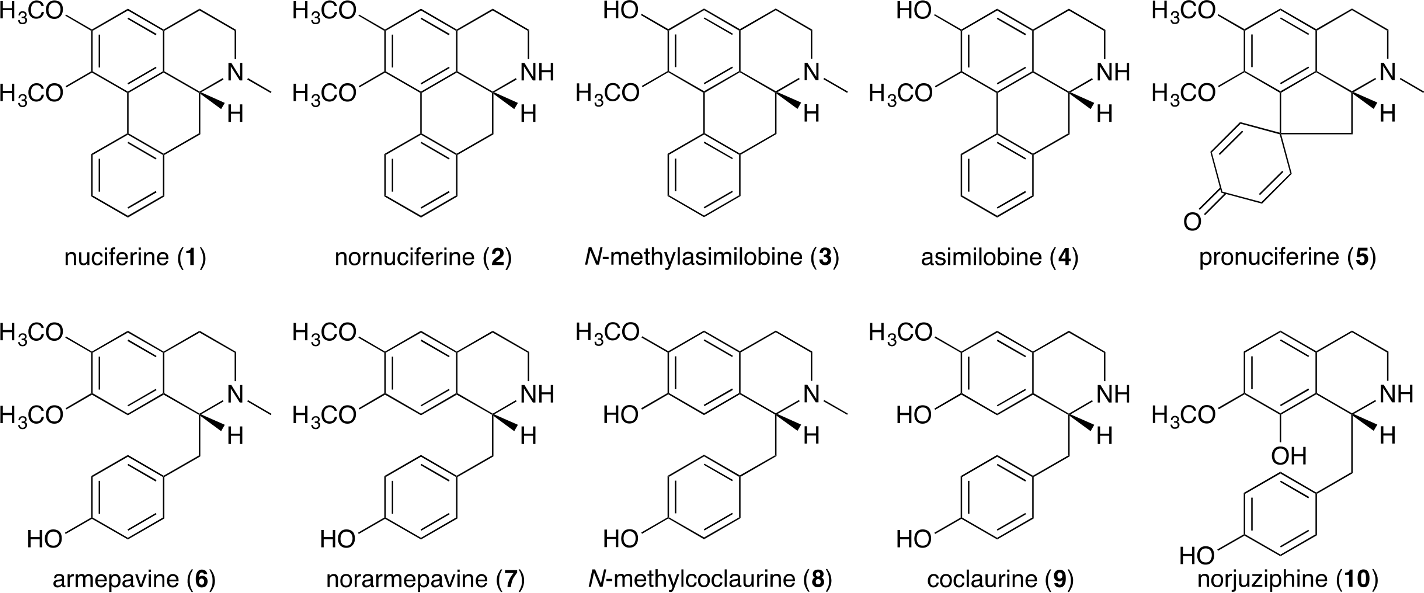
Aporphine and benzylisoquinoline alkaloids (1-10) from flower buds of N. nucifera.
In total, 5 test samples were collected according to the different blooming states: the beginning of blooming (abbreviated as NN-S1), one-third in bloom (NN-S2), half in bloom (NN-S3), three-quarters in bloom (NN-S4), and in full bloom (NN-S5) from the same field in Saga prefecture, Japan (Figure 2).
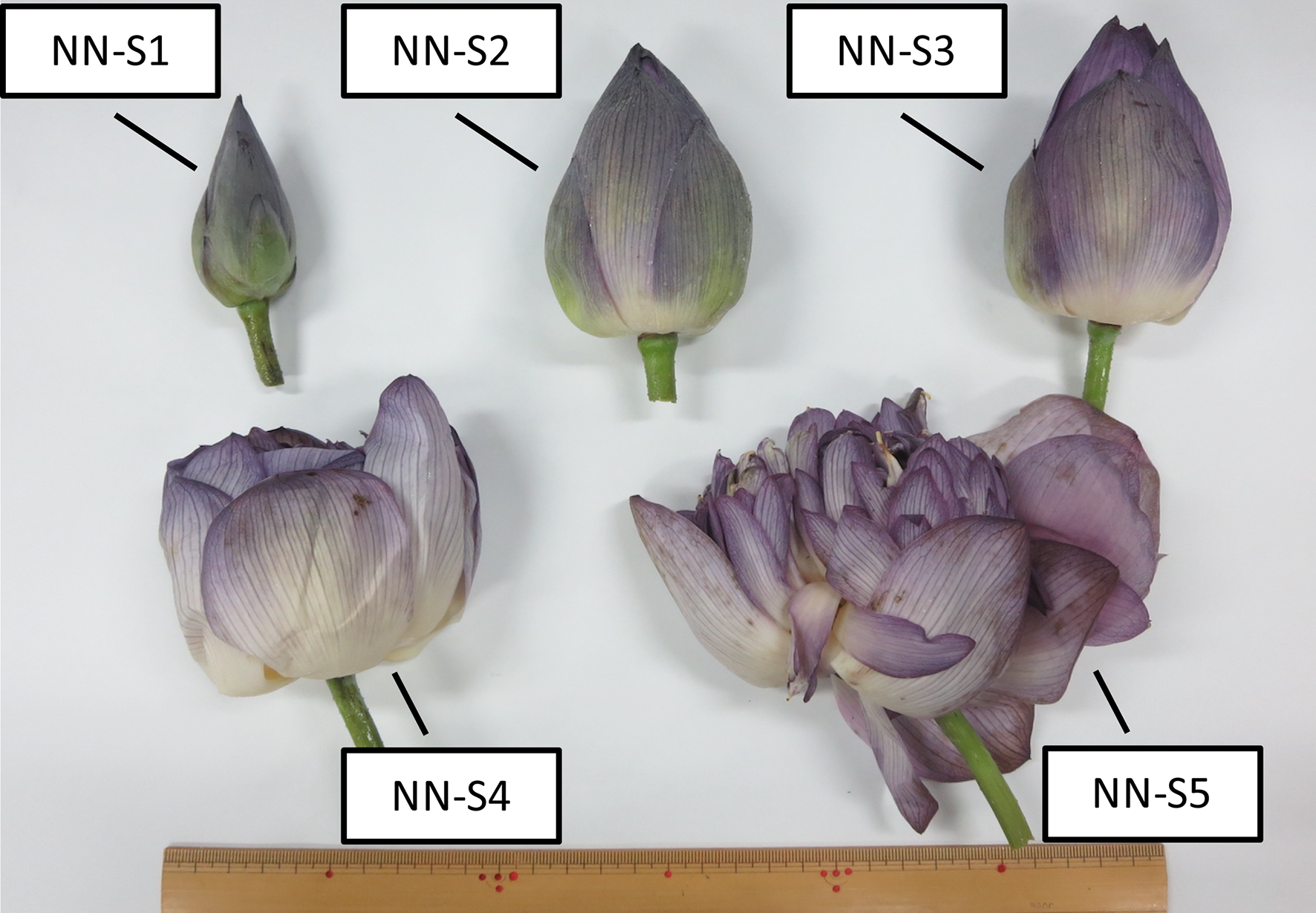
Collected samples sorted according to the different blooming states at the same field in Saga prefecture (Minato, Karatsu), Japan.
As shown in Figure 3, a typical liquid chromatography-mass spectrometry (LC-MS) chromatogram under optimized conditions for alkaloids (

LC-MS chromatograms of alkaloids (1-10). Selected ion monitoring (SIM) chromatograms (positive electrospray ionization [ESI]) of (a) a standard solution mixture (each 10 mg/mL) and the methanol extract of (b) NN-S1 (beginning of blooming), (c) NN-S2 (one-third in bloom), (d) NN-S3 (half in bloom), (e) NN-S4 (three-quarters in bloom), and (f) NN-S5 (in full bloom).
Contents of Alkaloids (

Total alkaloid content per one flower (mg/g in dry material) is given in parentheses.
aEach fresh sample was weighed after drying by hot air dryer at 50°C for 3 days (n = 4–8).
bEach powdered sample was dried at 105°C for 8 hours.
cEach powdered sample was extracted twice with methanol under reflux for 120 minutes.
Originating in dThailand or eTaiwan. 1
fLess than the quantitation limit.
Hyaluronidase is a mucopolysaccharide related to inflammation by the histamine released from mast cells. Hyaluronidase inhibitors seem to be effective in suppressing allergies and inflammation.
3
-5
It is known that the antiallergic medicine DSCG exhibits a strong inhibitory effect against hyaluronidase.
3
Therefore, it has been found that there is a close relationship between allergic reactions and hyaluronidase inhibitory activity
3,5
Through our continued studies on antiallergic principles with hyaluronidase inhibitory activity, the methanol extracts of the lotus flower, such as NN-S1 and NN-S2 (IC50 = 52.8 and 58.6 µg/mL), were found to show the activity displayed in Supplemental Table S1. To identify the active constituents of this plant material, the inhibitory effects of the alkaloids (
In conclusion, using the recently developed analytical protocol, distributions of 5 aporphine alkaloids, nuciferine (
Experimental
Plant Material
Five samples were collected in Minato, Karatsu, Saga prefecture, Japan from 8:30 to 9:30 am on August 10, 2016, and were abbreviated as follows: NN-S1 (beginning of blooming), one-third in bloom (NN-S2), half in bloom (NN-S3), three-quarters in bloom (NN-S4), and in full bloom (NN-S5). These plant materials were supplied by Mr Youichi Matsuura (Iwase Cosfa Co., Ltd., Osaka, Japan) and identified by one of the authors (M.Y.). Voucher specimens of them are on file in our laboratory. The materials were finely air-dried at 50°C for 3 days using a hot-air dryer.
Reagents and Chemicals
Acetic acid, acetonitrile, and distilled water were purchased from Nacalai Tesque Inc. (Kyoto, Japan). The reference sample of the hydrochloride of each alkaloid (
LCMS Analysis for Alkaloids (1-10)
An LC-20A series Prominence HPLC system (Shimadzu Co.) was equipped with a binary pump, a degasser, an autosampler, a thermostated column compartment, a UV detector, and a control module connected with a LCMS-2010EV mass spectrometer (Shimadzu Co.) equipped with an ESI interface. The chromatographic separation was performed on a Cosmosil πNAP column (5 µm particle size, 2.0 mm i.d. × 150 mm, Nakalai Tesque Inc.) operated at 40°C with mobile phase A (acetonitrile) and B (H2O containing 0.2% acetic acid). The gradient program was as follows: 0 minutes (A:B 15:85, v/v) → 20 minutes (18:82, v/v) → 50 minutes (50:50, v/v). The flow rate was 0.2 mL/min and the injection volume was 2.0 µL. The detections were performed at 260 nm (UV) and under SIM by a positive-mode ESI-MS. The operating parameters for MS detection were as follows; nebulizing gas flow: 1.5 L/min, drying gas pressure: 0.15 MPa, CDL temperature: 250°C, block heater temperature: 250°C, interface voltage: −3.5 kV, CDL voltage: constant-mode, Q-array DS and RF voltage: Scan-mode. 1
Preparation of Standard Solution
A standard solution was prepared according to the previously reported method.
1
Thus, an accurately weighed 2.00 mg of each hydrochloride salt of alkaloid (
Sample Preparation
Pulverized sample powders were accurately weighed (circa 2.0 g, conversion with loss on drying) and extracted twice with 20 mL of methanol under reflux for 120 minutes. After centrifugation of the combined extracts at 3000 rpm for 5 minutes, the supernatants were combined and diluted to 100 mL with the extraction solvent. An aliquot (1 mL) of the extract solution was transferred into a 5 mL volumetric flask and made up to the volume with methanol. The solution was filtered through a syringe filter (0.45 µm), and an aliquot of 5.0 µL was subjected to the LC-MS analysis. The remaining extraction solution (90 mL) was evaporated in vacuo to calculate the extraction yields.
Hyaluronidase Inhibitory Activity
The experiment was performed according to a previously reported method 3 -7 with a slight modification. Briefly, the assay was performed in 96-well microplates. Pre-incubation of 10 µL hyaluronidase enzyme (Type IV-S from bovine testes; 340 NF unit/mL, Sigma-Aldrich Co. LLC, St Louis, USA) or a blank buffer (0.1 M acetate buffer, pH 3.5) with 20 µL of sample or control was incubated at 37°C for 20 minutes. Twenty μL of calcium dichloride (final concentration: 2.0 mM) was added to the buffer, and the mixture was incubated at 37°C for 40 minutes. Then, 50 µL of hyaluronic acid potassium salt (final concentration: 0.6 mg/mL, Sigma-Aldrich Co. LLC) was added, and the mixture was incubated at 37°C for 40 minutes. The reaction was stopped by adding 0.4 M NaOH (10 µL) and 0.08 M borate solution (pH 9.1, 10 µL) and immediately heated by boiling water for 3 minutes. Twenty μL of the reaction solution was transferred to another 96-well microplate. Eighty μL of p-dimethylaminobenzaldehyde (final concentration: 8.0 mg/mL, Wako Pure Chemical Industries Ltd., Osaka, Japan) acetate solution was added to the reaction mixture and incubated at 37°C for 20 minutes. The optical density (O.D.) of the reaction mixture was measured using a microplate reader (SH-9000, CORONA) at a wavelength of 585 nm (reference 670 nm). The final concentration of dimethyl sulfoxide (DMSO) in the test solution was 1.0% and no influence of DMSO on the inhibitory activity was detected. All the experiments were performed in quadruplicate and IC50 was determined graphically. DSCG, a clinically used antiallergic medicine, was used as the reference compound.

Control (C): enzyme (+), test sample (–); Test (T): enzyme (+), test sample (+); Blank (B): enzyme (–), test sample (+); Normal (N): enzyme (–), test sample (–)
Supplemental Material
Supplemental Table S1 - Supplemental material for Quantitative Determination of Principal Aporphine and Benzylisoquinoline Alkaloids Due to Blooming State in Lotus Flower (Flower Buds of Nelumbo nucifera) and Their Hyaluronidase Inhibitory Activity
Supplemental material, Supplemental Table S1, for Quantitative Determination of Principal Aporphine and Benzylisoquinoline Alkaloids Due to Blooming State in Lotus Flower (Flower Buds of Nelumbo nucifera) and Their Hyaluronidase Inhibitory Activity by Toshio Morikawa, Shuhei Okugawa, Yoshiaki Manse, Osamu Muraoka, Masayuki Yoshikawa, and Kiyofumi Ninomiya in Natural Product Communications
Footnotes
Declaration of Conflicting Interests
The author(s) declared no potential conflicts of interest with respect to the research, authorship, and/or publication of this article.
Funding
The author(s) disclosed receipt of the following financial support for the research, authorship, and/or publication of this article: This work was supported by MEXT-Supported Program for the Strategic Research Foundation at Private Universities, 2014–2018, S1411037 (T.M.) and a Grant-in-aid for Scientific Research (KAKENHI), 18K06726 (T.M.), 16K08313 (O.M.), and 18K06739 (K.N.).
References
Supplementary Material
Please find the following supplemental material available below.
For Open Access articles published under a Creative Commons License, all supplemental material carries the same license as the article it is associated with.
For non-Open Access articles published, all supplemental material carries a non-exclusive license, and permission requests for re-use of supplemental material or any part of supplemental material shall be sent directly to the copyright owner as specified in the copyright notice associated with the article.
