Two Chinese black cardamom oils (Amomum tsao-ko) were analyzed using GC and GC/MS and compared to 2 Indian cardamom oils from the species Amomum subulatum and Elettaria cardamomum, respectively. The main constituents of A. tsao-ko oils were eucalyptol, geranial, geraniol, trans-2,3,3A,7A-tetrahydro-1H-indene-4-carbaldehyde, (2E)-decenal, neral, and 4-indanecarbaldehyde. Special attention was given to the 1H-indene-carbaldehyes, which are frequently wrongly assigned in previous literature. A detailed odor evaluation of the oils was also carried out. In addition, composition variations of 28 main constituents of 8 E. cardamomum oils were investigated, taking various factors like origin, production methods, plant material, and drying stage into consideration.
Spices1 and the resulting essential oils and oleoresins2 are key components in flavor creations. Some spices, like cardamom, also play an important role in the fragrance industry.3 Cardamom essential oil for fragrances is hydrodistilled from seeds or less frequently from whole pods of Elettaria cardamomum (L.) Maton.4,5 However, the term cardamom is not limited to only one species. Several plants in the genera Elettaria, Amomum, and Aframomum, all belonging to the Zingiberaceae family, are also referred to as cardamom.1 In the Encyclopedia of Herbs and Spices, 8 different cardamoms1 are described in detail while ISO 676:1995 (Spices and Condiments—Botanical Nomenclature) lists 10 species.6 Our Scent Expeditions to Kerala/India in 2007 and Yunnan/China in 2011, respectively, sparked our fascination for cardamom further.
Cardamom is often distinguished into true or green cardamom on one hand represented by the species E. cardamomum and false or black cardamom referring oftentimes to a variety of species.5 The color classification is based on their dried fruit appearance. Further indexing of cardamom refers to the fruit size (eg, small or large), form (eg, round), or the historic region of origin like China and Madagascar.1
Green, small, or true cardamom, E. cardamomum, is known as the “Queen of Spices”4,5,7-10. When bleached it is named as white cardamom.8,9 Its essential oil is one of the oldest raw materials in perfumery and the third most expensive spice after vanilla and saffron. It is cultivated widely in the tropical region with Guatemala, India, and Sri Lanka as the main producer countries currently.4,5,7-10 The biggest growing regions in India are Kerala followed by Karnataka.10 At least 2 varieties of E. cardamomum are listed in ISO 676:1995: var. major Thwaites and var. minuscula Burkill.6Elettaria cardamomum var. minuscula could be better classified into 3 cultivars according to literature: Malabar, Mysore, and Vazhukka, the latter a hybrid between Malabar and Mysore.11,12 Besides the essential oil, CO2 extracts, as well as the oleoresin, are commercially available. These products are normally obtained only from the seeds by removing the outer husk before processing.
Black, large, or false cardamom covers the species Amomum and Aframomum.13 By far the most important species is Amomum subulatum Roxb., also known as Nepal cardamom native to the Eastern Himalayan region.14-17 India is the main producer followed by Nepal and Bhutan. In India, 85% of A. subulatum is cultivated in the Indian state of Sikkim but also partly the Darjeeling district in West Bengal, Assam, and Himachal Pradesh.14 While large quantities of the spice itself are commercially available, the respective essential oil and oleoresin are hardly found.
The same applies for its Chinese relative Amomum tsao-ko Crevost & Lemarié.13,18 However, production volumes seem to be significantly lower and the capsule fruit is bigger compared to A. subulatum.19 It is an important spice in many parts of China and also used in traditional Chinese medicine.18 Chinese black or tsao-ko cardamom is widely distributed in the southwestern provinces of China like Yunnan and Guangxi, but also in the northern highlands of Vietnam and Laos.20 In China 90% of the crop has its origin in Yunnan province.
While green cardamom (E. cardamomum)7-12,21-23 and black cardamom (A. subulatum) from India14-17,24-31 are scientifically well investigated over the years, significantly less is published about Chinese black cardamom (A. tsao-ko).18,32-36 In addition, most publications have been published only in Chinese37–48 and some compounds have been repeatedly wrongly assigned.
Here we report detailed analyses of 2 A. tsao-ko essential oils distilled from crushed whole pods originated from China and compared with 2 other cardamom essential oils from the species A. subulatum and E. cardamomum, respectively, both from India in terms of constituents and odor. In addition, E. cardamomum essential oils distilled from dried and fresh pods from India were compared with 3 commercial oils from India and Guatemala and a CO2 extract from whole dried pods regarding main constituents (>0.2%) to investigate variations in this species.
All 4 cardamom essential oils were hydrodistilled under standard lab conditions using ground dried pods (for details see Experimental section). Yields ranged from 0.7% to 1.8% for A. tsao-ko and 0.9% to 1.5% for A. subulatum and up to 5.2% for E. cardamomum. The 4 cardamom oils A-D were analyzed by GC and GC/MS (Table 1). Constituents were identified by comparing their mass spectra with known compounds, published spectra, or the Symrise in-house library.49 In all 4 cardamom oils A-D, a broad range of major, minor, and trace compounds were identified. Compounds >0.1% are listed in Table 1. These constituents represent a total of 91.6% (A), 91.8% (B), 94.0% (C), and 97.7% (D), respectively. All 4 cardamom oils contained as a common feature high amounts (>20%) of eucalyptol (=1,8-cineol). High eucalyptol levels are not limited to cardamom oil but are also found in eucalyptus, rosemary, laurel leaf, Spanish spike lavender, and Spanish sage oils.3
Chemical Composition (Area %) of Main Constituents (>0.1%) of 4 Cardamom Oils.a
RI: retention index relative to C7-C30 n-alkanes on DB-Wax column; t: trace (≤0.01%); -: not detected; A/B: A. tsao-ko,C: A. subulatum, and D: E. cardamomum;
aMeasured on DB-Wax column;
bcorrect isomer not determined.
In both A. tsao-ko oils (A/B) similar major and minor compounds were detected but some showed significant variations in concentration. The composition of the 2 A. tsao-ko essential oils (A/B) revealed, besides eucalyptol (28.1%/22.6%), the following main ingredients (compounds >1.5%): geranial (1.6%/7.8%), geraniol (7.1%/7.0%), trans-2,3,3A,7A-tetrahydro-1H-indene-4-carbaldehyde (3.7%/6.8%), (2E)-decenal (3.0%/6.1%), neral (1.0%/4.7%), 4-indanecarbaldehyde (4.3%/2.3%), (E)-nerolidol (3.6%/2.6%), α-terpineol (3.5%/3.3%), p-cymene (3.3%/0.7%), geranyl acetate (3.1%/2.7%), α-phellandrene (3.0%/2.6%), limonene (2.7%/1.7%), (2E)-dodecenal (0.9%/2.5%), cis-2,3,3A,7A-tetrahydro-1H-indene-4-carbaldehyde (1.9%/2.3%), α-pinene (2.3%/1.1%), 5-indanecarbaldehyde (1.7%/2.1%), β-pinene (2.1%/1.2%), and (2E)-decenyl acetate (1.5%/0.7%). This is well in line with some previously published analyses.18,20,31,33-35,39,45 However, one previous analysis reported very high levels of limonene together with other major compounds which were not present in our analysis.25
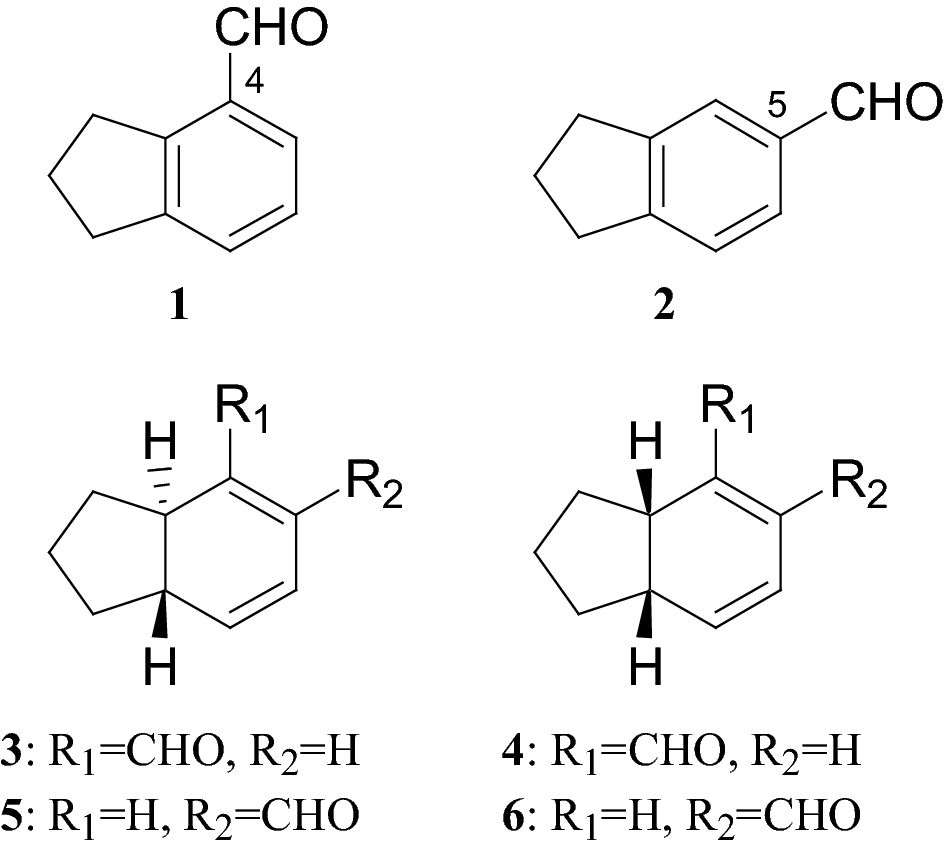
Both oils contained very characteristic indane (=2,3-dihydro-1H-indene) derivatives: 4-indanecarbaldehyde (1) and 5-indanecarbaldehyde (2) and the respective dihydroindane compounds trans- and cis-2,3,3A,7A-tetrahydro-1H-indene-4-carbaldehyde (3/4) (Figure 1).
Chemical structure of 1H-indene-carbaldehyes 1 to 6 from Amomum tsao-ko.
The indanecarbaldehydes 1 and 2 have been isolated and characterized in 1978 from A. tsao-ko.50 The paper is published under the species name Amomum medium Loureiro, which is synonymous with A. tsao-ko.50,51 Nevertheless, especially compound 2 has been wrongly assigned in several publications as α- or β-methyl cinnamic aldehyde,20,40 2-phenyl-2-butenal,36 and 3-methyl-3-phenyl-2-propenal,35 having the same molecular mass (M = 146) as 1 and 2. Also our MS-database showed α-methyl cinnamic aldehyde as a possible hit for 2. Re-isolation of aldehydes 1 and 2 confirmed the structural assignment published in literature (see also the “Experimental” section) with 3 distinct aromatic H-atom signals in 1H-NMR for both 1 and 2.50 The wrong assignment is probably linked to the different mass spectra of 1 and 2, especially the significantly higher [M-H]+ peak of 2 compared with 1. While m/z = 145 is the base peak of (E)-α- and (E)-β-methyl cinnamic aldehyde, both 1 and 2 have m/z = 119 as the base peak. The mass spectrum of 2-phenyl-2-butenal is very close to aldehyde 1; however, the base peak is m/z = 115 compared to m/z = 117 in 1 and 2. Aldehydes 1 and 2 were most likely also present in A. tsao-ko oil from Vietnam, but were wrongly assigned here, as well as α-methyl cinnamic aldehyde.52
The respective dihydroindane-4-carboxylaldehydes 3 (trans) and 4 (cis) have also been detected in an A. tsao-ko extract and synthesized by Starkenmann et al.53 Also compounds 3 and 4 have been wrongly characterized as p-propyl32,35 or isopropyl benzaldehyde34-37,41 in previous A. tsao-ko analyses, all having a molecular mass of M = 148, but mass spectra are far off from compounds 3 and 4. The cis/trans-ratio can vary depending on the interconversion of 3 into 4, as according to Starkenmann the cis-isomer 4 is more stable compared with the trans-isomer 3.53 Oil A showed a trans/cis-ratio of 1.96:1 while B had a ratio of 2.92:1. Oil B had a higher amount of 3 and 4, but a lower amount of 1 compared to oil A.
Interestingly, to the best of our knowledge, the respective dihydroindane-5-carbaldehydes have not been described before in A. tsao-ko. Two unknown compounds showed high similarities in the mass spectra with 3 and 4. These compounds represent most likely the respective tetrahydro-1H-indene-5-carbaldehydes 5 and 6. However, the characterization is only based on mass spectra similarities and needs further verification by isolation and full spectroscopic characterization as only comparison of mass spectra can lead as shown above to wrong structural assignments.
The indane derivatives 1 to 6 are characteristic for A. tsao-ko and also comprise the structurally related compounds tsaokoin54 and isotsaokoin55 isolated from a CHCl3 and a methanol extract, respectively. None of these indane derivatives 1 to 6 are present in the other 2 cardamom oils C and D from the species A. subulatum and E. cardamomum, respectively. A literature search confirmed that compounds 1 to 4 have to the best of our knowledge so far not been found in any other species. Therefore aldehydes 1 to 4 can be used as a species marker for A. tsao-ko probably independent of the growing region as they were found in oils from both China and Vietnam.52
High levels of straight chain unsaturated aldehyde (2E)-decenal together with the presence of (2E)-decenol and (2E)-dodecenol and the corresponding acetates seem to differentiate A. tsao-ko further from the other 2 cardamom species.
The concentrations of eucalyptol, p-cymene, and indane-4-carbaldehyde (1) were lower while those of citral (geranial/neral), (2E)- decanal, (2E)-dodecenal, and trans-tetrahydroindene-4-carbaldehyde 3 were significantly higher in oil B compared with oil A. Citral variations described in literature before for A. tsao-ko were linked not only to fruit forms and therefore to genic variations,20 but also to different growing regions.40 Higher citral levels were also found in seeds compared with husk,40 but as whole fruits were processed this factor is not relevant here. Fruits distilled for oil A showed indeed a more conical shape while pods used for B had an elliptic form. Composition differences of natural products can be caused not only by genetic factors20 but by various factors like geographical origin,40 harvest time, date and year, as well as abiotic (eg, climate/weather, soil) and biotic factors (such as herbivores, parasites). However, we are unable to rule out any of these factors as both batches of pods were commercially purchased from different sources and the authors rely on the information obtained by the suppliers.
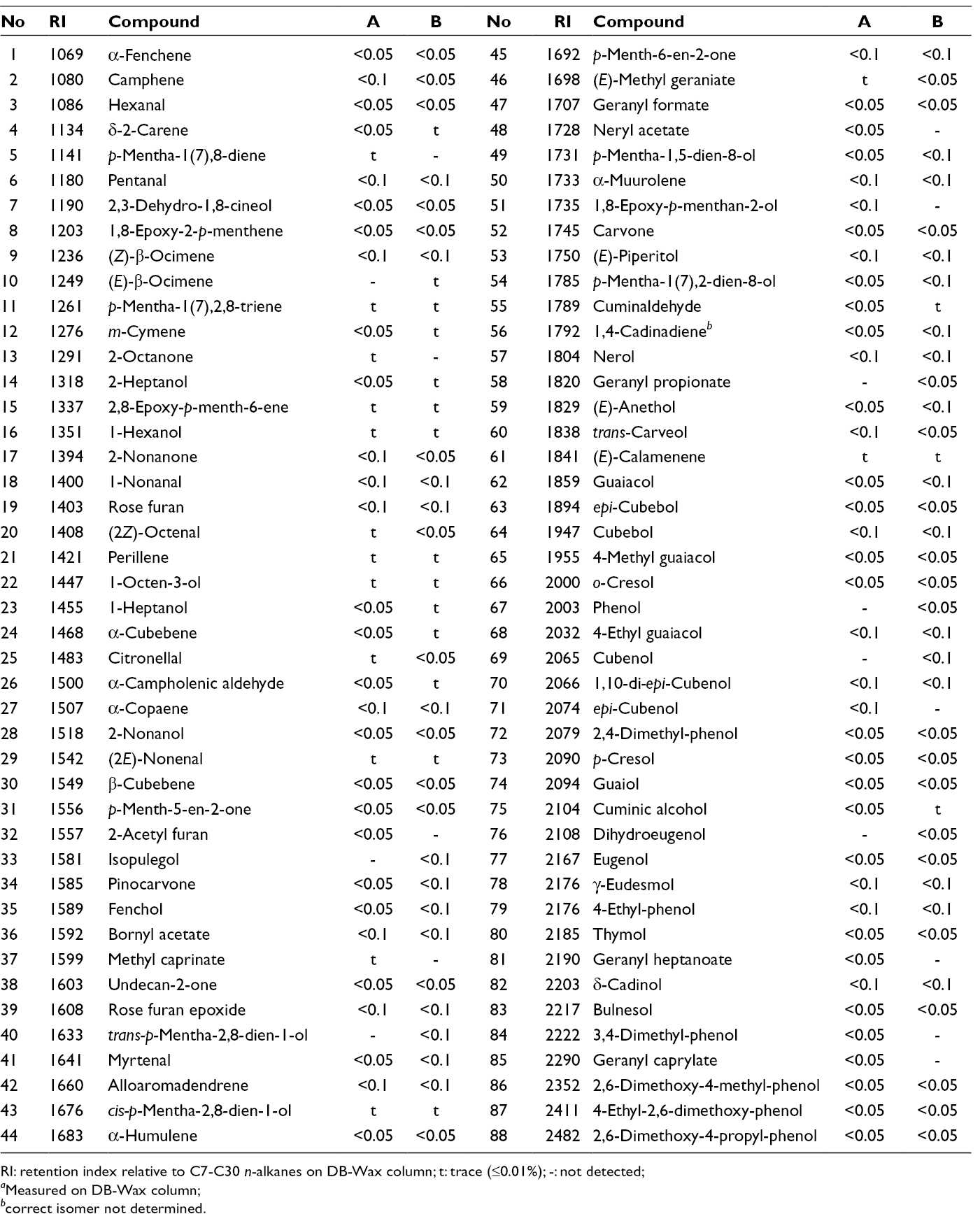
A detailed analysis of additional minor compounds (<0.1%) from A. tsao-ko is shown in Table 2. These 88 constituents represent only 1.7% to 2.0% of the total oil content and were detected in most cases in both oils A and B.
Chemical Composition (Area %) of Minor Constituents (<0.1%) of 2 Amomum tsao-ko Oils.a
RI: retention index relative to C7-C30 n-alkanes on DB-Wax column; t: trace (≤0.01%); -: not detected;
aMeasured on DB-Wax column;
bcorrect isomer not determined.
Amomum subulatum oil (C) showed the highest amount of eucalyptol (52.8%) of all 3 cardamom oils A/B-D. The following other main compounds (>1.5%) were detected: α-terpineol (8.2%), limonene (6.9%), β-pinene (6.3%), α-pinene (4.3%), 4-terpinenol (3.2%), and (E)-nerolidol (2.1%). This is in line with previously published analyses.24,56 Eucalyptol levels can go up to 86%29 and some analyses do not show limonene at all or at very low levels.30 This is not linked to the fact that whole pods and not just seeds were distilled as the husk does not contribute much to limonene levels.57
Other than in the 2 Amomum species subulatum and tsao-ko which did not contain α-terpinyl acetate, this was the major ingredient in E. cardamomum oil D. The essential oil from dried pods D contained 44.8% α-terpinyl acetate followed by eucalyptol (27.9%), sabinene (3.1%), 4-terpinenol (3.0%), limonene (2.9%), geraniol (2.2%), and myrcene (1.7%). It is interesting to mention that besides α-, also δ-terpinyl acetate (0.3%) was detected. This compound was identified in laurel leaf oil, which also contained the combination of α-terpinyl acetate and eucalyptol, but in lower and opposite ratio.58 The ratio of α-terpinyl acetate and eucalyptol can vary significantly depending on the variety of E. cardamomum.9
A detailed odor evaluation by our perfumers of the neat oils A-D on smelling strips is given in Table 3. We used E. cardamomum oil D from whole pods as reference.
Strong smoky-leathery, sweet dill, sharp aldehydic-nitrilic, not reminiscent of D; dry-down: smoky, cinnamic, aldehydic-nitrilic, fresher compared to C
A. tsao-ko (B)
Strong smoky-cresolic, more rounded, less leathery and aldehydic-nitrilic compared to A; dry-down: same as A but more rounded and less aldehydic-nitrilic
A. subulatum (C)
Strong smoky-phenolic, birch tar like, aromatic herbaceous, camphoraceous with aspects reminiscent of D; dry-down: strong smoky-tobacco, herbaceous, reminiscent of extracted wet coffee powder
Similar to D but much more rounded and less eucalyptus
aOn smelling strips as neat oil.
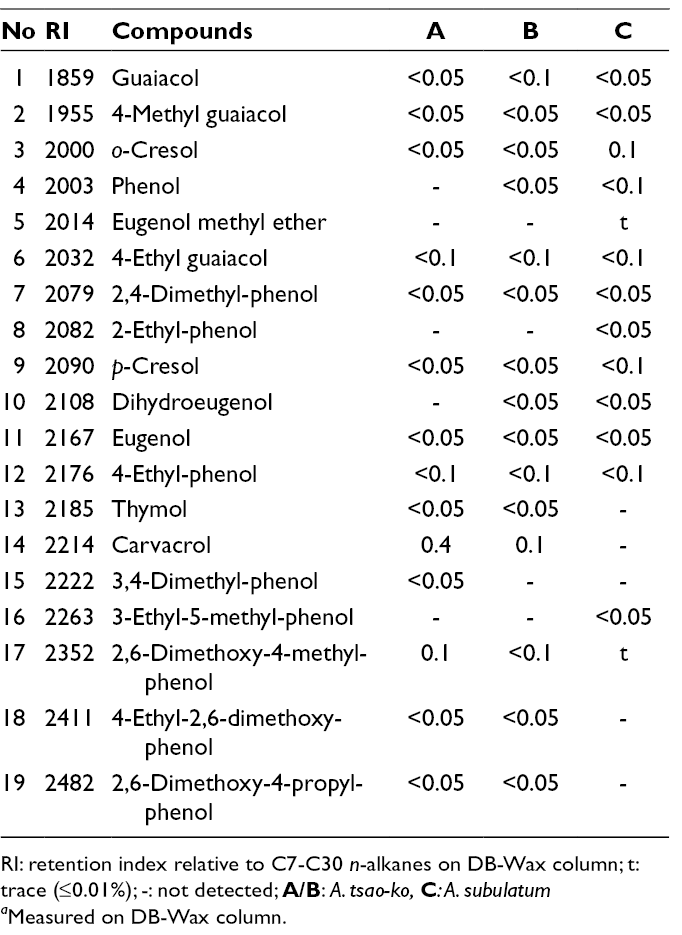
The oils from the 3 cardamom species gave a very characteristic odor profile. Although the A. tsao-ko oils (A) and (B) were slightly different from an olfactive point they could be clearly distinguished from oils C and D. Especially the smoky notes of both Amomum species A-C are interesting to mention as they were completely absent in green cardamom oil D. These smoky notes can be sometimes attributed to simple phenol derivatives. Besides carvacrol and thymol in oil A and small amounts of eugenol and derivatives a variety of simple phenolic compounds (Table 4) are indeed present in both A. tsao-ko oils (A/B) as well as in A. subulatum oil (C) but not in E. cardamomum oil (D).
RI: retention index relative to C7-C30 n-alkanes on DB-Wax column; t: trace (≤0.01%); -: not detected; A/B: A. tsao-ko,C: A. subulatum
aMeasured on DB-Wax column.
Chemical Composition (Mean Area %) of Major Constituents (>0.2%) of 6 Elettaria cardamomum Oils.a
No
RI
Compound
SD
D
E
F
G
H
I
1
1031
α-Pinene
0.11
1.3
1.2
1.9
1.9
1.6
1.0
2
1122
β-Pinene
0.02
0.3
0.5
0.4
0.4
0.3
0.3
3
1129
Sabinene
0.20
3.1
4.1
3.3
3.2
3.6
2.8
4
1165
Myrcene
0.27
1.7
1.9
2.1
1.9
1.7
1.2
5
1190
α-Terpinene
0.15
0.5
0.3
0.5
0.4
0.2
t
6
1210
Limonene
0.20
2.9
2.3
2.9
2.9
2.3
1.8
7
1226
Eucalyptol
0.33
27.9
20.9
24.7
25.4
22.6
24.6
8
1254
γ-Terpinene
0.22
0.9
0.6
0.9
0.8
0.4
0.1
9
1279
p-Cymene
0.22
0.1
t
0.3
0.5
0.2
0.1
10
1294
Terpinolene
0.09
0.4
0.5
0.4
0.3
0.1
<0.1
11
1470
trans-Sabinene hydrate
0.01
0.2
0.5
0.3
0.3
0.5
0.4
12
1474
trans-Sabinyl acetate
<0.01
<0.1
t
<0.1
<0.1
0.6
1.8
13
1477
1-Octylacetate
<0.01
0.1
0.2
0.2
0.1
0.1
<0.1
14
1545
Linalool
0.03
1.1
0.9
0.9
0.6
3.9
0.3
15
1556
cis-Sabinene hydrate
<0.01
0.2
0.4
0.2
0.2
0.3
0.3
16
1558
Linalyl acetate
0.04
0.7
0.5
1.6
1.3
6.5
1.3
17
1612
4-Terpinenol
0.03
3.0
2.0
2.0
1.9
1.1
0.6
18
1659
δ-Terpinyl acetate
0.01
0.3
0.1
0.3
0.3
0.2
0.3
19
1688
Neral
0.01
0.2
0.1
0.3
0.2
0.4
0.3
20
1704
α-Terpineol
0.17
1.4
3.1
0.4
0.4
0.7
0.1
21
1707
α-Terpinyl acetate
0.81
44.8
48.7
46.6
47.4
44.1
53.1
22
1733
β-Selinene
0.02
0.4
0.1
0.8
1.1
0.4
1.6
23
1737
Geranial
0.05
0.3
0.3
0.4
0.1
0.5
0.3
24
1758
Geranyl acetate
0.03
1.2
2.3
1.5
1.3
0.8
0.5
25
1770
γ-Cadinene
<0.01
0.1
<0.1
0.2
0.2
0.2
0.2
26
1849
Geraniol
0.04
2.2
2.1
1.3
1.1
1.3
0.8
27
2041
(E)-Nerolidol
0.05
0.7
0.7
1.2
1.2
1.4
1.1
28
2358
(2E,6E)-Farnesol
0.01
0.1
0.3
0.2
0.1
0.1
0.1
RI: retention index relative to C7-C30 n-alkanes on DB-Wax column; SD: max. ± standard deviation; t: trace (≤0.01%); -: not detected; D: dried pods India, E: fresh pods India, F/G: seeds—commercial India, H: seeds—commercial Guatemala, I: dried pods India—CO2 extract.
aMeasured in triplicate on DB-Wax column.
Such compounds can be either natural products or linked to smoky wood fires.59 Zerihun et al describe that different wood fires gave very characteristic phenolic patterns.59 Drying or curing in wood-fired houses is at least described for A. subulatum17 and also for E. cardamomum.10,60 As the same compounds were detected in both Amomum species from India and China the likelihood that all 3 samples have been dried using smoke from the same wood is minimal and therefore these compounds should be most likely considered part of the natural minor compounds spectrum in these 2 species. However, further investigation is needed to prove this theory. It is worth mentioning that most phenolic compounds described here were found in various smoke flavors before61 but also in birch tar oil,62 which might be the reason for the odor reminiscence. In addition phenolic compounds are linked to antioxidant properties, which were described before in literature for both Amomum species subulatum63 and tsao-ko.32,64
Nature sometimes harbors odor secrets even in well-known products, and smelling fresh green E. cardamomum pods during our Scent Expedition to Kerala in India was one of these moments for our perfumers. Fresh green cardamom pods are normally harvested 3 to 5 months after flowering and converted by drying into the final spice product.11 The odor of the oil from fresh green pods E was much rounder with less eucalyptol smell compared to the oil from dried pods D (Table 3). The odor differences were even more significant to commercial seed oils. However, the oil yield (<2.1%) from fresh green undried pods was also significantly lower compared with the oil from dry pods (<5.2%). To investigate this from a composition point of view we used our steam-distilled oil from dried pods D as a reference and compared it with an oil from fresh green pods E, 3 commercial steam-distilled seed oils of Indian F/G and Guatemalan H origin, and a CO2 extract from dried pods I (Table 5). This exercise also helped to understand the composition variability of E. cardamomum oils based on various factors like origin (India/Guatemala), production methods [steam distillation (lab/industrial scale)/CO2 extraction], plant material (seeds/pods), and drying stage (fresh/dried). This picture is still simplistic as it leaves harvest time11 and annual variations due to abiotic and biotic environmental factors out of the equation.
The 28 compounds listed in Table 5 represent between 94.6% (E) and 96.1% (D) of the total green cardamom oil. Cardamom oil D was used as a reference for comparison. Only compounds having an absolute composition difference (>0.7%) are listed in the text below to reflect differences between the oils. The small sample size does not allow a general statement but reflects only a variation snapshot.
The oil from fresh green cardamom pods E showed significantly lower eucalyptol and 4-terpinenol levels and higher amounts of α-terpinyl acetate, α-terpineol, geranyl acetate, and sabinene compared with D.11,65 These composition differences can explain the odor differences. The 2 Indian steam-distilled commercial oils from seeds F/G were very close in composition to each other with only minor differences in the 2 major ingredients. The analyses of E. cardamomum oils (F/G) are well in agreement with previous analyses.66 The oils F/G, however, showed some differences to the lab-distilled oil D, which used whole pods and not just seeds. The commercial oils F/G contained lower amounts of eucalyptol, 4-terpinenol, α-terpineol, and geraniol and higher amounts of α-terpinyl acetate and linalyl acetate. The variances to the commercial oil from Guatemala H were even more significant66: eucalyptol, 4-terpinenol, geraniol, α-terpineol, and α-terpinyl acetate levels were lower but linalyl acetate, linalool, and (E)-nerolidol content was significantly higher in comparison to lab oil D from India. This picture does not change much by looking only at the commercial Indian seed oils (F/G) vs the Guatemalan seed oil (H): α-terpinyl acetate, eucalyptol, and 4-terpinenol amounts were lower and linalyl acetate and linalool content was significantly higher in the oil H from Guatemala. High levels of linalyl acetate are also found in oils from Sri Lanka66 and Costa Rica67 and recently in a study from Turkey,68 but it stays unclear if the cardamom really originated from Turkey or was only purchased there. Literature shows that linalool and linalyl acetate levels may depend significantly more on the variety and genotype cultivated than on the country of origin.11
The CO2 extract I from whole pods gave lower amounts of eucalyptol, 4-terpinenol, geraniol, α-terpineol, limonene, linalool, geranyl acetate, and γ-terpinene but higher amounts of α-terpinyl acetate, trans-sabinyl acetate, and β-selinene in comparison to oil D. This picture changed slightly when the commercial Indian seeds oils F/G were compared to the CO2 extract from whole pods I. Nevertheless here also significant differences were found despite the fact that some other compounds contributed to this: lower 4-terpinenol, limonene, geranyl acetate, α-pinene, myrcene, and γ-terpinene amounts were found in I but higher amounts of α-terpinyl acetate, trans-sabinyl acetate, and β-selinene compared to oils F/G. Our results are in contrast to previous investigations69 where nearly no differences were found between a steam-distilled oil and a CO2 extract.
From this small study of green cardamom it can be clearly seen that many factors contribute to variations in natural products, however, to a different extent.
In summary, despite the fact that most essential oils are well investigated they still hold many secrets worthy of proper analysis and discovery. Many places in the world still harbor real treasures70 and some Asian spices are definitively belonging in this category.1,71 These spices, for example, both Amomum species, have not even reached the global flavor palette,3 not to mention the fragrance industry, despite the fact that they are used as culinary ingredients in large quantities in their respective countries of origin.1
In addition composition variations in natural products like those shown here for E. cardamomum and A. tsao-ko need to be seen more as fact than as burden. This is a neglected topic in a world targeting not only standardized synthetic aroma molecules but also standardized natural products like essential oils. If the trend for more naturalness continues as anticipated and consumers aim for real authentic natural products, education of customers and consumers is required to make them aware that such variations are a given in any natural product.72 We should not forget that the chance for long-term survival of plants and other living organisms depends on such variations and is a prerequisite for the adaptability of a species to the environment and consecutively allows natural selection which can be the origin of new varieties and species.73
Experimental
General
GC/MS: Agilent 6890N GC (DB-Wax: 60 m × 0.25 mm × 0.25 μm film thickness, carrier gas He, 60°C-240°C at 3°C/min) connected to Agilent 5975B quadrupole mass spectrometer, 70 eV (EI mode), mass range 25 to 550 amu. GC: Hewlett Packard 6890 with FID and sniffing port (for column and temperature program, see GC/MS). NMR spectra (δ/ppm, J/Hz) were recorded on a Bruker Avance III with 600 MHz (1H-NMR) or 151 MHz (13C-NMR) in C6D6 and using TMS as internal standard. All solvents and reagents are commercial products (Merck) and were used as received.
Plant Material
Dried pods of A. tsao-ko were purchased at a spice market in Shanghai, China, and a traditional Chinese medicine retail store in Singapore. Both samples originated from Yunnan province in China according to the suppliers. Dried A. subulatum as well as dried and fresh E. cardamomum pods were obtained from Synthite Industries Ltd, Kolenchery, Kerala, India. Black Nepal cardamom A. subulatum had its origin in the North Eastern Indian state of Sikkim, while the green cardamom was harvested in Kerala state in Southern India. Fresh green pods were collected in the Idukki district of Kerala at an age of 3 months after flowering. All 3 commercial cardamom essential oils from India and Guatemala were sourced in India and France from different suppliers on the open market. The CO2 extract was received from Ultra International Ltd, Ghaziabad, Uttar Pradesh, India.
Oil Isolation
Whole fresh and dried cardamom pods (100 g) were crushed by hand in a mortar and further ground in a commercial fruit blender followed by hydrodistillation in a Clevenger-type circulatory distillation apparatus74 for 4 hours to yield the respective essential oils. Amomum tsao-koA/B: yellow oil (0.7%-1.8%); A. subulatumC: yellow oil (0.9%-1.5%), E. cardamomum: dried—pods D: colorless to slightly yellow oil (up to 5.2%), and fresh pods E: colorless to slightly yellow oil (0.6%-2.1%).
We are especially grateful to Neethu Jose, Synthite Industries Ltd, Kolenchery, India, for providing fresh and dried green and black cardamom pods. We owe a special thanks to Bhuvana Nageshwaran, for the CO2 extract and information on the drying process. Su Kay Tan expresses her sincere gratitude to Symrise Asia Pacific Pte. Ltd, Singapore, for the opportunity to carry out part of this work during her SENSE internship in 2015 in Scent & Care Innovation—Analytical. The authors are indebted to Rüdiger Wittlake, Symrise AG, Holzminden, Germany, for NMR measurements and many helpful discussions. We thank our perfumers at Symrise Asia Pacific Pte. Ltd, Singapore, with a special mention to Florin Lutz and M. Subramanian, for odor evaluation. Dedicated to Dr. Brian M. Lawrence, an esteemed colleague and expert in essential oils, on the occasion of his 80th birthday in June 2019.
Declaration of Conflicting Interests
The author(s) declared no potential conflicts of interest with respect to the research, authorship, and/or publication of this article.
Author's Note
Citations should be considered as examples and may not be limited to these publications only. In addition the wrong assignment of one ingredient should not be linked to an overall quality judgment of these papers as the 1H-indene derivativesare not common in nature. Citations for the wrong assignment of 1H-indene derivatives should be considered as examples and may not be limited to these publications only. In addition the wrong assignment of one ingredient should not be linked to an overall quality judgment of the papers as these compounds are not common in nature.
Funding
The author(s) declared no financial support for the research, authorship, and/or publication of this article.
References
1.
RavindranPN. The encyclopedia of herbs and spicesVol 1 and 2. Wallingford, UK: CABI; 2017:1-1128.
2.
LawrenceBM. A preliminary report on the world production of some selected essential oils and countries. Perfum Flavor. 2009;34(1):38-44.
3.
SurburgH.PantenJ. Natural raw materials in the flavor and fragrance industry. In: Wiley-VCHW., ed.Common fragrance and flavor materials. 5th ed; 2006:177-238.
4.
NairKPP. The agronomy and economy of cardamom (Elettaria cardamomum M.): the "Queen of Spices". Adv Agronomy. 2006;91:179-471.
5.
RavindranPN.MadhusoodananKJ. Cardamom – the genus elettaria. London: CRC Taylor and Francis; 2002:1-368.
6.
ISO 676. Spices and condiments – botanical nomenclature. Geneva, Switzerland: International Organization for Standardization; 1995.
7.
RavindranPN. Cardamom – Elettaria cardamomum. In: The encyclopedia of herbs and spices. Vol 1. Wallingford, UK: CABI; 2017:215-221.
8.
ParthasarathyVA.PrasathD. Cardamom. In: PeterKV., ed.Handbook of herbs and spices. Vol 1. 2nd ed. Oxford, UK: Woodhead Publishing; 2012:131-170.
9.
ChempakamB.SindhuS. Small cardamom. In: ParthasarathyVA.ChempakamB.ZachariahTJ., eds.Chemistry of Spices. Wallingford, UK: CABI; 2008:41-58.
10.
ParthasarathyVA.KandiannanK. Cardamom. In:Horticulture – vegetable science - vegetables, tuber & spice crops – spices and condiments. Calicut: Indian Institute of Spice Research (ICAR); 2007:36-50.
11.
LeelaNK.PrasathD.VenugopalMN. Essential oil composition of selected cardamom genotypes at different maturity levels. Indian J Hortic. 2008;65:366-369.
12.
PrasathD.VenugopalVA. Genetic diversity and conservation of cardamom (Elettaria cardamomum Maton) in India. Plant Genet Resour Newsl. 2004;138:55-60.
13.
RavindranPN.ShylajaM.BabaKN. False cardamom. In: RavindranPN.MadhusoodananKJ., eds.Cardamom – the genus elettaria. London: CRC Taylor and Francis; 2002:330-340.
14.
RavindranPN. Large cardamom – Amomum subulatum. In The encyclopedia of herbs and spices. Vol 2Wallingford, UK: CABI; 2017:522-525.
15.
ChempakamB.SindhuS. Large cardamom. In: ParthasarathyVA.ChempakamB.ZachariahTJ., eds.Chemistry of Spices. Wallingford, UK: CABI; 2008:59-69.
16.
VaradarasanS.BiswasAK. Large cardamom (Amomum subulatum Roxb.). In: RavindranPN.MadhusoodananKJ., eds.Cardamom – The genus elettaria. London: CRC Taylor and Francis; 2002:299-329.
17.
MadhusoodananKJ.SaideswaraY. Cardamom (large). In: PeterKV., ed.Handbook of herbs and spices. Vol 11st ed. Oxford, UK: Woodhead Publishing; 2001:134-142.
18.
RavindranPN. Tsao-ko cardamom – Amomum tsao-ko. In The encyclopedia of herbs and spices. 2. Wallingford, UK: CABI; 2017:1003-1005.
19.
WuMH.ZhangW.GuoP.ZhaoZZ. Identification of seven Zingiberaceous species based on comparative anatomy of microscopic characteristics of seeds. Chin Med. 2014;9(10):1-7.doi:10.1186/1749-8546-9-10
20.
ZhangW.ChenJW.ShenY.YangZQ.XieSQ.YangSC. Extraction and determination of essential oil in different cultivars of Amomum tsao-ko. Adv Mat Res (Chemical Engineering and Material Properties II). 2012;549:474-477.doi:10.4028/www.scientific.net/AMR.549.474
21.
LawrenceBM. Progress in essential oils. Perfum Flavor. 2004;29(1):44-59.
22.
ZachariahTJ. Chemistry of cardamom. In: RavindranPN.MadhusoodananKJ., eds.Cardamom – The genus elettaria. London: CRC Taylor and Francis; 2002:69-90.
23.
LawrenceBM. Progress in essential oils. Perfum Flavor. 1986;11(1):29-35.
24.
JoshiR.SharmaP.SharmaV.PrasadR.SudRK.GulatiA. Analysis of the essential oil of large cardamom (Amomum subulatum Roxb.) growing in different agro-climatic zones of Himachal Pradesh, India. J Sci Food Agric. 2013;93(6):1303-1309.doi:10.1002/jsfa.5886
25.
BhandariAK.BishtVK.NegiJS.BaunthiyalM. 1,8-Cineole: a predominant component in the essential oil of large cardamom (Amomum subulatum Roxb.). J Med Plant Res. 2013;7:1951-1956.
26.
SatyalP.DosokyNS.KincerBL.SetzerWN. Chemical compositions and biological activities of Amomum subulatum essential oils from Nepal. Nat Prod Commun. 2012;7(9):1233-1236.doi:10.1177/1934578X1200700935
27.
KaskoosRA.MirSR.KapoorR.AliM. Essential Oil Composition of the Fruits of Amomum subulatum Roxb. J Essent Oil Bear Pl. 2008;11(2):184-187.doi:10.1080/0972060X.2008.10643617
28.
GilaniSR.ShahidI.JavedM.MehmudS.AhmeR. Antimicrobial activities and physico-chemical properties of the essential oil from Amomum subulatum. Int J Applied Chem. 2006;2(2-3):81-86.
29.
RoutPK.SahooD.JenaKS.RaoYR. Analysis of the oil of large cardamom (Amomum subulatum Roxb.) growing in Sikkim. J Essent Oil Res. 2003;15(4):265-266.doi:10.1080/10412905.2003.9712138
30.
LawrenceBM. Progress in essential oils. Perfum Flavor. 2003;28(2):52-70.
CuiQ.WangL-T.LiuJ-Zet al. Rapid extraction of Amomum tsao-ko essential oil and determination of its chemical composition, antioxidant and antimicrobial activities. J Chromatogr B. 2017;1061-1062:364-371.doi:10.1016/j.jchromb.2017.08.001
33.
WangY.YouC-X.WangC-Fet al. Chemical constituents and insecticidal activities of the essential oil from Amomum tsaoko against two stored-product insects. J Oleo Sci. 2014;63(10):1019-1026.doi:10.5650/jos.ess14087
34.
LiW.WangPJ.ShigematsuM.LuZG. Chemical composition and antimicrobial activity of essential oil from Amomum tsao-ko cultivated in Yunnan Area. Adv Mat Res (Environmental Biotechnology and Materials Engineering). 2011;183-185:910-914.doi:10.4028/www.scientific.net/AMR.183-185.910
35.
FengX.JiangZ-T.WangY.LiR. Composition Comparison of Essential Oils Extracted by Hydrodistillation and Microwave-assisted Hydrodistillation from Amomum tsao-ko in China. J Essent Oil Bear Pl. 2010;13(3):286-291.doi:10.1080/0972060X.2010.10643823
36.
YangY.YanR-W.CaiX-Q.ZhengZ-L.ZouG-L. Chemical composition and antimicrobial activity of the essential oil of Amomum tsao-ko. J Sci Food Agric. 2008;88(12):2111-2116.doi:10.1002/jsfa.3321
37.
WanHY.LLG.LiuWT.XGL. Extraction of volatile oil from Amomum tsao-ko by supercritical fluid CO2 extraction and its component analysis. Xiandai Huagong. 2015;35(12):96-100.
38.
HuangYF.QinLF.QMH.LaiMX.XCQ. Gas chromatography-mass spectrometry analysis of essential oil from Amomum tsao-ko Crevost et Lemarie and Amomum paratsao-ko S. Q. Tong et Y. M. Xia in GuangXi. Xiandai Zhongyao Yanjiu Yu Shijian. 2014;28(2):22-24.
39.
ZhangQ.HuangY.YangY. Research progress in essential oils of Amomum tsao-ko. Shizhen Guoyi Guoyao. 2014;25:931-933.
40.
HeQM.QuinJP.HuangY.YRL.LiuWL. Analysis of volatile oils from seeds and shells of Amomum tsao-ko by GC-MS. Chin J Experiment Tradit Med Formu. 2013;19(14):112-117.
41.
MengDW.LiW.WangPJ.Shigematsu M. RenHF.LuZG. Identification of compositions of Amomum tsao-ko essential oil using GC-MS and its antibacterial activity. Shipin Kexue Jishu Xuebao. 2013;31(5):24-30.
42.
FengX.JiangZ.LiR. Research progress in essential oil of natural food spice, Amomum tsao-ko. Zhongguo Tiaoweipin. 2009;8:40-42.
43.
MaJ.ZhangLX.PengJM. Studies on the chemical constituents of Amomum tsao-ko fruit introduced and cultivated in Xishuangbanna area by GC-MS. Zhongchengyao. 2008;30:1192-1194.
44.
DingYX.CuiXM.LiXL.DaiY. Study on GC-MS chromatographic fingerprint of Amomum tsao-ko essential oil. Guangpu Shiyanshi. 2006;23:81-84.
45.
ZhaoY.ZhangG.XiaoZ.QiuQ. Study of chemical constituents of the essential oil from Amomum tsao-ko Crevost at Lemaire by supercritical CO2 fluid extraction. Zhongguo Yaoxue Zazhi. 2004;39:705-706.
46.
ZhaoY.QiuQ.ZhangG.XiaoZ.LiuT. Study on chemical constituents of volatile oils from Amomum tsao-ko Crevost et Lemaire produced from Guangxi and Yunnan. Zhongcaoyao. 2004;35:1225-1227.
47.
WuHQ.HuangXL.HuangF.LinXS.HouDY.FHG. Gas chromatography-mass spectrometry fingerprint analysis of essential oil from Amomum tsao-ko Crevost et Lemaire. Zhipu Xuebao. 2004;25(2):92-94.
48.
LiZ.LuoL.DaiW.HuangR.ZhangY. Chemical constituents of essential oil on Amomum tsao-ko from Yunnan province. Yunnan Zhiwu Yanjiu. 1998;20(1):119-122.
49.
KönigWA.JoulainD.HochmuthDH. GC/MS Library: terpenoids and related constituents of essential oils. MassFinder3; 2004.
50.
TakidoM.YoshikawaY.YamanouchiS.KimuraY. 1H-Indene-2,3-dihydro-4-carboxaldehyde and 1H-indene-2,3-dihydro-5-carboxaldehyde from the seeds of Amomum medium. Phytochemistry. 1978;17(2):327-328.doi:10.1016/S0031-9422(00)94183-9
51.
SawerJC. Odorographie - a natural history of raw materials and drugs used in the perfume industry including the aromatics used in flavouring - intended for the use of growers, manufacturers and consumers. 125. 2nd ed. London: Gurney and Jackson; 1894.
52.
NguyenXD.KBL.LeclercqPA. The essential oil of Amomum tsao-ko Crevost et Lemarie from Vietnam. J Essent Oil Res. 1992;4:91-92.
53.
StarkenmannC.MayenzetF.BrauchliR.WunscheL.VialC. Structure elucidation of a pungent compound in black cardamom: Amomum tsao-ko Crevost et Lemarié (Zingiberaceae). J Agric Food Chem. 2007;55(26):10902-10907.doi:10.1021/jf072707b
54.
SongQS.TengRW.LiuX.YangCR. Tsaokoin, a new bicyclic nonane from Amomum tsao-ko. Chin Chem Lett. 2001;12:227-230.
55.
MoonSS.LeeJY.ChoSC. Isotsaokoin, an antifungal agent from Amomum tsao-ko. J Nat Prod. 2004;67(5):889-891.doi:10.1021/np030464l
56.
LawrenceBM. Terpenes in two Amomum oils. Phytochemistry. 1970;9:665.
57.
Pura NaikJ.Jagan Mohan RaoL.Mohan KumarTM.SampathuSR.LJMR.KumarTMM. Chemical composition of the volatile oil from the pericarp (husk) of large cardamom (Amomum subulatum Roxb.). Flavor Fragrance J. 2004;19(5):441-444.doi:10.1002/ffj.1336
58.
BraunNA.MeierM.KohlenbergB.HammerschmidtF-J. δ-Terpinyl Acetate. A New Natural Component from the Essential Leaf Oil of Laurus nobilis L. (Lauraceae). J Essent Oil Res. 2001;13(2):95-97.doi:10.1080/10412905.2001.9699624
59.
KellyD.ZerihunA.SinghDPet al. Exposure of grapes to smoke of vegetation with varying lignin composition and accretion of lignin derived putative smoke taint compounds in wine. Food Chem. 2012;135(2):787-798.doi:10.1016/j.foodchem.2012.05.036
60.
AliSA. Cardamom processing. In: Practical Action. Rugby, UK: The Schumacher Centre for Technology & Development; 2007:1-10.
61.
HoCT. Phenolic Compounds in Food. In: CTH.LeeCY.HuangMT., eds.Phenolic Compounds in Food and their Effects on Health I. 506. Washington, DC: American Chemical Society; 1992:2-7.
62.
MurwanashyakaJN.PakdelH.RoyC. Separation of syringol from birch wood-derived vacuum pyrolysis oil. Separation and Purification Technology. 2001;24(1-2):155-165and 575 (Erratum).doi:10.1016/S1383-5866(00)00225-2
63.
KapoorIPS.SinghB.SinghG.IsidorovV.SzczepaniakL. Chemistry, antifungal and antioxidant activities of cardamom (Amomum subulatum) essential oil and oleoresins. Int J Essent Oil Ther. 2008;2(1):29-40.
64.
MartinTS.KikuzakiH.HisamotoM.NakataniN. Constituents of Amomum tsao-ko and their radical scavenging and antioxidant activities. J Am Oil Chem Soc. 2000;77(6):667-673.doi:10.1007/s11746-000-0107-4
65.
KumaraSJS.PackiyasothyEV.JanszER. Some studies on the effect of maturity and storage on the chlorophyll content and essential oils of the cardamon fruit (Elettaria cardamomum). J Sci Food Agric. 1985;36(6):491-498.doi:10.1002/jsfa.2740360611
66.
ThomasE.KizhakkayilJ.ZachariahTJ.SyamkumarS.SasikumarB. GC/MS analysis of essential oil of export grade Indian, Guatemalan and Sri Lankan cardamom. J Med Aromatic Plant Sci. 2009;31:206-208.
67.
NoleauI.ToulemondeB.RichardH. Volatile constituents of cardamom (Elettaria cardamomum maton) cultivated in Costa Rica. Flavour Fragr J. 1987;2(3):123-127.doi:10.1002/ffj.2730020309
MarongiuB.PirasA.PorceddaS. Comparative analysis of the oil and supercritical CO2 extract of Elettaria cardamomum (L.) Maton. J Agric Food Chem. 2004;52(20):6278-6282.doi:10.1021/jf034819i
70.
JoulainD. Flower scents from the pacific. Chemistry and Biodiversity. 2008;5(6):896-909.doi:10.1002/cbdv.200890103
BraunNA.SimS. Jasminum sambac flower absolutes from India and China--geographic variations. Nat Prod Commun. 2012;7(5):645-650.doi:10.1177/1934578X1200700526
73.
DarwinC. The origin of species by means of natural selection or the preservation of favoured races in the struggle for life. 6th ed. London: John Murray; 1859:1-458.
74.
RubioloP.SgorbiniB.LibertoE.Cordero CB. Essential oils and volatiles: sample preparation and analysis. A review. Flavour Fragr J. 2010;25(5):282-290.doi:10.1002/ffj.1984