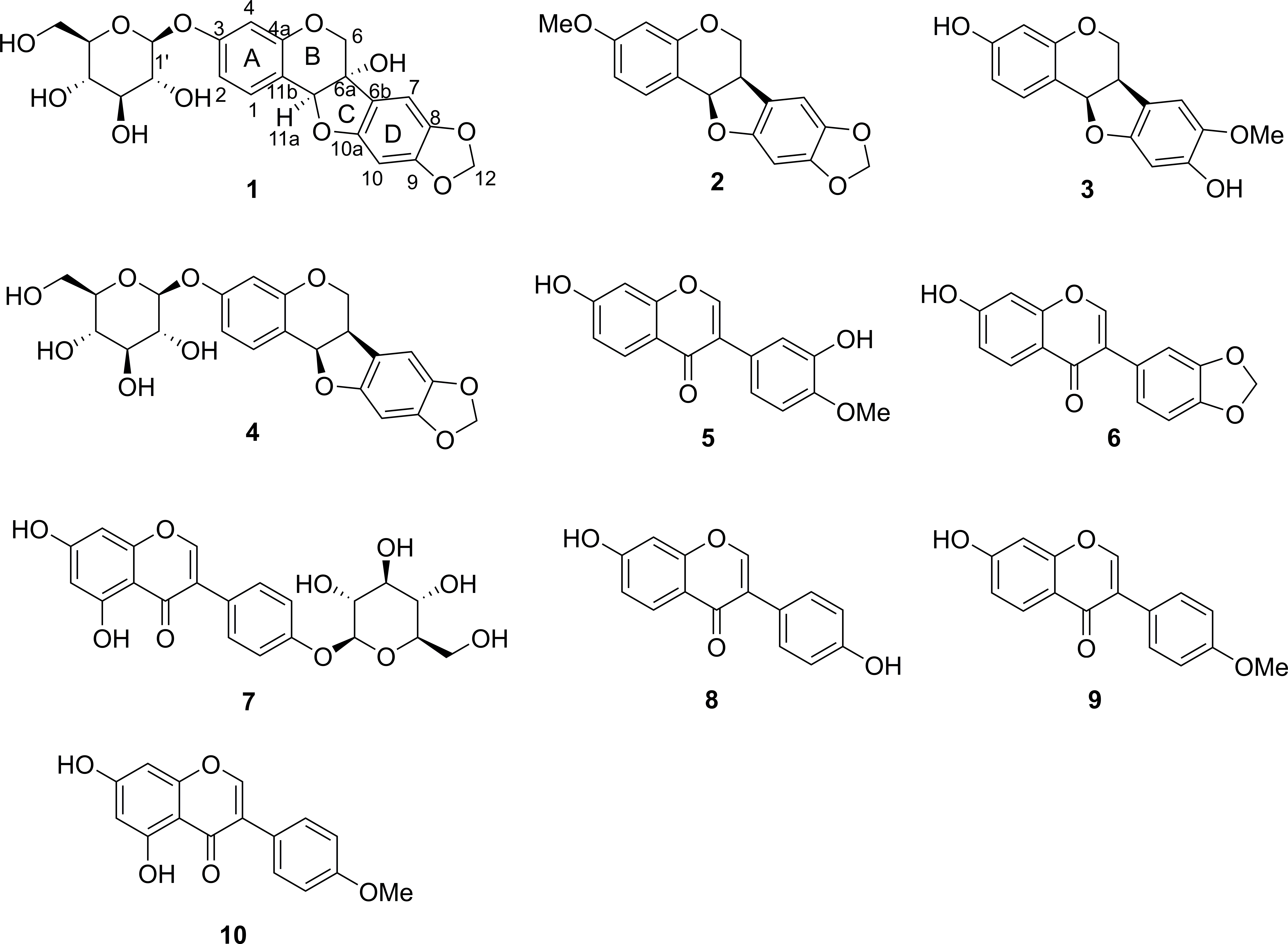
A new pterocarpan, named davidicarpan A (1), together with 9 known flavonoids, including 3 pterocarpans (2-4) and 6 isoflavones (5-10), were isolated from the flowers of Sophora davidii (France.) Pavol. Their structures were confirmed by high-resolution electrospray ionization-mass spectrometry, one-dimensional (1D) and 2D nuclear magnetic resonance spectroscopy, and comparison with reported literature values. Compounds 1 and 4 exhibited anti-tobacco mosaic virus (anti-TMV) activities with inhibition rates of 27.4% and 26.2%, which was higher than that of the positive control, ningnamycin.
The genus Sophora, belonging to the family Leguminosae, comprises approximately 70 species of shrubs or small trees that are widely distributed in tropical and temperate zones, with 21 species occurring in China.1 Among them, Sophora davidii (France.) Pavol., a deciduous shrub, occurs on hill slopes and sandy places in valleys in the Hubei, Sichuan, Henan, and Yunnan provinces. As reported previously, S. davidii contains a diversity of chemical constituents, including alkaloids,2 flavones,3 and stilbene oligomers.4,5 It also exhibits various biological activities, such as antitumor,6 anti-inflammatory,7 and antiallergic7 activities. In the current study, we report the isolation and structural identification of a new pterocarpan, davidicarpan A (1), which have a hydroxyl at C-6a as well as a β-D-glucose moiety at C-3 in the structure, along with 9 known compounds, including pterocarpin,2,8,9 kushenin,3,10 trifolirhizin,4,11 calycosin,5,11 pseudobaptigenin,6,12 sophoricoside,7,13 daidzein,8,11 formononetin,9,14 and biochanin A10,15 (Figure 1). Compounds 2, 3, and 8 to 10 were isolated from S. davidii for the first time in this study. Since some flavonoids16 and the isolates from the plants of genus Sophora17 exhibit potential anti-tobacco mosaic virus (TMV) activities, the anti-TMV activities of compounds 1 to 10 were also assessed.
Compounds 1-10 isolated from Sophora davidii (France.) Pavol.
Compound 1 was isolated as a yellow amorphous powder with a molecular formula of C22H22O11, implying 12 degrees of unsaturation, which was determined based on the high-resolution electrospray ionization-mass spectrometry (HR-ESI-MS) and 13C-nuclear magnetic resonance (NMR) spectra. The infrared (IR) spectrum displayed characteristic absorptions of hydroxy (3374 cm−1) and aromatic ring (1619 and 1463 cm−1) groups. The 1H-NMR data (Table 1) of compound 1 displayed the signals readily corresponding to 1 set of the ABX system at δH 7.37 (1H, d, J = 8.5 Hz, H-1), 6.71 (1H, dd, J = 8.5, 2.5 Hz, H-6'), and 6.53 (1H, d, J = 2.5 Hz, H-4), belonging to a tri-substituted benzene ring, and 2 isolated aromatic protons at δH 6.96 (1H, s, H-7) and 6.51 (1H, s, H-10), which indicated the presence of a 1,2,4,5-tetrasubstituted aromatic ring. In the upfield region, the protons at δH 4.05 (2H, m, H-6) and an oxymethine signal at δH 5.26 (1H, s, H-11a) were also observed. In combination, the above NMR data suggested the existence of a pterocarpan structure.16 The assignments for the pterocarpan skeleton were confirmed by the heteronuclear multiple bond correlation (HMBC) correlations (Figure 2) from H-11a to C-1, C-4a, C-6, C-6a, and C-6b and from H-7 to C-6a. Moreover, protons of a β-glucose moiety, for which the anomeric proton resonated at δH 4.83 (1H, d, J = 7.5 Hz, H-1′), were found in the high-field region, and the moiety was attached at C-3 as deduced by the HMBC cross-peak between H-1′ and C-3. The D-configuration of the glucose moiety was assessed via gas chromatography analysis of its chiral derivatives following snailase hydrolysis. Excluding the aforementioned signals, methylenedioxy group protons were found at δH 5.97 (1H, d, J = 1.0 Hz, H-12α) and 5.93 (1H, d, J = 1.0 Hz, H-12β) upfield of 1H-NMR and at δC 101.7 (C-12) of 13C-NMR, the location of which was confirmed by the HMBC correlations from H-12 to C-8 and C-9. According to biogenetical regulations, the conformation at B/C ring junction has always been regarded as cis because these compounds are presumably derived from pterocarpan in which the cis fusion has been proven by X-ray crystallography. Furthermore, the absolute configuration at C-6a and C-11a was S, as indicated by the negative optical rotation value ([α]20 D‒142) and the negative cotton effect at 214 nm (Supplementary Material).18 The structure of compound 1 was, therefore, established as (6aS,11aS)−3,6a-dihydroxy-8,9-methylenedioxy-pterocarpan-3-O-β-D-glucopyranoside (Figure 1). It is here named davidicarpan A.
Characteristic correlations observed by heteronuclear multiple bond correlation spectrum for compound 1.
1H and 13C-NMR Data of Compound 1 in DMSO-D6 (δ, ppm; J, Hz).
No.
δH
δC
No.
δH
δC
1
7.37 (1H, d, J = 8.5 Hz)
131.9
10a
153.7
2
6.71 (1H, dd, J = 8.5, 2.5 Hz)
110.6
11a
5.26 (1H, s)
84.3
3
158.4
11b
114.5
4
6.53 (1H, d, J = 2.5 Hz)
103.9
12α
5.97 (1H, d, J = 1.0 Hz)
101.2
4a
155.5
12β
5.93 (1H, d, J = 1.0 Hz)
6
4.05 (2H, m)
69.2
1′
4.83 (1H, d, J = 7.5 Hz)
100.3
6a
75.6
2′
3.20 (1H, m)
73.1
6b
120.6
3′
3.24 (1H, m)
76.5
7
6.96 (1H, s)
103.8
4′
3.13 (1H, m)
69.7
8
148.7
5′
3.30 (1H, m)
77.0
9
141.4
6′
3.68 (1H, m); 3.43 (1H, m)
60.6
10
6.51 (1H, s)
93.4
As some flavonoids exhibit potential anti-TMV activities, all the isolates were evaluated for their protective effects against TMV replication at the concentration of 20 µM using the half-half method.19 Ningnanmycin, a commercial product for plant disease in China, was used as a positive control. The results showed that compounds 1 and 4 exhibited anti-TMV activity with inhibition rates of 27.4% and 26.2%, respectively, compared with that of the positive control ningnanmycin (24.8%). Compounds 2 and 6 showed moderate activity with inhibition rates of 21.2% and 19.8%, respectively. The preliminary results suggested that the presence of 1,3-benzodioxole ring could lead to an increase of protective effects against TMV replication. Moreover, in contrast with compounds 1 and 4, compounds 2 and 6 have no β-D-glucose moiety on position C-3. This result implied that the β-D-glucose substitute at C-3 is necessary for the anti-TMV activity.
Experimental
General Experimental Procedures
Optical rotation, Jasco P-2000 polarimeter; UV, JASCO V-650 spectrophotometer; ECD, Jasco J-815 spectrometer; IR, Nicolet 5700 spectrometer; NMR spectra, Bruker AM500 FT-NMR spectrometer; HR-ESI-MS, AB SCIEX TripleTOF 6600 mass spectrometer; preparative high-performance liquid chromatography (HPLC), Waters Prep 150 LC system using a YMC-Pack ODS-column. Column chromatography, Diaion HP-20 macroporous resin and Sephadex LH-20 columns.
Plant Material
The flowers of S. davidii in the present study were collected from Yiliang City, Yunnan Province, China, in October 2018. The plant was authenticated by one of the authors (Sheng Huang) and the voucher specimens were deposited at the Department of Plant Resources, School of Food and Bioengineering, Zhengzhou University of Light Industry, China.
Extraction and Isolation
Dried flowers of S. davidii (10 kg) were extracted 3 times with 80% EtOH (3 × 20 L, 3 hours) under reflux. All of the EtOH solution was evaporated under reduced pressure, following which the dark brown residue (1.1 kg) was suspended in H2O (3 L) and fractionated sequentially with petroleum ether (5 × 3 L), EtOAc (5 × 3 L), and n-BuOH (6 × 3 L). The obtained n-BuOH-soluble extract (0.4 kg) was subjected to chromatography on an HP-20 macroporous absorption resin column (200 × 15 cm i.d.) and eluted successively with 0%, 15%, 30%, 50%, 75%, and 95% ethanol (15 L each) to yield 6 fractions (fractions A-F). Fraction C (72 g) was separated on a Sephadex LH-20 column (120 cm × 10 cm i.d.) and eluted with a MeOH/H2O (0%-100%, with 10% stepwise increase of MeOH, 2 L each) mixture to give fractions C1-C9 under guidance of liquid chromatography with a photodiode array detector. Fraction C4 was further chromatographed on a Sephadex LH-20 column with MeOH/H2O (0%, 10%, 20%, 40%, 60%, 85%, and 100%, v/v, 1 L each) to generate fractions C4-1 to C4-18, of which fraction C4-9 was purified by reverse semipreparative HPLC, using MeOH/H2O/HOAC (45:55:0.1, v/v) as the mobile phase at 3 mL/min to afford compounds 1 (7 mg), 2 (24 mg), 3 (16 mg), and 4 (9 mg). Fraction C4-8 was chromatographed on a Sephadex LH-20 column with a gradient of MeOH/H2O (0%, 10%, 30%, 50%, 70%, and 100%, v/v, 1 L each) to generate fractions C4-8A to C4-8H. Fraction C4-8D was fractionated by semipreparative HPLC using MeOH/H2O/HOAc (40:60:0.1, v/v) at 3 mL/min to produce compounds 5 (28 mg), 6 (16 mg), and 7 (14 mg). Compounds 8 (9 mg), 9 (11 mg), and 10 (5 mg) were obtained from fraction C4-8F using MeOH/H2O/HOAC (65:35:0.1, v/v) as the mobile phase at 3 mL/min. All of the isolates were dried under reduced pressure, and comprehensive spectroscopic data were collected.
Anti-TMV Assays
The protective effects of all isolated compounds against TMV replication were examined at the concentration of 20 µM using the half-half method. TMV (U1 strain) was obtained from the Key Laboratory of Tobacco Chemistry, Yunnan Academy of Tobacco Science. The virus was multiplied in Nicotiana tabacum cv. K326. The concentration of TMV was adjusted to 20 mg/mL as determined by UV absorption [virus concentration = (A260 × dilution ratio)/ ]. The purified virus was kept at −20°C and was diluted to 32 µg/mL with 0.01 M phosphate-buffered saline before use. Nicotiana glutinosa plants were cultivated in an insect-free greenhouse. N. glutinosa was used as a local lesion host. The experiments were conducted when the plants grew to the 5-6-leaf stage. The tested compounds were dissolved in dimethyl sulfoxide (DMSO) and diluted with distilled H2O to the required concentrations. A solution of equal concentration of DMSO was used as a negative control. The commercial antiviral agent ningnanmycin was used as a positive control. For the half-leaf method, the virus was inhibited by mixing with the solution of compound. After 30 minutes, the mixture was inoculated on the left side of the leaves of N. glutinosa, whereas the right side of the leaves was inoculated with the mixture of DMSO solution and the virus as control. The local lesion numbers were recorded 3 or 4 days after inoculation. Three repetitions were conducted for each compound. The inhibition rates were calculated according to the formula inhibition rate (%) = [(C − T)/C] ×100%, where C is the average number of local lesions of the control and T is the average number of local lesions of the treatment.
HR-ESIMS: m/z 485.1069 [M + Na]+ (calculated for 485.1058, C22H22O11Na)
Footnotes
Declaration of Conflicting Interests
The author(s) declared no potential conflicts of interest with respect to the research, authorship, and/or publication of this article.
Funding
The author(s) disclosed receipt of the following financial support for the research, authorship, and/or publication of this article: This work was supported by Key Science and Technology Program of Henan Province (No. 182102310682), and Doctoral Scientific Research Foundation of Zhengzhou University of Light Industry (13501050063).
Supplemental Material
References
1.
Editorial Committee of Chinese Flora. Flora of China. Beijing, China: Science Press; 2010.
2.
WangXK.LiJS.DaGM.WeiLX. Studies on the alkaloid constituents in the seeds of Sophora viciifolia Hance. Chin J Chin Mat Med. 1995;4(3):154-156.
3.
DongLH.TaiZG.YangYB.LiuCS.CaiL.DingZT. Chemical constituents of the flowers of Sophora viciifolia Hance. West Chin J Pharm Sci. 2010;25(6):636-640.
4.
OhyamaM.IchiseM.TanakaT.IinumaM.BurandtCL. Davidiol D, first naturally occurring resveratrol pentamer isolated from Sophora davidii. Tetrahedron Lett. 1996;37(29):5155-5158.doi:10.1016/0040-4039(96)01078-7
5.
TanakaT.ItoT.IinumaM.OhyamaM.IchiseM.TateishiY. Stilbene oligomers in roots of Sophora davidii. Phytochemistry. 2000;53(8):1009-1014.doi:10.1016/S0031-9422(00)00016-9
6.
WangXK.LiJS.WeiLX.YanYN. The effects of inhibiting tumor in vitro of alkaloids from the seed of Sophora viciifolia. J Beijing Univ TCM. 1996;19(2):59-61.
7.
WenM.MaoXJ. Research on the anti-inflammatory and anti-allergic effects of chemical constituents from the flowers of Sophora viciifolia. Yunnan J Tradit Chin Med Mater Med. 2006;27(1):63-64.
8.
YooH.ChaeH-S.KimY-Met al. Flavonoids and arylbenzofurans from the rhizomes and roots of Sophora tonkinensis with IL-6 production inhibitory activity. Bioorg Med Chem Lett. 2014;24(24):5644-5647.doi:10.1016/j.bmcl.2014.10.077
9.
RyuYB.Curtis-LongMJ.KimJHet al. Pterocarpans and flavanones from Sophora flavescens displaying potent neuraminidase inhibition. Bioorg Med Chem Lett. 2008;18(23):6046-6049.doi:10.1016/j.bmcl.2008.10.033
10.
WuLI.MiyaseT.UenoA.KuroyanagiM.NoroT.FukushimaS. Studies on the constituents of Sophora flavescens Aiton. II. Chem Pharm Bull. 1985;33(8):3231-3236.doi:10.1248/cpb.33.3231
11.
ZhangC.WangY-M.ZhaoF-Cet al. Phenolic Metabolites from the Stems and Leaves of Sophora flavescens. Helv Chim Acta. 2014;97(11):1516-1525.doi:10.1002/hlca.201400013
12.
ShiratakiY.YoshidaS.SugitaYet al. Isoflavanones in roots of Sophora secundiflora. Phytochemistry. 1997;44(4):715-718.doi:10.1016/S0031-9422(96)00582-1
13.
AbdallahHM.Al-AbdAM.AsaadGF.Abdel-NaimAB.El-halawanyAM. Isolation of antiosteoporotic compounds from seeds of Sophora japonica. PLoS One. 2014;9(6):e98559-e98559/8.doi:10.1371/journal.pone.0098559
14.
ParkYK.LeeHJ.LeeSS.ChoiDH.OhJS. New isoflavone glycoside from the woods of Sophora japonica. Bull Korean Chem Soc. 2004;25(1):147-148.
15.
MaQ.LeiHM.ZhouYX.WangCH. Study on the chemical constituents of Trifolium pratense. Chin Pharm J. 2005;40(14):1057-1059.
16.
ZhaoW.ZengX.ZhangTet al. Flavonoids from the bark and stems of Cassia fistula and their anti-tobacco mosaic virus activities. Phytochem Lett. 2013;6(2):179-182.doi:10.1016/j.phytol.2012.12.006
17.
NiW.LiC.LiuYet al. Various bioactivity and relationship of structure-activity of matrine analogues. J Agric Food Chem. 2017;65(10):2039-2047.doi:10.1021/acs.jafc.6b05474
18.
InghamJL.MarkhamKR. Identification of the Erythrina phytoalexin cristacarpin and a note on the chirality of other 6a-hydroxypterocarpans. Phytochemistry. 1980;19(6):1203-1207.doi:10.1016/0031-9422(80)83084-6
19.
HuQ-F.ZhouB.GaoX-Met al. Antiviral chromones from the stem of Cassia siamea. J Nat Prod. 2012;75(11):1909-1914.doi:10.1021/np300395m
Supplementary Material
Please find the following supplemental material available below.
For Open Access articles published under a Creative Commons License, all supplemental material carries the same license as the article it is associated with.
For non-Open Access articles published, all supplemental material carries a non-exclusive license, and permission requests for re-use of supplemental material or any part of supplemental material shall be sent directly to the copyright owner as specified in the copyright notice associated with the article.