



Abstract
Among 60-70 species of Amaranthaceae, only three are grain-producing species and Amaranthus cruentus is one of them. It stands out for its significant chemical composition. The high protein content and amino acid composition give amaranth medicinal benefits such as cholesterol lowering, antioxidant, anticancer, anti-allergic, and antihypertensive activity. The fixed oil yield obtained by cold-pressing the grain is only 7-8%, but these lipids are valuable due to the presence of unsaturated fatty acids, tocopherols, tocotrienols, phytosterols, and squalene, which are not present in the same composition in other common oils. Among them, squalene is highly desirable.
Keywords
Amaranthus species belong to the Caryophyllales order, Amaranthaceae family, Amaranthoideae subfamily, and Amaranthus genus. 1,2 The Caryophyllales contains 33 families, 692 genera, and 11 155 species. 3 The taxonomic classification of the Amaranthaceae has been studied intensively and genetic research revealed that morphological and anatomical characters are different from phylogenetic relationships. 4 The two subfamilies, Amaranthoideae and Chenopodioideae, are closely related, and for a long time were considered as one evolutionary line due to their morphological similarities. Chenopodiaceae and Amaranthaceae together, have been separated based on three characters: stamen connation, sepal fleshiness, and sepal color, but there are numerous exceptions to these subfamilies (Amaranthoideae, Betoideae, Camphorosmoideae, Chenopodioideae, Corispermoideae, Gomphrenoideae, Polycnemoideae, Salicornioideae, Salsoloideae, Suaedoideae) with 180 genera (including Amaranthus) and 2500 species. 5,6 The genus Amaranthus has been the subject of many taxonomic studies, but it is still classed as “difficult.” The taxonomy is complicated by numerous hybrid forms, a wide geographical distribution, and small and difficult to recognize diagnostic elements. 7
The Amaranthus genus includes around 60 species of which 40 are native to the Americas and the rest to Africa, Asia, and Europe, 8 with 17 species with edible leaves and 3 grain amaranths. 9 Seventy-five species were reported by Sauer, 10 123 are reported by the United States Department of Agriculture (USDA), National Plant Germplasm System, 11 and 100 are reported in the Hanf study (as cited in Assad et al. 7 Assad et al., 7 followed by Jacobsen et al., 12 report 87 species, of which 14 are recognizable in Australia, 17 in Europe, and 56 in America.
Sauer’s 13 taxonomic key lists 3 principal species of Amaranthus, for grain production:
Amaranthus caudatus L.
Amaranthus hypochondriacus L.
Amaranthus cruentus L.
The USDA 14 presents the following taxonomic classification of A. cruentus:
Kingdom: Plantae
Subkingdom: Tracheobionta
Superdivision: Spermatophyta
Division: Magnoliophyta
Class: Magnoliopsida
Subclass: Caryophyllidae
Order: Caryophyllales
Family: Amaranthaceae
Genus: Amaranthus L.
Species: Amaranthus cruentus L.
Amaranthus cruentus is an annual herbaceous plant which reproduces only by seeds and has a short growing period: of 4–6 weeks. 15 It produces one dominant, large, central root (tap root). Thick stems are often straight and branched, 0.1 to 2.0 m in height, ribbed, and red dyed. Leaves are arranged spirally, simple, without stipules, and their shape varies from ovate to rhombic-ovate. Small fine hairs cover leaf and stem surfaces. Numerous unisexual flowers are green and form finger-like spikes with long and dense terminal panicle and axillary spikes below. The terminal spike is often lax. There are 5 tepal segments, which are lanceolate, acute, 2-3 mm long, with a sharp and long tip, causing the inflorescence to feel distinctly prickly. Five, 1 mm long stamens form a male flower, while the female flower is a 1-celled ovary crowned by 3 stigmas. At maturity, the whole plant may be reddish. 16,17 The large and complex inflorescence consists of numerous concentrated cymes arranged axillary, ended with racemes and spikes. The top one, with numerous laterals, is perpendicular, with thin branches up to 45 cm long. There 2-3 mm long bracts. 16 The inflorescence is more than 50 cm long, characterized by high color variability. Each of them produces about 50 000 seeds in round or more often in lenticular shape, 1-1.5 mm in diameter, shiny, and dark brown. 16,18 Either light only or together with high temperatures stimulate germination. Temperatures of 20/35°C and light give the greatest rise. 19
The grain of amaranth is small, around 0.9 to 1.7 mm in diameter. The mass of 1000 seeds is around 0.6-1.0 g. 20 Grains are lenticular, with a color that varies from white, pink, through gold and brown to black. The coat of the seed is smooth and thin. The germ is campylotropous, which is caused by the shape of the seed and they are bent down and surround the perisperm like a ring. 20 Diploid in chromosome number. The perisperm is the main seed storage. Endosperm is present only in the micropylar area of the seed. 20–23
Amaranthus belongs to the NAD-ME (nicotinamide adenine dinucleotide-dependent malic enzyme) type of C4 pathway of photosynthesis type plants. Involvement with this pathway of photosynthesis has allowed amaranth to adapt from raw (typical for Andean highlands climate) to tropical and temperate conditions. 17,24,25 The ecological advantage of species with this photosynthetic pathway is revealed not only in the very efficient assimilation of CO2, but also in more efficient water economy. These plants consume 60% of the water needed for production of biomass compared with C3 plants. This allows amaranth rapid growth at high temperatures and under drought conditions (reported by Hauptli as cited in Kauffman and Weber). 26 This mechanism of photosynthesis of the C4 pathway provides amaranth efficient osmotic pressure, so that a crop can be grown even at an annual total rainfall of 200 mm. 27
Different environmental conditions, such as temperature, light, and soil type, have an influence on amaranthus seed germination and thus affect grain yield. Yields of amaranth grain in European conditions range between 500 and 3.800 kg/ha and are strongly influenced by growing conditions, location, and fertilizer inputs. 28
The distinctive characteristic of A. cruentus grain, and what distinguishes it from a true cereal, is its high protein content, and its beneficial amino acid composition. 20,29–31 In amaranth, 65% of proteins are found in the embryo and only 35% in the perisperm, and a balanced amino acid composition is a characteristic of this plant. 2,30
By accepting 100 as the highest biological value of a protein with a balanced amino acid composition, a value of 73-77 is given for cow’s milk, while for amaranth this is 75-79. 18 Ratusz and Wirkowska 32 indicate a 14% protein content, depending on the plant variety, climatic and soil conditions, and fertilization method. 33 Protein of A. cruentus seeds consists of albumins, globulins, prolamins, and glutelins fractions, 34,35 respectively: 48.9-65%, 13.7-18.1%, 1.0-3.2%, and 22.4-42.3% of the total protein content. 33,36–38 The values given by different authors differ due to the use of variable extraction conditions. Because of a low content of gluten prolamins, which do not contain gliadin, secalins, or hordein, adverse immune responses are not produced. 33,39,40 It should also be emphasized that pseudocereals do not contain gluten, and so can be introduced into the diet of patients suffering from celiac disease. 2,35,41,42 Ballabio et al. 43 have shown that most Amaranthus species contain less than 20 ppm gluten protein in 100 g dry matter, which is a safety measure for celiac disease; this was confirmed by Barca et al. 44 Since globulins and glutelins are the major fractions of amaranth seed storage proteins, they can be considered as a natural potential source of antihypertensive peptides. The peptide, with strong potential biological activities, is a unique 43 amino acid peptide, called lunasin, 45 with 9 aspartic acids (D) at the C-terminus. It contains an RGD, the arginine-glycine-aspartic acid (Arg-Gly-Asp) cell-adhesion motif, and a conserved region of the chromatin-binding protein. 46–48
The presence of lunasin in common cereals, like barley 45,49 and wheat, 45,50 suggest that lunasin or lunasin-like compounds may be found in other grains. Silva-Sánchez et al. 45 analyzed the presence, characteristic features, and anticarcinogenic properties of the lunasin peptide and other bioactive peptides present in amaranth seed. Lunasin concentrations in total extracted protein from amaranth mature seeds ranged from 9.5 to 12.1 µg. Western blot analysis detected lunasin with a molecular weight of 18.5 kDa. However, amaranth protein reacted immunologically with soy lunasin antibodies, and for this reason, it was considered as a lunasin-like protein. It was found in globulin 7S, globulin 11S, and glutelin fractions, as well as in the total protein extract of mature seeds. 45
It is possible that nucleus membrane-peptide recognition depends on the presence of a transmembrane motif present in the full amaranth lunasin sequence (22 kDa). The lunasin-like peptide has the ability to inhibit acetylation of H3 and H4 histones and it can explain an epigenetic mechanism for the cancer-preventive properties of lunasin. 48–54 The role of chromatin modification is well recognized in cell cycle control and in the role of tumor suppressors in carcinogenesis. 48,55 Five hundred nM of amaranth lunasin selectively induces apoptosis in chemically transformed cells. Ten μM barley lunasin or synthetic lunasin inhibits colony formation, while inhibition of foci formation requires less amount of amaranth lunasin. 45,48 This indicates that amaranth lunasin is more efficient as a cancer-preventive peptide. Amaranth lunasin peptide is located inside a lipid-transfer protein, and not as part of a Bowman-Birk protease inhibitor, as was reported for soybean. 48 The presence of lunasin in plants can support new research on amaranth as an alternative food, containing health-promoting benefit peptides. 48
Biopeptides identified in a tryptic digest of an amaranth glutelin fraction by LC-MS/MS (mass spectrometry and liquid chromatography-tandem mass spectrometry) showed 508 de novo peptides. Active peptides were found in amaranth proteins with 12 main activities (Table 1): antiamnestic, antithrombotic, immunomodulating, opioid, regulating, antioxidant, ligand, activating ubiquitin-mediated proteolysis, immunostimulating, embryotoxic, protease inhibiting, and antihypertensive. 45
Active Peptides in Amaranth and Their Activities. 45

*Amino acid abbreviations: A-Alanine (Ala), B-Asparagine (Asx), C-Cysteine (Cys), D-Aspartic acid (Asp), E-Glutamic acid (Glu), F-Phenylalanine (Phe), G-Glycine (Gly), H-Histidine (His), I-Isoleucine (Ile), K-Lysine (Lys), L-Leucine (Leu), M-Methionine (Met), N-Asparagine (Asn), P-Proline (Pro), Q-Glutamine (Gln), R-Arginine (Arg), S-Serine (Ser), T-Threonine (Thr),V-Valine (Val), W-Tryptophan (Trp), Y-Tyrosine (Tyr).
Amaranth protein contains relatively larger amounts of lysine, tryptophan, and sulfur amino acids in comparison with other lysine-containing crops (i.e., soy). 56–58 Trypsin inhibitors would stimulate gastrointestinal secretion, including cholecystokinin, which causes a contraction of the biliary vesicle muscles, leading to biliary secretion in the intestinal tract. 59,60 The composition of selected amino acids of amaranth seed is shown in Table 2.
The Composition of Selected Amino Acids of A. cruentus Seed.

The main sugar found in the carbohydrates profile of amaranth seeds was sucrose, 64 which was 2 to 3 times higher in content in comparison with wheat grain and non-starch polysaccharide components. 65,66 Seed samples contained inositol, maltose, raffinose, and stachyose, but only in small amounts. 64 There was 65% to 75% starch and 4% to 5% dietary fibers. 65,66
Amaranth seeds contain about 1% of inositol, a small amount of glucose, fructose, other monosaccharides (0.05-0.67%) and disaccharides such as raffinose (0.27-2.3%), sucrose (0.4-2%), maltose (0.02-0.36%), and stachyose (0.02-0.29%). The raffinose content is higher than in wheat, but less than that in corn. 33,37,67 The contents of low-molecular-weight carbohydrates in A. cruentus and A. caudatus were reported in the following ranges (g/100 g): fructose (0.12 to 0.17), glucose (0.34 to 0.42), inositol (0.02 to 0.04), maltose (0.24 to 0.28), raffinose (0.39-0.48), stachyose (0.15-0.130), and sucrose (0.58-0.75). 65,68
Starch is the main constituent of the carbohydrate fraction of amaranth grain. In comparison with the size of starch of other grains, such as maize (5 to 2 µm), wheat (3 to 34 µm), and rice (3-8 μm), amaranth starch granules are small, but still show good gelatinization properties and freeze/thaw stability. 65 Another advantage of the starch is that its amylopectin content is 88.9-99.9% and thus makes it a waxy type of starch with some unique characteristics, such as high viscosity and gelatinization at a higher temperature. Normal starch contains amylase in an amount between 17% and 24%. 2,65
Smaller granules are resistant to amylases, have a greater water-binding capacity, higher swelling power, and lower gelatinization temperature. 2,65,67 The small size of the grains causes a rapid increase in blood glucose level due to improved digestion and stimulation of insulin secretion. An increasing glycemic index indicates a careful use of amaranth products in diabetic patients. 33
The physiological action of amaranth is important because of the presence of dietary fiber. 33 The fiber content of amaranth seeds ranges from 2.2% to 8.1%. The soluble dietary fiber (SDF) fraction represents 14% of the total content of fiber. The SDF contains pectin, uronic acid, and undigested biopolymers made from glucose, arabinose, xylose, mannose, and galactose. These substances, when under the influence of bacteria present in the large intestine, undergo fermentation and produce acetic acid, lactic acid, butyric acid, and fatty acid. That brings changes in the pH level in the intestine and helps to keep the mucous membrane healthy. Soluble dietary fiber can also affect lipid metabolism in the liver and peripheral tissues by modification of the secretion of the gastrointestinal hormones: insulin and glucagon. 60,69 Soluble dietary fiber has a hypolipemic action because it elevates the viscosity in the small intestine, decreases lipid absorption, and bonds to bile acids, thus increasing cholesterol catabolism. The insoluble dietary fiber fraction consists of lignin, cellulose, and hemicellulose, which stimulate the motor activity of the digestive tract, reduces transit time, and increases the volume of feces. 33,40,60,70,71
Amaranth seeds are rich in manganese (425.2 mg/100 g), nickel, chromium, zinc, copper (1.25 mg/100 g), and selenium. 56 Amaranth products are recommended for elderly people, pregnant women, and people with anemia or bone disorders. 29,72 The content of iron 29.35 mg/100 g in amaranth is several times higher than that in traditional cereals. 62 The whole plant decoction is used in natural medicine as an astringent, aseptic remedy, and for accelerating healing in women in puerperium, as well as in the treatment of inflammation of pharyngitis, gastritis, and hemorrhage. 72 According to USDA Food Composition Databases 61 report, the content of mineral components per 100 g in uncooked amaranth grain is 159 mg for calcium, 7.61 mg for iron, 248 mg for magnesium, 557 mg for phosphorus, 508 mg for potassium, 4 mg for sodium, 2.87 mg for zinc, 0.53 mg for copper, 3.33 mg for manganese, and 18.7 µg for selenium. 67
Regarding mineral composition, amaranth has a valuable level of minerals, the consumption of which may reduce the risk of prostate cancer, coronary heart disease, and anemia, osteoporosis and maintain the immune system. Potassium, found as the major mineral in amaranth grains, is important to prevent hypotension, and aid respiratory and muscle weakness. 62
Amaranth plant products can neutralize free radicals, because of the presence of flavonoids and phenolic acids with antioxidant activity. 35,64
Paśko, 35 using a high-performance liquid chromatography (HPLC) method, found that the total phenolic acids contents of seeds were similar. In A. cruentus variety (v.) Aztek, the value was 464 mg/kgd.w.(dry weight) and in v. Rawa was 424.6 mg/kg d.w. The prevalent phenolic acid was gallic acid: 440 mg/kg d.w. in. v. Aztek, and 400 mg/kg d.w. in v. Rawa. The amount of gallic acid in the seeds of the pseudocereals is many times higher than in either white corn seeds (4 mg/kg d.w.) or in brown rice seeds (19 mg/kg d.w.), 73 but lower than in dark buckwheat flour, in which the amount of gallic acid was greater than 1700 mg/kg d.w. 35 The content of p-hydroxybenzoic acid in the seeds of. v. Rawa was 20.7 mg/kg d.w., and in the seeds of v. Aztek 8.5 mg/kg d.w., which is lower in comparison with gallic acid. Variety Aztek seeds also contained vanillic acid, in an amount of 15.5 mg/kg d.w; v. Rawa seeds did not contain vanillic acid, but traces of p-coumaric acid (3.9 mg/kg d.w.). 35
There was a clear difference in the number of flavonoids in the amaranth seed varieties. The seeds of v. Aztek contained no flavonoids whereas the total flavonoid content of v. Rawa seeds was 676 mg/kg d.w., but only vitexin (410 mg/kg d.w.) and isovitexin (266 mg/kg d.w.) were detected. 35
Amaranth seeds contain 5.7-9% of lipids. 61,62 The beneficial composition of amaranth seed lipids is one of the main causes of the good nutritional and health value of this plant. The lipid fraction contains mostly unsaturated fatty acids, 31,72 ranging from 67% to 80%. 34 The saturated to unsaturated fatty acids ratio ranges from 0.2 to 0.5.31,34 Among the fatty acids, the dominant one is linoleic acid (C18:2), whose content is about 47% of the total fatty acids. 31 Oleic acid (C18:1) was found in the amount of 24% and palmitic acid (C16:0) in the amount of 23.4% of the total fatty acids. A lower content of palmitic acid and higher of oleic acid was also determined by Gamel et al. 73 Stearic acid (C18:0) formed 4.16% of the total fatty acids, and α-linolenic acid 0.69% of the total. 31 Table 3 shows the content of different fatty acid fractions in amaranth grain reported by different researchers.
Fatty Acid Composition of A. Cruentus Grain.
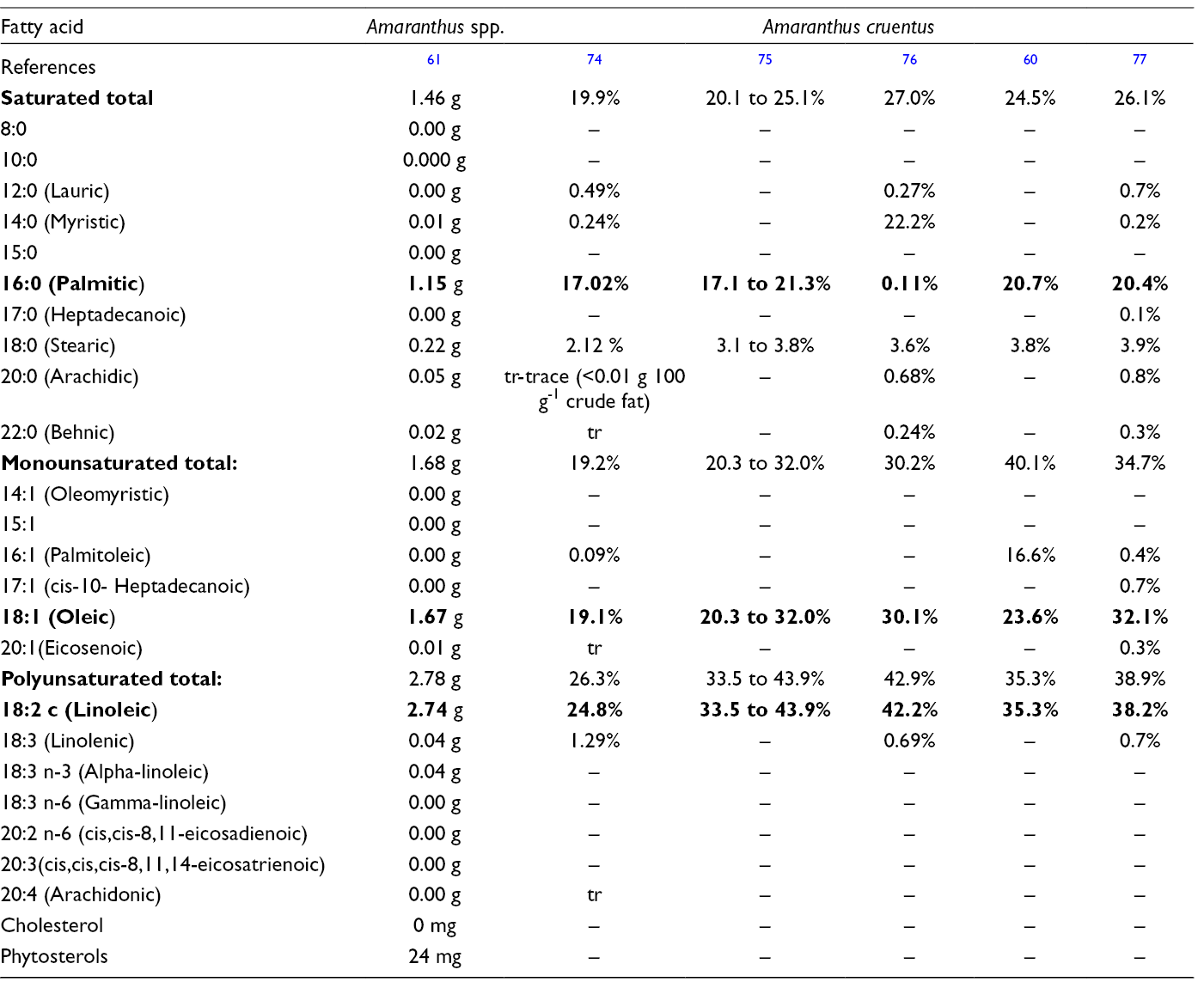
Palombini et al. 62 studied the fatty acid composition of amaranth and reported the total amounts of omega 6 (n-6) and omega 3 (n-3) fatty acids as 315.9 mg/g and 6.96 mg/g, respectively. The n-6/n-3 ratio was 45.42 mg/g in the amaranth cultivar. The ratio of 1:1 or 2:1 between an omega acid n-6/n-3 is highly recommended. Higher ratios may result in allergic or anti-inflammatory disorders, and the irregular proliferation of cells. 62
The physical and technological properties of a fixed oil depend on the percentage distribution of fatty acids in TAGs (triacylglycerols). 65 In three Amaranthus species: PLL, POL, OLL, OOL, POO, and LLL (where L is linoleic, P is palmitic, O is oleic, Ln is linolenic acid, and S is stearic acid) were identified as the main TAGs. 77 The percentages of TAGs in A. cruentus oil were reported as follows: PLO + SLL (20.0%), OLO (11.8%), and PPL (7.5%); POO +SOL (12.5%), OOO (7.9%), POP (3.8%), SOO (2.2%), PLS (2.1%), and SOS (1.3%); OLL (12.1%), PLL (13.8%); LLL (4.0%), LnLO (0.6%), and LnLP (0.5%). 65,76 Gamel et al. 68 showed the quantitative composition of TAGs in A. cruentus as: PLO (25.4%), PPL (22.6%), POO (16.7%), PLL +PLnO (16.7%), POP (6.5%), OOO (3.6%), POS (2.7%), OLO (2.6%), OLL + OLLn (2.4%), and SOO (0.8%). 65,68
In 1906, Mitsumaru Tsujimoto separated the unsaponifiable fraction from shark liver oil and 10 years later he obtained squalene (C30H50). Squalene is a highly unsaturated triterpenoid hydrocarbon consisting of 6 isolated double bonds. 78,79 It is low viscosity oil. The last 40 years has brought about a huge interest in squalene as a valuable compound in pharmacy and industry, but fishing of Squalus sp. went so far that some of the species (i.e., Squalus acanthias, Squalus albifrons, Squalus brevirostris) are threatened species. 80 Searching for an alternative source of squalene was started and it was found to be widely present as a component of the unsaponifiable fraction of some vegetable oils. Olive oil from Olea eruopea contains 0.6-0.7% of squalene, while amaranth seeds, depending on the variety, can contain up to 8% of squalene. 78
Berganza et al. 75 analyzed the content of squalene in amaranth seeds, which they determined in the range of 3.20% to 5.80% of total fatty acids, depending on the species and place of cultivation. 31
The daily intake of squalene by people living in Mediterranean countries can range from 30 to 200 mg and even 1000 mg. The minimum amount of squalene to be taken is 11 mg/day. 79,81 Doses of 2000 to 5000 mg per day are considered therapeutic against cancer, and the risk of bowel, breast, and skin cancer decreases. Squalene is able to reduce tumor cell growth and cause existing tumors to wane. In the last few years, the protective role of squalene has been demonstrated against a number of carcinogens causing, for example, hairy cell leukemia, and skin cancer. Squalene also strengthens the effect of antineoplastic agents such as adriamycin, 5-fluorouracil, and bleomycin. Including alkylglycerols and omega-3s, squalene has a beneficial effect on the natural immune system and can be helpful in the treatment of diseases, associated with an impaired immune function. 71
Squalene consumed with food is absorbed in 60-85% of the adopted dose and divided among individual tissues. Only a small amount is converted to cholesterol (about 300 mg from a pool of 2400 mg). There was no visible effect of squalene when taken orally on serum cholesterol, which is explained by the increase in cholesterol excretion after ingestion. This mechanism causes inhibition of the enzyme cholesterol synthesis pathway-HMG Co-A reductase. Only an amount over 1 g/day starts the synthesis of a new cholesterol pool. No toxicity was observed in the event of increased supply of squalene. 79
Doses up to 500 mg per day are beneficial, regulating the level of cholesterol accumulated in the organism. Such doses increase the amount of positive high-density lipoprotein cholesterol and reduce the level of low-density lipoprotein (LDL) cholesterol. Taking 860 mg per day for 20 weeks by people with hypercholesterolemia resulted in a significant decrease of overall cholesterol, LDL, and triglycerides. 79
The cold pressing method to produce the oil from the seeds of amaranth is a technology without the use of organic solvents. By using cold pressing, the squalane content and properties of amaranthus oil do not undergo changes. However, it is extremely difficult with the small size of the seed and its low-fat content. The developed method allows the extraction of the native oil called virgin oil (virgine). 79
The content of phytosterols (0.22, 0.36 mg/g dry matter) in amaranth seeds is much higher than that of most other plants. The phytosterol fraction contains 46-54% spinasterol, 15-18% delta-7-stigmasterol, 12-15%, delta-7-ergosterol, and 10-13% stigmasterol. 65,70,79,82 Fifteen sterols were found in A. cruentus from Australia: brassicasterol, campestanol, cholesterol, sistostanol, Δ5,23-stigmastadienol, and Δ5,24-stigmastadienol in trace levels, and 24-methylen-cholesterol (0.3%), campesterol (1.6%), stigmasterol (0.9%), Δ7-campesterol (24.8%), clerosterol (42.0%), β-sitosterol (1.3%), Δ5-avenasterol (2.0%), Δ7-stigmastenol (15.2%), and Δ5-avenasterol (11.9%). 65,77 The same researchers found other lipophilic constituents: 348 ppm of taraxeol, 189.0 ppm of dammaradienol 213.8 ppm of β-amyrin, 9499.0 ppm of gramisterol, 401.8 ppm of cycloartenol, 446.7 ppm of 24-methylene-cycloartanol, 320.5 ppm of citrostadienol, and 4 ppm of unidentified terpenic alcohols and methyl sterols in total concentrations of 34.9, 35.6, 49.2, 24.6 ppm. 65,77 Thirteen saturated and 10 unsaturated hydrocarbons with one double bond (C21-C33) were reported in A. cruentus crude oil by using high-resolution gas chromatography-mass spectrometry (GC-MS). In cold pressed amaranth oil the total 101.60 ± 3.22 mg/kg of polycyclic aromatic hydrocarbons with a dominance of light ones (anthracene, fluoranthene, phenanthrene, and pyrene) were found in the same study. 64,83,84
“Tocols” is the common name for the group of lipid-soluble compounds present in all oil-containing seeds; however, their content and composition are different in different plant species and varieties. 65 Amaranth seeds are not different from other true cereals in their composition of vitamins, 33 but they accumulate significant amounts of both β- and γ-tocotrienols, compared with many cereal grains. 85 Remarkably higher concentrations of β-tocopherol were reported in A. cruentus grown in Austria. As mentioned at the beginning, the content of tocols may be different in the grains of different origin: African vegetable-types of A. cruentus had significantly lower levels of tocols than a Mesoamerican origin grain. 65,77
Amaranthus cruentus seeds and products analyzed by Ogrodowska et al. 31 and Palombini et al. 62 were rich in tocopherols. Analysis was carried out by HPLC. With contents at 4.07 mg/100 g, β-tocopherol is the dominant homolog of vitamin E found in amaranth seeds, which contributes to approximately 38% of the total tocopherols. A contribution of 32% of δ-tocopherol and 18% of α-tocopherol was found. The lowest content was determined for γ-tocopherol—1.29 mg/100 g, which accounted for 12% of all tocopherols. 31 The contents of tocopherols and tocotrienols in A. cruentus seeds obtained by traditional methods were compared with ultrasound and supercritical carbon dioxide (SCE-CO2) method. In the traditional method, using normal-phase HPLC with fluorescence detection the contents determined were: α-tocopherol (2.97-15.65 mg/kg), β-tocotrienol (5.92-11.47 mg/kg), γ-tocotrienol (0.95-8.69 mg/kg), and δ-tocotrienol (0.01-0.42 mg/kg). In the ultrasound and SCE-CO2 method the contents of: α-tocopherol, β-tocotrienol, γ-tocotrienol, δ-tocotrienol were:17.8 to 20.6 mg/kg d.w.; 35.4 to 39.8 mg/kg d.w.; 2.0 to 4.0 mg/kg d.w.; and 15.5 to 18.4 mg/kg d.w., respectively. 65
γ- and δ-Tocotrienols have the ability to inhibit, dose-dependently, the activity of HMG-CoA reductase, whereas α-tocopherol exhibits antagonistic properties by increasing the reductase activity. 81
The seeds of amaranth contain non-nutritional substances such as trypsin and chymotrypsin inhibitors, phenol compounds, including saponins and tannins, phytates, and phytohemagglutinins. Their content is different, the same or lower than in cereal grains or other raw materials. They often have double action and meaning, both negative and positive, for example, strengthening the resistance functions of the body, or playing the role of natural antioxidants. The least desirable non-nutrient substance in amaranth seed is saponin (saponin glycosides). Saponins irritate the digestive tract and after getting into the bloodstream, they cause hemolysis. In addition, they inhibit acetylcholinesterase, which results in disorders in transmission nerve stimulation. 23
Amaranth seeds contain a low amount (about 0.1% in dry weight) of triterpene glycosides which show low toxicity. The lethal dose ranges between 1500 and 1750 mg/kg body weight. 23
Amaranth seeds are characterized by an exceptionally rich chemical composition. The processed parts of the plants are a very valuable supplement to the diet. 17 White and Broadley 86 wrote: for proper nutrition people need to take with food at least 22 micronutrients. However, it is estimated that 60% of the people in the world suffer from iron deficiency, 30% of zinc, 30% of iodine, and 15% of selenium, and deficiencies in calcium, magnesium, and copper are present in many regions, independently from the development of the country. Dramatic effects of a diet low in micronutrients are recorded in African and in some Asian countries. So, a number of actions are being undertaken to promote the cultivation of amaranth. 86
Summarizing: Amaranthus cruentus is a pseudocereal with a particularly highly regarded nutritional value, which is determined by
presence of proteins that consist of albumin, globulin, glutelin, and prolamin fractions. Seeds do not contain gluten, so they can be introduced into the diet of patients suffering from celiac disease;
large amounts of lysine, tryptophan, and sulfur amino acids that support high nutritional quality of the seed;
bioactive peptides and lunasin-like peptides thought to have antioxidant, anticancer, anti-allergic, and antihypertensive properties;
the main constituent of the carbohydrate fraction found in the seeds is starch, which shows good gelatinization properties and freeze/thaw stability that is appreciated in the food industry;
the physiological effect of amaranth is important because of the fiber presence;
amaranth grain is rich in easily absorbed iron, magnesium, calcium, and potassium;
the seeds of amaranth are not different from other cereals in composition of vitamins, characterized by the presence of folic acid, pantothenic acid, niacin, and B vitamins, but accumulate significant amounts of both β- and γ-tocotrienols;
there is a high biological significance of the flavonoids and phenolic acids in amaranth grain;
seeds contain more total fat, compared with other cereals: quinoa, wheat, barley, rye, and oat. The lipid fraction contains mostly unsaturated fatty acids with linoleic acid predominant. Palmitic and oleic acids were also found in amaranth seeds. Grains are also a source of valuable squalene, with wide biological activity and antioxidant properties.
Footnotes
Declaration of Conflicting Interests
The author(s) declared no potential conflicts of interest with respect to the research, authorship, and/or publication of this article.
Funding
The author(s) received no financial support for the research, authorship, and/or publication of this article.