



Abstract
A method for isolation of volatile compounds from samples of stem wood by solid-phase microextraction was developed. The extraction method was optimized using a central composite design approach. Extraction temperature and extraction time were optimized in the ranges of 40°C to 120°C and 10 to 90 minutes, respectively. Final extraction method was combined with GC-MS for separation and identification of volatile components of wood samples of seven tree species, commonly occurring in Central Europe. All of them were deciduous (acacia, alder, beech, elm, larch, maple, and oak). In total 185 organic compounds were identified in volatile profiles of all the samples by the developed method. To facilitate the evaluation of the suitability of the proposed method for extraction of different compound types, all identified compounds were categorized into 16 groups. Percentage of compound groups in volatile profiles of individual wood samples shows that the developed method is suitable for evaluation of a wide range of volatile components from stem wood.
Wood is composed of three nonvolatile polymers: lignin, cellulose, and hemicellulose. In addition, some secondary organic metabolites are present at generally 0.5% to 5% (w/w) levels, which include polymers such as pectins and low-molecular-weight volatile organic compounds (VOC), which together belong to extractives. Major categories of extractives include volatile oils, terpenes, fatty acids and their esters, waxes, polyhydric alcohols, mono- and polysaccharides, alkaloids, and aromatic compounds. Extractives of certain kinds of wood are commonly used in many medical products and also in the perfume industry. The location of the extractives may be in heartwood (dead and nonfunctional part of wood), in the resin canals of softwoods, or as reserve materials in sapwood (living portion of the wood involved in ascent of sap). 1,2
VOC are responsible for a pleasant smell of most woods. 3 VOC are present in greater concentration in barks and give wood its characteristic odor. Some volatiles are responsible for the endurance of wood against fungi decay, insect injuries and bacterial infections. 4 The elementary composition of VOC in wood is carbon (45%-50%), oxygen (38%-42%), hydrogen (6%-6.5%), nitrogen (0.1%-0.5%), and sulfur (up to 0.05%). The amount and type of VOC differ between species and even within one wood sample depending on whether the sapwood or heartwood is analyzed. However, the chemical composition of the wood is affected not only by species, but also by other factors such as location of the cells within the tree. Growth conditions and environment also influence the final chemical composition. 5
Because there are a plethora of articles dealing with representation of VOC occurring in a huge number of examined plants, we are very well acquainted with the chemical composition of such plants. But there are far fewer studies dealing with the analysis of volatile compounds of wood. Wajs et al used three extraction techniques, that is, solid-phase microextraction, hydrodistillation and dynamic headspace, for isolation of VOC from different wood tissues of Norway spruce. 6 Ohira et al compared the analytical and sensory data on odors from dried sugi wood. 7 Cullere et al characterized the most odor-active compounds in extracts prepared from acacia, chestnut, cherry, ash and oak woods by gas chromatography-olfactometry. 8
Volatile profiles of wood samples of 7 tree species were examined in the present work. Headspace solid-phase microextraction (HS-SPME) was chosen for the isolation of VOC. Separation and detection of VOC were carried out using gas chromatography coupled to a mass spectrometer (GC-MS).
Statistical Evaluation of Design of Experiment
Because the observed matrices have a large amount of volatile compounds with different polarities, the commercial divinylbenzene/carboxen/polydimethylsiloxane (DVB/CAR/PDMS) coating (50/30 µm) fiber was used. Moreover, this fiber was chosen as the most effective in the work of Wajs.
6
Extraction temperature and extraction time were selected for optimization of SPME in the present work. The number of experimental runs in central composite design (CCD) contains factorial runs of 2k, axial runs of 2k, and center point runs C
0. Therefore the total experimental runs (N) of CCD are given by


The significance of individual factors was tested by P-value and F-value. Factor with a P-value less than 0.05 and F-value higher than critical F-value is considered statistically significant. According to the results of analysis of variance (ANOVA; Table 1), extraction temperature is a statistically significant parameter in the model, in both linear and quadratic terms. P-value of lack-of-fit is lower than 0.05 and indicates that the model is suitable for prediction of NoP in relation to extraction conditions. Equation (2) is depicted as a three-dimensional graph in Figure 1, which represents the dependency of NoP on independent variables. The biaxial contour plot in the base of three-dimensional plot as well as the shape of three-dimensional surface can estimate the effects of extraction parameters on the number of peaks in the chromatograms of extracts. Dark color indicates increase of NoP and area of optimum conditions. As it is seen, the highest values of NoP in the experimental area were obtained at extraction temperature between 95°C and 115°C and extraction time between 10 and 20 minutes. Taking into account these results, the optimal extraction conditions were chosen as follows: temperature 105°C and time 15 minutes.
Regression Coefficients of the Model and Analysis of Variance of Obtained Results.

DF, degrees of freedom;SS, sum of squares.

Response surface plot showing effects of extraction temperature and extraction time on the number of peaks detected in chromatograms.
Real Sample Analysis
HS-SPME method developed in this study was applied in the analysis of volatile profile of seven types of wood. To facilitate the evaluation of the suitability of the method for extraction of different compound types, all identified compounds (summarized in Table S1 of Supplementary data) were categorized into 16 groups as alcohols, carbonyl compounds, acids, esters, monoterpenes, oxygenated monoterpenes, sesquiterpenes, oxygenated sesquiterpenes, diterpenes, oxygenated diterpenes, aliphatic hydrocarbons, aromatic hydrocarbons, phenolics, apocarotenoids, lactones, and miscellaneous compounds which contained sulfur or nitrogen. As is seen in Table 2, all compound groups were present at least in two volatile profiles (like sesquiterpenes), more often in more than two. The most represented group of substances among the identified compounds is given in bold. The extraction method has a good applicability mainly for the carbonyl compounds, fatty acids, esters, terpenes and terpenoids, and aliphatic and aromatic hydrocarbons. Carbonyls were evaluated as a main compound group in acacia and alder; main representatives were pentadecanal (acacia, 11.7% of total peak area) and decanal (alder, 10.3%). Beech and maple were rich in aliphatic hydrocarbons such as heptadecane (beech 12.4%, maple 9.2%), pristane (maple 9.2%) and hexadecane (beech 6.6%). Terpenes were main components in volatile profile of larch (sesquiterpenes, germacrene B 3.1%) and elm (oxygenated sesquiterpenes, cadin-1,3,5-trien-5-ol 25.9%). Volatile profile of oak was rich in acids (acetic acid 15.3%) and aliphatic hydrocarbons (pentadecane and hexadecane, both 3.7%). Identification of different types of compounds shows us that the developed extraction method is suitable for evaluation of a wide range of volatile compounds from wood.
Chemical Composition (% Rel.) of Volatile Profiles of Wood Samples Obtained by the Application of HS-SPME Method.
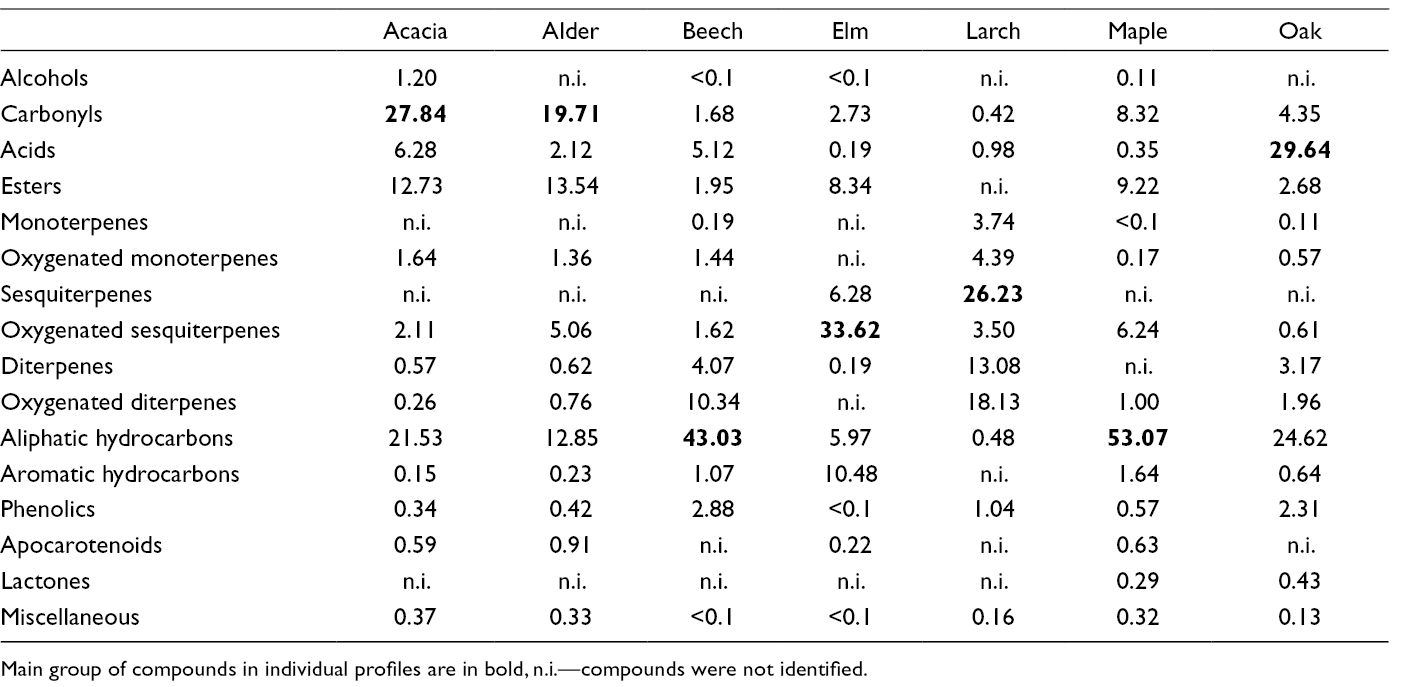
Main group of compounds in individual profiles are in bold, n.i.—compounds were not identified.
This work is based on an optimization of conditions for extraction of VOC from wood sample and subsequent application on various timbers. For this purpose, a HS-SPME method, using a fiber DVB/CAR/PDMS, combined with GC-MS for separation, detection, and identification of individual compounds, was employed. High sensitivities of the proposed method for extraction of volatile compounds were obtained using CCD. The method was successfully applied to the analysis of the wood of various trees commonly occurring in Central Europe. This method works well to analyze VOC in different and variable wood samples and could be used for identification of indoor emissions of VOC from wood. Differences in VOC amounts in bark, sapwood and heartwood could be determined by application of the proposed method. Thus we can also learn what could potentially be extracted into various alcoholic beverages during storage in different wooden barrels.
Experimental
Chemicals and Materials
Timber, in a form of wood shavings (size approximately 0.5 × 0.5 cm2, all from the trees growing in a region of the White Carpathians), typical for Central Europe was purchased from a local Czech company Drevex (Veseli nad Moravou, Czech Republic), which focuses on processing of wood (primarily of leafy trees), such as heat-treating and shredding. The company guaranteed the timber’s origin. The wood shavings were obtained after the processing of wood by natural drying. The samples of each wood were a mixture of heartwood and sapwood because our objective was to know how the optimized method is applicable to analyze the volatile profile of various wood samples without dealing with their natural variations. All the samples are listed in Table 3. Prior to the analysis, the samples were preserved in dark glass flasks at laboratory temperature.
List of Examined Samples.

n-Alkane standard solutions (C8-C20 and C21-C40) in concentrations of 40 mg/L, dissolved in n-hexane and toluene, respectively, were purchased from Sigma-Aldrich (Prague, Czech Republic). SPME holder for an automatic sampling and SPME fiber StableFlex (DVB/CAR/PDMS; 50/30 µm) were purchased from Supelco (Bellefonte, PA, United States).
Instrumentation
A gas chromatograph, model GC-2010 plus, coupled to mass spectrometer TQ-8030 was used for the analyses. An autosampler AOC-5000 Plus (all from Shimadzu, Kyoto, Japan) equipped with a heating/agitating unit was used for automated HS-SPME procedure, including desorption of analytes from the fiber into an injector and cleaning of the fiber in a cleaner. A capillary column SLB-5ms with 30 m length, 0.25 mm inner diameter, and 0.25 µm film thickness (Supelco, Bellefonte, PA, United States) was used for separation. Helium 5.0 (Linde Gas a.s., Prague, Czech Republic) was used as a carrier gas at a constant linear velocity of 30 cm/s. The temperature of the injector was maintained at 200°C. After the desorption which lasted 20 seconds, the fiber was transported to the cleaner set up at 250°C for 5 minutes in order to prevent any carry-over effect. The oven temperature was held at 40°C for 2 minutes and then increased to 250°C by 4 °C/min, held for 5.5 minutes. The total run time was 60 minutes. The mass spectrometer was operated in the electron ionization (EI) mode (70 eV) and in the full-scan mode over a mass range of m/z 33 to 500. The mixtures of n-alkanes (C8-C20 and C21-C40) were injected using the mentioned temperature program because of the calculation of the retention index (RI) for each observed peak. The components were identified by comparison of mass spectral fragmentation patterns stored in MS data libraries NIST 11 (NIST, Gaithersburg, MD, United States) and FFNSC 2 (Shimadzu, Kyoto, Japan) and verified by comparison of RI of identified compounds to published data 10–12 and/or RI from MS data libraries.
Solid-Phase Microextraction
Before the first use, an extraction fiber was conditioned according to manufacturer’s recommendations. The fiber was heated at 270°C for 1 hour. A total of 300 ± 10 mg of a sample was placed into a 20 mL vial for headspace analysis, closed by a cap with a Teflon septum. Prior to extraction, an incubation step lasting 20 minutes at the temperature of extraction was included. After incubation the analytes were extracted with SPME fiber at 105°C for 15 minutes. After each analysis, the fiber was introduced into a cleaning device set up at 250°C for 5 minutes to overcome any carry-over effects. The whole procedure including the vial transfer, incubation, extraction, injection, and cleaning step was auto-performed with the AOC-5000 Plus autosampler.
Optimization of Extraction Conditions
If SPME is chosen as an extraction method, it is necessary to optimize the parameters which facilitate attainment of sensitivity as high as possible for the observed analytes. Among such parameters belong extraction time, extraction temperature, incubation time, stirring speed, pH, ion strength, or some derivatization conditions. 13 Two variables (extraction parameters) considered for this study were extraction time (10-90 minutes) and extraction temperature (40°C-120°C). Statistical CCD method of experiment was used to determine the optimal extraction conditions. Experimental design with experimentally obtained responses (number of peaks in chromatogram) determined using GC-MS (values detected) and subsequently by statistical model (values predicted) is summarized in Table 4. The impact of each variable on extraction efficiency was evaluated by ANOVA using the Statistica software, version 12 (StatSoft CR, Prague, Czech Republic).
Central Composite Design of Experiment; Experimental Conditions and Results of Extractions Expressed as Number of Peaks in Chromatograms.

Footnotes
Declaration of Conflicting Interests
The author(s) declared no potential conflicts of interest with respect to the research, authorship, and/or publication of this article.
Funding
The author(s) received no financial support for the research, authorship, and/or publication of this article.
Supplemental Material
References
Supplementary Material
Please find the following supplemental material available below.
For Open Access articles published under a Creative Commons License, all supplemental material carries the same license as the article it is associated with.
For non-Open Access articles published, all supplemental material carries a non-exclusive license, and permission requests for re-use of supplemental material or any part of supplemental material shall be sent directly to the copyright owner as specified in the copyright notice associated with the article.
